


 Скачать презентацию Program Strategies State Planning Requirements for WIA
65c498c681e6dc21723140c257a230bd.ppt
- Количество слайдов: 41
 Program Strategies
 State Planning Requirements for WIA Adult, WIA Dislocated Worker and Wagner-Peyser Gina King Wells Workforce Analyst Office of Workforce Investment Employment and Training Administration
 Agenda/Objectives § Relevant State Planning Requirements § Setting the Context § Cross Program Alignment: Strategies, Outcomes, and Resources 3
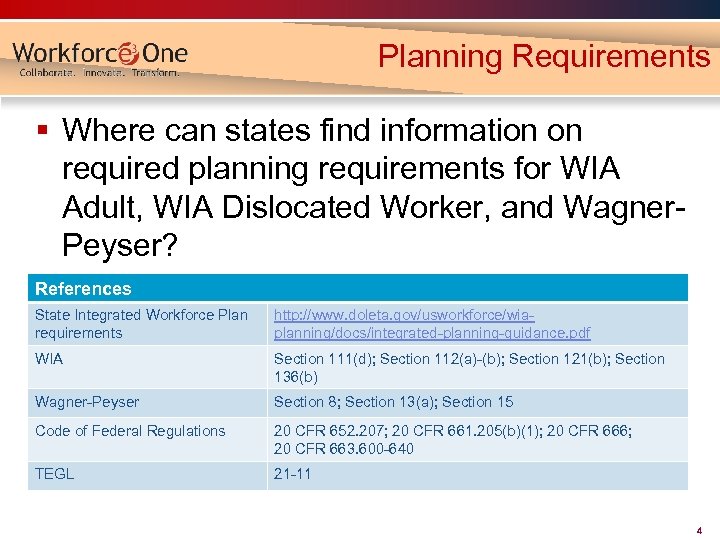 Planning Requirements § Where can states find information on required planning requirements for WIA Adult, WIA Dislocated Worker, and Wagner. Peyser? References State Integrated Workforce Plan requirements http: //www. doleta. gov/usworkforce/wiaplanning/docs/integrated-planning-guidance. pdf WIA Section 111(d); Section 112(a)-(b); Section 121(b); Section 136(b) Wagner-Peyser Section 8; Section 13(a); Section 15 Code of Federal Regulations 20 CFR 652. 207; 20 CFR 661. 205(b)(1); 20 CFR 666; 20 CFR 663. 600 -640 TEGL 21 -11 4
 Setting the Context § What are your state’s future economic realities? § How will your state meet the needs of the longterm unemployed? § How will veterans get the services they need to become reemployed? § How will you meet employers’ needs for a skilled workforce? § How will you meet your goals given budgetary constraints? 5
 Promoting Effective Leadership § Strategy: Promoting strong leadership to increase administrative efficiency and foster innovation § How: – Redesigning services; – Increasing credential attainment and creating integrated workforce training models; and – Meeting dual customer needs. § Tools: – Enhancing Workforce Leadership Project (https: //enhancingworkforceleadership. workforce 3 one. org) – Workforce Innovation Forum (https: //innovation. workforce 3 one. org) 6
 Linking with Unemployment Insurance § Strategy: Better connect UI claimants to reemployment services through the public workforce system § Outcome: Reduce UI duration for unemployed jobseekers § Tools: – Report: A National Call for Innovation: Rethinking Reemployment Services for UI Claimants (https: //www. workforce 3 one. org/view/4011107031250628020/info) – Webinar: Re-envisioning UI Claimant Reemployment Strategies: A Call to Innovate (https: //www. workforce 3 one. org/view/5001104841322592962/info) 7
 Connecting with Human Services § Strategy: Align workforce system programs with human services programs such as TANF and SNAP § Outcome: Reduce potential redundancies and better serve low-income, low skilled adults § Tools: – Integrating TANF and WIA Into a Single Workforce System: An Analysis of Legal Issues (http: //www. clasp. org/admin/site/publications/files/0171. pdf) – TEN 35 -09 Connecting One-Stop Career Center Customers to SNAP (http: //wdr. doleta. gov/directives/attach/TEN/ten 2009/ten 3509 acc. pdf) – Benefits. gov 8
 Innovative Training Strategies § Strategy: Training programs should integrate academic and occupational skills, e. g. Career Pathways, and provide earnlearn opportunities, e. g. on-the-job training § Outcome: Increased credential attainment for jobseekers, meet employers’ need for skilled workers, and increased cost effectiveness § Tools: – Career Pathways Toolkit (https: //learnworkforce 3 one. org) – Workforce Credentials Information Center (www. careeronestop. org/credentialing/Credentialing. Home. asp) – On-the-Job Training Toolkit (https: //ojttoolkit. workforce 3 one. org/) – TEGL 15 -10, Increasing Credential, Degree, and Certificate Attainment by Participants of the Public Workforce System (http: //wdr. doleta. gov/directives/attach/TEGL 15 -10. pdf) 9
 Next Steps § Review State Planning Requirements and TEGL § Convene Stakeholders § Start Planning! 10
 www. workforce 3 one. org 11
 Rapid Response
 Presenter Alona Mays Office of National Response 13
 Why Rapid Response Should Be Included in State Plan Development § Flexible, solutions based and critical component of strategic planning § Access to most current economic data and ability to turn data into actionable intelligence § Wide network of strategic partners § Connections to business community statewide § Establishes and/or executes layoff aversion strategies and operations 14
 Role of Rapid Response in State Plan: Strategic § Rapid Response defines the “promise” of the workforce system: When you need us most, we will be there § Requires organization/Infrastructure designed for flexibility § Requires existing policy/process focused on solutions § Develops and carries out layoff aversion strategies § Rapid Response is central to state’s business services strategies and connects to employers at all points of the business cycle 15
 Role of Rapid Response in State Plan: Operational § Describe organizational structure for Rapid Response activities § Describe how Rapid Response activities are carried out § Describe any intelligence gathering procedures and early warning systems § Describe innovative approaches to providing solutions to employer and worker customers § Describe existing partnerships and efforts to expand § Describe layoff aversion strategies and activities (beyond incumbent worker training) 16
 Resources § Rapid Response Framework TEN (31 -11): http: //wdr. doleta. gov/directives/attach/TEN/ten 2011/ten_31_11. pdf § Rapid Response Self-Assessment Tool TEN (32 -11): http: //wdr. doleta. gov/directives/attach/TEN/ten 2011/ten_32_11. pdf § Rapid Response Initiative TEN (3 -10): http: //wdr. doleta. gov/directives/attach/TEN/ten 2010/TEN 03 -10. pdf § The following Rapid Response presentations are found on (not a DOL site). § The New Vision for Rapid Response: http: //www. slideshare. net/ttheberge/rapidresponse-community § You Can Do That with Rapid Response Funding? : http: //www. slideshare. net/ttheberge/you-can-do-that-with-rapid-response-fundsphiladelphia-version § Layoff Aversion: Preventing or Minimizing Unemployment: http: //www. slideshare. net/ttheberge/layoff-aversion-under-the-workforce-investment -act 17
 www. workforce 3 one. org 18
 Trade Adjustment Assistance
 Featured Speakers Presenters § Susan Worden, Program Analyst, Office of Trade Adjustment Assistance 20
 Integrating TAA with Other Workforce Programs In order to be effectively administered TAA must coordinate with: § UI (which also administers TRA) § Wagner Peyser TAA operates most effectively when coordinated with: § WIA/ Dislocated Workers 21
 Areas of Integration Three elements of integration: 1. Align Policies 2. Reconfiguring Staffs 3. Sharing Data 22
 Integrating TAA with Partner Programs 1. Align policies • Some inter-program staff communication across programs but customers still meet with different program staff for services (some) • Align multiple programs’ policies for data warehouse (good) • Align policies to share and use captured information for multiple program applications and reporting requirements. (best) 23
 Integrating TAA with Partner Programs 2. Reconfigure Staffs • Some level of inter-program staff communication (some) • Increase inter-program staff communication; customers provide program info once even if programs remain siloed (good) OR • Create cross-program functional teams of formalized information sharing with shared customer pool (best) 24
 Integrating TAA with Partner Programs 3. Sharing Data • Cross program staff sharing information despite siloed systems (something) • Data warehouse stores customer information in accordance with security protocols (good) • Create cross-program functional teams of formalized information sharing with shared customer pool (best) 25
 Resources § Resources that may be helpful to you regarding Trade Adjustment Assistance: § For information in In-Take Strategies: https: //integratingintake. workforce 3 one. org/ § For information on Effective case management: https: //effectivecasemanagement. workforce 3 one. org/ 26
 www. workforce 3 one. org 27
 Youth Program Strategies
 Featured Speakers Presenters § La. Sharn Youngblood § Workforce Development Specialist 29
 Considerations for State Operational Planning Activities for Youth How will states provide services to youth in an integrated service delivery system? § Through strengthening partnerships at the state and local level to increase opportunities for disconnected youth. § Implementation of cross program alignment strategies to connect youth to multiple systems to help meet their education and training needs. 30
 Operating Systems: Strategies to Support Youth Customers What strategies should state and local workforce systems incorporate when planning activities to support youth? § Promote the alignment of policy and programs among workforce, education, human services and justice to ensure that youth make a successful transition to work and earn in-demand credentials. § Create partnerships with state and local agencies that receive funds from the federal agencies listed below. § Partnering Agencies - Departments of: Health and Human Services, Education, Justice, and Agriculture and Interior. 31
 Cross Program Alignments What steps can states take to enhance Cross Program Alignments and Build Partnerships for youth customers? § Leverage resources for WIA youth to enhance program outcomes through partnering efforts. § Coordinate and align services across WIA funded programs like Job Corps, Youth Build, and Apprenticeship where applicable. § State Planners are encouraged to adopt similar strategies like those referenced above to increase integrated system alignments at the state and local levels. 32
 Resources: Promoting Partnerships § U. S. Department of Education – TEGL 18 -11, encourages partnerships between adult education and WIA youth programs to maximize resources to achieve employment related and educational outcomes. http: //wdr. doleta. gov/directives/corr_doc. cfm? DOCN=4054 § U. S. Department of Health and Human Services (HHS), TEN 24 -09 encourages public workforce systems to partner with TANF agencies to promote subsidized employment opportunities allowable under ARRA to create subsidized summer employment for low income youth. http: //wdr. doleta. gov/directives/corr_doc. cfm? DOCN=2844 § Current partnership with HHS, TEN coming soon encourages public workforce system to partner with TANF jurisdictions and State community Service Block Grants for summer employment opportunities. § U. S. Departments of Interior and Agriculture, TEN 24 -10 encourages public workforce system to partner with public land management agencies to increase work experience opportunities for youth on public lands. http: //wdr. doleta. gov/directives/corr_doc. cfm? DOCN=2988 § U. S. Department of Justice – http: //www. ojjdp. gov 33
 Additional Technical Assistance Resources § TEGL 30 -10 published June 2, 2011, provides guidance for WIA youth formula funded activities for Program Year 2011. http: //wdr. doleta. gov/directives/corr_doc. cfm? DOCN=3034 § TEGL 31 -10 published June 13, 2011, provides information on promising practices and successful strategies that promote the enrollment, education, training and employment outcomes of youth with disabilities. http: //wdr. doleta. gov/directives/corr_doc. cfm? DOCN=3037 § TEGL 27 -09 published May 13, 2010, provides guidance for WIA Youth formula funded activities for Program Year 2010. http: //wdr. doleta. gov/directives/corr_doc. cfm? DOCN=2900 § TEGL 13 -09, Connecting Strategies that Facilitate Serving the Youth Most in Need published February 16, 2010, provides guidance to states, on contracting strategies that facilitate service providers to serve the youth most in need, while still achieving performance goals. http: //wdr. doleta. gov/directives/attach/TEGL 13 -09 acc. pdf § Webinars: • Collaborations and Partnerships https: //www. workforce 3 one. org/view/5001131339251952297/info • “Resource Note – Improving State Coordination of Youth Workforce Development Services, ” by Nanette Relave and is available at: http: //www. financeproject. org/publications/RN-state-coordination_8_6_08. pdf 34
 Coordinating with Competitive Grants
 Featured Speakers Presenters § Robin Fernkas, Director, ETA Office of Workforce Investment, Division of Strategic Investments § Steve Rietzke, Workforce Analyst, ETA Office of Workforce Investment, Division of Strategic Investments 36
 Collaborating with Discretionary Grants § Why should I collaborate with discretionary grants? § What are some examples of programs I might collaborate with and how do they align with the State planning requirements? § Where do I go for more information? 37
 Benefits of Collaboration § Why should I collaborate with discretionary grants? – Leverage investments – Fill gaps/niches in existing services – Seed innovation – Expand on existing efforts – Develop productive partnerships 38
 Examples of Discretionary Grants § What are some examples of discretionary programs and where do they fit in? – TAACCCT: community colleges serving tradeimpacted and other adults, using innovative and technology-enabled training methods – H 1 -B Technical Skills Training: focusing on highgrowth industries, OJT, long-term unemployed, and healthcare occupations – Recovery Act Grants: Pathways out of Poverty, and State Energy Sector Partnerships 39
 Key Program Strategies § Examples of key strategies and priorities in discretionary programs: – Employer engagement and involvement – Career pathways – Online and technology-enabled learning – Credential attainment – Use of evidence-based practices 40
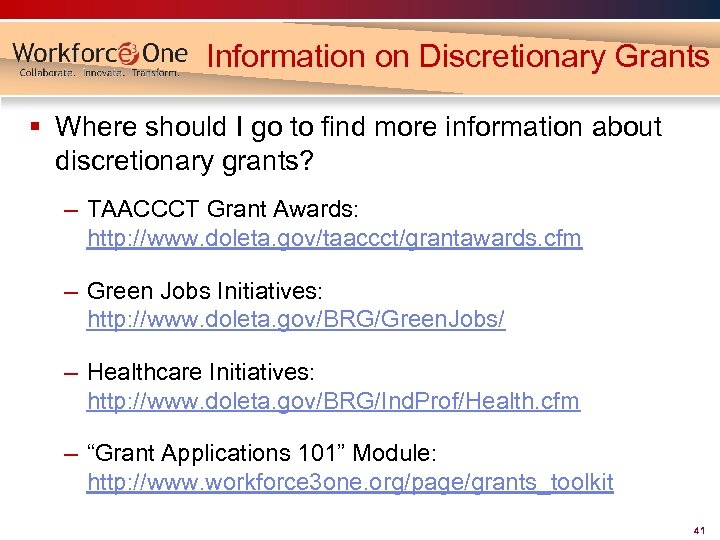 Information on Discretionary Grants § Where should I go to find more information about discretionary grants? – TAACCCT Grant Awards: http: //www. doleta. gov/taaccct/grantawards. cfm – Green Jobs Initiatives: http: //www. doleta. gov/BRG/Green. Jobs/ – Healthcare Initiatives: http: //www. doleta. gov/BRG/Ind. Prof/Health. cfm – “Grant Applications 101” Module: http: //www. workforce 3 one. org/page/grants_toolkit 41