


 Скачать презентацию PROGRAM REVIEW ASSESSMENT Overview SERC Program Assassment
115217c80954409d34d568420d082e5b.ppt
- Количество слайдов: 30
 PROGRAM REVIEW & ASSESSMENT Overview SERC Program Assassment
 Why assess your instructional program? For all the reasons Cathy reviewed! May be required in program performance reviews or curricular reform proposals Part I: Program Performance Reviews Part II: Instructional Program Assessment strategies Data collection
 PROGRAM REVIEW & ASSESSMENT Part 1: Program Performance Reviews (PPR)
 Common Elements of a PPR Department Context SWOT Analysis Learning Assessment Goals/strategies/actions for next review period
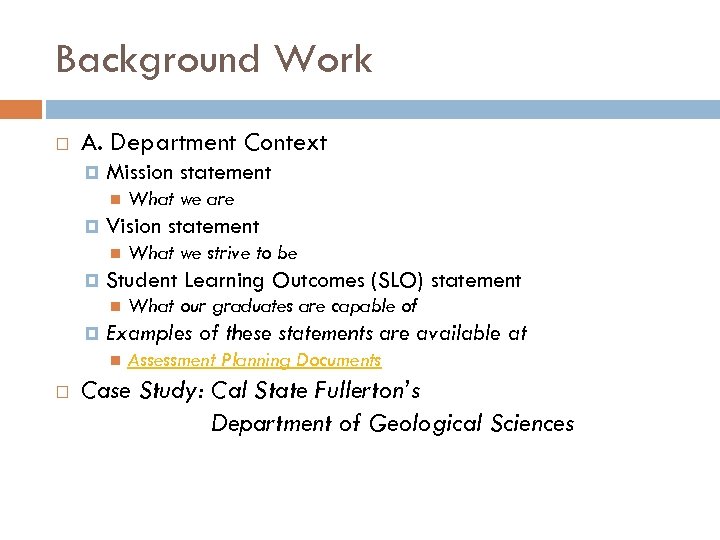 Background Work A. Department Context Mission statement Vision statement What our graduates are capable of Examples of these statements are available at What we strive to be Student Learning Outcomes (SLO) statement What we are Assessment Planning Documents Case Study: Cal State Fullerton’s Department of Geological Sciences
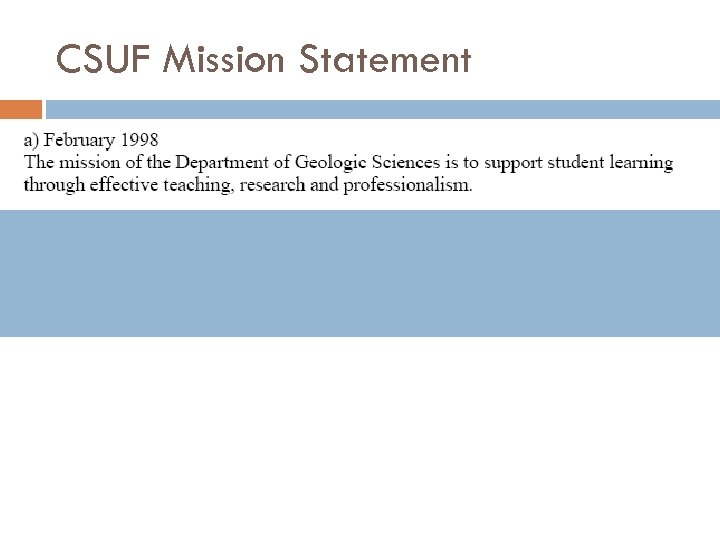 CSUF Mission Statement
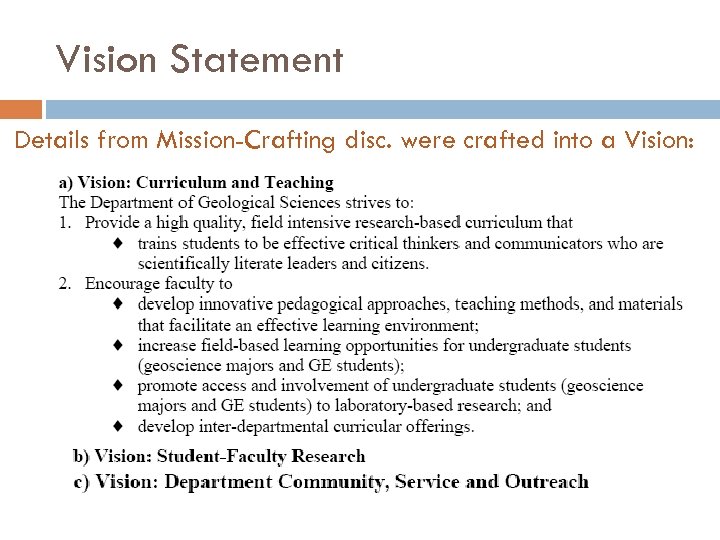 Vision Statement Details from Mission-Crafting disc. were crafted into a Vision:
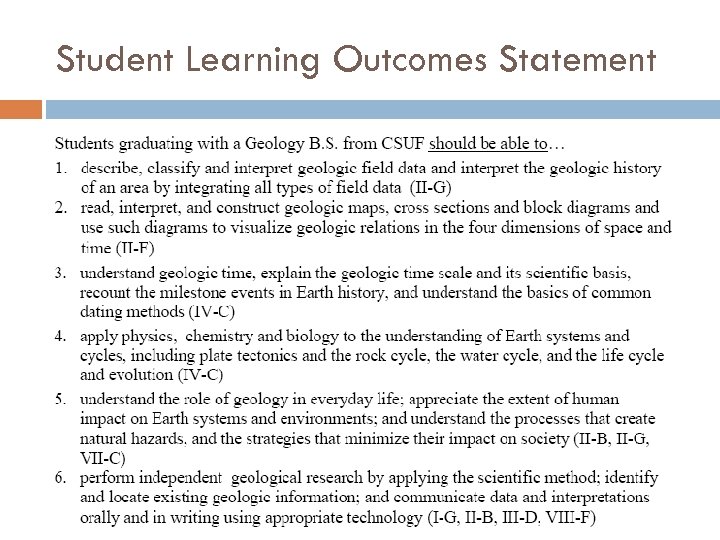 Student Learning Outcomes Statement
 Student Learning Outcomes Statement Carleton's SLO
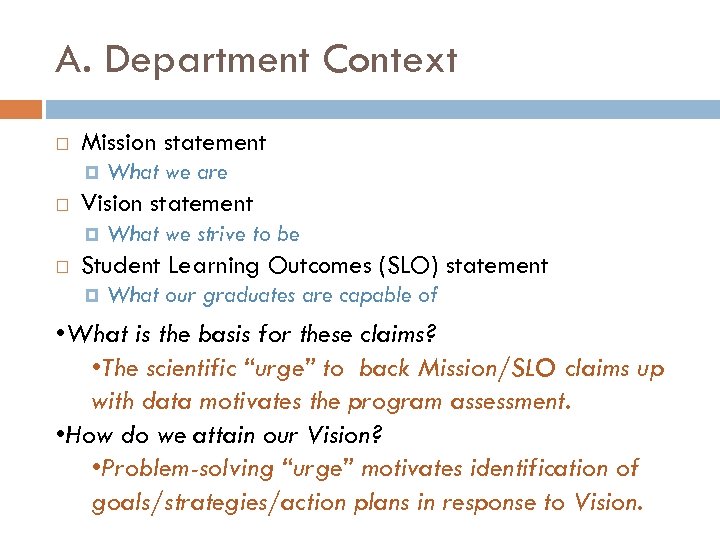 A. Department Context Mission statement Vision statement What we are What we strive to be Student Learning Outcomes (SLO) statement What our graduates are capable of • What is the basis for these claims? • The scientific “urge” to back Mission/SLO claims up with data motivates the program assessment. • How do we attain our Vision? • Problem-solving “urge” motivates identification of goals/strategies/action plans in response to Vision.
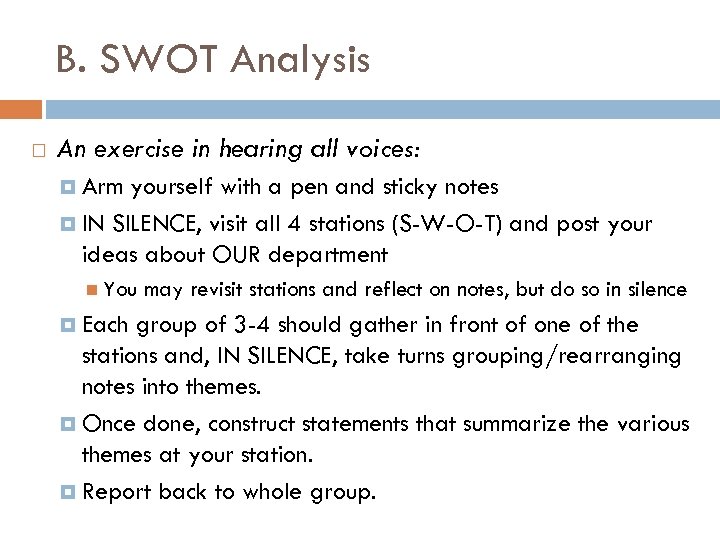 B. SWOT Analysis An exercise in hearing all voices: Arm yourself with a pen and sticky notes IN SILENCE, visit all 4 stations (S-W-O-T) and post your ideas about OUR department You Each may revisit stations and reflect on notes, but do so in silence group of 3 -4 should gather in front of one of the stations and, IN SILENCE, take turns grouping/rearranging notes into themes. Once done, construct statements that summarize the various themes at your station. Report back to whole group.
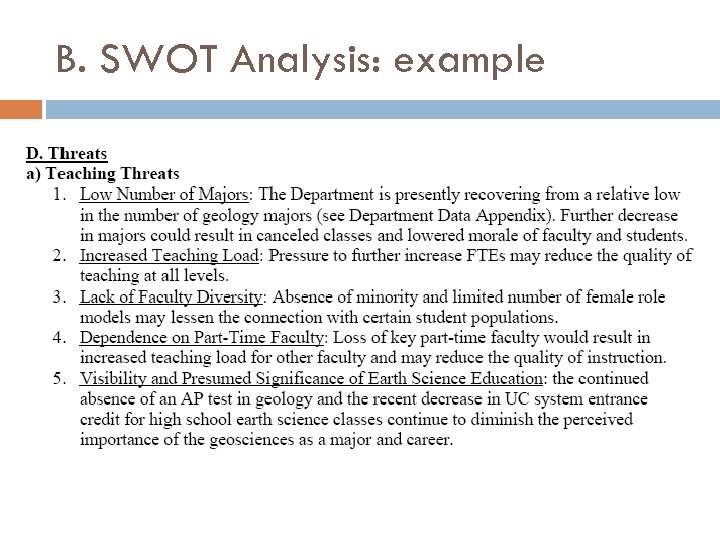 B. SWOT Analysis: example
 B. SWOT Analysis Suggestion: Solicit alumni input prior to exercise re their perceptions of strengths/weaknesses. Volunteer one member of each group to be on a SWOT subcommittee to finalize SWOT statement. Subcommittee can also perform following analysis: Leverage (O+S) Vulnerability (T+S) Constraints (O+W) Problems (T+W)
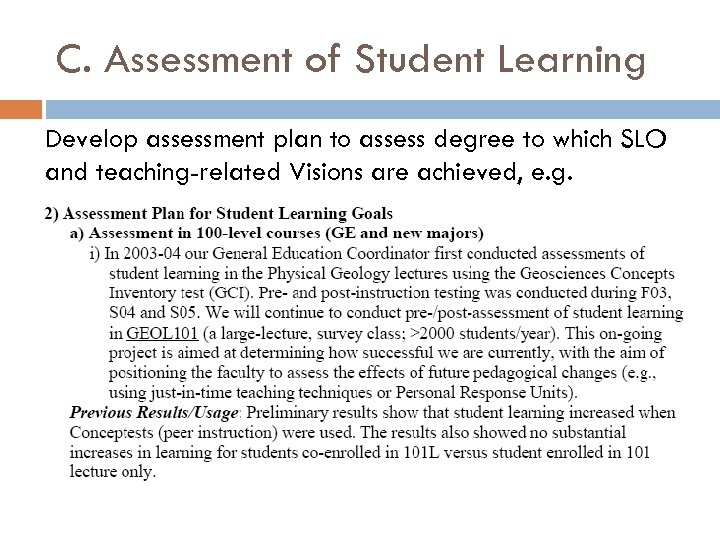 C. Assessment of Student Learning Develop assessment plan to assess degree to which SLO and teaching-related Visions are achieved, e. g.
 C. Assessment of Student Learning UT Austin site on Assessment of Instructional Programs Assessment Resources Planning steps (with worksheets!): Describe program context Identify stakeholders and their central questions Students: Will this degree prepare me/help me get a job? Determine the evaluation purpose Identify intended uses of data Create an evaluation plan
 D. Goals can be identified by inspecting Vision statements and asking What are we currently doing to embody this Vision? Is there something we could do differently to more fully realize our vision? WHAT IS YOUR THEORY OF CHANGE? ? Make a logic model! Prioritize goals (1 -3 years; 3 -6 years) Identify strategies to achieve goals Develop an action plan Assign something to everyone!
 INSTRUCTIONAL PROGRAM ASSESSMENT (IPA) Part 2: Assessment Strategies
 Common elements of an IPA Assessment of Student Learning Define learning objectives for individual courses Analysis of degree curriculum Benchmark exams Capstone experiences Student surveys Employer surveys There are LOTS of examples of these on the SERC site. . . Program Metrics and Instruments
 Student Learning: Individual Courses Define learning objectives for individual courses “Successful completion satisfactorily demonstrates student mastery of SLO” assessed by pass/fail rate Student ratings of instruction Annual student achievement data for highenrollment, “standardized” classes Performance Exams Pre-/Post- Testing Assessed by changes in scores
 Analysis of degree curriculum “map” courses to the degree’s SLO statement using SLOs for individual courses assessment consists of demonstration that SLO are met by students passing required coursework Pt. #4, Carleton College's Assessment Plan “maps” can also be made to the institution’s Mission and Goals This is a useful springboard for redesigning the curriculum…
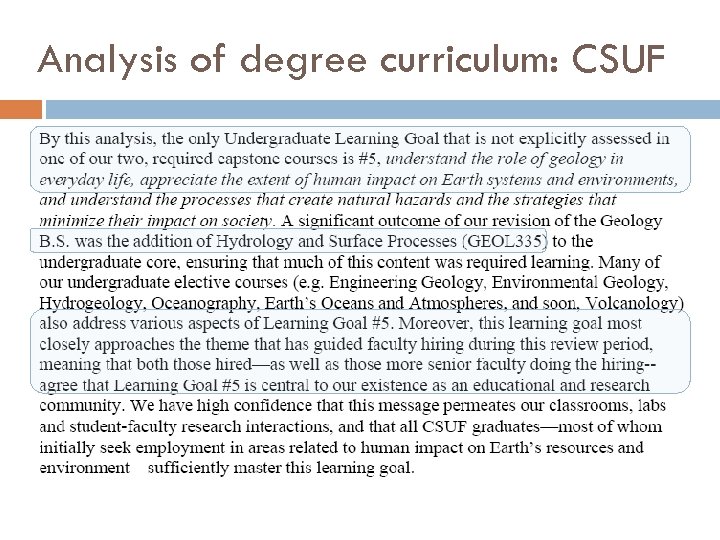 Analysis of degree curriculum: CSUF
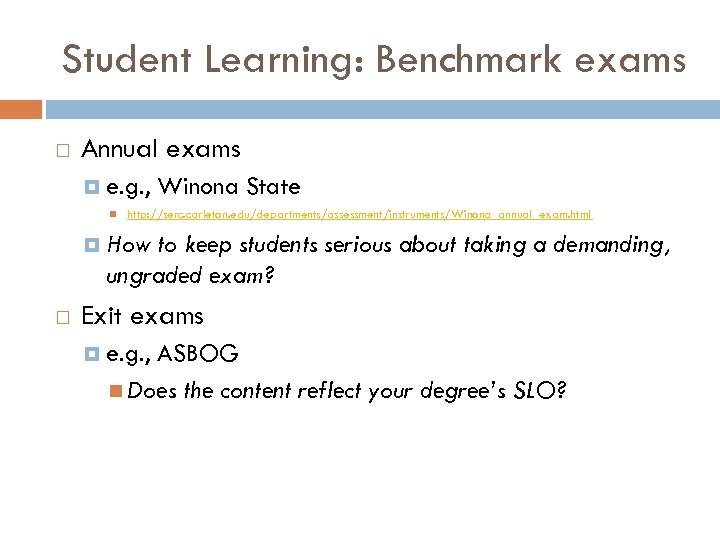 Student Learning: Benchmark exams Annual exams e. g. , Winona State http: //serc. carleton. edu/departments/assessment/instruments/Winona_annual_exam. html How to keep students serious about taking a demanding, ungraded exam? Exit exams e. g. , ASBOG Does the content reflect your degree’s SLO?
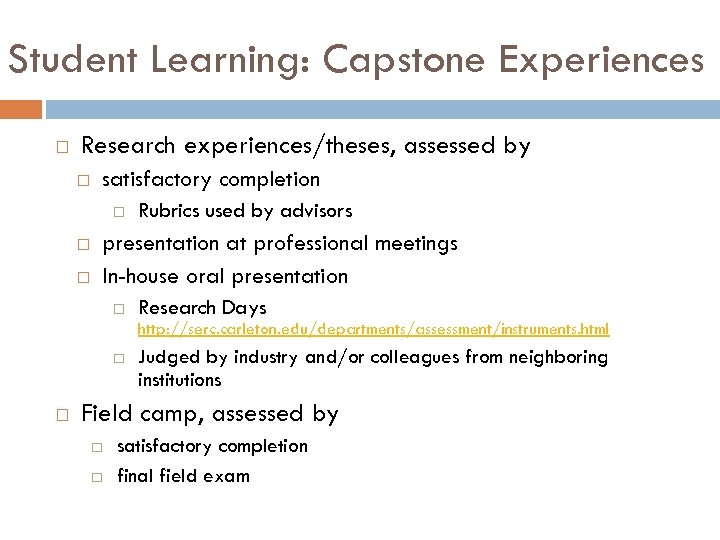 Student Learning: Capstone Experiences Research experiences/theses, assessed by satisfactory completion Rubrics used by advisors presentation at professional meetings In-house oral presentation Research Days http: //serc. carleton. edu/departments/assessment/instruments. html Judged by industry and/or colleagues from neighboring institutions Field camp, assessed by satisfactory completion final field exam
 PROGRAM ASSESSMENT Part 3: Collecting Data
 Student Surveys Exit surveys and interviews Surveys given in classes populated by seniors or by mail Interviews conducted by Chair or by advisor Alumni surveys Collect similar data over extended time period May want to separate data by graduation date Can add one-time questions to guide curriculum development, scheduling, outreach, etc. Collect data re graduate programs for use in advising seniors Lists of Exit/Alumni Survey Questions
 Employer Surveys Brainstorm re possible survey questions How many graduates employed? Strengths/weaknesses? Compare to graduates of other programs? Incentives to participate? Possibility of improving the “product”? Opportunity to give expert advice Role of Advisory Boards
 Web-based Survey Instruments http: //serc. carleton. edu/departments/assessment/survey_tools. html Survey. Methods, Zoomerang, Survey. Monkey Note factors to consider Cost (group rate for institution? ) Number of expected responses Types of questions you’d like to use Desired access to raw data How to “code” qualitative data http: //www. utexas. edu/academic/diia/assessment/iar/programs/report/f ocus-Qual. Code. php? task=programs
 Web-based Survey Instruments Brainstorm: How could you get acceptable response rates? Consider low/no cost options Response rates (link/eval prog w/surveys) Note: “Guidelines for maximizing response rates” http: //www. utexas. edu/academic/diia/assessment/iar/programs/g ather/method/survey. php On-line surveys: forewarn; remind; provide incentives
 Closing Thoughts A possible key to obtaining faculty “buy-in” to Program Reviews/Learning Assessments is by crafting Mission, Vision and SLO statements together Get their claims of success on record, then let the scientist’s urge to collect supporting data and to solve problems kick in! Retreat, and hire a professional facilitator Successful implementation of quantitative assessment plan will increase the integration of your educational and research missions.
 PROGRAM REVIEW & ASSESSMENT Overview SERC Program Assassment