 Скачать презентацию Program for North American Mobility In Higher Education
5c24a2aa16a43574f506c84d33c01bc0.ppt
- Количество слайдов: 150




Program for North American Mobility In Higher Education PIECE Program for North American Mobility in Higher Education (NAMP) Introducing Process Integration for Environmental Control in Engineering Curricula (PIECE) Module 8: “Introduction to Process Integration” Rev: 1. 2
NAMP PIECE Purpose of Module 8 What is the purpose of this module? This module is intended to covey the basic aspects of Process Integration Methods and Tools, and places Process Integration into a broad perspective. It will be identified as a prerequisite for all other modules related to the learning of Process Integration. Module 8: introduction to process integration 2
NAMP PIECE Struture of module 8 What is the structure of this module? The Module 8 is divided into 3 “tiers”, each with a specific goal: Tier 1: Background Information Tier 2: Case Study Applications of Process Integration Tier 3: Open-Ended Design Problem These tiers are intended to be completed in order. Students are quizzed at various points, to measure their degree of understanding, before proceeding. Each tier contains a statement of intent at the beginning, and a quiz at the end. Module 8: introduction to process integration 3
NAMP PIECE Tier 1: Background Information Module 8: introduction to process integration 4
NAMP PIECE Tier 1: Statement of intent: The goal is to provide a general overview of process integration tools, with a focus on it’s link with profitability analysis. At the end of Tier 1, the student should: Distinguish the key elements of Process Integration. Know the scope of each process integration tool. Have overview of each process integration tool. Module 8: introduction to process integration 5
NAMP PIECE Tier 1: contents The tier 1 is broken down into three sections: 1. 1 Introduction and definition of Process integration. 1. 2 Overview of PI tools 1. 3 An “around-the-world tour” of PI practitioners focuses of expertise At the end of this tier there is a short multiple-answer Quiz. Module 8: introduction to process integration 6
NAMP PIECE Outline 1. 1 Introduction and definition of Process integration. 1. 2 Overview of Process Integration tools Process Integration 1. 3 An “around-the-world tour” of PI “around-the-world practitioners focuses of expertise Module 8: introduction to process integration 7
NAMP PIECE 1. 1 Introduction and definition of Process integration. Module 8: introduction to process integration 8
NAMP PIECE introduction The president of your company probably does not know what process integration can do for the company. . . . . But he should. Let’s look at why? Module 8: introduction to process integration 9
NAMP PIECE A Very Brief History of Process Integration Linnhoff started the area of pinch (bottleneck identification) at UMIST in the 60’s, focusing on the area of Heat Integration UMIST Dept of Process Integration was created in 1984, shortly after the consulting firm Linnhoff-March Inc. was formed PI is not really easy to define… Module 8: introduction to process integration 10
NAMP PIECE Definition of process integration The International Energy Agency (IEA) definition of process integration "Systematic and General Methods for Designing Integrated Production Systems, ranging from Individual Processes to Total Sites, with special emphasis on the Efficient Use of Energy and reducing Environmental Effects" From an Expert Meeting in Berlin, October 1993 Module 8: introduction to process integration 11
NAMP PIECE Definition of process integration Later, this definition was somewhat broadened and more explicitly stated in the description of it’s role in the technical sector by this Implementing Agreement: "Process Integration is the common term used for the application of methodologies developed for System-oriented and Integrated approaches to industrial process plant design for both new and retrofit applications. Such methodologies can be mathematical, thermodynamic and economic models, methods and techniques. Examples of these methods include: Artificial Intelligence (AI), Hierarchical Analysis, Pinch Analysis and Mathematical Programming. Process Integration refers to Optimal Design; examples of aspects are: capital investment, energy efficiency, emissions, operability, flexibility, controllability, safety and yields. Process Integration also refers to some aspects of operation and maintenance". Later, based on input from the Swiss National Team, we have found that Sustainable Development should be included in our definition of Process Integration. Truls Gunderson, International Energy Agency (IEA) Implementing Agreement, “A worldwide catalogue on Process Integration” (jun. 2001). Module 8: introduction to process integration 12
NAMP PIECE Definition of process integration El-Halwagi, M. M. , Pollution Prevention through Process Integration: Systematic Design Tools. Academic Press, 1997. “A Chemical Process is an integrated system of interconnected units and streams, and it should be treated as such. Process Integration is a holistic approach to process design, retrofitting, and operation which emphasizes the unity of the process. In light of the strong interaction among process units, streams, and objectives, process integration offers a unique framework for fundamentally understanding the global insights of the process, methodically determining its attainable performance targets, and systematically making decisions leading to the realization of these targets. There are three key components in any comprehensive process integration methodology: synthesis, analysis, and optimization. ” Module 8: introduction to process integration 13
NAMP PIECE Definition of process integration Nick Hallale, Aspentech – CEP July 2001 – “Burning Bright Trends in Process Integration” “Process Integration is more than just pinch technology and heat exchanger networks. Today, it has far wider scope and touches every area of process design. Switched-on industries are making more money from their raw materials and capital assets while becoming cleaner and more sustainable” Module 8: introduction to process integration 14
NAMP PIECE Definition of process integration North American Mobility Program in Higher Education (NAMP)-January 2003 “Process integration (PI) is the synthesis of process control, process engineering and process modeling and simulation into tools that can deal with the large quantities of operating data now available from process information systems. It is an emerging area, which offers the promise of improved control and management of operating efficiencies, energy use, environmental impacts, capital effectiveness, process design, and operations management. ” Module 8: introduction to process integration 15
NAMP PIECE Definition of process integration So What Happened? In addition to thermodynamics (the foundation of pinch), other techniques are being drawn upon for holistic analysis, in particular: Process modeling Process statistics Process optimization Process economics Process control Process design Module 8: introduction to process integration 16
NAMP PIECE Modern Process Integration context Process integration is primarily regarded as process design (both new and retrofits design), but also involve planning and operation. The methods and systems are applied to continuous, semi-batch, and batch process. Business objectives currently driving the development of PI: a) b) c) Emphasis is on retrofit projects in the “new economy” driven by Return on Capital Employed (ROCE) PI is “Finding value in data quality” Corporations wish to make more knowledgeable decisions: 1. For operations, 2. During the design process. Module 8: introduction to process integration 17
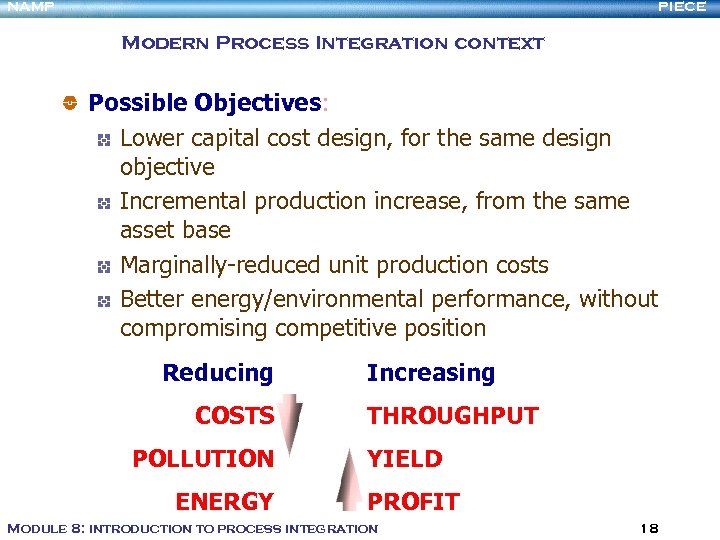
NAMP PIECE Modern Process Integration context Possible Objectives: Lower capital cost design, for the same design objective Incremental production increase, from the same asset base Marginally-reduced unit production costs Better energy/environmental performance, without compromising competitive position Reducing COSTS POLLUTION ENERGY Increasing THROUGHPUT YIELD PROFIT Module 8: introduction to process integration 18
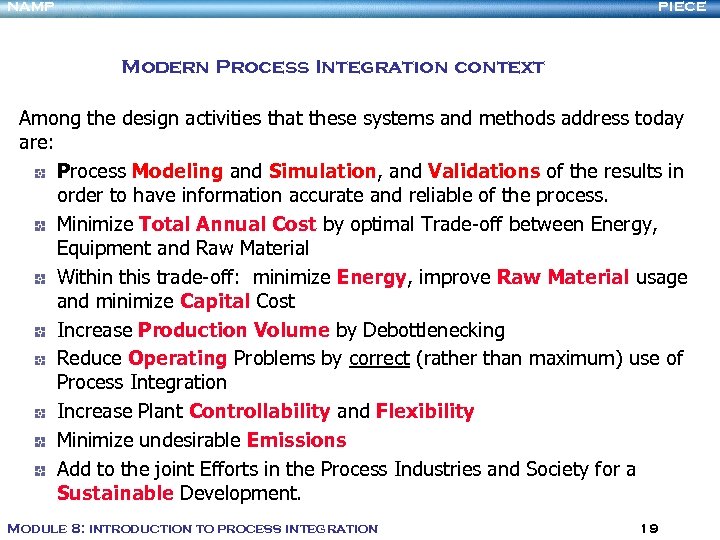
NAMP PIECE Modern Process Integration context Among the design activities that these systems and methods address today are: Process Modeling and Simulation, and Validations of the results in order to have information accurate and reliable of the process. Minimize Total Annual Cost by optimal Trade-off between Energy, Equipment and Raw Material Within this trade-off: minimize Energy, improve Raw Material usage and minimize Capital Cost Increase Production Volume by Debottlenecking Reduce Operating Problems by correct (rather than maximum) use of Process Integration Increase Plant Controllability and Flexibility Minimize undesirable Emissions Add to the joint Efforts in the Process Industries and Society for a Sustainable Development. Module 8: introduction to process integration 19
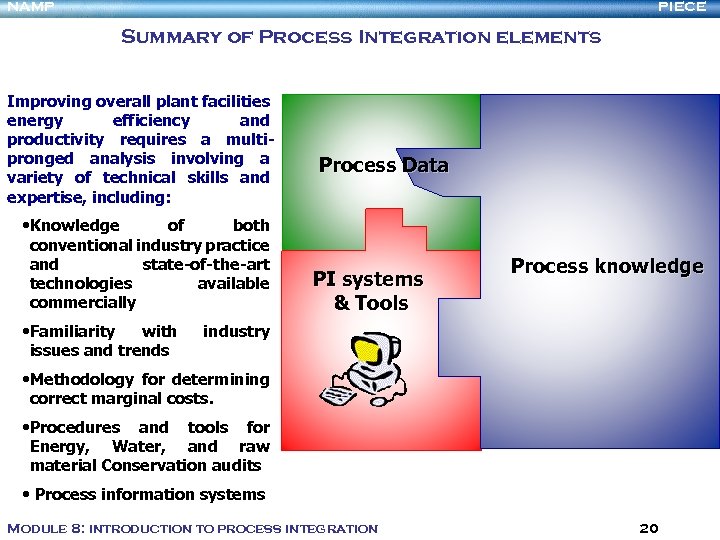
NAMP PIECE Summary of Process Integration elements Improving overall plant facilities energy efficiency and productivity requires a multipronged analysis involving a variety of technical skills and expertise, including: • Knowledge of both conventional industry practice and state-of-the-art technologies available commercially • Familiarity with issues and trends Process Data PI systems & Tools Process knowledge industry • Methodology for determining correct marginal costs. • Procedures and tools for Energy, Water, and raw material Conservation audits • Process information systems Module 8: introduction to process integration 20
NAMP PIECE Definition of process integration In conclusion, process integration has evolved from Heat recovery methodology in the 80’s to become what a number of leading industrial companies and research groups in the 20 th century regarding the holistic analysis of processes, involving the following elements: Process data – lots of it Systems and tools – typically computer-oriented Process engineering principles - in-depth process sector knowledge Targeting - Identification of ideal unit constraints for the overall process Module 8: introduction to process integration 21
NAMP PIECE Outline 1. 1 Introduction and definition of Process integration. 1. 2 Overview of Process Integration tools 1. 3 An “around-the-world tour” of PI “around-the-world practitioners focuses of expertise Module 8: introduction to process integration 22
NAMP PIECE 1. 2 Overview of Process Integration Tools Module 8: introduction to process integration 23
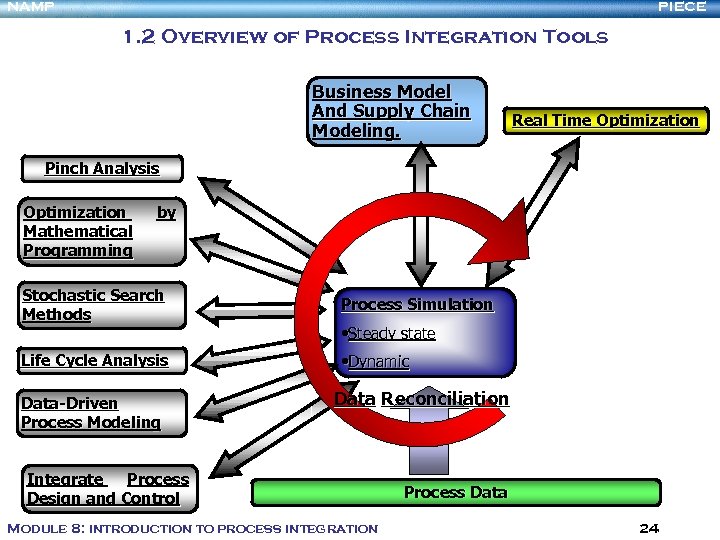
NAMP PIECE 1. 2 Overview of Process Integration Tools Business Model And Supply Chain Modeling. Real Time Optimization Pinch Analysis Optimization Mathematical Programming by Stochastic Search Methods Process Simulation Life Cycle Analysis • Dynamic Data-Driven Process Modeling • Steady state Data Reconciliation Integrate Process Design and Control Module 8: introduction to process integration Process Data 24
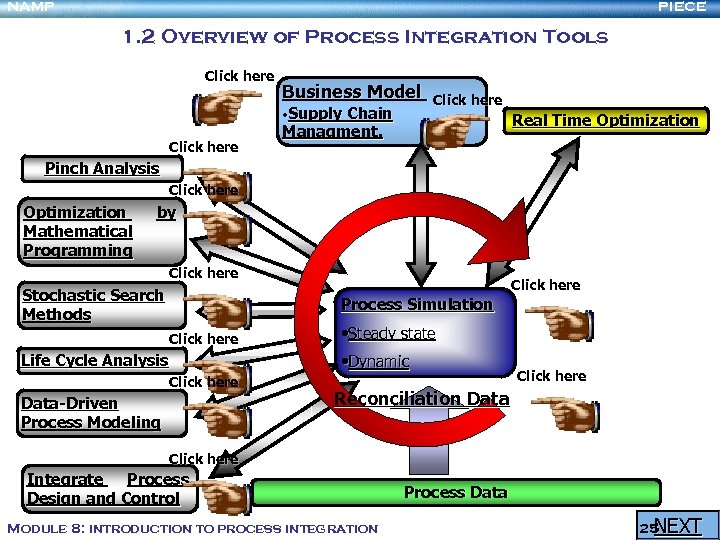
NAMP PIECE 1. 2 Overview of Process Integration Tools Click here Business Model Click here • Supply Chain Click here Real Time Optimization Managment. Pinch Analysis Click here Optimization Mathematical Programming by Click here Stochastic Search Methods Click here Life Cycle Analysis Click here Process Simulation • Steady state • Dynamic Click here Data-Driven Process Modeling Click here Reconciliation Data Click here Integrate Process Design and Control Module 8: introduction to process integration Process Data NEXT 25
NAMP PIECE Process Simulation Module 8: introduction to process integration 26
NAMP PIECE Process Simulation Process modeling What is a model? “A model is an abstraction of a process operation used to build, change, improve, control, and answer questions about that process” Process modeling is an activity using models to solve problems in the areas of the process design, control, optimization, hazards analysis, operation training, risk assessment, and software engineering for computer aided engineering environments. Module 8: introduction to process integration 27
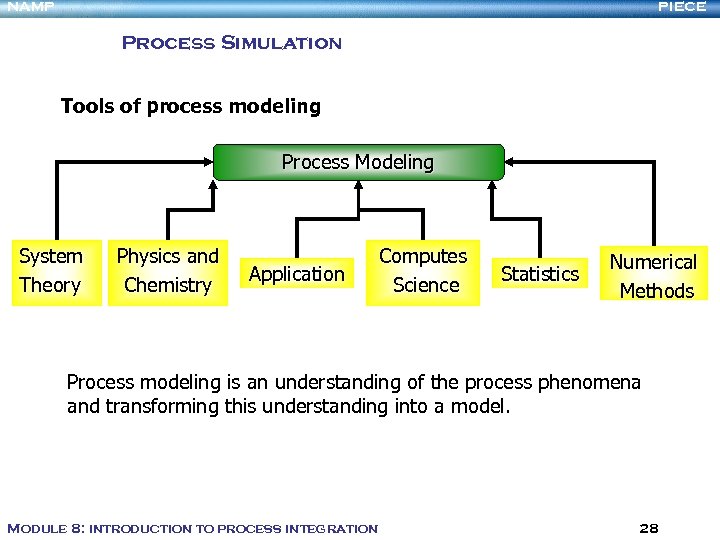
NAMP PIECE Process Simulation Tools of process modeling Process Modeling System Theory Physics and Chemistry Application Computes Science Statistics Numerical Methods Process modeling is an understanding of the process phenomena and transforming this understanding into a model. Module 8: introduction to process integration 28
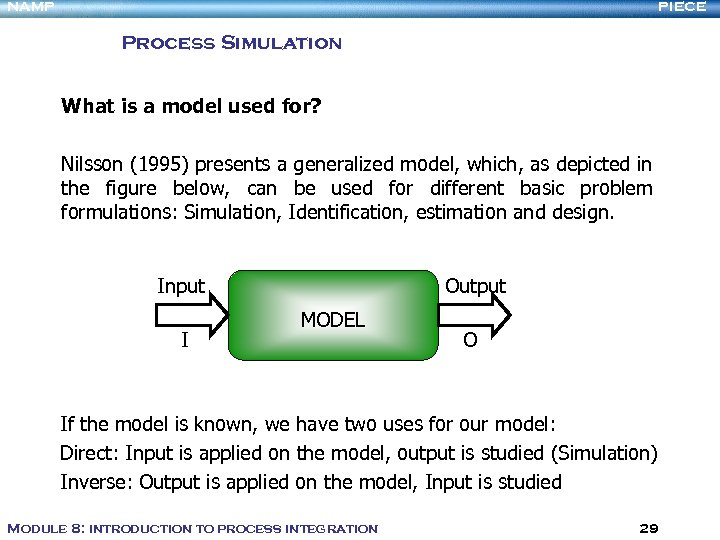
NAMP PIECE Process Simulation What is a model used for? Nilsson (1995) presents a generalized model, which, as depicted in the figure below, can be used for different basic problem formulations: Simulation, Identification, estimation and design. Input I Output MODEL O If the model is known, we have two uses for our model: Direct: Input is applied on the model, output is studied (Simulation) Inverse: Output is applied on the model, Input is studied Module 8: introduction to process integration 29
NAMP PIECE Process Simulation If both Input and Output are Known, we have three formulations (Juha Yaako, 1998): Identification: We can find the structure and parameters in the model. Estimation: If the internal structure of model is known, we can find the internal states in model. Design: If the structure and internal states of model are known, we can study the parameters in model. Module 8: introduction to process integration 30
NAMP PIECE Process Simulation Demands set to models: Accuracy Requirements placed on quantitative and qualitative models. Validity Consideration of the model constraints. A typical model process is non-linear, nevertheless, non-linear models are linearized when possible, because they are easier to use and guarantee global solutions. Complexity Models can be simple (usually macroscopic) or detailed (usually microscopic). The detail level of the phenomena should be considered. Computational The models should currently regard computational orientation. Robustness Models that can be used for multiple processes are always desired. Module 8: introduction to process integration 31
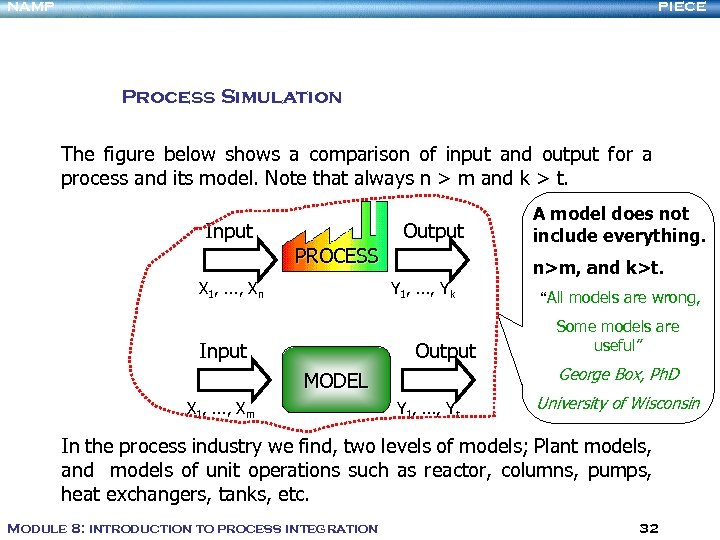
NAMP PIECE Process Simulation The figure below shows a comparison of input and output for a process and its model. Note that always n > m and k > t. Input Output PROCESS X 1, . . . , Xn Y 1, . . . , Yk Input Output MODEL X 1, . . . , Xm Y 1, . . . , Yt A model does not include everything. n>m, and k>t. “All models are wrong, Some models are useful” George Box, Ph. D University of Wisconsin In the process industry we find, two levels of models; Plant models, and models of unit operations such as reactor, columns, pumps, heat exchangers, tanks, etc. Module 8: introduction to process integration 32
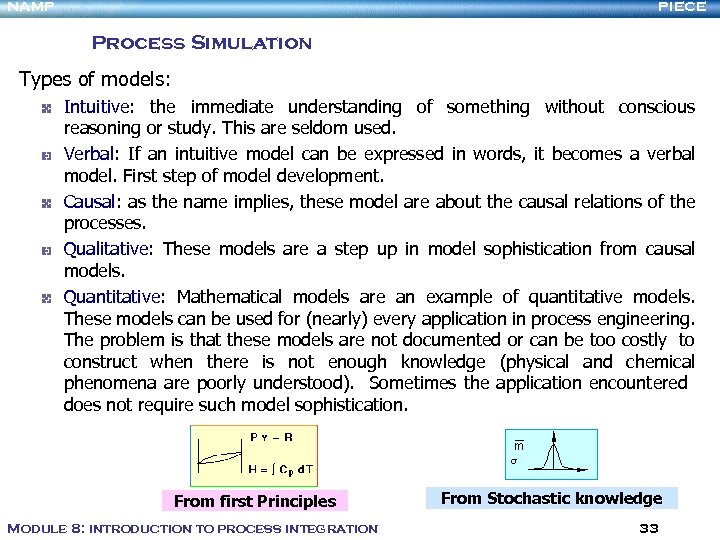
NAMP PIECE Process Simulation Types of models: Intuitive: the immediate understanding of something without conscious reasoning or study. This are seldom used. Verbal: If an intuitive model can be expressed in words, it becomes a verbal model. First step of model development. Causal: as the name implies, these model are about the causal relations of the processes. Qualitative: These models are a step up in model sophistication from causal models. Quantitative: Mathematical models are an example of quantitative models. These models can be used for (nearly) every application in process engineering. The problem is that these models are not documented or can be too costly to construct when there is not enough knowledge (physical and chemical phenomena are poorly understood). Sometimes the application encountered does not require such model sophistication. From first Principles Module 8: introduction to process integration From Stochastic knowledge 33
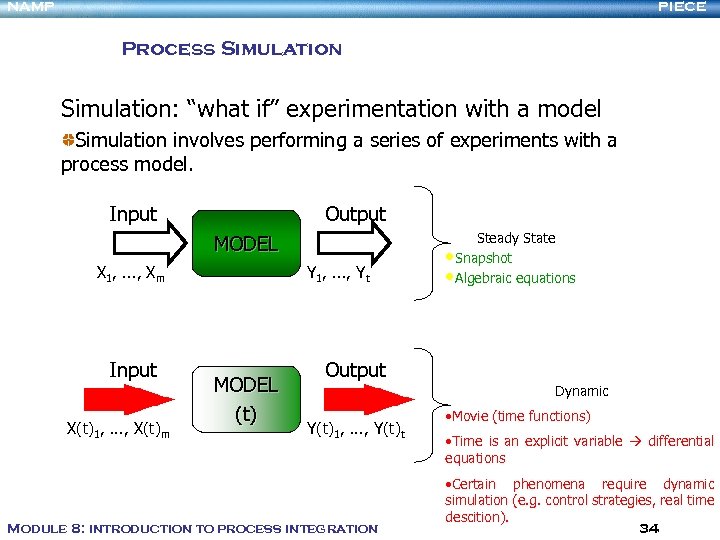
NAMP PIECE Process Simulation: “what if” experimentation with a model Simulation involves performing a series of experiments with a process model. Input Output MODEL X 1, . . . , Xm Input X(t)1, . . . , X(t)m Y 1, . . . , Yt MODEL (t) Output Y(t)1, . . . , Y(t)t Module 8: introduction to process integration Steady State • Snapshot • Algebraic equations Dynamic • Movie (time functions) • Time is an explicit variable differential equations • Certain phenomena require dynamic simulation (e. g. control strategies, real time descition). 34
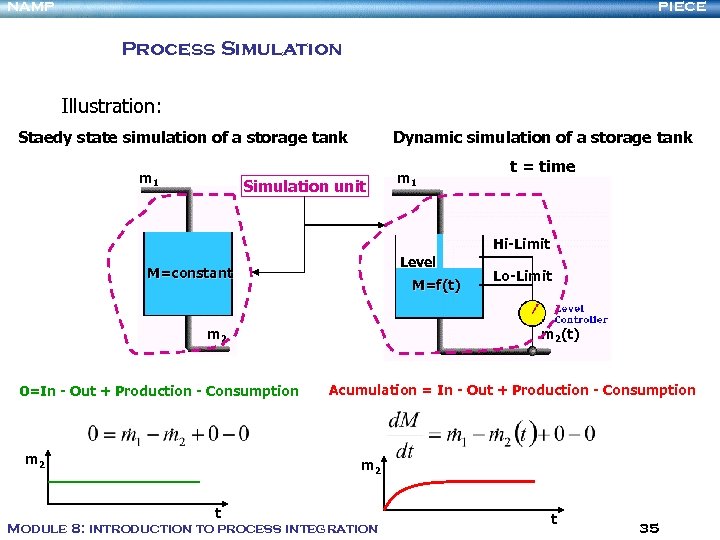
NAMP PIECE Process Simulation Illustration: Staedy state simulation of a storage tank m 1 Dynamic simulation of a storage tank Simulation unit m 1 t = time Hi-Limit Level M=constant M=f(t) m 2 0=In - Out + Production - Consumption m 2 Lo-Limit m 2(t) Acumulation = In - Out + Production - Consumption m 2 t Module 8: introduction to process integration t 35
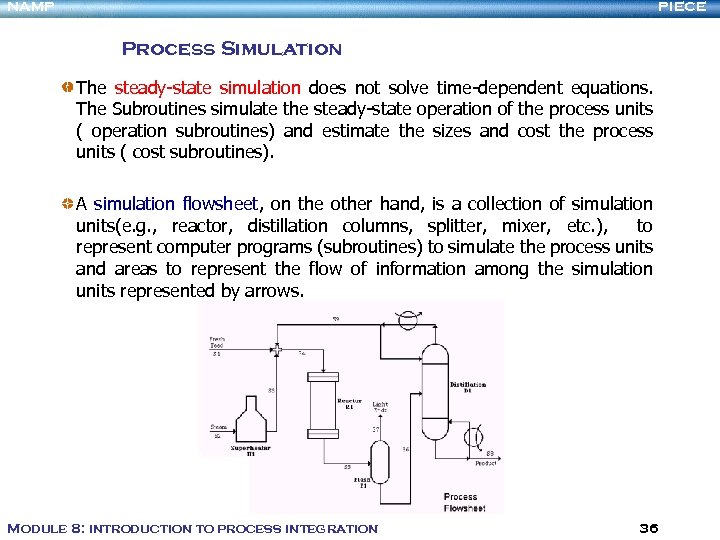
NAMP PIECE Process Simulation The steady-state simulation does not solve time-dependent equations. The Subroutines simulate the steady-state operation of the process units ( operation subroutines) and estimate the sizes and cost the process units ( cost subroutines). A simulation flowsheet, on the other hand, is a collection of simulation units(e. g. , reactor, distillation columns, splitter, mixer, etc. ), to represent computer programs (subroutines) to simulate the process units and areas to represent the flow of information among the simulation units represented by arrows. Module 8: introduction to process integration 36
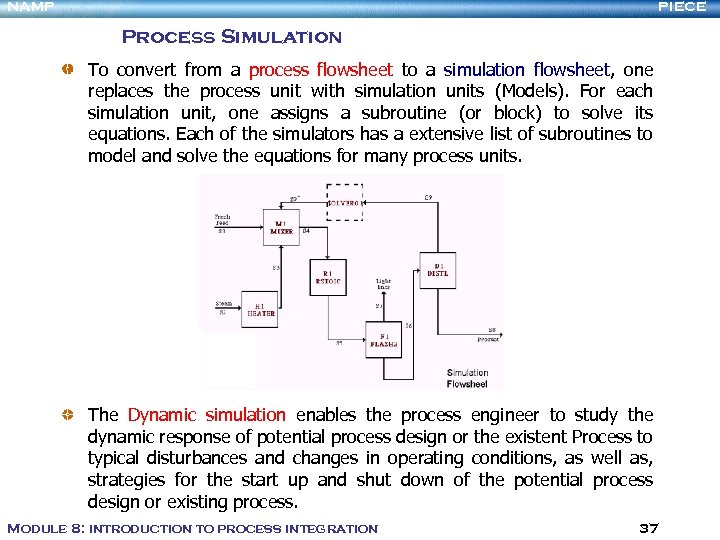
NAMP PIECE Process Simulation To convert from a process flowsheet to a simulation flowsheet, one replaces the process unit with simulation units (Models). For each simulation unit, one assigns a subroutine (or block) to solve its equations. Each of the simulators has a extensive list of subroutines to model and solve the equations for many process units. The Dynamic simulation enables the process engineer to study the dynamic response of potential process design or the existent Process to typical disturbances and changes in operating conditions, as well as, strategies for the start up and shut down of the potential process design or existing process. Module 8: introduction to process integration 37
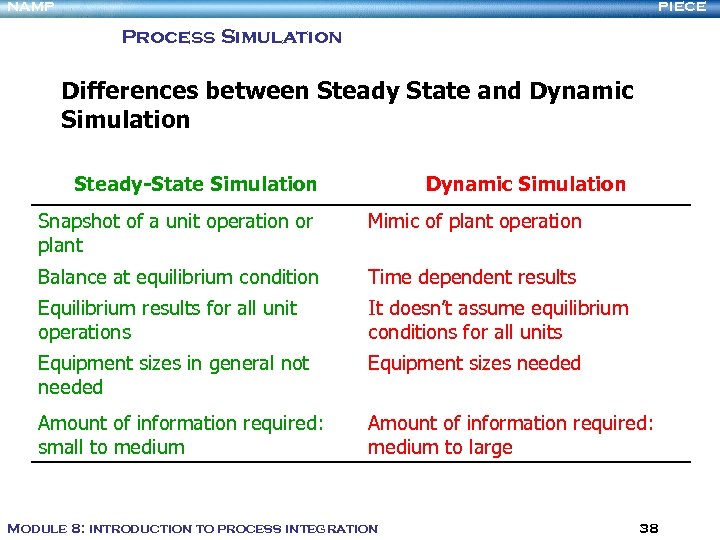
NAMP PIECE Process Simulation Differences between Steady State and Dynamic Simulation Steady-State Simulation Dynamic Simulation Snapshot of a unit operation or plant Mimic of plant operation Balance at equilibrium condition Time dependent results Equilibrium results for all unit operations It doesn’t assume equilibrium conditions for all units Equipment sizes in general not needed Equipment sizes needed Amount of information required: small to medium Amount of information required: medium to large Module 8: introduction to process integration 38
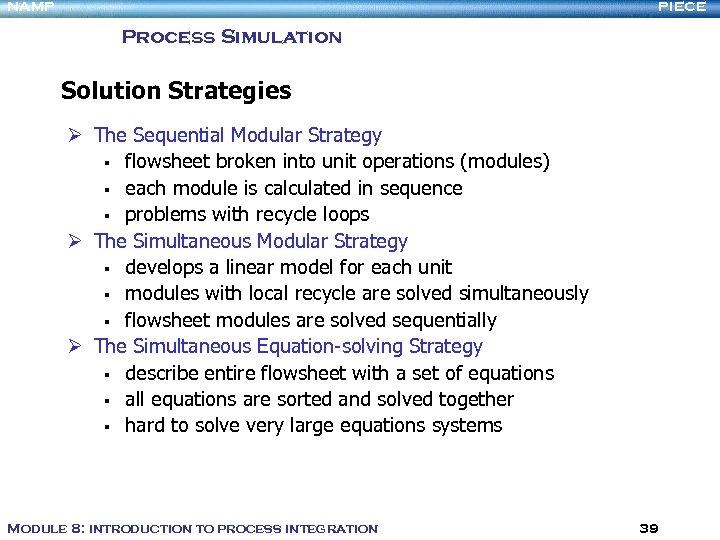
NAMP PIECE Process Simulation Solution Strategies Ø The Sequential Modular Strategy § flowsheet broken into unit operations (modules) § each module is calculated in sequence § problems with recycle loops Ø The Simultaneous Modular Strategy § develops a linear model for each unit § modules with local recycle are solved simultaneously § flowsheet modules are solved sequentially Ø The Simultaneous Equation-solving Strategy § describe entire flowsheet with a set of equations § all equations are sorted and solved together § hard to solve very large equations systems Module 8: introduction to process integration 39
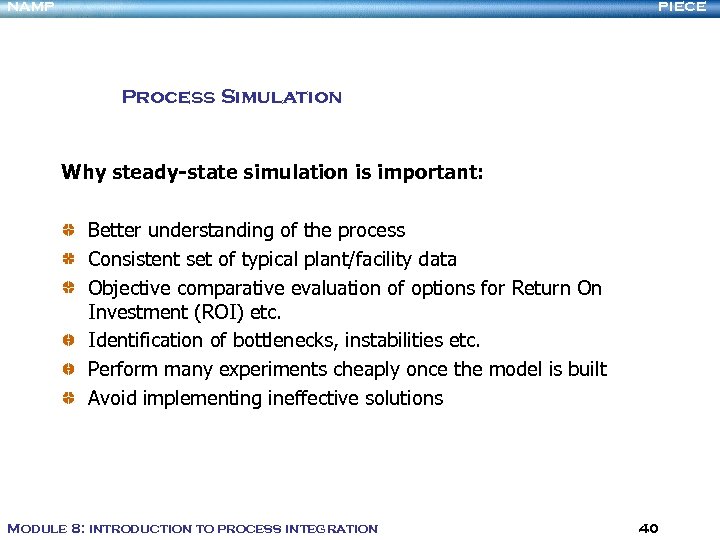
NAMP PIECE Process Simulation Why steady-state simulation is important: Better understanding of the process Consistent set of typical plant/facility data Objective comparative evaluation of options for Return On Investment (ROI) etc. Identification of bottlenecks, instabilities etc. Perform many experiments cheaply once the model is built Avoid implementing ineffective solutions Module 8: introduction to process integration 40
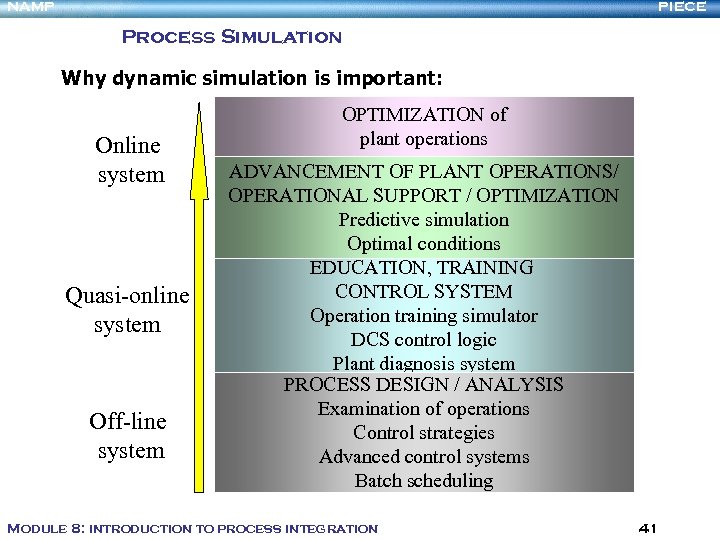
NAMP PIECE Process Simulation Why dynamic simulation is important: Online system Quasi-online system Off-line system OPTIMIZATION of plant operations ADVANCEMENT OF PLANT OPERATIONS/ OPERATIONAL SUPPORT / OPTIMIZATION Predictive simulation Optimal conditions EDUCATION, TRAINING CONTROL SYSTEM Operation training simulator DCS control logic Plant diagnosis system PROCESS DESIGN / ANALYSIS Examination of operations Control strategies Advanced control systems Batch scheduling Module 8: introduction to process integration 41
NAMP PIECE Challenges of simulation Simulation is not the highest priority in the plant facilities Production or quality issues take precedence Hard to get plant facilities resources for simulation “Up front” time required before results are available Model must be calibrated, and results validated, before they can be trusted At odds with “quarterly balance sheet culture” May need to structure project to get some results out early NEXT Module 8: introduction to process integration 42
NAMP PIECE Data Reconciliation Module 8: introduction to process integration 43
NAMP PIECE Data Reconciliation Typical Objectives of Data Treatment. Provide reliable information and knowledge of complete data for validation of process simulation and analysis Yield monitoring and accounting Plant facilities management and decision-making Optimization and control Perform instrument maintenance Instrument monitoring Malfunction detection calibration Detect operating problems Process leaks or product loss Estimate unmeasured values Reduce random and gross errors in measurements Detect steady states Module 8: introduction to process integration 44
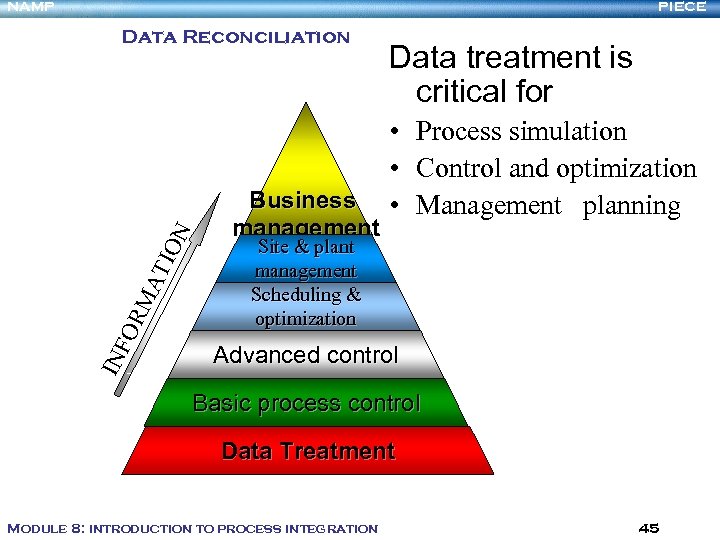
NAMP PIECE IN F OR MA T IO N Data Reconciliation Business management Data treatment is critical for • • • Process simulation Control and optimization Management planning Site & plant management Scheduling & optimization Advanced control Basic process control Data Treatment Module 8: introduction to process integration 45
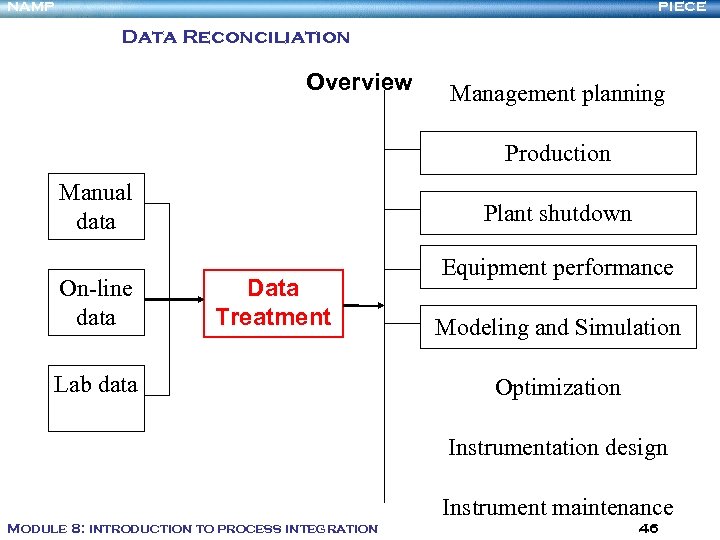
NAMP PIECE Data Reconciliation Overview Management planning Production Manual data On-line data Plant shutdown Data Treatment Lab data Equipment performance Modeling and Simulation Optimization Instrumentation design Module 8: introduction to process integration Instrument maintenance 46
NAMP PIECE Data Reconciliation Typical Problems With Process Measurements inherently corrupted by errors: measurement faults errors during processing and transmission of the measured signal Random errors Caused by random or temporal events Inconsistency (Gross) errors Caused by nonrandom events: instrument miscalibration or malfunction, process leaks Non-measurements Sampling restriction, measuring technique, instrument failure Module 8: introduction to process integration 47
NAMP PIECE Data Reconciliation Random errors Features High frequency Unrepeatable: neither magnitude nor sign can be predicted with certitude Sources Power supply fluctuation Signal conversion noise Changes in ambient condition Module 8: introduction to process integration 48
NAMP PIECE Data Reconciliation Inconsistency (Gross error) Features Low frequency Predictable: certain sign and magnitude Sources Caused by nonrandom events Instrument related • Miscalibration or malfunction • Wear or corrosion of the sensors Process related • Process leaks • Solid deposits Module 8: introduction to process integration 49
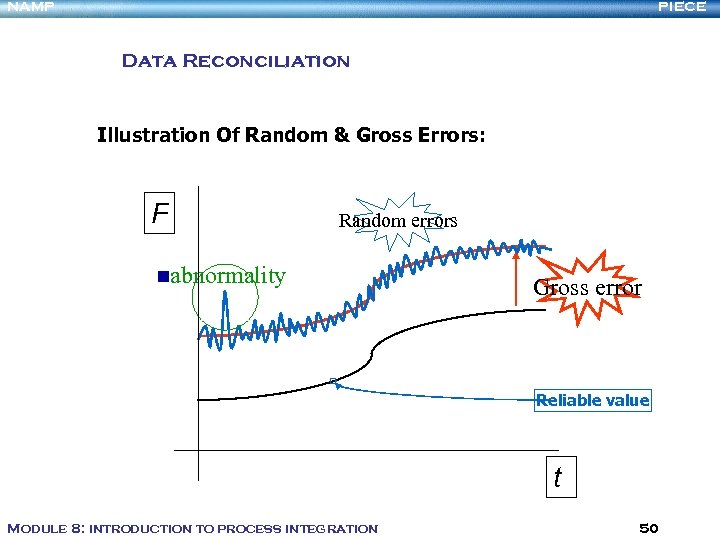
NAMP PIECE Data Reconciliation Illustration Of Random & Gross Errors: F Random errors nabnormality Gross error Reliable value t Module 8: introduction to process integration 50
NAMP PIECE Data Reconciliation Solutions To Problems Random errors: Data processing Based on successive measurement of each individual variable: Temporal redundancy Traditional filtering techniques Wavelet Transform techniques Inconsistency: Data reconciliation Based on plant structure: Spatial redundancy Subject to conservation laws Unmeasured data Ø Data reconciliation Module 8: introduction to process integration 51
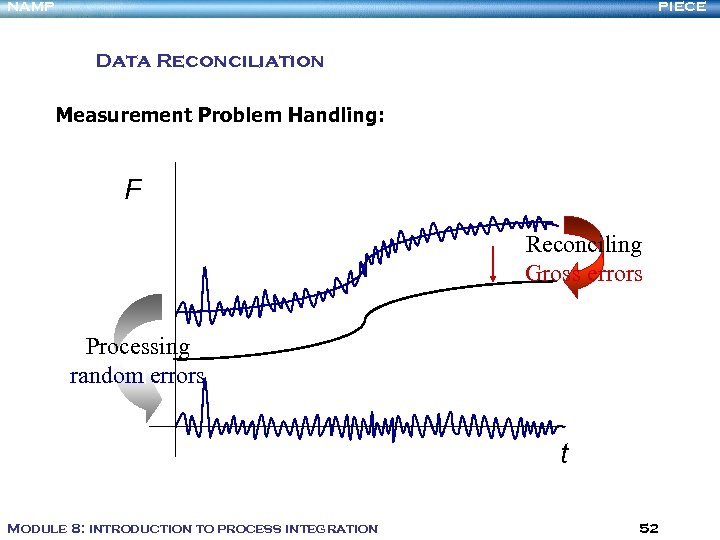
NAMP PIECE Data Reconciliation Measurement Problem Handling: F Reconciling Gross errors Processing random errors t Module 8: introduction to process integration 52
NAMP PIECE Data Reconciliation Data Treatment Typical Strategy 1. Establish Plant facilities operating regimes 2. Data processing Remove random noise Detect and correct abnormalities 3. Steady state detection Identify steady-state duration Select data set 4. Data reconciliation Detect gross errors Correct inconsistencies Calculate unmeasured parameters Module 8: introduction to process integration 53
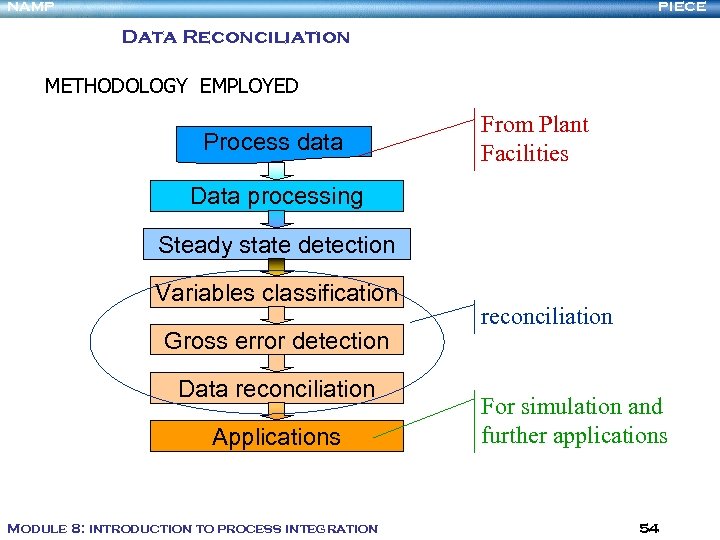
NAMP PIECE Data Reconciliation METHODOLOGY EMPLOYED Process data From Plant Facilities Data processing Steady state detection Variables classification Gross error detection Data reconciliation Applications Module 8: introduction to process integration reconciliation For simulation and further applications 54
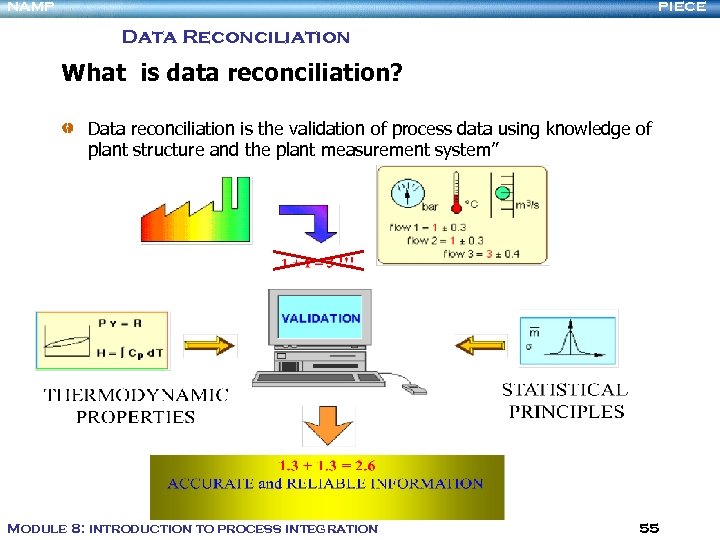
NAMP PIECE Data Reconciliation What is data reconciliation? Data reconciliation is the validation of process data using knowledge of plant structure and the plant measurement system” Module 8: introduction to process integration 55
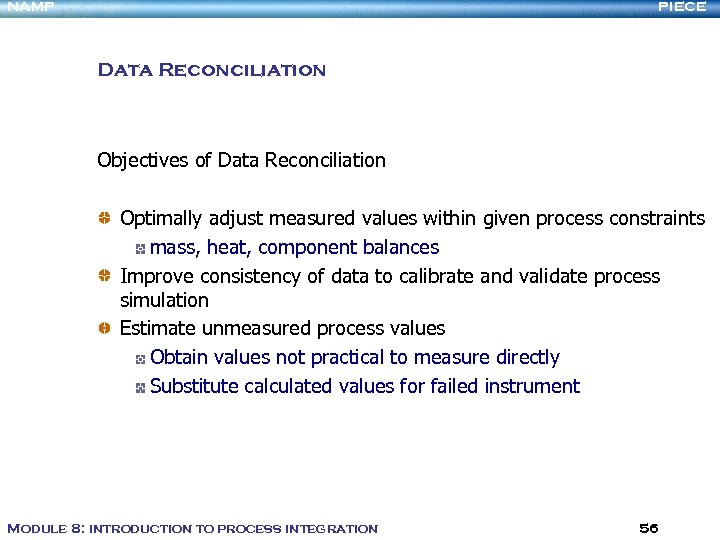
NAMP PIECE Data Reconciliation Objectives of Data Reconciliation Optimally adjust measured values within given process constraints mass, heat, component balances Improve consistency of data to calibrate and validate process simulation Estimate unmeasured process values Obtain values not practical to measure directly Substitute calculated values for failed instrument Module 8: introduction to process integration 56
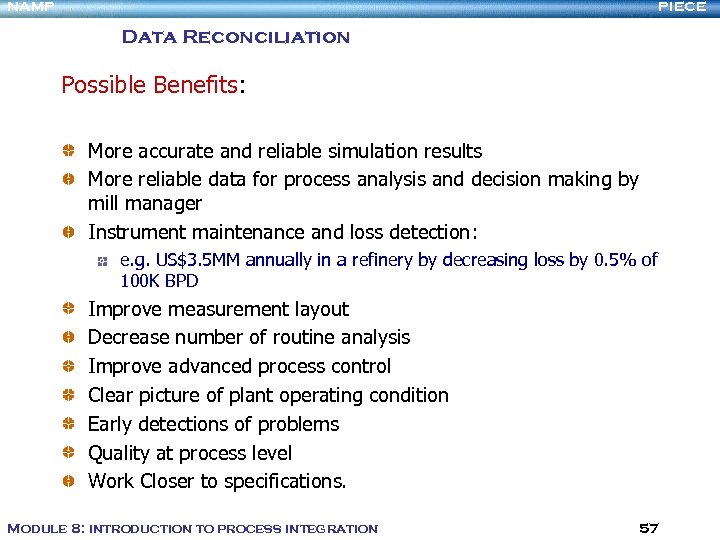
NAMP PIECE Data Reconciliation Possible Benefits: More accurate and reliable simulation results More reliable data for process analysis and decision making by mill manager Instrument maintenance and loss detection: e. g. US$3. 5 MM annually in a refinery by decreasing loss by 0. 5% of 100 K BPD Improve measurement layout Decrease number of routine analysis Improve advanced process control Clear picture of plant operating condition Early detections of problems Quality at process level Work Closer to specifications. Module 8: introduction to process integration 57
NAMP PIECE Data Reconciliation Problem of Process Under Different Status Steady-state data reconciliation based on steady-state model Using spatial redundancy Dynamic data reconciliation based on dynamic models Using both spatial & temporal redundancy Module 8: introduction to process integration 58
NAMP PIECE Data reconciliation (DR) DR Problem Of Process Under Different Status (Contd. ) General expression of conservation law: input- output + generation- consumption- accumulation= 0 Steady state case: no accumulation of any measurement Constraints are expressed algebraically Dynamic process: Accumulation cannot be neglected Constraints are differential equations Module 8: introduction to process integration 59
NAMP PIECE Data Reconciliation of Different Constraints Linear data reconciliation Only mass balance is considered flows are reconciled Bilinear data reconciliation Component balance imposed as well as energy balance flows & composition measurements are reconciled Nonlinear data reconciliation Mass/energy/component balances are included Flow rate, composition, temperature or pressure measurements are reconciled Module 8: introduction to process integration 60
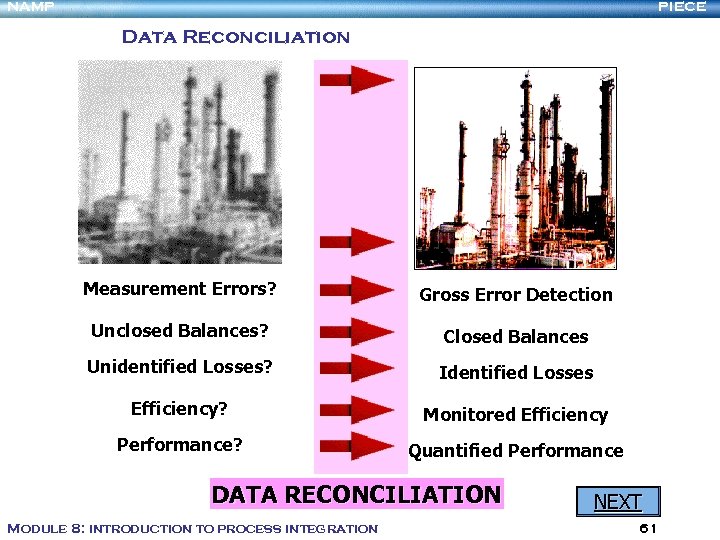
NAMP PIECE Data Reconciliation Measurement Errors? Gross Error Detection Unclosed Balances? Closed Balances Unidentified Losses? Identified Losses Efficiency? Monitored Efficiency Performance? Quantified Performance DATA RECONCILIATION Module 8: introduction to process integration NEXT 61
NAMP PIECE Pinch Analysis. Module 8: introduction to process integration 62
NAMP PIECE Pinch Analysis What is Pinch Analysis? The prime objective of Pinch Analysis is to achieve financial savings in the process industries by optimizing the ways in which process utilities (particularly energy, mass, water, and hydrogen), are applied for a wide variety of purposes. The Heat Recovery Pinch (Thermal Pinch Analysis now) was discovered indepently by Hohmann (71), Umeda et al. (78 -79) and Linnhoff et al. (78 -79). Pinch Analysis does this by making an inventory of all producers and consumers of these utilities and then systematically designing an optimal scheme of utility exchange between these producers and consumers. Energy, Mass, and water re-use are at the heart of Pinch Analysis activities. With the application of Pinch Analysis, savings can be achieved in both capital investment and operating cost. Emissions can be minimized and throughput maximized. Module 8: introduction to process integration 63
NAMP PIECE Pinch Analysis FEATURES The Pinch analysis is a technique to design: • Recovery Networks (Heat and Mass) • Utility Networks (so called Total site Analysis) • The basis of Pinch Analysis: ØThe use of thermodynamic principles (first and second law). ØThe use heuristics (insight), about design and economy. • The Pinch Analysis makes extensive use of various graphical representations Module 8: introduction to process integration 64
NAMP PIECE Pinch Analysis • The Pinch Analysis provides insights about the process. • In Pinch analysis, the design engineering controls the design procedure (interactive method). • The pinch Analysis integrates economic parameters Module 8: introduction to process integration 65
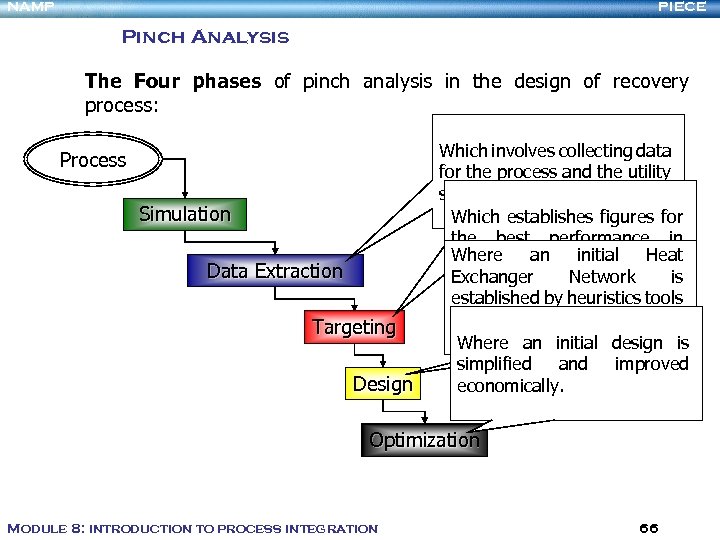
NAMP PIECE Pinch Analysis The Four phases of pinch analysis in the design of recovery process: Process Simulation Data Extraction Targeting Design Which involves collecting data for the process and the utility system Which establishes figures for the best performance in Where an initial Heat various aspects. Exchanger Network is established by heuristics tools allowing a minimum target to be reached. initial design is Where an simplified and improved economically. Optimization Module 8: introduction to process integration 66
NAMP PIECE Pinch Analysis Heat Exchanger Network (HEN) HEN design is the classical domain of Pinch Analysis. By making proper use of temperature driving forces available between process steams, the optimum heat exchanger network can be designed, taking into account constraints of equipment location, materials of construction, safety, control, and operating flexibility. This then sets the hot and cold utility demand profile of the plant. When used correctly, Pinch Analysis yields optimum HEN designs that one would have been unlikely to obtain by experience and intuition alone. Module 8: introduction to process integration 67
NAMP PIECE Pinch Analysis Combined Heat and Power (CHP) CHP is the terminology used to describe plant energy utilities, boilers, steam turbines, gas turbines, heat pumps, etc. Traditionally, these have been referred to as "plant utilities", without distinguishing them from other plant utilities such as cooling water and wastewater treatment. The CHP system supplies the hot utility and power requirements of the process. Pinch Analysis offers a convenient way to guarantee the optimum design, which can include the use of cogeneration or three-generation (use of hot utility to produce cold utility and power for things like refrigeration). Module 8: introduction to process integration 68
NAMP PIECE Pinch Analysis Possible Benefits: One of the main advantages of Pinch Analysis over conventional design methods is the ability to set a target energy consumption for an individual process or for an entire production site before to design the processes. The energy target is the minimum theoretical energy demand for the plant or site. Pinch Analysis will therefore quickly identify where energy savings are likely to be found. Reduction of emissions Pinch Analysis enable to the engineer with tool to find the best way to change the process, if the process let it. Module 8: introduction to process integration 69
NAMP PIECE Pinch Analysis In addition, Pinch Analysis allow you to: o Update or Development of Process Flow Diagrams o Identify the bottleneck in the process o Departmental Simulations o Full Plant Facilities Simulation o Determine Minimal Heating (Steam) and Cooling Requirements o Determine Cogeneration and Three-generation Opportunities o Determine Projects with Cost Estimates to Achieve Energy Savings o Evaluation of New Equipment Configurations for the Most Economical Installation o Pinch Replaces the Old Energy Studies with a Live Study that Can Be Easily Updated Using Simulation NEXT Module 8: introduction to process integration 70
NAMP PIECE Optimization by Mathematical Programming Module 8: introduction to process integration 71
NAMP PIECE Optimization by Mathematical Programming: introduction A Mathematical Model of a system is a set of mathematical relationships (e. g. , equalities, inequalities, logical conditions) which represent an abstraction of the real world system under consideration. A Mathematical Model can be developed using: Fundamental approaches Accepted theories of sciences are used to derive the equations (e. g. , Thermodynamics Laws). Empirical Methods Input-output data are employed in tandem with statistical analysis principles so as to generate empirical or “Black box” models. Methods Based on analogy Analogy is employed in determining the essential features of the system of interest by studying a similar, well understood system. Module 8: introduction to process integration 72
NAMP PIECE Optimization by Mathematical Programming: introduction A mathematical Model of a system consists of four key elements: 1. Variables The variables can take different values and their specifications define different states of the systems. 1. Continuous, 2. Integer, 3. Mixed set of continuous and integer. 2. 3. 4. Parameters The parameters are fixed to one or multiple specific values, and each fixation defines a different model. Constraints the constraints are fixed quantities by the model statement Mathematical Relationships The mathematical model relations can be classified as: 1. Equalities usually composed of mass balance, energy balance, equilibrium relations, physical property calculations, and engineering design relations which describe the physical phenomena of the system. 2. Inequalities consist of allowable operating regimes, specifications on qualities, feasibility of heat and mass transfer, performance requirements, and bound on availabilities and demands. 3. Logical conditions provide the connection between the continuous and integer variables. The mathematical relations can be algebraic, differential, or a mixed set of both constraints. These can be linear or nonlinear. Module 8: introduction to process integration 73
NAMP PIECE Optimization by Mathematical Programming What is Optimization? A optimization problem is a mathematical model which in addition to the before mentioned elements contains one or more performance criteria. The performance criteria is denoted as an objective function. It can be minimization of cost, the maximization or profit or yield of a process for instance. If we have multiple performance criteria then the problem is classified as multi-objective optimization problem. A well defined optimization problem features a number of variables greater than the number of equality constraints, which implies that there exist degrees of freedom upon which we optimize. Module 8: introduction to process integration 74
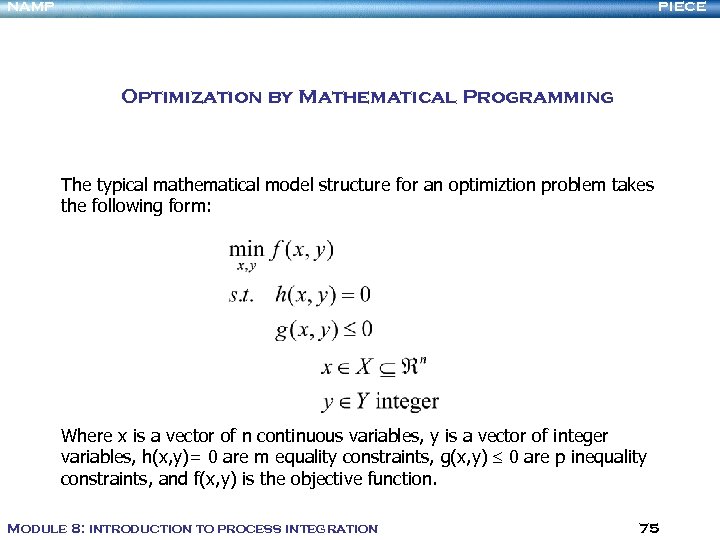
NAMP PIECE Optimization by Mathematical Programming The typical mathematical model structure for an optimiztion problem takes the following form: Where x is a vector of n continuous variables, y is a vector of integer variables, h(x, y)= 0 are m equality constraints, g(x, y) 0 are p inequality constraints, and f(x, y) is the objective function. Module 8: introduction to process integration 75
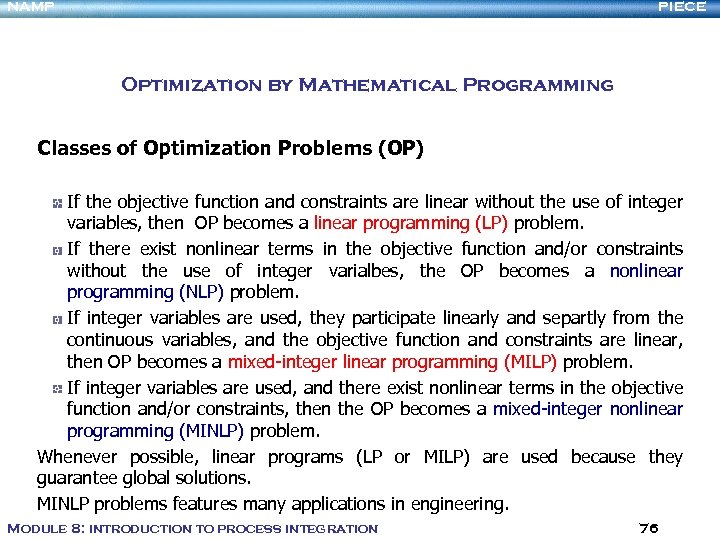
NAMP PIECE Optimization by Mathematical Programming Classes of Optimization Problems (OP) If the objective function and constraints are linear without the use of integer variables, then OP becomes a linear programming (LP) problem. If there exist nonlinear terms in the objective function and/or constraints without the use of integer varialbes, the OP becomes a nonlinear programming (NLP) problem. If integer variables are used, they participate linearly and separtly from the continuous variables, and the objective function and constraints are linear, then OP becomes a mixed-integer linear programming (MILP) problem. If integer variables are used, and there exist nonlinear terms in the objective function and/or constraints, then the OP becomes a mixed-integer nonlinear programming (MINLP) problem. Whenever possible, linear programs (LP or MILP) are used because they guarantee global solutions. MINLP problems features many applications in engineering. Module 8: introduction to process integration 76
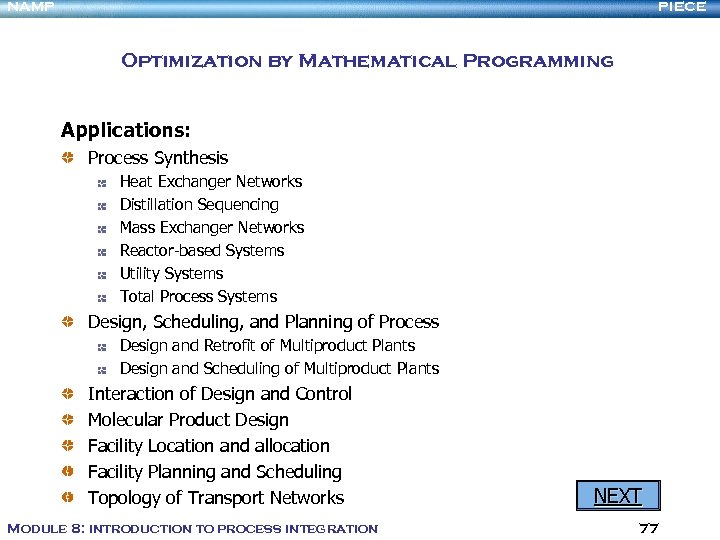
NAMP PIECE Optimization by Mathematical Programming Applications: Process Synthesis Heat Exchanger Networks Distillation Sequencing Mass Exchanger Networks Reactor-based Systems Utility Systems Total Process Systems Design, Scheduling, and Planning of Process Design and Retrofit of Multiproduct Plants Design and Scheduling of Multiproduct Plants Interaction of Design and Control Molecular Product Design Facility Location and allocation Facility Planning and Scheduling Topology of Transport Networks Module 8: introduction to process integration NEXT 77
NAMP PIECE Stochastic Search Methods Module 8: introduction to process integration 78
NAMP PIECE Stochastic Search Methods Why stochastic Search Methods All of the model formulations that you have encountered thus far in the Optimization have assumed that the data for the given problem are known accurately. However, for many actual problems, the problem data cannot be known accurately for a variety of reasons. The first reason is due to simple measurement error. The second and more fundamental reason is that some data represent information about the future (e. g. , product demand or price for a future time period) and simply cannot be known with certainty. Module 8: introduction to process integration 79
NAMP PIECE Stochastic Search Methods There are probabilistic algorithms, such as: Simulated annealing (SA) Genetic Algorithms (GAs) Tabu search These are suitable for problems that deal with uncertainty. These computer algorithms or procedure models do not guarantee global optimally but are successful and widely known to come very close to the global optimal solution (if not to the global optimal). GA has the capability of collectively searching for multiple optimal solutions for the same best cost. Such information could be very useful to a designer, because one configuration could be much easier to build than another. SA takes one solution and efficiently moves it around in the search space, avoiding local optima. Module 8: introduction to process integration 80
NAMP PIECE Stochastic Search Methods What is GAs? GAs simulate the survival of the fittest among individuals over consecutive generation for solving a problem. Each individual represents a point in a search space and a possible solution. The individuals in the population are then made to go through a process of evolution. GAs are based on an analogy with the genetic structure and behaviour of chromosomes within a population of individuals using the following foundations: Individuals in a population compete for resources and mates. Those individuals most successful in each 'competition' will produce more offspring than those individuals that perform poorly. Genes from “good” individuals propagate throughout the population so that two good parents will sometimes produce offspring that are better than either parent. Thus each successive generation will become more suited to their environment. Module 8: introduction to process integration 81
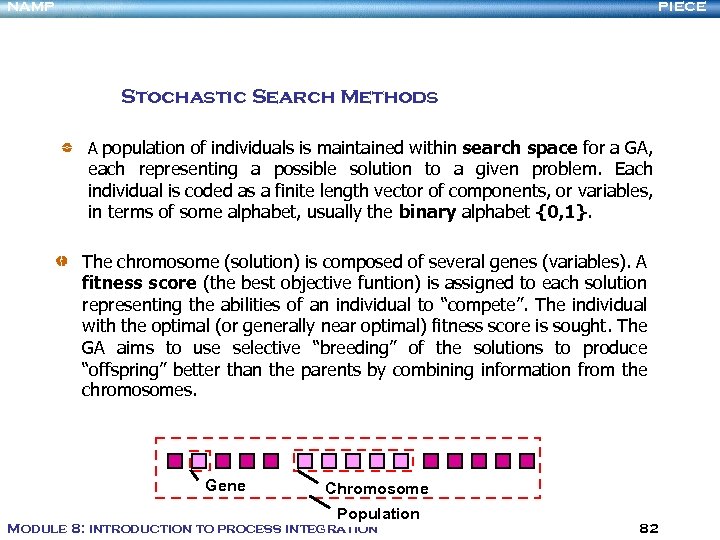
NAMP PIECE Stochastic Search Methods A population of individuals is maintained within search space for a GA, each representing a possible solution to a given problem. Each individual is coded as a finite length vector of components, or variables, in terms of some alphabet, usually the binary alphabet {0, 1}. The chromosome (solution) is composed of several genes (variables). A fitness score (the best objective funtion) is assigned to each solution representing the abilities of an individual to “compete”. The individual with the optimal (or generally near optimal) fitness score is sought. The GA aims to use selective “breeding” of the solutions to produce “offspring” better than the parents by combining information from the chromosomes. Gene Chromosome Population Module 8: introduction to process integration 82
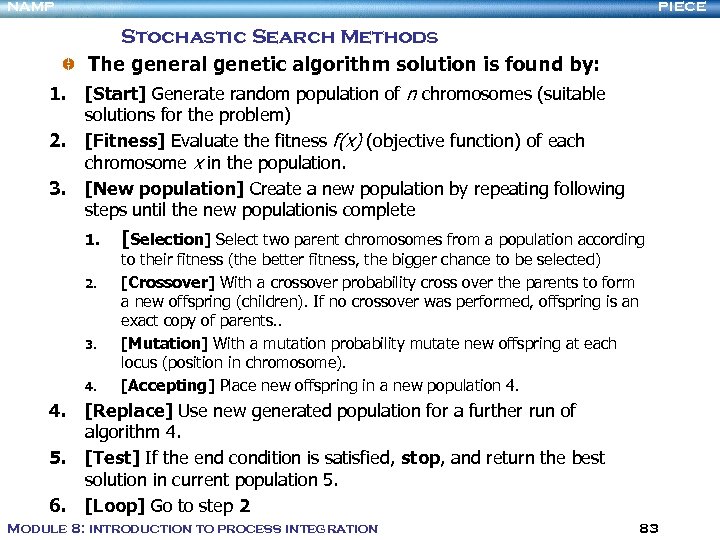
NAMP PIECE Stochastic Search Methods The general genetic algorithm solution is found by: 1. [Start] Generate random population of n chromosomes (suitable solutions for the problem) 2. [Fitness] Evaluate the fitness f(x) (objective function) of each chromosome x in the population. 3. [New population] Create a new population by repeating following steps until the new populationis complete 1. 2. 3. 4. [Selection] Select two parent chromosomes from a population according to their fitness (the better fitness, the bigger chance to be selected) [Crossover] With a crossover probability cross over the parents to form a new offspring (children). If no crossover was performed, offspring is an exact copy of parents. . [Mutation] With a mutation probability mutate new offspring at each locus (position in chromosome). [Accepting] Place new offspring in a new population 4. [Replace] Use new generated population for a further run of algorithm 4. 5. [Test] If the end condition is satisfied, stop, and return the best solution in current population 5. 6. [Loop] Go to step 2 Module 8: introduction to process integration 83
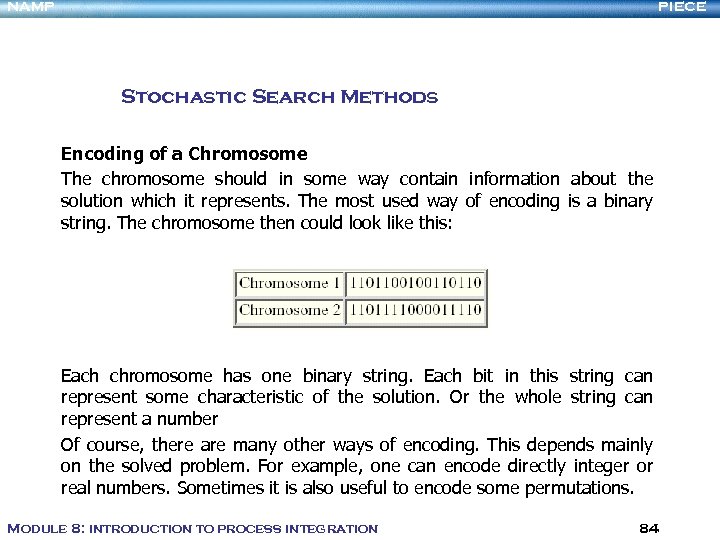
NAMP PIECE Stochastic Search Methods Encoding of a Chromosome The chromosome should in some way contain information about the solution which it represents. The most used way of encoding is a binary string. The chromosome then could look like this: Each chromosome has one binary string. Each bit in this string can represent some characteristic of the solution. Or the whole string can represent a number Of course, there are many other ways of encoding. This depends mainly on the solved problem. For example, one can encode directly integer or real numbers. Sometimes it is also useful to encode some permutations. Module 8: introduction to process integration 84
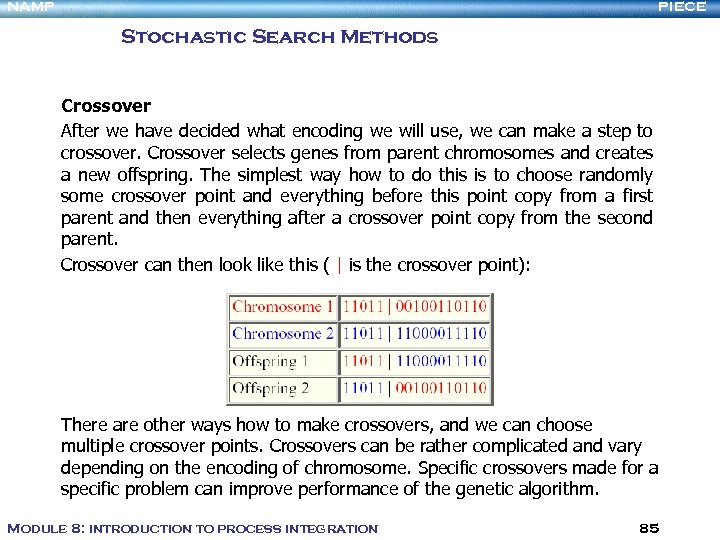
NAMP PIECE Stochastic Search Methods Crossover After we have decided what encoding we will use, we can make a step to crossover. Crossover selects genes from parent chromosomes and creates a new offspring. The simplest way how to do this is to choose randomly some crossover point and everything before this point copy from a first parent and then everything after a crossover point copy from the second parent. Crossover can then look like this ( | is the crossover point): There are other ways how to make crossovers, and we can choose multiple crossover points. Crossovers can be rather complicated and vary depending on the encoding of chromosome. Specific crossovers made for a specific problem can improve performance of the genetic algorithm. Module 8: introduction to process integration 85
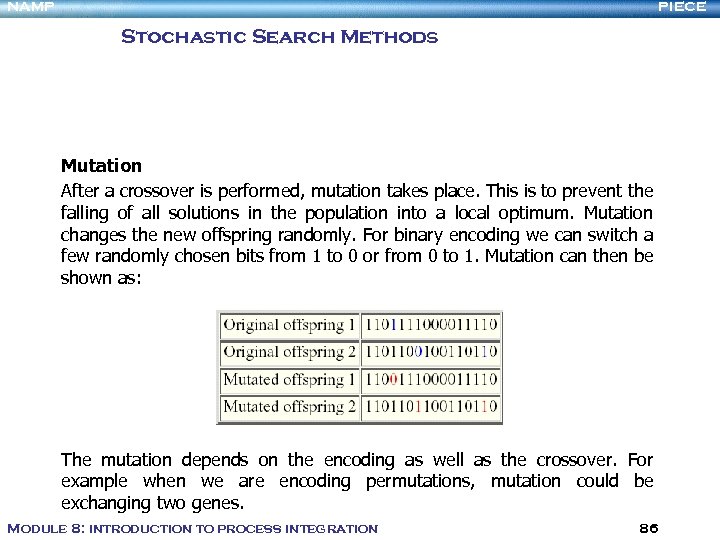
NAMP PIECE Stochastic Search Methods Mutation After a crossover is performed, mutation takes place. This is to prevent the falling of all solutions in the population into a local optimum. Mutation changes the new offspring randomly. For binary encoding we can switch a few randomly chosen bits from 1 to 0 or from 0 to 1. Mutation can then be shown as: The mutation depends on the encoding as well as the crossover. For example when we are encoding permutations, mutation could be exchanging two genes. Module 8: introduction to process integration 86
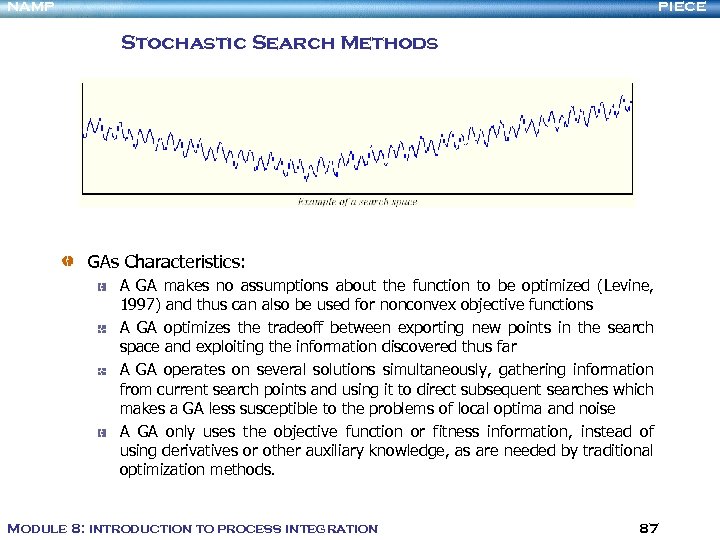
NAMP PIECE Stochastic Search Methods GAs Characteristics: A GA makes no assumptions about the function to be optimized (Levine, 1997) and thus can also be used for nonconvex objective functions A GA optimizes the tradeoff between exporting new points in the search space and exploiting the information discovered thus far A GA operates on several solutions simultaneously, gathering information from current search points and using it to direct subsequent searches which makes a GA less susceptible to the problems of local optima and noise A GA only uses the objective function or fitness information, instead of using derivatives or other auxiliary knowledge, as are needed by traditional optimization methods. Module 8: introduction to process integration 87
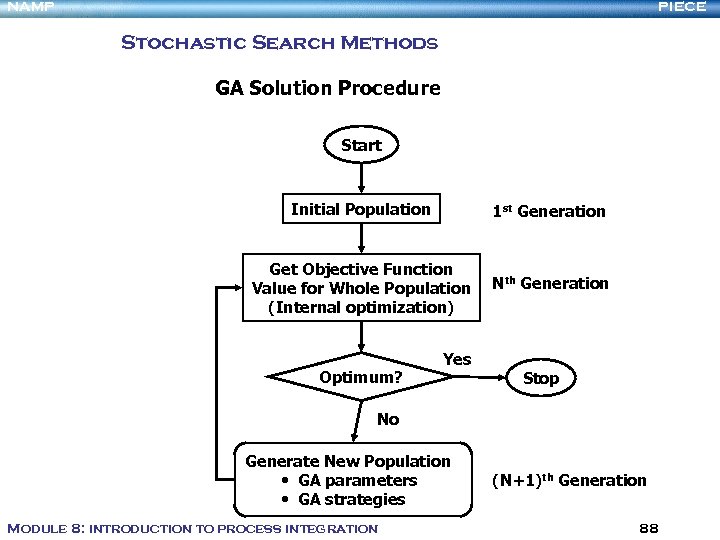
NAMP PIECE Stochastic Search Methods GA Solution Procedure Start Initial Population 1 st Generation Get Objective Function Value for Whole Population (Internal optimization) Nth Generation Optimum? Yes Stop No Generate New Population • GA parameters • GA strategies Module 8: introduction to process integration (N+1)th Generation 88
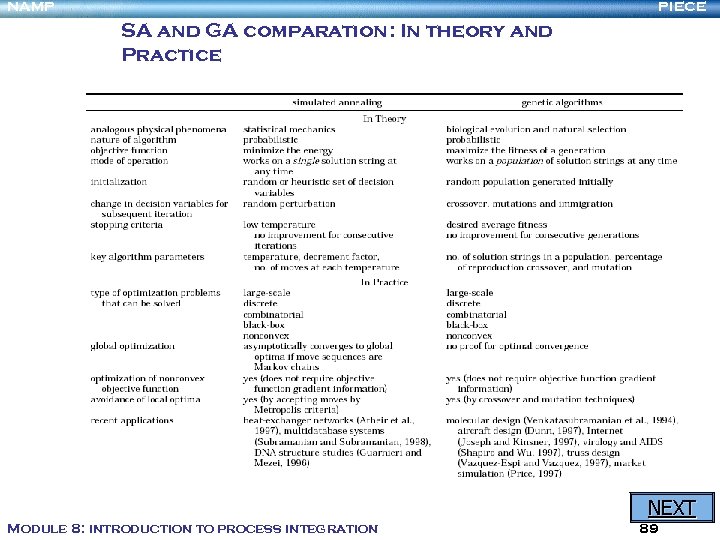
NAMP PIECE SA and GA comparation: In theory and Practice NEXT Module 8: introduction to process integration 89
NAMP PIECE Life Cycle Analysis. Module 8: introduction to process integration 90
NAMP PIECE Life Cycle Analysis What is Life Cycle Analysis? Technique for assessing the environmental aspects and potential impacts associated with a product by: An inventory of relevant inputs and outputs of a system Evaluating the potential environmental impacts associated with those inputs and outputs Interpreting the results of the inventory and impact phases in relation to the objectives of the study heading Evaluation of some aspects of a product system through all stages of its life cycle Module 8: introduction to process integration 91
NAMP PIECE Life Cycle Analysis Why LCA is important: Tool for improvement of environmental performance Systematic way of managing an organization’s environmental affairs Way to address immediate and long-term impacts of products, services and processes on the environment Focus on continual improvement of the system Module 8: introduction to process integration 92
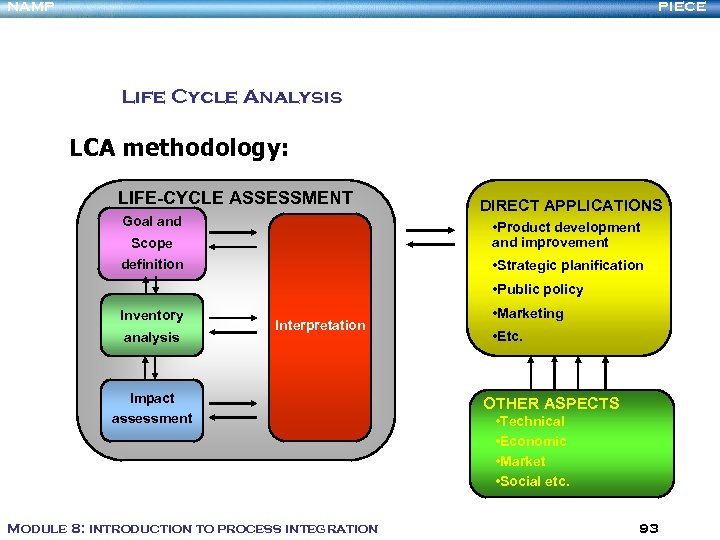
NAMP PIECE Life Cycle Analysis LCA methodology: LIFE-CYCLE ASSESSMENT Goal and DIRECT APPLICATIONS Scope • Product development and improvement definition • Strategic planification • Public policy Inventory analysis Interpretation Impact assessment Module 8: introduction to process integration • Marketing • Etc. OTHER ASPECTS • Technical • Economic • Market • Social etc. 93
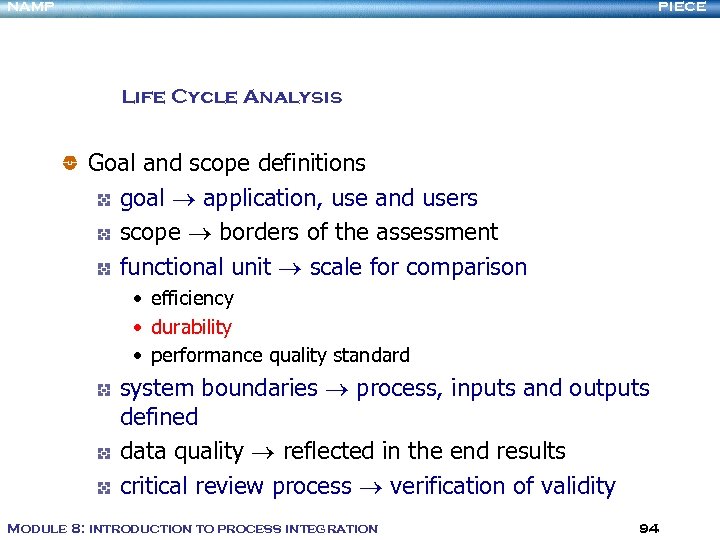
NAMP PIECE Life Cycle Analysis Goal and scope definitions goal application, use and users scope borders of the assessment functional unit scale for comparison • efficiency • durability • performance quality standard system boundaries process, inputs and outputs defined data quality reflected in the end results critical review process verification of validity Module 8: introduction to process integration 94
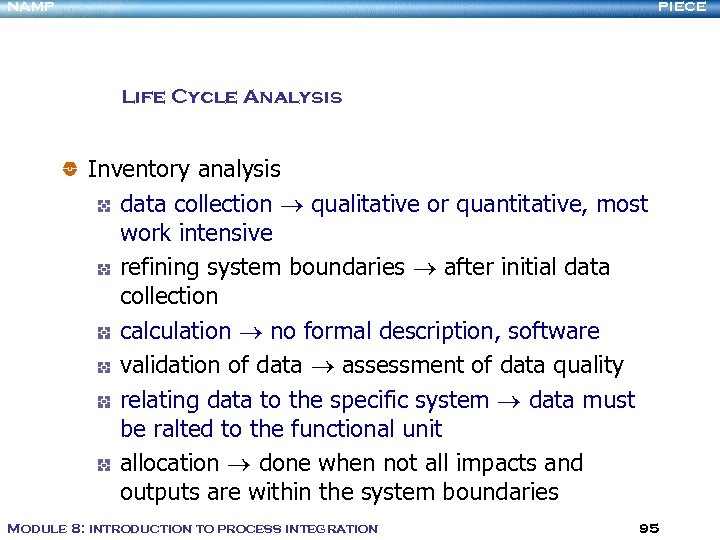
NAMP PIECE Life Cycle Analysis Inventory analysis data collection qualitative or quantitative, most work intensive refining system boundaries after initial data collection calculation no formal description, software validation of data assessment of data quality relating data to the specific system data must be ralted to the functional unit allocation done when not all impacts and outputs are within the system boundaries Module 8: introduction to process integration 95
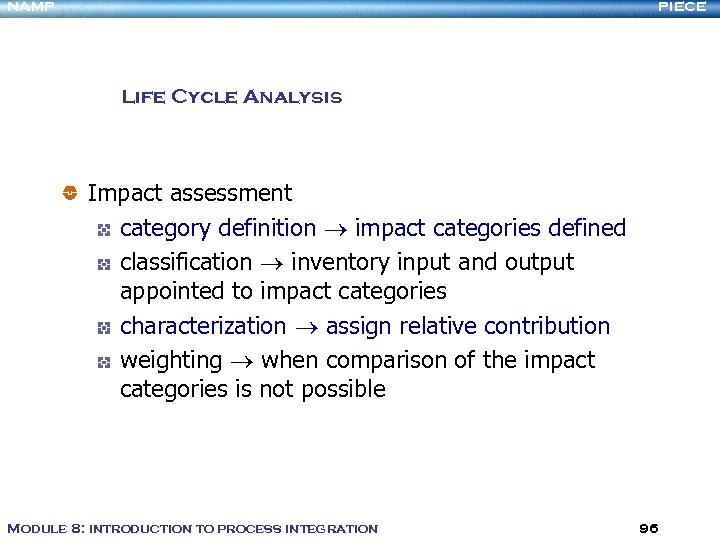
NAMP PIECE Life Cycle Analysis Impact assessment category definition impact categories defined classification inventory input and output appointed to impact categories characterization assign relative contribution weighting when comparison of the impact categories is not possible Module 8: introduction to process integration 96
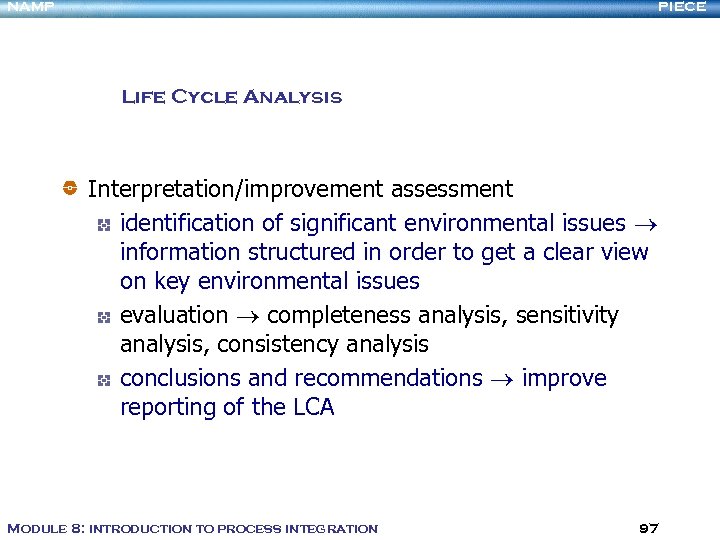
NAMP PIECE Life Cycle Analysis Interpretation/improvement assessment identification of significant environmental issues information structured in order to get a clear view on key environmental issues evaluation completeness analysis, sensitivity analysis, consistency analysis conclusions and recommendations improve reporting of the LCA Module 8: introduction to process integration 97
NAMP PIECE Life Cycle Analysis Possible Benefits: Improvements in overall environmental performance and compliance Provides a framework for using pollution prevention practices to meet LCA objectives Increased efficiency and potential cost savings when managing environmental obligations Promotes predictability and consistency in managing environmental obligations More effective measurement of scarce environmental NEXT Module 8: introduction to process integration 98
NAMP PIECE Data-Driven Process Modeling Module 8: introduction to process integration 99
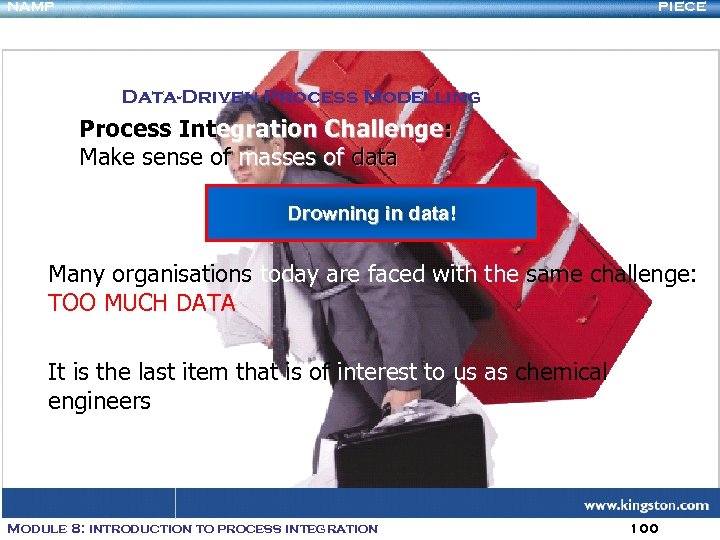
NAMP PIECE Data-Driven Process Modelling Process Integration Challenge: Make sense of masses of data Drowning in data! Many organisations today are faced with the same challenge: TOO MUCH DATA It is the last item that is of interest to us as chemical engineers Module 8: introduction to process integration 100
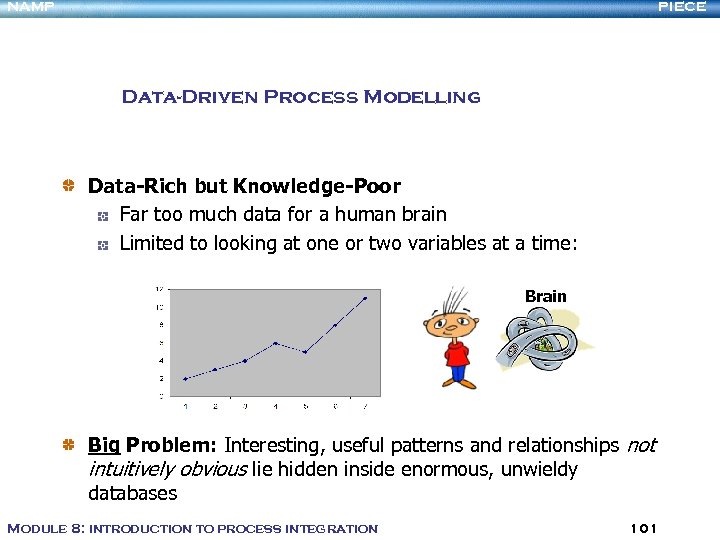
NAMP PIECE Data-Driven Process Modelling Data-Rich but Knowledge-Poor Far too much data for a human brain Limited to looking at one or two variables at a time: Brain Big Problem: Interesting, useful patterns and relationships not intuitively obvious lie hidden inside enormous, unwieldy databases Module 8: introduction to process integration 101
NAMP PIECE Data-Driven Process Modelling OUTSIDE IN Empirical Model This approach uses the plant process data directly, to establish mathematic correlations. Unlike theoretical models, empirical models do NOT take the process fundamentals into account. They only use pure mathematical and statistical techniques. Multi-Variable Analysis (MVA) is one such method, because it reveals patterns and correlations independently of any pre-conceived notions. Obviously this approach is garbage-out” which is why important. very sensitive to “Garbage-in, validation of the model is so Module 8: introduction to process integration 102
NAMP PIECE Data-Driven Process Modelling With MVA you move From Data to Information. From Information to Knowledge. – From Knowledge to Action. Module 8: introduction to process integration 103
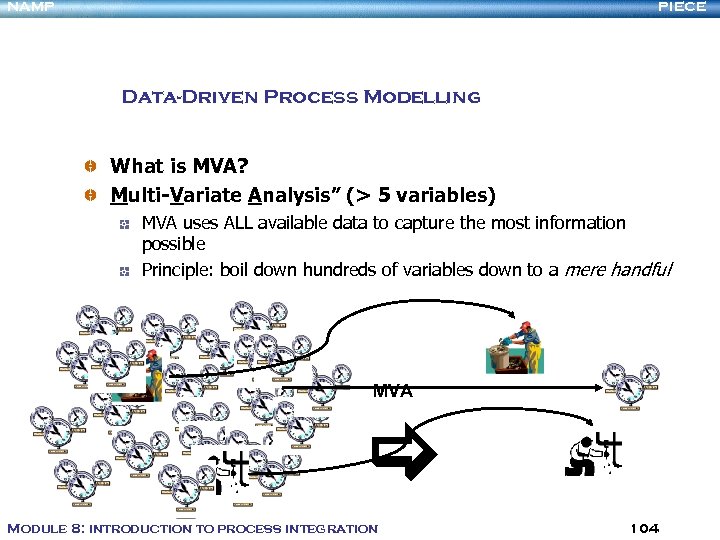
NAMP PIECE Data-Driven Process Modelling What is MVA? Multi-Variate Analysis” (> 5 variables) MVA uses ALL available data to capture the most information possible Principle: boil down hundreds of variables down to a mere handful MVA Module 8: introduction to process integration 104
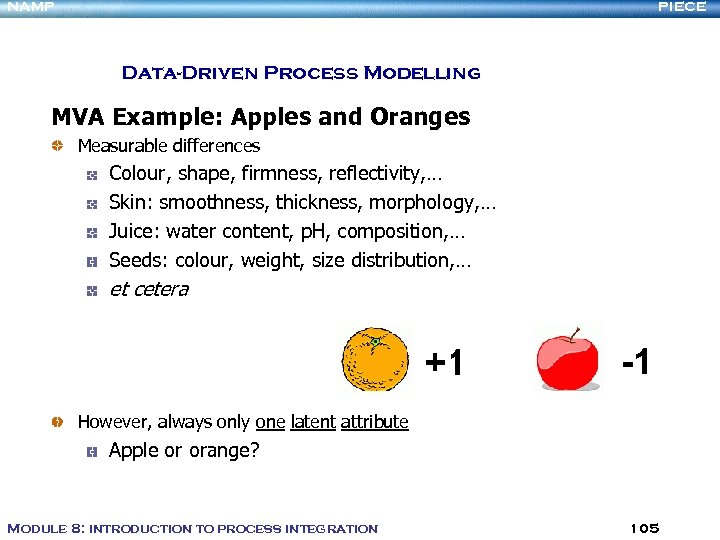
NAMP PIECE Data-Driven Process Modelling MVA Example: Apples and Oranges Measurable differences Colour, shape, firmness, reflectivity, … Skin: smoothness, thickness, morphology, … Juice: water content, p. H, composition, … Seeds: colour, weight, size distribution, … et cetera +1 -1 However, always only one latent attribute Apple or orange? Module 8: introduction to process integration 105
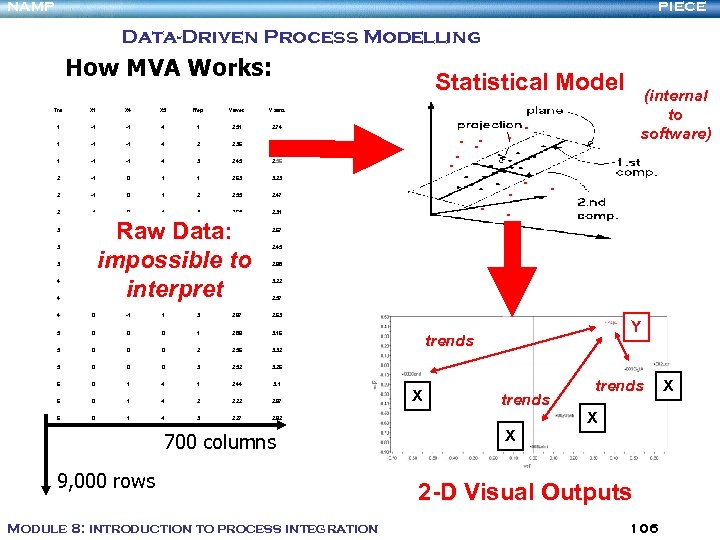
NAMP PIECE Data-Driven Process Modelling How MVA Works: Tmt X 1 X 4 X 5 Rep Y avec -1 -1 -1 1 2. 51 2. 74 1 -1 -1 -1 2 2. 36 3. 22 1 -1 -1 -1 3 2. 45 2. 56 2 -1 0 1 1 2. 63 3. 23 2 -1 0 1 2 2. 55 2. 47 2 -1 0 1 3 2. 65 2. 31 3 -1 4 0 4 (internal to software) Y sans 1 Statistical Model Raw Data: impossible to interpret 1 0 1 2. 45 2. 67 1 0 2 2. 6 2. 45 1 0 3 2. 53 2. 98 -1 1 1 3. 02 3. 22 -1 1 2 2. 7 2. 57 0 -1 1 3 2. 97 2. 63 5 0 0 0 1 2. 89 3. 16 5 0 0 0 2 2. 56 3. 32 5 0 0 0 3 2. 52 3. 26 6 0 1 -1 1 2. 44 3. 1 6 0 1 -1 2 2. 22 2. 97 6 0 1 -1 3 2. 27 . . . 2. 92 700 columns 9, 000 rows Module 8: introduction to process integration Y trends X X 2 -D Visual Outputs 106 X
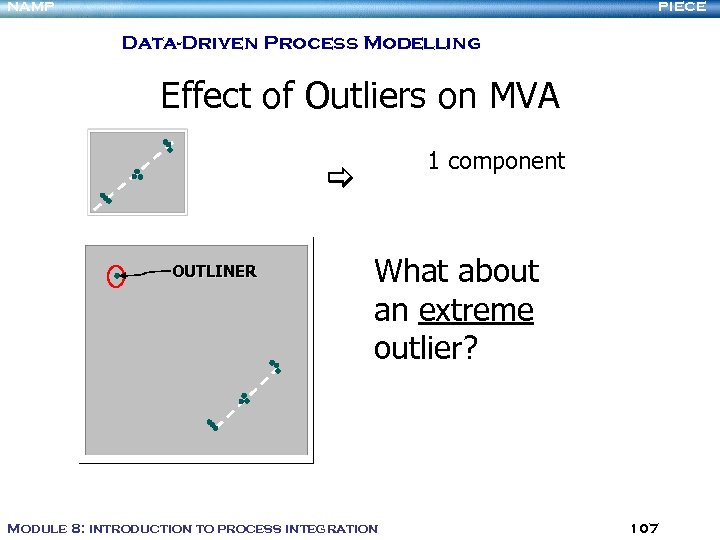
NAMP PIECE Data-Driven Process Modelling Effect of Outliers on MVA 1 component OUTLINER What about an extreme outlier? Module 8: introduction to process integration 107
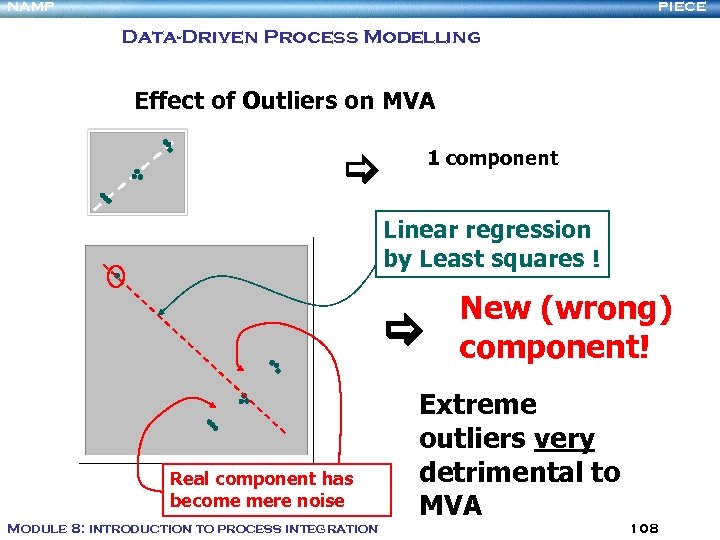
NAMP PIECE Data-Driven Process Modelling Effect of Outliers on MVA 1 component Linear regression by Least squares ! Real component has become mere noise Module 8: introduction to process integration New (wrong) component! Extreme outliers very detrimental to MVA 108
NAMP PIECE Data-Driven Process Modelling Benefits: Explore Inter-Relationships Create and Learn by modelling « What-if » Exercises Low-cost investigation of options Soft Sensor (Inferential Control) for parameters we can’t measure directly Feed-Forward (Model-Based) Control NEXT Module 8: introduction to process integration 109
NAMP PIECE Integrate Process Design and Control Module 8: introduction to process integration 110
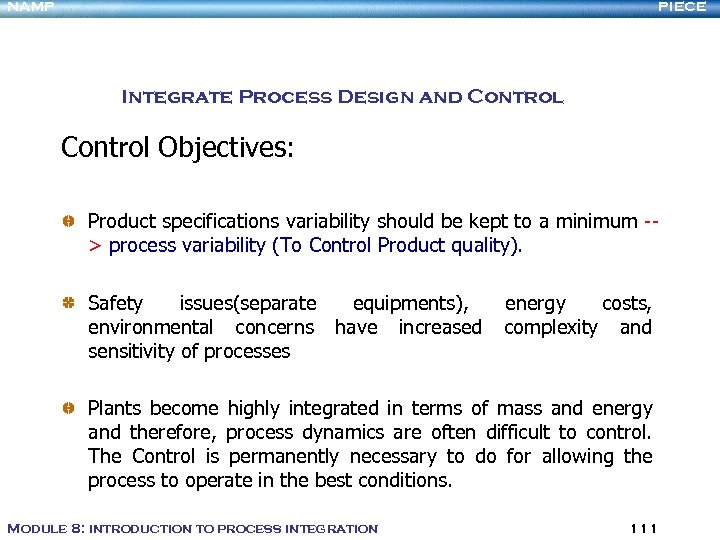
NAMP PIECE Integrate Process Design and Control Objectives: Product specifications variability should be kept to a minimum -> process variability (To Control Product quality). Safety issues(separate equipments), energy costs, environmental concerns have increased complexity and sensitivity of processes Plants become highly integrated in terms of mass and energy and therefore, process dynamics are often difficult to control. The Control is permanently necessary to do for allowing the process to operate in the best conditions. Module 8: introduction to process integration 111
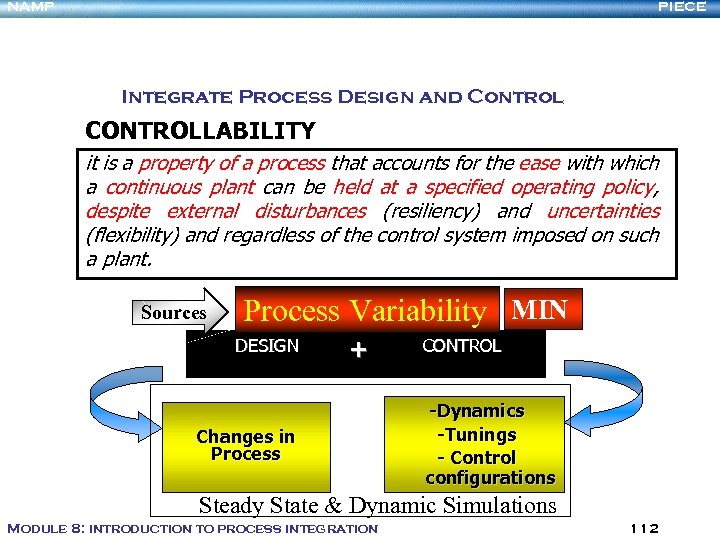
NAMP PIECE Integrate Process Design and Control CONTROLLABILITY it is a property of a process that accounts for the ease with which a continuous plant can be held at a specified operating policy, despite external disturbances (resiliency) and uncertainties (flexibility) and regardless of the control system imposed on such a plant. Sources Process Variability MIN DESIGN + Changes in Process CONTROL -Dynamics -Tunings - Control configurations Steady State & Dynamic Simulations Module 8: introduction to process integration 112
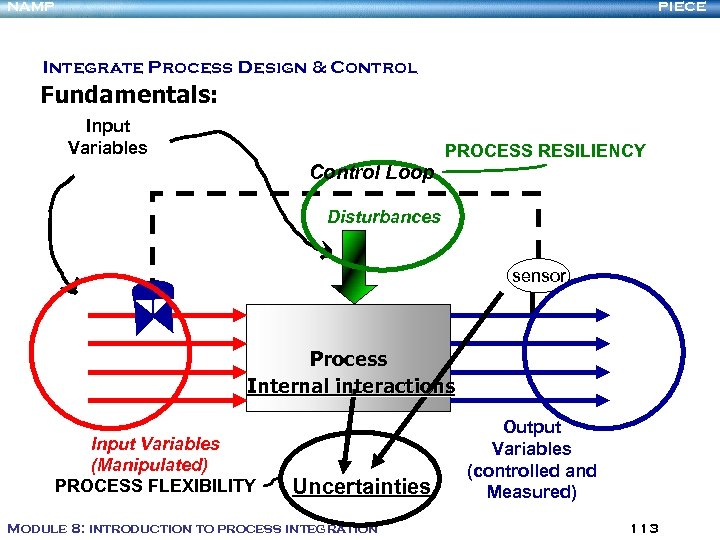
NAMP PIECE Integrate Process Design & Control Fundamentals: Input Variables PROCESS RESILIENCY Control Loop Disturbances sensor Process Internal interactions Input Variables (Manipulated) PROCESS FLEXIBILITY Uncertainties Module 8: introduction to process integration Output Variables (controlled and Measured) 113
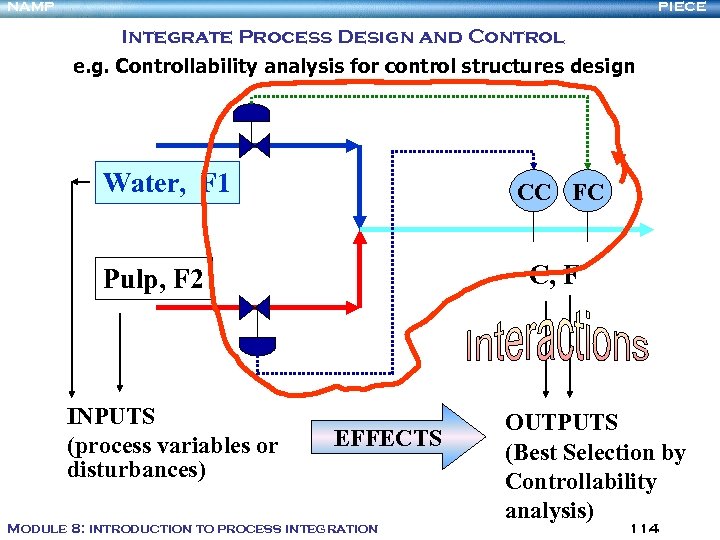
NAMP PIECE Integrate Process Design and Control e. g. Controllability analysis for control structures design Water, F 1 CC FC C, F Pulp, F 2 INPUTS (process variables or disturbances) EFFECTS Module 8: introduction to process integration OUTPUTS (Best Selection by Controllability analysis) 114
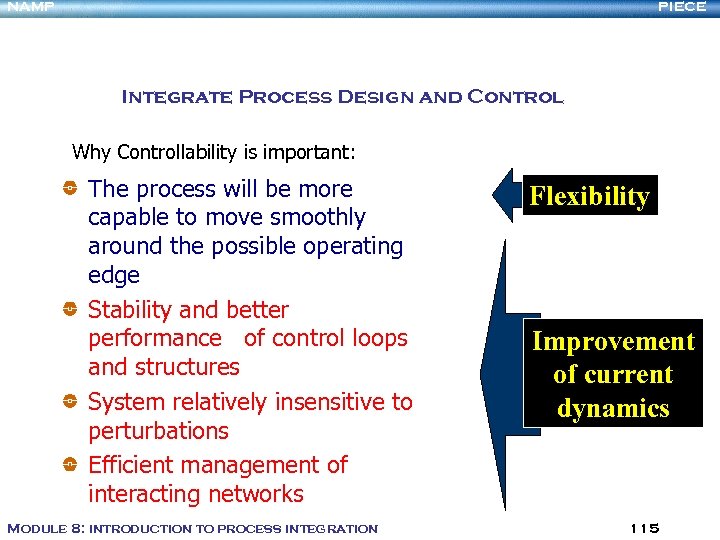
NAMP PIECE Integrate Process Design and Control Why Controllability is important: The process will be more capable to move smoothly around the possible operating edge Stability and better performance of control loops and structures System relatively insensitive to perturbations Efficient management of interacting networks Module 8: introduction to process integration Flexibility Improvement of current dynamics 115
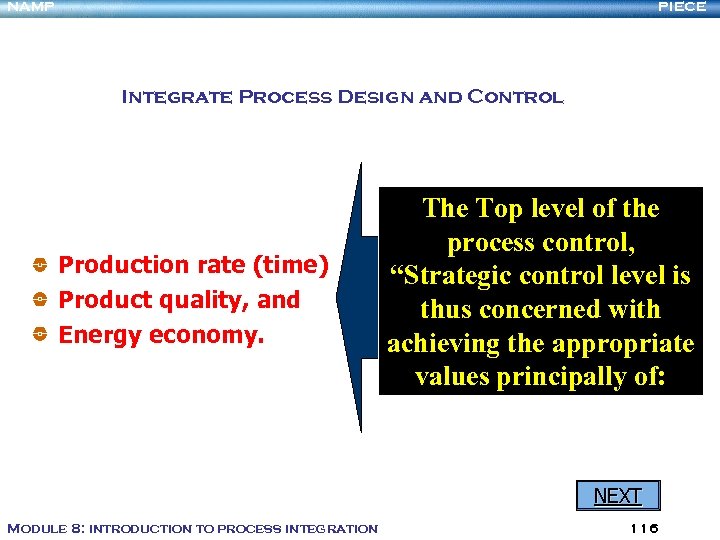
NAMP PIECE Integrate Process Design and Control Production rate (time) Product quality, and Energy economy. The Top level of the process control, “Strategic control level is thus concerned with achieving the appropriate values principally of: NEXT Module 8: introduction to process integration 116
NAMP PIECE Real Time Optimizations (RTO) Module 8: introduction to process integration 117
NAMP PIECE Real Time Optimizations The Process Industries are increasingly compelled to operate profitably in very dynamic and global market. The increasing competition in the international area and stringent product requirements mean decreasing profit margins unless plant operations are optimized dynamically to adopt to the changing market conditions and to reduce the operating cost. Hence, the importance of real-time or on-line optimization of an entire plant is rapidly increasing. Module 8: introduction to process integration 118
NAMP PIECE Real Time Optimizations What is RTO? Real-time Optimization is a model-based steady-state technology that determines the economically optimal operating policy for a process in the near term The system optimizes a process simulation and not the process directly Performance measured in terms of economic benefit Is an active field of research: • Model accuracy, error transmission, performance evaluation Module 8: introduction to process integration 119
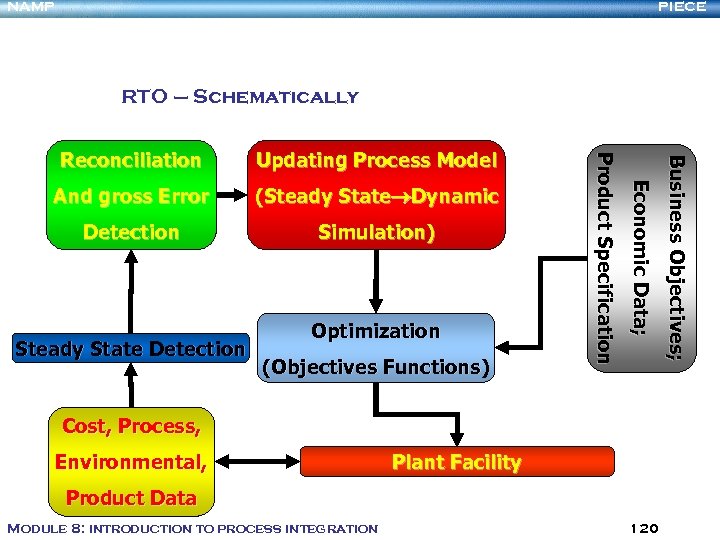
NAMP PIECE RTO – Schematically (Steady State Dynamic Detection Simulation) Steady State Detection Optimization (Objectives Functions) Cost, Process, Environmental, Plant Facility Product Data Module 8: introduction to process integration 120 Business Objectives; And gross Error Economic Data; Updating Process Model Product Specification Reconciliation
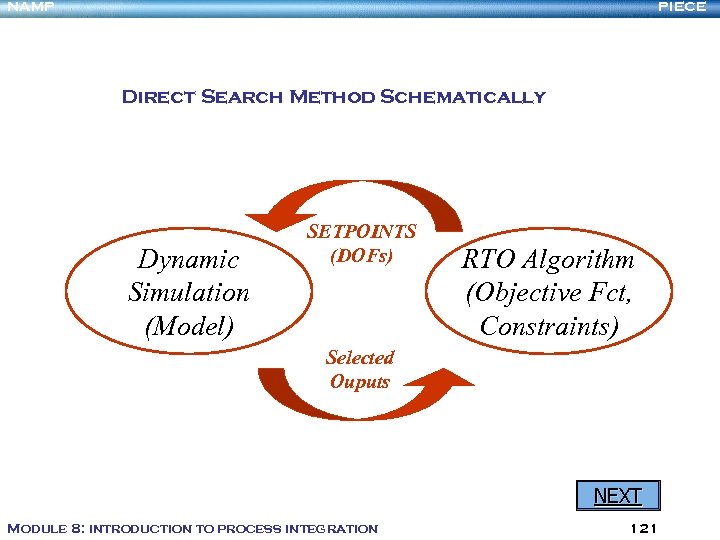
NAMP PIECE Direct Search Method Schematically Dynamic Simulation (Model) SETPOINTS (DOFs) RTO Algorithm (Objective Fct, Constraints) Selected Ouputs NEXT Module 8: introduction to process integration 121
NAMP PIECE Business Model And Supply Chain Modeling Module 8: introduction to process integration 122
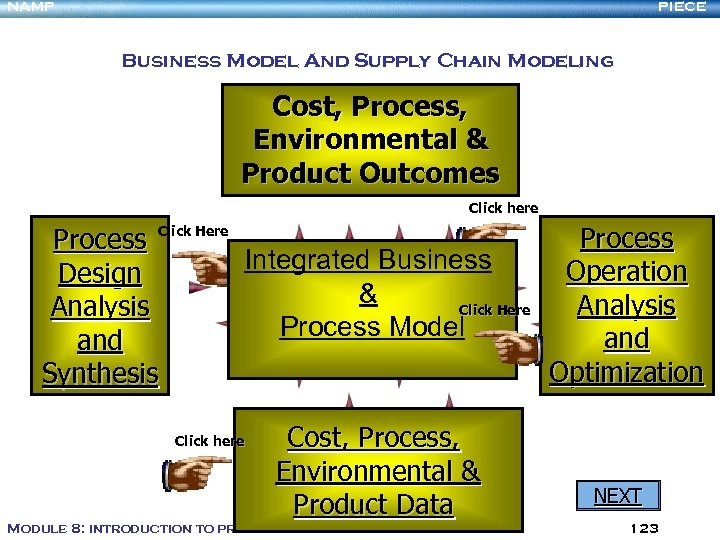
NAMP PIECE Business Model And Supply Chain Modeling Cost, Process, Environmental & Product Outcomes Click here Process Design Analysis And and Synthesis Click Here Integrated Business & & Click Here Process Model Process Click here Cost, Process, Environmental & Product Data Module 8: introduction to process integration Process Operation Analysis and Optimization NEXT 123
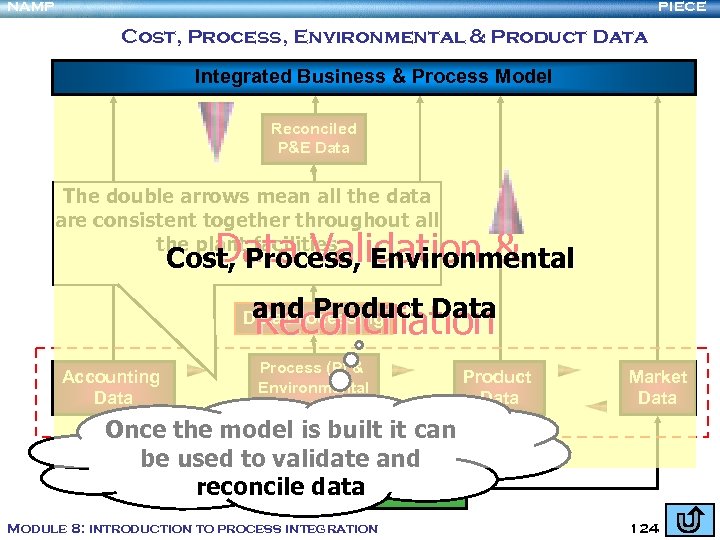
NAMP PIECE Cost, Process, Environmental & Product Data Integrated Business & Process Model Reconciled P&E Data The double arrows mean all the data Data Reconciliation are consistent together throughout all the plant facilities Processed Data Validation & Cost, Process, Environmental P&E Data and Product Data Processing Reconciliation Accounting Data Process (P) & Environmental (E) Data Product Data Market Data Once the model is built it can be used to validate and reconcile data Plant Facilities Module 8: introduction to process integration 124
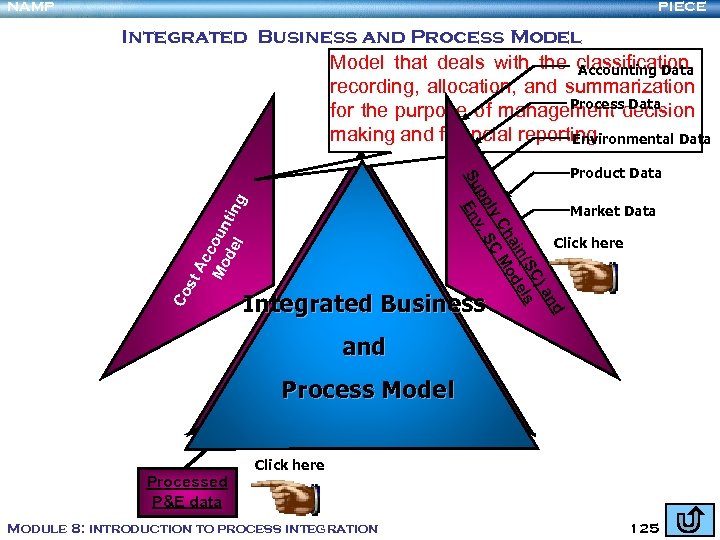
NAMP PIECE Product Data Market Data Click here Ac Mo coun de tin l g st Integrated Business Co st Co d an C) (S ls ain ode Ch C M ly pp v. S d Su En an C) (S ls ain ode Ch C M ly pp v. S Su E n Ac Mo coun de tin l g Integrated Business and Process Model that deals with the classification, Accounting Data recording, allocation, and summarization Process Data for the purpose of management decision making and financial reporting Environmental Data and Process Principles Process Model 1 st Simulation Models Data Driven Models Click here Processed P&E data Module 8: introduction to process integration 125
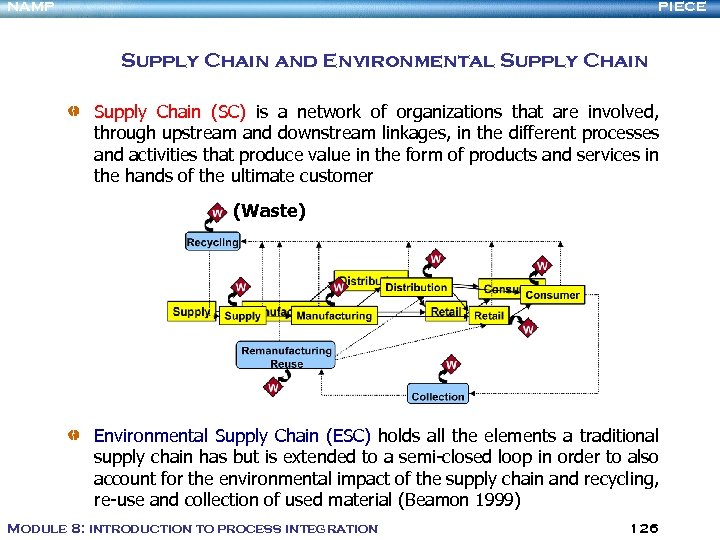
NAMP PIECE Supply Chain and Environmental Supply Chain (SC) is a network of organizations that are involved, through upstream and downstream linkages, in the different processes and activities that produce value in the form of products and services in the hands of the ultimate customer (Waste) Environmental Supply Chain (ESC) holds all the elements a traditional supply chain has but is extended to a semi-closed loop in order to also account for the environmental impact of the supply chain and recycling, re-use and collection of used material (Beamon 1999) Module 8: introduction to process integration 126
NAMP PIECE Supply Chain and Environmental Supply Chain The objective of the SC and ESC models are: To integrate inter-organizational units along a SC and coordinate materials, information and financial flows in order to fulfill customer demands with the aim of improving SC profitability and responsiveness To gain insight in the total environmental impact of the production process (from supplier to customer and back to the facility by recycling) and all the products that are manufactured. (closely linked to LCA) Module 8: introduction to process integration 127
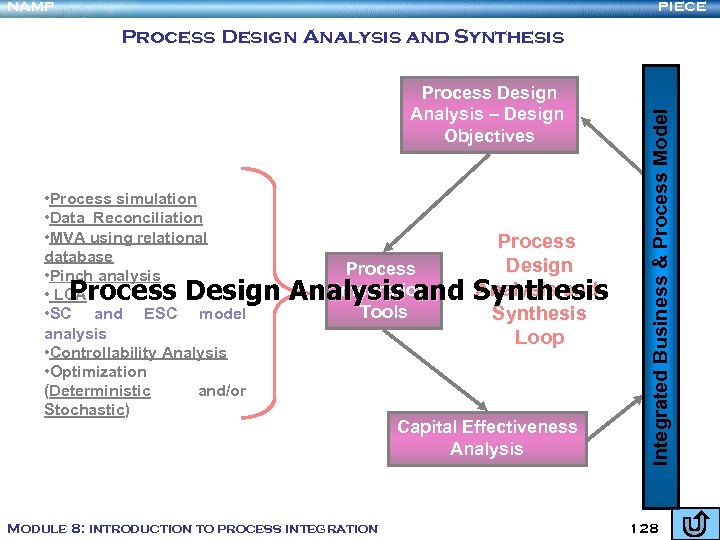
NAMP PIECE Process Design Analysis – Design Objectives • Process simulation • Data Reconciliation • MVA using relational database • Pinch analysis • LCA • SC and ESC model analysis • Controllability Analysis • Optimization (Deterministic and/or Stochastic) Process Design Process Integration Analysis and Process Design Analysis and Synthesis Tools Synthesis Loop Module 8: introduction to process integration Capital Effectiveness Analysis Integrated Business & Process Model Process Design Analysis and Synthesis 128
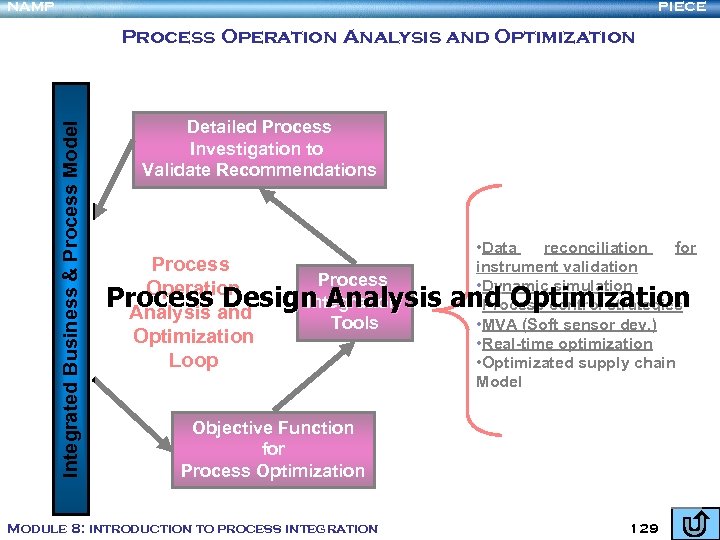
NAMP PIECE Integrated Business & Process Model Process Operation Analysis and Optimization Detailed Process Investigation to Validate Recommendations • Data reconciliation for instrument validation • Dynamic simulation • Process control strategies • MVA (Soft sensor dev. ) • Real-time optimization • Optimizated supply chain Model Process Operation Process Design Analysis and Optimization Integration Analysis and Tools Optimization Loop Objective Function for Process Optimization Module 8: introduction to process integration 129
NAMP PIECE Outline 1. 1 Introduction and definition of Process integration. 1. 2 Overview of Process Integration tools Process Integration 1. 3 An “around-the-world tour” of PI “around-the-world practitioners focuses of expertise Module 8: introduction to process integration 130
NAMP PIECE 1. 3 An “around-the-world tour” of PI practitioners focuses of expertise (May 2003). Module 8: introduction to process integration 131
NAMP PIECE Around the World tour of PI practitioners focuses of experience Courtesy mainly of the www – to capture the flavor of the evolution of Process Integration PI is relatively new: Researchers build on their strengths Many of the ground-breaking techniques are coming from universities When techniques become practical, the private sector generally capitalizes and techniques advance more rapidly Module 8: introduction to process integration 132
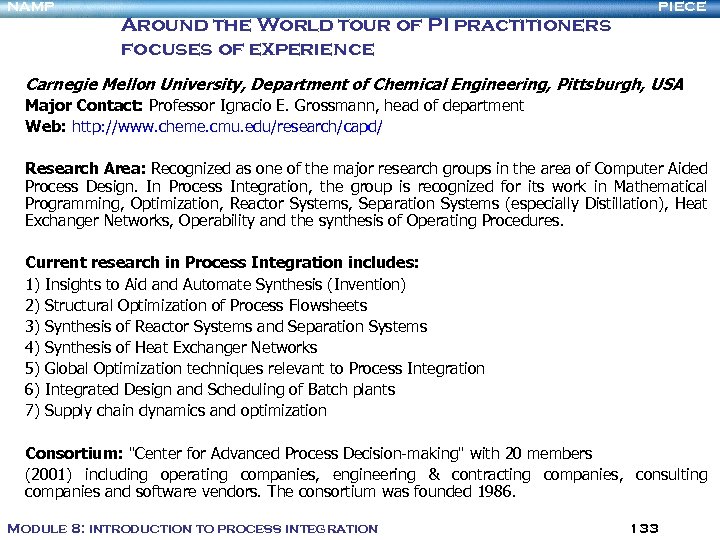
NAMP Around the World tour of PI practitioners focuses of experience PIECE Carnegie Mellon University, Department of Chemical Engineering, Pittsburgh, USA Major Contact: Professor Ignacio E. Grossmann, head of department Web: http: //www. cheme. cmu. edu/research/capd/ Research Area: Recognized as one of the major research groups in the area of Computer Aided Process Design. In Process Integration, the group is recognized for its work in Mathematical Programming, Optimization, Reactor Systems, Separation Systems (especially Distillation), Heat Exchanger Networks, Operability and the synthesis of Operating Procedures. Current research in Process Integration includes: 1) Insights to Aid and Automate Synthesis (Invention) 2) Structural Optimization of Process Flowsheets 3) Synthesis of Reactor Systems and Separation Systems 4) Synthesis of Heat Exchanger Networks 5) Global Optimization techniques relevant to Process Integration 6) Integrated Design and Scheduling of Batch plants 7) Supply chain dynamics and optimization Consortium: "Center for Advanced Process Decision-making" with 20 members (2001) including operating companies, engineering & contracting companies, consulting companies and software vendors. The consortium was founded 1986. Module 8: introduction to process integration 133
NAMP PIECE Around the World tour of PI practitioners focuses of experience Imperial College, Centre for Process Systems Engineering, London, UK Major Contact: Prof. Efstratios N Pistikopoulos Web: http: //www. ps. ic. ac. uk/ and http: //www. psenterprise. com Research Area: Recognized as the largest research group in the area of Process Systems Engineering (PSE), which includes Synthesis/Design, Operations, Control and Modeling. The group is recognized as a world-wide center of excellence in Process Modeling, Numerical Techniques/Optimization and Integrated Process Design (includes simultaneous consideration of Process Integration and Control). The Centre is also an important contributor in the area of Integration and Operation of Batch Processes. Current research in Process Integration includes: 1) Integrated Batch Processing 2) Design and Management of Integrated Supply Chain Processes 3) Uncertainty and Operability in Process Design 4) Formulation of Mathematical Programming Models to address problems in Process Synthesis and Integration Consortium: "Process Systems Engineering" with 17 members (2003) including operating, engineering & contracting companies, software vendors. Module 8: introduction to process integration 134
NAMP Around the World tour of PI practitioners focuses of experience PIECE UMIST, Department of Process Integration, Manchester, UK Major Contact: Professor Robin Smith, head of department Web: http: //www. cpi. umist. ac. uk/ Research Area: Recognized as the pioneering and major research group in the area of Pinch Analysis. Previous research includes targets and design methods for Heat Exchanger Networks (grassroots and retrofits), Heat and Power systems, Heat driven Separation Systems, Flexibility, Total Sites, Pressure Drop considerations, Batch Process Integration, Water and Waste Minimization and Distributed Effluent Treatment. Current research is organized in three major areas: 1) Efficient Use of Raw Materials (including Water) 2) Energy Efficiency 3) Emissions Reduction 4) Eefficient use of capital. Consortium: "Process Integration Research Consortium" with 27 members (2003) including operating companies, engineering & contracting companies, consulting companies and software vendors. The consortium was founded in 1984 by six multinational companies. Module 8: introduction to process integration 135
NAMP Around the World tour of PI practitioners focuses of experience PIECE Chalmers Univ. of Technol. , Department of Heat and Power, Gothenburg, Sweden Major Contact: Professor Thore Berntsson, head of department Web: http: //www. hpt. chalmers. se/ Research Area: Methodology development and applied research based on Pinch Technology. Emphasis on new Retrofit methods including realistic treatment of geographical distances, pressure drops, varying fixed costs, etc. Important new Concepts include the Cost Matrix for Retrofit Screening and new Grand Composite type Thermodynamic Diagrams for Heat and Power applications (including Gas Turbines and Heat Pumps). Research towards pulp and paper with focus on energy and environment. Research areas are: 1) Retrofit Design of Heat Exchanger Networks 2) Process Integration of Heat Pumps in Grassroots and Retrofits 3) Gas Turbine based CHP plants in Retrofit Situations 4) Applied research in Pulp and Paper industry, such as black liquor gasification, closing the bleaching plant, etc. 5) Environmental aspects of Process Integration, especially greenhouse gas emissions) Industry: Close co-operation with some of the major pulp and paper industry groups, including training courses, consulting, etc. Module 8: introduction to process integration 136
NAMP PIECE Around the World tour of PI practitioners focuses of experience École Polytechnique de Montréal, Chemical engineering Department, Quebec, Canada Major Contact: Dr. Paul Stuart, Chair holder Web: http: //www. pulp-paper. ca Research Area: the application of Process Integration in the pulp and paper industry, with emphasis on pollution prevention techniques and profitability analysis, the Efficiency use of energy and Raw Materials (including Water), process control, and plant sustainability. Research areas are: : 1)process simulation, 2)Data reconciliation, 3)Process Control, 4)Networks Analysis HEN and MEN, 5)Environmental technologies (e. g. , LCA), 6)Business Model. 7)Data Driving Modeling. Consortium: "Process Integration Research Consortium" with 13 members (2003) including operating companies, engineering & contracting companies, consulting companies and software vendors in pulp and paper industry. Module 8: introduction to process integration 137
NAMP PIECE Around the World tour of PI practitioners focuses of experience Universitat Politècnica de Catalunya, Chemical Engng. Department, Barcelona, Spain Major Contact: Professor Luis Puigjaner, Director LCMA Web: http: //tqg. upc. es/ Research Area: Pioneering work on Computer Aided Process Operations. Within Process Integration, the group is recognized for its contributions in Time-Dependent Processes, such as Combined Heat and Power, Combined Energy-Waste and Waste Minimization, Integrated Process Monitoring, Diagnosis and Control and finally Process Uncertainty. Current research in the area of Process Integration includes: 1) Evolutionary Modeling and Optimization 2) Multi-objective Optimization in time-dependent systems 3) Combined Energy and Water Use Minimization 4) Integration of Thermally Coupled Distillation Columns 5) Hot-gas Recovery and Cleaning Systems Consortium: "Manufacturing Reference Centre" with 12 members (1966) including Conselleria d'Indústria and associated operating companies, engineering and contracting companies, consultants and software vendors. Module 8: introduction to process integration 138
NAMP PIECE Around the World tour of PI practitioners focuses of experience Texas A&M University, Chemical Engineering Department, Texas, USA Major Contact: Professor Mahmoud M. El-Halwagi Web: http: //process-integration. tamu. edu/ and http: //www-che. tamu. edu/cpipe/ Research Area: Recognized as a leading research group in the areas of Mass Integration and Pollution Prevention through Process Integration. Research areas are: 1) Global allocation of Mass and Energy 2) Synthesis of Waste Allocation and Species Interception Networks 3) Physical and Reactive Mass Pinch Analysis 4) Synthesis of Heat-Induced Networks 5) Design of Membrane-Hybrid Systems 6) Design of Environmentally acceptable Reactions 7) Integration of Reaction and Separation Systems 8) Flexibility and Scheduling Systems 9) Simultaneous Design and Control 10) Global Optimization via Interval Analysis Module 8: introduction to process integration 139
NAMP PIECE Around the World tour of PI practitioners focuses of experience University of Guanajuato, Faculty of Chemistry, Guanajuato, México Major contact: Dr. Martin-Picon-Nunez, Director Web: http: //www. ugto. mx Web: Research Area: Hosts the only course Masters Program in process integration in North America, they are developing in the next areas Analysis of Processes, Power Systems, and to develop of technology benign Environmental. Research areas are: 1) Synthesis of Processes; Modeling, Simulation, Control and Optimization of Processes; New Processes and Materials. 2) Recovery systems of Heat; Renewable sources of Energy; Thermodynamic Optimization. 3) Contaminated Atmosphere rehabilitation; Treatment of Effluents; Environmental Processes. Module 8: introduction to process integration 140
NAMP PIECE Around the World tour of PI practitioners focuses of experience University of the Witwatersrand, Process & Materials Eng. , Johannesburg, South Africa Major Contact: Professor David Glasser, AECI Professor Web: http: //www. wits. ac. za/fac/engineering/procmat/homepage. html Research Area: Recognized as the major research group in the development of the Attainable Region (AR) method for Reactor and Process Synthesis. The Attainable Region concept has been expanded to systems where mass transfer, heat transfer and separation take place. In its generalized form (reaction, mixing, separation, heat transfer and mass transfer), the Attainable Region concept provides a Synthesis tool that will provide targets for "optimal" designs against which more practical solutions can be judged. Research areas are: 1) Systems involving Reaction, Mixing and Separation (e. g. Reactive Distillation) 2) Non-isothermal Chemical Reactor Systems 3) Optimization of Dynamic Systems Clients: they have founded your own consultancy enterprise the name “Wits Enterprise”. Module 8: introduction to process integration 141
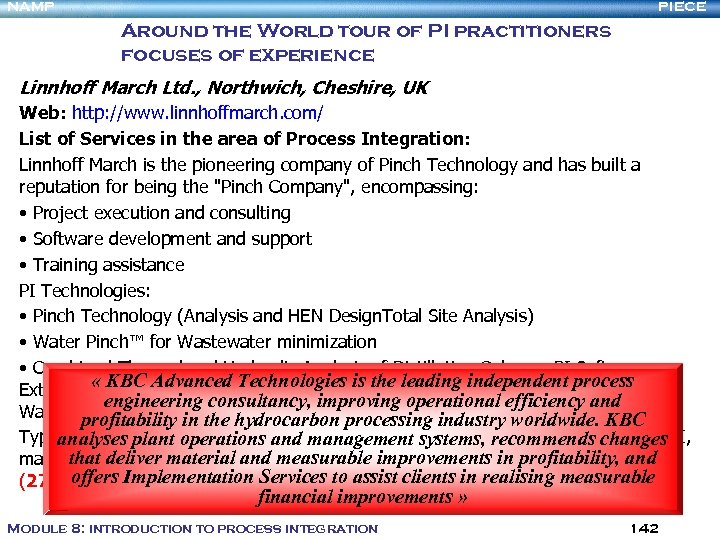
NAMP PIECE Around the World tour of PI practitioners focuses of experience Linnhoff March Ltd. , Northwich, Cheshire, UK Web: http: //www. linnhoffmarch. com/ List of Services in the area of Process Integration: Linnhoff March is the pioneering company of Pinch Technology and has built a reputation for being the "Pinch Company", encompassing: • Project execution and consulting • Software development and support • Training assistance PI Technologies: • Pinch Technology (Analysis and HEN Design. Total Site Analysis) • Water Pinch™ for Wastewater minimization • Combined Thermal and Hydraulic Analysis of Distillation Columns PI Software: « KBC Advanced Technologies is the leading independent process Extensively proven state-of-the-art software including Super. Target, Pinch. Express, engineering consultancy, improving operational efficiency and Water. Target and Steam 97. profitability in the hydrocarbon processing industry worldwide. KBC Typical Projects: 1200 assignments over 18 years - or over 50 studies per year in PI, analyses plant operations and management systems, recommends changes that deliver material and measurable improvements in profitability, and making them the unquestionable world leader offers Implementation Services to assist clients in realising measurable (27 th February 2002)Was acquired last year by KBC process technology… financial improvements » Module 8: introduction to process integration 142
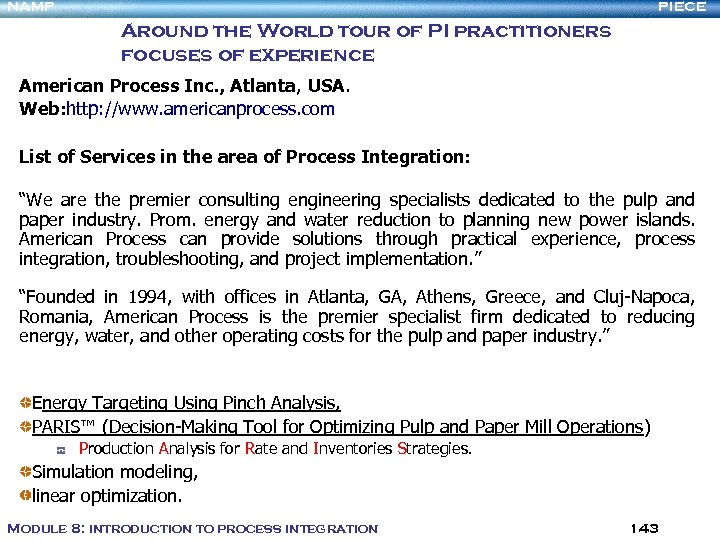
NAMP PIECE Around the World tour of PI practitioners focuses of experience American Process Inc. , Atlanta, USA. Web: http: //www. americanprocess. com List of Services in the area of Process Integration: “We are the premier consulting engineering specialists dedicated to the pulp and paper industry. Prom. energy and water reduction to planning new power islands. American Process can provide solutions through practical experience, process integration, troubleshooting, and project implementation. ” “Founded in 1994, with offices in Atlanta, GA, Athens, Greece, and Cluj-Napoca, Romania, American Process is the premier specialist firm dedicated to reducing energy, water, and other operating costs for the pulp and paper industry. ” Energy Targeting Using Pinch Analysis, PARIS™ (Decision-Making Tool for Optimizing Pulp and Paper Mill Operations ) Production Analysis for Rate and Inventories Strategies. Simulation modeling, linear optimization. Module 8: introduction to process integration 143
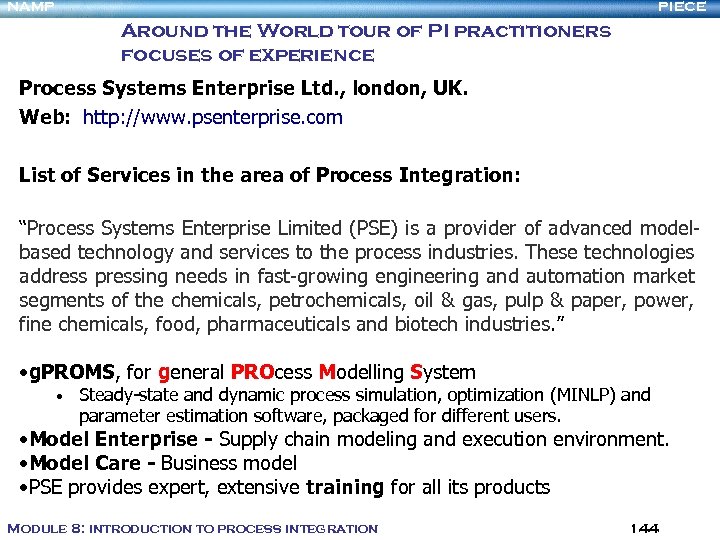
NAMP PIECE Around the World tour of PI practitioners focuses of experience Process Systems Enterprise Ltd. , london, UK. Web: http: //www. psenterprise. com List of Services in the area of Process Integration: “Process Systems Enterprise Limited (PSE) is a provider of advanced modelbased technology and services to the process industries. These technologies address pressing needs in fast-growing engineering and automation market segments of the chemicals, petrochemicals, oil & gas, pulp & paper, power, fine chemicals, food, pharmaceuticals and biotech industries. ” • g. PROMS, for general PROcess Modelling System • Steady-state and dynamic process simulation, optimization ( MINLP) and parameter estimation software, packaged for different users. • Model Enterprise - Supply chain modeling and execution environment. • Model Care - Business model • PSE provides expert, extensive training for all its products Module 8: introduction to process integration 144
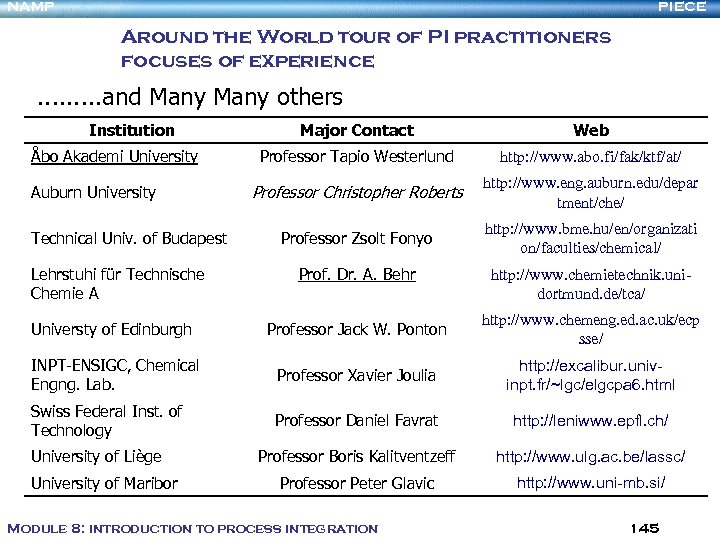
NAMP PIECE Around the World tour of PI practitioners focuses of experience . . and Many others Institution Åbo Akademi University Auburn University Technical Univ. of Budapest Lehrstuhi für Technische Chemie A Major Contact Web Professor Tapio Westerlund http: //www. abo. fi/fak/ktf/at/ Professor Christopher Roberts http: //www. eng. auburn. edu/depar tment/che/ Professor Zsolt Fonyo http: //www. bme. hu/en/organizati on/faculties/chemical/ Prof. Dr. A. Behr http: //www. chemietechnik. unidortmund. de/tca/ Professor Jack W. Ponton http: //www. chemeng. ed. ac. uk/ecp sse/ INPT-ENSIGC, Chemical Engng. Lab. Professor Xavier Joulia http: //excalibur. univinpt. fr/~lgc/elgcpa 6. html Swiss Federal Inst. of Technology Professor Daniel Favrat http: //leniwww. epfl. ch/ Professor Boris Kalitventzeff http: //www. ulg. ac. be/lassc/ Professor Peter Glavic http: //www. uni-mb. si/ Universty of Edinburgh University of Liège University of Maribor Module 8: introduction to process integration 145
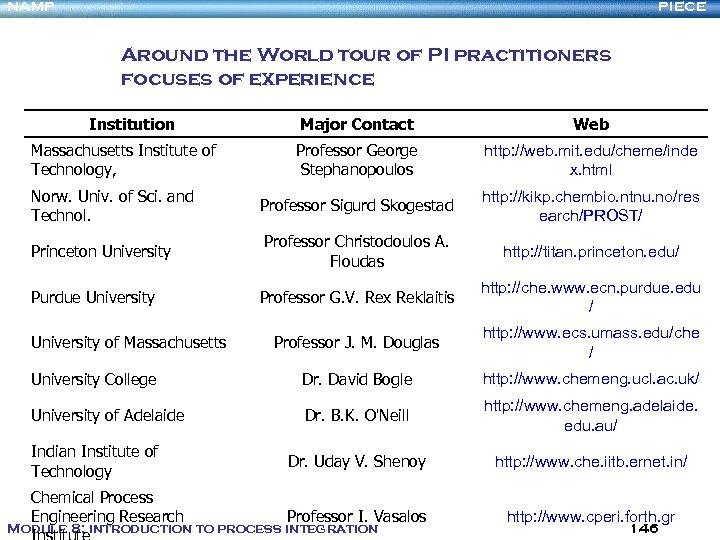
NAMP PIECE Around the World tour of PI practitioners focuses of experience Institution Major Contact Web Professor George Stephanopoulos http: //web. mit. edu/cheme/inde x. html Norw. Univ. of Sci. and Technol. Professor Sigurd Skogestad http: //kikp. chembio. ntnu. no/res earch/PROST/ Princeton University Professor Christodoulos A. Floudas http: //titan. princeton. edu/ Professor G. V. Rex Reklaitis http: //che. www. ecn. purdue. edu / Professor J. M. Douglas http: //www. ecs. umass. edu/che / University College Dr. David Bogle http: //www. chemeng. ucl. ac. uk/ University of Adelaide Dr. B. K. O'Neill http: //www. chemeng. adelaide. edu. au/ Dr. Uday V. Shenoy http: //www. che. iitb. ernet. in/ Professor I. Vasalos http: //www. cperi. forth. gr Massachusetts Institute of Technology, Purdue University of Massachusetts Indian Institute of Technology Chemical Process Engineering Research Module 8: introduction to process integration 146
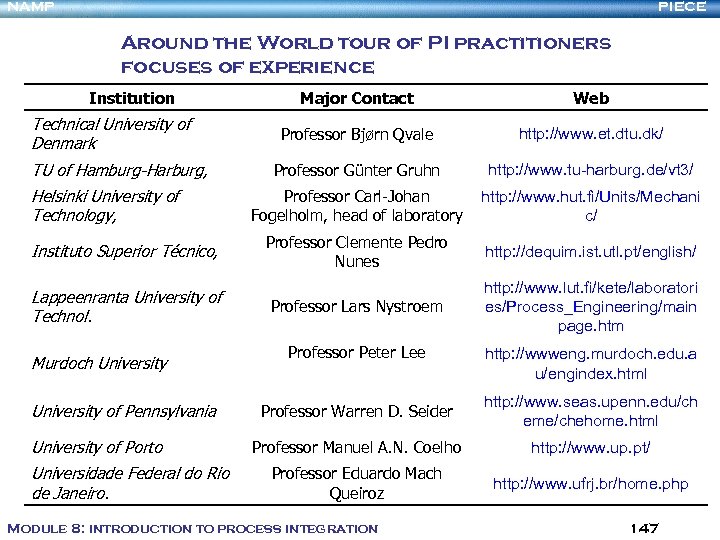
NAMP PIECE Around the World tour of PI practitioners focuses of experience Institution Technical University of Denmark TU of Hamburg-Harburg, Helsinki University of Technology, Instituto Superior Técnico, Lappeenranta University of Technol. Murdoch University of Pennsylvania University of Porto Universidade Federal do Rio de Janeiro. Major Contact Web Professor Bjørn Qvale http: //www. et. dtu. dk/ Professor Günter Gruhn http: //www. tu-harburg. de/vt 3/ Professor Carl-Johan Fogelholm, head of laboratory http: //www. hut. fi/Units/Mechani c/ Professor Clemente Pedro Nunes http: //dequim. ist. utl. pt/english/ Professor Lars Nystroem http: //www. lut. fi/kete/laboratori es/Process_Engineering/main page. htm Professor Peter Lee http: //wwweng. murdoch. edu. a u/engindex. html Professor Warren D. Seider http: //www. seas. upenn. edu/ch eme/chehome. html Professor Manuel A. N. Coelho http: //www. up. pt/ Professor Eduardo Mach Queiroz http: //www. ufrj. br/home. php Module 8: introduction to process integration 147
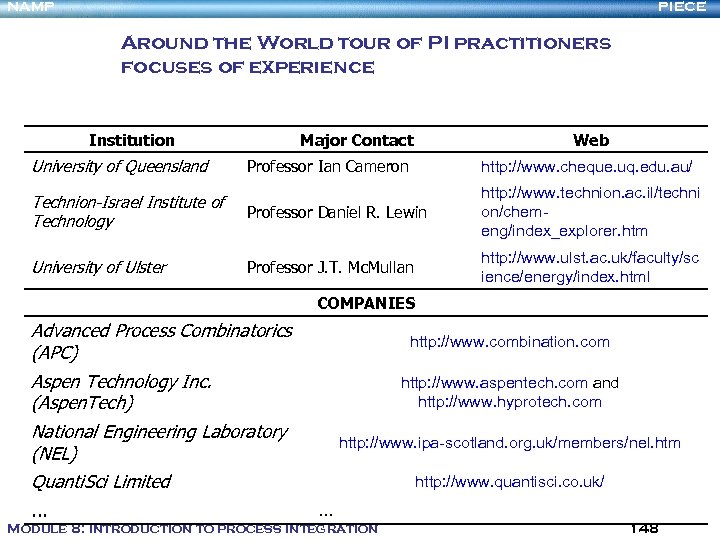
NAMP PIECE Around the World tour of PI practitioners focuses of experience Institution University of Queensland Major Contact Web Professor Ian Cameron http: //www. cheque. uq. edu. au/ Technion-Israel Institute of Technology Professor Daniel R. Lewin http: //www. technion. ac. il/techni on/chemeng/index_explorer. htm University of Ulster Professor J. T. Mc. Mullan http: //www. ulst. ac. uk/faculty/sc ience/energy/index. html COMPANIES Advanced Process Combinatorics (APC) Aspen Technology Inc. (Aspen. Tech) National Engineering Laboratory (NEL) Quanti. Sci Limited. . . http: //www. combination. com http: //www. aspentech. com and http: //www. hyprotech. com http: //www. ipa-scotland. org. uk/members/nel. htm http: //www. quantisci. co. uk/. . . Module 8: introduction to process integration 148
NAMP PIECE End of Tier 1 At the moment we are assuming that you have done all the reading, this is the end of Tier 1. We do not have doubt that much of this information seems fuzzy, but we are only trying to set all the pieces in the Process Integration scope. Before to pass to tier 2 lefts to answer a short Quiz Module 8: introduction to process integration 149

NAMP PIECE QUIZ Module 8: introduction to process integration 150
Скачать презентацию Program for North American Mobility In Higher Education
5c24a2aa16a43574f506c84d33c01bc0.ppt