


 Скачать презентацию Profit Planning Through Volume Cost Analysis The questions are
9d7f65c8f461370e3e2e9fb031f287e0.ppt
- Количество слайдов: 43
 Profit Planning Through Volume/Cost Analysis The questions are the same … only the answers change…
 Definition of Success? • My Definition: – Meeting or exceeding business goals. • Staying in business • expansion – Meeting or exceeding personal goals. • If you want to put 8 kids thru Yale your price structure will be different. • Goals matter! Do you have them and are you meeting them?
 Keys to Success! • A business assessment--what am I doing right and what am I doing wrong? – Business Summary Tools • What are my personal and business goals? – Questionnaire (hand out) • What is it going to take to achieve them? – Setting goals (involve whole family/employees) • Just do it. Develop your life philosophy • Then ask the questions again, the answers do change!
 Do Your Business Goals Match Your Philosophy? Your goals vs. the customer’s goals • What are you in business for? • Who is your customer? What do they want? – Absolute Lowest price, 1 whole unit – Absolute Highest quality, 1 whole unit – Absolute Best service, 1 whole unit
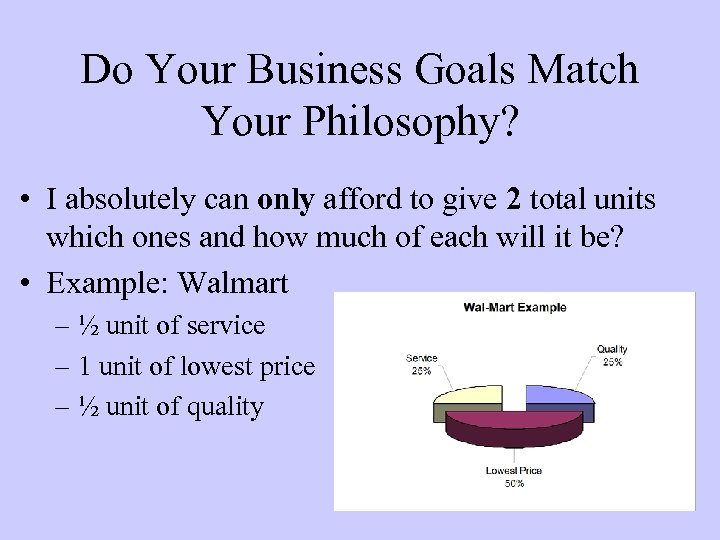 Do Your Business Goals Match Your Philosophy? • I absolutely can only afford to give 2 total units which ones and how much of each will it be? • Example: Walmart – ½ unit of service – 1 unit of lowest price – ½ unit of quality
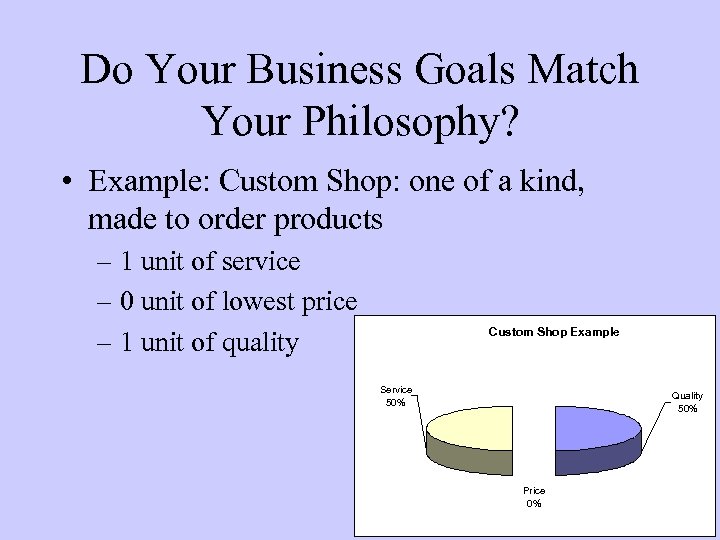 Do Your Business Goals Match Your Philosophy? • Example: Custom Shop: one of a kind, made to order products – 1 unit of service – 0 unit of lowest price – 1 unit of quality Custom Shop Example Service 50% Quality 50% Price 0%
 So do your business goals match your philosophy? • Who is your competition, how do they mix their 2 units? • If your pricing mirrors THEIR pricing, you are pricing to THEIR goals!
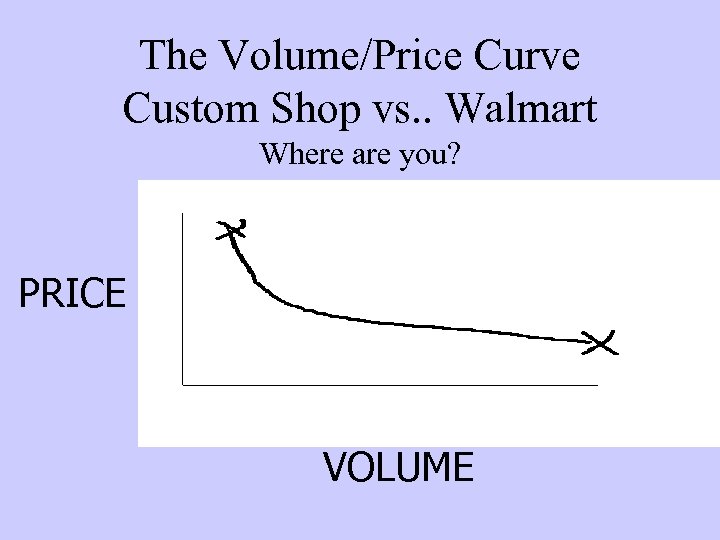 The Volume/Price Curve Custom Shop vs. . Walmart Where are you? PRICE VOLUME
 ? • Questions on – Who are you – What is your life philosophy – What the customer wants – What you can afford to give
 Profit Planning through Volume/Cost Analysis Do You Price for Success? • Do you price for profit, or does it just happen? • What are your goals for profit? • Cost analysis is the “nuts and bolts” of your pricing strategy DO THE MATH
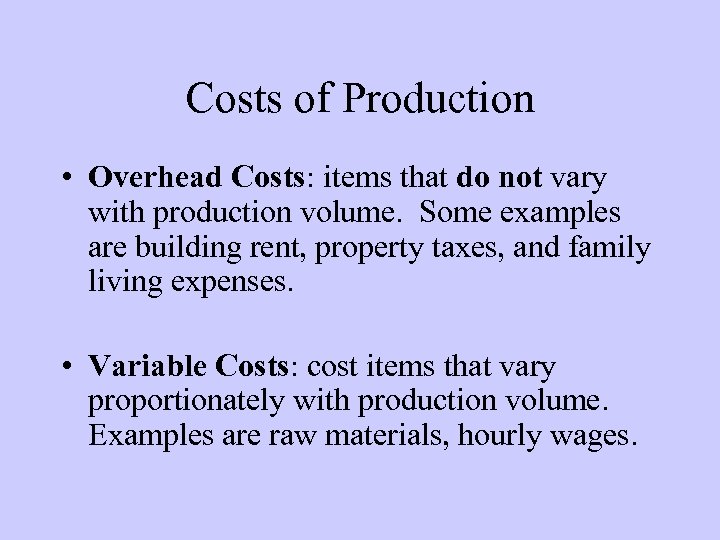 Costs of Production • Overhead Costs: items that do not vary with production volume. Some examples are building rent, property taxes, and family living expenses. • Variable Costs: cost items that vary proportionately with production volume. Examples are raw materials, hourly wages.
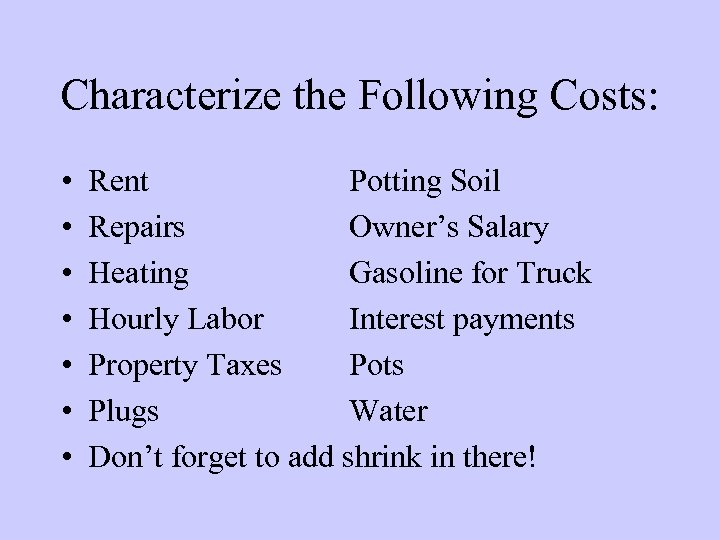 Characterize the Following Costs: • • Rent Potting Soil Repairs Owner’s Salary Heating Gasoline for Truck Hourly Labor Interest payments Property Taxes Pots Plugs Water Don’t forget to add shrink in there!
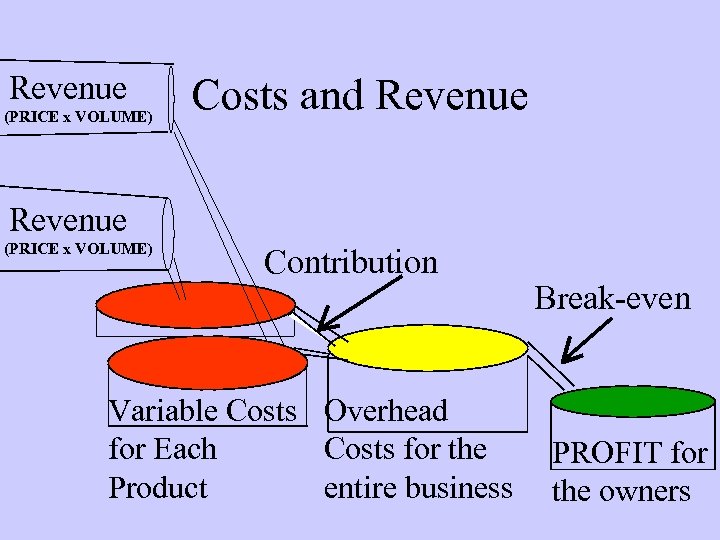 Revenue (PRICE x VOLUME) Costs and Revenue (PRICE x VOLUME) Contribution Variable Costs Overhead for Each Costs for the Product entire business Break-even PROFIT for the owners
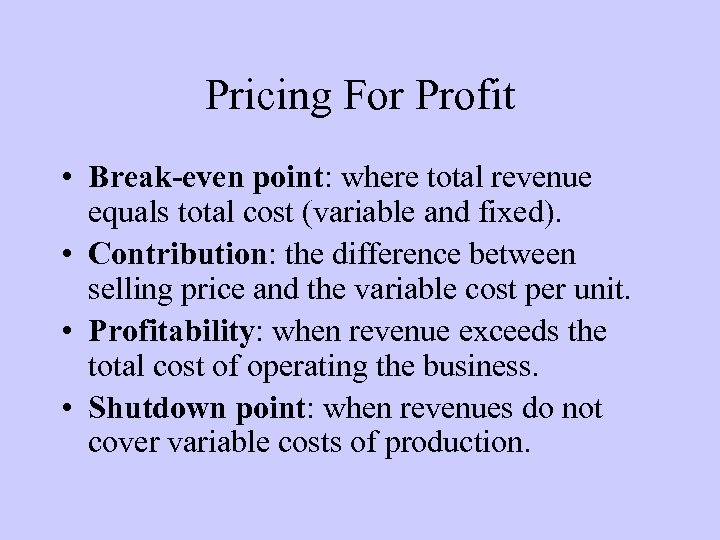 Pricing For Profit • Break-even point: where total revenue equals total cost (variable and fixed). • Contribution: the difference between selling price and the variable cost per unit. • Profitability: when revenue exceeds the total cost of operating the business. • Shutdown point: when revenues do not cover variable costs of production.
 What is Your Margin? • Margin = overhead costs +desired profit • Your profit should be consistent with your goals set in the beginning • Don’t forget to add family living costs to overhead costs, NOT profit.
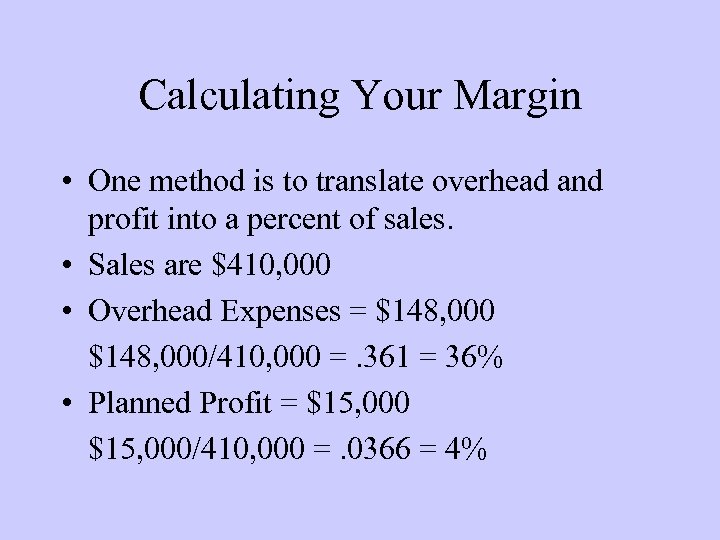 Calculating Your Margin • One method is to translate overhead and profit into a percent of sales. • Sales are $410, 000 • Overhead Expenses = $148, 000/410, 000 =. 361 = 36% • Planned Profit = $15, 000/410, 000 =. 0366 = 4%
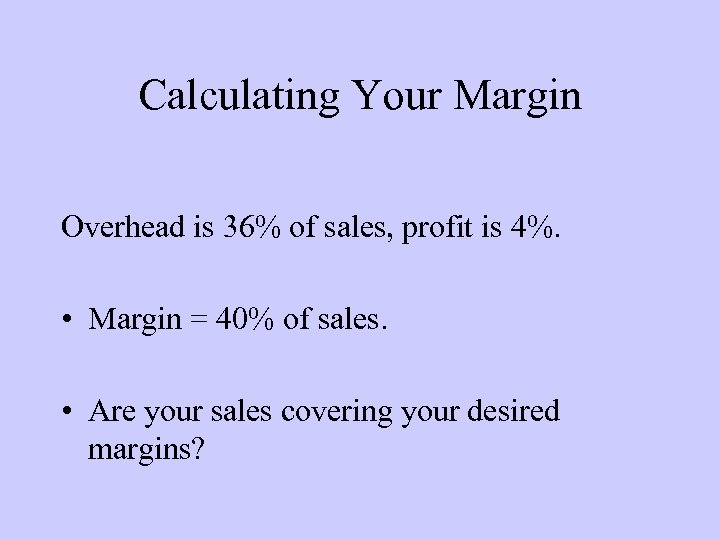 Calculating Your Margin Overhead is 36% of sales, profit is 4%. • Margin = 40% of sales. • Are your sales covering your desired margins?
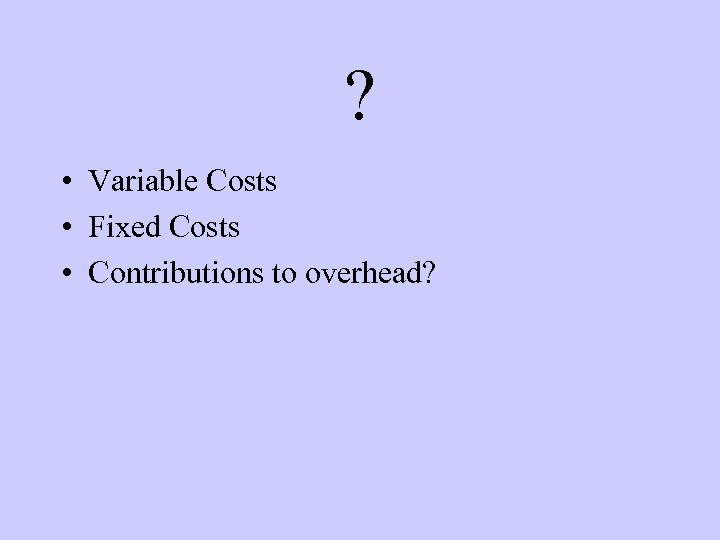 ? • Variable Costs • Fixed Costs • Contributions to overhead?
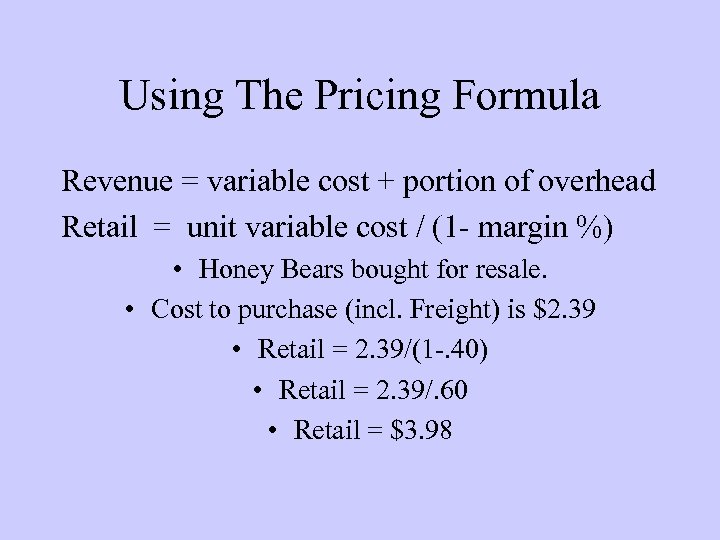 Using The Pricing Formula Revenue = variable cost + portion of overhead Retail = unit variable cost / (1 - margin %) • Honey Bears bought for resale. • Cost to purchase (incl. Freight) is $2. 39 • Retail = 2. 39/(1 -. 40) • Retail = 2. 39/. 60 • Retail = $3. 98
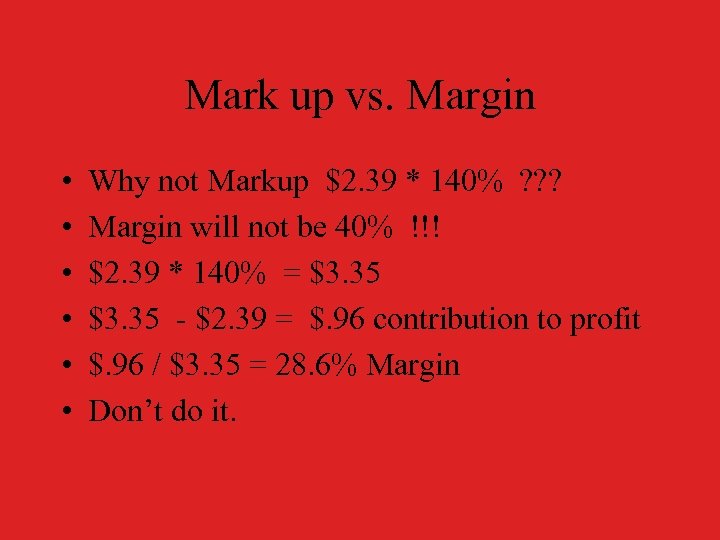 Mark up vs. Margin • • • Why not Markup $2. 39 * 140% ? ? ? Margin will not be 40% !!! $2. 39 * 140% = $3. 35 - $2. 39 = $. 96 contribution to profit $. 96 / $3. 35 = 28. 6% Margin Don’t do it.
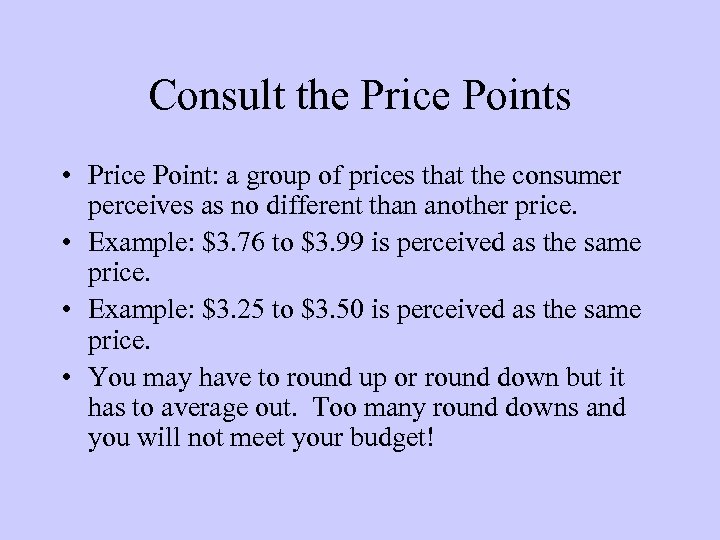 Consult the Price Points • Price Point: a group of prices that the consumer perceives as no different than another price. • Example: $3. 76 to $3. 99 is perceived as the same price. • Example: $3. 25 to $3. 50 is perceived as the same price. • You may have to round up or round down but it has to average out. Too many round downs and you will not meet your budget!
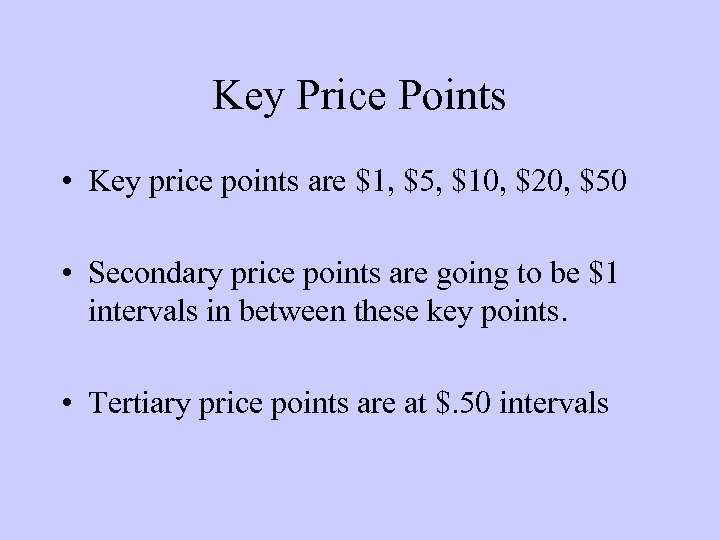 Key Price Points • Key price points are $1, $5, $10, $20, $50 • Secondary price points are going to be $1 intervals in between these key points. • Tertiary price points are at $. 50 intervals
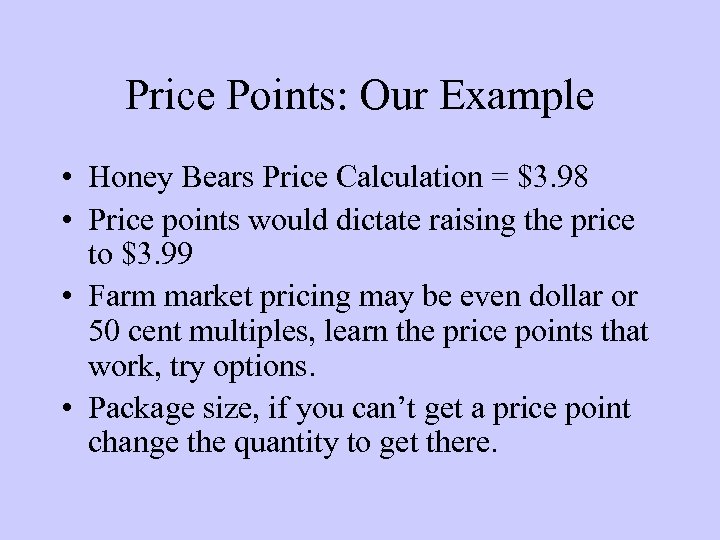 Price Points: Our Example • Honey Bears Price Calculation = $3. 98 • Price points would dictate raising the price to $3. 99 • Farm market pricing may be even dollar or 50 cent multiples, learn the price points that work, try options. • Package size, if you can’t get a price point change the quantity to get there.
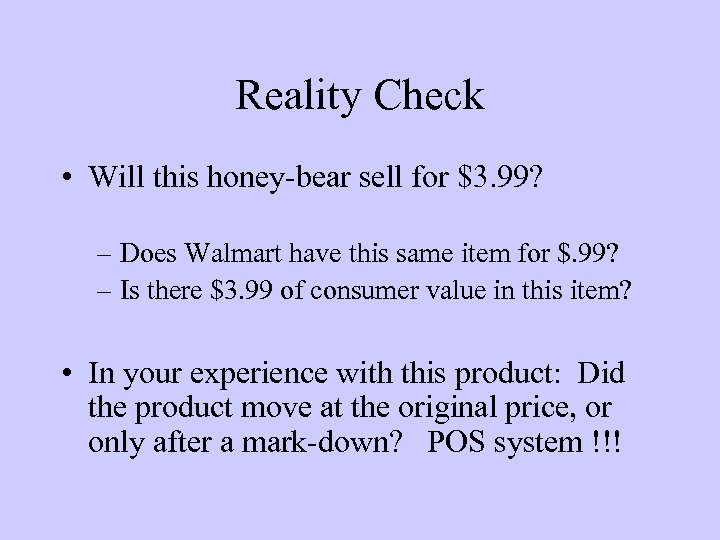 Reality Check • Will this honey-bear sell for $3. 99? – Does Walmart have this same item for $. 99? – Is there $3. 99 of consumer value in this item? • In your experience with this product: Did the product move at the original price, or only after a mark-down? POS system !!!
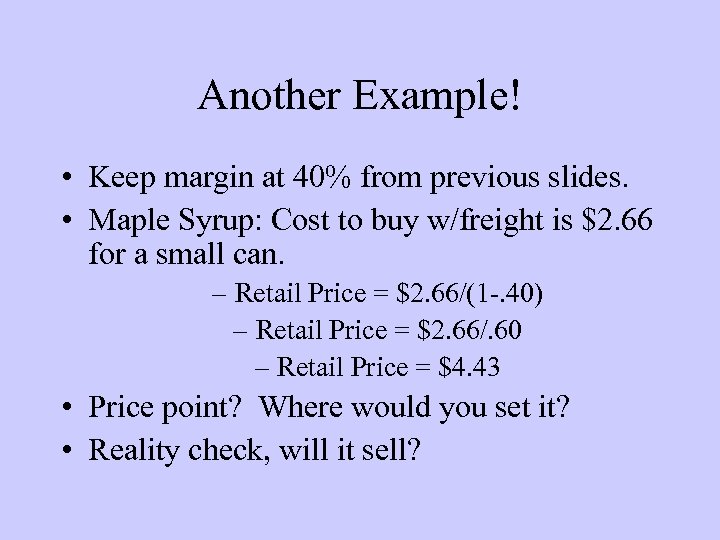 Another Example! • Keep margin at 40% from previous slides. • Maple Syrup: Cost to buy w/freight is $2. 66 for a small can. – Retail Price = $2. 66/(1 -. 40) – Retail Price = $2. 66/. 60 – Retail Price = $4. 43 • Price point? Where would you set it? • Reality check, will it sell?
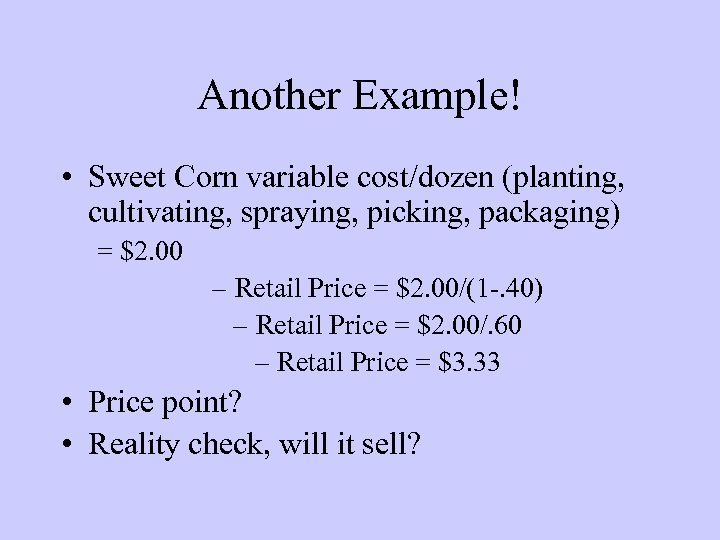 Another Example! • Sweet Corn variable cost/dozen (planting, cultivating, spraying, picking, packaging) = $2. 00 – Retail Price = $2. 00/(1 -. 40) – Retail Price = $2. 00/. 60 – Retail Price = $3. 33 • Price point? • Reality check, will it sell?
 ? • Pricing formula questions • Price point questions
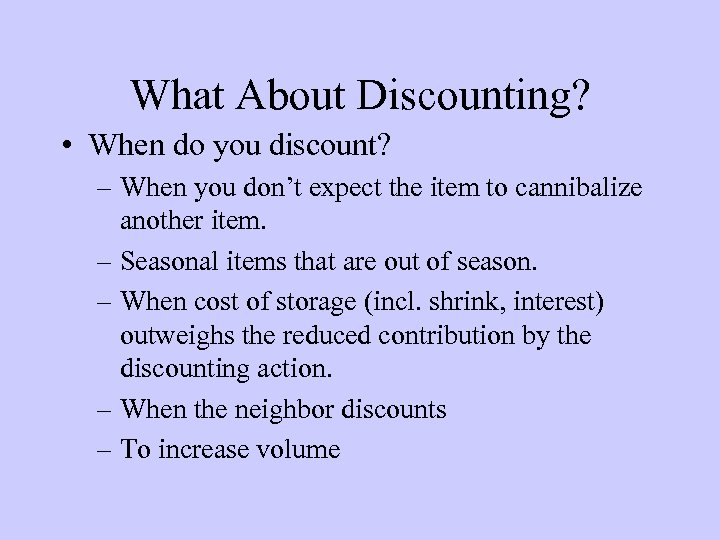 What About Discounting? • When do you discount? – When you don’t expect the item to cannibalize another item. – Seasonal items that are out of season. – When cost of storage (incl. shrink, interest) outweighs the reduced contribution by the discounting action. – When the neighbor discounts – To increase volume
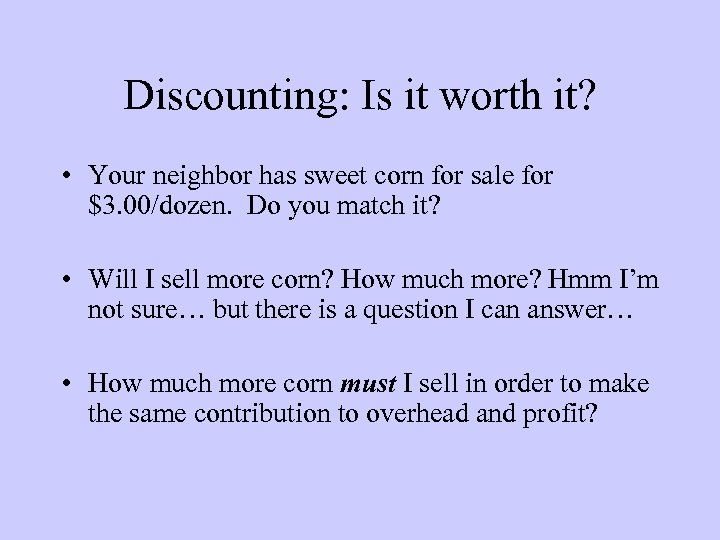 Discounting: Is it worth it? • Your neighbor has sweet corn for sale for $3. 00/dozen. Do you match it? • Will I sell more corn? How much more? Hmm I’m not sure… but there is a question I can answer… • How much more corn must I sell in order to make the same contribution to overhead and profit?
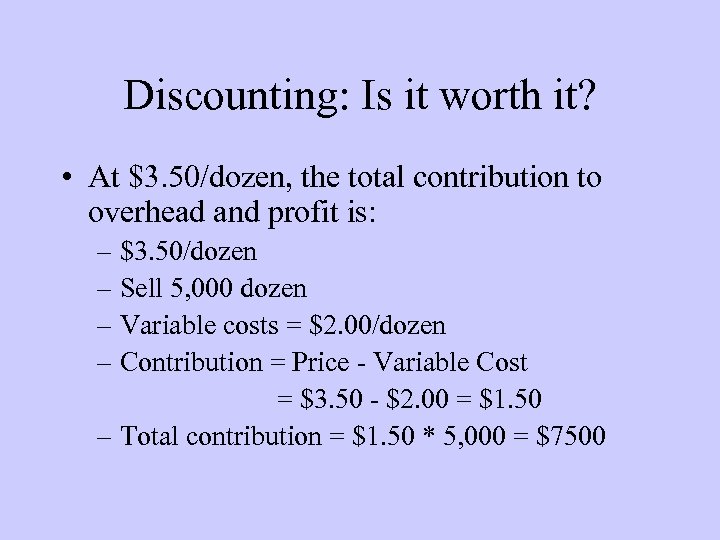 Discounting: Is it worth it? • At $3. 50/dozen, the total contribution to overhead and profit is: – $3. 50/dozen – Sell 5, 000 dozen – Variable costs = $2. 00/dozen – Contribution = Price - Variable Cost = $3. 50 - $2. 00 = $1. 50 – Total contribution = $1. 50 * 5, 000 = $7500
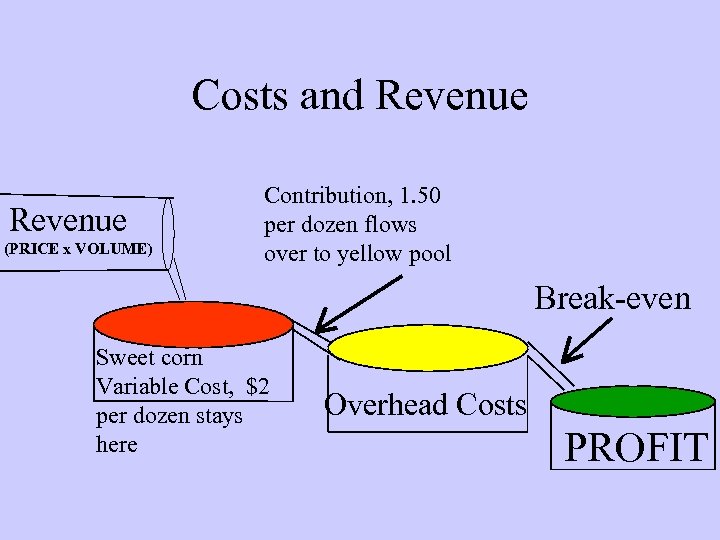 Costs and Revenue (PRICE x VOLUME) Contribution, 1. 50 per dozen flows over to yellow pool Break-even Sweet corn Variable Cost, $2 per dozen stays here Overhead Costs PROFIT
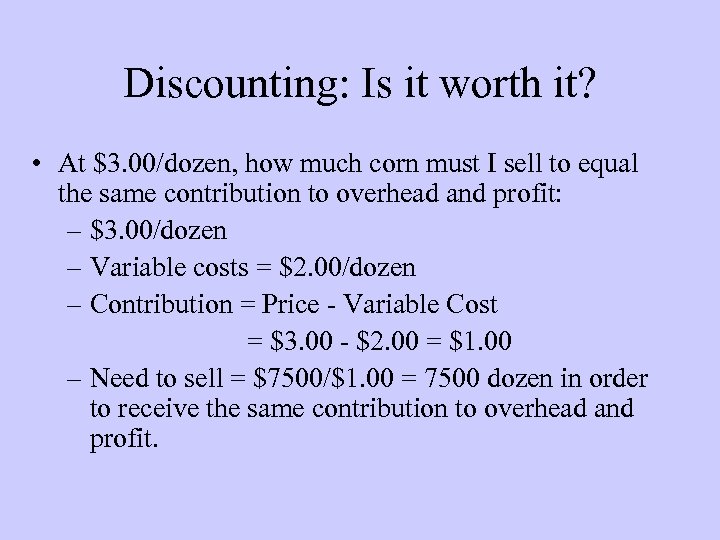 Discounting: Is it worth it? • At $3. 00/dozen, how much corn must I sell to equal the same contribution to overhead and profit: – $3. 00/dozen – Variable costs = $2. 00/dozen – Contribution = Price - Variable Cost = $3. 00 - $2. 00 = $1. 00 – Need to sell = $7500/$1. 00 = 7500 dozen in order to receive the same contribution to overhead and profit.
 Reality Check: Sweet Corn • If I reduce my price by $. 50/dozen, will I sell an additional 2500 dozen? • So did I protect profit by discounting? • Basically, for a 14% discount on price, I need to sell 50% more product!! So how can a guy increase profitable revenue?
 Profit Planning through Volume/Cost Analysis Increase Average Ticket • Example: restaurants want to sell you the appetizer, the mixed drink, the dessert and the gift certificate in addition to the meal! • They want to collect more dollars per table, so what can you do? • We put in upick strawberries and suddenly we sell out of sweet cherries, in 4 hours!
 The Opposite of Increased Average Ticket : Cannibalism • Cannibalism: Similar products with reduced margins stealing sales from products with full margins. • Example: Marked down apple “seconds” competing with “fancy” grade apples. • 25 cent 2 nd or a $1 Extra Fancy • Don’t give them the option! • Do the math and give them options that add to your bottom line.
 When volume Cannibalizes profit. • Buy 2 get 1 free!!! – Move lots of product – Increases Average Ticket – But what about contribution and profit? Assume an item is $1, variable cost is. 60, with a 40% margin, it’s properly priced at $1 and it contributes 40 cents per sale. – 2 x. 40, is your contribution right? – But 3 x. 60 = 1. 80 is your total variable cost, and revenue is only $2, so your net contribution is only 20 cents!!!! Half of what it was! BAD for the Seller! – You have to do the math or you give away the store!
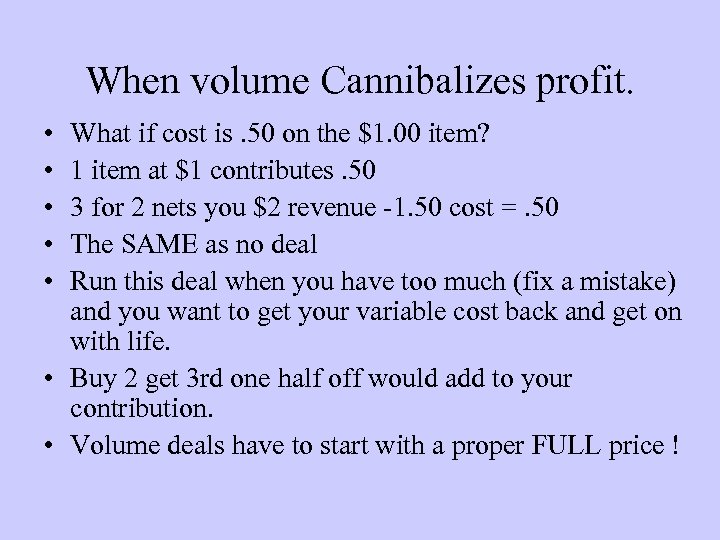 When volume Cannibalizes profit. • • • What if cost is. 50 on the $1. 00 item? 1 item at $1 contributes. 50 3 for 2 nets you $2 revenue -1. 50 cost =. 50 The SAME as no deal Run this deal when you have too much (fix a mistake) and you want to get your variable cost back and get on with life. • Buy 2 get 3 rd one half off would add to your contribution. • Volume deals have to start with a proper FULL price !
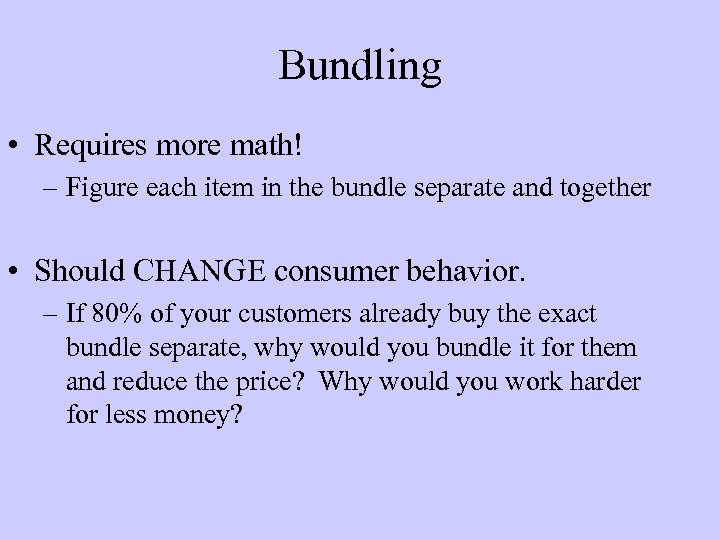 Bundling • Requires more math! – Figure each item in the bundle separate and together • Should CHANGE consumer behavior. – If 80% of your customers already buy the exact bundle separate, why would you bundle it for them and reduce the price? Why would you work harder for less money?
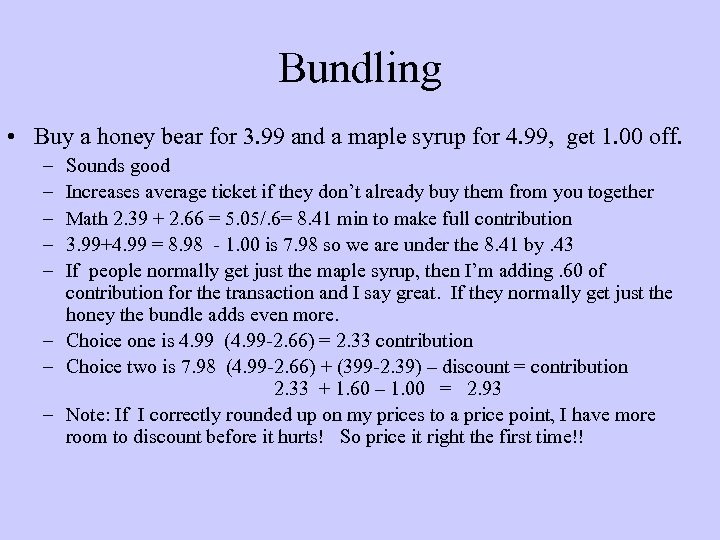 Bundling • Buy a honey bear for 3. 99 and a maple syrup for 4. 99, get 1. 00 off. – – – Sounds good Increases average ticket if they don’t already buy them from you together Math 2. 39 + 2. 66 = 5. 05/. 6= 8. 41 min to make full contribution 3. 99+4. 99 = 8. 98 - 1. 00 is 7. 98 so we are under the 8. 41 by. 43 If people normally get just the maple syrup, then I’m adding. 60 of contribution for the transaction and I say great. If they normally get just the honey the bundle adds even more. – Choice one is 4. 99 (4. 99 -2. 66) = 2. 33 contribution – Choice two is 7. 98 (4. 99 -2. 66) + (399 -2. 39) – discount = contribution 2. 33 + 1. 60 – 1. 00 = 2. 93 – Note: If I correctly rounded up on my prices to a price point, I have more room to discount before it hurts! So price it right the first time!!
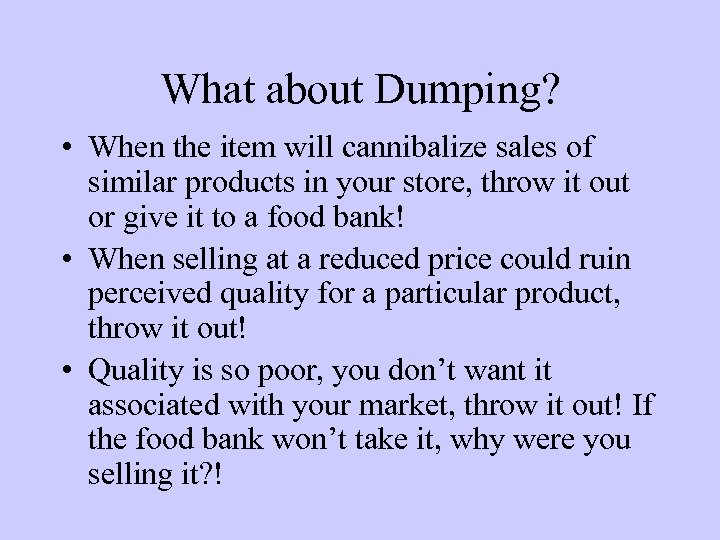 What about Dumping? • When the item will cannibalize sales of similar products in your store, throw it out or give it to a food bank! • When selling at a reduced price could ruin perceived quality for a particular product, throw it out! • Quality is so poor, you don’t want it associated with your market, throw it out! If the food bank won’t take it, why were you selling it? !
 Feedback to Price/Volume Curve • Did we make a profit at our volumeoverhead level? • Can we make a profit at our volumeoverhead level? • What about alternative products that may make a full contribution to overhead/profit. • Do we need to adjust our position on the price/volume curve?
 Special Cases? • Are there other reasons for carrying a product if it can’t meet the margin test. Should only be done in limited products and quantities. Overhead still rules your bottom line. – Adds variety – “Loss Leader” BUT it must lead the customer to empty their wallet on other profitable items or it’s just a loss. – Does not require additional overhead to carry – Does not cannibalize other products – Other reasons?
 Contact Information • Warren Abbott • apples@abbottfarms. com