 Скачать презентацию Profit maximization by firms ECO 61 Udayan Roy
4bc7609ac16c786ee84da0c4d93392b2.ppt
- Количество слайдов: 22



Profit maximization by firms ECO 61 Udayan Roy Fall 2008
Revenues and costs • A firm’s costs (C) were discussed in the previous chapter • A firm’s revenue is R = P Q – Where P is the price charged by the firm for the commodity it sells and Q is the quantity of the firm’s output that people buy – We discussed the link between price and quantity consumed – the demand curve – earlier • Now it is time to bring revenues and costs together to study a firm’s behavior
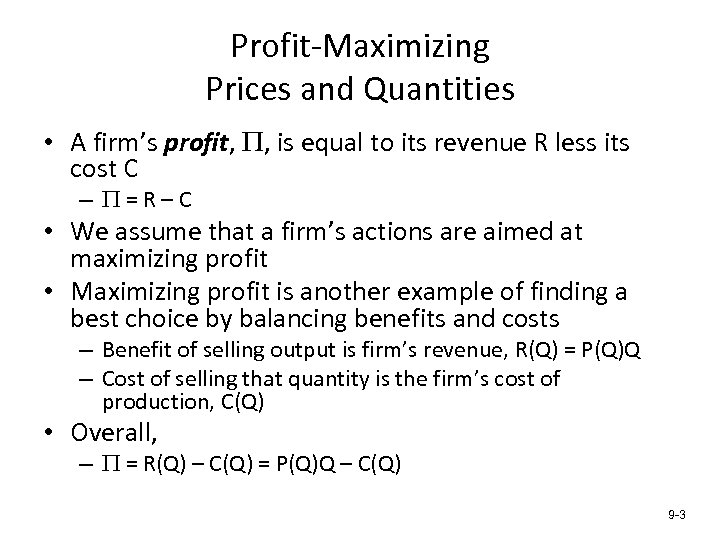
Profit-Maximizing Prices and Quantities • A firm’s profit, P, is equal to its revenue R less its cost C – P=R–C • We assume that a firm’s actions are aimed at maximizing profit • Maximizing profit is another example of finding a best choice by balancing benefits and costs – Benefit of selling output is firm’s revenue, R(Q) = P(Q)Q – Cost of selling that quantity is the firm’s cost of production, C(Q) • Overall, – P = R(Q) – C(Q) = P(Q)Q – C(Q) 9 -3
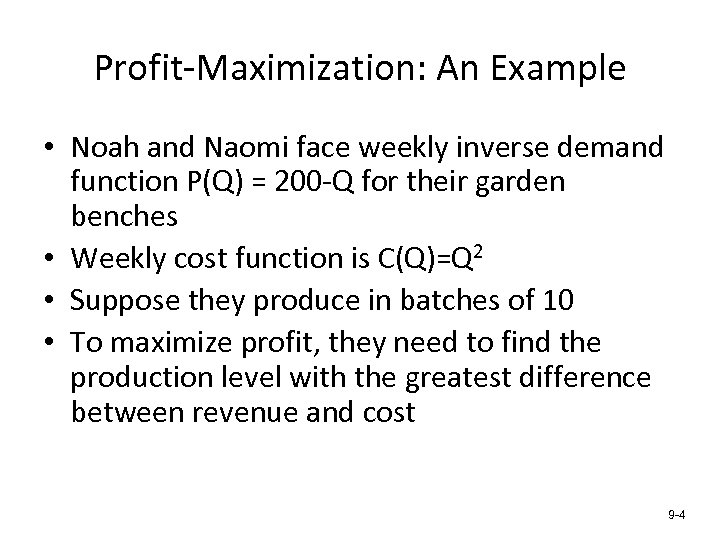
Profit-Maximization: An Example • Noah and Naomi face weekly inverse demand function P(Q) = 200 -Q for their garden benches • Weekly cost function is C(Q)=Q 2 • Suppose they produce in batches of 10 • To maximize profit, they need to find the production level with the greatest difference between revenue and cost 9 -4
![Profit-Maximization: An Example Note that [50 – Q]2 is always a positive number. Therefore,](https://present5.com/presentation/4bc7609ac16c786ee84da0c4d93392b2/image-5.jpg "Profit-Maximization: An Example Note that [50 – Q]2 is always a positive number. Therefore,")
Profit-Maximization: An Example Note that [50 – Q]2 is always a positive number. Therefore, to maximize profit one must minimize [50 – Q]2. Therefore, to maximize profit, Noah and Naomi must produce Q = 50 units. This is their profit-maximizing output. When Q = 50, π = 2 502 = 5000. this is the biggest profit Noah and Naomi can achieve.
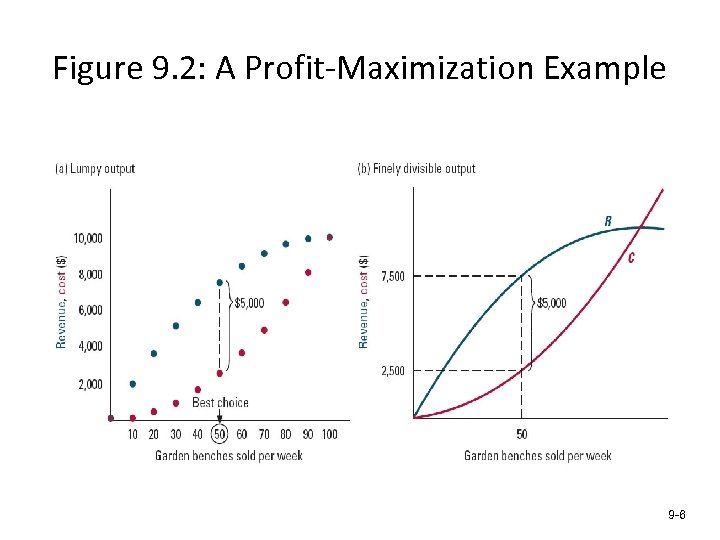
Figure 9. 2: A Profit-Maximization Example 9 -6
Choice requires balance at the margin • In general marginal benefit must equal marginal cost at a decision-maker’s best choice whenever a small increase or decrease in her action is possible
Example
Marginal Revenue • Here the firm’s marginal benefit is its marginal revenue: the extra revenue produced by the Q marginal units sold, measured on a per unit basis 9 -9
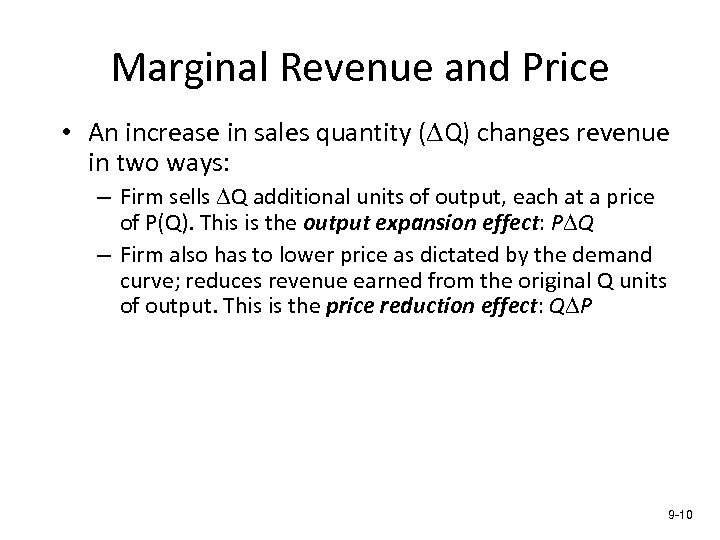
Marginal Revenue and Price • An increase in sales quantity ( Q) changes revenue in two ways: – Firm sells Q additional units of output, each at a price of P(Q). This is the output expansion effect: P Q – Firm also has to lower price as dictated by the demand curve; reduces revenue earned from the original Q units of output. This is the price reduction effect: Q P 9 -10
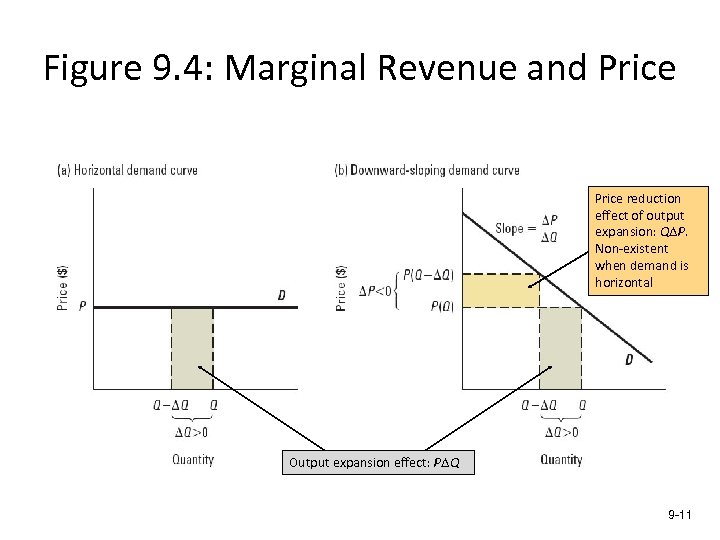
Figure 9. 4: Marginal Revenue and Price reduction effect of output expansion: Q P. Non-existent when demand is horizontal Output expansion effect: P Q 9 -11
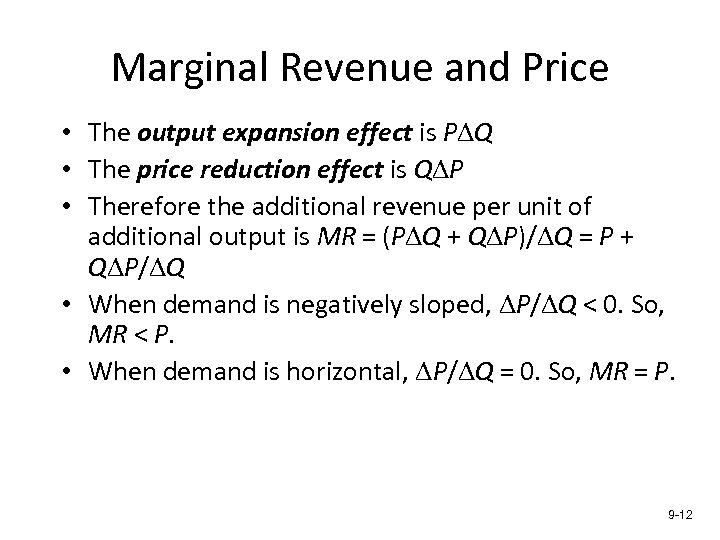
Marginal Revenue and Price • The output expansion effect is P Q • The price reduction effect is Q P • Therefore the additional revenue per unit of additional output is MR = (P Q + Q P)/ Q = P + Q P/ Q • When demand is negatively sloped, P/ Q < 0. So, MR < P. • When demand is horizontal, P/ Q = 0. So, MR = P. 9 -12
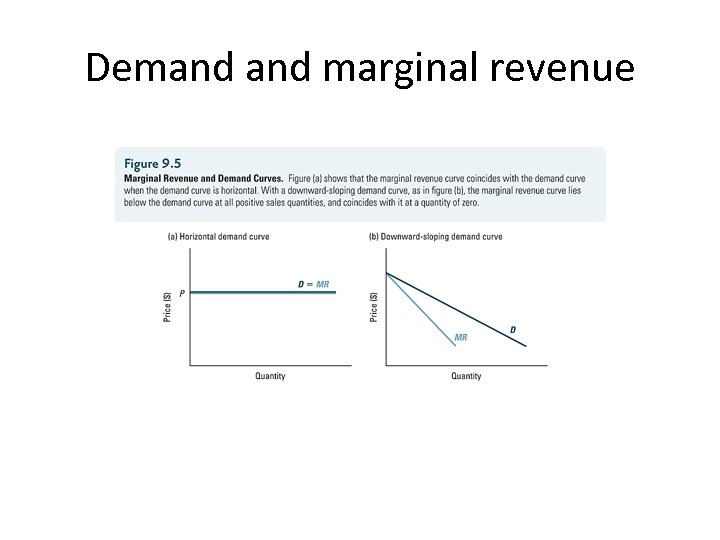
Demand marginal revenue
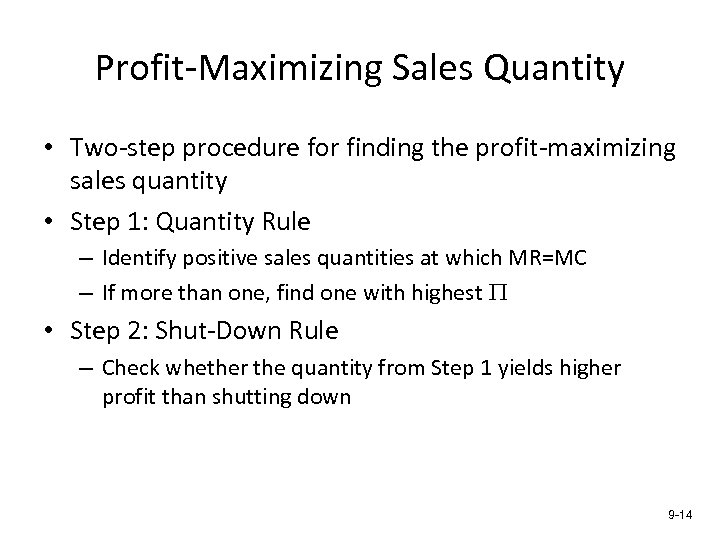
Profit-Maximizing Sales Quantity • Two-step procedure for finding the profit-maximizing sales quantity • Step 1: Quantity Rule – Identify positive sales quantities at which MR=MC – If more than one, find one with highest P • Step 2: Shut-Down Rule – Check whether the quantity from Step 1 yields higher profit than shutting down 9 -14
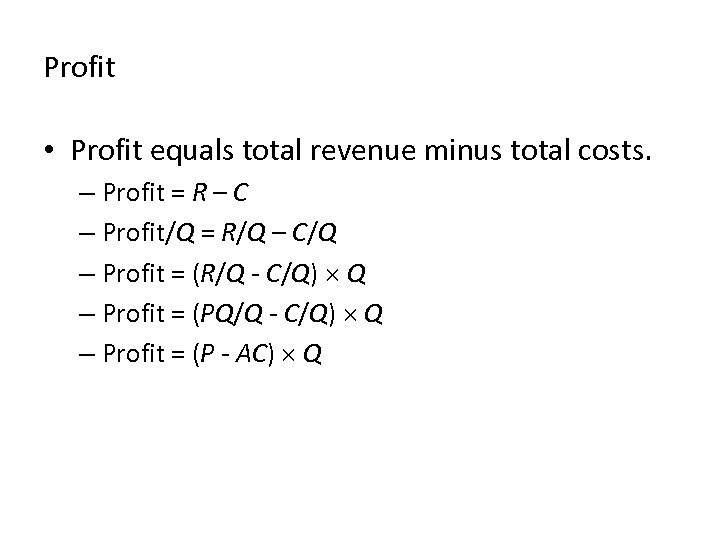
Profit • Profit equals total revenue minus total costs. – Profit = R – C – Profit/Q = R/Q – C/Q – Profit = (R/Q - C/Q) Q – Profit = (PQ/Q - C/Q) Q – Profit = (P - AC) Q
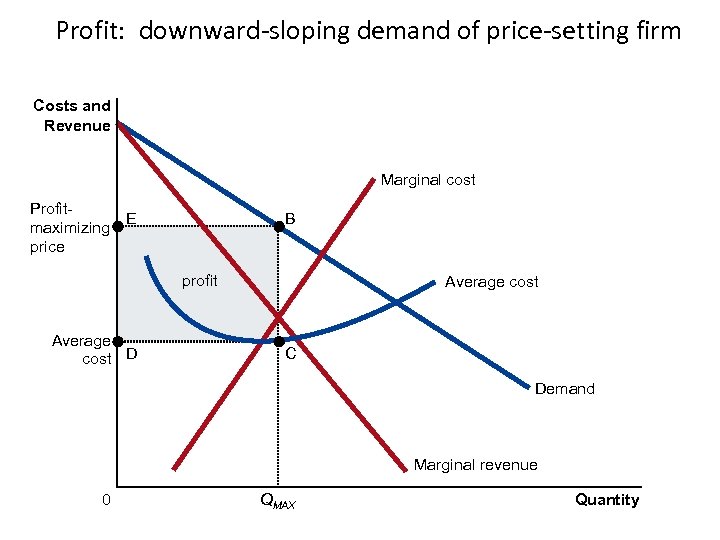
Profit: downward-sloping demand of price-setting firm Costs and Revenue Marginal cost Profit. E maximizing price B profit Average cost D Average cost C Demand Marginal revenue 0 QMAX Quantity
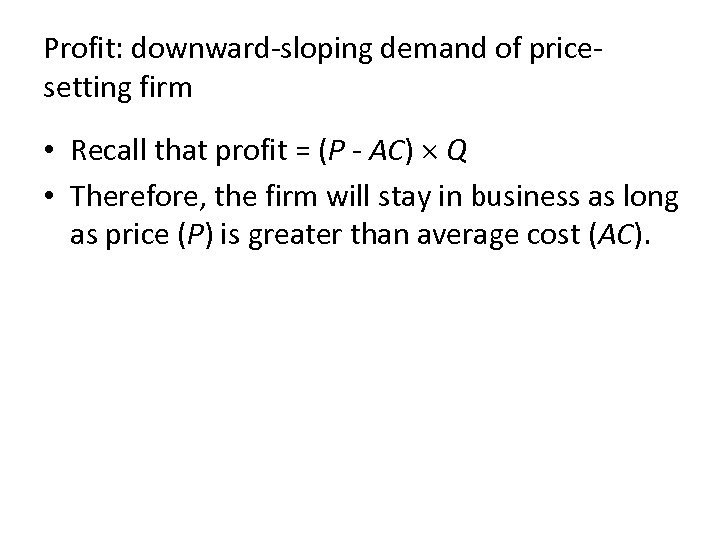
Profit: downward-sloping demand of pricesetting firm • Recall that profit = (P - AC) Q • Therefore, the firm will stay in business as long as price (P) is greater than average cost (AC).
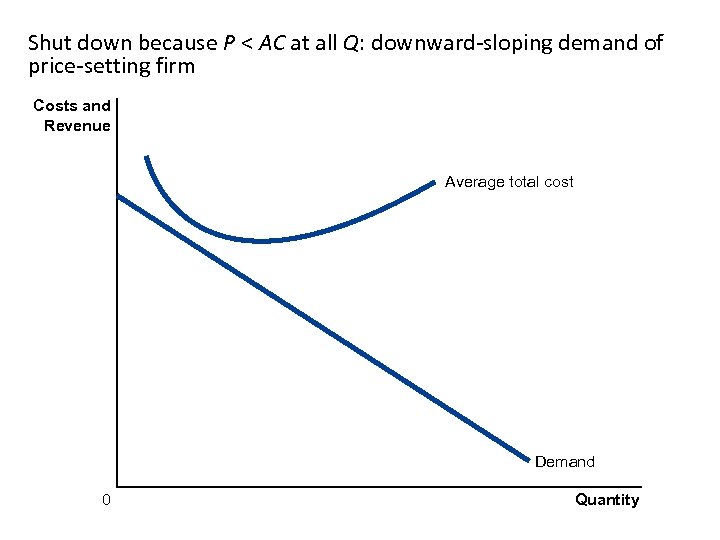
Shut down because P < AC at all Q: downward-sloping demand of price-setting firm Costs and Revenue Average total cost Demand 0 Quantity
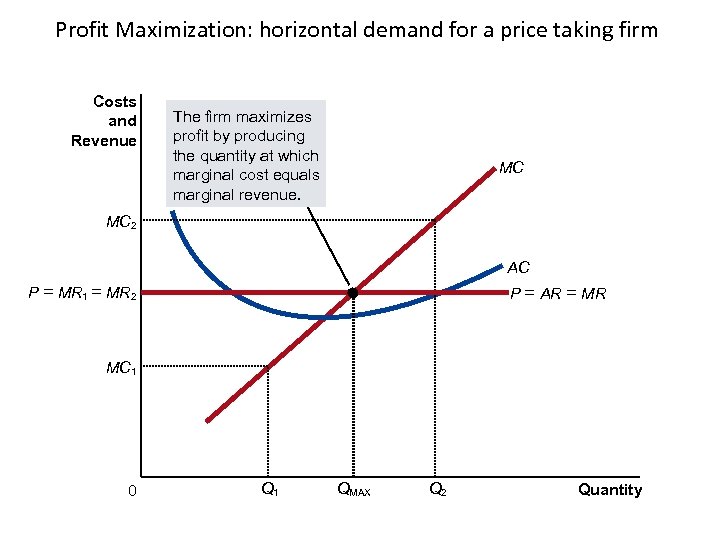
Profit Maximization: horizontal demand for a price taking firm Costs and Revenue The firm maximizes profit by producing the quantity at which marginal cost equals marginal revenue. MC MC 2 AC P = MR 1 = MR 2 P = AR = MR MC 1 0 Q 1 QMAX Q 2 Quantity
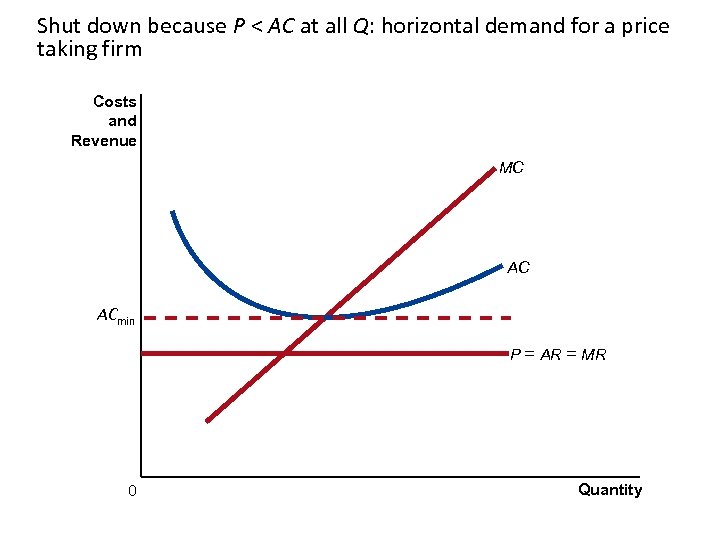
Shut down because P < AC at all Q: horizontal demand for a price taking firm Costs and Revenue MC AC ACmin P = AR = MR 0 Quantity
Supply Decisions • Price takers are firms that can sell as much as they want at some price P but nothing at any higher price – Face a perfectly horizontal demand curve • not subject to the price reduction effect – Firms in perfectly competitive markets, e. g. – MR = P for price takers • Use P=MC in the quantity rule to find the profit-maximizing sales quantity for a price-taking firm • Shut-Down Rule: – If P>ACmin, the best positive sales quantity maximizes profit. – If P<ACmin, shutting down maximizes profit. – If P=ACmin, then both shutting down and the best positive sales quantity yield zero profit, which is the best the firm can do. 9 -21
Price determination • We have seen how the price is determined in the case of price setting firms that have downward sloping demand curves • But how is the price that price taking firms use to guide their production determined? – For now think of it as determined by trial and error. Pick a random price. See what quantity is demanded by buyers and what quantity is supplied by producers. Keep trying different prices whenever the two quantities are unequal – The market equilibrium price is the price at which the quantities supplied and demanded are equal
Скачать презентацию Profit maximization by firms ECO 61 Udayan Roy
4bc7609ac16c786ee84da0c4d93392b2.ppt