


 Скачать презентацию Profiling Your Target Customer Explore Customer Groups chapter
2aa2829f7acea3a7d556489679cabf63.ppt
- Количество слайдов: 20
 Profiling Your Target Customer Explore Customer Groups chapter 4 Prepared by Ron Knowles Algonquin College & Jennifer Rouse Barbeau Canadore College 4 -1
 Chapter Overview Chapter 4 will: chapter 4 Ø Help you begin collecting information to understand, develop a profile of, and connect with your target customer. Ø Begin to formulate your market strategy. 4 -2
 Learning Opportunities chapter 4 Ø Understand that your key to survival in small business is the target customer. Ø Recognize three kinds of customer groups. Ø Use primary and secondary research to profile your target customer. Ø Match your target customer with what he or she reads, watches, and listens to. 4 -3
 Learning Opportunities chapter 4 Ø Become more aware of and start being on the look-out for potential partnerships, alliances, and associations. Ø Recognize the market and the target customers who are about to surface. Ø Research your prospective target customers and refine your mission statement. Ø Visualize your business and target customer. 4 -4
 What is Customer Relationship Marketing? A Key Trend: Customer Relationship Marketing • • • The development of long-term, mutually beneficial and cost-effective relationships with your customer. Emphasizes a market pull strategy: Ø Determine what your target customer (TC) wants. Ø Profile your target customer. Ø Adapt or create a product or service to satisfy this want or need. Emphasizes a one-to-one marketing strategy. 4 -5
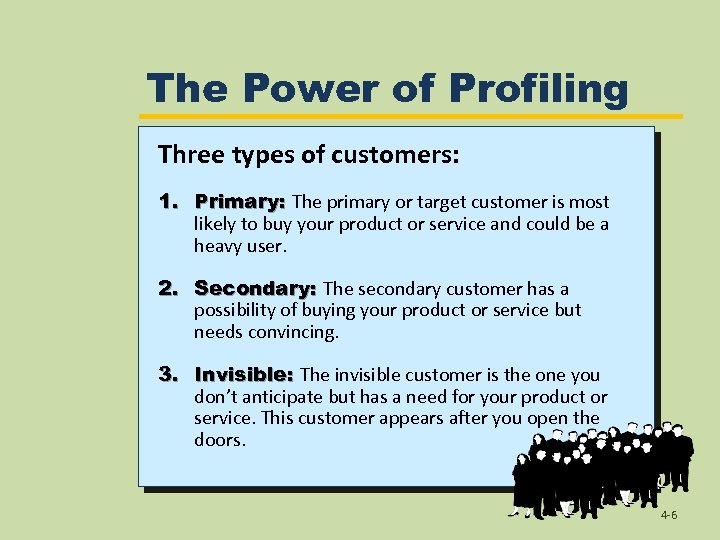 The Power of Profiling Three types of customers: 1. Primary: The primary or target customer is most likely to buy your product or service and could be a heavy user. 2. Secondary: The secondary customer has a possibility of buying your product or service but needs convincing. 3. Invisible: The invisible customer is the one you don’t anticipate but has a need for your product or service. This customer appears after you open the doors. 4 -6
 Two Types of Customer Profiles 1. Business to Consumer (B 2 C) or End-User Profile Ø If your TC is the consumer or end-user, your customer profile will likely require demographics or psychographics. 2. Business-to-Business (B 2 B) Profile Ø Many small businesses offer their services or products, often on a contract basis, to other businesses. Ø These supply chain companies need a customer profile that is based on business or companytype information. 4 -7
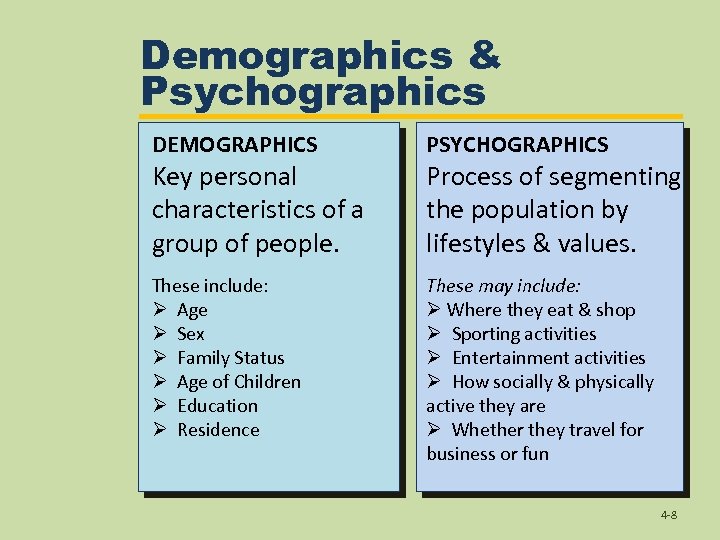 Demographics & Psychographics DEMOGRAPHICS PSYCHOGRAPHICS These include: Ø Age Ø Sex Ø Family Status Ø Age of Children Ø Education Ø Residence These may include: Ø Where they eat & shop Ø Sporting activities Ø Entertainment activities Ø How socially & physically active they are Ø Whether they travel for business or fun Key personal characteristics of a group of people. Process of segmenting the population by lifestyles & values. 4 -8
 Psychographic Profiling Chances are you will have to do your own psychographic research. Use Action Step 24 to get started: Ø What is your VALS? Click on the SRI Consulting Business Intelligence site. Ø Profile your target customer using postal codes. Link on to Generation 5. Ø Do your own psychographic profiling. Invite a few friends to a psychographic party. 4 -9
 Media Sources Can Help Demographic & psychographic profiles are available from media sources: ØMagazines ØTV and radio stations ØOnline 4 -10
 Media Sources Can Help • Analyze media sources aimed at different target markets. • What does your target customer read, listen to or watch? • Action Step 25 will help you get started. Ø Conduct primary and “new eyes” research. • Interview magazine buyers. Ø Do some secondary research. • Write to advertising departments. • Ask for media kits and reader profiles. 4 -11
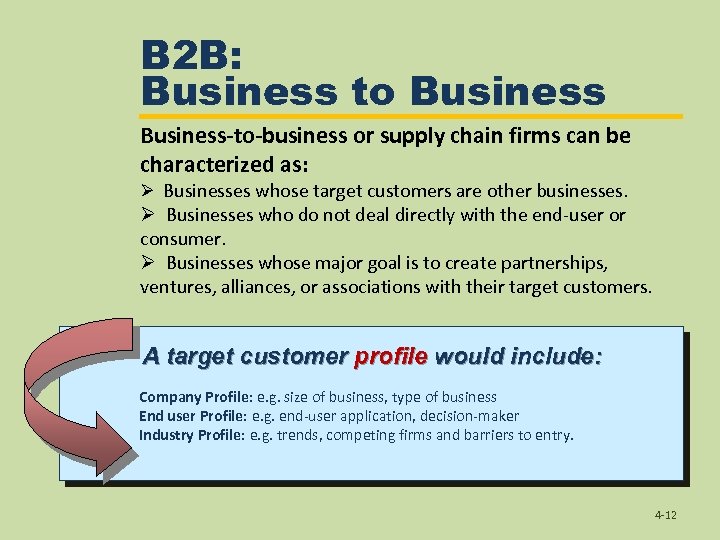 B 2 B: Business to Business-to-business or supply chain firms can be characterized as: Ø Businesses whose target customers are other businesses. Ø Businesses who do not deal directly with the end-user or consumer. Ø Businesses whose major goal is to create partnerships, ventures, alliances, or associations with their target customers. A target customer profile would include: Company Profile: e. g. size of business, type of business End user Profile: e. g. end-user application, decision-maker Industry Profile: e. g. trends, competing firms and barriers to entry. 4 -12
 Joint Ventures & Strategic Alliances: 10 Tips 1. Have a common purpose 2. Conduct research 3. Consider mutual benefits 4. Provide a structure 5. Consider potential advantages 6. Invest in human resources 7. Put it in writing 8. Stay in touch 9. Keep tabs 10. Exit stage left 4 -13
 B 2 B or B 2 C? Which one will it “B”? Ø Recall the experience of Adrienne Armstrong at Arbour Environmental. You can benefit from both worlds. 4 -14
 Field Interviewing & Surveying FIELD INTERVIEWING TARGET CUSTOMERS SURVEYING Test your TC profile, developed from secondary research, against reality. Develop a questionnaire & identify a survey location. Ask questions of your potential customers. Get permission from the location owner. Bargaining tactic: share the information you discover. Recall the experience of Julia Gonzales. Recall the experience of Elizabeth Wood. 4 -15
 Other Sources of Primary Research Mentoring: Locate a business owner who wants to help. Experience: Work in a similar business and get all the information you can. Networking: Go out and talk to local businesses and friends. Brainstorming: Gather a group of friends, associates, or family and brainstorm your TC. Competitors: In some cases, researching your competition may provide some good information about your potential TC. 4 -16
 Business Vision Visualize your new business and the target customer. A business vision is: Ø A mental picture of your business, product or service at some time in the future. Ø A source of guidance and direction. Ø A driving force for your persistence and passion. 4 -17
 Business Plan Building Block Chapter 4 helps you prepare Part B of your business plan: ØThe Market & ØThe Target Customer 4 -18
 Checklist for Your Business Plan q Profile your target market in terms of primary, secondary, and invisible customers. q What do the results of your primary research questionnaire tell you about your target market? q What information have you developed about your target customer from your secondary research? q What characteristics are unique or clearly definable about your target customer? q What is the best way to reach your target market? 4 -19
 Case Study My Virtual Model (MVM) is a successful company headed up by Louise Guay and Jean-Francois St-Arnaud. Answer the Chapter 4 case study questions to learn: Ø How MVM takes advantage of relationship marketing, the market pull approach and one-to-one marketing. Ø The three types of MVM customers. Ø MVM’s and Lands’ End target customer profile. Ø What MVM’s business vision was and how Louise Guay used primary research to help start the business. Ø How MVM benefits from market trends and partnerships. 4 -20