


 Скачать презентацию Profiles and Trends of Canadian Philanthropic Environmental and
75f5e8776713117cae9f339cd8304f67.ppt
- Количество слайдов: 47
 Profiles and Trends of Canadian Philanthropic, Environmental and Land Donors A Presentation to the Land Trust Alliance of B. C. Susan Anderson, E-Cocreate Solutions, www. e-cocreate. com on behalf of Environment Canada’s Ecological Gifts Program
 Today’s Menu § A Profile of Canadian Donors § § § § How many Canadians donate and how much? What influences Canadians to donate? What organizations do they donate to? How do Canadians donate? How do BC Donors donate? Factors that influence donations Planned Gifts, Legacies, and High Value donations What’s the Future for Canadian donors? § Canadian Environmental Donors § Canadian donations to environmental causes § Canadian Land Donors § Intergenerational Transfer of Land Assets 2
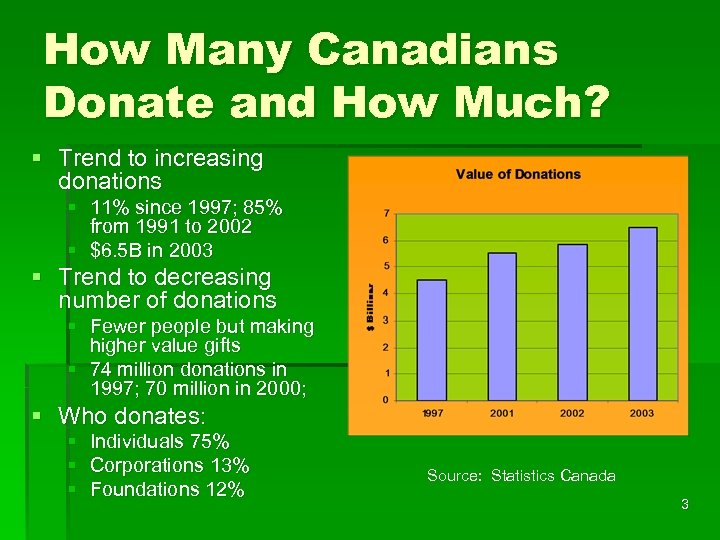 How Many Canadians Donate and How Much? § Trend to increasing donations § 11% since 1997; 85% from 1991 to 2002 § $6. 5 B in 2003 § Trend to decreasing number of donations § Fewer people but making higher value gifts § 74 million donations in 1997; 70 million in 2000; § Who donates: § Individuals 75% § Corporations 13% § Foundations 12% Source: Statistics Canada 3
 What Influences Canadians to Donate? 1. Tax policy changes § Split receipting 2. Financial capacity to give § 3. 4. Economic conditions which effect discretionary income Values and attitudes about giving Opportunities to give § Land trusts can effect this through fundraising and promotion efforts 4
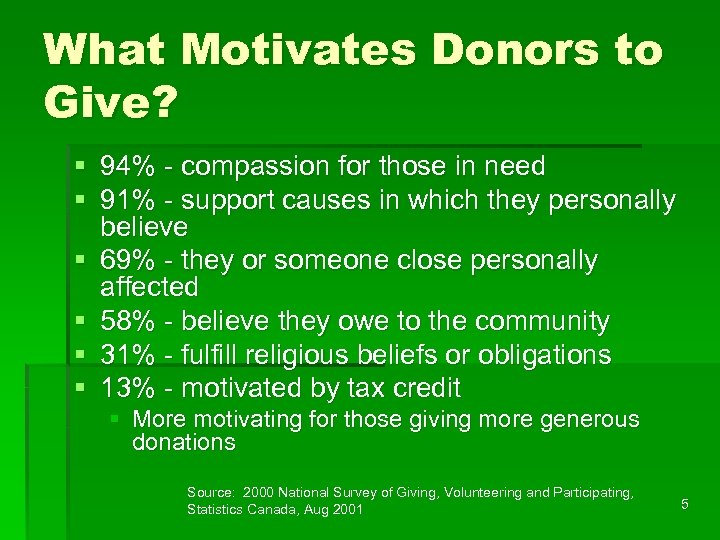 What Motivates Donors to Give? § 94% - compassion for those in need § 91% - support causes in which they personally believe § 69% - they or someone close personally affected § 58% - believe they owe to the community § 31% - fulfill religious beliefs or obligations § 13% - motivated by tax credit § More motivating for those giving more generous donations Source: 2000 National Survey of Giving, Volunteering and Participating, Statistics Canada, Aug 2001 5
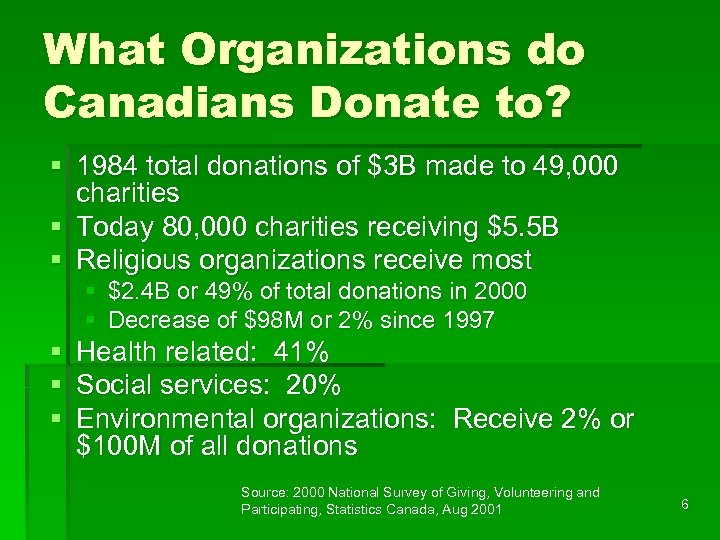 What Organizations do Canadians Donate to? § 1984 total donations of $3 B made to 49, 000 charities § Today 80, 000 charities receiving $5. 5 B § Religious organizations receive most § $2. 4 B or 49% of total donations in 2000 § Decrease of $98 M or 2% since 1997 § § § Health related: 41% Social services: 20% Environmental organizations: Receive 2% or $100 M of all donations Source: 2000 National Survey of Giving, Volunteering and Participating, Statistics Canada, Aug 2001 6
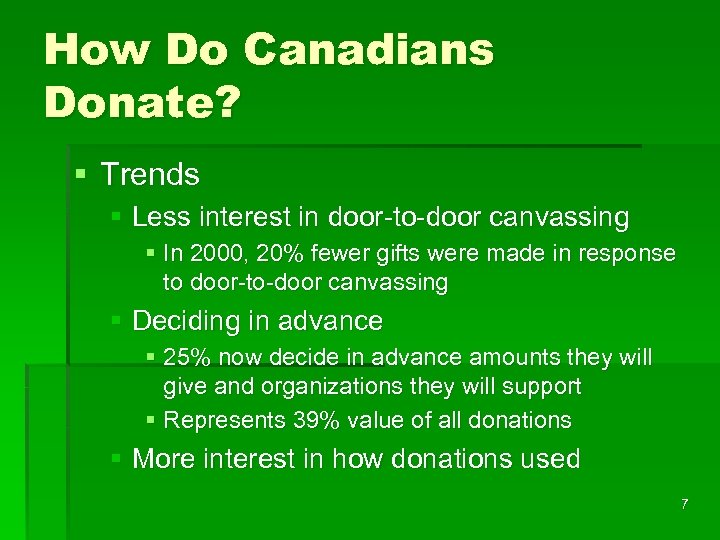 How Do Canadians Donate? § Trends § Less interest in door-to-door canvassing § In 2000, 20% fewer gifts were made in response to door-to-door canvassing § Deciding in advance § 25% now decide in advance amounts they will give and organizations they will support § Represents 39% value of all donations § More interest in how donations used 7
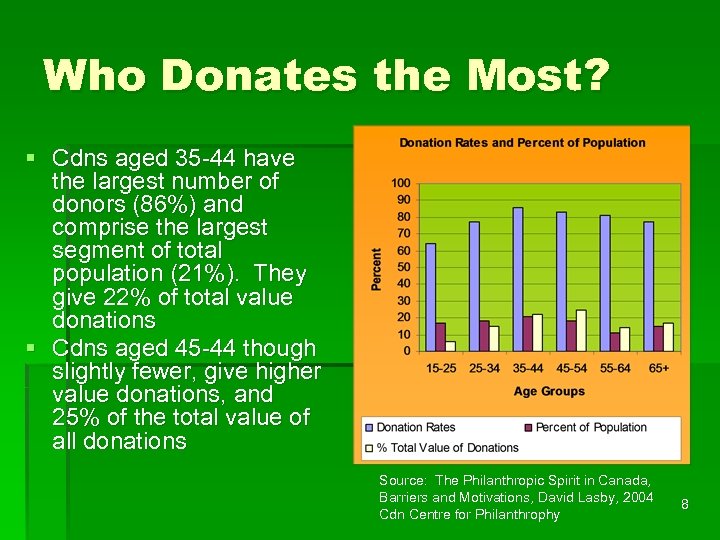 Who Donates the Most? § Cdns aged 35 -44 have the largest number of donors (86%) and comprise the largest segment of total population (21%). They give 22% of total value donations § Cdns aged 45 -44 though slightly fewer, give higher value donations, and 25% of the total value of all donations Source: The Philanthropic Spirit in Canada, Barriers and Motivations, David Lasby, 2004 Cdn Centre for Philanthrophy 8
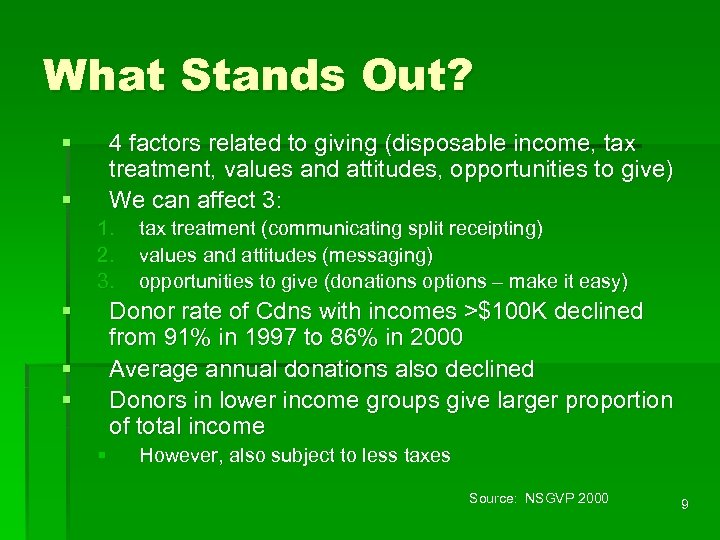 What Stands Out? § 4 factors related to giving (disposable income, tax treatment, values and attitudes, opportunities to give) We can affect 3: § 1. 2. 3. § tax treatment (communicating split receipting) values and attitudes (messaging) opportunities to give (donations options – make it easy) Donor rate of Cdns with incomes >$100 K declined from 91% in 1997 to 86% in 2000 Average annual donations also declined Donors in lower income groups give larger proportion of total income § § § However, also subject to less taxes Source: NSGVP 2000 9
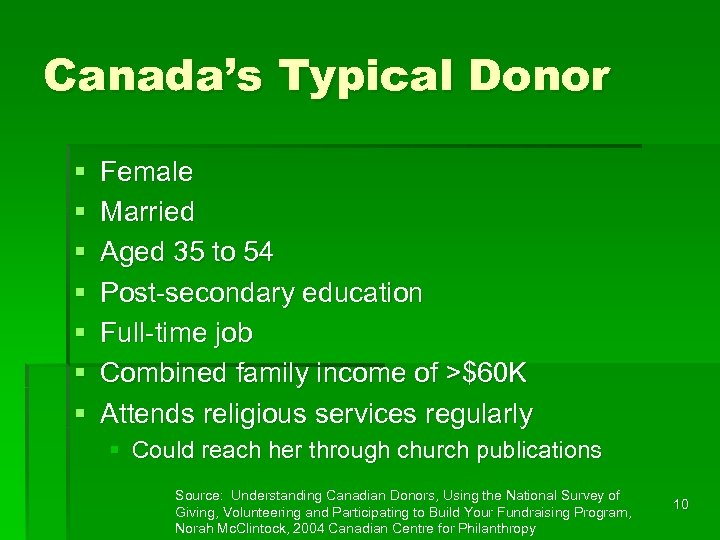 Canada’s Typical Donor § § § § Female Married Aged 35 to 54 Post-secondary education Full-time job Combined family income of >$60 K Attends religious services regularly § Could reach her through church publications Source: Understanding Canadian Donors, Using the National Survey of Giving, Volunteering and Participating to Build Your Fundraising Program, Norah Mc. Clintock, 2004 Canadian Centre for Philanthropy 10
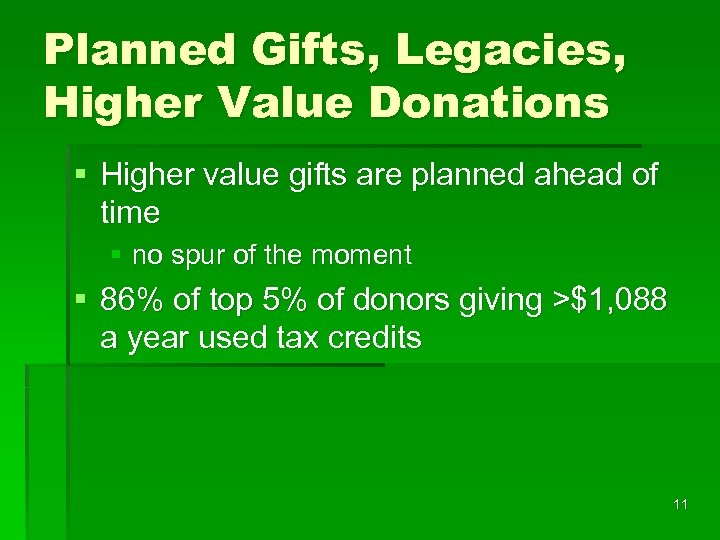 Planned Gifts, Legacies, Higher Value Donations § Higher value gifts are planned ahead of time § no spur of the moment § 86% of top 5% of donors giving >$1, 088 a year used tax credits 11
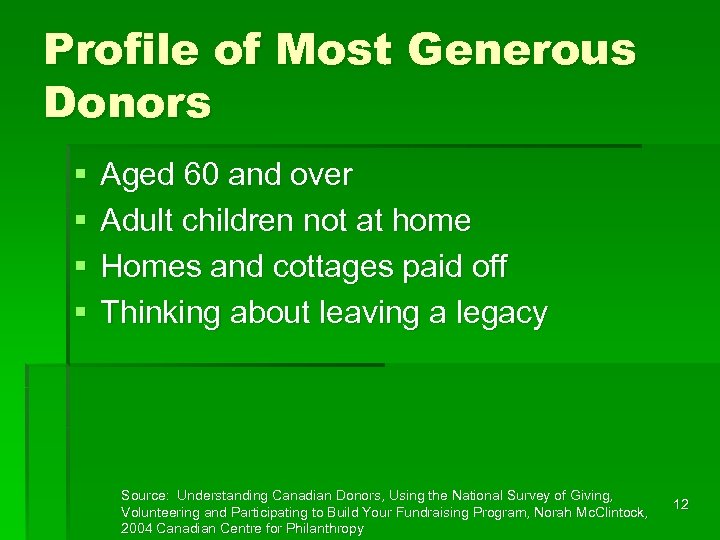 Profile of Most Generous Donors § § Aged 60 and over Adult children not at home Homes and cottages paid off Thinking about leaving a legacy Source: Understanding Canadian Donors, Using the National Survey of Giving, Volunteering and Participating to Build Your Fundraising Program, Norah Mc. Clintock, 2004 Canadian Centre for Philanthropy 12
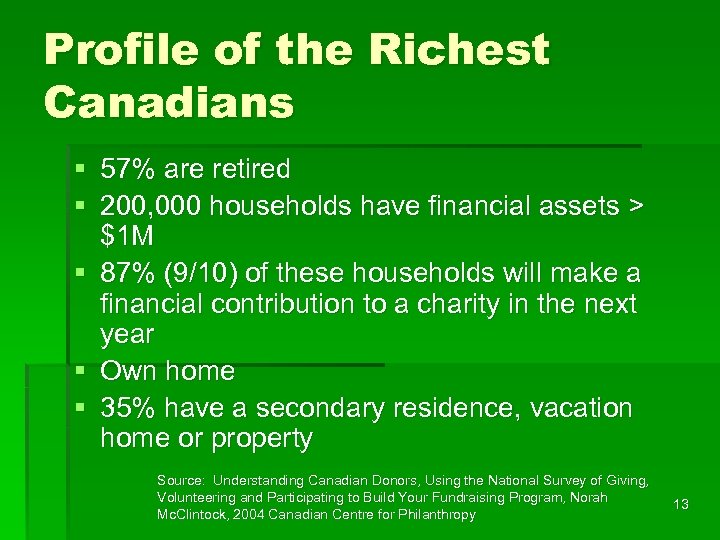 Profile of the Richest Canadians § 57% are retired § 200, 000 households have financial assets > $1 M § 87% (9/10) of these households will make a financial contribution to a charity in the next year § Own home § 35% have a secondary residence, vacation home or property Source: Understanding Canadian Donors, Using the National Survey of Giving, Volunteering and Participating to Build Your Fundraising Program, Norah Mc. Clintock, 2004 Canadian Centre for Philanthropy 13
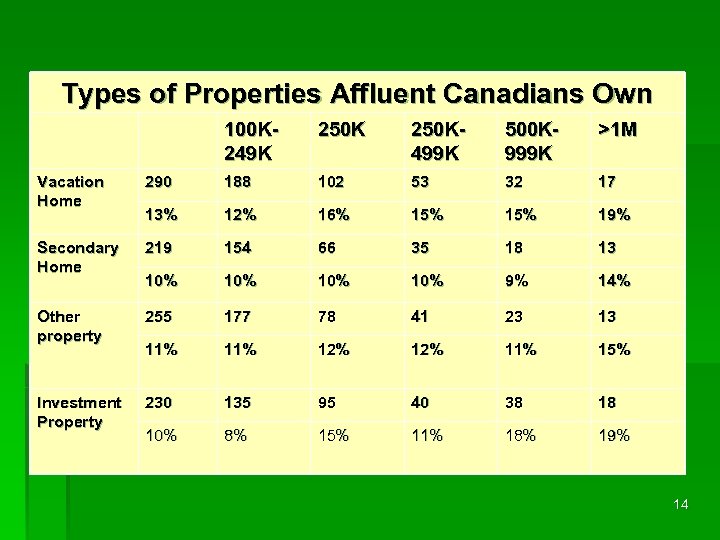 Types of Properties Affluent Canadians Own 100 K 249 K 250 K 499 K 500 K 999 K >1 M Vacation Home 290 188 102 53 32 17 13% 12% 16% 15% 19% Secondary Home 219 154 66 35 18 13 10% 10% 9% 14% Other property 255 177 78 41 23 13 11% 12% 11% 15% Investment Property 230 135 95 40 38 18 10% 8% 15% 11% 18% 19% 14
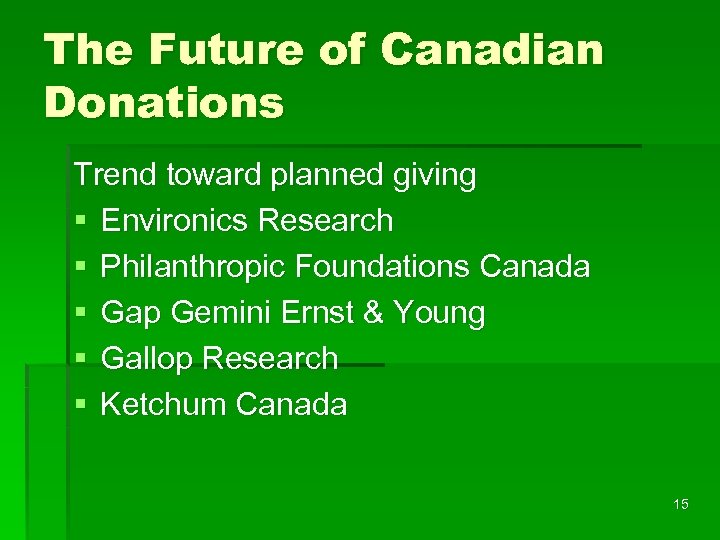 The Future of Canadian Donations Trend toward planned giving § Environics Research § Philanthropic Foundations Canada § Gap Gemini Ernst & Young § Gallop Research § Ketchum Canada 15
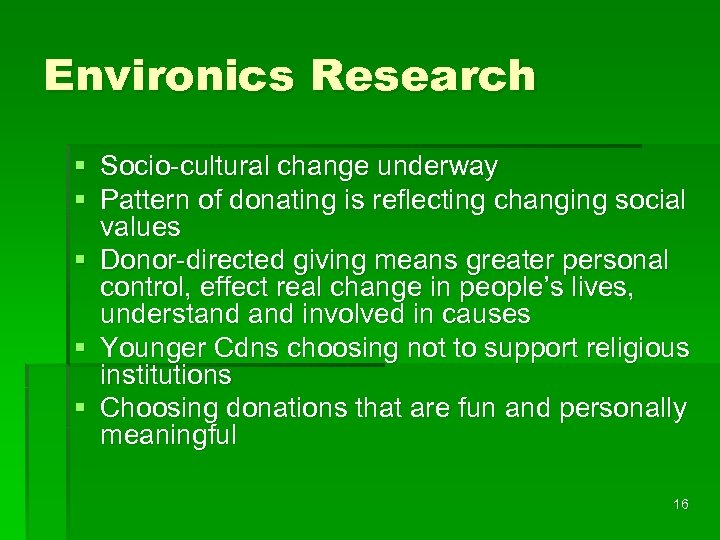 Environics Research § Socio-cultural change underway § Pattern of donating is reflecting changing social values § Donor-directed giving means greater personal control, effect real change in people’s lives, understand involved in causes § Younger Cdns choosing not to support religious institutions § Choosing donations that are fun and personally meaningful 16
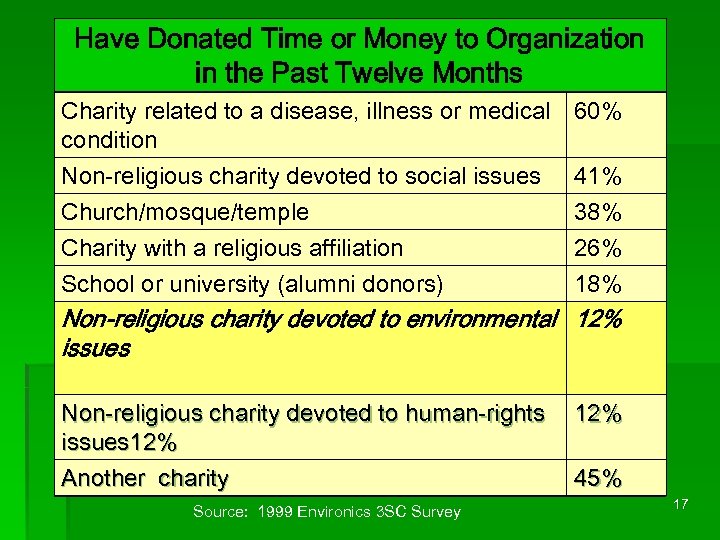 Have Donated Time or Money to Organization in the Past Twelve Months Charity related to a disease, illness or medical 60% condition Non-religious charity devoted to social issues Church/mosque/temple Charity with a religious affiliation School or university (alumni donors) 41% 38% 26% 18% Non-religious charity devoted to environmental 12% issues Non-religious charity devoted to human-rights issues 12% Another charity Source: 1999 Environics 3 SC Survey 12% 45% 17
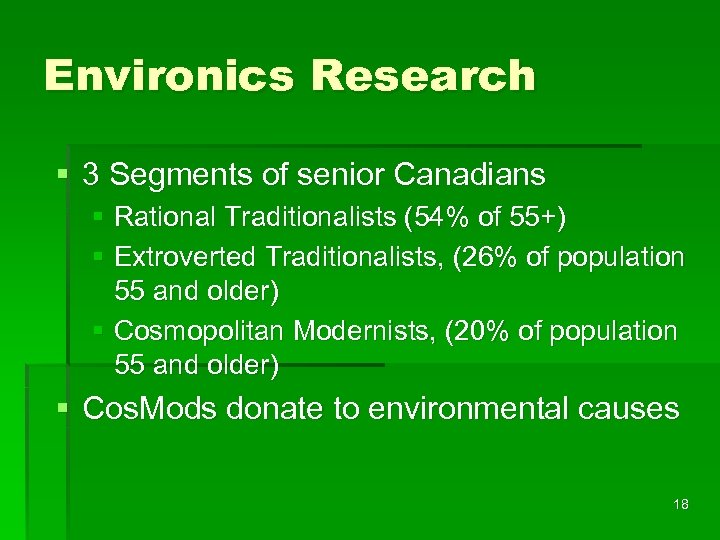 Environics Research § 3 Segments of senior Canadians § Rational Traditionalists (54% of 55+) § Extroverted Traditionalists, (26% of population 55 and older) § Cosmopolitan Modernists, (20% of population 55 and older) § Cos. Mods donate to environmental causes 18
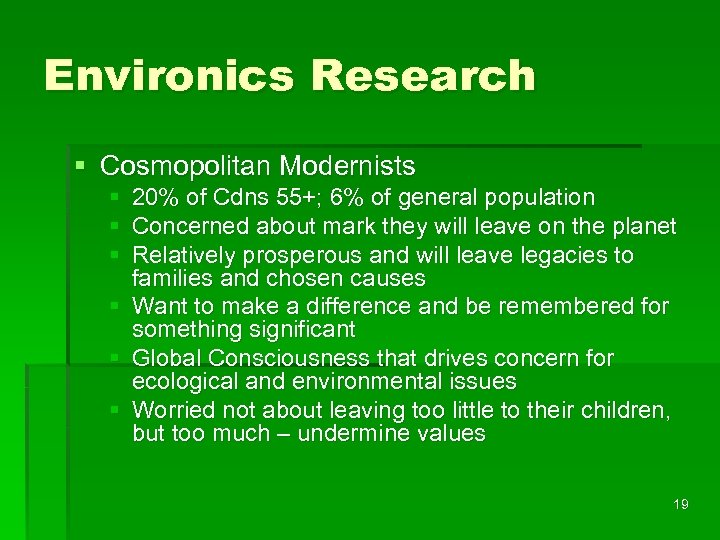 Environics Research § Cosmopolitan Modernists § 20% of Cdns 55+; 6% of general population § Concerned about mark they will leave on the planet § Relatively prosperous and will leave legacies to families and chosen causes § Want to make a difference and be remembered for something significant § Global Consciousness that drives concern for ecological and environmental issues § Worried not about leaving too little to their children, but too much – undermine values 19
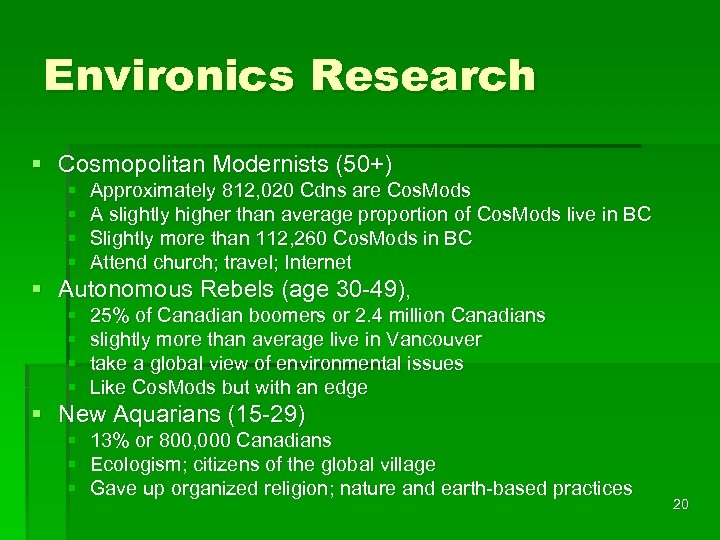 Environics Research § Cosmopolitan Modernists (50+) § § Approximately 812, 020 Cdns are Cos. Mods A slightly higher than average proportion of Cos. Mods live in BC Slightly more than 112, 260 Cos. Mods in BC Attend church; travel; Internet § Autonomous Rebels (age 30 -49), § § 25% of Canadian boomers or 2. 4 million Canadians slightly more than average live in Vancouver take a global view of environmental issues Like Cos. Mods but with an edge § New Aquarians (15 -29) § 13% or 800, 000 Canadians § Ecologism; citizens of the global village § Gave up organized religion; nature and earth-based practices 20
 Philanthropic Foundations Canada § “The trillion-dollar intergeneration transfer of wealth has already started and is expected to continue over the next 20 years. ” § “The baby boomers who are inheriting wealth have a profoundly different attitude from past generations – they don’t want to passively write cheques, they want to be directly involved. They want to change the world and make a difference. ” Source: “World of Charity on the Cusp of Change”, Philanthropic Foundations Canada, May 20, 2004 21
 Philanthropic Foundations Canada § Babyboomer inheritors want to be directly involved not passively write cheques § Change the world and make a difference § New type of entrepreneurial, activist philanthropist § Donate 6 X more to charity as those who inherit § Cdns give more when they plan donations ahead of time § 32% planned § 64% did not 22
 Cap Gemini Ernst & Young § Life expectancy growing; inheritors are older (50 s, 60 s, 70 s) § People receiving sizeable inheritances already successful in own right § Already have a financial advisor 23
 Gallop Research § Canadian baby boomers are expected to inherit an estimated one trillion dollars in bequests over the next 20 years § Between 8 and 10 million bequests are expected § 4 in 10 Canadians will inherit money 24
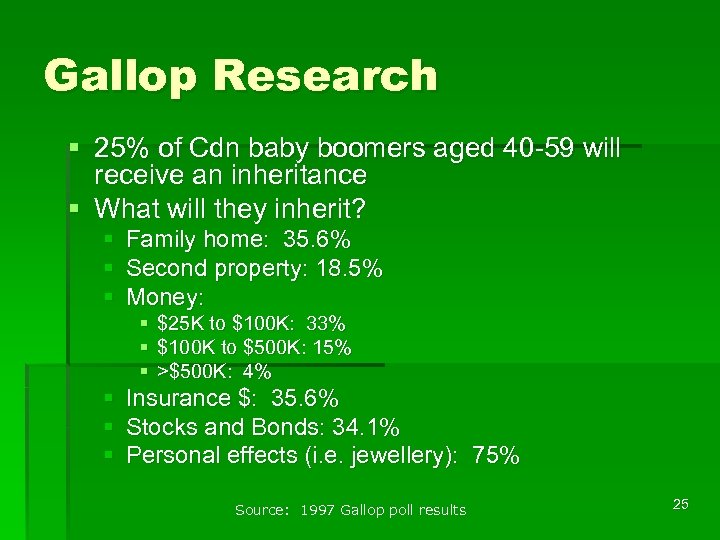 Gallop Research § 25% of Cdn baby boomers aged 40 -59 will receive an inheritance § What will they inherit? § § § Family home: 35. 6% Second property: 18. 5% Money: § $25 K to $100 K: 33% § $100 K to $500 K: 15% § >$500 K: 4% § § § Insurance $: 35. 6% Stocks and Bonds: 34. 1% Personal effects (i. e. jewellery): 75% Source: 1997 Gallop poll results 25
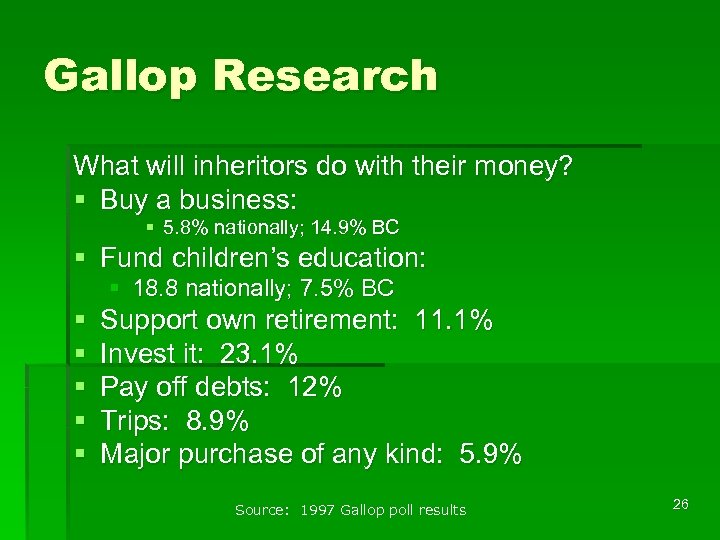 Gallop Research What will inheritors do with their money? § Buy a business: § 5. 8% nationally; 14. 9% BC § Fund children’s education: § 18. 8 nationally; 7. 5% BC § § § Support own retirement: 11. 1% Invest it: 23. 1% Pay off debts: 12% Trips: 8. 9% Major purchase of any kind: 5. 9% Source: 1997 Gallop poll results 26
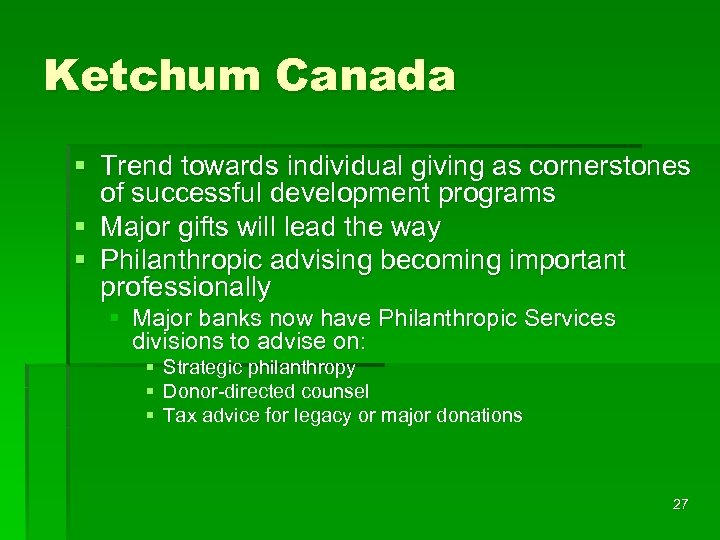 Ketchum Canada § Trend towards individual giving as cornerstones of successful development programs § Major gifts will lead the way § Philanthropic advising becoming important professionally § Major banks now have Philanthropic Services divisions to advise on: § Strategic philanthropy § Donor-directed counsel § Tax advice for legacy or major donations 27
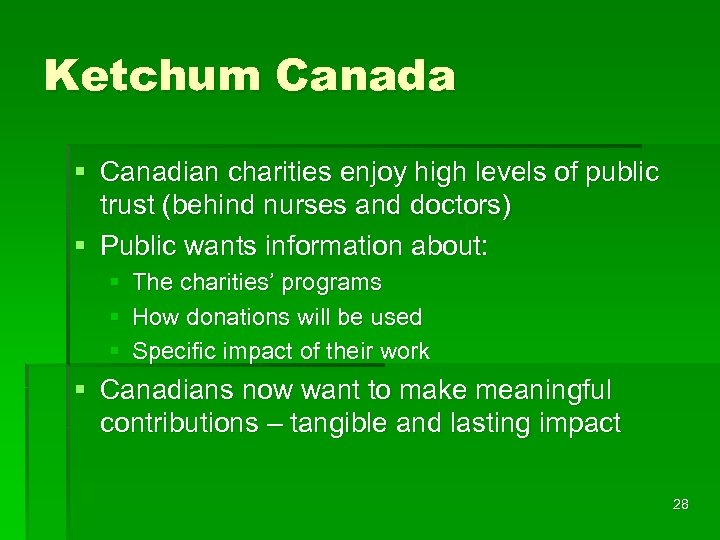 Ketchum Canada § Canadian charities enjoy high levels of public trust (behind nurses and doctors) § Public wants information about: § § § The charities’ programs How donations will be used Specific impact of their work § Canadians now want to make meaningful contributions – tangible and lasting impact 28
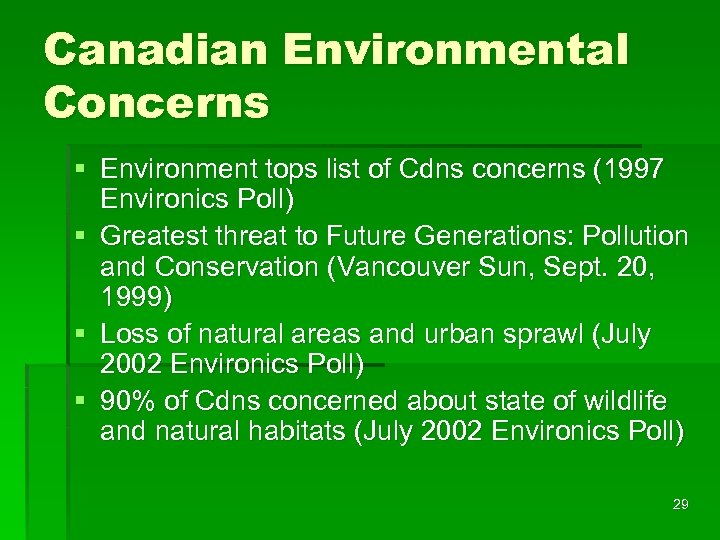 Canadian Environmental Concerns § Environment tops list of Cdns concerns (1997 Environics Poll) § Greatest threat to Future Generations: Pollution and Conservation (Vancouver Sun, Sept. 20, 1999) § Loss of natural areas and urban sprawl (July 2002 Environics Poll) § 90% of Cdns concerned about state of wildlife and natural habitats (July 2002 Environics Poll) 29
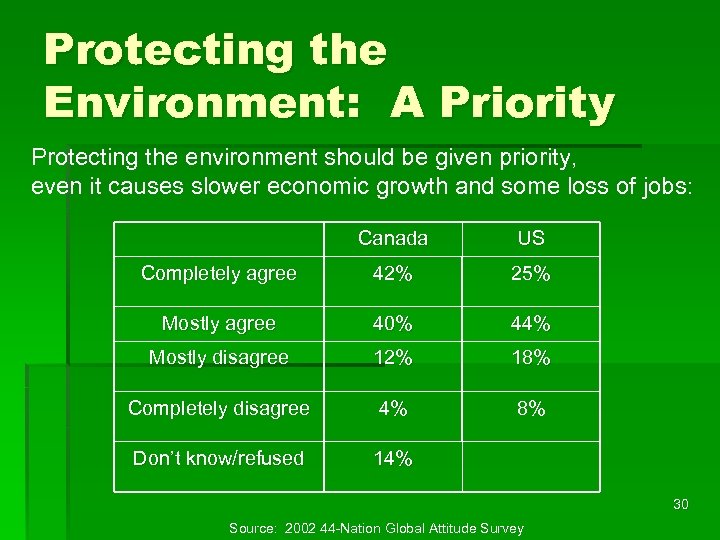 Protecting the Environment: A Priority Protecting the environment should be given priority, even it causes slower economic growth and some loss of jobs: Canada US Completely agree 42% 25% Mostly agree 40% 44% Mostly disagree 12% 18% Completely disagree 4% 8% Don’t know/refused 14% 30 Source: 2002 44 -Nation Global Attitude Survey
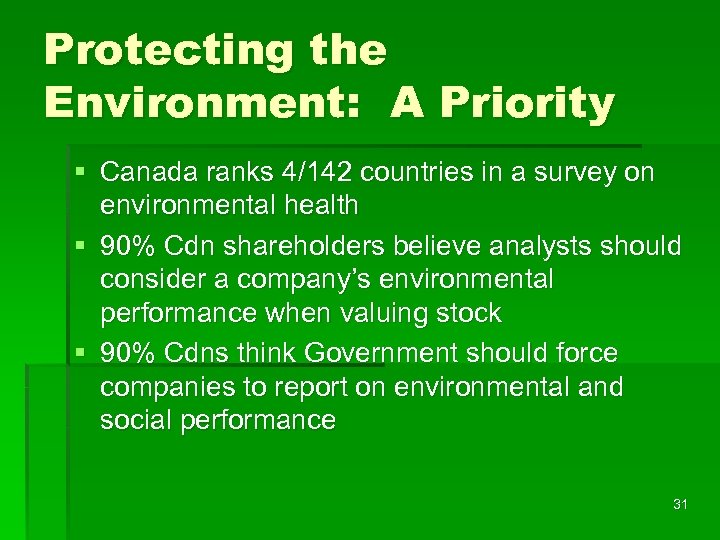 Protecting the Environment: A Priority § Canada ranks 4/142 countries in a survey on environmental health § 90% Cdn shareholders believe analysts should consider a company’s environmental performance when valuing stock § 90% Cdns think Government should force companies to report on environmental and social performance 31
 Donations to Environmental Causes § Yet only 2% of all donations go to environmental organizations 32
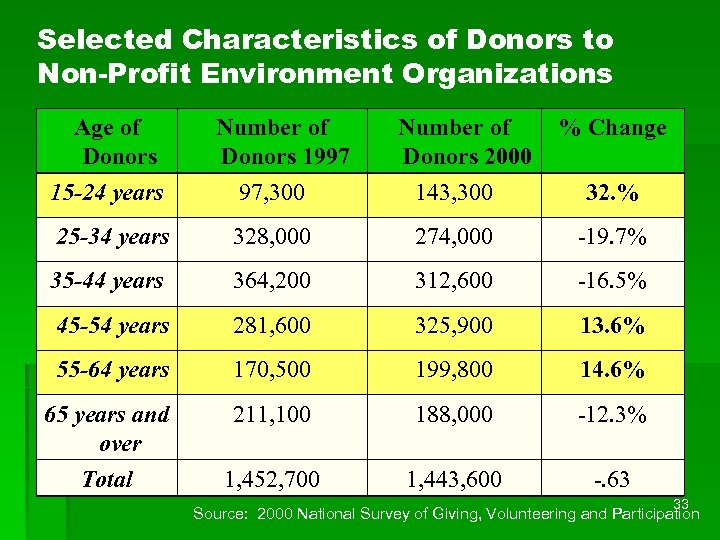 Selected Characteristics of Donors to Non-Profit Environment Organizations Age of Donors 15 -24 years Number of Donors 1997 97, 300 Number of Donors 2000 143, 300 % Change 32. % 25 -34 years 328, 000 274, 000 -19. 7% 35 -44 years 364, 200 312, 600 -16. 5% 45 -54 years 281, 600 325, 900 13. 6% 55 -64 years 170, 500 199, 800 14. 6% 65 years and over 211, 100 188, 000 -12. 3% Total 1, 452, 700 1, 443, 600 -. 63 33 Source: 2000 National Survey of Giving, Volunteering and Participation
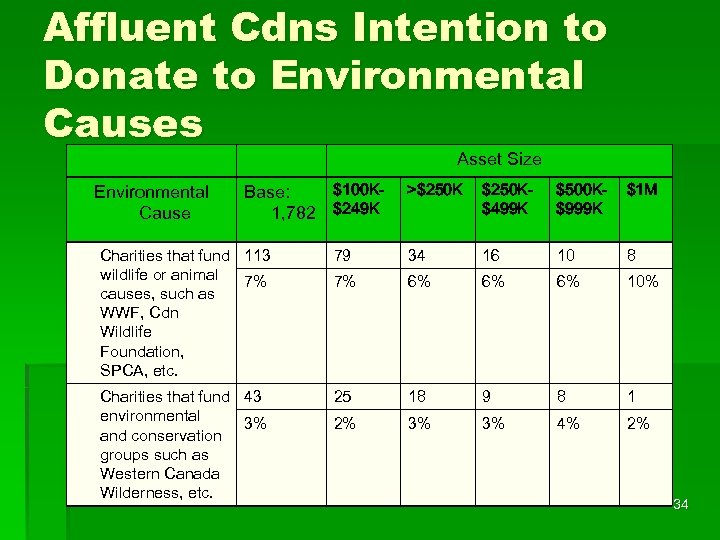 Affluent Cdns Intention to Donate to Environmental Causes Asset Size Environmental Cause $100 KBase: 1, 782 $249 K >$250 K$499 K $500 K$999 K $1 M Charities that fund 113 wildlife or animal 7% causes, such as WWF, Cdn Wildlife Foundation, SPCA, etc. 79 34 16 10 8 7% 6% 6% 6% 10% Charities that fund 43 environmental 3% and conservation groups such as Western Canada Wilderness, etc. 25 18 9 8 1 2% 3% 3% 4% 2% 34
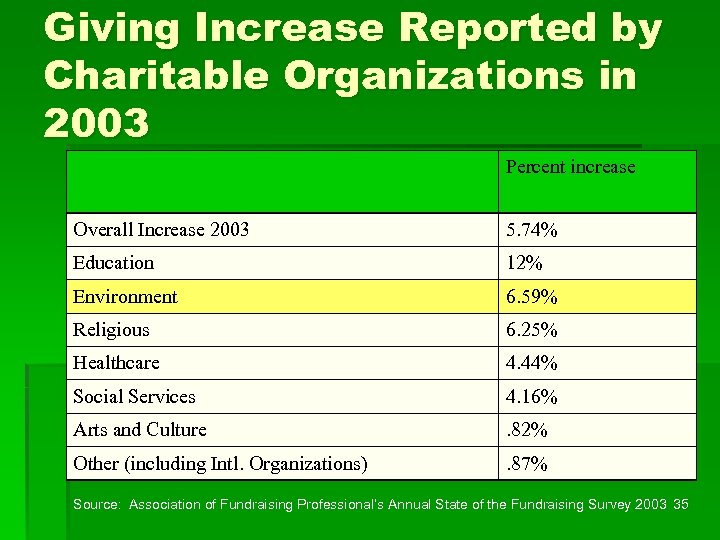 Giving Increase Reported by Charitable Organizations in 2003 Percent increase Overall Increase 2003 5. 74% Education 12% Environment 6. 59% Religious 6. 25% Healthcare 4. 44% Social Services 4. 16% Arts and Culture . 82% Other (including Intl. Organizations) . 87% Source: Association of Fundraising Professional’s Annual State of the Fundraising Survey 2003 35
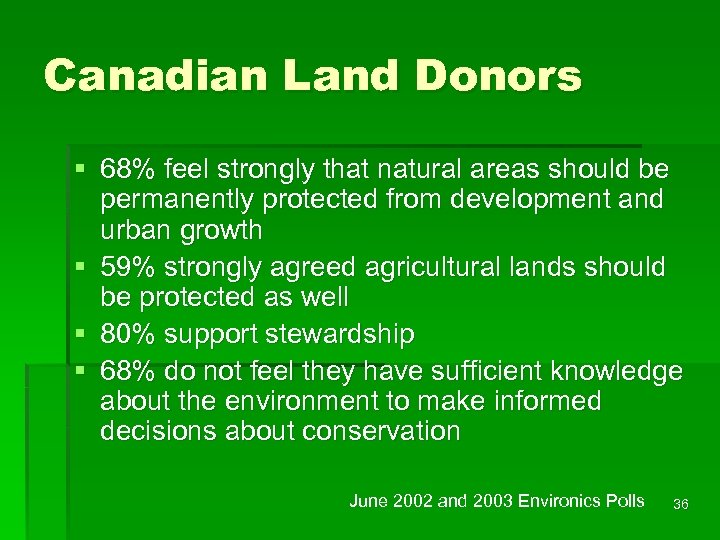 Canadian Land Donors § 68% feel strongly that natural areas should be permanently protected from development and urban growth § 59% strongly agreed agricultural lands should be protected as well § 80% support stewardship § 68% do not feel they have sufficient knowledge about the environment to make informed decisions about conservation June 2002 and 2003 Environics Polls 36
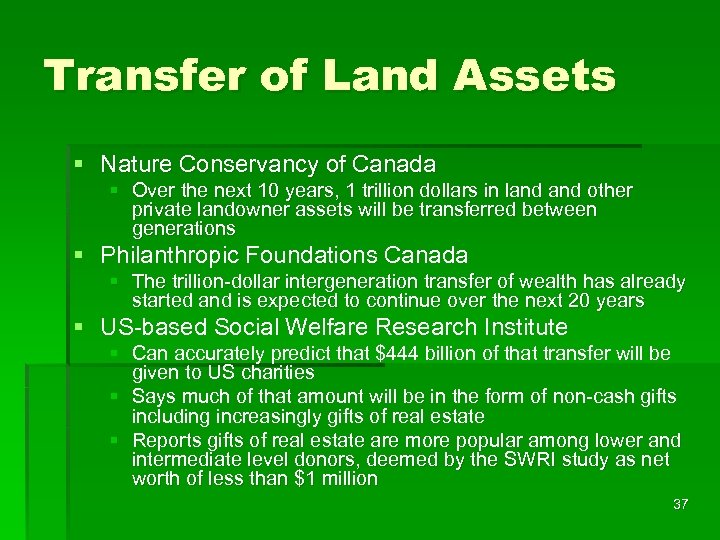 Transfer of Land Assets § Nature Conservancy of Canada § Over the next 10 years, 1 trillion dollars in land other private landowner assets will be transferred between generations § Philanthropic Foundations Canada § The trillion-dollar intergeneration transfer of wealth has already started and is expected to continue over the next 20 years § US-based Social Welfare Research Institute § Can accurately predict that $444 billion of that transfer will be given to US charities § Says much of that amount will be in the form of non-cash gifts including increasingly gifts of real estate § Reports gifts of real estate are more popular among lower and intermediate level donors, deemed by the SWRI study as net worth of less than $1 million 37
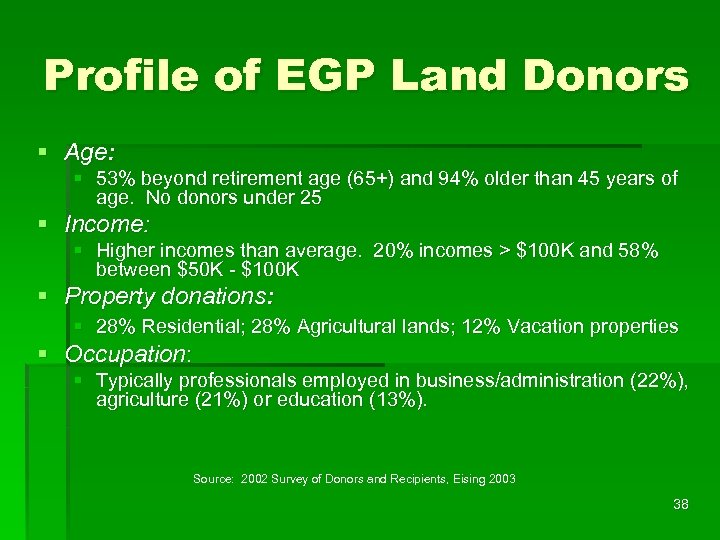 Profile of EGP Land Donors § Age: § 53% beyond retirement age (65+) and 94% older than 45 years of age. No donors under 25 § Income: § Higher incomes than average. 20% incomes > $100 K and 58% between $50 K - $100 K § Property donations: § 28% Residential; 28% Agricultural lands; 12% Vacation properties § Occupation: § Typically professionals employed in business/administration (22%), agriculture (21%) or education (13%). Source: 2002 Survey of Donors and Recipients, Eising 2003 38
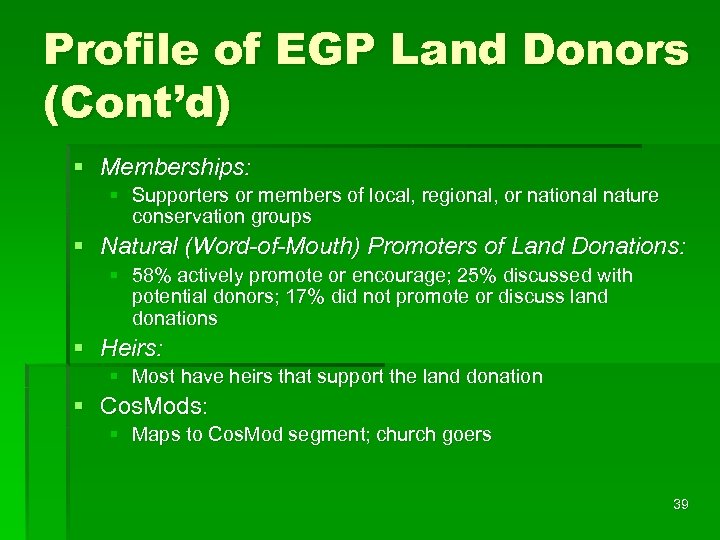 Profile of EGP Land Donors (Cont’d) § Memberships: § Supporters or members of local, regional, or national nature conservation groups § Natural (Word-of-Mouth) Promoters of Land Donations: § 58% actively promote or encourage; 25% discussed with potential donors; 17% did not promote or discuss land donations § Heirs: § Most have heirs that support the land donation § Cos. Mods: § Maps to Cos. Mod segment; church goers 39
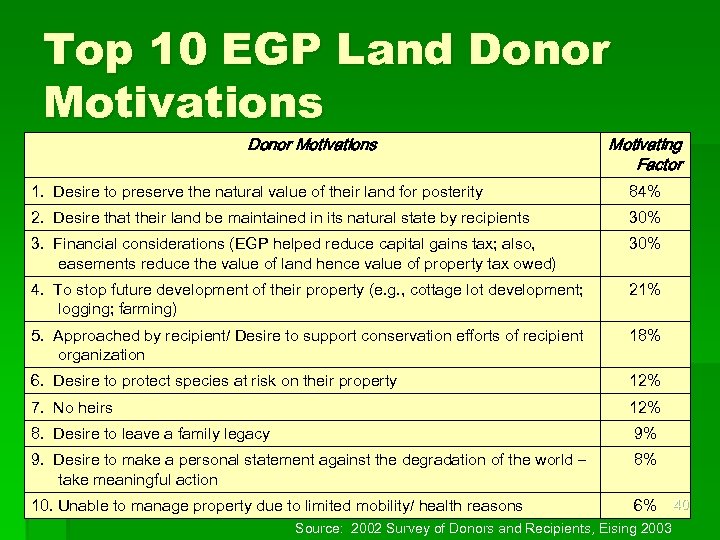 Top 10 EGP Land Donor Motivations Motivating Factor 1. Desire to preserve the natural value of their land for posterity 84% 2. Desire that their land be maintained in its natural state by recipients 30% 3. Financial considerations (EGP helped reduce capital gains tax; also, easements reduce the value of land hence value of property tax owed) 30% 4. To stop future development of their property (e. g. , cottage lot development; logging; farming) 21% 5. Approached by recipient/ Desire to support conservation efforts of recipient organization 18% 6. Desire to protect species at risk on their property 12% 7. No heirs 12% 8. Desire to leave a family legacy 9% 9. Desire to make a personal statement against the degradation of the world – take meaningful action 8% 10. Unable to manage property due to limited mobility/ health reasons 6% Source: 2002 Survey of Donors and Recipients, Eising 2003 40
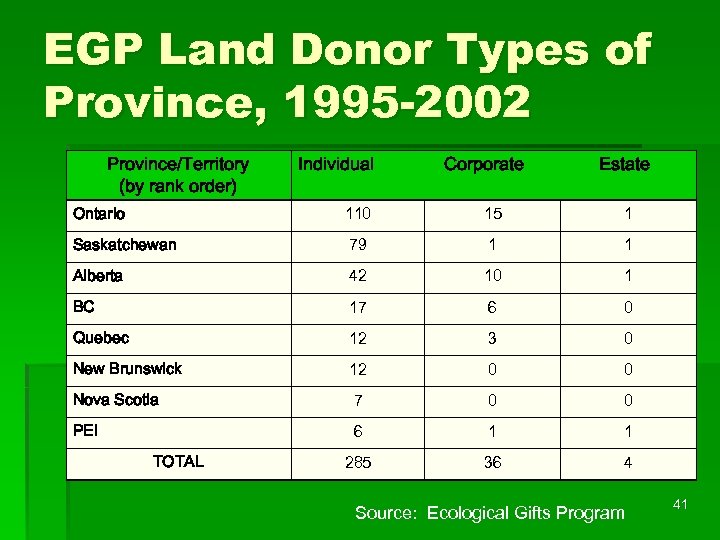 EGP Land Donor Types of Province, 1995 -2002 Province/Territory (by rank order) Individual Corporate Estate Ontario 110 15 1 Saskatchewan 79 1 1 Alberta 42 10 1 BC 17 6 0 Quebec 12 3 0 New Brunswick 12 0 0 Nova Scotia 7 0 0 PEI 6 1 1 285 36 4 TOTAL Source: Ecological Gifts Program 41
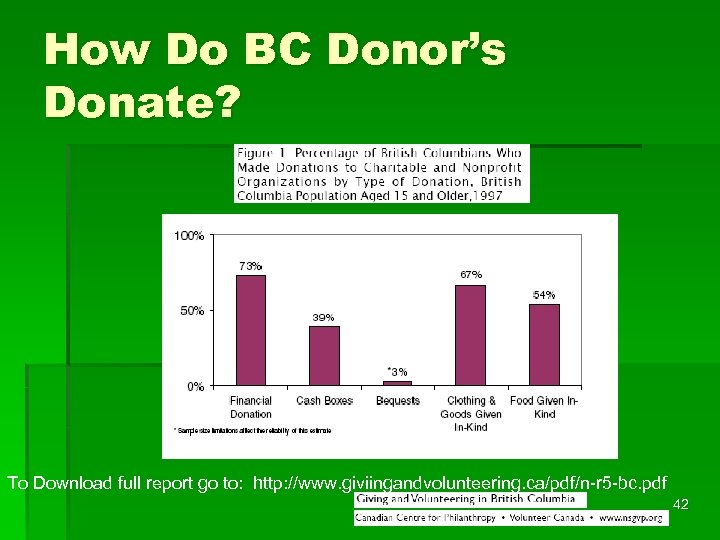 How Do BC Donor’s Donate? To Download full report go to: http: //www. giviingandvolunteering. ca/pdf/n-r 5 -bc. pdf 42
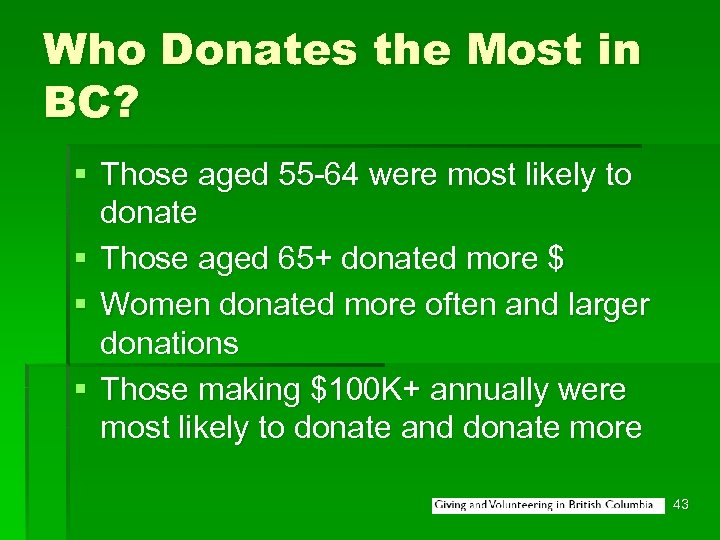 Who Donates the Most in BC? § Those aged 55 -64 were most likely to donate § Those aged 65+ donated more $ § Women donated more often and larger donations § Those making $100 K+ annually were most likely to donate and donate more 43
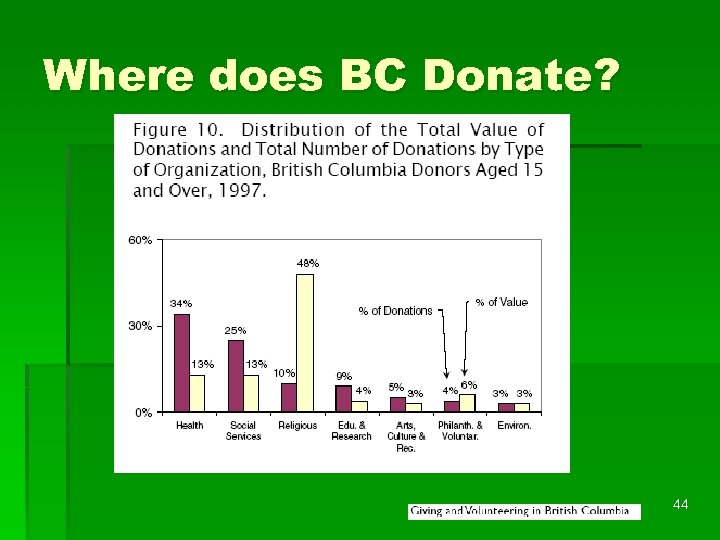 Where does BC Donate? 44
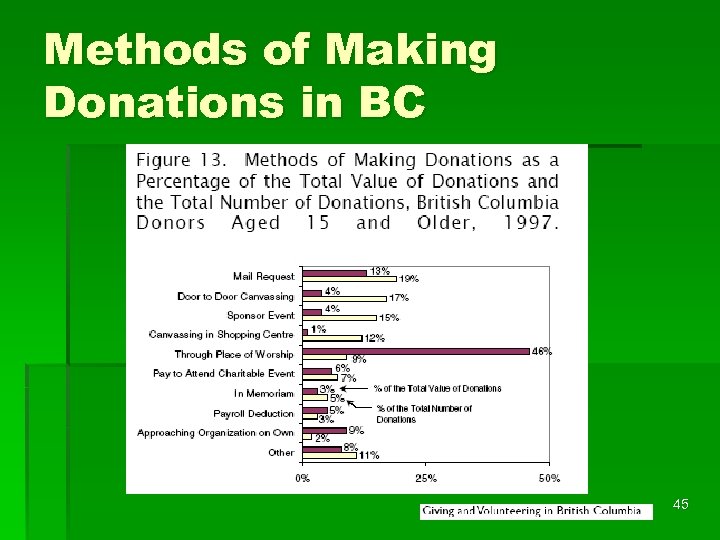 Methods of Making Donations in BC 45
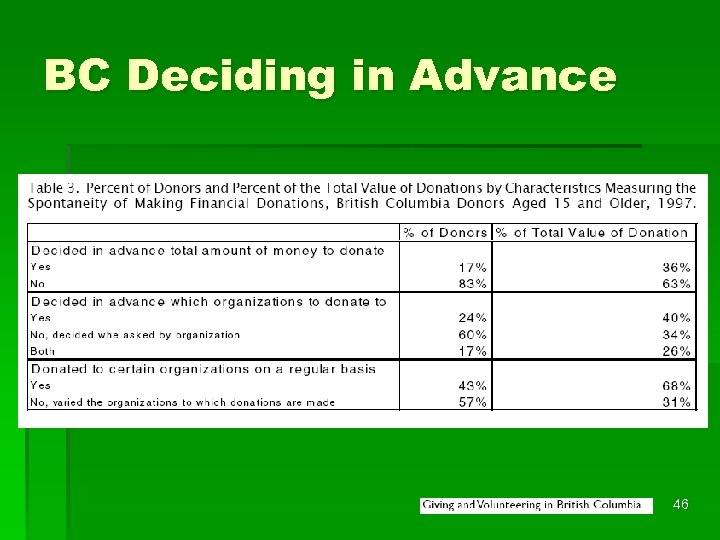 BC Deciding in Advance 46
 QUESTIONS? § Workshop: Finding your Donors, Sunday 10 a. m. to noon (Lorna Visser and Susan Anderson) § What this research means for you and your organization § What you need to have in place in your organization to undertake an effective planned giving program § Where to find your planned giving donors § How can you engage "allied professionals“ (financial planners, advisors, etc. ) in your community § What tools you can use to support your outreach effort § To download a copy of EGP’s Canadian Philanthropy and Environmental Donors report: www. e-cocreate. com and click on Links webpage. § To download a copy of Giving and Volunteering in British Columbia: http: //www. givingandvolunteering. ca/pdf/n-r 5 -bc. pdf § Our Thanks! 47