


 Скачать презентацию Profile on the country Italy Alina Vorontsova Narva
Italy- Profile on the country.pptx
- Количество слайдов: 10
 Profile on the country: Italy Alina Vorontsova Narva 2016
 Universalism vs. Particularism • Italia is a country who can be seen as universalism society. • In universalism, rules do not depend on a certain situation but are always true and always have to be followed. • No matter what is said in business negotiations, in Italy the contract itself is what is important. The legal written document is binds the parties involved.
 Individualism vs. Communitarism / Collectivism • Italians will see themselves and their close family as the center of their world and they refer everything they do back to the happiness of those people. Therefore, Italians are rather individualistic people as their immediate family is most important to them. • There are 76% of individualism according to the data of Geert Hofstede. • Also, it is said that Italians, who live in Southern Italy have less Individualistic behavior. They say that they feel cold not only for the different climate but for the less “warm” approach in relationships.
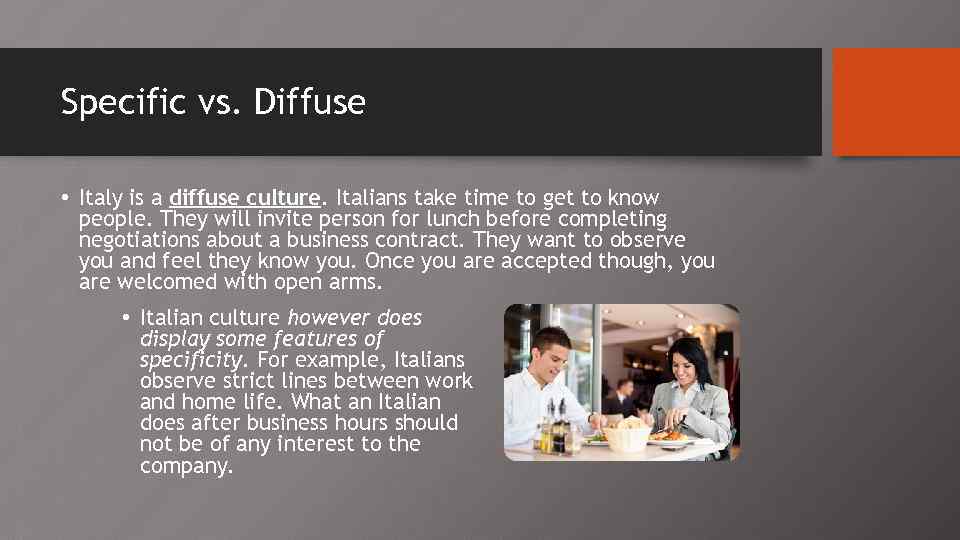 Specific vs. Diffuse • Italy is a diffuse culture. Italians take time to get to know people. They will invite person for lunch before completing negotiations about a business contract. They want to observe you and feel they know you. Once you are accepted though, you are welcomed with open arms. • Italian culture however does display some features of specificity. For example, Italians observe strict lines between work and home life. What an Italian does after business hours should not be of any interest to the company.
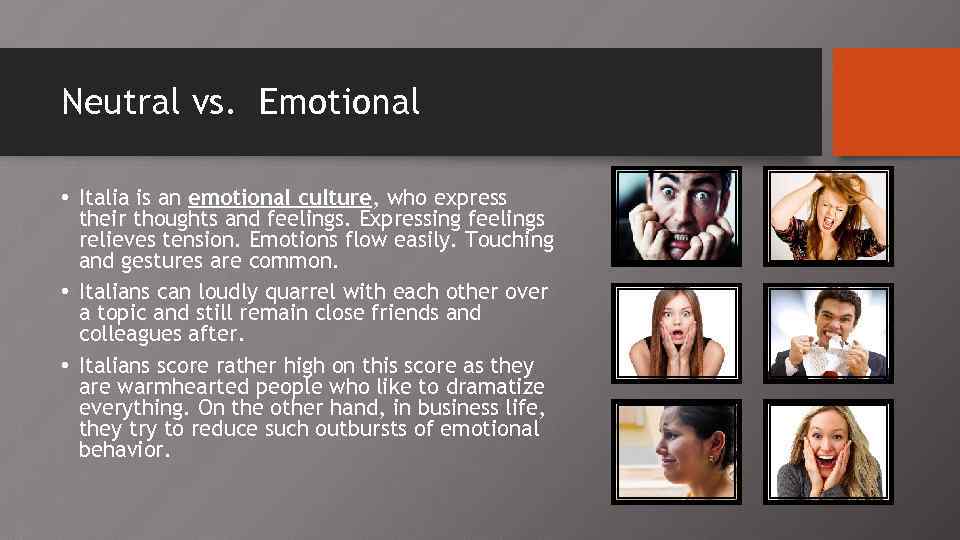 Neutral vs. Emotional • Italia is an emotional culture, who express their thoughts and feelings. Expressing feelings relieves tension. Emotions flow easily. Touching and gestures are common. • Italians can loudly quarrel with each other over a topic and still remain close friends and colleagues after. • Italians score rather high on this score as they are warmhearted people who like to dramatize everything. On the other hand, in business life, they try to reduce such outbursts of emotional behavior.
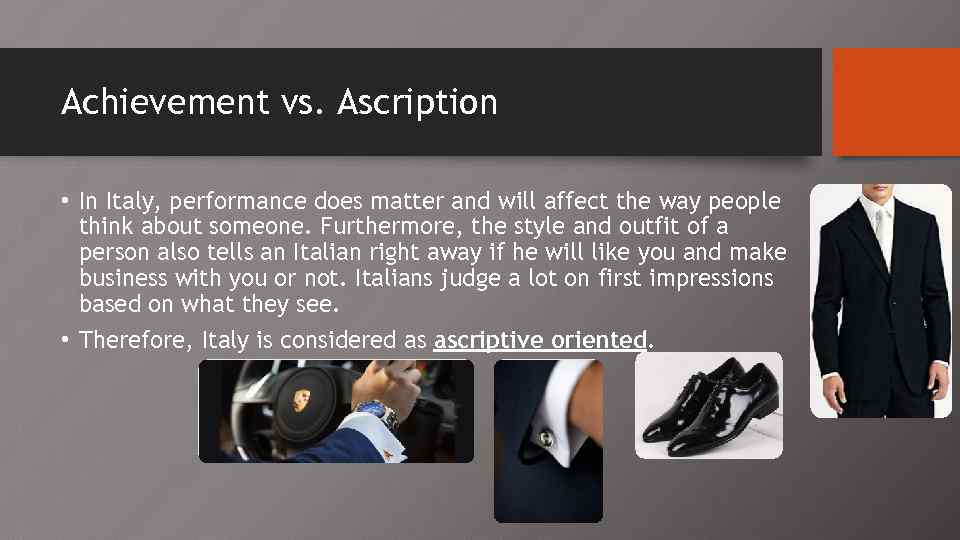 Achievement vs. Ascription • In Italy, performance does matter and will affect the way people think about someone. Furthermore, the style and outfit of a person also tells an Italian right away if he will like you and make business with you or not. Italians judge a lot on first impressions based on what they see. • Therefore, Italy is considered as ascriptive oriented.
 Sequential vs. Synchronic Time • Italians should be put in the category of synchronic time as they do not value punctuality so much and have less strict time schedules. • Еhey are usually capable of and willing to do several tasks at the same time. • Italians have learned to take the long view, anticipating the unexpected and coping with surprises philosophically.
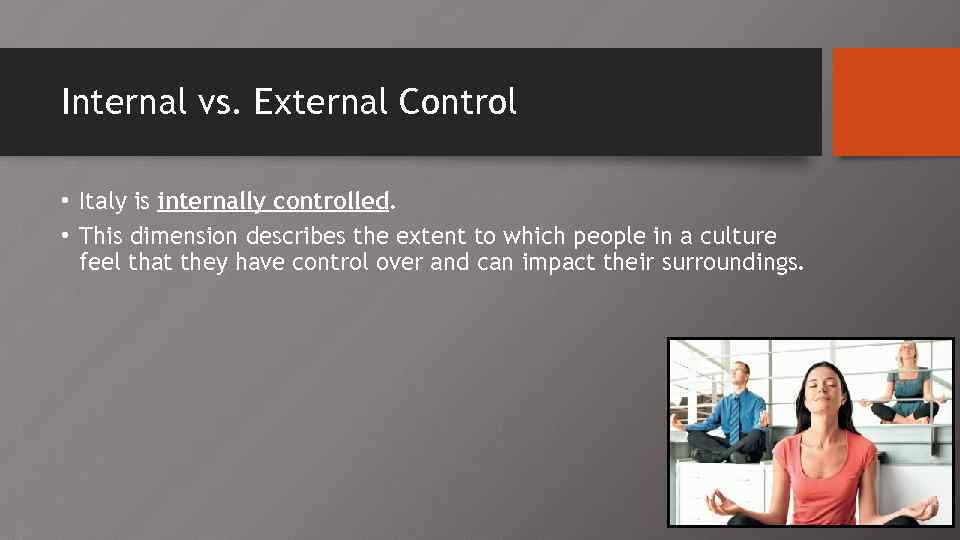 Internal vs. External Control • Italy is internally controlled. • This dimension describes the extent to which people in a culture feel that they have control over and can impact their surroundings.
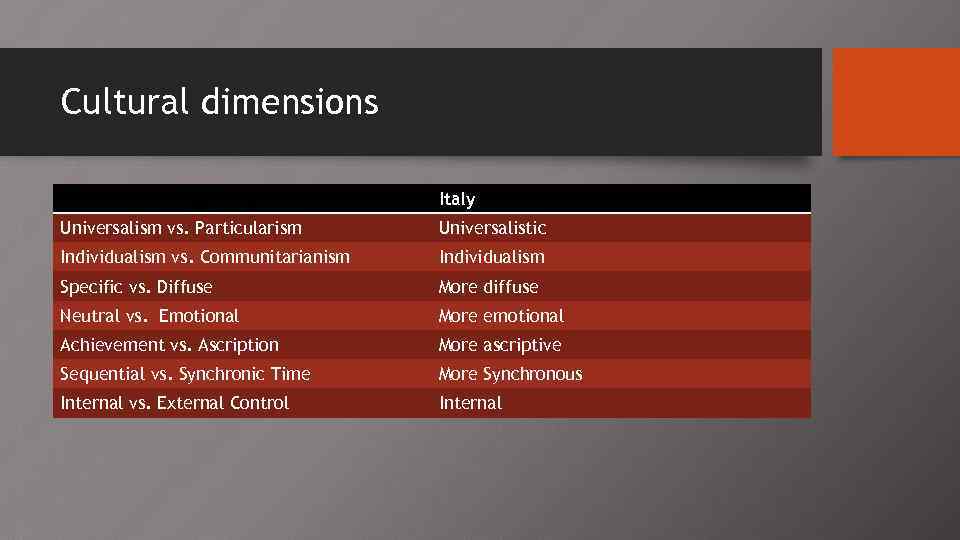 Cultural dimensions Italy Universalism vs. Particularism Universalistic Individualism vs. Communitarianism Individualism Specific vs. Diffuse More diffuse Neutral vs. Emotional More emotional Achievement vs. Ascription More ascriptive Sequential vs. Synchronic Time More Synchronous Internal vs. External Control Internal
 • Thank you for your kind attention!