


 Скачать презентацию Professor David Eastwood Chief Executive Higher Education Funding
197aa7b4420fa831eb2e66324e6185ac.ppt
- Количество слайдов: 45
 Professor David Eastwood Chief Executive Higher Education Funding Council for England HEFCE Annual Conference 7 April 2008 Unlocking the full potential of higher education: achievements, challenges and opportunities
 The Funding Environment
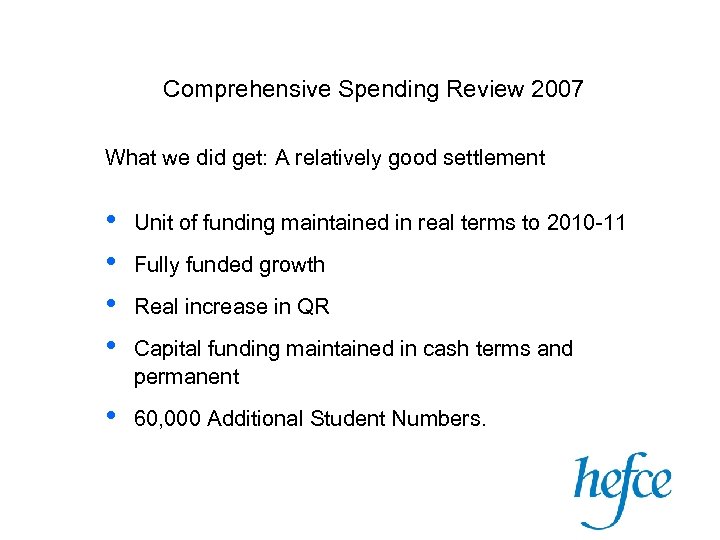 Comprehensive Spending Review 2007 What we did get: A relatively good settlement • • Unit of funding maintained in real terms to 2010 -11 • 60, 000 Additional Student Numbers. Fully funded growth Real increase in QR Capital funding maintained in cash terms and permanent
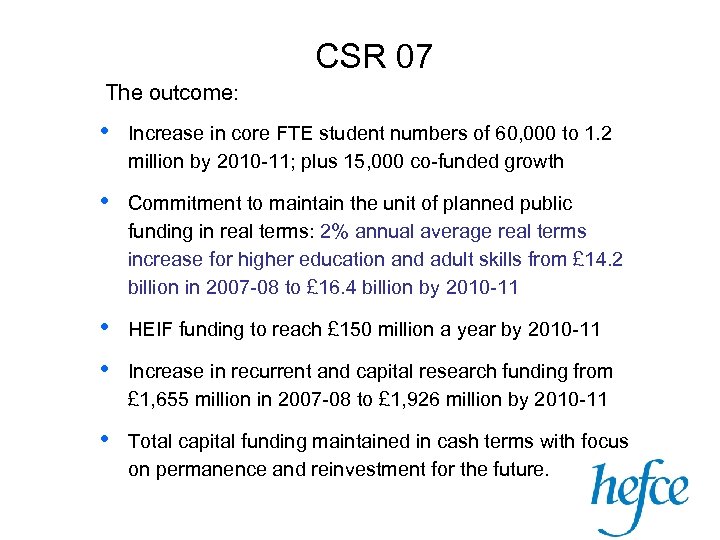 CSR 07 The outcome: • Increase in core FTE student numbers of 60, 000 to 1. 2 million by 2010 -11; plus 15, 000 co-funded growth • Commitment to maintain the unit of planned public funding in real terms: 2% annual average real terms increase for higher education and adult skills from £ 14. 2 billion in 2007 -08 to £ 16. 4 billion by 2010 -11 • • HEIF funding to reach £ 150 million a year by 2010 -11 • Total capital funding maintained in cash terms with focus on permanence and reinvestment for the future. Increase in recurrent and capital research funding from £ 1, 655 million in 2007 -08 to £ 1, 926 million by 2010 -11
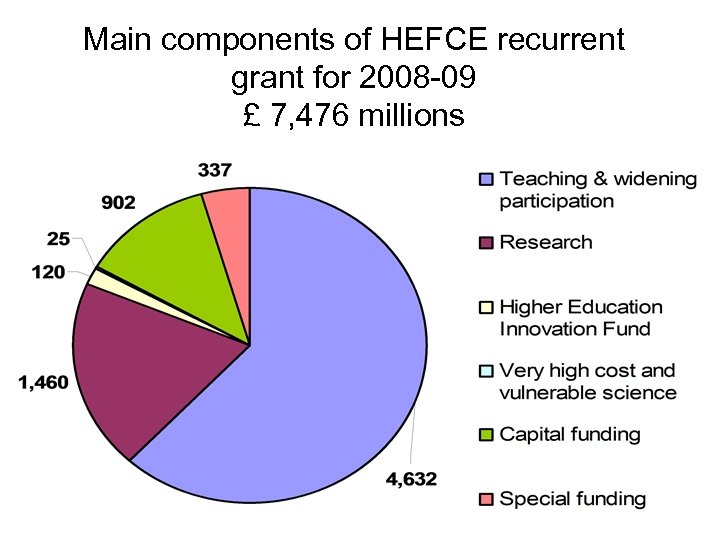 Main components of HEFCE recurrent grant for 2008 -09 £ 7, 476 millions
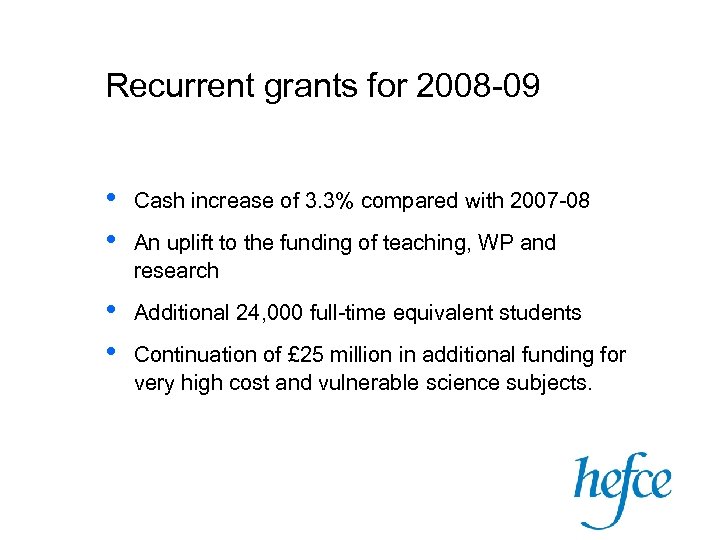 Recurrent grants for 2008 -09 • • Cash increase of 3. 3% compared with 2007 -08 • • Additional 24, 000 full-time equivalent students An uplift to the funding of teaching, WP and research Continuation of £ 25 million in additional funding for very high cost and vulnerable science subjects.
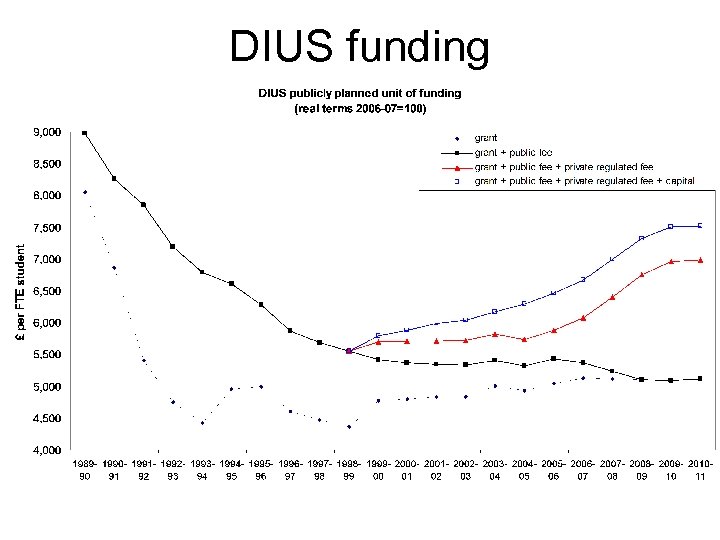 DIUS funding
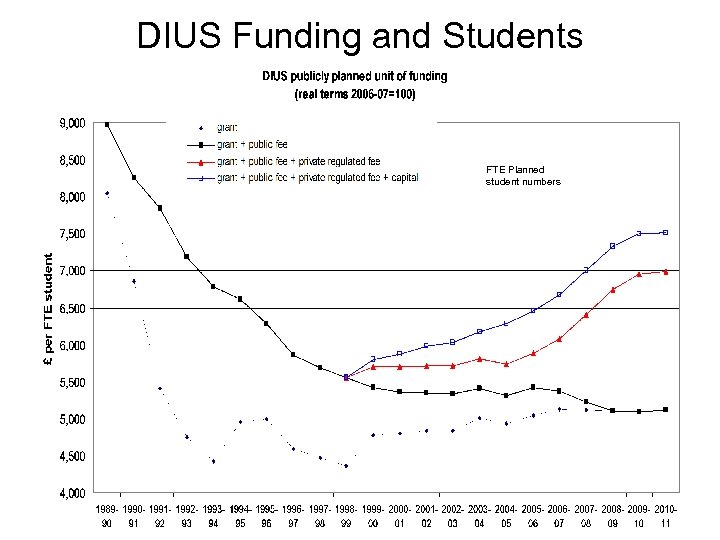 DIUS Funding and Students FTE Planned student numbers
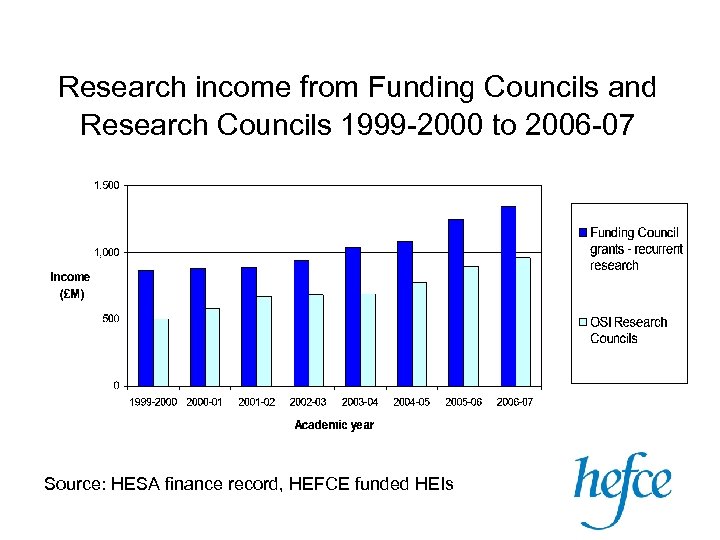 Research income from Funding Councils and Research Councils 1999 -2000 to 2006 -07 Source: HESA finance record, HEFCE funded HEIs
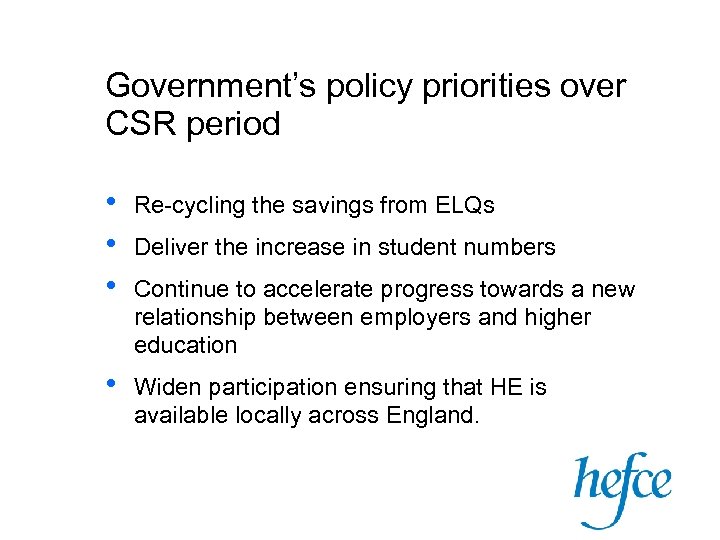 Government’s policy priorities over CSR period • • • Re-cycling the savings from ELQs • Widen participation ensuring that HE is available locally across England. Deliver the increase in student numbers Continue to accelerate progress towards a new relationship between employers and higher education
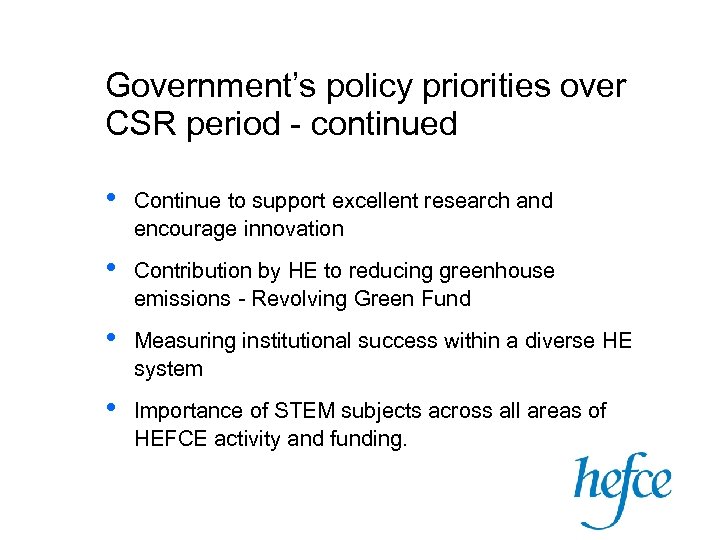 Government’s policy priorities over CSR period - continued • Continue to support excellent research and encourage innovation • Contribution by HE to reducing greenhouse emissions - Revolving Green Fund • Measuring institutional success within a diverse HE system • Importance of STEM subjects across all areas of HEFCE activity and funding.
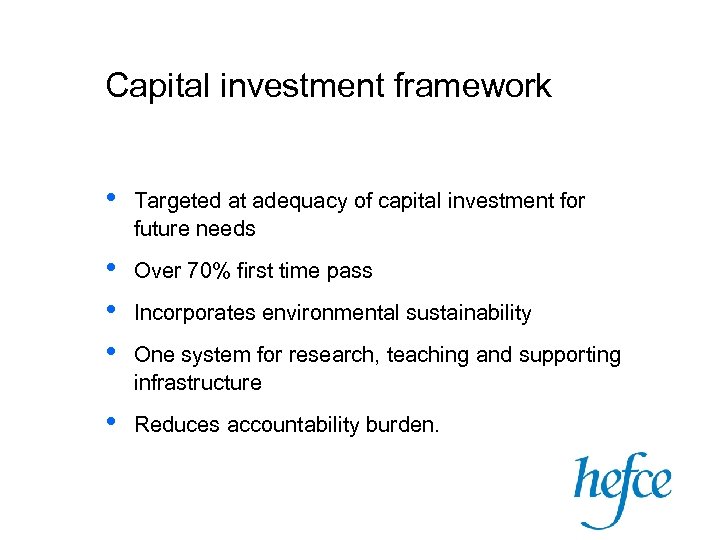 Capital investment framework • Targeted at adequacy of capital investment for future needs • • • Over 70% first time pass • Reduces accountability burden. Incorporates environmental sustainability One system for research, teaching and supporting infrastructure
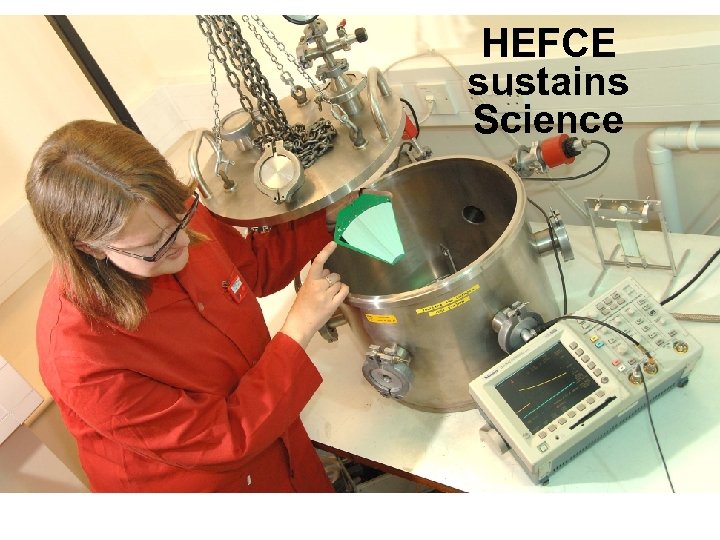 HEFCE sustains Science
 HEFCE sustains science • • 2005 Roberts review: healthy and vibrant HE system • £ 250 m programme of work tailored to the needs of each vulnerable discipline • 2008 Follett review: reviewing progress and locating STEM within new policy environment of employer engagement • Beyond 2008: addressing the Sainsbury issue of graduate supply and demand. Selective approach to strategically important and vulnerable subjects
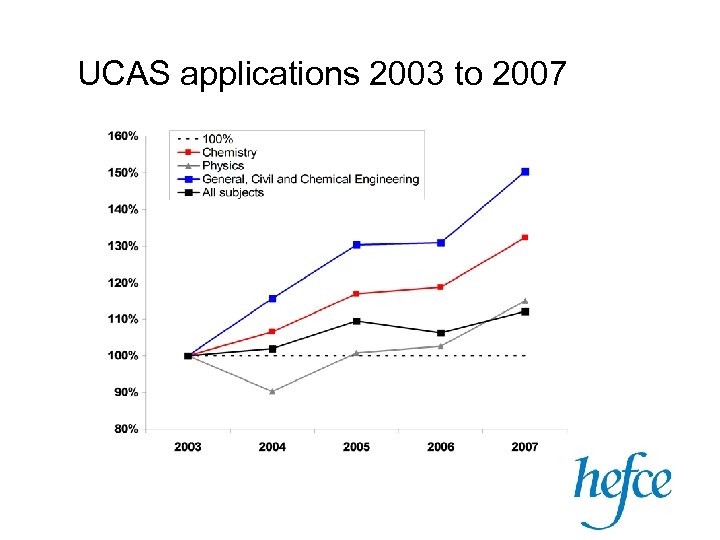 UCAS applications 2003 to 2007
 HEFCE additional support for STEM • Additional £ 75 m for very high cost and vulnerable lab based subjects • Over £ 15 m to date for demand raising work in physics, chemistry, engineering and mathematics; integrated and embedded programme planned for 2009 • £ 12. 5 m award for South East Physics Network (SEPNET).
 Research capacity building and collaboration in STEM subjects Developing regional research capacity with RDAs • £ 4 m for Great Western Research; £ 4 m for Midlands Physics; £ 10 m for Birmingham & Warwick Science City Alliance • Developing national research capacity with Research Councils • £ 4 m for integrative mammalian biology; £ 6 m to date for engineering and physical sciences.
 Research Excellence Framework
 Research Excellence Framework (REF) The story so far: • The Secretary of State has asked HEFCE to implement the new framework, working with the other funding bodies and in consultation with the sector • We consulted widely on key elements in the proposals and received 274 responses (338 UK)
 Responses: Key points (1) • • Strong support for the dual support system and QR • Recognition that bibliometrics can provide robust indicators, but will require more work • Many – but not all – say that REF should capture user value and impact, but little consensus on how this can be done Support for REF to focus on research excellence wherever it is found
 Responses: Key points (2) Most respondents had strong concerns about two elements in the proposals: • The proposed twin track assessment approach with two discrete subject blocks was considered too inflexible and potentially complex to operate. A more unified system, combining a range of metrics and with varying expert input as appropriate in different disciplines, would be preferred. • The timetable for developing the framework is too tight, including in relation to the need for further consultation and to give due notice of what will be required from HEIs.
 REF: what happens next? • • An early start on a pilot exercise in bibliometric analysis • Further work on a number of other issues raised in the consultations • We remain committed to full implementation of a new framework by 2014. An early start to dialogue with the sector on developing light touch peer review and on choosing and using other metrics
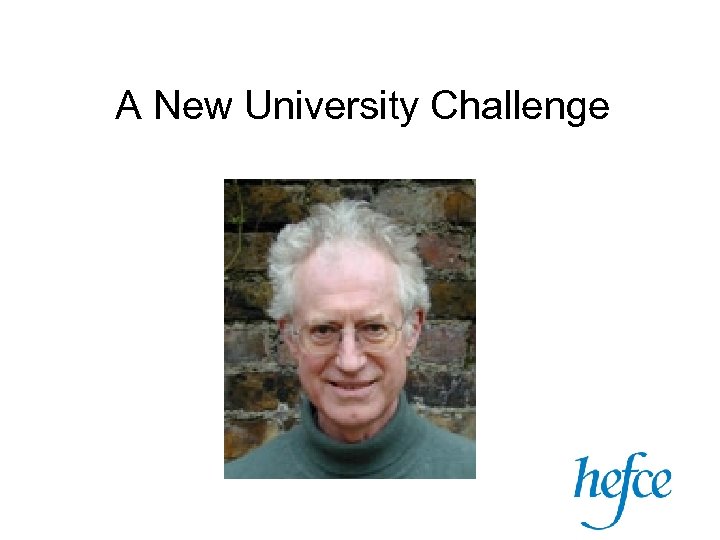 A New University Challenge
 A new “university challenge” • • Programme announced on 3 March • Builds on HEFCE’s existing programme – £ 132 Million HEFCE expenditure in eight regions since 2004 • Range from major transformational developments (University of Cumbria, Combined Universities in Cornwall), through to small feasibility studies, which have led to decisions not to proceed. Plan to develop 20 new HE centres over the next 6 years
 A new “university challenge” • All projects have long gestation periods • All involve bringing together a range of funding sources – HEFCE, RDA, LSC and others • Complex negotiation processes • Careful assessment • All need to be sustainable and to take account of local demand available provision.
 So what’s new? • • No additional resources in this spending review Use of SDF – many other demands A number of projects are already in the pipeline No planning blight HEFCE to lead a debate Seek to develop broader and more explicit criteria Possible greater emphasis on regeneration as a strong focus.
 Timetable • Paper to HEFCE Board on 8 May • Initial consultation June to end September • Wider range of consultees than usual – RDAs, local authorities • Assessment of consultation responses in the autumn • Return to HEFCE Board in November • Further debate on criteria – possible regional meetings • Report back to Secretary of State • Revised policy statement Spring 2009.
 The certainty of uncertainty
 Spending Review 2009 • • • What? When? How? The fiscal climate? The political climate?
 Fees Review 2009 In 2004 the Secretary of State for Education and Skills announced: • An independent review, working with the Office For Fair Access, to report to the House, on all aspects of the new arrangements based on the first three years’ operation of the policy. • This would include: – The impact of the new arrangements on higher education institutions – The impact of the new arrangements on students and prospective students – Future policy.
 Challenges to the HE sector
 Challenges to the HE Sector • • • Aligning resources and academic priorities • • • Building on strengths Clarity of mission – institutional distinctiveness Reviewing and re-engineering institutional business models Promoting quality Pay and pensions.
 Pay and Pensions
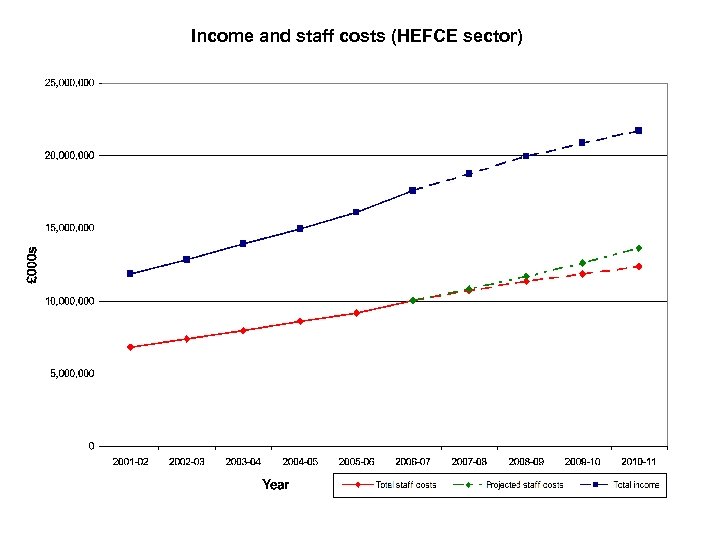 Income and staff costs (HEFCE sector)
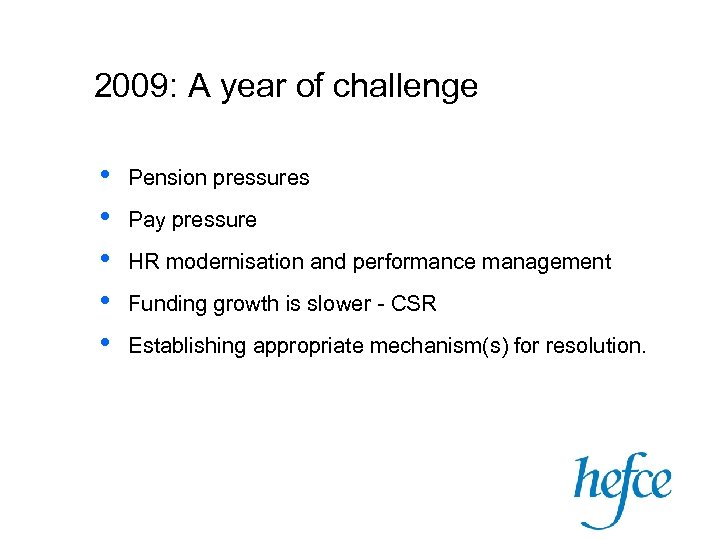 2009: A year of challenge • • • Pension pressures Pay pressure HR modernisation and performance management Funding growth is slower - CSR Establishing appropriate mechanism(s) for resolution.
 Development of 10 -15 year framework for higher education
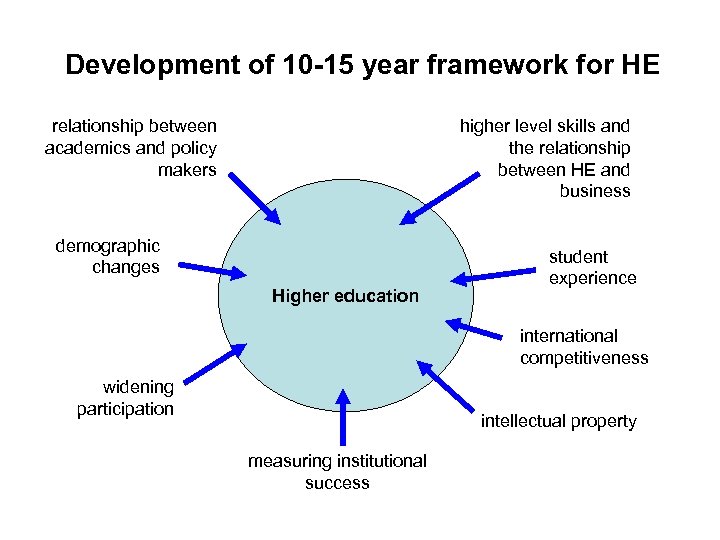 Development of 10 -15 year framework for HE relationship between academics and policy makers higher level skills and the relationship between HE and business demographic changes Higher education student experience international competitiveness widening participation intellectual property measuring institutional success
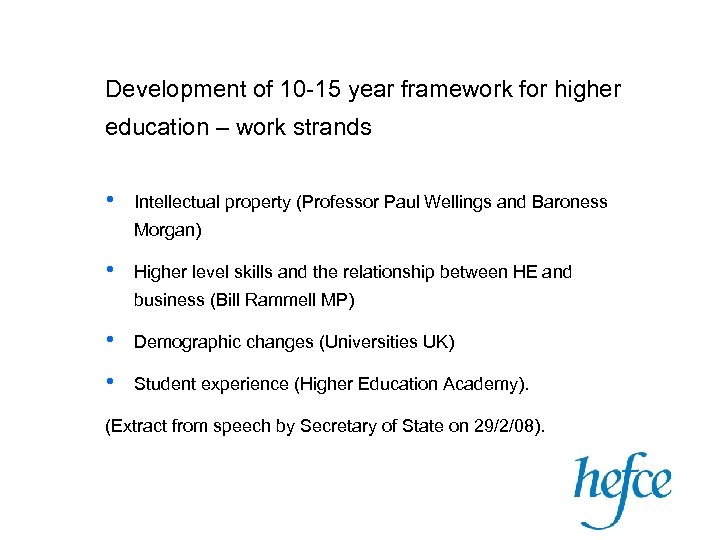 Development of 10 -15 year framework for higher education – work strands • Intellectual property (Professor Paul Wellings and Baroness Morgan) • Higher level skills and the relationship between HE and business (Bill Rammell MP) • Demographic changes (Universities UK) • Student experience (Higher Education Academy). (Extract from speech by Secretary of State on 29/2/08).
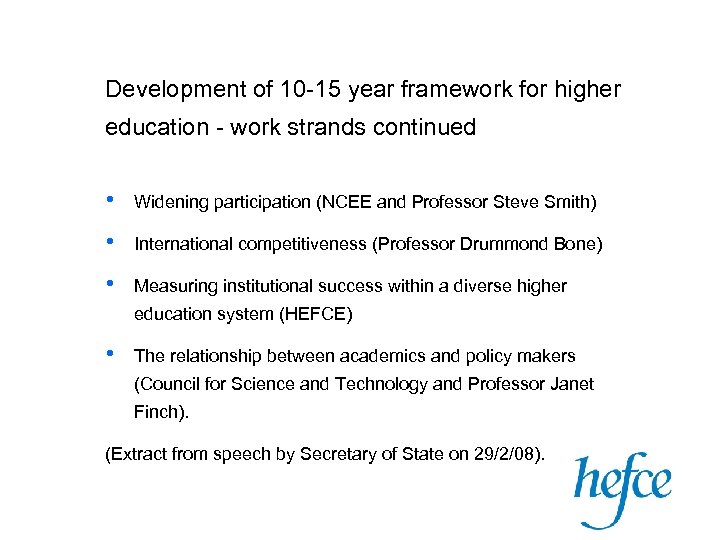 Development of 10 -15 year framework for higher education - work strands continued • Widening participation (NCEE and Professor Steve Smith) • International competitiveness (Professor Drummond Bone) • Measuring institutional success within a diverse higher education system (HEFCE) • The relationship between academics and policy makers (Council for Science and Technology and Professor Janet Finch). (Extract from speech by Secretary of State on 29/2/08).
 Challenges to the HEFCE
 Development of HEFCE Strategic Plan 2009 -14
 Towards a strategy for 2009 -14 Some significant issues • • Next steps for widening participation • • Workforce development and skills T funding - stability or dynamism? Role of students in shaping HE Unlocking the full potential of HE to inspire creativity, innovation and enterprise International competitiveness and globalisation Risk and regulation Role of public funding.
 Dialogue on key issues Towards a strategy for 2009 -14 • April 2008 – HEFCE annual conference • Summer 2008 – initial discussions with stakeholders • Autumn 2008 – informal consultation • February 2009 – formal consultation • July 2009 – anticipated publication of 2009 -14 strategic plan.
 The big conversation – is starting
 Thank you Questions and answers