Скачать презентацию Professional Services Forming and Managing Innovation Factories www
4a2e85e42298545aeea2e86b05884795.ppt
- Количество слайдов: 53
 Professional Services: Forming and Managing Innovation Factories www. novell. com Chris Belden Principal Strategist Novell, Inc. chris. belden@novell. com Robin Conway Senior Digital Strategist Novell, Inc. robin. conway@novell. com
 Innovation: An Introduction The best innovators aren’t lone geniuses. They’re people who can take an idea that’s obvious in one context and apply it in not-so-obvious ways to a different context. The best companies have learned to systematize that process. —Andrew Hargadon and Robert Sutton, HBR May-June 2000
 Vision…one Net A world where networks of all types—corporate and public, intranets, extranets, and the Internet—work together as one Net and securely connect employees, customers, suppliers, and partners across organizational boundaries Mission To solve complex business and technical challenges with Net business solutions that enable people, processes, and systems to work together and our customers to profit from the opportunities of a networked world
 Innovation: A Definition Innovation: the active pursuit of new business models, concepts, products, services and/or processes It’s more than R&D or invention—successful innovators: • Capture and generate good ideas AND keep them alive • Test ideas quickly and well on their own merits—“Easy come, easy go” • Look at innovation holistically—including technology, people, process, organization, governance, culture, values • Understand how their company must think about innovation and change how their company culture reflects that thinking • Leverage both sustaining and disruptive innovations
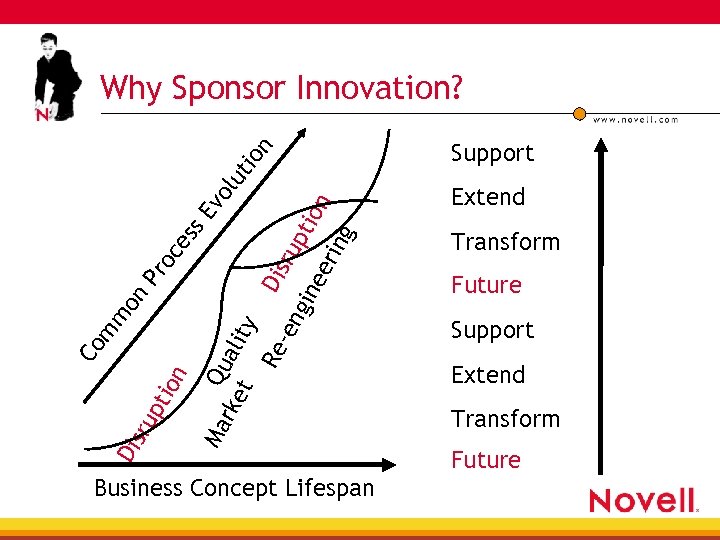 Ma Dis rup tio n Co m m on Pr oc es s. E vo Q rke ual lu ity tio t n Re Dis -en rup gin ee tion rin g Why Sponsor Innovation? Business Concept Lifespan Support Extend Transform Future
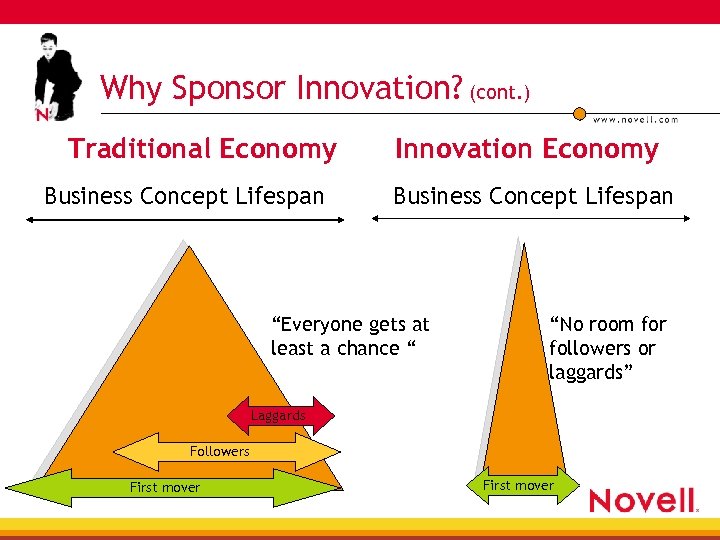 Why Sponsor Innovation? (cont. ) Traditional Economy Business Concept Lifespan Innovation Economy Business Concept Lifespan “Everyone gets at least a chance “ “No room for followers or laggards” Laggards Followers First mover
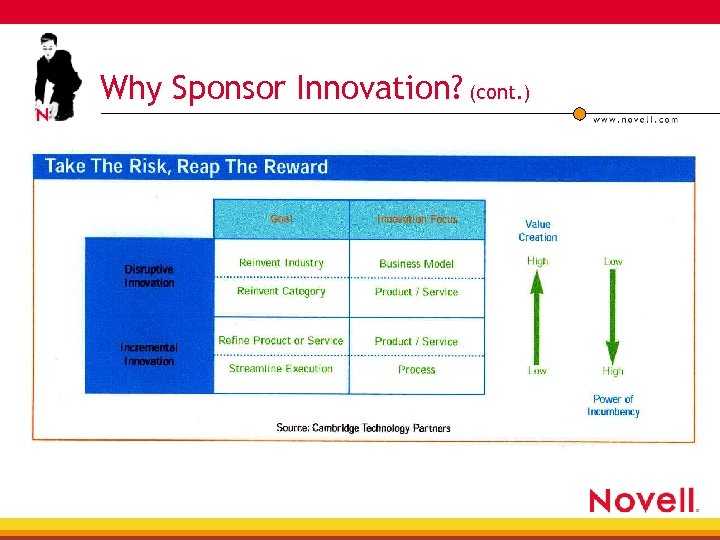 Why Sponsor Innovation? (cont. )
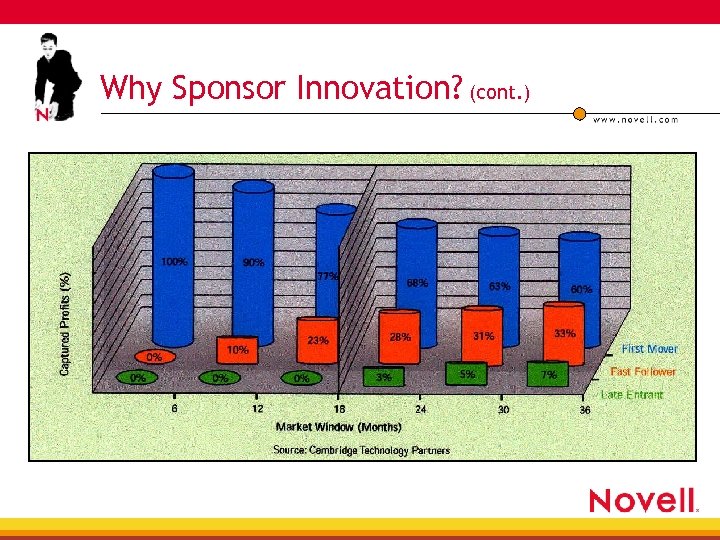 Why Sponsor Innovation? (cont. )
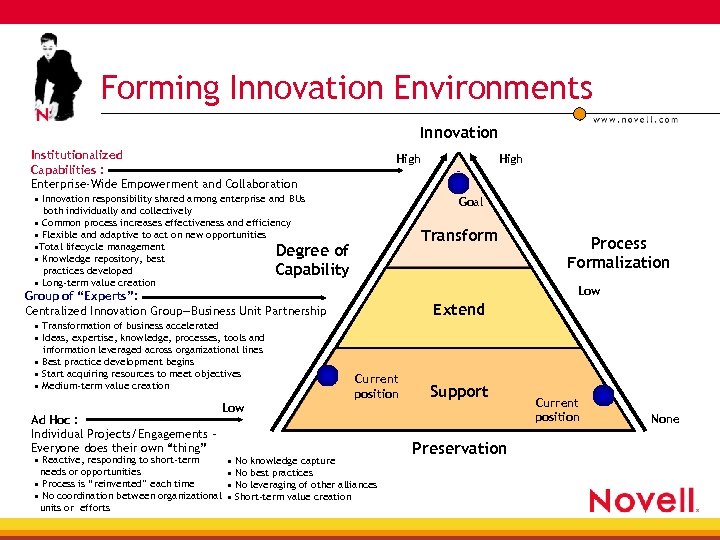 Forming Innovation Environments Innovation Institutionalized Capabilities : Enterprise-Wide Empowerment and Collaboration High • Innovation responsibility shared among enterprise and BUs both individually and collectively • Common process increases effectiveness and efficiency • Flexible and adaptive to act on new opportunities • Total lifecycle management Degree of • Knowledge repository, best practices developed Capability • Long-term value creation Goal Transform Ad Hoc : Individual Projects/Engagements – Everyone does their own “thing” • Reactive, responding to short-term needs or opportunities • Process is “reinvented” each time • No coordination between organizational units or efforts Process Formalization Low Group of “Experts”: Centralized Innovation Group—Business Unit Partnership • Transformation of business accelerated • Ideas, expertise, knowledge, processes, tools and information leveraged across organizational lines • Best practice development begins • Start acquiring resources to meet objectives • Medium-term value creation High Extend Current position Support Low • No knowledge capture • No best practices • No leveraging of other alliances • Short-term value creation Preservation Current position None
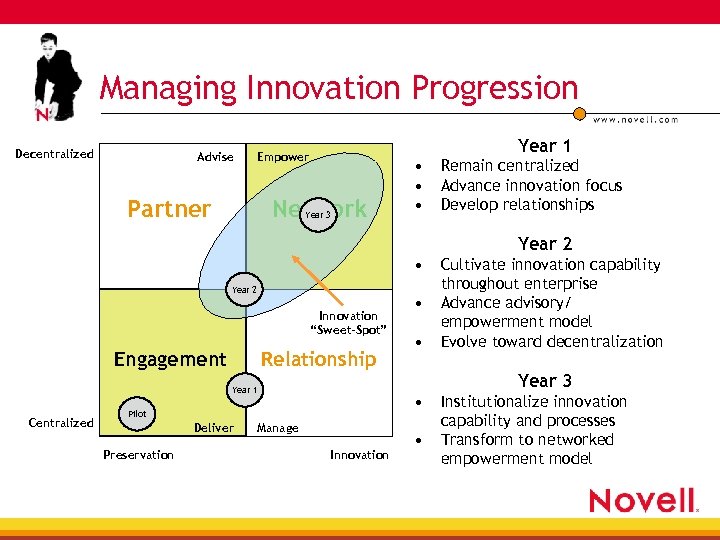 Managing Innovation Progression Decentralized Advise Year 1 Empower Partner Network Year 3 • • • Remain centralized Advance innovation focus Develop relationships Year 2 • Year 2 Innovation “Sweet-Spot” Engagement Relationship Year 1 Centralized Preservation • Year 3 • Pilot Deliver • Manage Innovation Cultivate innovation capability throughout enterprise Advance advisory/ empowerment model Evolve toward decentralization • Institutionalize innovation capability and processes Transform to networked empowerment model
 Forming An Innovation Factory
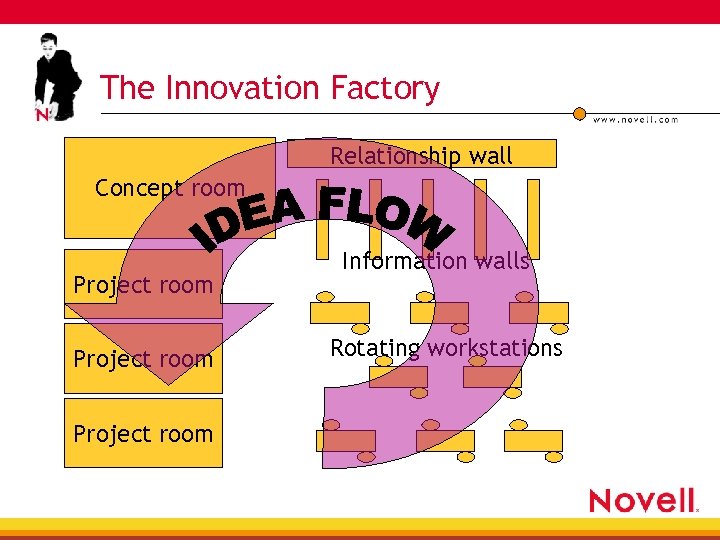 The Innovation Factory Relationship wall Concept room Project room Information walls Rotating workstations
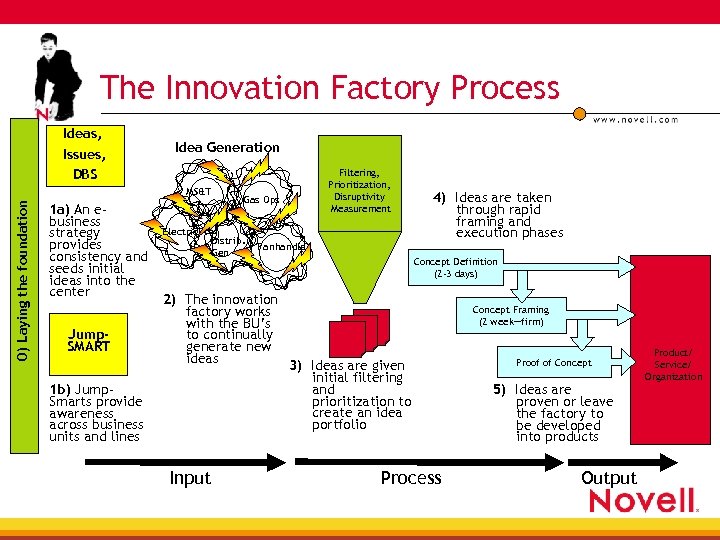 The Innovation Factory Process Ideas, Issues, DBS Idea Generation 0) Laying the foundation MS&T 1 a) An ebusiness strategy provides consistency and seeds initial ideas into the center Jump. SMART Electric Gas Ops Distrib. Gen Panhandle 2) The innovation factory works with the BU’s to continually generate new ideas 1 b) Jump. Smarts provide awareness across business units and lines Input Filtering, Prioritization, Disruptivity Measurement 4) Ideas are taken through rapid framing and execution phases Concept Definition (2 -3 days) Concept Framing (2 week—firm) 3) Ideas are given initial filtering and prioritization to create an idea portfolio Process Proof of Concept 5) Ideas are proven or leave the factory to be developed into products Output Product/ Service/ Organization
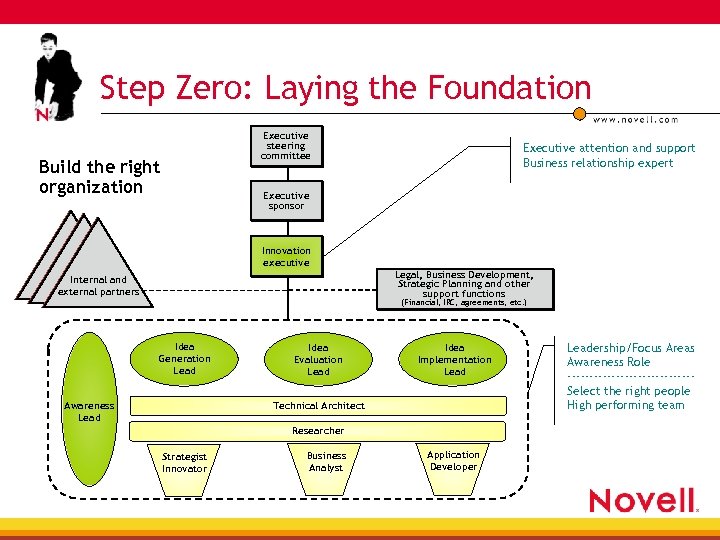 Step Zero: Laying the Foundation Executive steering committee Build the right organization Executive attention and support Business relationship expert Executive sponsor Innovation executive Legal, Business Development, Strategic Planning and other support functions Internal and external partners (Financial, IRC, agreements, etc. ) Idea Generation Lead Idea Evaluation Lead Idea Implementation Lead Technical Architect Awareness Lead Researcher Strategist Innovator Business Analyst Application Developer Leadership/Focus Areas Awareness Role --------------Select the right people High performing team
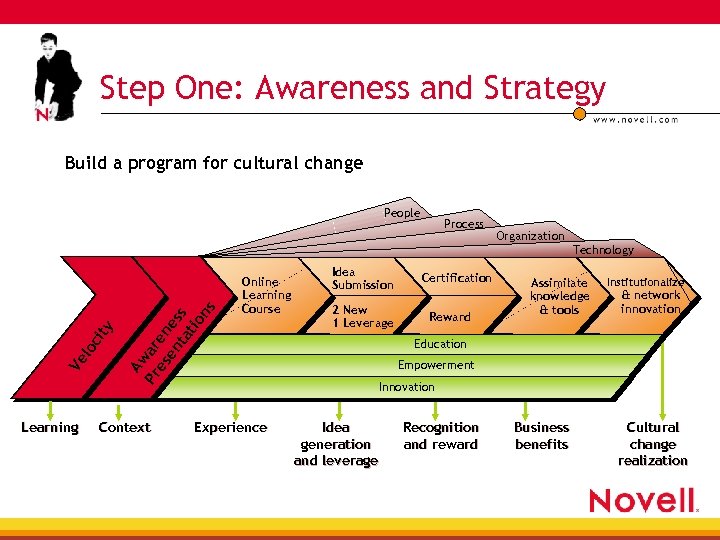 Step One: Awareness and Strategy Build a program for cultural change Learning A Pr war es en en es ta s tio ns Ve lo ci ty People Context Online Learning Course Experience Idea Submission 2 New 1 Leverage Process Certification Reward Organization Technology Assimilate knowledge & tools Institutionalize & network innovation Education Empowerment Innovation Idea generation and leverage Recognition and reward Business benefits Cultural change realization
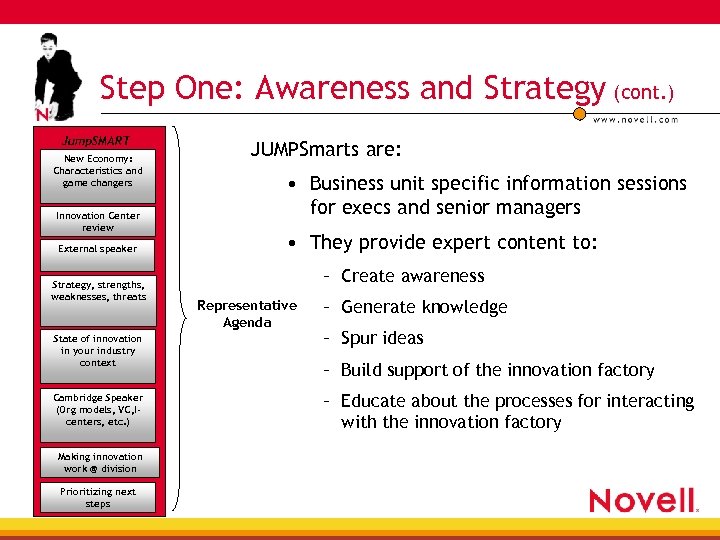 Step One: Awareness and Strategy (cont. ) Jump. SMART New Economy: Characteristics and game changers Innovation Center review External speaker Strategy, strengths, weaknesses, threats State of innovation in your industry context Cambridge Speaker (Org models, VC, Icenters, etc. ) Making innovation work @ division Prioritizing next steps JUMPSmarts are: • Business unit specific information sessions for execs and senior managers • They provide expert content to: – Create awareness Representative Agenda – Generate knowledge – Spur ideas – Build support of the innovation factory – Educate about the processes for interacting with the innovation factory
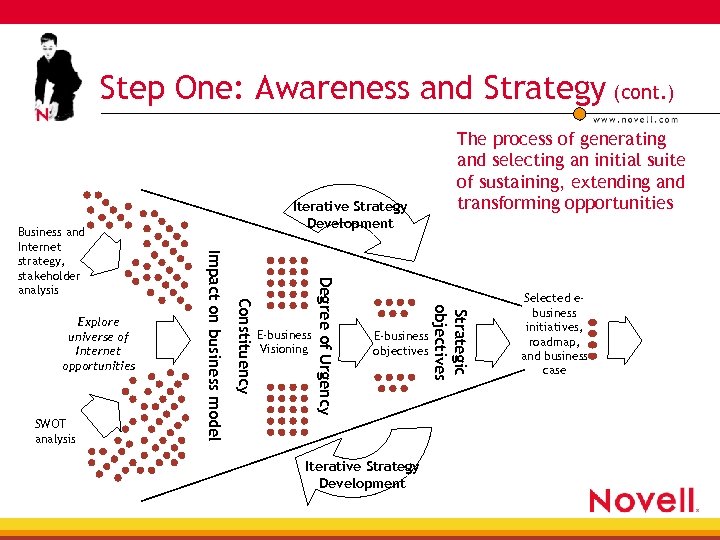 Step One: Awareness and Strategy (cont. ) E-business objectives Iterative Strategy Development Strategic objectives E-business Visioning Degree of Urgency SWOT analysis Constituency Explore universe of Internet opportunities Impact on business model Business and Internet strategy, stakeholder analysis Iterative Strategy Development The process of generating and selecting an initial suite of sustaining, extending and transforming opportunities Selected ebusiness initiatives, roadmap, and business case
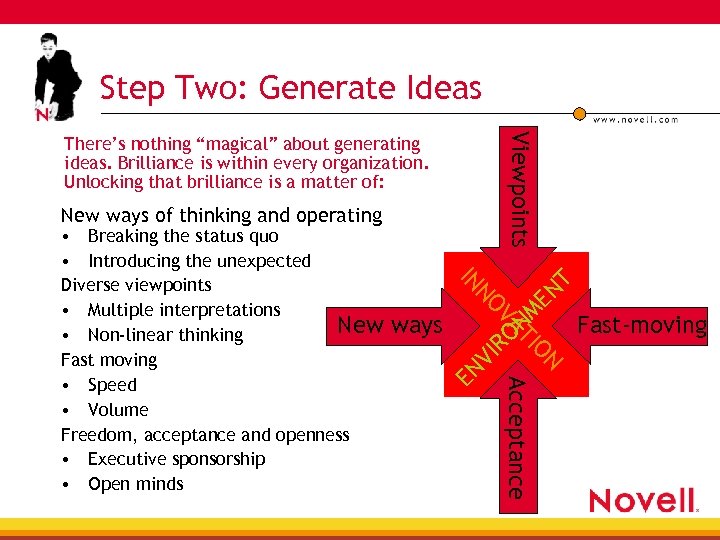 Step Two: Generate Ideas EN ON TI Acceptance VI RO VA ways NO IN • Breaking the status quo • Introducing the unexpected Diverse viewpoints • Multiple interpretations New • Non-linear thinking Fast moving • Speed • Volume Freedom, acceptance and openness • Executive sponsorship • Open minds NM EN New ways of thinking and operating T Viewpoints There’s nothing “magical” about generating ideas. Brilliance is within every organization. Unlocking that brilliance is a matter of: Fast-moving
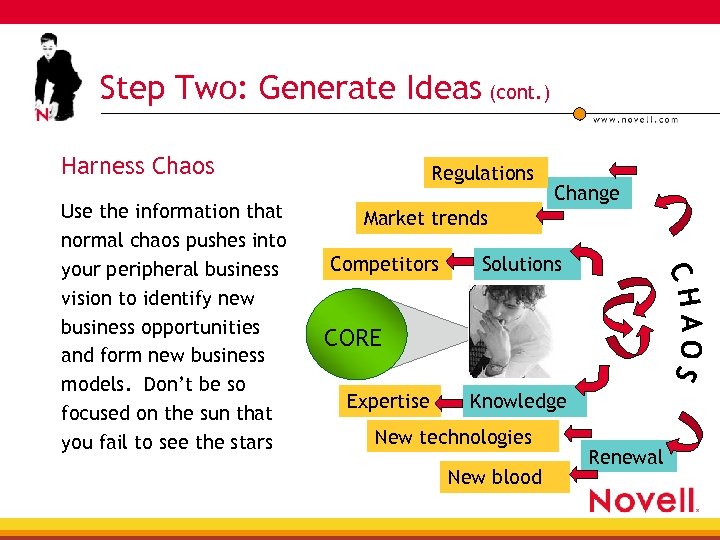 Step Two: Generate Ideas (cont. ) Harness Chaos Use the information that normal chaos pushes into your peripheral business vision to identify new business opportunities and form new business models. Don’t be so focused on the sun that you fail to see the stars Regulations Change Market trends Competitors Solutions CORE Expertise Knowledge New technologies New blood Renewal
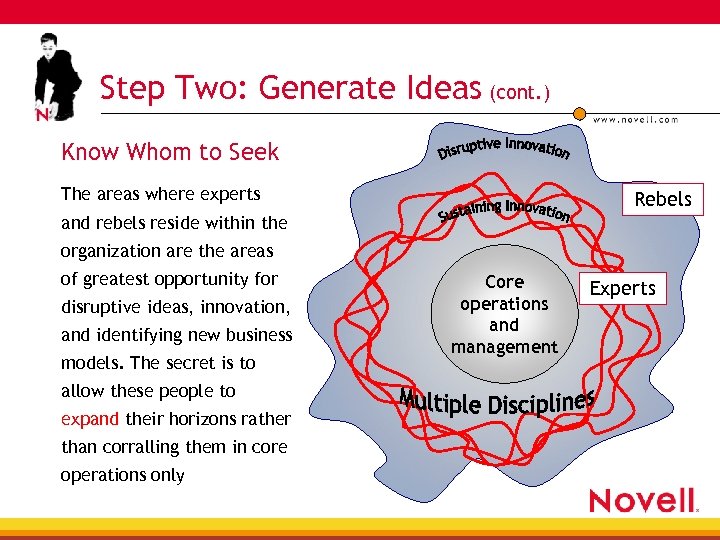 Step Two: Generate Ideas (cont. ) Know Whom to Seek The areas where experts Rebels and rebels reside within the organization are the areas of greatest opportunity for disruptive ideas, innovation, and identifying new business models. The secret is to allow these people to expand their horizons rather than corralling them in core operations only Core operations and management Experts
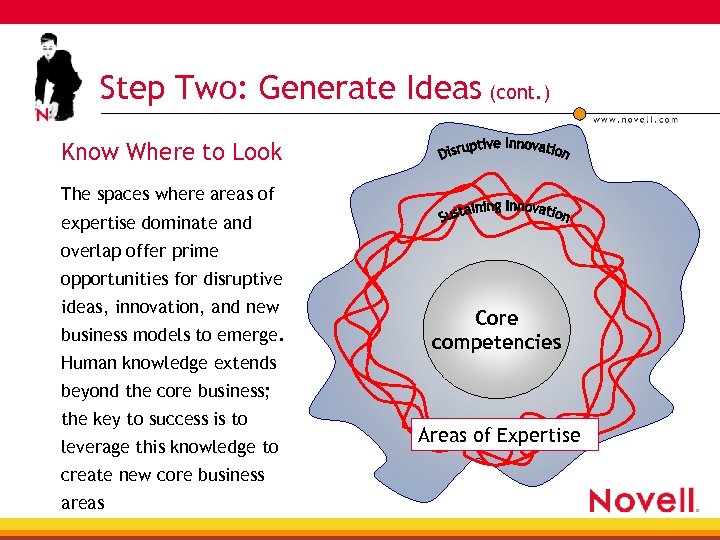 Step Two: Generate Ideas (cont. ) Know Where to Look The spaces where areas of expertise dominate and overlap offer prime opportunities for disruptive ideas, innovation, and new business models to emerge. Human knowledge extends Core competencies beyond the core business; the key to success is to leverage this knowledge to create new core business areas Areas of Expertise
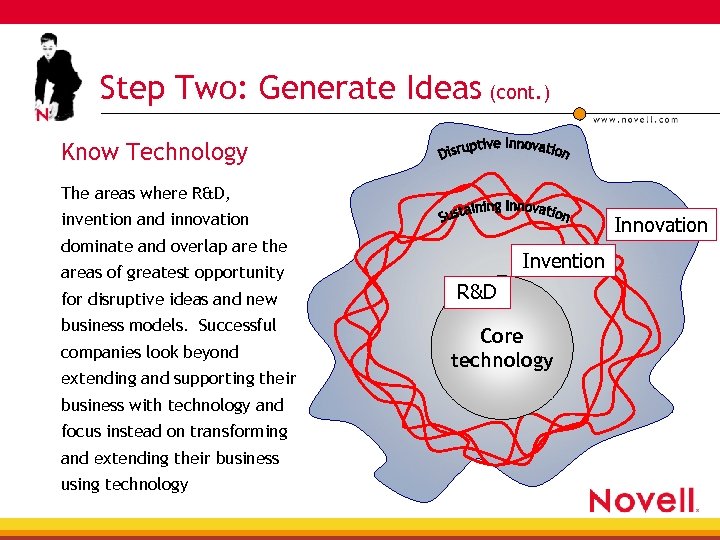 Step Two: Generate Ideas (cont. ) Know Technology The areas where R&D, invention and innovation Innovation dominate and overlap are the areas of greatest opportunity for disruptive ideas and new business models. Successful companies look beyond extending and supporting their business with technology and focus instead on transforming and extending their business using technology Invention R&D Core technology
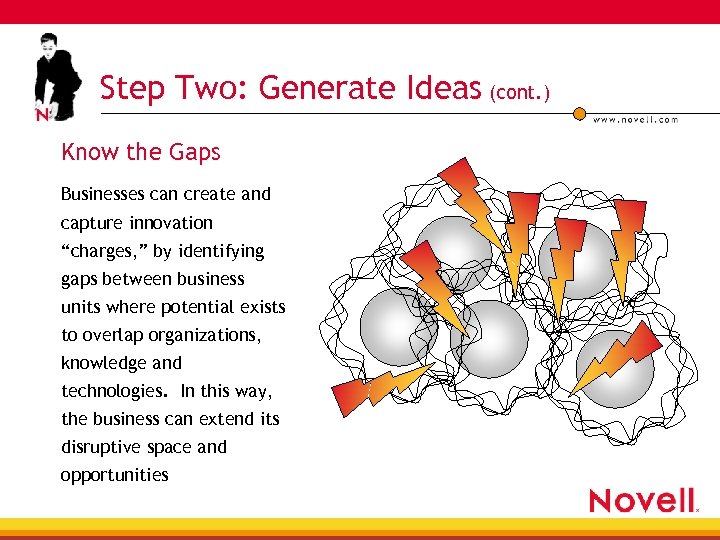 Step Two: Generate Ideas (cont. ) Know the Gaps Businesses can create and capture innovation “charges, ” by identifying gaps between business units where potential exists to overlap organizations, knowledge and technologies. In this way, the business can extend its disruptive space and opportunities
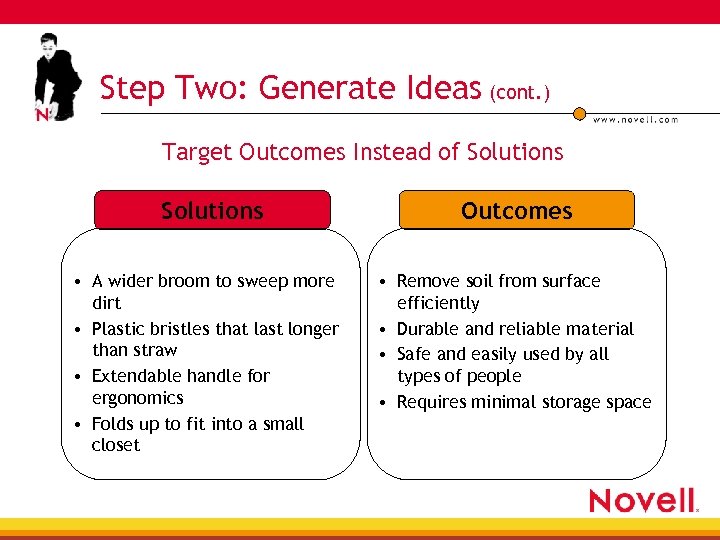 Step Two: Generate Ideas (cont. ) Target Outcomes Instead of Solutions • A wider broom to sweep more dirt • Plastic bristles that last longer than straw • Extendable handle for ergonomics • Folds up to fit into a small closet Outcomes • Remove soil from surface efficiently • Durable and reliable material • Safe and easily used by all types of people • Requires minimal storage space
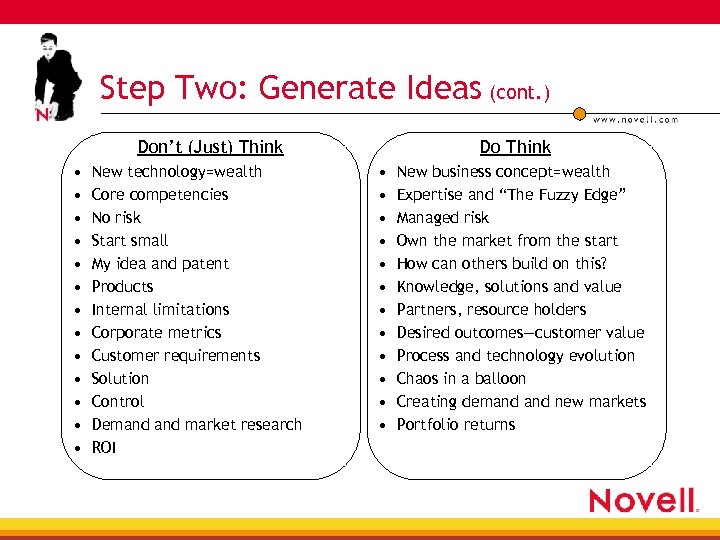 Step Two: Generate Ideas (cont. ) Don’t (Just) Think • • • • New technology=wealth Core competencies No risk Start small My idea and patent Products Internal limitations Corporate metrics Customer requirements Solution Control Demand market research ROI Do Think • • • New business concept=wealth Expertise and “The Fuzzy Edge” Managed risk Own the market from the start How can others build on this? Knowledge, solutions and value Partners, resource holders Desired outcomes—customer value Process and technology evolution Chaos in a balloon Creating demand new markets Portfolio returns
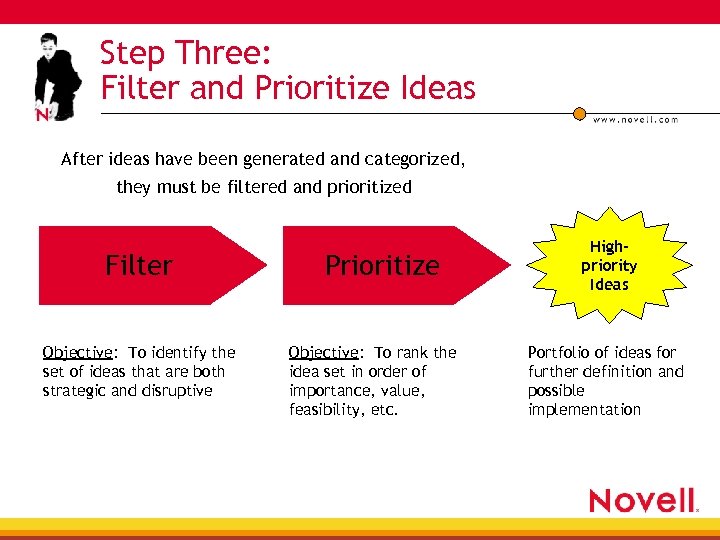 Step Three: Filter and Prioritize Ideas After ideas have been generated and categorized, they must be filtered and prioritized Filter Objective: To identify the set of ideas that are both strategic and disruptive Prioritize Objective: To rank the idea set in order of importance, value, feasibility, etc. Highpriority Ideas Portfolio of ideas for further definition and possible implementation
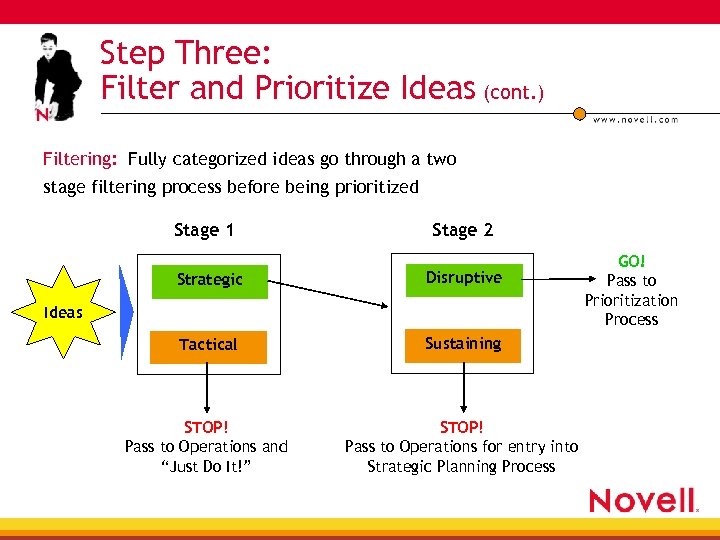 Step Three: Filter and Prioritize Ideas (cont. ) Filtering: Fully categorized ideas go through a two stage filtering process before being prioritized Stage 1 Stage 2 Strategic Disruptive Tactical Sustaining STOP! Pass to Operations and “Just Do It!” STOP! Pass to Operations for entry into Strategic Planning Process Ideas GO! Pass to Prioritization Process
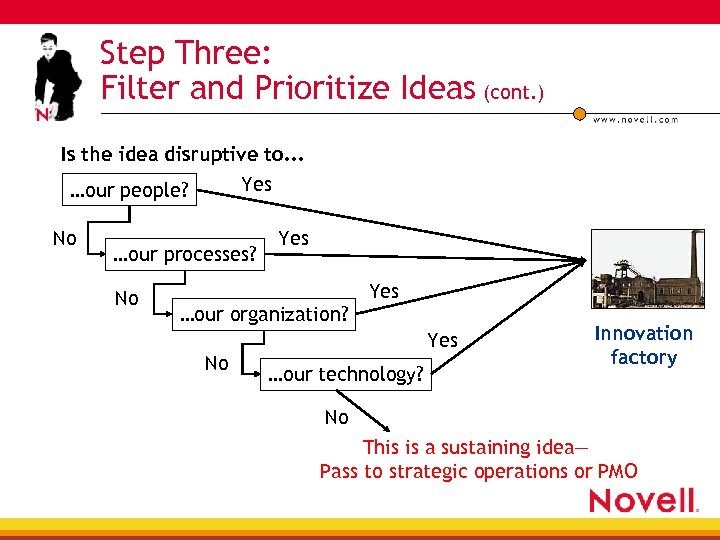 Step Three: Filter and Prioritize Ideas (cont. ) Is the idea disruptive to. . . Yes …our people? No …our processes? No Yes …our organization? No Yes …our technology? Innovation factory No This is a sustaining idea— Pass to strategic operations or PMO
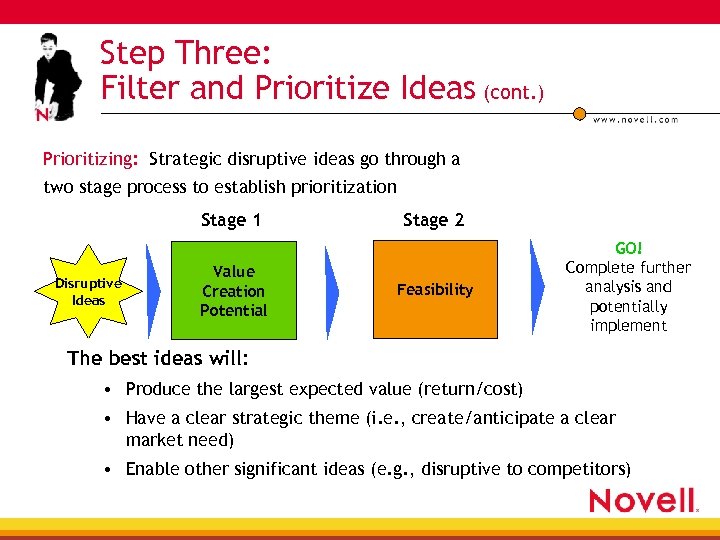 Step Three: Filter and Prioritize Ideas (cont. ) Prioritizing: Strategic disruptive ideas go through a two stage process to establish prioritization Stage 1 Disruptive Ideas Value Creation Potential Stage 2 Feasibility GO! Complete further analysis and potentially implement The best ideas will: • Produce the largest expected value (return/cost) • Have a clear strategic theme (i. e. , create/anticipate a clear market need) • Enable other significant ideas (e. g. , disruptive to competitors)
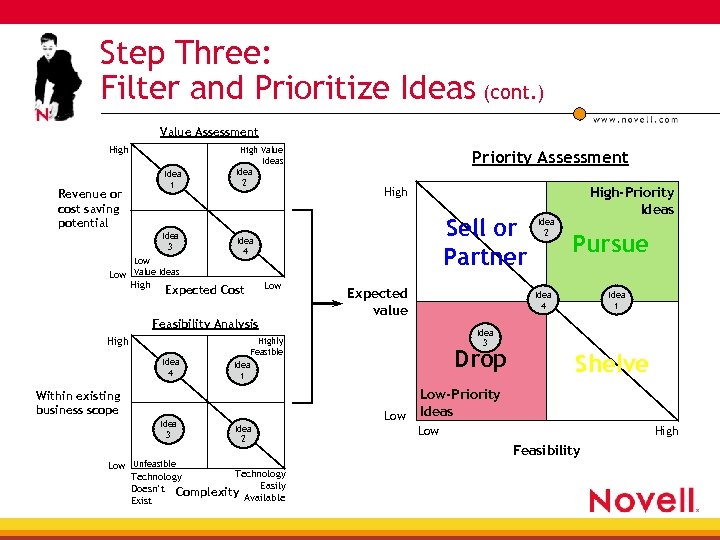 Step Three: Filter and Prioritize Ideas (cont. ) Value Assessment High Idea 1 Revenue or cost saving potential Idea 3 Low Value Ideas High Value Ideas Idea 2 Sell or Partner Low Feasibility Analysis Idea 4 Idea 3 Low Unfeasible Expected value Technology Easily Doesn’t Complexity Available Exist Pursue Idea 1 Idea 3 Drop Low Idea 2 Idea 4 Highly Feasible Idea 1 Within existing business scope High-Priority Ideas High Idea 4 Expected Cost High Priority Assessment Shelve Low-Priority Ideas High Low Feasibility
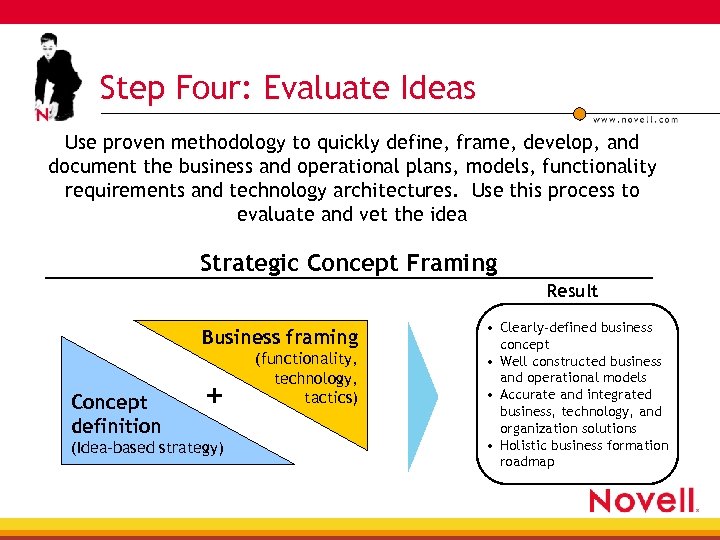 Step Four: Evaluate Ideas Use proven methodology to quickly define, frame, develop, and document the business and operational plans, models, functionality requirements and technology architectures. Use this process to evaluate and vet the idea Strategic Concept Framing Result Business framing Concept definition + (Idea-based strategy) (functionality, technology, tactics) • Clearly-defined business concept • Well constructed business and operational models • Accurate and integrated business, technology, and organization solutions • Holistic business formation roadmap
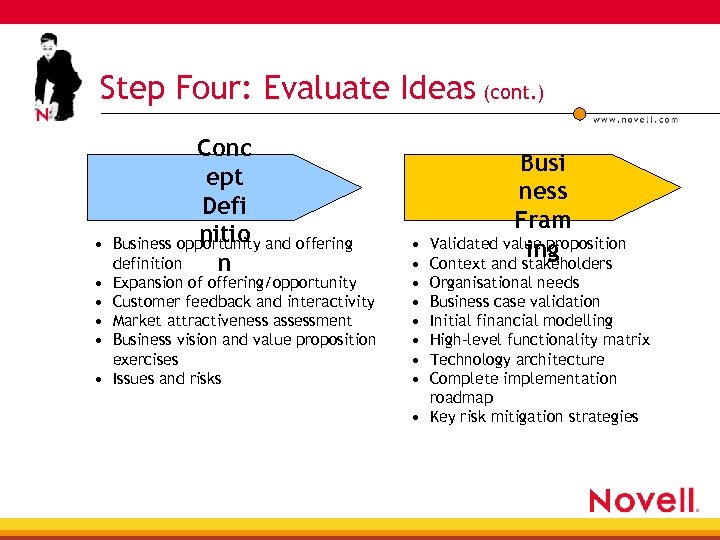 Step Four: Evaluate Ideas (cont. ) • • • Conc ept Defi nitio Business opportunity and offering definition n Expansion of offering/opportunity Customer feedback and interactivity Market attractiveness assessment Business vision and value proposition exercises • Issues and risks • • Busi ness Fram Validated value proposition ing Context and stakeholders Organisational needs Business case validation Initial financial modelling High-level functionality matrix Technology architecture Complete implementation roadmap • Key risk mitigation strategies
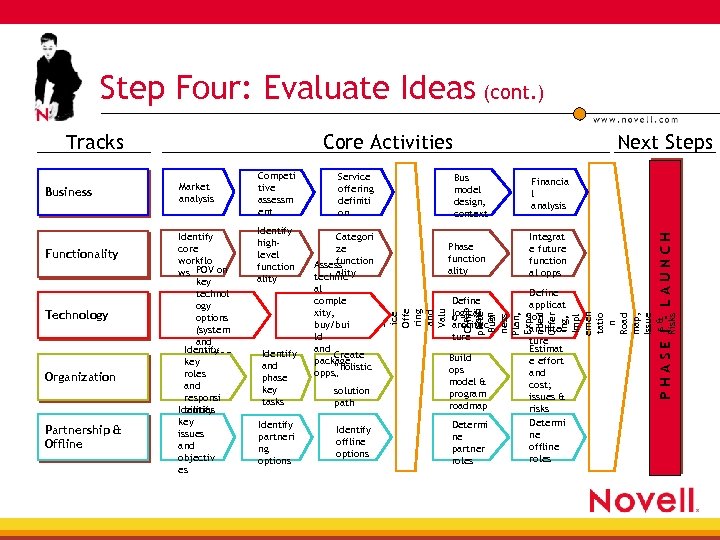 Step Four: Evaluate Ideas (cont. ) Tracks Technology Organization Partnership & Offline Service offering definiti on Bus model design, context Financia l analysis Identify highlevel function ality Categori ze function Assess ality technic Phase function ality Integrat e future function al opps al comple xity, buy/bui ld and Create package “holistic opps ” solution path Define logical architec ture Define applicat ion architec ture Estimat e effort and cost; issues & risks Determi ne offline roles AUNCH Identify core workflo ws POV on key technol ogy options (system and Identify solution key ) roles and responsi bilities Identify key issues and objectiv es Competi tive assessm ent Identify and phase key tasks Identify partneri ng options Identify offline options Build ops model & program roadmap Determi ne partner roles PHASE Functionality Market analysis Next Steps Clea rly Defi ned Serv ice Offe ring and Valu e Prop Com ositi plete on Busi ness Plan, Expa nded Offer ing, Impl emen tatio n Road map, Issue Is & L Risks Business Core Activities
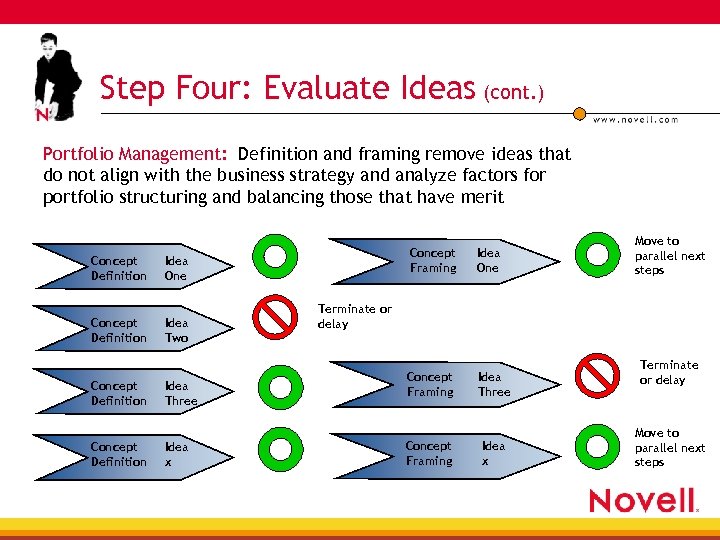 Step Four: Evaluate Ideas (cont. ) Portfolio Management: Definition and framing remove ideas that do not align with the business strategy and analyze factors for portfolio structuring and balancing those that have merit Concept Definition Idea One Concept Definition Idea Two Concept Framing Concept Definition Idea Three Concept Definition Idea x Idea One Concept Framing Idea Three Concept Framing Idea x Move to parallel next steps Terminate or delay Move to parallel next steps
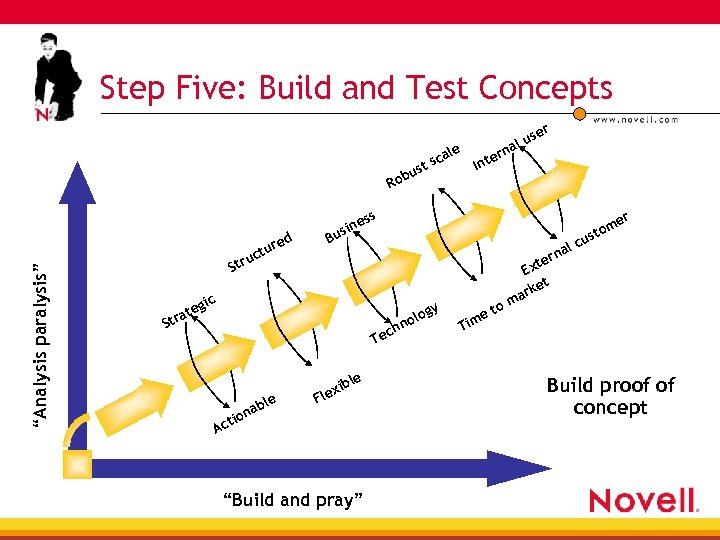 Step Five: Build and Test Concepts le sca st u b Ro se lu r na er Int ss “Analysis paralysis” d e tur c er ne usi B a ern u Str ic eg rat St n gy olo ch Te t Ac ble a ion le xib Fle “Build and pray” u lc m sto t Ex t rke a m to e Tim Build proof of concept
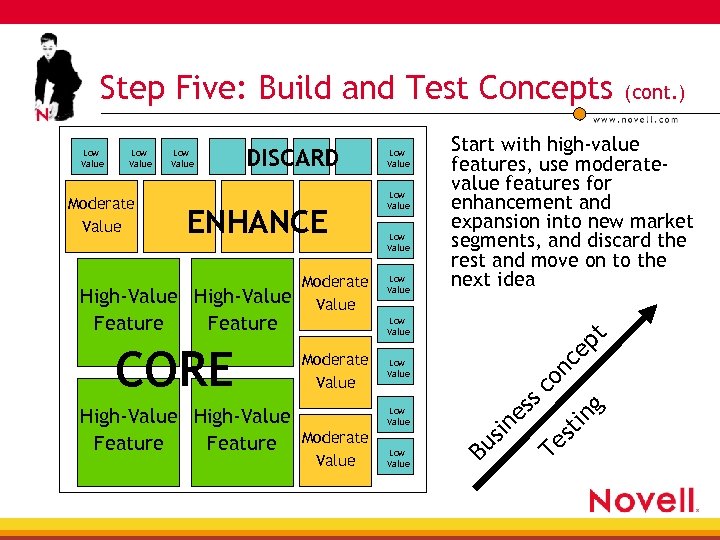 Step Five: Build and Test Concepts ENHANCE High-Value Feature Low Value Moderate Value ce Low Value on Moderate Value pt Low Value Te st in CORE Low Value sc High-Value Feature Moderate Value Low Value Start with high-value features, use moderatevalue features for enhancement and expansion into new market segments, and discard the rest and move on to the next idea g DISCARD Low Value es Moderate Value Low Value sin Low Value Bu Low Value (cont. )
 Managing An Innovation Factory
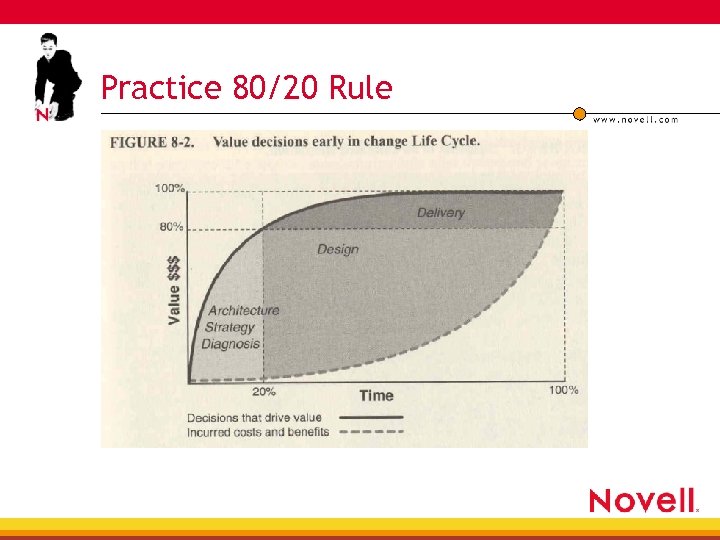 Practice 80/20 Rule
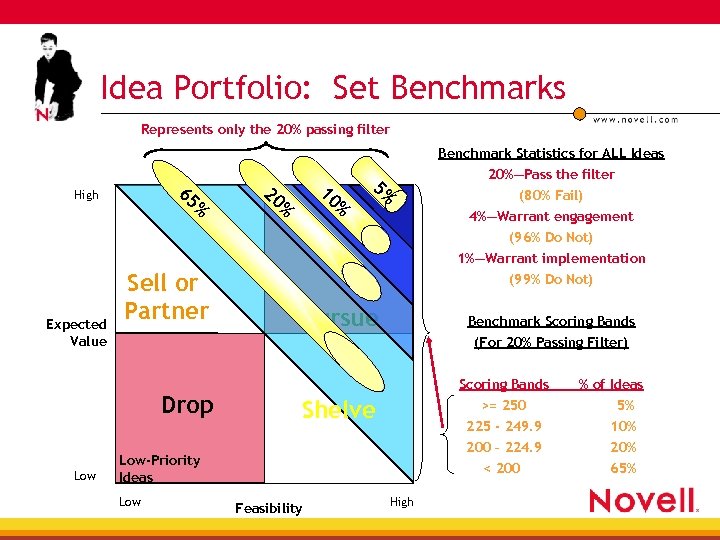 Idea Portfolio: Set Benchmarks Represents only the 20% passing filter Benchmark Statistics for ALL Ideas 20%—Pass the filter 5% % Low 10 Drop % Expected Value Sell or Partner 20 % 65 High Pursue Benchmark Scoring Bands (For 20% Passing Filter) Scoring Bands >= 250 225 - 249. 9 200 – 224. 9 < 200 Shelve Low-Priority Ideas Low Feasibility (80% Fail) 4%—Warrant engagement (96% Do Not) 1%—Warrant implementation (99% Do Not) High % of Ideas 5% 10% 20% 65%
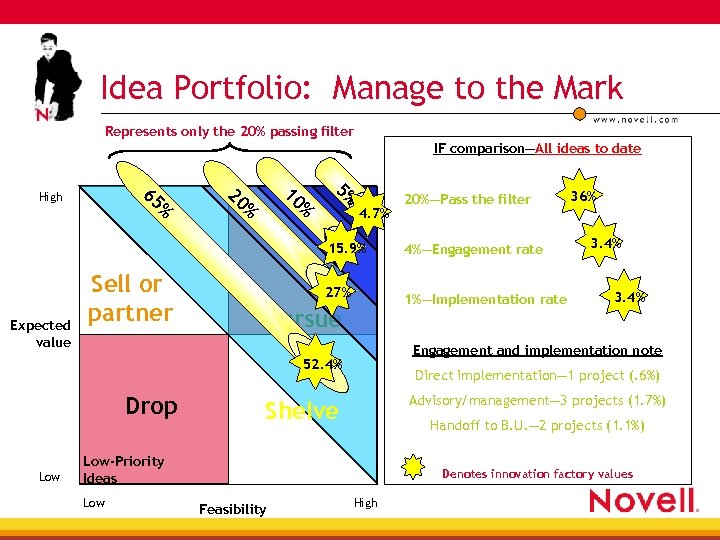 Idea Portfolio: Manage to the Mark Represents only the 20% passing filter IF comparison—All ideas to date 10 4%—Engagement rate 27% 1%—Implementation rate 4. 7% % % 20 % 65 Expected value 20%—Pass the filter 15. 9% Sell or partner 5% High Pursue Low 3. 4% Direct implementation— 1 project (. 6%) Advisory/management— 3 projects (1. 7%) Shelve Handoff to B. U. — 2 projects (1. 1%) Low-Priority Ideas Low 3. 4% Engagement and implementation note 52. 4% Drop 36% Denotes innovation factory values Feasibility High
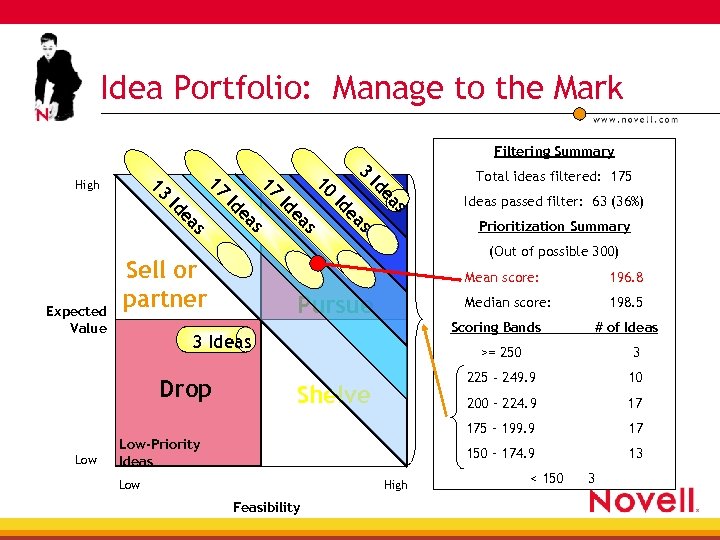 Idea Portfolio: Manage to the Mark Filtering Summary 3 10 Ideas passed filter: 63 (36%) Prioritization Summary as e Id Total ideas filtered: 175 (Out of possible 300) Sell or partner Mean score: 196. 8 Median score: Pursue 198. 5 Scoring Bands 3 Ideas Drop Low e Id as e Id Expected Value 17 17 13 High # of Ideas >= 250 225 - 249. 9 High Feasibility 17 150 – 174. 9 Low 17 175 – 199. 9 Low-Priority Ideas 10 200 – 224. 9 Shelve 3 13 < 150 3
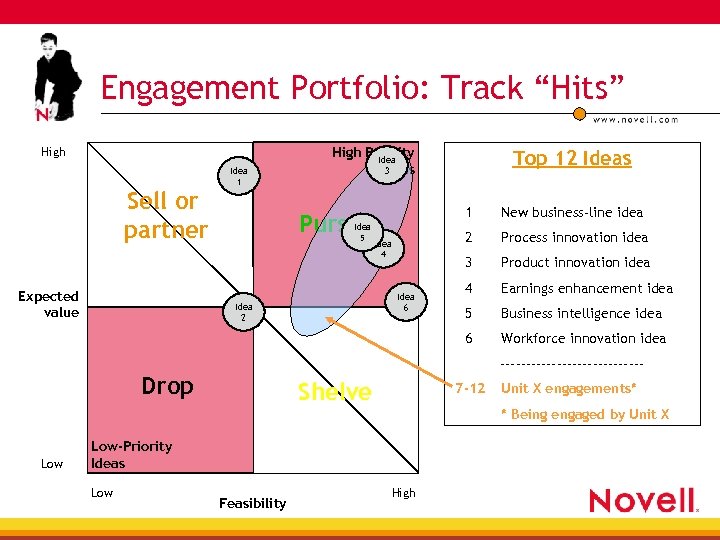 Engagement Portfolio: Track “Hits” High Sell or partner Idea 1 High Priority Idea 3 Ideas Top 12 Ideas Idea 5 2 Idea 6 Idea 2 Process innovation idea 3 Idea 4 New business-line idea Product innovation idea 4 Earnings enhancement idea 5 Business intelligence idea 6 Expected value 1 Pursue Workforce innovation idea -------------- Drop Shelve 7 -12 Unit X engagements* * Being engaged by Unit X Low-Priority Ideas Low Feasibility High
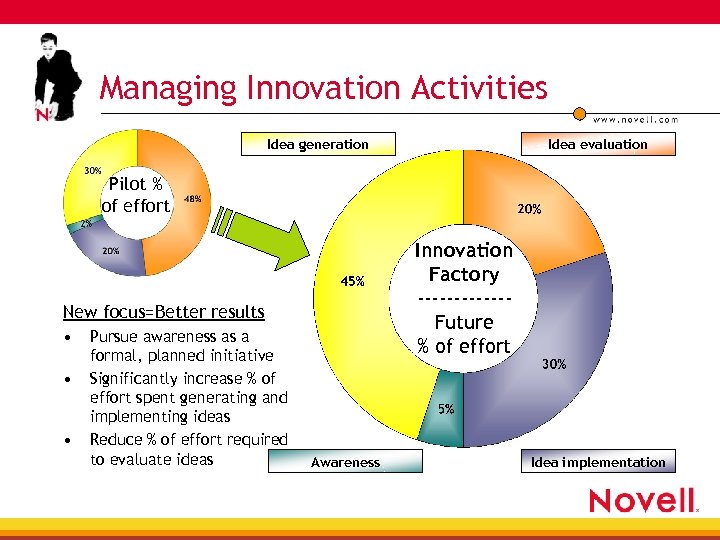 Managing Innovation Activities Idea generation Idea evaluation Pilot % of effort Innovation Factory ------Future % of effort New focus=Better results • • • Pursue awareness as a formal, planned initiative Significantly increase % of effort spent generating and implementing ideas Reduce % of effort required to evaluate ideas Awareness Idea implementation
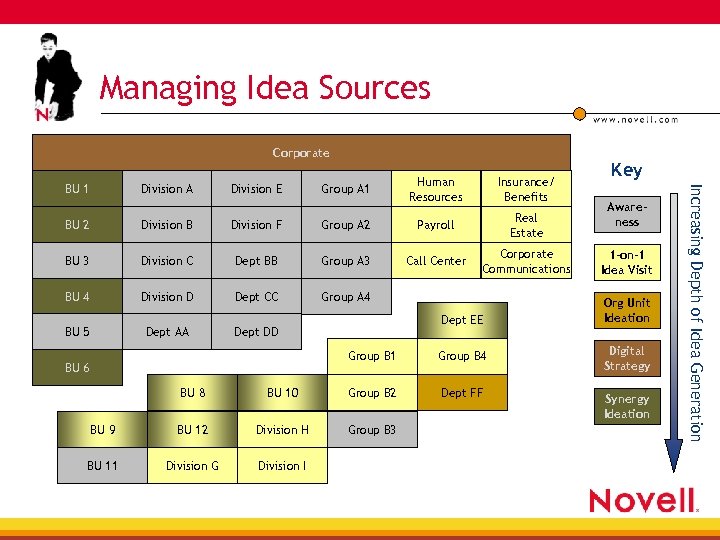 Managing Idea Sources Corporate Division A Division E Group A 1 Insurance/ Benefits BU 2 Division B Division F Group A 2 Payroll Real Estate BU 3 Division C Dept BB Group A 3 Call Center Corporate Communications BU 4 Division D Dept CC Group A 4 BU 5 Dept AA Dept DD Dept EE Key Awareness 1 -on-1 Idea Visit Org Unit Ideation Group B 1 BU 6 Group B 4 Digital Strategy Dept FF Synergy Ideation BU 8 BU 10 Group B 2 BU 9 BU 12 Division H Group B 3 BU 11 Division G Division I Increasing Depth of Idea Generation BU 1 Human Resources
 Lessons Learned
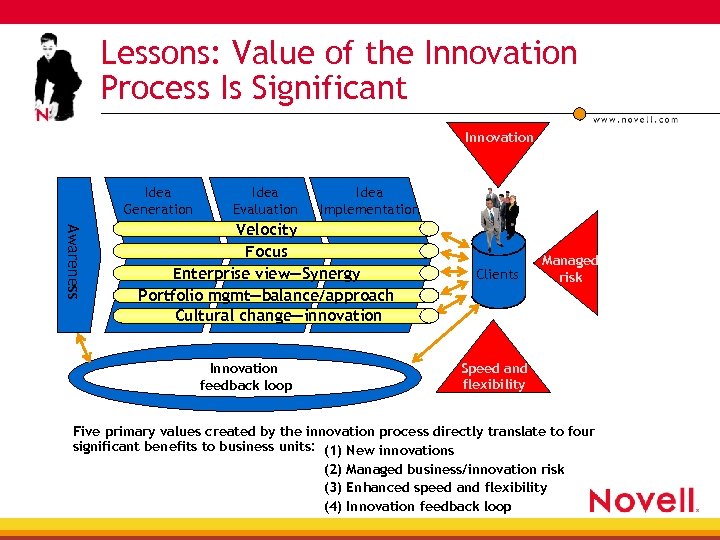 Lessons: Value of the Innovation Process Is Significant Innovation Idea Generation Idea Evaluation Idea Implementation Awareness Velocity Focus Enterprise view—Synergy Portfolio mgmt—balance/approach Cultural change—innovation Innovation feedback loop Clients Managed risk Speed and flexibility Five primary values created by the innovation process directly translate to four significant benefits to business units: (1) New innovations (2) Managed business/innovation risk (3) Enhanced speed and flexibility (4) Innovation feedback loop
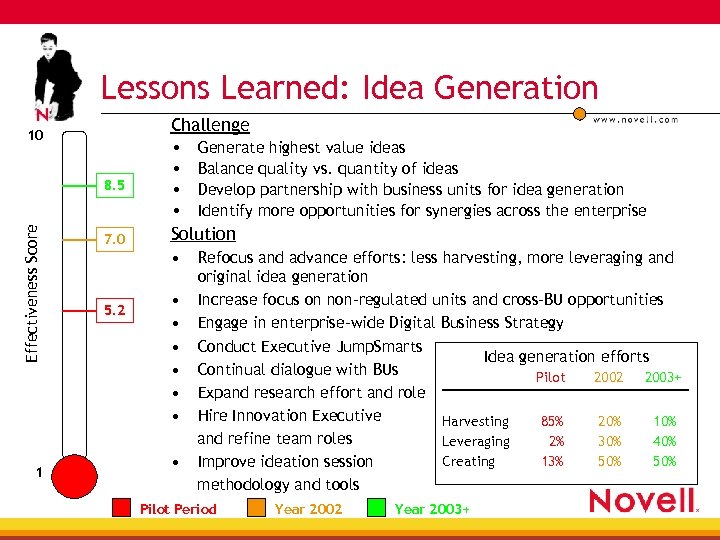 Lessons Learned: Idea Generation 10 Effectiveness Score 8. 5 1 7. 0 Challenge • Generate highest value ideas • Balance quality vs. quantity of ideas • Develop partnership with business units for idea generation • Identify more opportunities for synergies across the enterprise Solution • 5. 2 • • Refocus and advance efforts: less harvesting, more leveraging and original idea generation Increase focus on non-regulated units and cross-BU opportunities Engage in enterprise-wide Digital Business Strategy Conduct Executive Jump. Smarts Idea generation efforts Continual dialogue with BUs Pilot 2002 2003+ Expand research effort and role Hire Innovation Executive Harvesting 85% 20% 10% and refine team roles Leveraging 2% 30% 40% Creating 13% 50% Improve ideation session methodology and tools Pilot Period Year 2002 Year 2003+
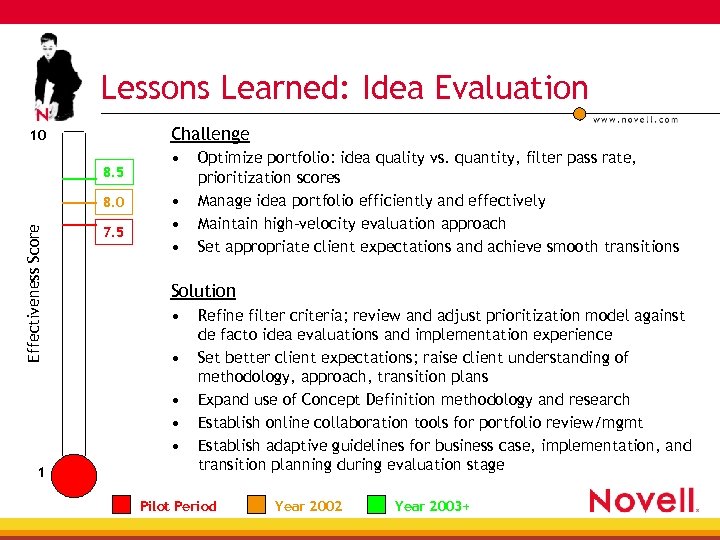 Lessons Learned: Idea Evaluation Challenge 10 8. 5 Effectiveness Score 8. 0 7. 5 • • Solution • • • 1 Optimize portfolio: idea quality vs. quantity, filter pass rate, prioritization scores Manage idea portfolio efficiently and effectively Maintain high-velocity evaluation approach Set appropriate client expectations and achieve smooth transitions Refine filter criteria; review and adjust prioritization model against de facto idea evaluations and implementation experience Set better client expectations; raise client understanding of methodology, approach, transition plans Expand use of Concept Definition methodology and research Establish online collaboration tools for portfolio review/mgmt Establish adaptive guidelines for business case, implementation, and transition planning during evaluation stage Pilot Period Year 2002 Year 2003+
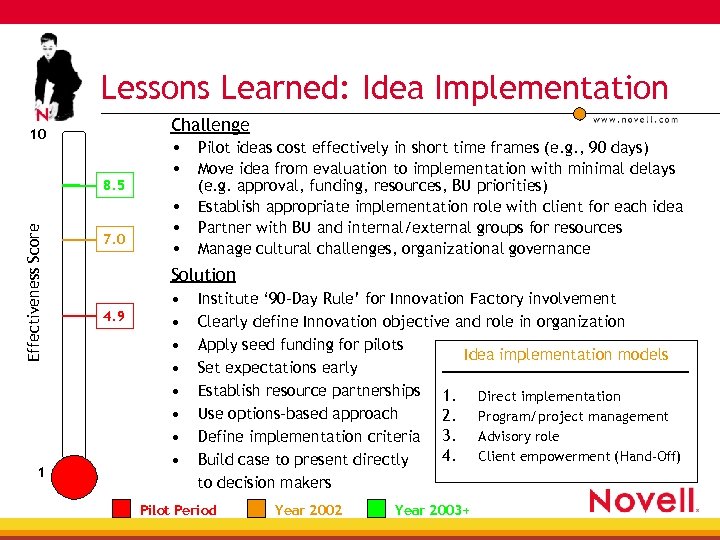 Lessons Learned: Idea Implementation 10 Effectiveness Score 8. 5 1 7. 0 4. 9 Challenge • Pilot ideas cost effectively in short time frames (e. g. , 90 days) • Move idea from evaluation to implementation with minimal delays (e. g. approval, funding, resources, BU priorities) Establish appropriate implementation role with client for each idea Partner with BU and internal/external groups for resources Manage cultural challenges, organizational governance • • • Solution • • Institute ‘ 90 -Day Rule’ for Innovation Factory involvement Clearly define Innovation objective and role in organization Apply seed funding for pilots Idea implementation models Set expectations early Establish resource partnerships 1. Direct implementation Use options-based approach 2. Program/project management Define implementation criteria 3. Advisory role 4. Client empowerment (Hand-Off) Build case to present directly to decision makers Pilot Period Year 2002 Year 2003+
 Lessons: Triggers to Killing Innovation • Preoccupation with past performance instead of new opportunity • Business metrics set up to measure where you’ve been instead of where • • • you’re going Structure around products, brands, and geography instead of user value Measuring past improvements rather than future gaps Measuring by market share instead of growth share Functional definition rather than business definition Measuring success and satisfaction rather than dissatisfaction Downsizing your knowledge base and organizational capacity Underestimating expertise surrounding core competencies Staying up with competitors rather than outpacing them Practicing static planning rather than dynamic strategy Concentrating on information rather than knowledge Using your innovators as veterinarians for your cash cows
 Conclusion • Whereas many companies are looking at ways to keep their cash cows alive, innovative companies are looking at not only how to find new cash cows, but how to breed cash rabbits, cash goats, cash elephants, and cash whales • Use the power to change to help you innovate