 Скачать презентацию Professional and Business Ethics Prof Peter Hadreas Spring
e198120ef3f4d1998bc19f0390c02517.ppt
- Количество слайдов: 68



Professional and Business Ethics Prof. Peter Hadreas Spring, 2014 Course Website: http: //www. sjsu. edu/people/peter. hadreas/courses/P rofand. Bus. Ethics/ 1
Passage exerpted from last week’s reading about the prospect to raise the Minimum Wage to $10. “Jason Furman, chairman of the White House's Council of Economic Advisers, and council member Betsey Stevenson referred in a blog post to a statement by more than 600 economists who cited recent academic findings that ‘increases in the minimum wage have had little or no negative effect on the employment of minimum-wage workers, even during times of weakness in the labor market. ’” Many students dismissed this statement saying that the economists specified were unknown -- they might be all biased, possibly all Democrats or Republicans. But the method of ethical decision making, as in most decisions in business, is to work with probabilities. There is no right or wrong, that is right or wrong absolutely, but a probably more right or wrong. Also one of the important step in making such a decision is to become aware of you own biases. 2
So do we simply need to settle with dismissing the judgment of the 600 economists because they are unknown? No we don’t. There’s plenty of information online specifying who the 600 economics are. See for example the letter posted by the 600 economists and available on line at http: //www. epi. org/minimum-wage-statement/ 3
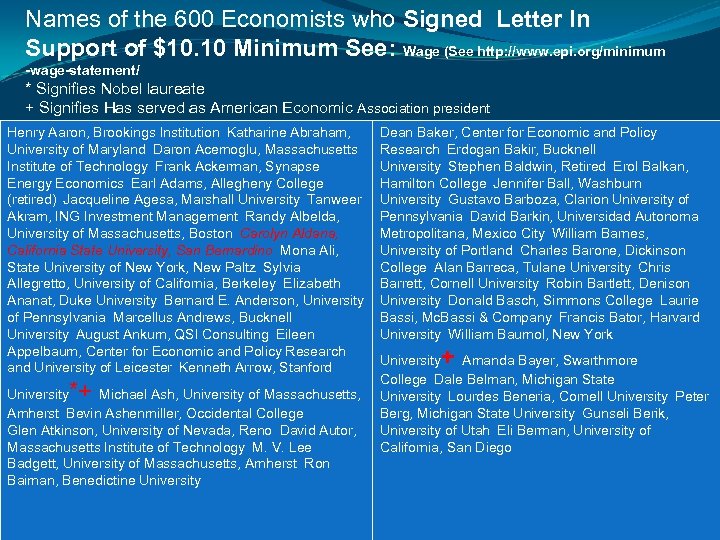
Names of the 600 Economists who Signed Letter In Support of $10. 10 Minimum See: Wage (See http: //www. epi. org/minimum -wage-statement/ * Signifies Nobel laureate + Signifies Has served as American Economic Association president Henry Aaron, Brookings Institution Katharine Abraham, University of Maryland Daron Acemoglu, Massachusetts Institute of Technology Frank Ackerman, Synapse Energy Economics Earl Adams, Allegheny College (retired) Jacqueline Agesa, Marshall University Tanweer Akram, ING Investment Management Randy Albelda, University of Massachusetts, Boston Carolyn Aldana, California State University, San Bernardino Mona Ali, State University of New York, New Paltz Sylvia Allegretto, University of California, Berkeley Elizabeth Ananat, Duke University Bernard E. Anderson, University of Pennsylvania Marcellus Andrews, Bucknell University August Ankum, QSI Consulting Eileen Appelbaum, Center for Economic and Policy Research and University of Leicester Kenneth Arrow, Stanford *+ University Michael Ash, University of Massachusetts, Amherst Bevin Ashenmiller, Occidental College Glen Atkinson, University of Nevada, Reno David Autor, Massachusetts Institute of Technology M. V. Lee Badgett, University of Massachusetts, Amherst Ron Baiman, Benedictine University Dean Baker, Center for Economic and Policy Research Erdogan Bakir, Bucknell University Stephen Baldwin, Retired Erol Balkan, Hamilton College Jennifer Ball, Washburn University Gustavo Barboza, Clarion University of Pennsylvania David Barkin, Universidad Autonoma Metropolitana, Mexico City William Barnes, University of Portland Charles Barone, Dickinson College Alan Barreca, Tulane University Chris Barrett, Cornell University Robin Bartlett, Denison University Donald Basch, Simmons College Laurie Bassi, Mc. Bassi & Company Francis Bator, Harvard University William Baumol, New York + University Amanda Bayer, Swarthmore College Dale Belman, Michigan State University Lourdes Beneria, Cornell University Peter Berg, Michigan State University Gunseli Berik, University of Utah Eli Berman, University of California, San Diego 4
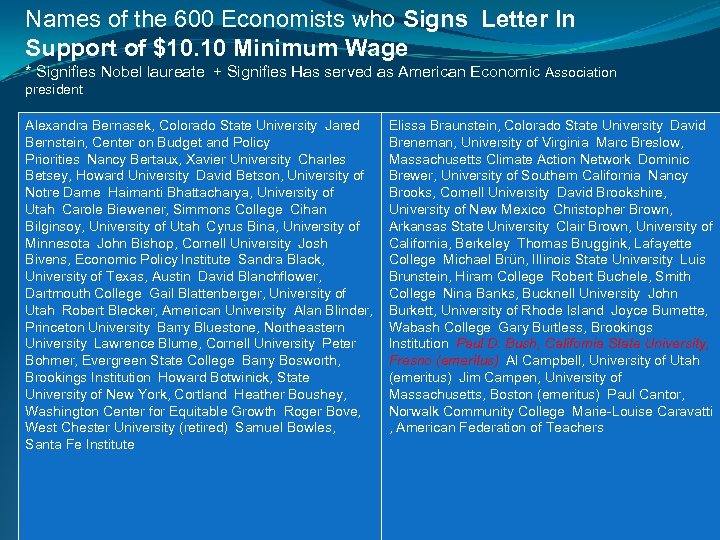
Names of the 600 Economists who Signs Letter In Support of $10. 10 Minimum Wage * Signifies Nobel laureate + Signifies Has served as American Economic Association president Alexandra Bernasek, Colorado State University Jared Bernstein, Center on Budget and Policy Priorities Nancy Bertaux, Xavier University Charles Betsey, Howard University David Betson, University of Notre Dame Haimanti Bhattacharya, University of Utah Carole Biewener, Simmons College Cihan Bilginsoy, University of Utah Cyrus Bina, University of Minnesota John Bishop, Cornell University Josh Bivens, Economic Policy Institute Sandra Black, University of Texas, Austin David Blanchflower, Dartmouth College Gail Blattenberger, University of Utah Robert Blecker, American University Alan Blinder, Princeton University Barry Bluestone, Northeastern University Lawrence Blume, Cornell University Peter Bohmer, Evergreen State College Barry Bosworth, Brookings Institution Howard Botwinick, State University of New York, Cortland Heather Boushey, Washington Center for Equitable Growth Roger Bove, West Chester University (retired) Samuel Bowles, Santa Fe Institute Elissa Braunstein, Colorado State University David Breneman, University of Virginia Marc Breslow, Massachusetts Climate Action Network Dominic Brewer, University of Southern California Nancy Brooks, Cornell University David Brookshire, University of New Mexico Christopher Brown, Arkansas State University Clair Brown, University of California, Berkeley Thomas Bruggink, Lafayette College Michael Brün, Illinois State University Luis Brunstein, Hiram College Robert Buchele, Smith College Nina Banks, Bucknell University John Burkett, University of Rhode Island Joyce Burnette, Wabash College Gary Burtless, Brookings Institution Paul D. Bush, California State University, Fresno (emeritus) Al Campbell, University of Utah (emeritus) Jim Campen, University of Massachusetts, Boston (emeritus) Paul Cantor, Norwalk Community College Marie-Louise Caravatti , American Federation of Teachers 5
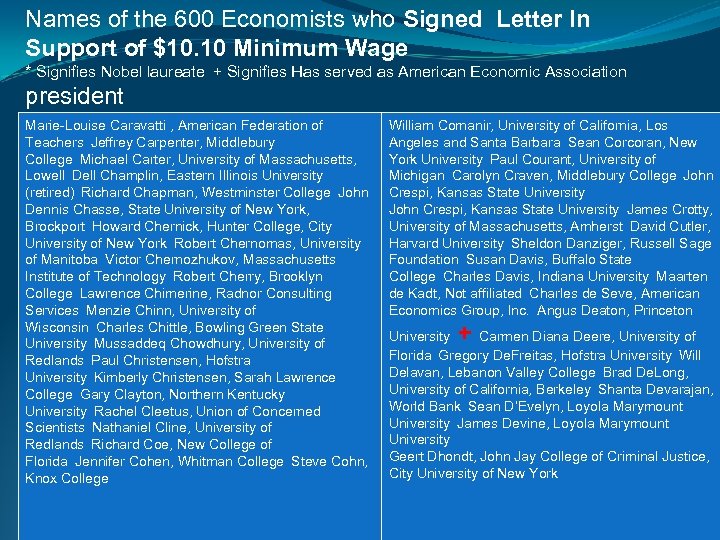
Names of the 600 Economists who Signed Letter In Support of $10. 10 Minimum Wage * Signifies Nobel laureate + Signifies Has served as American Economic Association president Marie-Louise Caravatti , American Federation of Teachers Jeffrey Carpenter, Middlebury College Michael Carter, University of Massachusetts, Lowell Dell Champlin, Eastern Illinois University (retired) Richard Chapman, Westminster College John Dennis Chasse, State University of New York, Brockport Howard Chernick, Hunter College, City University of New York Robert Chernomas, University of Manitoba Victor Chernozhukov, Massachusetts Institute of Technology Robert Cherry, Brooklyn College Lawrence Chimerine, Radnor Consulting Services Menzie Chinn, University of Wisconsin Charles Chittle, Bowling Green State University Mussaddeq Chowdhury, University of Redlands Paul Christensen, Hofstra University Kimberly Christensen, Sarah Lawrence College Gary Clayton, Northern Kentucky University Rachel Cleetus, Union of Concerned Scientists Nathaniel Cline, University of Redlands Richard Coe, New College of Florida Jennifer Cohen, Whitman College Steve Cohn, Knox College William Comanir, University of California, Los Angeles and Santa Barbara Sean Corcoran, New York University Paul Courant, University of Michigan Carolyn Craven, Middlebury College John Crespi, Kansas State University James Crotty, University of Massachusetts, Amherst David Cutler, Harvard University Sheldon Danziger, Russell Sage Foundation Susan Davis, Buffalo State College Charles Davis, Indiana University Maarten de Kadt, Not affiliated Charles de Seve, American Economics Group, Inc. Angus Deaton, Princeton + University Carmen Diana Deere, University of Florida Gregory De. Freitas, Hofstra University Will Delavan, Lebanon Valley College Brad De. Long, University of California, Berkeley Shanta Devarajan, World Bank Sean D’Evelyn, Loyola Marymount University James Devine, Loyola Marymount University Geert Dhondt, John Jay College of Criminal Justice, City University of New York 6
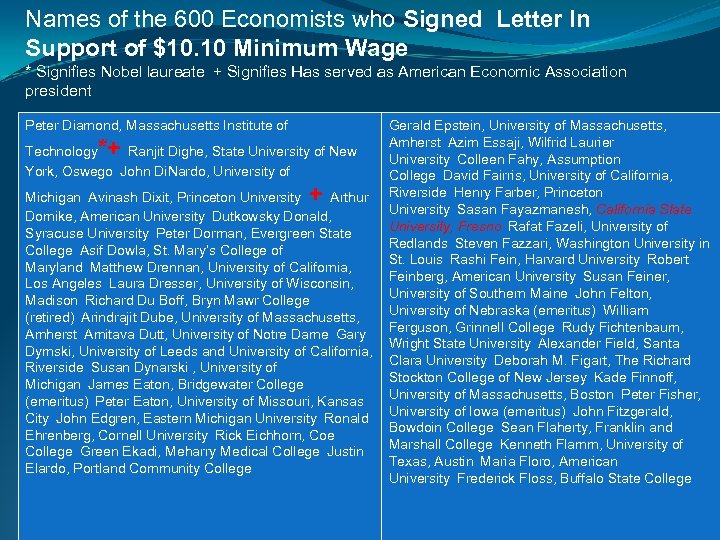
Names of the 600 Economists who Signed Letter In Support of $10. 10 Minimum Wage * Signifies Nobel laureate + Signifies Has served as American Economic Association president Peter Diamond, Massachusetts Institute of Gerald Epstein, University of Massachusetts, Amherst Azim Essaji, Wilfrid Laurier Technology Ranjit Dighe, State University of New University Colleen Fahy, Assumption York, Oswego John Di. Nardo, University of College David Fairris, University of California, Michigan Avinash Dixit, Princeton University Arthur Riverside Henry Farber, Princeton University Sasan Fayazmanesh, California State Domike, American University Dutkowsky Donald, University, Fresno Rafat Fazeli, University of Syracuse University Peter Dorman, Evergreen State Redlands Steven Fazzari, Washington University in College Asif Dowla, St. Mary’s College of St. Louis Rashi Fein, Harvard University Robert Maryland Matthew Drennan, University of California, Feinberg, American University Susan Feiner, Los Angeles Laura Dresser, University of Wisconsin, University of Southern Maine John Felton, Madison Richard Du Boff, Bryn Mawr College University of Nebraska (emeritus) William (retired) Arindrajit Dube, University of Massachusetts, Ferguson, Grinnell College Rudy Fichtenbaum, Amherst Amitava Dutt, University of Notre Dame Gary Wright State University Alexander Field, Santa Dymski, University of Leeds and University of California, Clara University Deborah M. Figart, The Richard Riverside Susan Dynarski , University of Stockton College of New Jersey Kade Finnoff, Michigan James Eaton, Bridgewater College University of Massachusetts, Boston Peter Fisher, (emeritus) Peter Eaton, University of Missouri, Kansas University of Iowa (emeritus) John Fitzgerald, City John Edgren, Eastern Michigan University Ronald Bowdoin College Sean Flaherty, Franklin and Ehrenberg, Cornell University Rick Eichhorn, Coe Marshall College Kenneth Flamm, University of College Green Ekadi, Meharry Medical College Justin Texas, Austin Maria Floro, American Elardo, Portland Community College University Frederick Floss, Buffalo State College *+ + 7
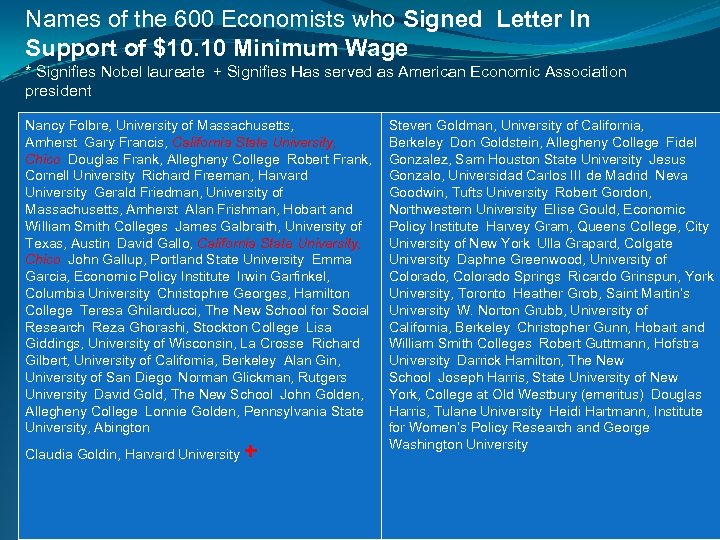
Names of the 600 Economists who Signed Letter In Support of $10. 10 Minimum Wage * Signifies Nobel laureate + Signifies Has served as American Economic Association president Nancy Folbre, University of Massachusetts, Amherst Gary Francis, California State University, Chico Douglas Frank, Allegheny College Robert Frank, Cornell University Richard Freeman, Harvard University Gerald Friedman, University of Massachusetts, Amherst Alan Frishman, Hobart and William Smith Colleges James Galbraith, University of Texas, Austin David Gallo, California State University, Chico John Gallup, Portland State University Emma Garcia, Economic Policy Institute Irwin Garfinkel, Columbia University Christophre Georges, Hamilton College Teresa Ghilarducci, The New School for Social Research Reza Ghorashi, Stockton College Lisa Giddings, University of Wisconsin, La Crosse Richard Gilbert, University of California, Berkeley Alan Gin, University of San Diego Norman Glickman, Rutgers University David Gold, The New School John Golden, Allegheny College Lonnie Golden, Pennsylvania State University, Abington Claudia Goldin, Harvard University + Steven Goldman, University of California, Berkeley Don Goldstein, Allegheny College Fidel Gonzalez, Sam Houston State University Jesus Gonzalo, Universidad Carlos III de Madrid Neva Goodwin, Tufts University Robert Gordon, Northwestern University Elise Gould, Economic Policy Institute Harvey Gram, Queens College, City University of New York Ulla Grapard, Colgate University Daphne Greenwood, University of Colorado, Colorado Springs Ricardo Grinspun, York University, Toronto Heather Grob, Saint Martin’s University W. Norton Grubb, University of California, Berkeley Christopher Gunn, Hobart and William Smith Colleges Robert Guttmann, Hofstra University Darrick Hamilton, The New School Joseph Harris, State University of New York, College at Old Westbury (emeritus) Douglas Harris, Tulane University Heidi Hartmann, Institute for Women’s Policy Research and George Washington University 8
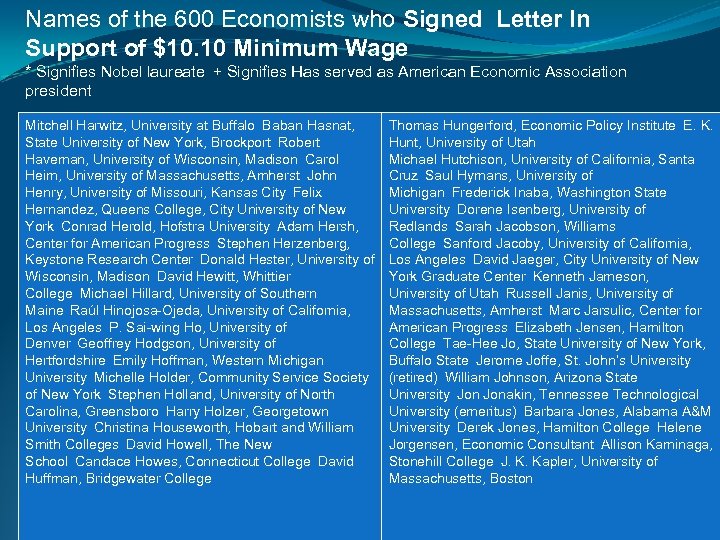
Names of the 600 Economists who Signed Letter In Support of $10. 10 Minimum Wage * Signifies Nobel laureate + Signifies Has served as American Economic Association president Mitchell Harwitz, University at Buffalo Baban Hasnat, State University of New York, Brockport Robert Haveman, University of Wisconsin, Madison Carol Heim, University of Massachusetts, Amherst John Henry, University of Missouri, Kansas City Felix Hernandez, Queens College, City University of New York Conrad Herold, Hofstra University Adam Hersh, Center for American Progress Stephen Herzenberg, Keystone Research Center Donald Hester, University of Wisconsin, Madison David Hewitt, Whittier College Michael Hillard, University of Southern Maine Raúl Hinojosa-Ojeda, University of California, Los Angeles P. Sai-wing Ho, University of Denver Geoffrey Hodgson, University of Hertfordshire Emily Hoffman, Western Michigan University Michelle Holder, Community Service Society of New York Stephen Holland, University of North Carolina, Greensboro Harry Holzer, Georgetown University Christina Houseworth, Hobart and William Smith Colleges David Howell, The New School Candace Howes, Connecticut College David Huffman, Bridgewater College Thomas Hungerford, Economic Policy Institute E. K. Hunt, University of Utah Michael Hutchison, University of California, Santa Cruz Saul Hymans, University of Michigan Frederick Inaba, Washington State University Dorene Isenberg, University of Redlands Sarah Jacobson, Williams College Sanford Jacoby, University of California, Los Angeles David Jaeger, City University of New York Graduate Center Kenneth Jameson, University of Utah Russell Janis, University of Massachusetts, Amherst Marc Jarsulic, Center for American Progress Elizabeth Jensen, Hamilton College Tae-Hee Jo, State University of New York, Buffalo State Jerome Joffe, St. John’s University (retired) William Johnson, Arizona State University Jon Jonakin, Tennessee Technological University (emeritus) Barbara Jones, Alabama A&M University Derek Jones, Hamilton College Helene Jorgensen, Economic Consultant Allison Kaminaga, Stonehill College J. K. Kapler, University of Massachusetts, Boston 9
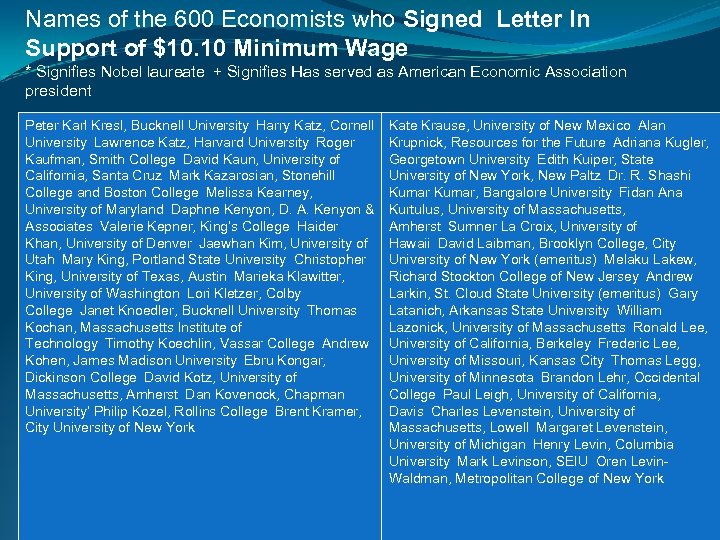
Names of the 600 Economists who Signed Letter In Support of $10. 10 Minimum Wage * Signifies Nobel laureate + Signifies Has served as American Economic Association president Peter Karl Kresl, Bucknell University Harry Katz, Cornell University Lawrence Katz, Harvard University Roger Kaufman, Smith College David Kaun, University of California, Santa Cruz Mark Kazarosian, Stonehill College and Boston College Melissa Kearney, University of Maryland Daphne Kenyon, D. A. Kenyon & Associates Valerie Kepner, King’s College Haider Khan, University of Denver Jaewhan Kim, University of Utah Mary King, Portland State University Christopher King, University of Texas, Austin Marieka Klawitter, University of Washington Lori Kletzer, Colby College Janet Knoedler, Bucknell University Thomas Kochan, Massachusetts Institute of Technology Timothy Koechlin, Vassar College Andrew Kohen, James Madison University Ebru Kongar, Dickinson College David Kotz, University of Massachusetts, Amherst Dan Kovenock, Chapman University’ Philip Kozel, Rollins College Brent Kramer, City University of New York Kate Krause, University of New Mexico Alan Krupnick, Resources for the Future Adriana Kugler, Georgetown University Edith Kuiper, State University of New York, New Paltz Dr. R. Shashi Kumar, Bangalore University Fidan Ana Kurtulus, University of Massachusetts, Amherst Sumner La Croix, University of Hawaii David Laibman, Brooklyn College, City University of New York (emeritus) Melaku Lakew, Richard Stockton College of New Jersey Andrew Larkin, St. Cloud State University (emeritus) Gary Latanich, Arkansas State University William Lazonick, University of Massachusetts Ronald Lee, University of California, Berkeley Frederic Lee, University of Missouri, Kansas City Thomas Legg, University of Minnesota Brandon Lehr, Occidental College Paul Leigh, University of California, Davis Charles Levenstein, University of Massachusetts, Lowell Margaret Levenstein, University of Michigan Henry Levin, Columbia University Mark Levinson, SEIU Oren Levin. Waldman, Metropolitan College of New York 10
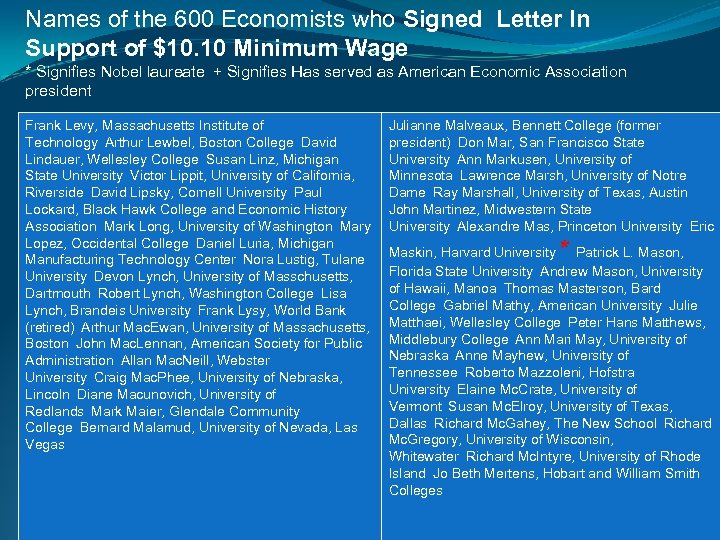
Names of the 600 Economists who Signed Letter In Support of $10. 10 Minimum Wage * Signifies Nobel laureate + Signifies Has served as American Economic Association president Frank Levy, Massachusetts Institute of Technology Arthur Lewbel, Boston College David Lindauer, Wellesley College Susan Linz, Michigan State University Victor Lippit, University of California, Riverside David Lipsky, Cornell University Paul Lockard, Black Hawk College and Economic History Association Mark Long, University of Washington Mary Lopez, Occidental College Daniel Luria, Michigan Manufacturing Technology Center Nora Lustig, Tulane University Devon Lynch, University of Masschusetts, Dartmouth Robert Lynch, Washington College Lisa Lynch, Brandeis University Frank Lysy, World Bank (retired) Arthur Mac. Ewan, University of Massachusetts, Boston John Mac. Lennan, American Society for Public Administration Allan Mac. Neill, Webster University Craig Mac. Phee, University of Nebraska, Lincoln Diane Macunovich, University of Redlands Mark Maier, Glendale Community College Bernard Malamud, University of Nevada, Las Vegas Julianne Malveaux, Bennett College (former president) Don Mar, San Francisco State University Ann Markusen, University of Minnesota Lawrence Marsh, University of Notre Dame Ray Marshall, University of Texas, Austin John Martinez, Midwestern State University Alexandre Mas, Princeton University Eric * Maskin, Harvard University Patrick L. Mason, Florida State University Andrew Mason, University of Hawaii, Manoa Thomas Masterson, Bard College Gabriel Mathy, American University Julie Matthaei, Wellesley College Peter Hans Matthews, Middlebury College Ann Mari May, University of Nebraska Anne Mayhew, University of Tennessee Roberto Mazzoleni, Hofstra University Elaine Mc. Crate, University of Vermont Susan Mc. Elroy, University of Texas, Dallas Richard Mc. Gahey, The New School Richard Mc. Gregory, University of Wisconsin, Whitewater Richard Mc. Intyre, University of Rhode Island Jo Beth Mertens, Hobart and William Smith Colleges 11
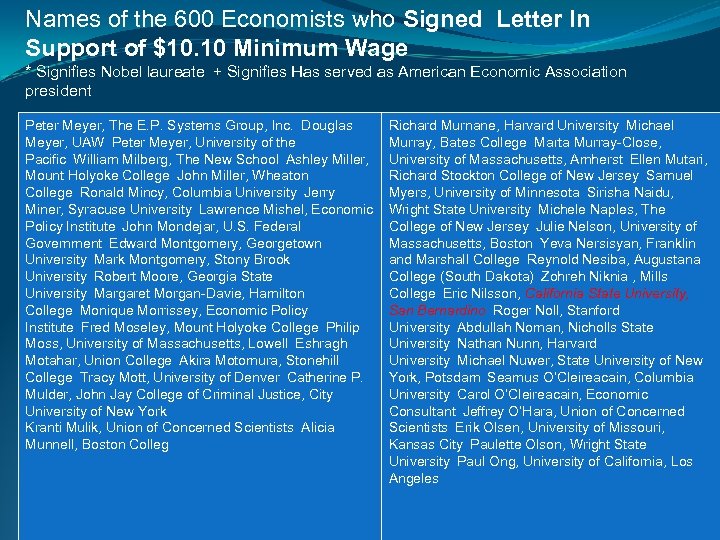
Names of the 600 Economists who Signed Letter In Support of $10. 10 Minimum Wage * Signifies Nobel laureate + Signifies Has served as American Economic Association president Peter Meyer, The E. P. Systems Group, Inc. Douglas Meyer, UAW Peter Meyer, University of the Pacific William Milberg, The New School Ashley Miller, Mount Holyoke College John Miller, Wheaton College Ronald Mincy, Columbia University Jerry Miner, Syracuse University Lawrence Mishel, Economic Policy Institute John Mondejar, U. S. Federal Government Edward Montgomery, Georgetown University Mark Montgomery, Stony Brook University Robert Moore, Georgia State University Margaret Morgan-Davie, Hamilton College Monique Morrissey, Economic Policy Institute Fred Moseley, Mount Holyoke College Philip Moss, University of Massachusetts, Lowell Eshragh Motahar, Union College Akira Motomura, Stonehill College Tracy Mott, University of Denver Catherine P. Mulder, John Jay College of Criminal Justice, City University of New York Kranti Mulik, Union of Concerned Scientists Alicia Munnell, Boston Colleg Richard Murnane, Harvard University Michael Murray, Bates College Marta Murray-Close, University of Massachusetts, Amherst Ellen Mutari, Richard Stockton College of New Jersey Samuel Myers, University of Minnesota Sirisha Naidu, Wright State University Michele Naples, The College of New Jersey Julie Nelson, University of Massachusetts, Boston Yeva Nersisyan, Franklin and Marshall College Reynold Nesiba, Augustana College (South Dakota) Zohreh Niknia , Mills College Eric Nilsson, California State University, San Bernardino Roger Noll, Stanford University Abdullah Noman, Nicholls State University Nathan Nunn, Harvard University Michael Nuwer, State University of New York, Potsdam Seamus O’Cleireacain, Columbia University Carol O’Cleireacain, Economic Consultant Jeffrey O’Hara, Union of Concerned Scientists Erik Olsen, University of Missouri, Kansas City Paulette Olson, Wright State University Paul Ong, University of California, Los Angeles 12
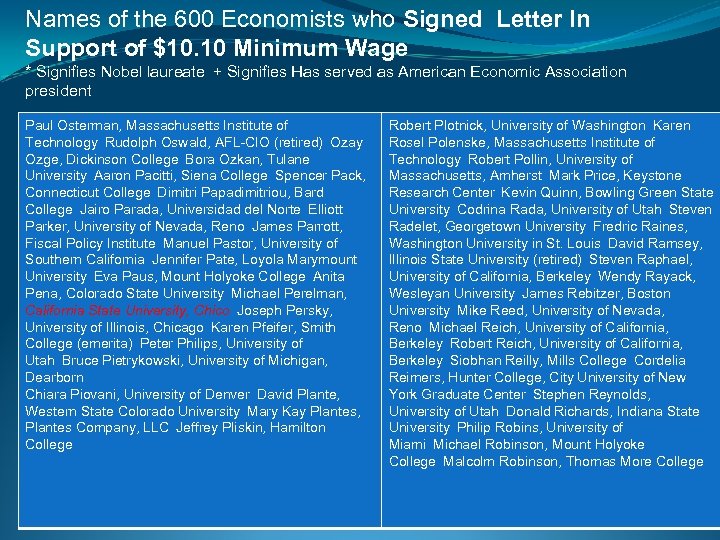
Names of the 600 Economists who Signed Letter In Support of $10. 10 Minimum Wage * Signifies Nobel laureate + Signifies Has served as American Economic Association president Paul Osterman, Massachusetts Institute of Technology Rudolph Oswald, AFL-CIO (retired) Ozay Ozge, Dickinson College Bora Ozkan, Tulane University Aaron Pacitti, Siena College Spencer Pack, Connecticut College Dimitri Papadimitriou, Bard College Jairo Parada, Universidad del Norte Elliott Parker, University of Nevada, Reno James Parrott, Fiscal Policy Institute Manuel Pastor, University of Southern California Jennifer Pate, Loyola Marymount University Eva Paus, Mount Holyoke College Anita Pena, Colorado State University Michael Perelman, California State University, Chico Joseph Persky, University of Illinois, Chicago Karen Pfeifer, Smith College (emerita) Peter Philips, University of Utah Bruce Pietrykowski, University of Michigan, Dearborn Chiara Piovani, University of Denver David Plante, Western State Colorado University Mary Kay Plantes, Plantes Company, LLC Jeffrey Pliskin, Hamilton College Robert Plotnick, University of Washington Karen Rosel Polenske, Massachusetts Institute of Technology Robert Pollin, University of Massachusetts, Amherst Mark Price, Keystone Research Center Kevin Quinn, Bowling Green State University Codrina Rada, University of Utah Steven Radelet, Georgetown University Fredric Raines, Washington University in St. Louis David Ramsey, Illinois State University (retired) Steven Raphael, University of California, Berkeley Wendy Rayack, Wesleyan University James Rebitzer, Boston University Mike Reed, University of Nevada, Reno Michael Reich, University of California, Berkeley Robert Reich, University of California, Berkeley Siobhan Reilly, Mills College Cordelia Reimers, Hunter College, City University of New York Graduate Center Stephen Reynolds, University of Utah Donald Richards, Indiana State University Philip Robins, University of Miami Michael Robinson, Mount Holyoke College Malcolm Robinson, Thomas More College 13
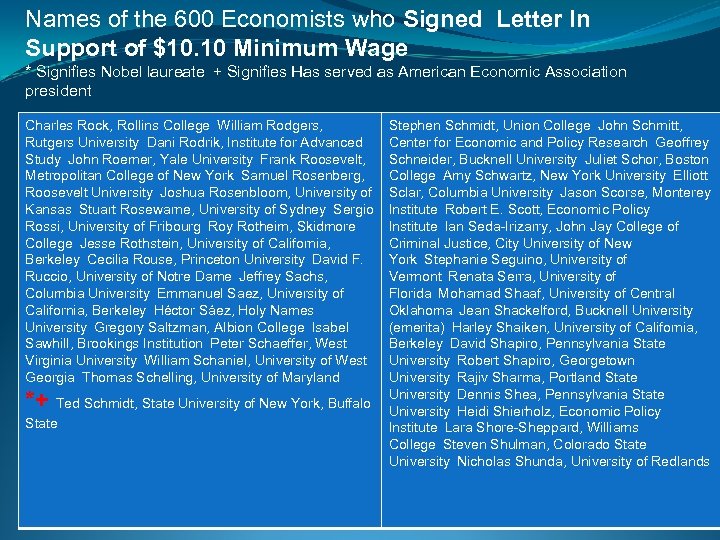
Names of the 600 Economists who Signed Letter In Support of $10. 10 Minimum Wage * Signifies Nobel laureate + Signifies Has served as American Economic Association president Charles Rock, Rollins College William Rodgers, Rutgers University Dani Rodrik, Institute for Advanced Study John Roemer, Yale University Frank Roosevelt, Metropolitan College of New York Samuel Rosenberg, Roosevelt University Joshua Rosenbloom, University of Kansas Stuart Rosewarne, University of Sydney Sergio Rossi, University of Fribourg Roy Rotheim, Skidmore College Jesse Rothstein, University of California, Berkeley Cecilia Rouse, Princeton University David F. Ruccio, University of Notre Dame Jeffrey Sachs, Columbia University Emmanuel Saez, University of California, Berkeley Héctor Sáez, Holy Names University Gregory Saltzman, Albion College Isabel Sawhill, Brookings Institution Peter Schaeffer, West Virginia University William Schaniel, University of West Georgia Thomas Schelling, University of Maryland Stephen Schmidt, Union College John Schmitt, Center for Economic and Policy Research Geoffrey Schneider, Bucknell University Juliet Schor, Boston College Amy Schwartz, New York University Elliott Sclar, Columbia University Jason Scorse, Monterey Institute Robert E. Scott, Economic Policy Institute Ian Seda-Irizarry, John Jay College of Criminal Justice, City University of New York Stephanie Seguino, University of Vermont Renata Serra, University of Florida Mohamad Shaaf, University of Central Oklahoma Jean Shackelford, Bucknell University (emerita) Harley Shaiken, University of California, Berkeley David Shapiro, Pennsylvania State University Robert Shapiro, Georgetown University Rajiv Sharma, Portland State University Dennis Shea, Pennsylvania State Ted Schmidt, State University of New York, Buffalo University Heidi Shierholz, Economic Policy State Institute Lara Shore-Sheppard, Williams College Steven Shulman, Colorado State University Nicholas Shunda, University of Redlands *+ 14
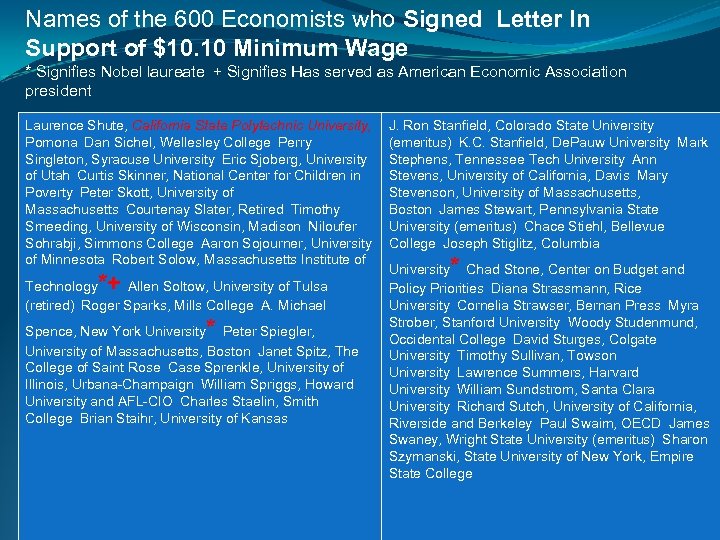
Names of the 600 Economists who Signed Letter In Support of $10. 10 Minimum Wage * Signifies Nobel laureate + Signifies Has served as American Economic Association president Laurence Shute, California State Polytechnic University, Pomona Dan Sichel, Wellesley College Perry Singleton, Syracuse University Eric Sjoberg, University of Utah Curtis Skinner, National Center for Children in Poverty Peter Skott, University of Massachusetts Courtenay Slater, Retired Timothy Smeeding, University of Wisconsin, Madison Niloufer Sohrabji, Simmons College Aaron Sojourner, University of Minnesota Robert Solow, Massachusetts Institute of *+ Technology Allen Soltow, University of Tulsa (retired) Roger Sparks, Mills College A. Michael * Spence, New York University Peter Spiegler, University of Massachusetts, Boston Janet Spitz, The College of Saint Rose Case Sprenkle, University of Illinois, Urbana-Champaign William Spriggs, Howard University and AFL-CIO Charles Staelin, Smith College Brian Staihr, University of Kansas J. Ron Stanfield, Colorado State University (emeritus) K. C. Stanfield, De. Pauw University Mark Stephens, Tennessee Tech University Ann Stevens, University of California, Davis Mary Stevenson, University of Massachusetts, Boston James Stewart, Pennsylvania State University (emeritus) Chace Stiehl, Bellevue College Joseph Stiglitz, Columbia * University Chad Stone, Center on Budget and Policy Priorities Diana Strassmann, Rice University Cornelia Strawser, Bernan Press Myra Strober, Stanford University Woody Studenmund, Occidental College David Sturges, Colgate University Timothy Sullivan, Towson University Lawrence Summers, Harvard University William Sundstrom, Santa Clara University Richard Sutch, University of California, Riverside and Berkeley Paul Swaim, OECD James Swaney, Wright State University (emeritus) Sharon Szymanski, State University of New York, Empire State College 15
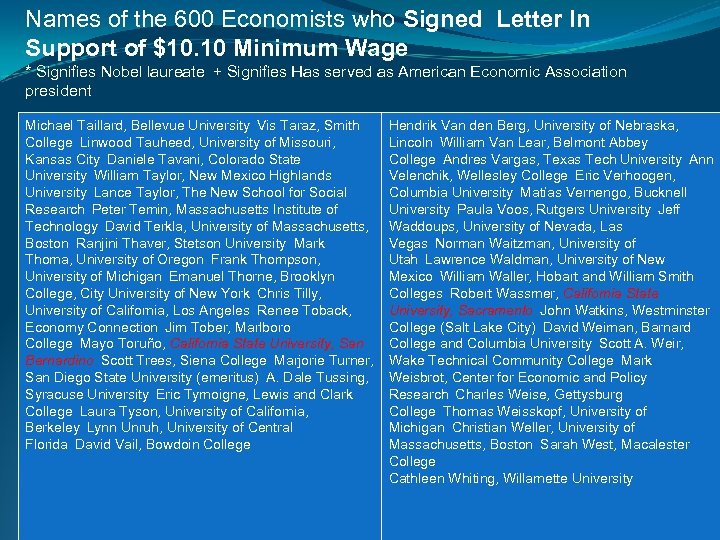
Names of the 600 Economists who Signed Letter In Support of $10. 10 Minimum Wage * Signifies Nobel laureate + Signifies Has served as American Economic Association president Michael Taillard, Bellevue University Vis Taraz, Smith College Linwood Tauheed, University of Missouri, Kansas City Daniele Tavani, Colorado State University William Taylor, New Mexico Highlands University Lance Taylor, The New School for Social Research Peter Temin, Massachusetts Institute of Technology David Terkla, University of Massachusetts, Boston Ranjini Thaver, Stetson University Mark Thoma, University of Oregon Frank Thompson, University of Michigan Emanuel Thorne, Brooklyn College, City University of New York Chris Tilly, University of California, Los Angeles Renee Toback, Economy Connection Jim Tober, Marlboro College Mayo Toruño, California State University, San Bernardino Scott Trees, Siena College Marjorie Turner, San Diego State University (emeritus) A. Dale Tussing, Syracuse University Eric Tymoigne, Lewis and Clark College Laura Tyson, University of California, Berkeley Lynn Unruh, University of Central Florida David Vail, Bowdoin College Hendrik Van den Berg, University of Nebraska, Lincoln William Van Lear, Belmont Abbey College Andres Vargas, Texas Tech University Ann Velenchik, Wellesley College Eric Verhoogen, Columbia University Matías Vernengo, Bucknell University Paula Voos, Rutgers University Jeff Waddoups, University of Nevada, Las Vegas Norman Waitzman, University of Utah Lawrence Waldman, University of New Mexico William Waller, Hobart and William Smith Colleges Robert Wassmer, California State University, Sacramento John Watkins, Westminster College (Salt Lake City) David Weiman, Barnard College and Columbia University Scott A. Weir, Wake Technical Community College Mark Weisbrot, Center for Economic and Policy Research Charles Weise, Gettysburg College Thomas Weisskopf, University of Michigan Christian Weller, University of Massachusetts, Boston Sarah West, Macalester College Cathleen Whiting, Willamette University 16
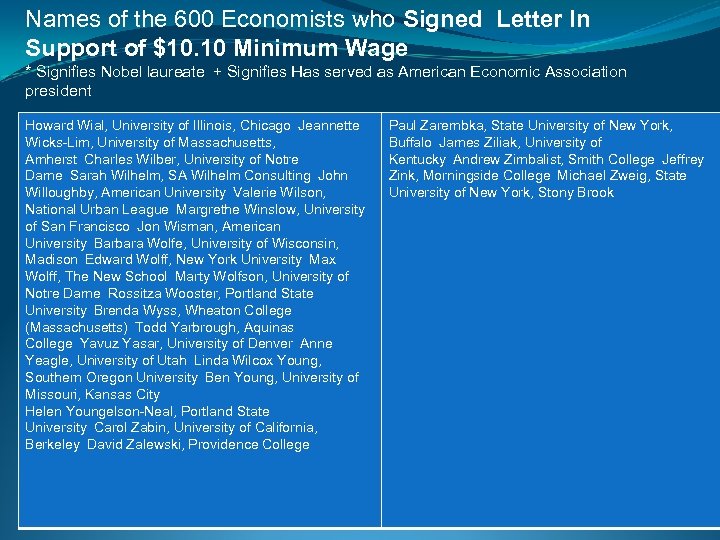
Names of the 600 Economists who Signed Letter In Support of $10. 10 Minimum Wage * Signifies Nobel laureate + Signifies Has served as American Economic Association president Howard Wial, University of Illinois, Chicago Jeannette Wicks-Lim, University of Massachusetts, Amherst Charles Wilber, University of Notre Dame Sarah Wilhelm, SA Wilhelm Consulting John Willoughby, American University Valerie Wilson, National Urban League Margrethe Winslow, University of San Francisco Jon Wisman, American University Barbara Wolfe, University of Wisconsin, Madison Edward Wolff, New York University Max Wolff, The New School Marty Wolfson, University of Notre Dame Rossitza Wooster, Portland State University Brenda Wyss, Wheaton College (Massachusetts) Todd Yarbrough, Aquinas College Yavuz Yasar, University of Denver Anne Yeagle, University of Utah Linda Wilcox Young, Southern Oregon University Ben Young, University of Missouri, Kansas City Helen Youngelson-Neal, Portland State University Carol Zabin, University of California, Berkeley David Zalewski, Providence College Paul Zarembka, State University of New York, Buffalo James Ziliak, University of Kentucky Andrew Zimbalist, Smith College Jeffrey Zink, Morningside College Michael Zweig, State University of New York, Stony Brook 17
Arguments Against Capitalism 18
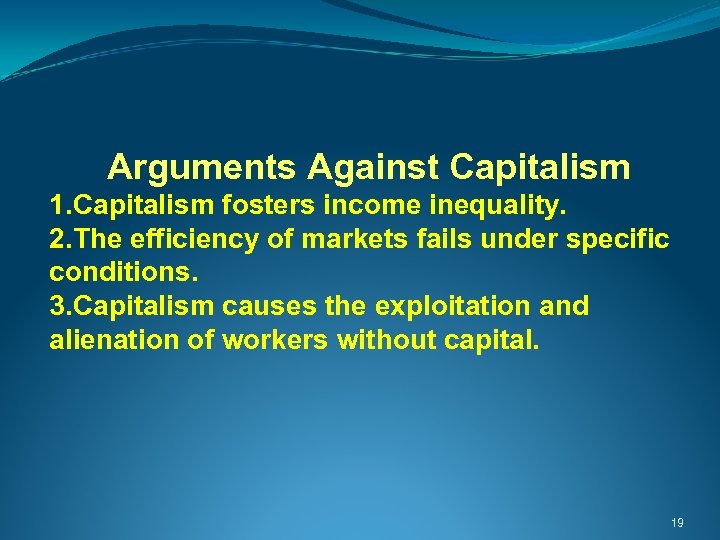
Arguments Against Capitalism 1. Capitalism fosters income inequality. 2. The efficiency of markets fails under specific conditions. 3. Capitalism causes the exploitation and alienation of workers without capital. 19
REVIEW of the social usefulness of free markets 20
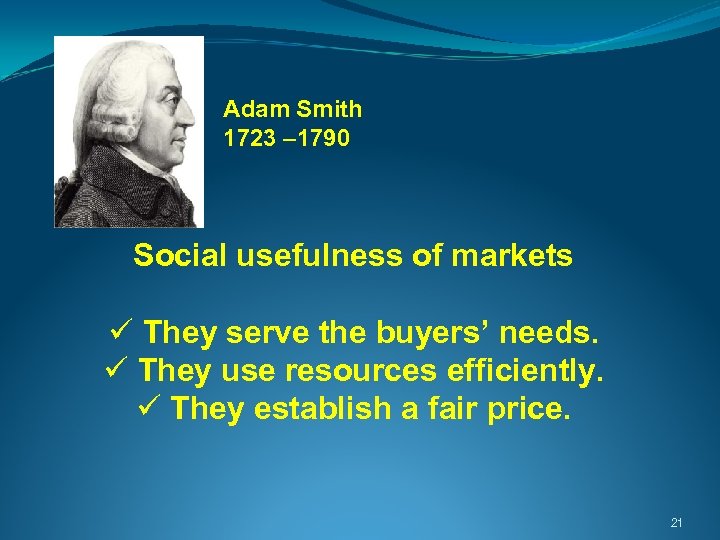
Adam Smith 1723 – 1790 Social usefulness of markets ü They serve the buyers’ needs. ü They use resources efficiently. ü They establish a fair price. 21
But the social usefulness of markets is undermined by monopolistic practices, in particular when companies can set or fix the price of a commodity. 22
![Monopolistic practices [continued]: If the few sellers of an oligopoly can control the](https://present5.com/presentation/e198120ef3f4d1998bc19f0390c02517/image-23.jpg "Monopolistic practices [continued]: If the few sellers of an oligopoly can control the")
Monopolistic practices [continued]: If the few sellers of an oligopoly can control the price, they function as a monopoly. They then create a monopoly surplus profit and undermine the usefulness of markets. 23
Oligopolies [few sellers – perhaps two, three or four sellers have more than 90% of the market share] are fairly common in the U. S. For example steel, aluminum, automobiles, gypsum, petroleum, tires, cigarettes and beer are oligopolies in the U. S. Some oligopolies in the U. S. have a long history of price fixing or setting, for example cigarettes 24
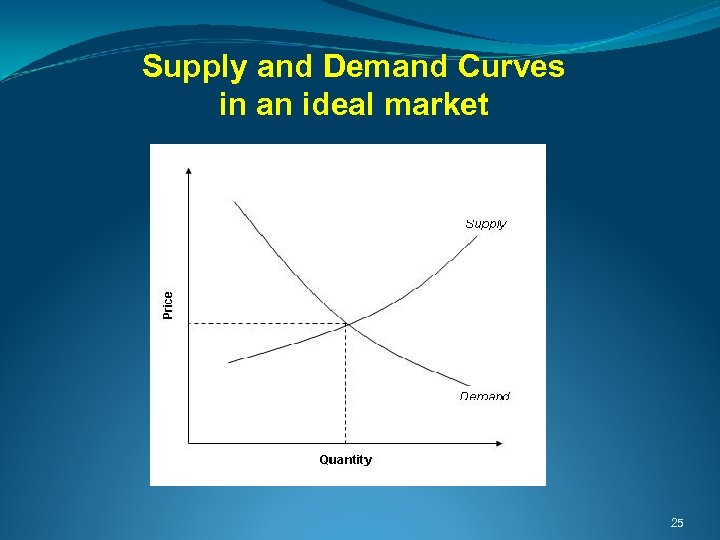
Supply and Demand Curves in an ideal market 25
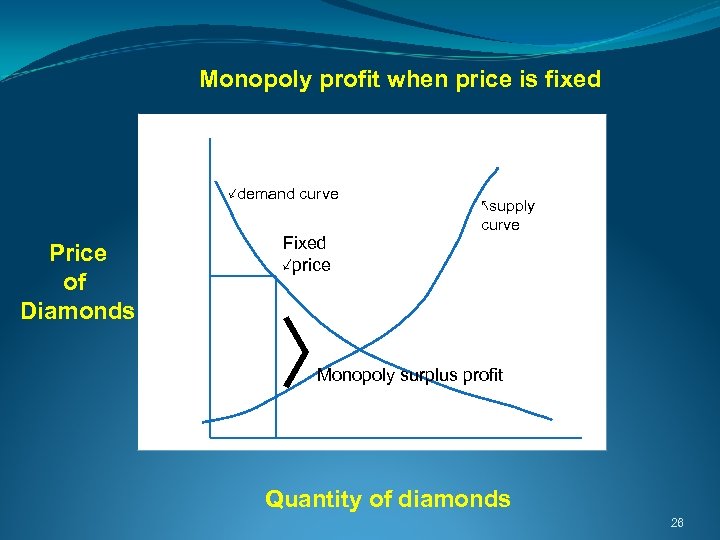
Monopoly profit when price is fixed ↙demand curve Price of Diamonds ↖supply curve Fixed ↙price 〉 Monopoly surplus profit Quantity of diamonds 26
Example of Monopolistic Practice as occuring in the recent “Great Recession” as described by Michael Lewis in The Big Short “If the subprime mortgage market had the slightest interest in being efficient, it would have shut down right there and then. For more than eighteen months, from mid-2005 until early 2007, there had been this growing disconnect between the price of subprime mortgage bonds and the value of the loans underpinning them. ” 1 1. Lewis, Michael, The Big Short, Chapter 7, “The Great Treasure Hunt, ” p. 164. 27
Michael Lewis continues: “A properly functioning market would assimilate new information into the prices of securities, the multi-trillion-dollar market in subprime mortage risk never budged. . It didn’t matter when big mortgage lenders like Ownit and Res. Cap failed, or some pool of subprime loans experienced higher than expected losses. All that matters was what Goldman Sachs and Morgan Stanley decided should matter. ” 1 1. Lewis, Michael, The Big Short, Chapter 8, “The Long Quiet, ” p. 186. 28
Second main limitations of markets: Public Goods Competitive markets cannot effectively distribute public goods. 29
What are Public Goods? Please remember: Public goods are not goods that are owned by the public. ‘Public goods’ have a specific definition as used in economics and social policy. 30
‘Public Goods’ are ‘non-excludable’ and ‘non-rivalrous. ’ ‘Non-excludable’ means that they cannot be consumed by an individual. ‘Non-rivalrous’ means that each individual's consumption of the good leads to no subtractions from any other individual's consumption of that good. . . 31
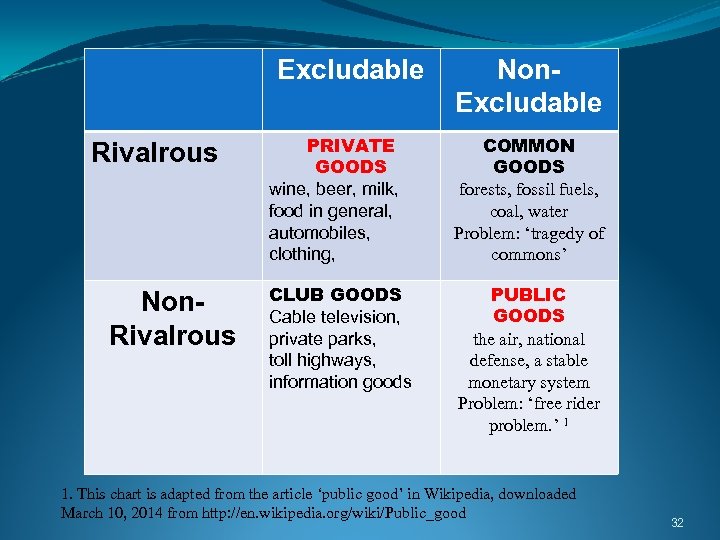
Excludable Rivalrous Non. Excludable PRIVATE GOODS wine, beer, milk, food in general, automobiles, clothing, COMMON GOODS forests, fossil fuels, coal, water Problem: ‘tragedy of commons’ CLUB GOODS Cable television, private parks, toll highways, information goods PUBLIC GOODS the air, national defense, a stable monetary system Problem: ‘free rider problem. ’ 1 1. This chart is adapted from the article ‘public good’ in Wikipedia, downloaded March 10, 2014 from http: //en. wikipedia. org/wiki/Public_good 32
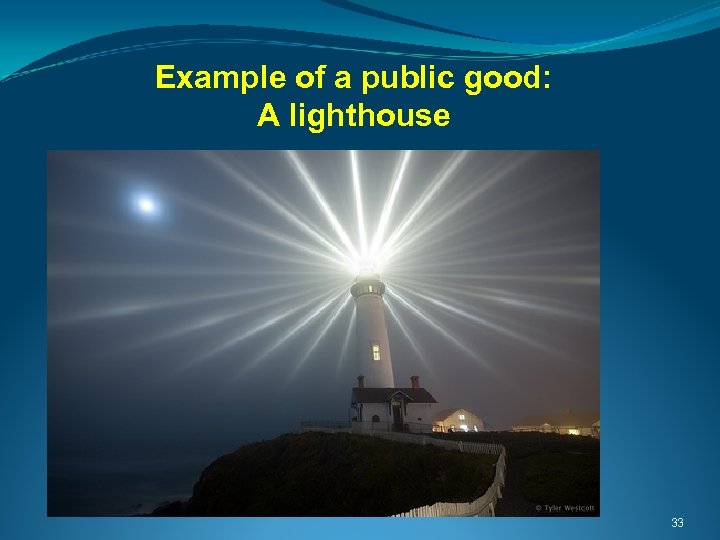
Example of a public good: A lighthouse 33
QUESTION Are cinemas public goods? Satellite television? 34
Since public goods are non-excludable and non-rivalrous the ‘invisible hand of competition’ does not operate on them as it does in a free market. Public goods invite the ‘free rider problem’ if handled through a free market. Consequently they are delivered generally by governments and paid for through taxation. 35
The Dodd–Frank Wall Street Reform and Consumer Protection Act was signed into federal law by President Obama on July 21, 2010. It brought the most significant changes to financial regulation in the United States since the regulatory reform following the Great Depression. 36
QUESTION: Is the Dodd–Frank Wall Street Reform and Consumer Protection Act a public good? 37
Third main limitation of markets : ‘Negative externalities’ or spillovers 38
What are ‘Negative externalities’ or Spillovers? 39
‘Negative externalities’ (spillovers) are social costs that are not included in the price of producing some good or service. Primary example: social costs of pollution and depletion of resources. 40
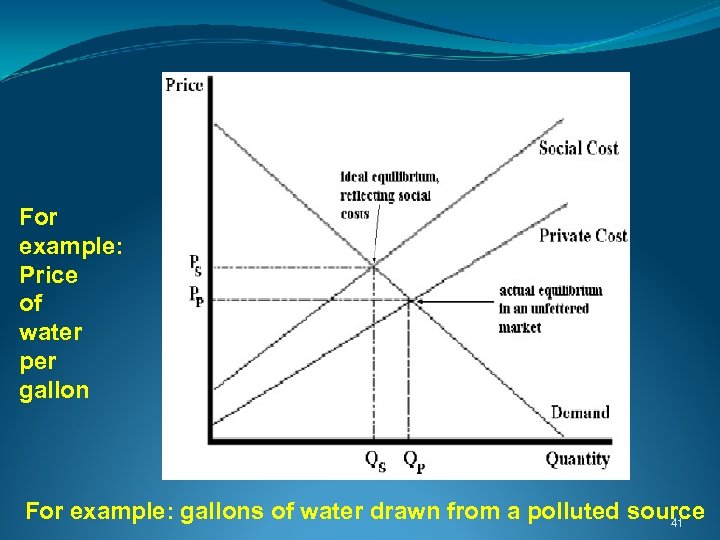
For example: Price of water per gallon For example: gallons of water drawn from a polluted source 41
Fourth (and last) limitation of the usefulness of markets: The prevalence of ignorance among buyers about a product or service 42
The prevalence of ignorance For a market to function in a socially productive way, it’s assumed products and services will result in consequences anticipated by a reasonable buyer. 43
Cases in automobile industry involving prevalence of ignorance. Ford Pintos (1970 -1975). GM Trucks with saddle-bag gas tanks (1980 s). Ford Explorers (1990 s). 44
Arguments Against Capitalism again– we’ve covered so far #1 and #2 1. Capitalism fosters income inequality. 2. The efficiency of markets fails under specific conditions. 3. Capitalism causes the exploitation and alienation of workers without capital. 45
Arguments Against Capitalism #3: Capitalism causes the exploitation and alienation of workers, historically speaking, most influential arguments were wielded by Karl Marx. 46
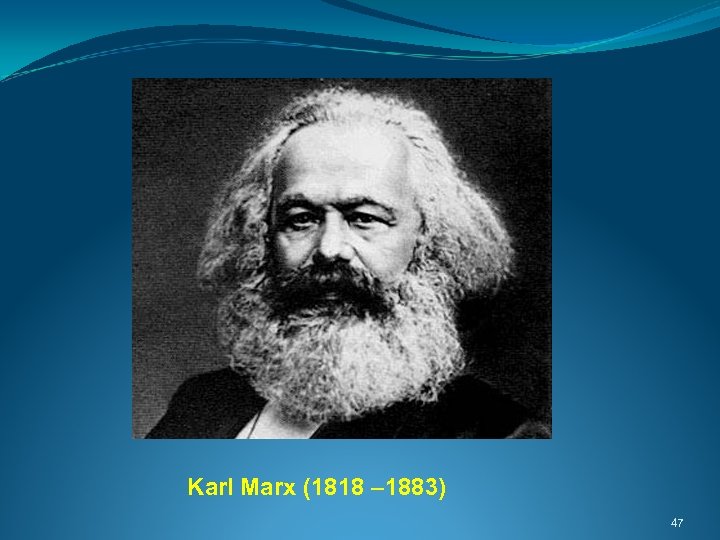
Karl Marx (1818 – 1883) 47
According to Marx, capitalism exploits and alienates workers in four ways: From their product, From their labor, From their humanity, From their society. Marx, Karl, Economic and Philosophic Manuscripts, 1844. 48
Alienation from their product In capitalism, the capitalist owns the products made by workers. Workers are removed (alienated) from a sense of ownership of their work. 49
Alienation from the product. Mike Fitzgerald . . . is a laborer in a steel mill interviewed by Studs Terkel. Fitzgerald expresses the product-alienation Marx referred to: “I feel like the guys who built the pyramids. Somebody built ‘em. Somebody built the Empire State Building too. There’s hard work behind it. I would like to see a building, say the Empire State, with a footwide strip from top to bottom and the name of every bricklayer on it, the name of every electrician. So when a guy walked by he could take his son and say, ‘See, that’s me over there on the 45 th floor. I put that steel beam in’. . . Everybody should have something to point to. ” Studs Terkel, How I Am a Worker, ” in Leonard Silk, ed. , Capitalism: The Moving Target (New York: Quadrangle, 1974), pp. 68 -9. 50
Alienation from labor. The monotony of work alienates people from a natural desire not to do the same uninteresting action over and over. Stud Turkel interviewed a college graduate Sharon Atkins who works as a receptionist in an advertising agency. She represents laboralienation: “The first myth that blew up in my face is that a college education will get you a worthwhile job. I didn’t look at myself as ‘just a dumb broad’ at the front desk, who took phone calls and messages. I thought I was something else. The office taught me differently. ” Studs Terkel, How I Am a Worker, ” in Leonard Silk, ed. , Capitalism: The Moving Target (New York: Quadrangle, 1974), pp. 68 -9. 51
Alienation from humanity. Marx’s argument is that especially human goods, such as justice, truth, and beauty, are ends in themselves. Capitalism, in an effort to make everything into a commodity, such ends in themselves, and makes them into means to sell products. 52

“Audi Q 7 with Advanced plus package. A masterpiece with much more. ” 53
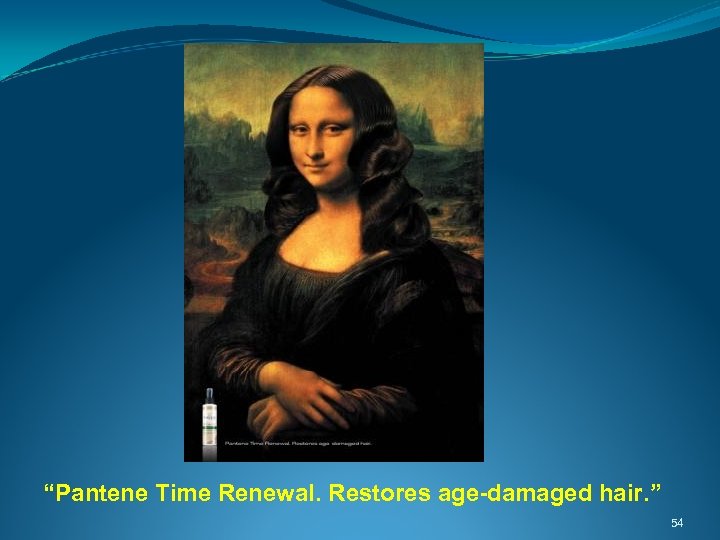
“Pantene Time Renewal. Restores age-damaged hair. ” 54
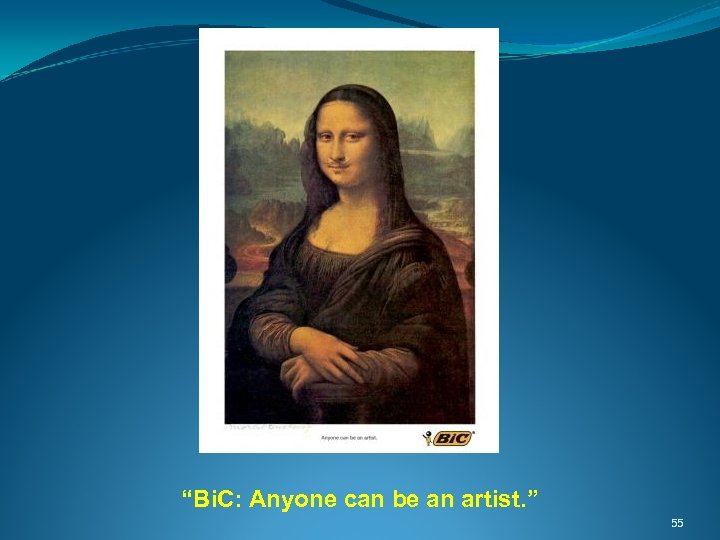
“Bi. C: Anyone can be an artist. ” 55
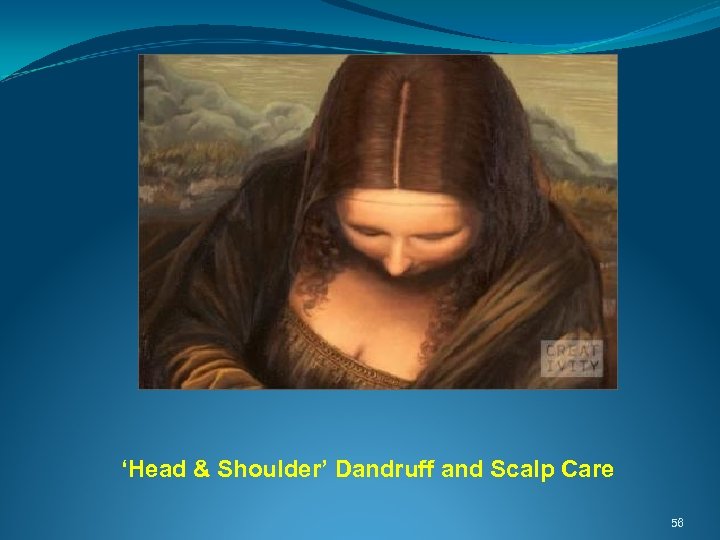
‘Head & Shoulder’ Dandruff and Scalp Care 56
Alienation from society. Marx thought that those who owned capital or the bourgeoisie would be alienated from the worker who did not own capital, the Proletariat, and vice versa. 57
The bourgeoisie are the social class that own the means of production. They are capitalists. The Proletariat are the working class. The term originally arose from class distinctions in Rome and meant those people who had no wealth other than their children. 58
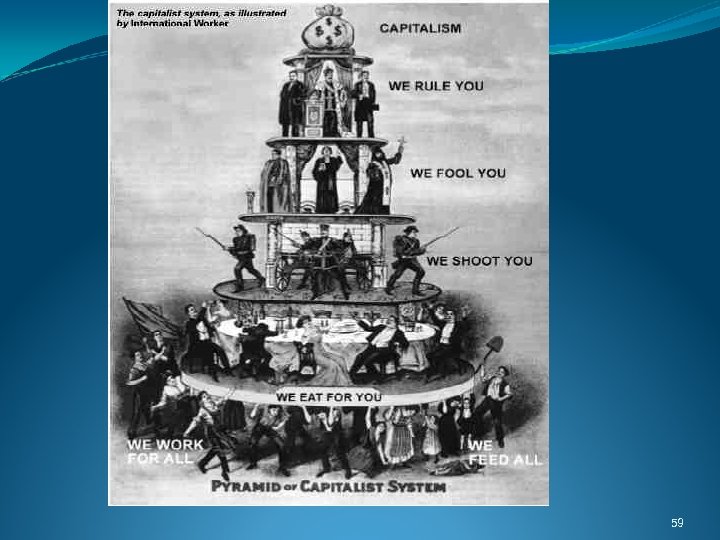
59
For Marx, both the capitalist class and the Proletariat depend on each other to maintain their livelihoods. But they also are aware that, in doing so, they both perpetuate social injustice and inequality. Thus they are both, in a fourth sense, alienated. They are alienated from an equitable society which has good will and friendship among its various classes. 60
In the past three decade there is a clear widening split between the very rich, ‘the 1 percenters’ and the remaining population. Some data follows. 61
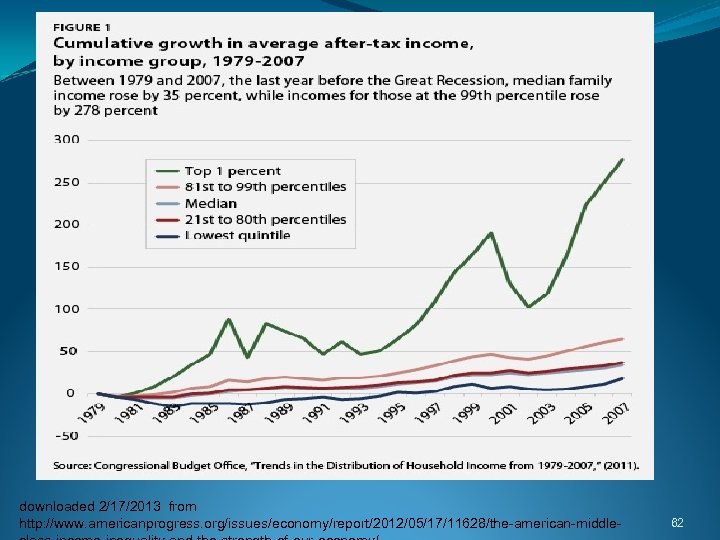
downloaded 2/17/2013 from http: //www. americanprogress. org/issues/economy/report/2012/05/17/11628/the-american-middle- 62
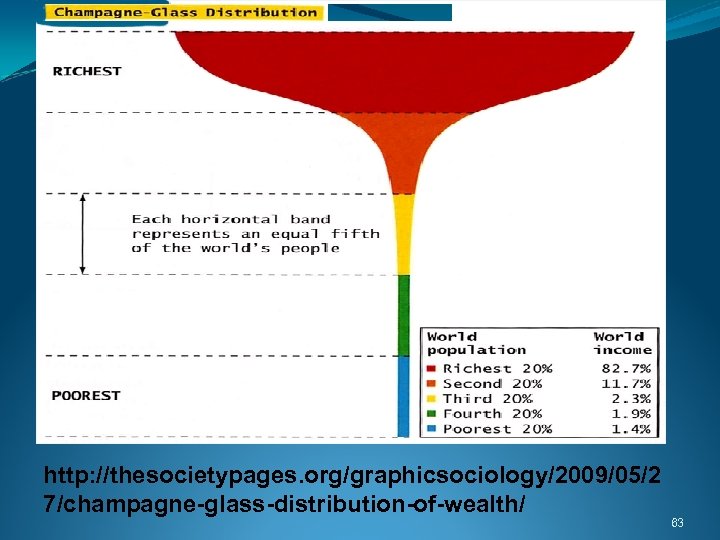
http: //thesocietypages. org/graphicsociology/2009/05/2 7/champagne-glass-distribution-of-wealth/ 63
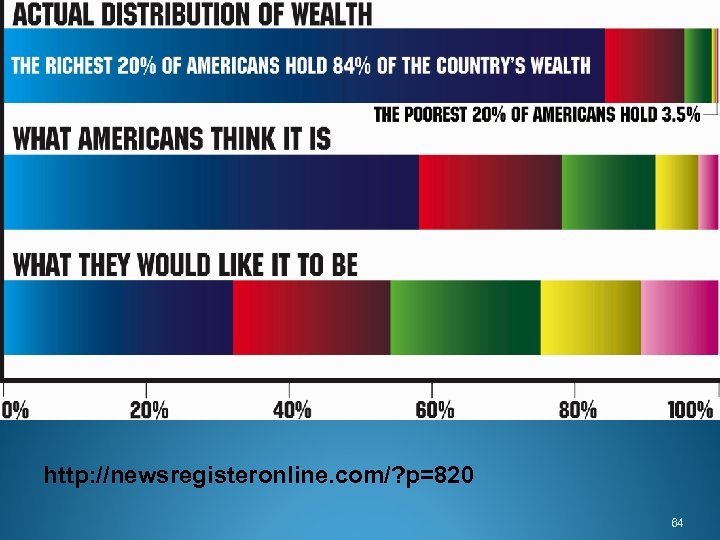
http: //newsregisteronline. com/? p=820 64
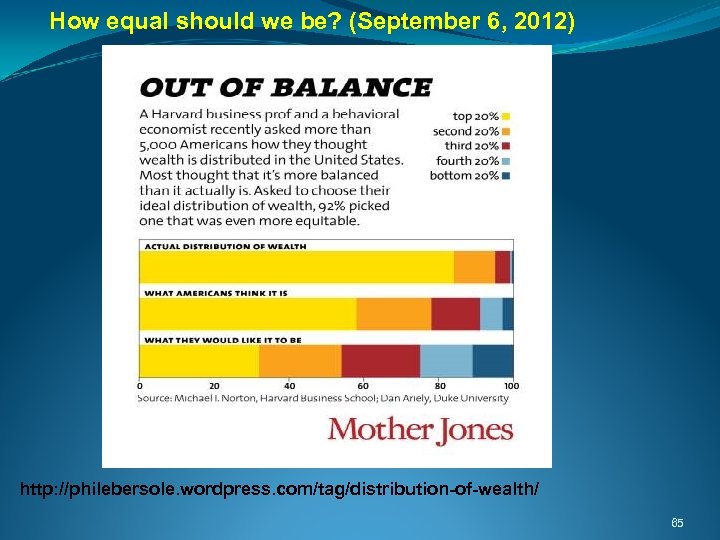
How equal should we be? (September 6, 2012) http: //philebersole. wordpress. com/tag/distribution-of-wealth/ 65
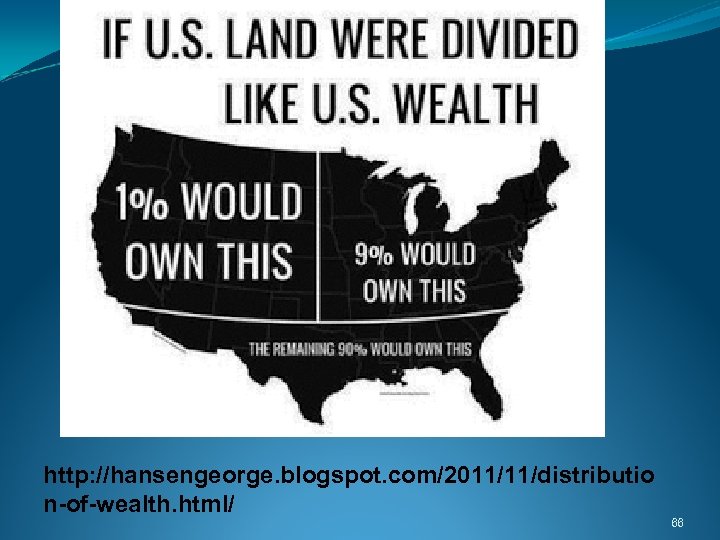
http: //hansengeorge. blogspot. com/2011/11/distributio n-of-wealth. html/ 66
According to Marx, capitalism exploits and alienates workers in four ways: From their product, From their labor, From their humanity, From their society. Marx, Karl, Economic and Philosophic Manuscripts, 1844. 67
Question: Does the widening split between the very rich, ‘the 1 percenters’ and the remaining population fit the Marxian analysis whereby capitalistic society is made up of two classes: the proletariat and the bourgeoisie? A BIG question: Where and how might the U. S. labor force be alienated from its product -- its labor – its humanity? Surely not everywhere, but where are the gravest offenses. 68
Скачать презентацию Professional and Business Ethics Prof Peter Hadreas Spring
e198120ef3f4d1998bc19f0390c02517.ppt