 Скачать презентацию Professional and Business Ethics Prof Peter Hadreas Spring
115af918940b27069e69fb710d0783bf.ppt
- Количество слайдов: 48




Professional and Business Ethics Prof. Peter Hadreas Spring, 2014 Course Website: http: //www. sjsu. edu/people/peter. hadreas/courses/P rofand. Bus. Ethics/ 1
Three Basic Types of Ethical Theory Teleological, or consequence-based. (MBE, pp. 40 -42) Deontological, or duty-based. (MBE, pp. 42 -46) Virtue ethical, or character-based. (MBE, pp. 46 -51) 2
Teleological, or consequence-based ethical theory 3
Utilitarianism “Utilitarianism is probably the bestknown consequentialist theory. According to the principle of utility, ethical decisions should best maximize benefits to society and minimize harms. What matters is the net consequences of good consequences over bad for society overall. ” Treviño and Nelson textbook, Chapter 2, p. 40. 4
Utilitarianism is usually the preferred ethical method in public policy decisions. This arises from its capacity to compare the relative strengths and weakness of a great number of possible actions. 5
Stakeholders “A utilitarian would approach an ethical dilemma by systematically identifying the stakeholders in a particular situation as well as the alternative actions and their consequences (harms and/or benefits) for each. A stakeholder is a person or group with a stake in the issue at hand. ” Treviño and Nelson textbook, Chapter 2, p. 40. 6
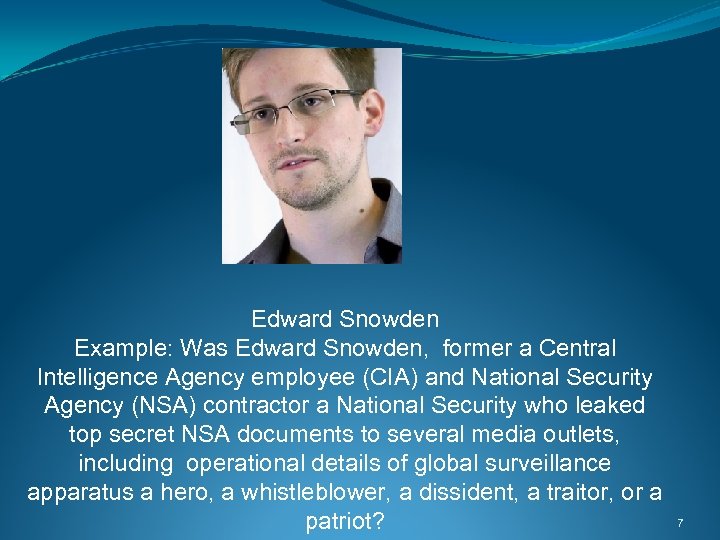
Edward Snowden Example: Was Edward Snowden, former a Central Intelligence Agency employee (CIA) and National Security Agency (NSA) contractor a National Security who leaked top secret NSA documents to several media outlets, including operational details of global surveillance apparatus a hero, a whistleblower, a dissident, a traitor, or a patriot? 7
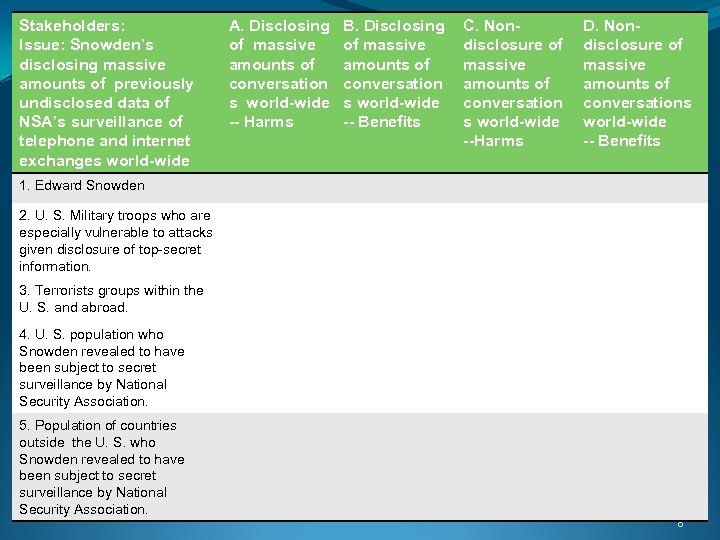
Stakeholders: Issue: Snowden’s disclosing massive amounts of previously undisclosed data of NSA’s surveillance of telephone and internet exchanges world-wide A. Disclosing of massive amounts of conversation s world-wide -- Harms B. Disclosing of massive amounts of conversation s world-wide -- Benefits C. Nondisclosure of massive amounts of conversation s world-wide --Harms D. Nondisclosure of massive amounts of conversations world-wide -- Benefits 1. Edward Snowden 2. U. S. Military troops who are especially vulnerable to attacks given disclosure of top-secret information. 3. Terrorists groups within the U. S. and abroad. 4. U. S. population who Snowden revealed to have been subject to secret surveillance by National Security Association. 5. Population of countries outside the U. S. who Snowden revealed to have been subject to secret surveillance by National Security Association. 8
Very recently, January 2014, the Republican Party passed a "Resolution To Renounce The National Security Agency’s Surveillance Program. " The party formed a committee to reveal to the extent of domestic spying. They based their decision on opposition to the rights of privacy derived from the Fourth Amendment. However, their decision was influenced by investigation by such groups as the Privacy and Civil Liberties Rights Board and the New America Foundation that had established that NSA ‘s collection of phone records had no discernible impact on preventing acts of terrorism. The PCLRB was not able to find a single telephone communication that served to disrupt a terrorist attack. 1 1. "White House rejects review board finding that NSA data sweep is illegal". Fox/AP. Retrieved February 2, 2014. 9
Utilitarianism Remember how Utilitarianism is defined: “. . . an ethical decision should maximize benefits to society and minimizes harms. ” (Treviño and Nelson textbook, Chapter 2, p. 40. ) But what counts as benefits and harms? What is the criterion? The founders of modern utilitarianism measured benefits and harms according to pleasure and pains. 10
Hedonism is the view that pleasure and pain are ultimately the only basis of what makes an action or experience good or bad. 11
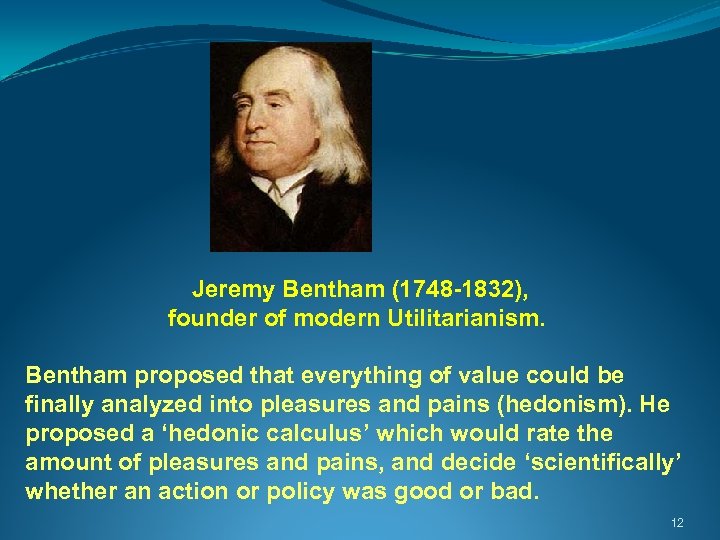
Jeremy Bentham (1748 -1832), founder of modern Utilitarianism. Bentham proposed that everything of value could be finally analyzed into pleasures and pains (hedonism). He proposed a ‘hedonic calculus’ which would rate the amount of pleasures and pains, and decide ‘scientifically’ whether an action or policy was good or bad. 12
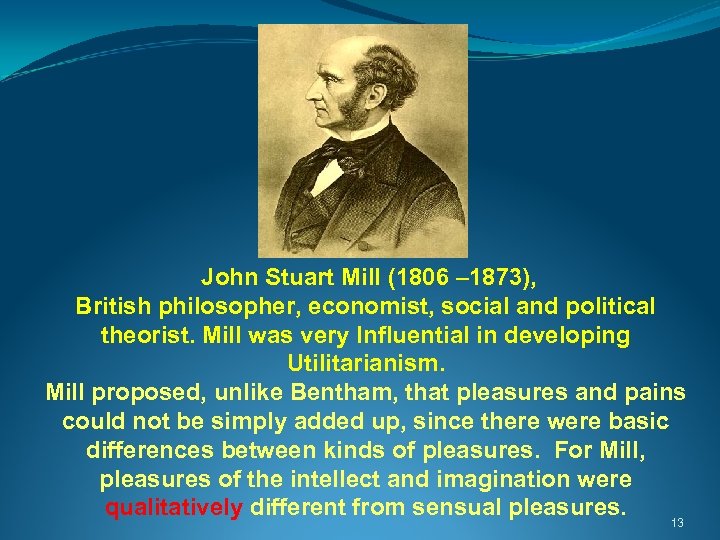
John Stuart Mill (1806 – 1873), British philosopher, economist, social and political theorist. Mill was very Influential in developing Utilitarianism. Mill proposed, unlike Bentham, that pleasures and pains could not be simply added up, since there were basic differences between kinds of pleasures. For Mill, pleasures of the intellect and imagination were qualitatively different from sensual pleasures. 13
Limits of Utilitarianism 1. Classical forms of Utilitarianism (Bentham’s and Mill’s versions) were based in pleasure and pain, that is in hedonism. But, arguably not all value can be reduced to pleasure and pain. 2. Especially in the long-term, the consequences of an action or decision are often very difficult to predict. (MBE, p. 42). 3. In some cases, the greatest happiness of the stakeholders might override – or appear to override -- the personal rights of a less populous group? Such was the argument of slaveholders in the Old South. Should then the Utilitarian decision still be followed? (MBE, p. 42). 14
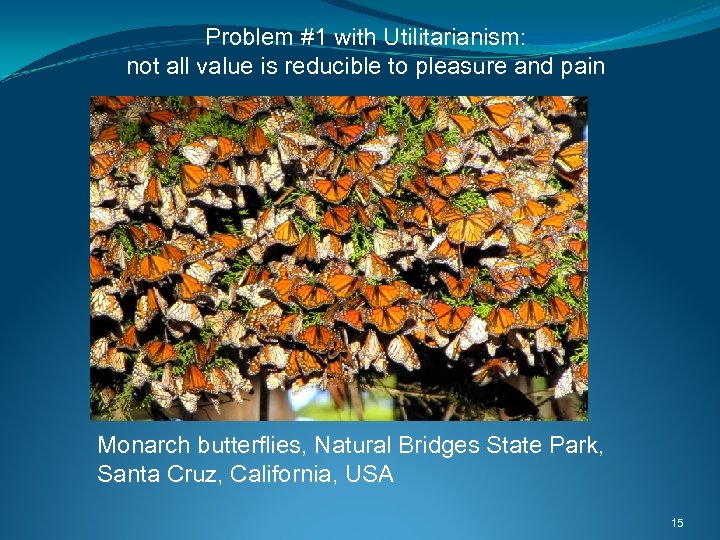
Problem #1 with Utilitarianism: not all value is reducible to pleasure and pain Monarch butterflies, Natural Bridges State Park, Santa Cruz, California, USA 15
Who are the stakeholders here? Are the butterflies one of them? Butterflies, presumably, will count little in the measurement of pleasure and pain.
In late the 1970 s, Synertex, a semiconductor company headquartered in Sunnyvale, CA, applied for a permit to build a $40 million research plant across the street from Monarch Butterfly Natural Preserve. The proposed plant would employ 350 -400 workers. Synertex’s environmental report indicated that the plant would sometimes release sulfur and nitrogen oxides into the air. These would blow in the direction of the park 20% of the time. Synertex was clearly unwilling to agree to shut down its $40 million plant if the butterflies were effected.
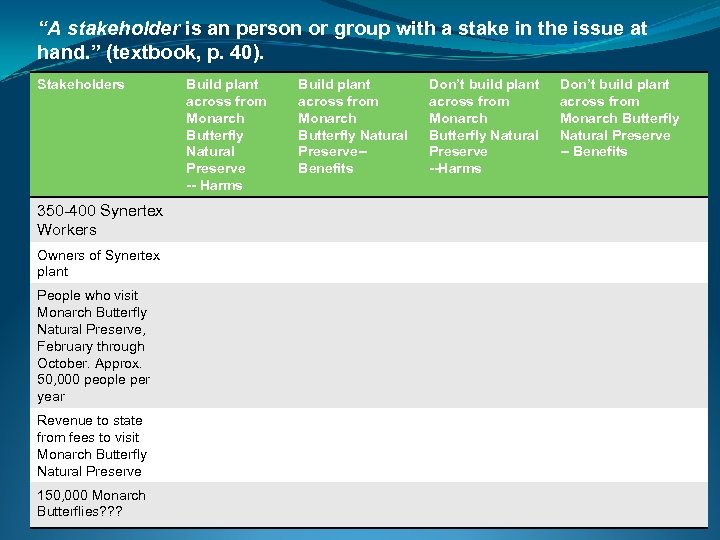
“A stakeholder is an person or group with a stake in the issue at hand. ” (textbook, p. 40). Stakeholders Build plant across from Monarch Butterfly Natural Preserve -- Harms Build plant across from Monarch Butterfly Natural Preserve-- Benefits Don’t build plant across from Monarch Butterfly Natural Preserve --Harms Don’t build plant across from Monarch Butterfly Natural Preserve -- Benefits 350 -400 Synertex Workers Owners of Synertex plant People who visit Monarch Butterfly Natural Preserve, February through October. Approx. 50, 000 people per year Revenue to state from fees to visit Monarch Butterfly Natural Preserve 150, 000 Monarch Butterflies? ? ? 18
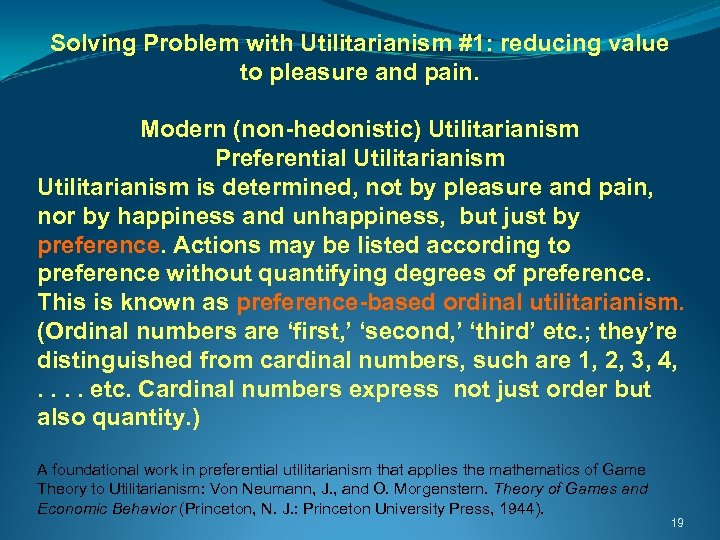
Solving Problem with Utilitarianism #1: reducing value to pleasure and pain. Modern (non-hedonistic) Utilitarianism Preferential Utilitarianism is determined, not by pleasure and pain, nor by happiness and unhappiness, but just by preference. Actions may be listed according to preference without quantifying degrees of preference. This is known as preference-based ordinal utilitarianism. (Ordinal numbers are ‘first, ’ ‘second, ’ ‘third’ etc. ; they’re distinguished from cardinal numbers, such are 1, 2, 3, 4, . . etc. Cardinal numbers express not just order but also quantity. ) A foundational work in preferential utilitarianism that applies the mathematics of Game Theory to Utilitarianism: Von Neumann, J. , and O. Morgenstern. Theory of Games and Economic Behavior (Princeton, N. J. : Princeton University Press, 1944). 19
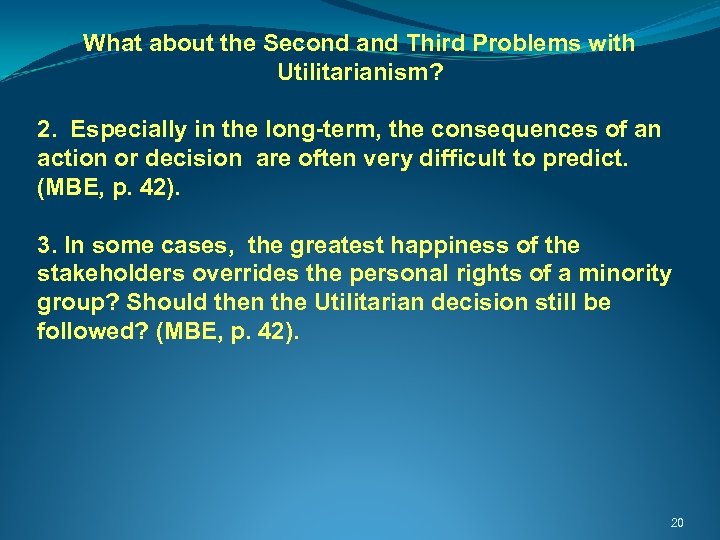
What about the Second and Third Problems with Utilitarianism? 2. Especially in the long-term, the consequences of an action or decision are often very difficult to predict. (MBE, p. 42). 3. In some cases, the greatest happiness of the stakeholders overrides the personal rights of a minority group? Should then the Utilitarian decision still be followed? (MBE, p. 42). 20
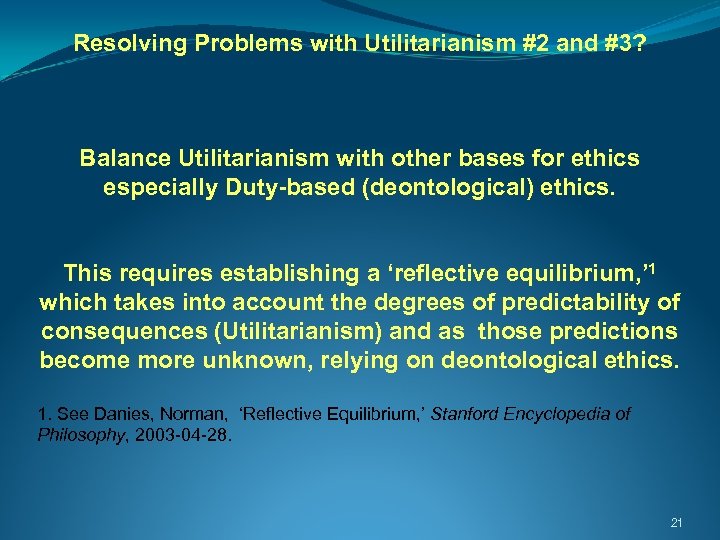
Resolving Problems with Utilitarianism #2 and #3? Balance Utilitarianism with other bases for ethics especially Duty-based (deontological) ethics. This requires establishing a ‘reflective equilibrium, ’ 1 which takes into account the degrees of predictability of consequences (Utilitarianism) and as those predictions become more unknown, relying on deontological ethics. 1. See Danies, Norman, ‘Reflective Equilibrium, ’ Stanford Encyclopedia of Philosophy, 2003 -04 -28. 21
Three Basic Types of Ethical Theory Teleological, or consequence-based. (MBE, pp. 40 -42) Deontological, or duty-based. (MBE, pp. 42 -46) Virtue ethical, or character-based. (MBE, pp. 46 -51) 22
Resolving Problems with Utilitarianism #2 and #3? Balance Utilitarianism with other bases for ethics especially Duty-based (deontological) ethics. This requires establishing a ‘reflective equilibrium, ’ 1 which takes into account the degrees of predictability of consequences (Utilitarianism) and as those predictions become more unknown, relying on deontological ethics. 1. See Danies, Norman, ‘Reflective Equilibrium, ’ Stanford Encyclopedia of Philosophy, 2003 -04 -28. 23
Deontological, or duty-based ethics 24
“. . . a deontologist focuses on doing what is ‘right’ (based on moral principles or values such as honesty), whereas a consequentialist focuses on doing what will maximize societal welfare. ” Treviño and Nelson textbook, Chapter 2, p. 42. 25
“An auditor taking a deontological approach would likely insist on telling the truth about a company’s financial difficulties even if doing so might risk putting the company out of business and many people out of work. A consequentialist auditor would weigh the societal norms and benefits before deciding what to do. If convinced that by lying now he or she could save a good company in the long term, the consequentialist auditor would be more willing to compromise the truth. ” Treviño and Nelson textbook, Chapter 2, p. 42 -3. 26
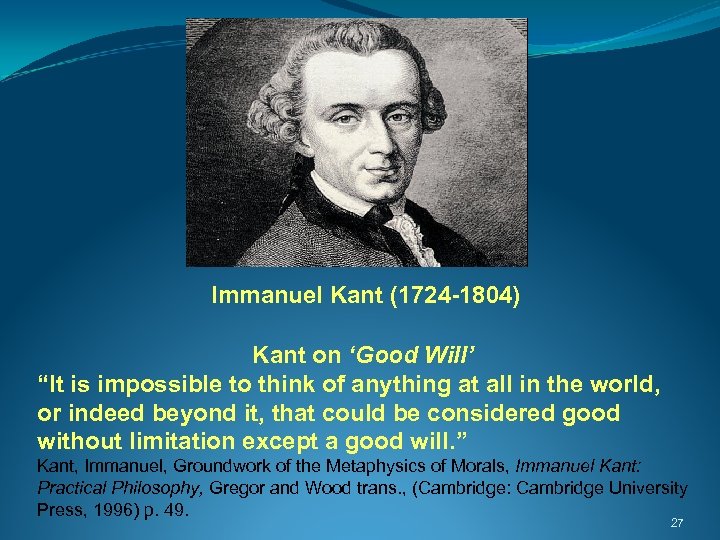
Immanuel Kant (1724 -1804) Kant on ‘Good Will’ “It is impossible to think of anything at all in the world, or indeed beyond it, that could be considered good without limitation except a good will. ” Kant, Immanuel, Groundwork of the Metaphysics of Morals, Immanuel Kant: Practical Philosophy, Gregor and Wood trans. , (Cambridge: Cambridge University Press, 1996) p. 49. 27
Kant on ‘Respect’ Respect applies always to persons only -- not to things. The latter may arouse inclination, and if they are animals (e. g. , horses, dogs, etc. ), even love or fear, like the sea, a volcano, a beast of prey; but never respect. . A man also may be an object of love, fear or admiration, even to astonishment, and yet not be an object of respect. . Fontenelle [a French writer, 1657 -1757] says: “I bow before a great man, but my mind does not bow. ” I would add, before an humble man, in whom I perceive uprightness of character in a higher degree than I am conscious of in myself, my mind bows whether I choose it or not. . . Why is this? Because his example exhibits to me a law that humbles my self-conceit when I compare it with my conduct: a law, the practicability of obedience to which I see by fact before my eyes. Kant, Critique of Practical Reason, Part I, Book I, Chapt. 3. 28
QUESTION When we say we respect someone – not admire nor fear someone, but just respect someone -- what sorts of character traits or qualities of the person do we respect? 29
For Kant ‘good will’ is categorically not hypothetically good. ‘Categorically’ good means good by the very category of ethical behavior. ‘Hypothetically’ good means good under the hypothesis (or assumption) of some desirable goal, such as health, perseverance or courage. 30
Kant on hypothetical goods “Understanding, wit, judgment, and the like, whatever such talents of the mind may be called, or courage, resoluteness, and perseverance in one’s plans, as qualities of temperament, are undoubtedly good and desirable for many purposes, but they can become extremely bad and harmful if the will, which is to make use of these gifts of nature and whose distinctive constitution is therefore called character, is not good. ” Kant, Immanuel, Groundwork of the Metaphysics of Morals, Immanuel Kant: Practical Philosophy, Gregor and Wood trans. , (Cambridge: Cambridge University Press, 1996) p. 80. 31

The First Version of Kant’s Categorical Imperative “Act as if the maxim of thy action were to become by thy will a universal law of nature. ” (cited in textbook, p. 43) 32
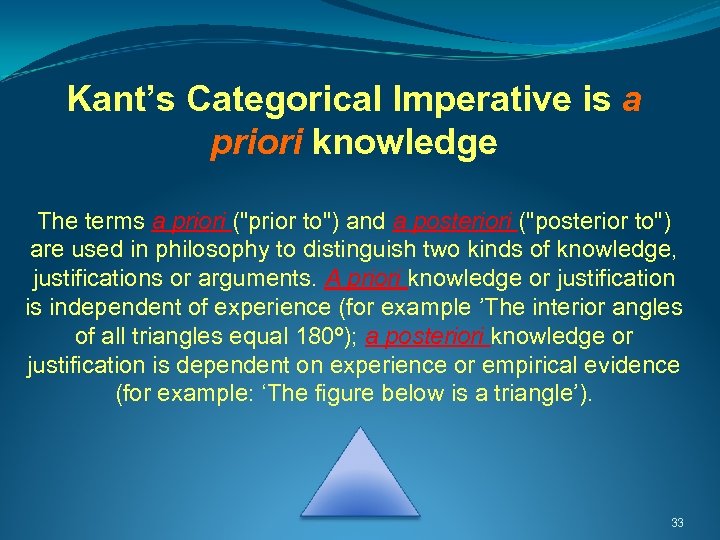
Kant’s Categorical Imperative is a priori knowledge The terms a priori ("prior to") and a posteriori ("posterior to") are used in philosophy to distinguish two kinds of knowledge, justifications or arguments. A priori knowledge or justification is independent of experience (for example ’The interior angles of all triangles equal 180º); a posteriori knowledge or justification is dependent on experience or empirical evidence (for example: ‘The figure below is a triangle’). 33

The Second Version of the Categorical Imperative “So act that you use humanity, whether in your own person or in the person of any other, always at the same time as an end, never merely as a means. ” Kant, Immanuel, Groundwork of the Metaphysics of Morals, Immanuel Kant: Practical Philosophy, Gregor and Wood trans. , (Cambridge: Cambridge University Press, 1996) p. 80. 34
Negative and Positive Rights (MBE, p. 43) All rights are entitlements and every right implies a duty. Negative rights are entitlements to be free from interferences, for example right to free speech. Positive rights are entitlements to receive certain vital benefits, for example right to adequate health care. 35
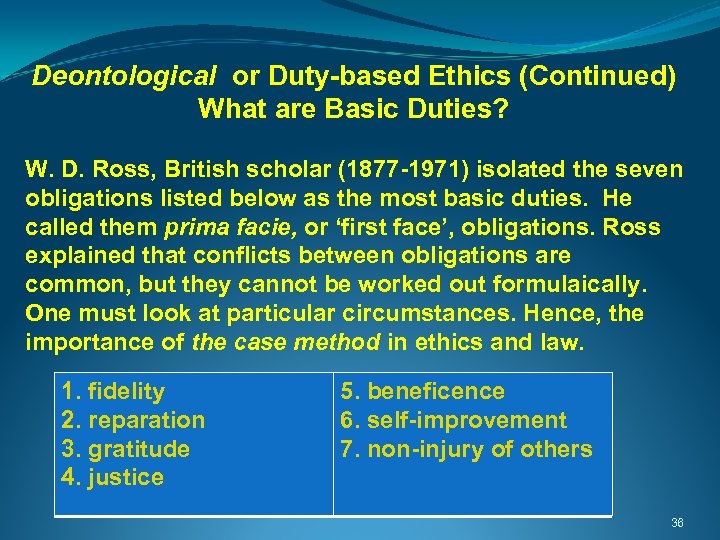
Deontological or Duty-based Ethics (Continued) What are Basic Duties? W. D. Ross, British scholar (1877 -1971) isolated the seven obligations listed below as the most basic duties. He called them prima facie, or ‘first face’, obligations. Ross explained that conflicts between obligations are common, but they cannot be worked out formulaically. One must look at particular circumstances. Hence, the importance of the case method in ethics and law. 1. fidelity 2. reparation 3. gratitude 4. justice 5. beneficence 6. self-improvement 7. non-injury of others 36
Virtue ethics, or character-based ethics. 37
Our textbook writers Treviño and Nelson define virtue ethics as follows: “The virtue ethics approach focuses more on the integrity of the moral actor (the person) than on the moral act itself (decision or behavior). The goal here is to be a good person because that is the type of person you wish to be. ” (p. 46) This is quite correct. But why should anyone want to be a ‘good person’ 38
Treviño and Nelson also write: “A virtue ethics approach is particularly useful for individuals who work within a professional community that has developed high standards of ethical conduct for community members. ” (p. 47) But, why should virtue ethics be particularly relevant to ‘professional community? ’ To explain why anyone would want ‘to be a good person’ or would want to be ‘ a good person’ particularly within a ‘professional community, ’ we’ll consider the explanations offered by the founders of these traditions in the West and East, Aristotle and Confucius. 39
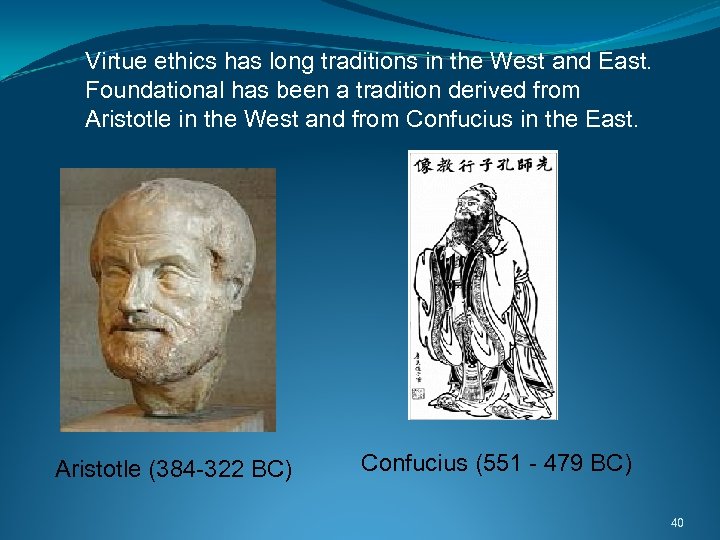
Virtue ethics has long traditions in the West and East. Foundational has been a tradition derived from Aristotle in the West and from Confucius in the East. Aristotle (384 -322 BC) Confucius (551 - 479 BC) 40
According to the Aristotelian account, virtue ethics begins with establishing certain truths regarding the human condition For example: Ordinary experience will lead us to feel certain emotions such as fear or anger. Our subsistence will require satisfying needs for food and shelter. 41
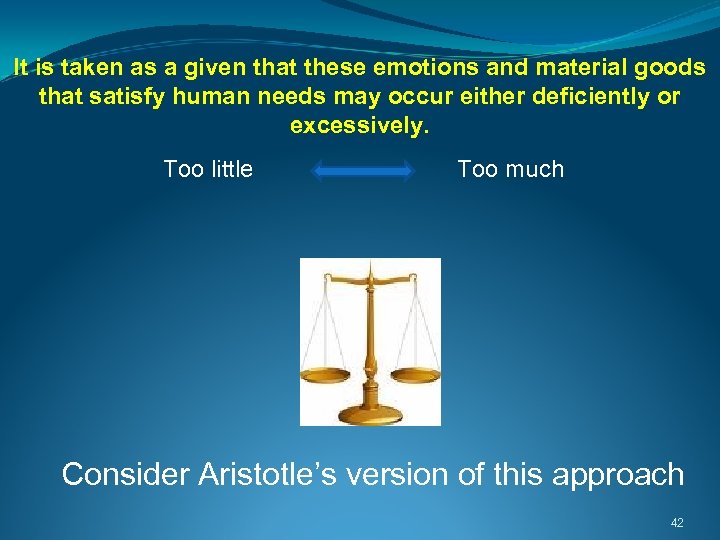
It is taken as a given that these emotions and material goods that satisfy human needs may occur either deficiently or excessively. Too little Too much Consider Aristotle’s version of this approach 42
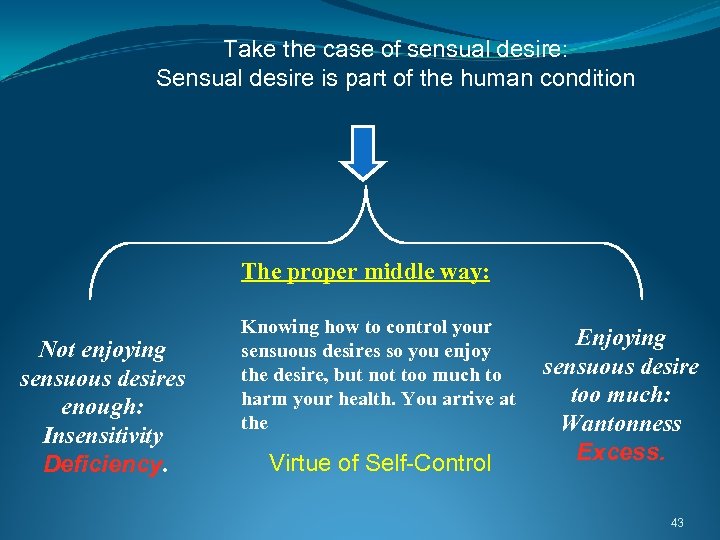
Take the case of sensual desire: Sensual desire is part of the human condition The proper middle way: Not enjoying sensuous desires enough: Insensitivity Deficiency. Knowing how to control your sensuous desires so you enjoy the desire, but not too much to harm your health. You arrive at the Virtue of Self-Control Enjoying sensuous desire too much: Wantonness Excess. 43
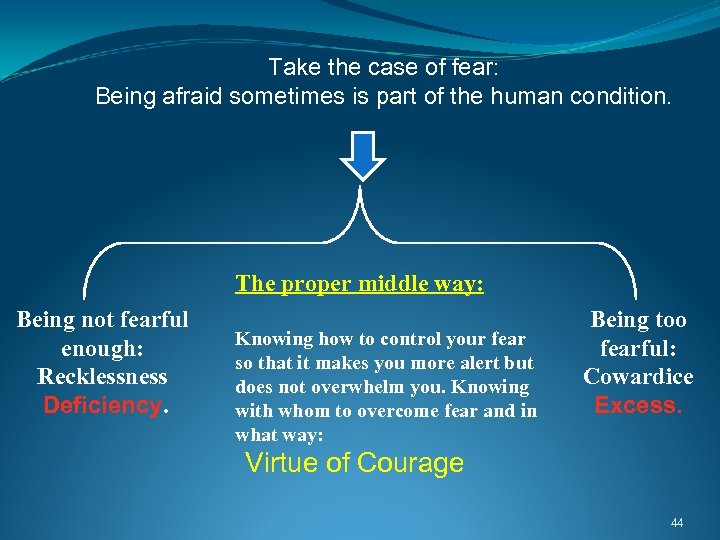
Take the case of fear: Being afraid sometimes is part of the human condition. The proper middle way: Being not fearful enough: Recklessness Deficiency. Knowing how to control your fear so that it makes you more alert but does not overwhelm you. Knowing with whom to overcome fear and in what way: Being too fearful: Cowardice Excess. Virtue of Courage 44
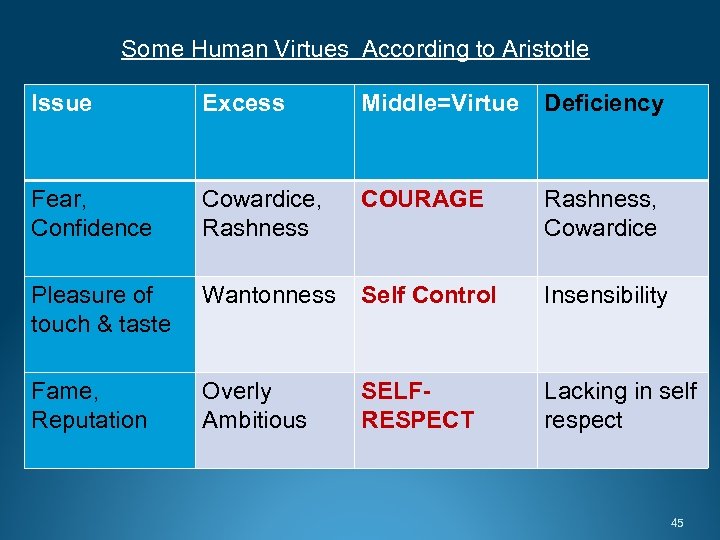
Some Human Virtues According to Aristotle Issue Excess Middle=Virtue Deficiency Fear, Confidence Cowardice, Rashness COURAGE Rashness, Cowardice Pleasure of touch & taste Wantonness Self Control Insensibility Fame, Reputation Overly Ambitious SELF- RESPECT Lacking in self respect 45
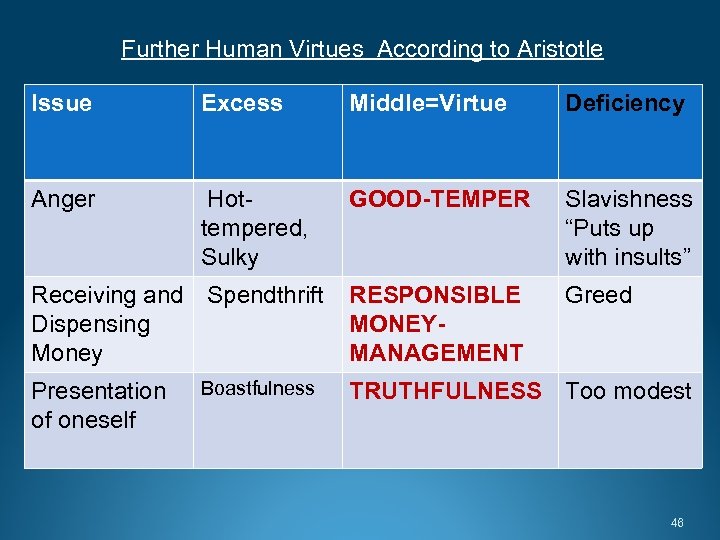
Further Human Virtues According to Aristotle Issue Excess Middle=Virtue Deficiency Anger Hottempered, Sulky GOOD-TEMPER Slavishness “Puts up with insults” RESPONSIBLE MONEYMANAGEMENT Greed Receiving and Spendthrift Dispensing Money Presentation of oneself Boastfulness TRUTHFULNESS Too modest 46
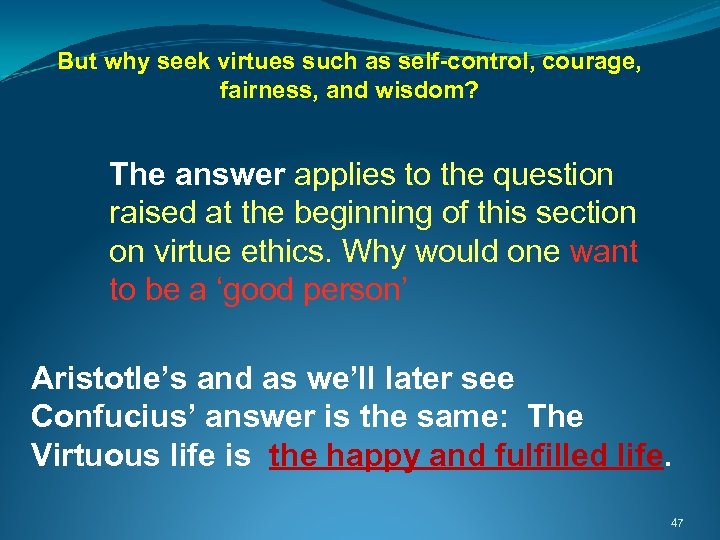
But why seek virtues such as self-control, courage, fairness, and wisdom? The answer applies to the question raised at the beginning of this section on virtue ethics. Why would one want to be a ‘good person’ Aristotle’s and as we’ll later see Confucius’ answer is the same: The Virtuous life is the happy and fulfilled life. 47

Citations for pictures in previous powerpoint: 1. Slide #7, picture of Edward Snowden: http: //en. wikipedia. org/wiki/File: Edward_Snowden 2. jpg 2. Slide #12, picture of Jeremy Bentham, http: //en. wikipedia. org/wiki/File: Jeremy_Bentham_by_Henry_William_Pickersgill_detail. jpg 3. Slide # 13, picture of J. S. Mill: %253 A%252 Fwww. nndb. com%252 Fpeople%252 F 147%252 F 000030057%252 Fjohnstuart-mill-sized. jpg Slide #6, picture of bust of Aristotle, http: //images. wikia. com/psychology/images/a/a 4/Aristoteles_Louvre. jpg&imgrefurl 4. Slide # 15, picture of Monarch Butterflies: 5. Slide #27, picture of Immanuel Kant, camberwelldesign. blogspot. com 6. Slide #40, picture of bust of Aristotle, http: //images. wikia. com/psychology/images/a/a 4/Aristoteles_Louvre. jpg&imgrefurl 7. Slide #40, picture of Confucius, en. wikipedia. org/wiki/File: Confucius_Tang_Dynasty. jpg http: //www. google. ca/search? q=picture+of+Monarch+Butterflies+in+Santa+Cruz&tbm 48
Скачать презентацию Professional and Business Ethics Prof Peter Hadreas Spring
115af918940b27069e69fb710d0783bf.ppt