


 Скачать презентацию Professional Accreditation and the Institution of Chemical Engineers
34f7831307c44a24f283f5b2a0971c6a.ppt
- Количество слайдов: 46
 Professional Accreditation and the Institution of Chemical Engineers Neil Atkinson Director of Qualifications(IChem. E) Tempus Project Moscow January 2010
 Outline… l l l What is IChem. E? Professional Accreditation The Bologna Process Accreditation & Learning Outcomes The process Course design (and course advice)
 The Institution of Chemical Engineers (IChem. E) l l Founded in 1922 An international professional membership organization The leading Qualifying Body for professional chemical engineers in the world The only organization to award Chartered Chemical Engineer status.
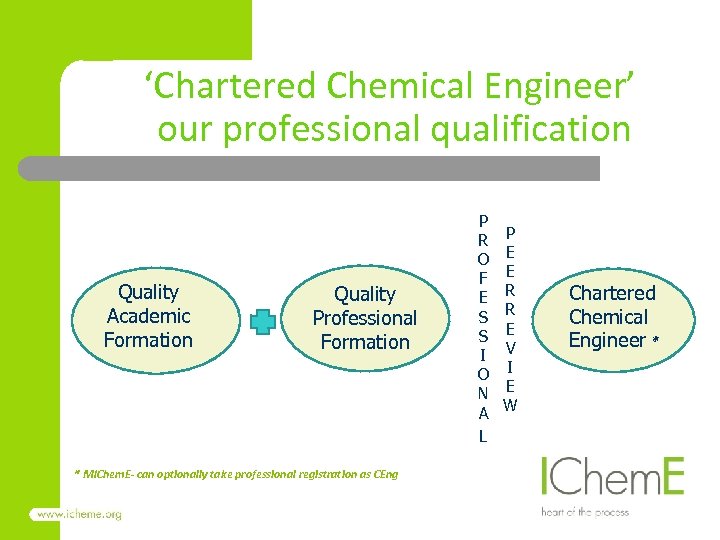 ‘Chartered Chemical Engineer’ our professional qualification Quality Academic Formation Quality Professional Formation * MIChem. E- can optionally take professional registration as CEng P R P O E F E E R S E I V O I N E A W L Chartered Chemical Engineer *
 What IChem. E does… l l l IChem. E represents chemical, biochemical and process engineering professionals worldwide. Promoting competence (e. g. through qualifications) With a commitment to sustainable development Advancing the discipline for the benefit of society Supporting the professional development of members. Accreditation of key education institutions worldwide (chemical engineering degrees)
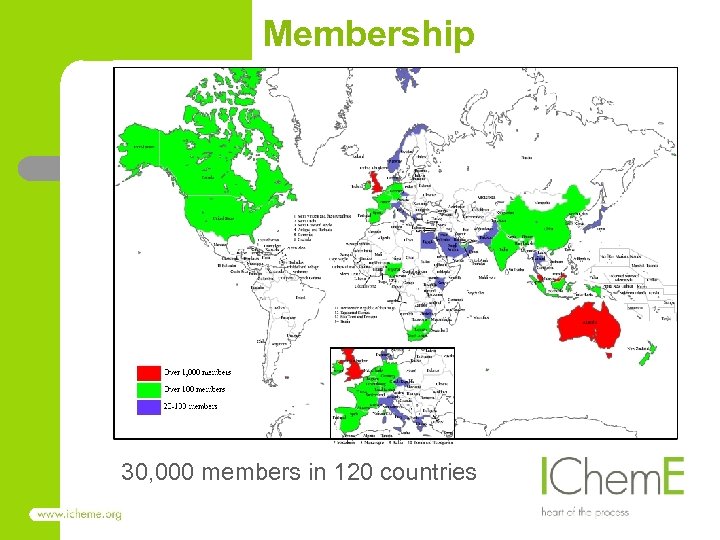 Membership 30, 000 members in 120 countries
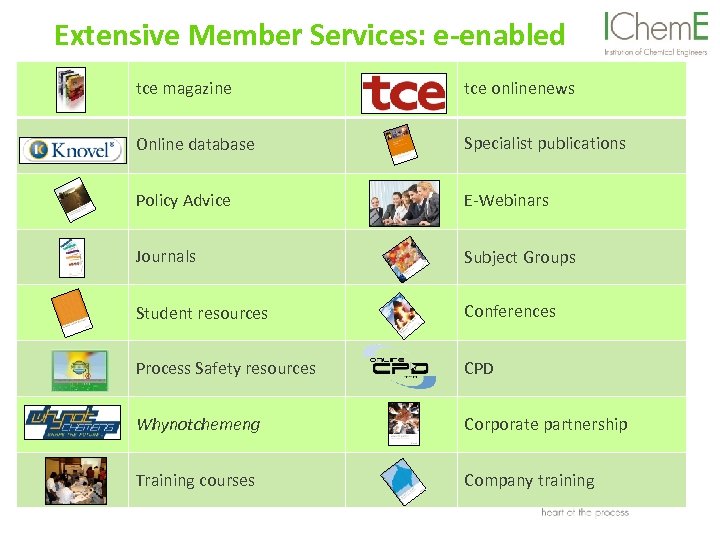 Extensive Member Services: e-enabled tce magazine tce onlinenews Online database Specialist publications Policy Advice E-Webinars Journals Subject Groups Student resources Conferences Process Safety resources CPD Whynotchemeng Corporate partnership Training courses Company training
 Our International Strength comes through Partnership l Maximising benefits to our profession - through alliances with – Industry Associations (eg CICM - Malaysia; CIESC – China) – Pan Engineering Institutions (eg EA - Australia; IES – Singapore) – Qualifications Providers and with Regulators (eg ECUK; Universities worldwide) – Chemical Engineering Institutions (eg SAICh. E - South Africa; IICh. E - India) – Kindred Societies (eg RSC; RAE - UK, RACI – Australia) – . . . and increasingly Key Employers
 Outline… l l l What is IChem. E? Professional Accreditation The Bologna Process Accreditation & Learning Outcomes The process Course design (and course advice)
 Professional Accreditation l Assessment of university courses (degree programmes) to determine whether they provide the necessary academic formation for graduates to become Chartered Chemical Engineers l Provides a common standard or ‘benchmark’ for all courses that are accredited l Increasingly, this is an International Standard
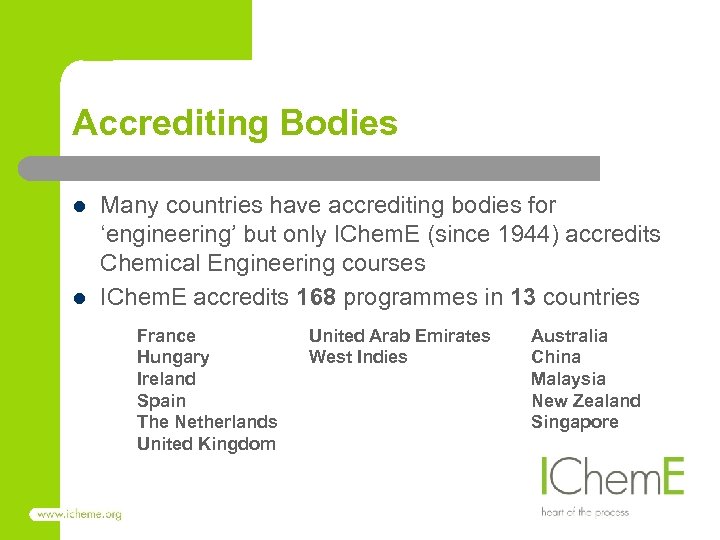 Accrediting Bodies l l Many countries have accrediting bodies for ‘engineering’ but only IChem. E (since 1944) accredits Chemical Engineering courses IChem. E accredits 168 programmes in 13 countries France Hungary Ireland Spain The Netherlands United Kingdom United Arab Emirates West Indies Australia China Malaysia New Zealand Singapore
 Benefits of Accreditation l Promotes, fosters and develops the general advancement of chemical engineering l Upholds the status of the discipline by requiring standards of knowledge and experience recognised throughout the world l Benefits universities – a globally significant group that are accredited (share best practice) l Benefits students – degree is easily recognised in many parts of the world and graduates can go on to become chartered engineers.
 Outline… l l l What is IChem. E? Professional Accreditation The Bologna Process Accreditation & Learning Outcomes The process Course design (and course advice)
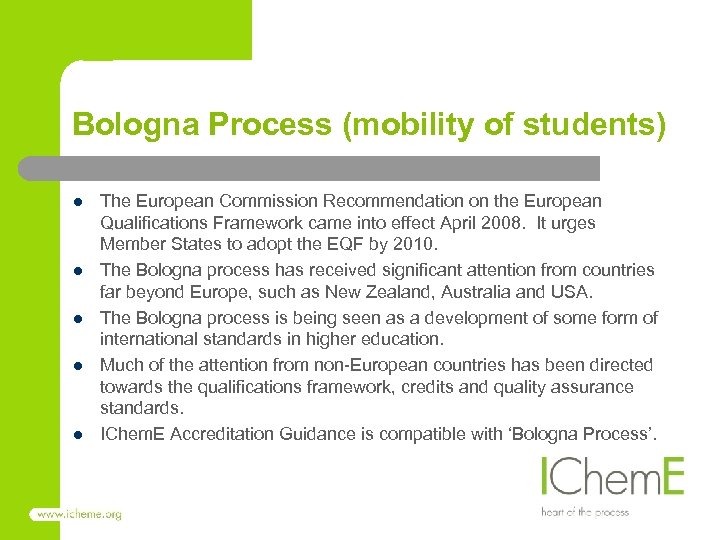 Bologna Process (mobility of students) l l l The European Commission Recommendation on the European Qualifications Framework came into effect April 2008. It urges Member States to adopt the EQF by 2010. The Bologna process has received significant attention from countries far beyond Europe, such as New Zealand, Australia and USA. The Bologna process is being seen as a development of some form of international standards in higher education. Much of the attention from non-European countries has been directed towards the qualifications framework, credits and quality assurance standards. IChem. E Accreditation Guidance is compatible with ‘Bologna Process’.
 Outline… l l l What is IChem. E? Professional Accreditation The Bologna Process Accreditation & Learning Outcomes The process Course design (and course advice)
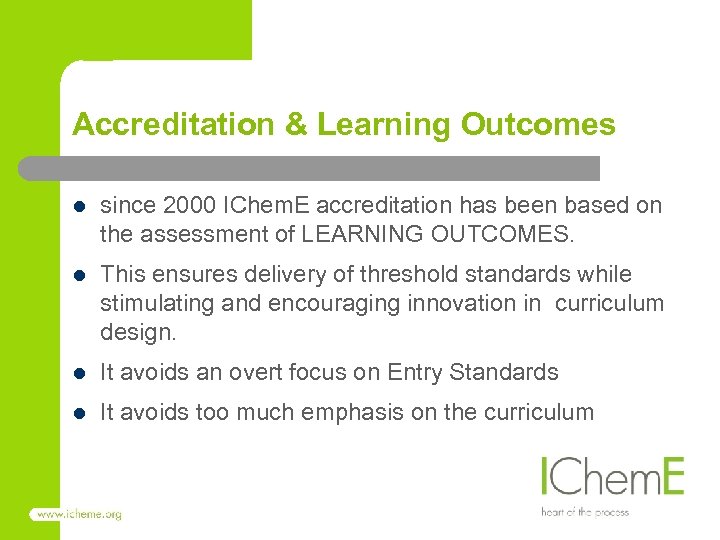 Accreditation & Learning Outcomes l since 2000 IChem. E accreditation has been based on the assessment of LEARNING OUTCOMES. l This ensures delivery of threshold standards while stimulating and encouraging innovation in curriculum design. l It avoids an overt focus on Entry Standards l It avoids too much emphasis on the curriculum
 What are Learning Outcomes? l Statements of the knowledge, skills, and understanding acquired through a student's participation in an educational activity. l They are essentially an expression of the competencies you expect your graduates to have after completing the course.
 Examples of Good Learning Outcomes l A student who has successfully completed this module will be able to: – Explain hydraulic behaviour in a packed column (2 nd year separation processes) – Determine the economic viability of specified process plant (3 rd year Process Economics) – Devise a flowsheet to separate non-ideal solvent mixtures by distillation (4 th year Separation Processes) – Conduct an initial evaluation of the potential for cleaner technology options in a fine chemicals manufacturing process (4 th year Waste Minimisation) – Conduct an initial life cycle assessment of a product (4 th year Risk Assessment & Reliability)
 Examples of Poor Learning Outcomes l A student who has successfully completed this module will be able to: – Solve problems in fluid dynamics (1 st year Fluid Dynamics) – Improve understanding of some of the key aspects of physical chemistry introduced in the first year chemistry syllabi (2 nd year Chemical Reaction Engineering) – Understand 2 nd year thermodynamics (2 nd year Thermodynamics) – Learn about unit operations (2 nd year Separation Processes)
 IChem. E Learning Outcomes categories: l l l l Underpinning Science & Maths; Core Chemical Engineering; Advanced Chemical Engineering; Engineering Practice; Design Practice Safety, Health & Environment Ethics & Sustainability Transferable skills More specific information regarding Learning Outcomes can be found in IChem. E’s published Accreditation Guidance.
 Outline… l l l What is IChem. E? Professional Accreditation The Bologna Process IChem. E Accreditation & Learning Outcomes The process Course design (and course advice)
 IChem. E Accreditation Process Approach l IChem. E brings academics and industrialists together to understand anticipate changing needs and to assess course provision. It seeks to: – – provide for mutual international recognition of degree programmes at benchmarked standards – l establish that graduates have acquired appropriate knowledge and practice to meet the academic requirements for membership grades of the IChem. E (e. g. Chartered Chemical Engineer) stimulate improvement in chemical engineering education by encouraging new and innovative approaches to taught curricula IChem. E routinely works alongside local engineering organisations and regularly conducts joint visits
 Assessment Criteria: l l The IChem. E assesses degree programme content against set published Guidelines (based upon ‘Learning Outcomes’ criteria) Ensures that the Chemical Engineering Department has, and will continue to have, adequate staff and physical resources to conduct the degree programme to the required standard.
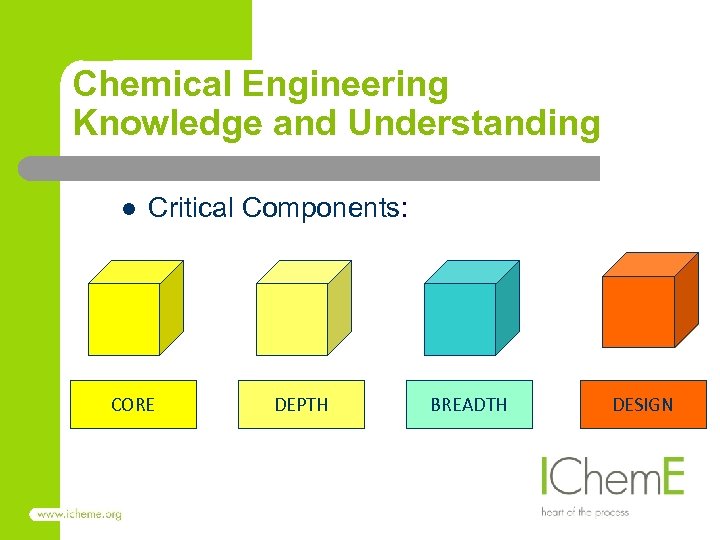 Chemical Engineering Knowledge and Understanding l Critical Components: CORE DEPTH BREADTH DESIGN
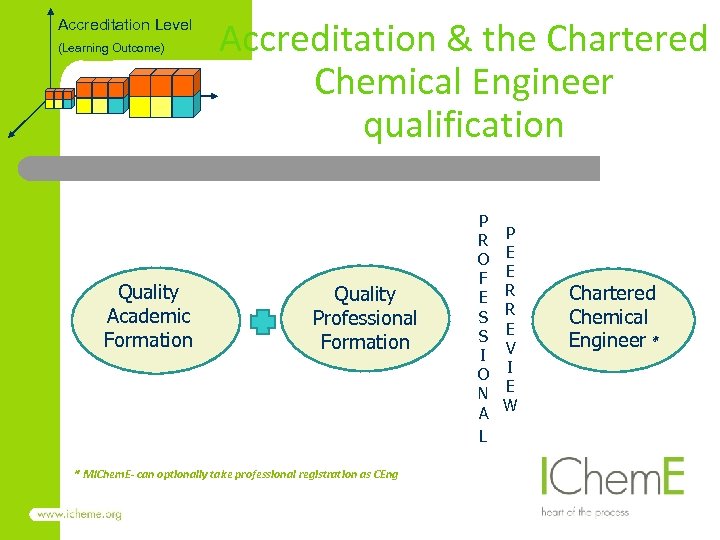 Accreditation Level (Learning Outcome) Quality Academic Formation Accreditation & the Chartered Chemical Engineer qualification Quality Professional Formation * MIChem. E- can optionally take professional registration as CEng P R P O E F E E R S E I V O I N E A W L Chartered Chemical Engineer *
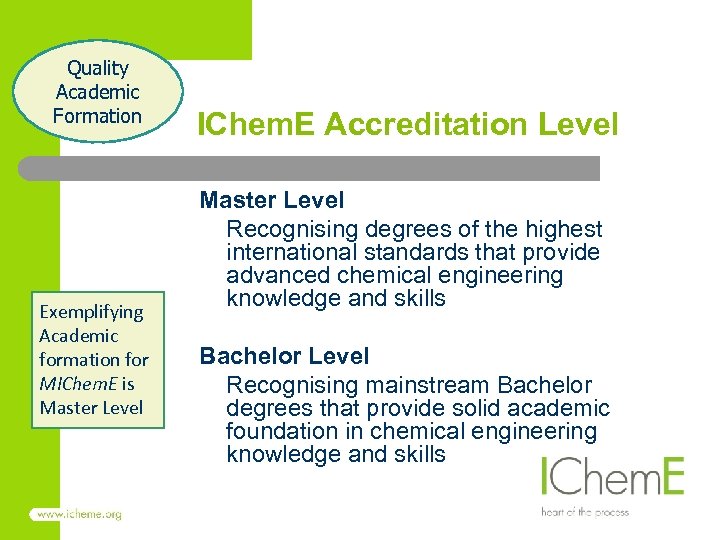 Quality Academic Formation Exemplifying Academic formation for MIChem. E is Master Level IChem. E Accreditation Level Master Level Recognising degrees of the highest international standards that provide advanced chemical engineering knowledge and skills Bachelor Level Recognising mainstream Bachelor degrees that provide solid academic foundation in chemical engineering knowledge and skills
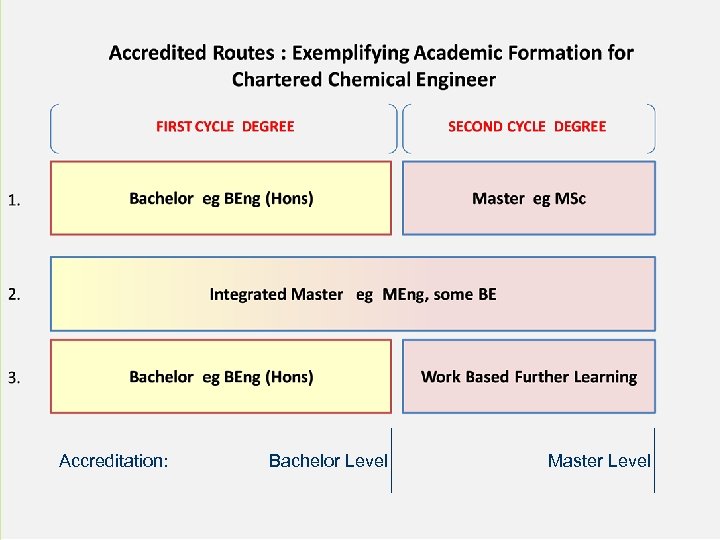 Accreditation: Bachelor Level Master Level
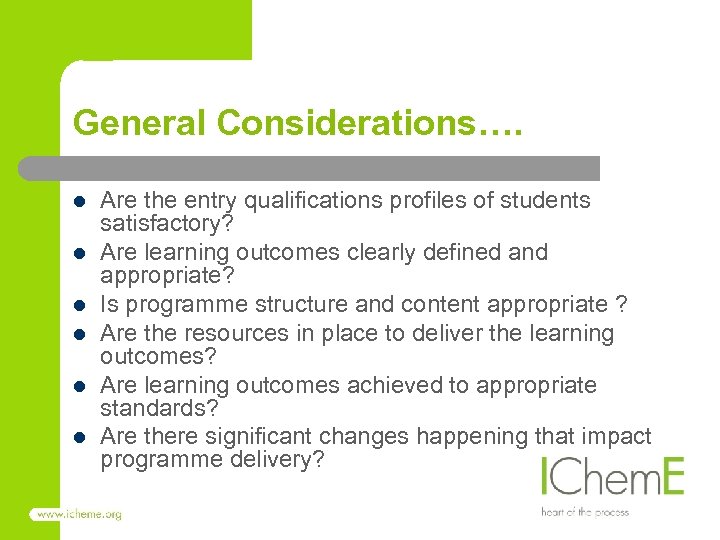 General Considerations…. l l l Are the entry qualifications profiles of students satisfactory? Are learning outcomes clearly defined and appropriate? Is programme structure and content appropriate ? Are the resources in place to deliver the learning outcomes? Are learning outcomes achieved to appropriate standards? Are there significant changes happening that impact programme delivery?
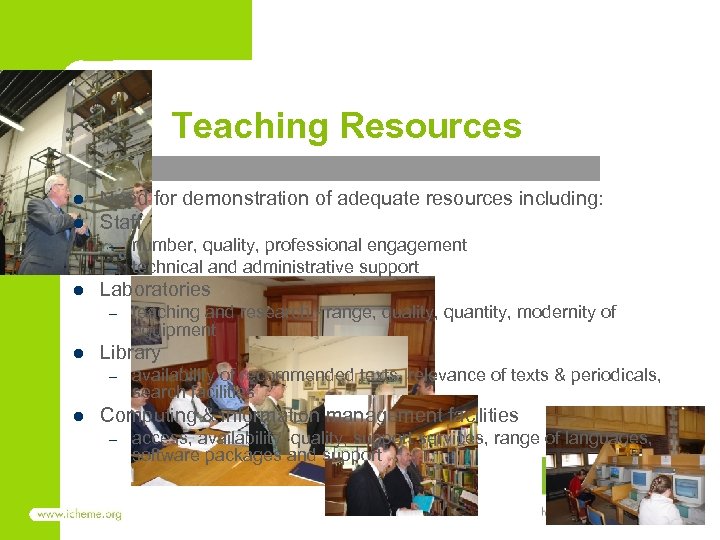 Teaching Resources l l Need for demonstration of adequate resources including: Staff – – l Laboratories – l teaching and research - range, quality, quantity, modernity of equipment Library – l number, quality, professional engagement technical and administrative support availability of recommended texts, relevance of texts & periodicals, search facilities Computing & information management facilities – access, availability, quality, support services, range of languages, software packages and support
 Safety/Safety Culture l l l IChem. E requires students to be instilled with appropriate attitudes to Safety, Health & Environment (SHE) and minimum core process safety knowledge. Departments must therefore demonstrate appropriate safety cultures and practice of operation. Appropriate records/documentation of hazard assessment and controls on lab equipment and processes are also expected.
 Summary l Brings together assessment of ALL that has relevant impact on a Department’s capability to successfully deliver the academic formation of a chemical engineering student l Qualitative, by design, yet takes account of ALL relevant quantitative information l Quality Assured (trained Assessors, Committee normalised, independent, academic & industrial participation) l Provides thorough & formal feedback to the Department with suggestions for programme improvement where appropriate
 Outline… l l l What is IChem. E? Professional Accreditation The Bologna Process IChem. E Accreditation & Learning Outcomes The process Course design (and course advice)
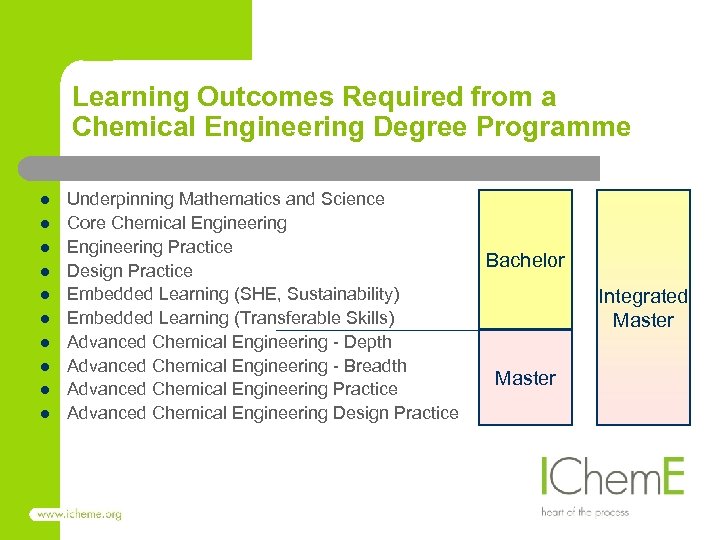 Learning Outcomes Required from a Chemical Engineering Degree Programme l l l l l Underpinning Mathematics and Science Core Chemical Engineering Practice Design Practice Embedded Learning (SHE, Sustainability) Embedded Learning (Transferable Skills) Advanced Chemical Engineering - Depth Advanced Chemical Engineering - Breadth Advanced Chemical Engineering Practice Advanced Chemical Engineering Design Practice Bachelor Integrated Master
 Underpinning Mathematics & Science(s) l Students’ knowledge and understanding of mathematics and science should be of sufficient depth and breadth to underpin their chemical engineering education, to enable appreciation of its scientific and engineering context, and to support their understanding of future developments. It is expected that this underpinning material should be taught in an engineering context and, where appropriate, a chemical engineering context l Should lay the foundations for understanding more applied fundamental courses when studied.
 Core Chemical Engineering l l l The main principles and applications of chemical engineering. Students must be able to handle problems in fluids and solids formation and processing. They must be able to apply chemical engineering methods to the analysis of complex systems within a structured approach to Safety, Health and Sustainability. e. g. : – – – thermodynamics & process analysis chemical, physical and biochemical conversion and transformation processes transfer and separation processes process systems engineering and control Core safety
 Engineering Practice l The practical application of engineering skills, combining theory and experience, together with the use of other relevant knowledge and skills. l Must include practical exercises and laboratory sessions
 Design Practice (Portfolio) l l The creation of a process, product or plant to meet a defined need. The application of engineering principles to the solution of a practical process engineering problem: – – – requires conceptual exploration develops an integrated systems approach encourages the application of chemical engineering principles to solve problems encourages students to demonstrate creative & critical powers by making choices in areas of uncertainty encourages the development of communication and other transferable skills
 Embedded Learning (Sustainability & SHE) l Knowledge and ability to handle a variety of societal, ethical and commercial aspects of chemical engineering: – – – l include health and process safety; sustainable development; commercial planning; process plant economics; ethics; standards Material is built upon and reinforced throughout the degree
 Embedded Learning (General Transferable skills) The curriculum must ensure that students develop a range of transferable skills that will be valuable in a wide range of situations to the conduct of their chemical engineering practice Skills are developed, built upon and practised throughout the degree e. g: Skills in communications time management team working inter-personal presentations
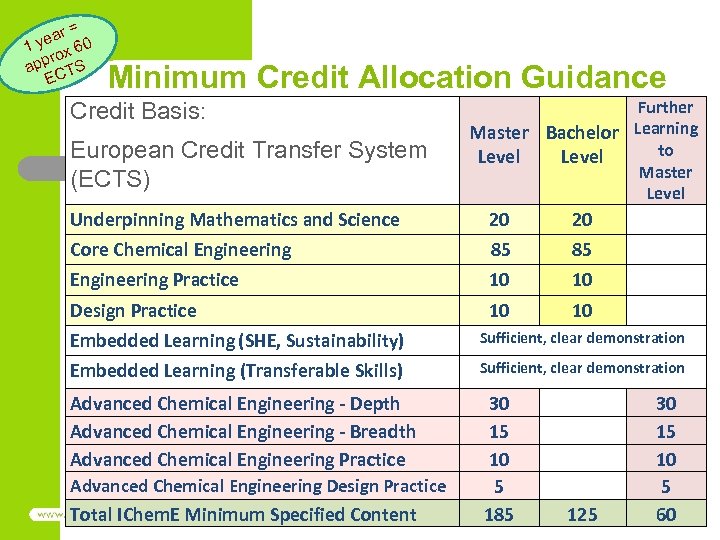 r= yea 60 1 ox ppr TS a EC Minimum Credit Allocation Guidance Credit Basis: European Credit Transfer System (ECTS) Further Master Bachelor Learning to Level Master Level Underpinning Mathematics and Science 20 20 Core Chemical Engineering 85 85 Engineering Practice 10 10 Design Practice 10 10 Embedded Learning (SHE, Sustainability) Sufficient, clear demonstration Embedded Learning (Transferable Skills) Sufficient, clear demonstration Advanced Chemical Engineering - Depth Advanced Chemical Engineering - Breadth Advanced Chemical Engineering Practice 30 15 10 5 185 Advanced Chemical Engineering Design Practice Total IChem. E Minimum Specified Content 125 30 15 10 5 60
 Advanced Chemical Engineering Content & Outcomes l l Master level (Advanced) courses are characterised by learning outcomes that represent knowledge and understanding beyond that which would normally be associated with Bachelor (Basic) programmes. Advanced material can only be taught after Basic material. Therefore it is very unlikely that there will be ‘Advanced’ material in 1 st or 2 nd year. Advanced (depth) material in subject X should have a pre-requisite of Basic material in subject X If a subject can be taught directly from a textbook it is probably NOT Advanced.
 Categories of Advanced Chemical Engineering l l Advanced – Depth is more likely to be associated with concepts and phenomena (e. g. advanced mass transfer, advanced process control) Advanced – Breadth is more likely to be associated with applications (e. g. polymer technology, nuclear technology). Research projects provide Advanced – Engineering Practice rather than Advanced – Depth. Advanced – Design involves the innovative, creative aspects of design synthesis.
 Guidance on Curriculum l l IChem. E encourages diversity of chemical engineering education and welcomes innovation: Provided the Learning Outcomes are met for a – – l ‘Minimally Constraining Core’ in Chemical Engineering Departments are encouraged to develop their own specialisms and emphasis. IChem. E recognises the value of study of subjects such as languages, law, management studies etc and allows such content to be included within the curriculum.
 SUMMING UP Neil Atkinson
 Accreditation as a Partnership l l l Provides international benchmarking Sharing best practice in chemical engineering education and teaching Peer Recognition IChem. E accreditation is of value to Departments (qualification & ongoing contribution within an international community of practice). IChem. E accreditation is of value to their Students (exempting qualifications & access to IChem. Eon. Campus etc). In return IChem. E derives value from access to academic communities and students as members and as contributors to the chemical engineering profession.
 Thank you l IChem. E is strongly appreciative of this unique opportunity: to explore how we might make a positive contribution to the quality and development of the chemical engineering profession in Russia. and share how educators here might also enrich IChem. E’s contribution to the international chemical engineering community as a whole.