 Скачать презентацию Prof Hosny Ibrahim Text book TX
e350359ad907f99109ab9234bd298d09.ppt
- Количество слайдов: 66



Prof. Hosny Ibrahim
Text book (TX 1): Data and Computer Communications By: William Stalling , 11 th Edition 2011 Text book (TX 2): Data Communications and networking By: Behrouz A. Forouzan , 4 th Edition 2007 3/18/2018 Data Communication IT 221 By: Prof. Hosny M. Ibrahim 2
Course Scores 30 points semester work ( 20 mid term , 10 quizzes and class work) 70 points Final exam 3/18/2018 Data Communication IT 221 By: Prof. Hosny M. Ibrahim 3
1 -Overview of data communications, components of comm. networking Model OSI, TCP/IP , LAN, WAN 2 - Physical Layer: Data transmission, analog, digital data, Spectrum, BW, Channel capacity …… 3 -Channel Impairments, Noise. . transmission Media, guided, Wireless 4 -LOS transmission, Signal Encoding; DD-AS, DD-DS, AD-AS, AD-DS, … DD communication Techniques, Asyn, Sync Trans. , . 3/18/2018 Data Communication IT 221 By: Prof. Hosny M. Ibrahim 4
5 -Data Link layer: Errors types, Error Detection Data link Control, HDLC protocol Flow control, stop and wait, sliding window, go back n 6 - Multiplexing, FDM, TDM, ADSL lines, x. DSL Circuit and packet switching , . . X 25, Frame Relay… , ATM. 7 - Wired LANs , Ethernet I. EEE 802. 11 3/18/2018 Data Communication IT 221 By: Prof. Hosny M. Ibrahim 5
DATA COMMUNICATIONS The term telecommunication means communication at a distance. The word data refers to information presented in whatever form is agreed upon by the parties creating and using the data. Data communications are the exchange of data between two devices via some form of transmission medium such as a wire cable. 3/18/2018 1. 6 Data Communication IT 221 By: Prof. Hosny M. Ibrahim
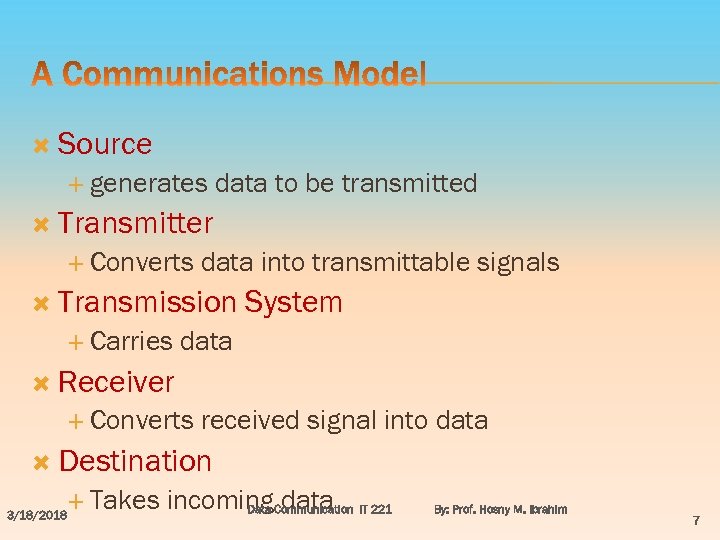
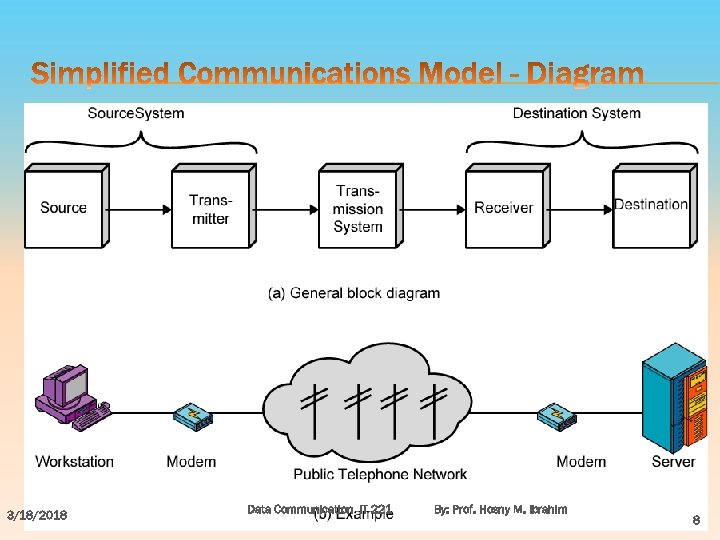
Source generates data to be transmitted Transmitter Converts data into transmittable signals Transmission Carries System data Receiver Converts received signal into data Destination Takes 3/18/2018 incoming. Communication IT 221 Data data By: Prof. Hosny M. Ibrahim 7
3/18/2018 Data Communication IT 221 By: Prof. Hosny M. Ibrahim 8
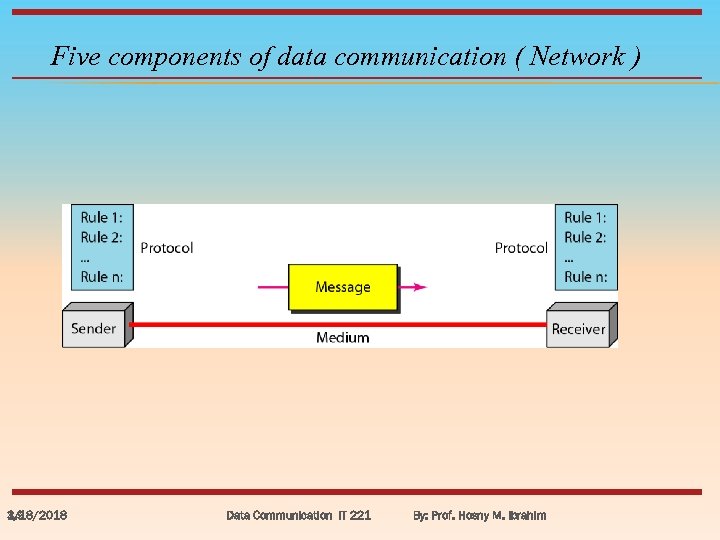
Five components of data communication ( Network ) 3/18/2018 1. 9 Data Communication IT 221 By: Prof. Hosny M. Ibrahim
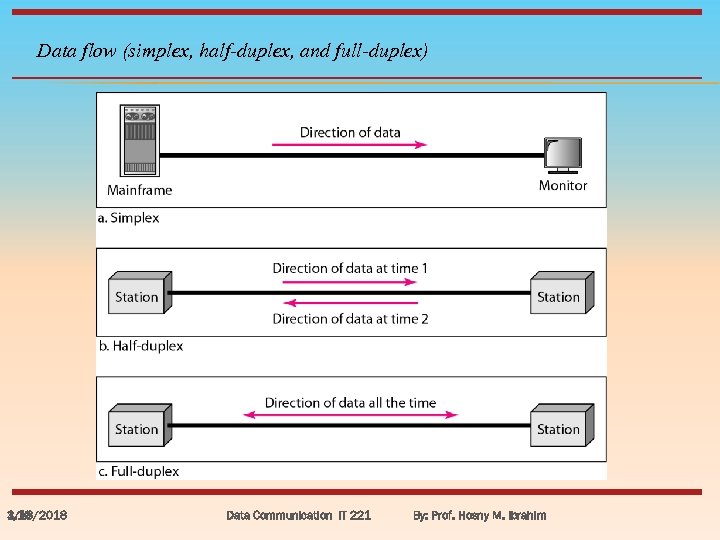
Data flow (simplex, half-duplex, and full-duplex) 3/18/2018 1. 10 Data Communication IT 221 By: Prof. Hosny M. Ibrahim
NETWORKS A network is a set of devices (often referred to as nodes) connected by communication links. A node can be a computer, printer, or any other device capable of sending and/or receiving data generated by other nodes on the network. 3/18/2018 1. 11 Data Communication IT 221 By: Prof. Hosny M. Ibrahim
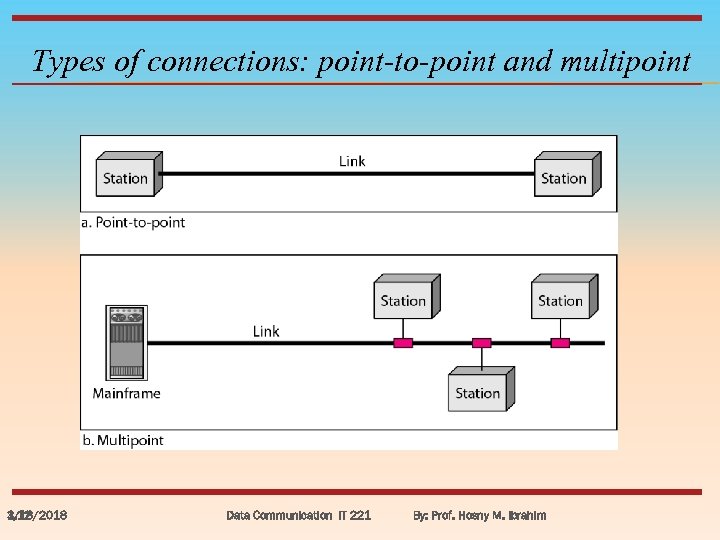
Types of connections: point-to-point and multipoint 3/18/2018 1. 12 Data Communication IT 221 By: Prof. Hosny M. Ibrahim
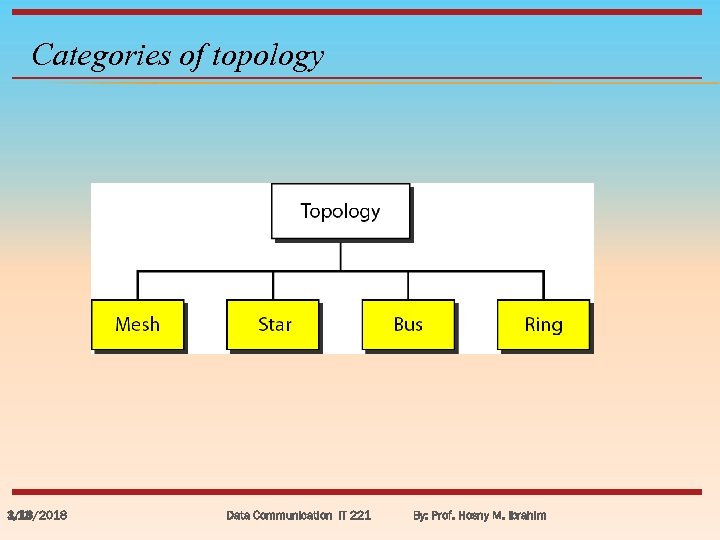
Categories of topology 3/18/2018 1. 13 Data Communication IT 221 By: Prof. Hosny M. Ibrahim
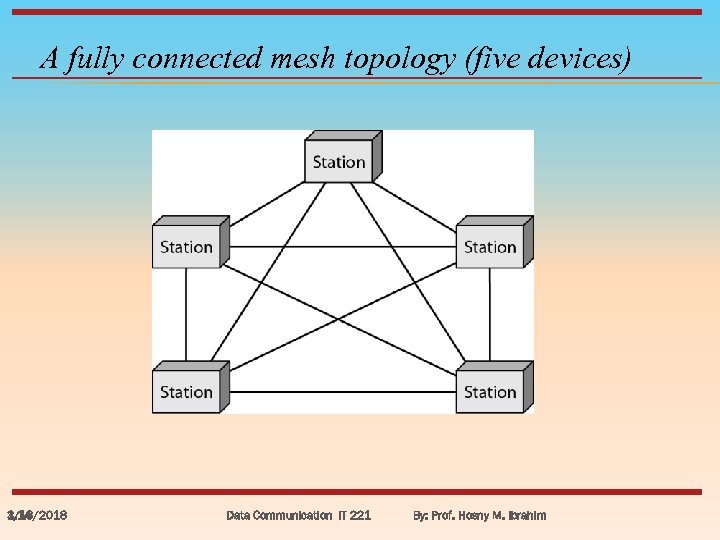
A fully connected mesh topology (five devices) 3/18/2018 1. 14 Data Communication IT 221 By: Prof. Hosny M. Ibrahim
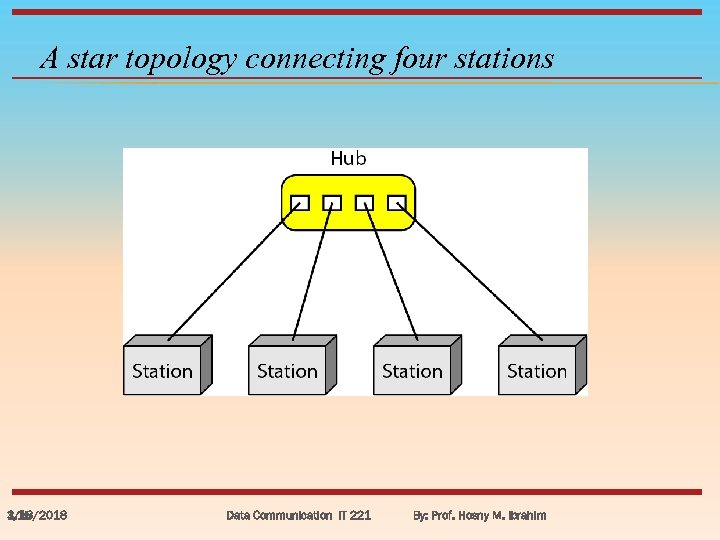
A star topology connecting four stations 3/18/2018 1. 15 Data Communication IT 221 By: Prof. Hosny M. Ibrahim
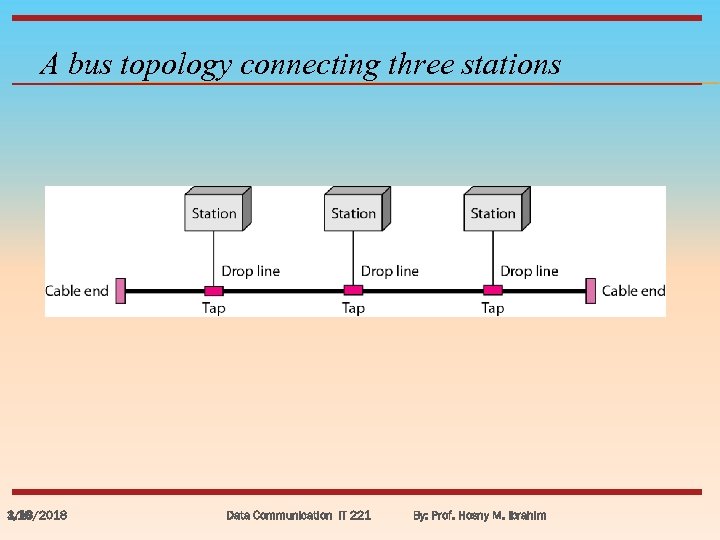
A bus topology connecting three stations 3/18/2018 1. 16 Data Communication IT 221 By: Prof. Hosny M. Ibrahim
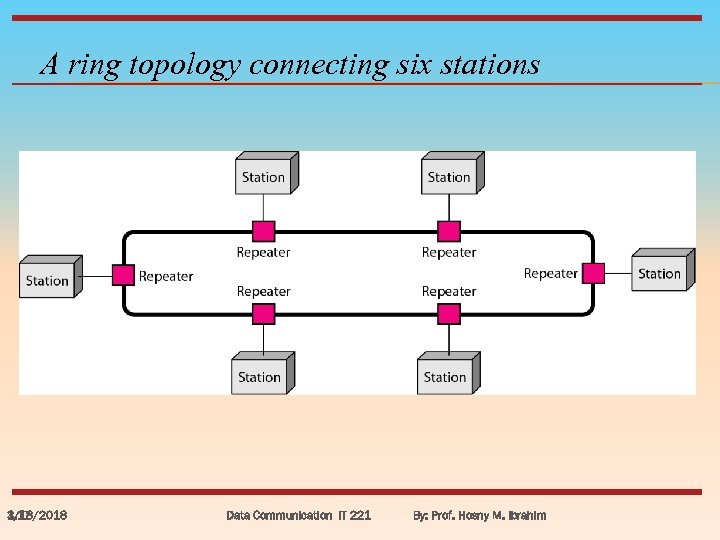
A ring topology connecting six stations 3/18/2018 1. 17 Data Communication IT 221 By: Prof. Hosny M. Ibrahim
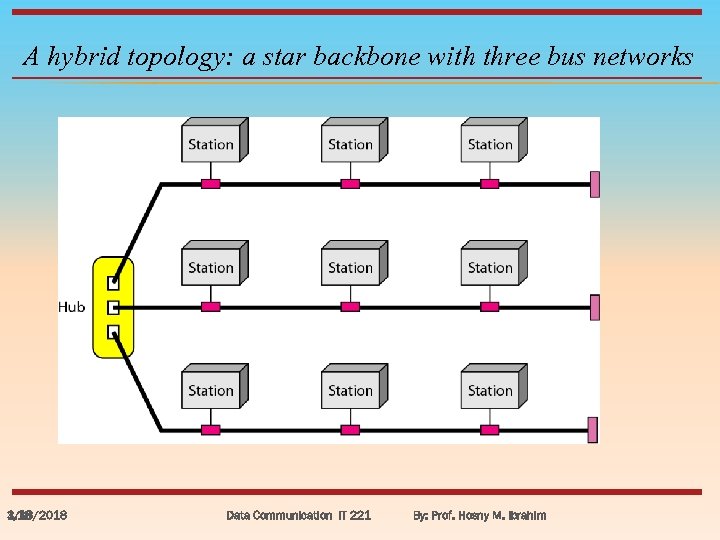
A hybrid topology: a star backbone with three bus networks 3/18/2018 1. 18 Data Communication IT 221 By: Prof. Hosny M. Ibrahim
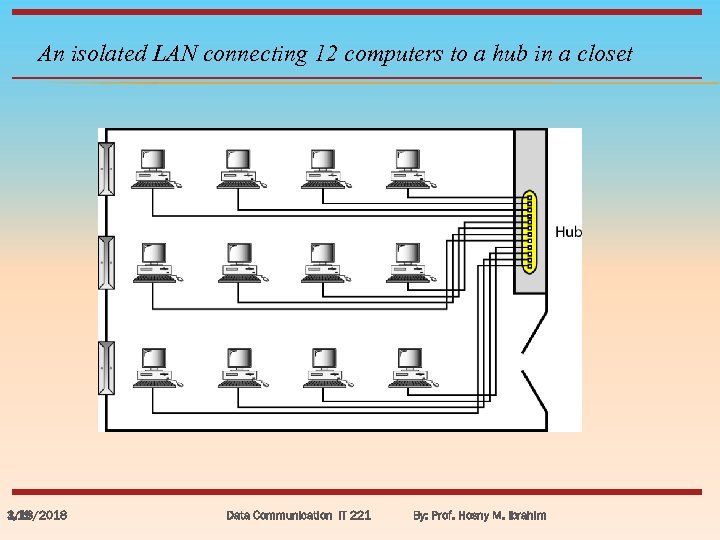
An isolated LAN connecting 12 computers to a hub in a closet 3/18/2018 1. 19 Data Communication IT 221 By: Prof. Hosny M. Ibrahim
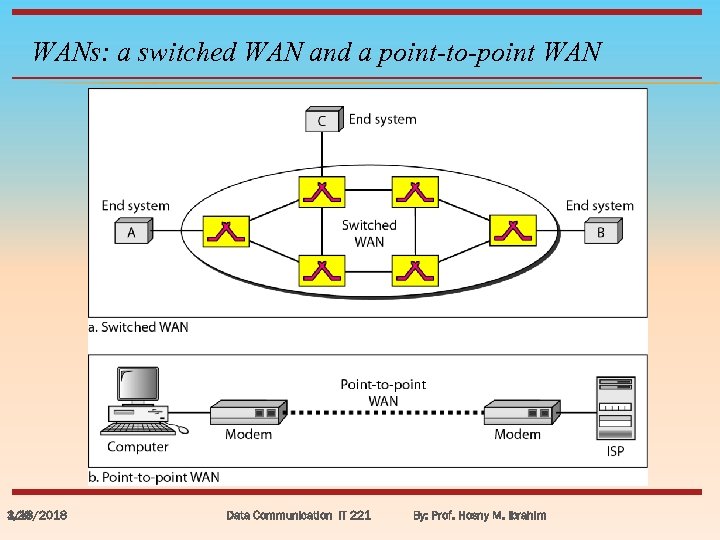
WANs: a switched WAN and a point-to-point WAN 3/18/2018 1. 20 Data Communication IT 221 By: Prof. Hosny M. Ibrahim
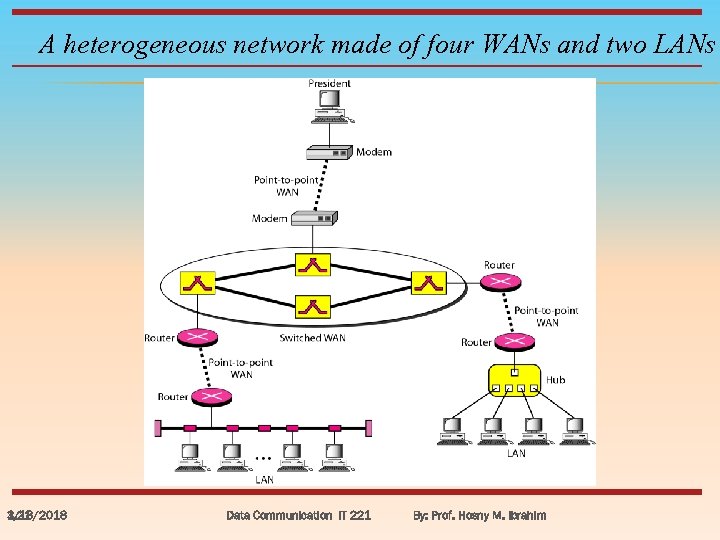
A heterogeneous network made of four WANs and two LANs 3/18/2018 1. 21 Data Communication IT 221 By: Prof. Hosny M. Ibrahim
THE INTERNET The Internet has revolutionized many aspects of our daily lives. It has affected the way we do business as well as the way we spend our leisure time. The Internet is a communication system that has brought a wealth of information to our fingertips and organized it for our use. 3/18/2018 1. 22 Data Communication IT 221 By: Prof. Hosny M. Ibrahim
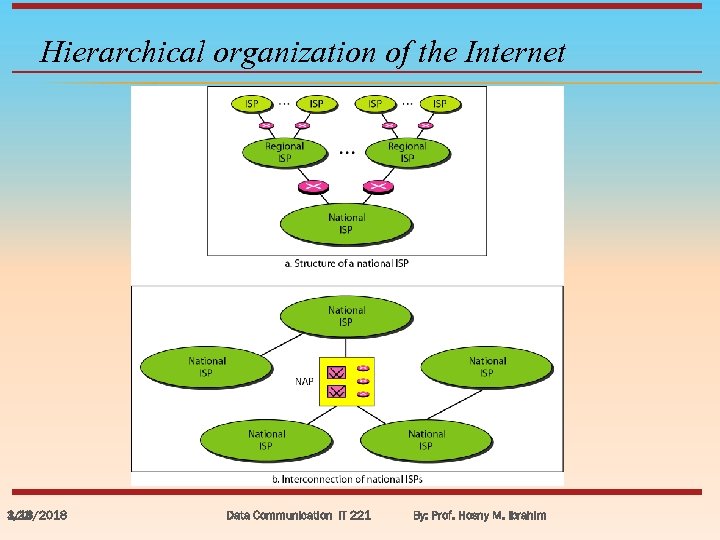
Hierarchical organization of the Internet 3/18/2018 1. 23 Data Communication IT 221 By: Prof. Hosny M. Ibrahim
PROTOCOLS AND STANDARDS In this section, we define two widely used terms: protocols and standards. First, we define protocol, which is synonymous with rule. Then we discuss standards, which are agreed-upon rules. 3/18/2018 1. 24 Data Communication IT 221 By: Prof. Hosny M. Ibrahim
LAYERED TASKS We use the concept of layers in our daily life. As an example, let us consider two friends who communicate through postal mail. The process of sending a letter to a friend would be complex if there were no services available from the post office. 3/18/2018 2. 25 Data Communication IT 221 By: Prof. Hosny M. Ibrahim
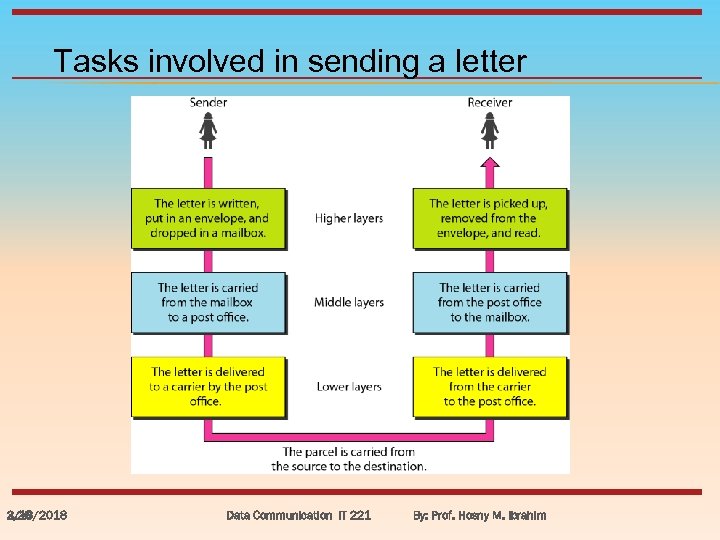
Tasks involved in sending a letter 3/18/2018 2. 26 Data Communication IT 221 By: Prof. Hosny M. Ibrahim
THE OSI MODEL Established in 1947, the International Standards Organization (ISO) is a multinational body dedicated to worldwide agreement on international standards. An ISO standard that covers all aspects of network communications is the Open Systems Interconnection (OSI) model. It was first introduced in the late 1970 s. 3/18/2018 2. 27 Data Communication IT 221 By: Prof. Hosny M. Ibrahim
Note ISO is the organization. OSI is the model. 3/18/2018 2. 28 Data Communication IT 221 By: Prof. Hosny M. Ibrahim
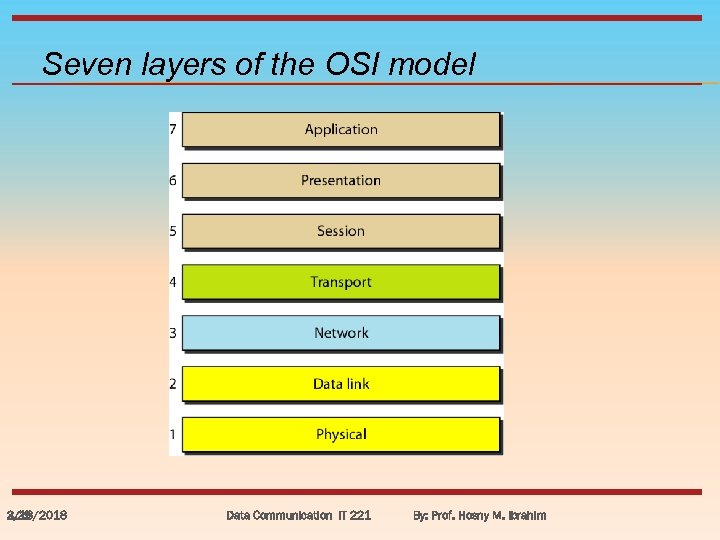
Seven layers of the OSI model 3/18/2018 2. 29 Data Communication IT 221 By: Prof. Hosny M. Ibrahim
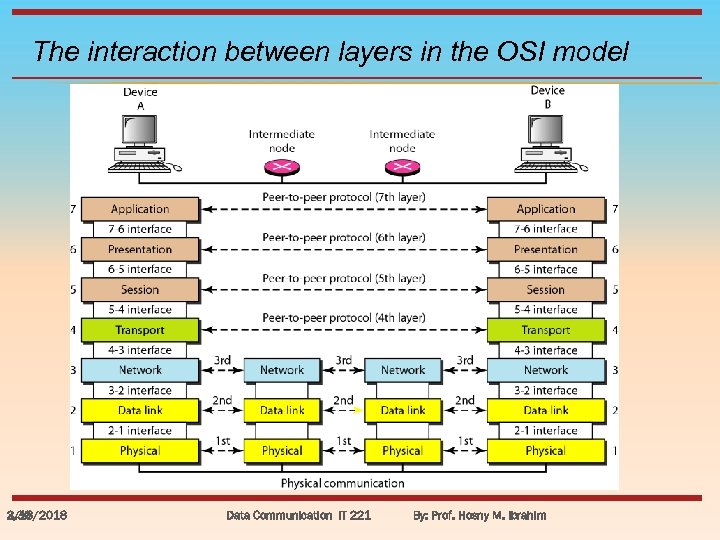
The interaction between layers in the OSI model 3/18/2018 2. 30 Data Communication IT 221 By: Prof. Hosny M. Ibrahim
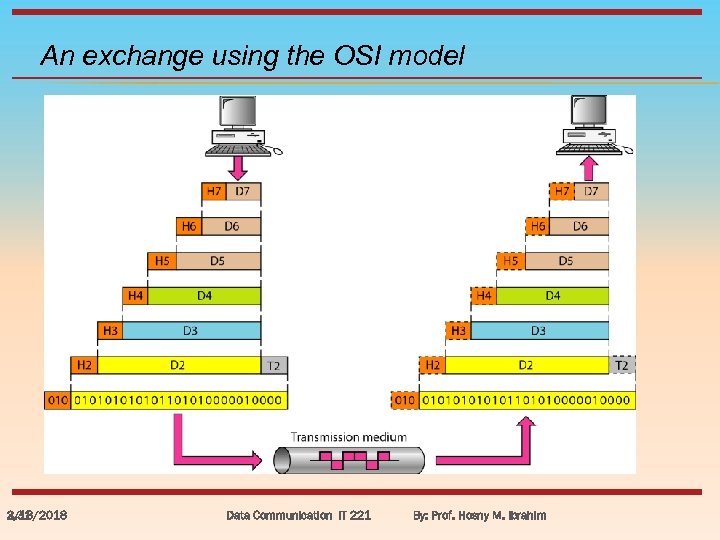
An exchange using the OSI model 3/18/2018 2. 31 Data Communication IT 221 By: Prof. Hosny M. Ibrahim
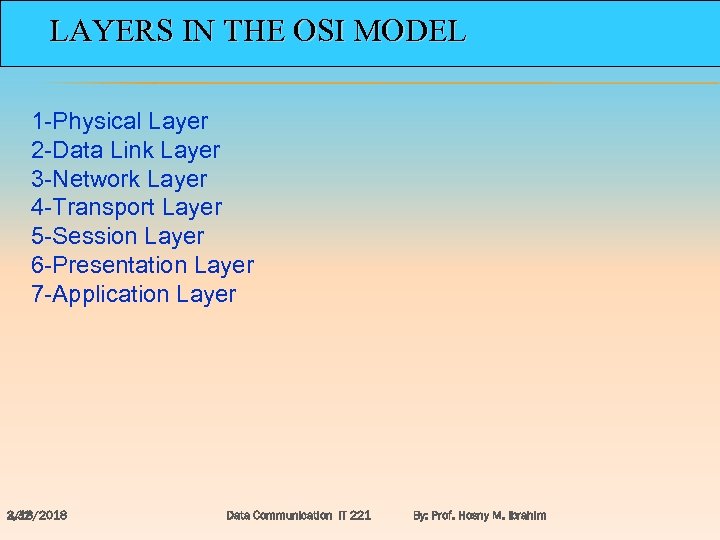
LAYERS IN THE OSI MODEL 1 -Physical Layer 2 -Data Link Layer 3 -Network Layer 4 -Transport Layer 5 -Session Layer 6 -Presentation Layer 7 -Application Layer 3/18/2018 2. 32 Data Communication IT 221 By: Prof. Hosny M. Ibrahim
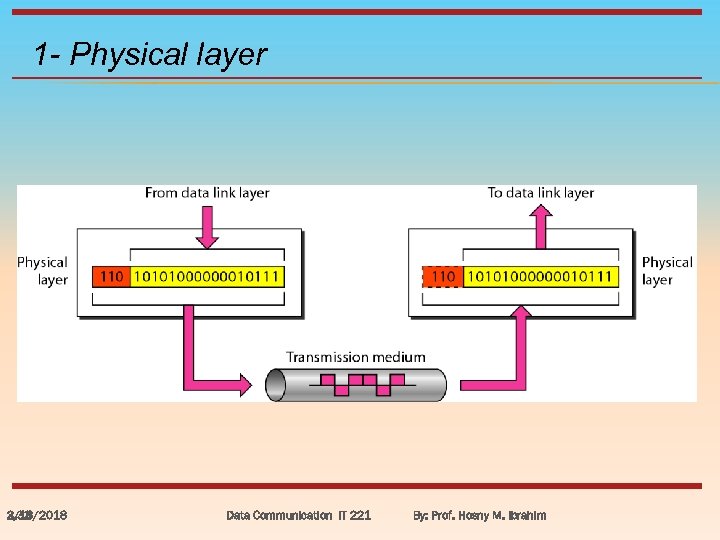
1 - Physical layer 3/18/2018 2. 33 Data Communication IT 221 By: Prof. Hosny M. Ibrahim
Note The physical layer is responsible for movements of individual bits from one hop (node) to the next. 3/18/2018 2. 34 Data Communication IT 221 By: Prof. Hosny M. Ibrahim
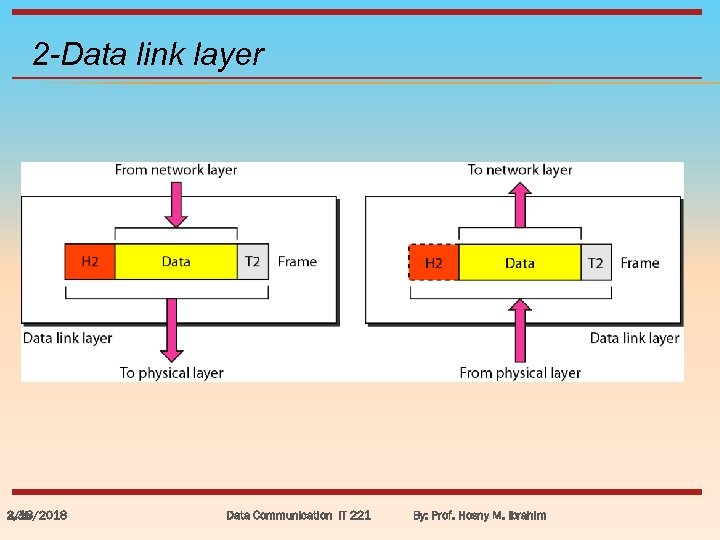
2 -Data link layer 3/18/2018 2. 35 Data Communication IT 221 By: Prof. Hosny M. Ibrahim
Note The data link layer is responsible for moving frames from one hop (node) to the next. 3/18/2018 2. 36 Data Communication IT 221 By: Prof. Hosny M. Ibrahim
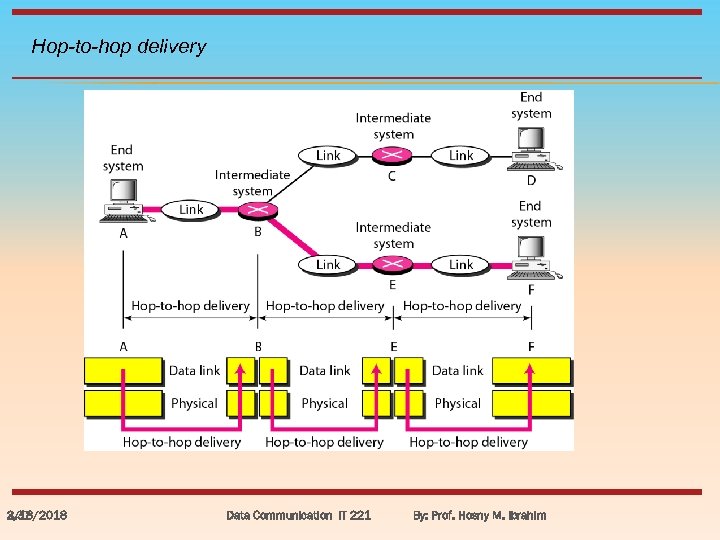
Hop-to-hop delivery 3/18/2018 2. 37 Data Communication IT 221 By: Prof. Hosny M. Ibrahim
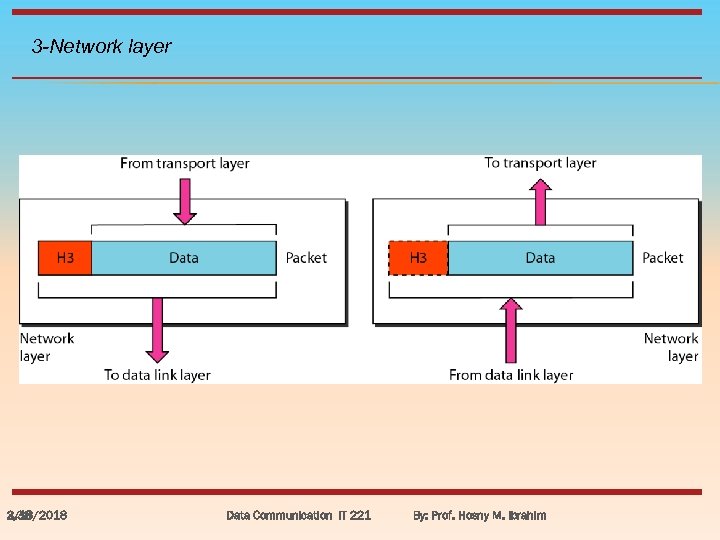
3 -Network layer 3/18/2018 2. 38 Data Communication IT 221 By: Prof. Hosny M. Ibrahim
Note The network layer is responsible for the delivery of individual packets from the source host to the destination host. 3/18/2018 2. 39 Data Communication IT 221 By: Prof. Hosny M. Ibrahim
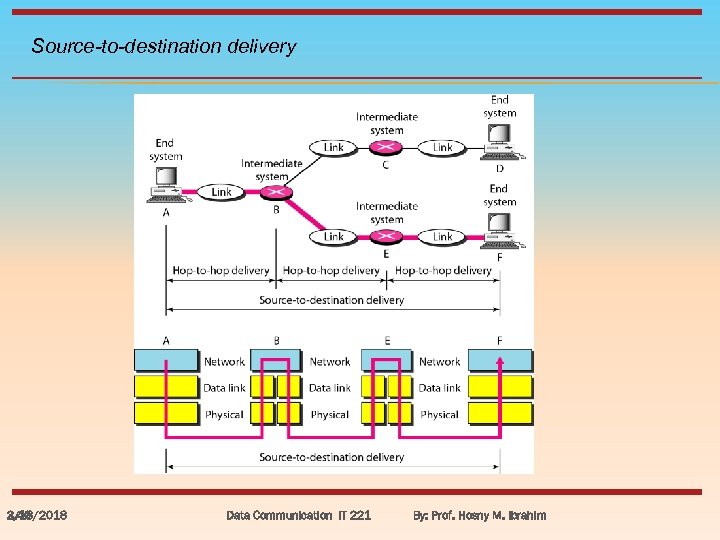
Source-to-destination delivery 3/18/2018 2. 40 Data Communication IT 221 By: Prof. Hosny M. Ibrahim
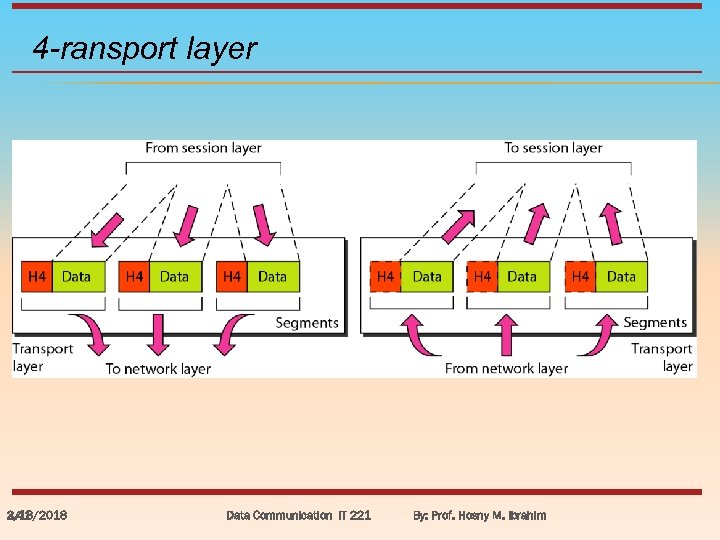
4 -ransport layer 3/18/2018 2. 41 Data Communication IT 221 By: Prof. Hosny M. Ibrahim
Note The transport layer is responsible for the delivery of a message from one process to another. 3/18/2018 2. 42 Data Communication IT 221 By: Prof. Hosny M. Ibrahim
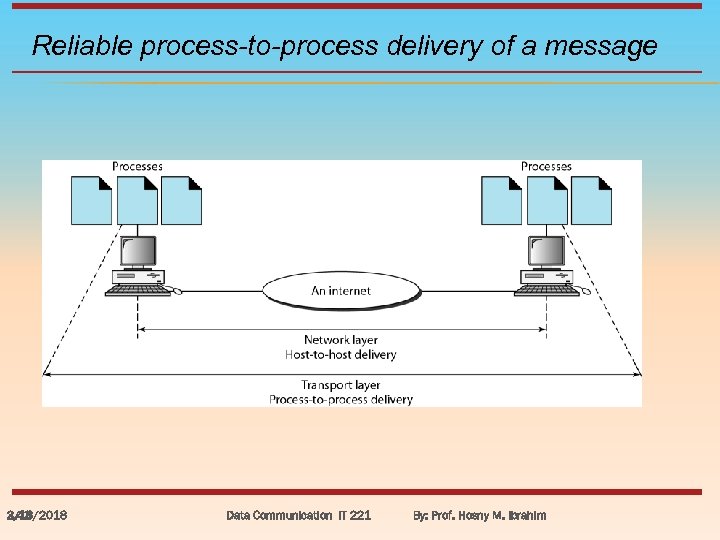
Reliable process-to-process delivery of a message 3/18/2018 2. 43 Data Communication IT 221 By: Prof. Hosny M. Ibrahim
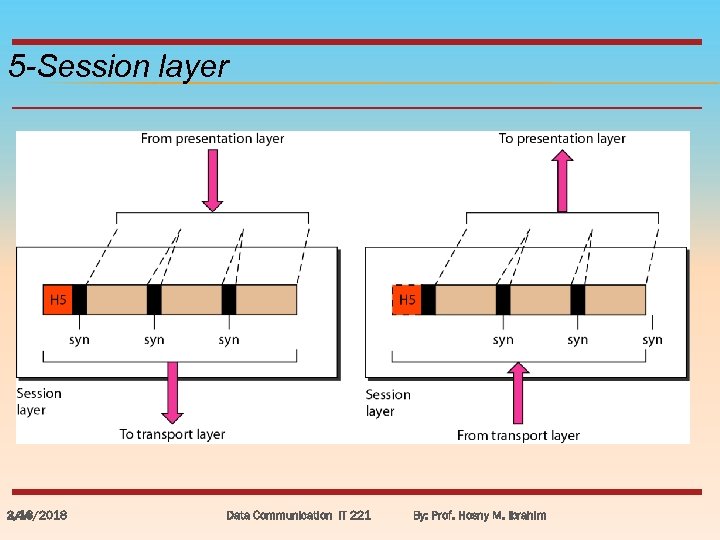
5 -Session layer 3/18/2018 2. 44 Data Communication IT 221 By: Prof. Hosny M. Ibrahim
Note The session layer is responsible for dialog control and synchronization. 3/18/2018 2. 45 Data Communication IT 221 By: Prof. Hosny M. Ibrahim
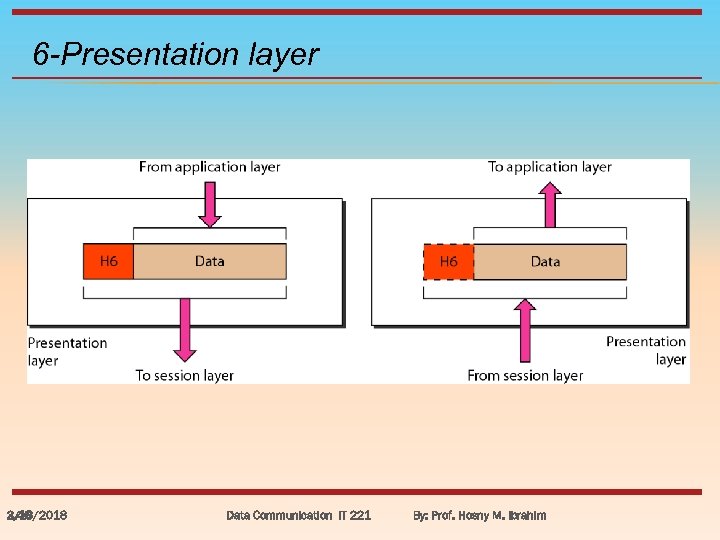
6 -Presentation layer 3/18/2018 2. 46 Data Communication IT 221 By: Prof. Hosny M. Ibrahim
Note The presentation layer is responsible for translation, compression, and encryption. 3/18/2018 2. 47 Data Communication IT 221 By: Prof. Hosny M. Ibrahim
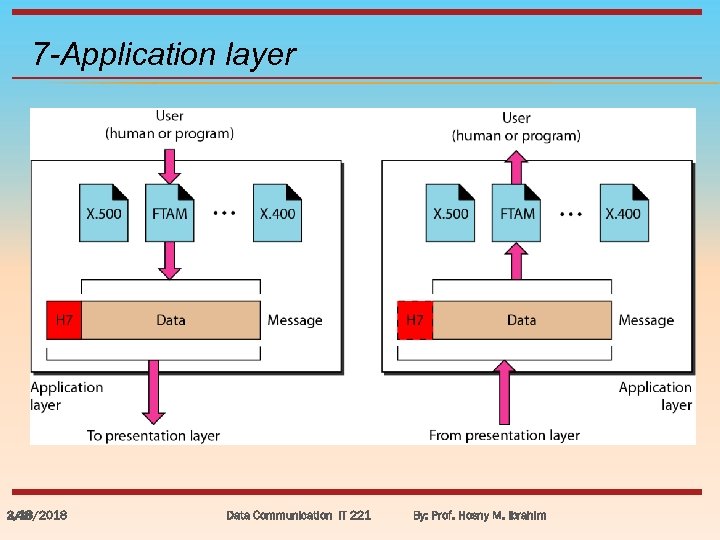
7 -Application layer 3/18/2018 2. 48 Data Communication IT 221 By: Prof. Hosny M. Ibrahim
Note The application layer is responsible for providing services to the user. 3/18/2018 2. 49 Data Communication IT 221 By: Prof. Hosny M. Ibrahim
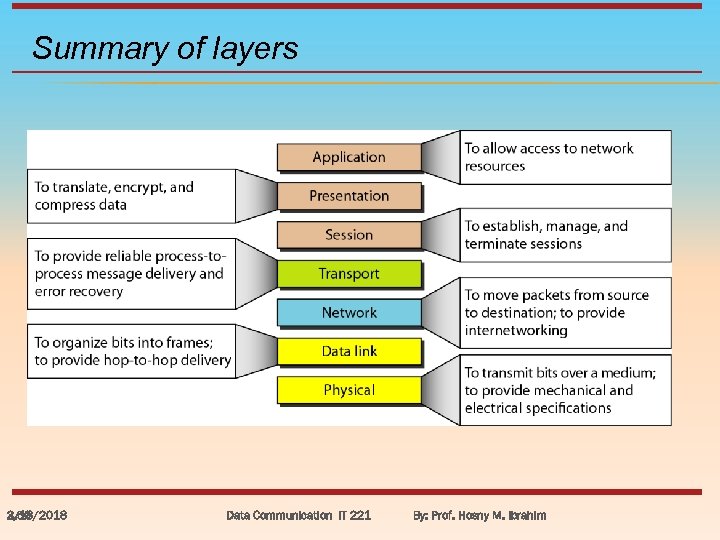
Summary of layers 3/18/2018 2. 50 Data Communication IT 221 By: Prof. Hosny M. Ibrahim
TCP/IP PROTOCOL SUITE The layers in the TCP/IP protocol suite do not exactly match those in the OSI model. The original TCP/IP protocol suite was defined as having four layers: host -to-network, internet, transport, and application. However, when TCP/IP is compared to OSI, we can say that the TCP/IP protocol suite is made of five layers: physical, data link, network, transport, and application. Topics discussed in this section: Physical and Data Link Layers Network Layer Transport Layer Application Layer 3/18/2018 2. 51 Data Communication IT 221 By: Prof. Hosny M. Ibrahim
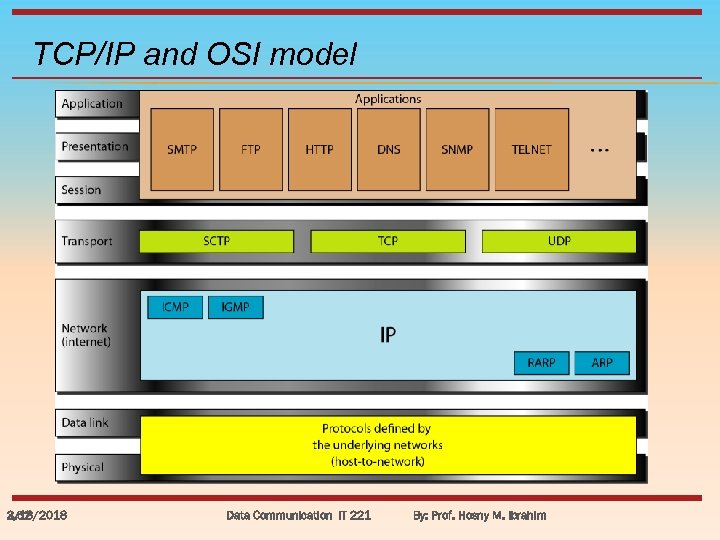
TCP/IP and OSI model 3/18/2018 2. 52 Data Communication IT 221 By: Prof. Hosny M. Ibrahim
ADDRESSING Four levels of addresses are used in an internet employing the TCP/IP protocols: physical, logical, port, and specific. Physical Addresses Logical Addresses Port Addresses Specific Addresses 3/18/2018 2. 53 Data Communication IT 221 By: Prof. Hosny M. Ibrahim
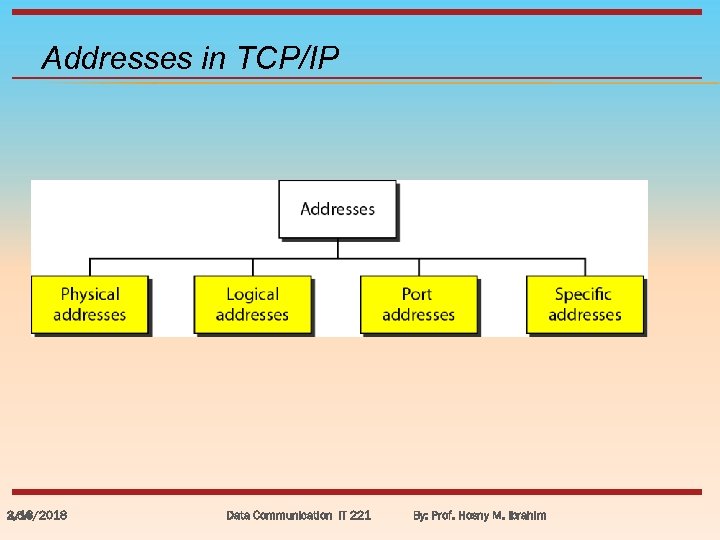
Addresses in TCP/IP 3/18/2018 2. 54 Data Communication IT 221 By: Prof. Hosny M. Ibrahim
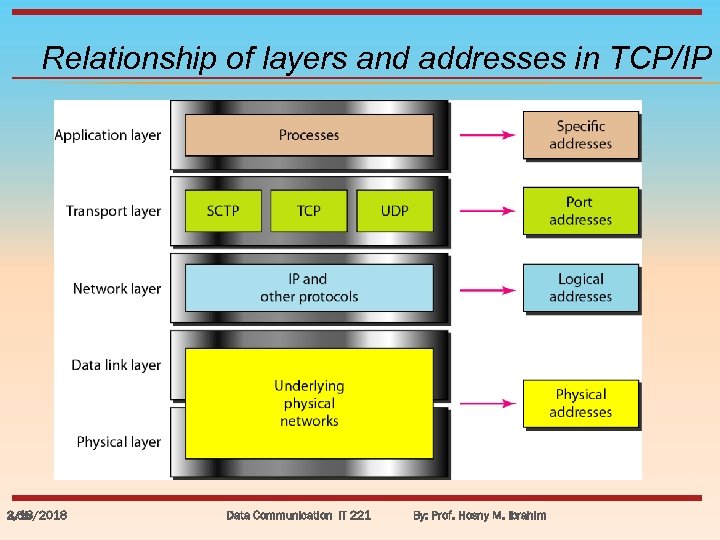
Relationship of layers and addresses in TCP/IP 3/18/2018 2. 55 Data Communication IT 221 By: Prof. Hosny M. Ibrahim
Example 2. 1 In Figure 1 a node with physical address 10 sends a frame to a node with physical address 87. The two nodes are connected by a link (bus topology LAN). As the figure shows, the computer with physical address 10 is the sender, and the computer with physical address 87 is the receiver. 3/18/2018 2. 56 Data Communication IT 221 By: Prof. Hosny M. Ibrahim
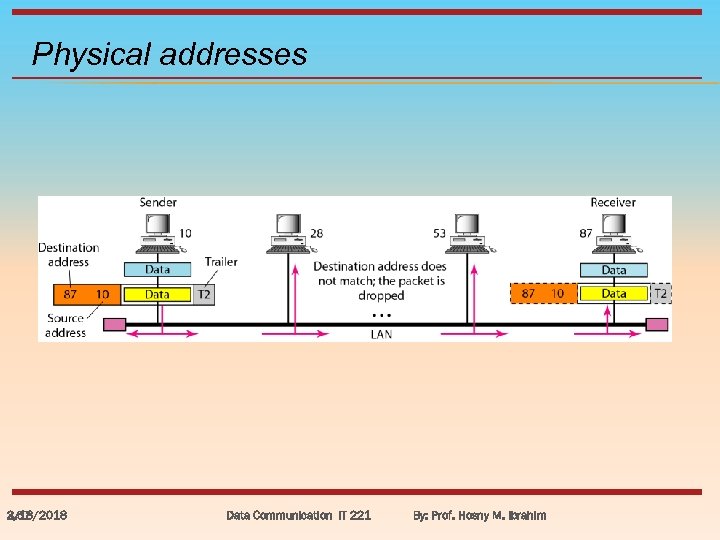
Physical addresses 3/18/2018 2. 57 Data Communication IT 221 By: Prof. Hosny M. Ibrahim
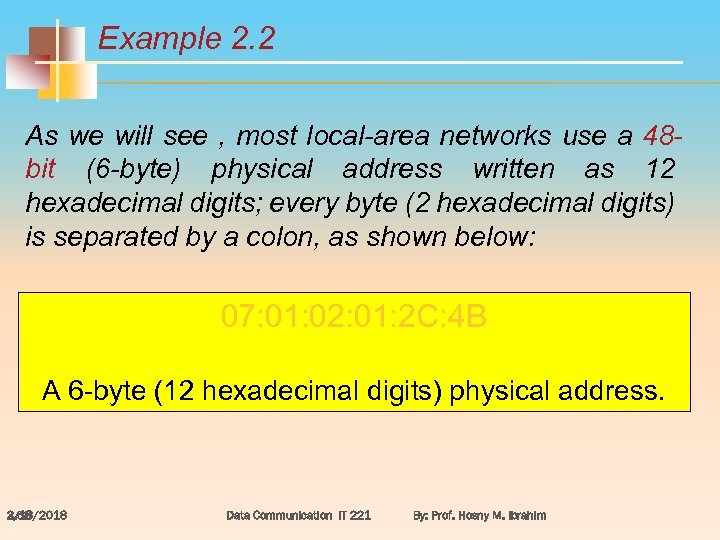
Example 2. 2 As we will see , most local-area networks use a 48 bit (6 -byte) physical address written as 12 hexadecimal digits; every byte (2 hexadecimal digits) is separated by a colon, as shown below: 07: 01: 02: 01: 2 C: 4 B A 6 -byte (12 hexadecimal digits) physical address. 3/18/2018 2. 58 Data Communication IT 221 By: Prof. Hosny M. Ibrahim
Example 3 Figure 2 shows a part of an internet with two routers connecting three LANs. Each device (computer or router) has a pair of addresses (logical and physical) for each connection. In this case, each computer is connected to only one link and therefore has only one pair of addresses. Each router, however, is connected to three networks (only two are shown in the figure). So each router has three pairs of addresses, one for each connection. 3/18/2018 2. 59 Data Communication IT 221 By: Prof. Hosny M. Ibrahim
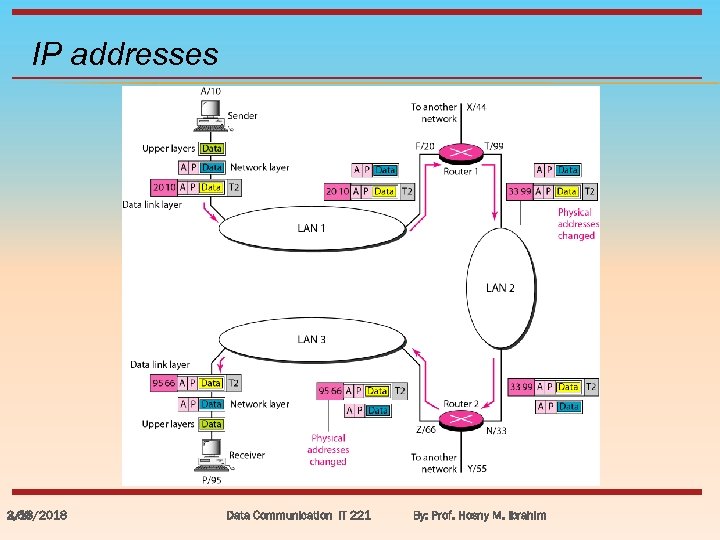
IP addresses 3/18/2018 2. 60 Data Communication IT 221 By: Prof. Hosny M. Ibrahim
Example 4 Figure 3 shows two computers communicating via the Internet. The sending computer is running three processes at this time with port addresses a, b, and c. The receiving computer is running two processes at this time with port addresses j and k. Process a in the sending computer needs to communicate with process j in the receiving computer. Note that although physical addresses change from hop to hop, logical and port addresses remain the same from the source to destination. 3/18/2018 2. 61 Data Communication IT 221 By: Prof. Hosny M. Ibrahim
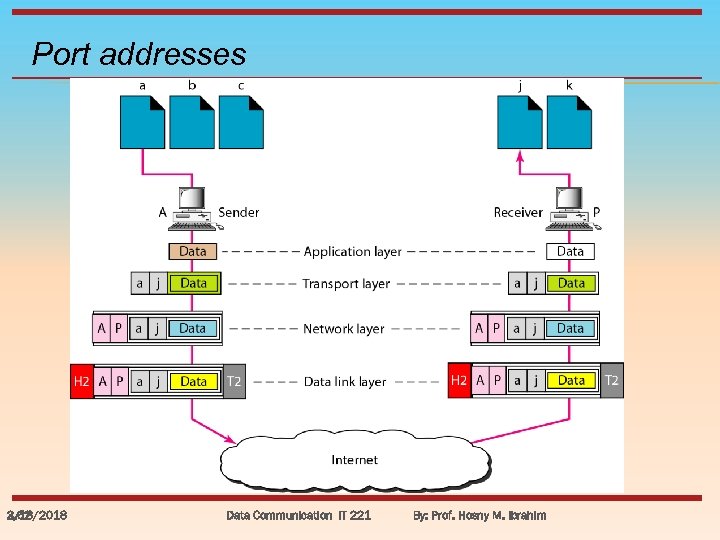
Port addresses 3/18/2018 2. 62 Data Communication IT 221 By: Prof. Hosny M. Ibrahim
Note The physical addresses will change from hop to hop, but the logical addresses usually remain the same. 3/18/2018 2. 63 Data Communication IT 221 By: Prof. Hosny M. Ibrahim
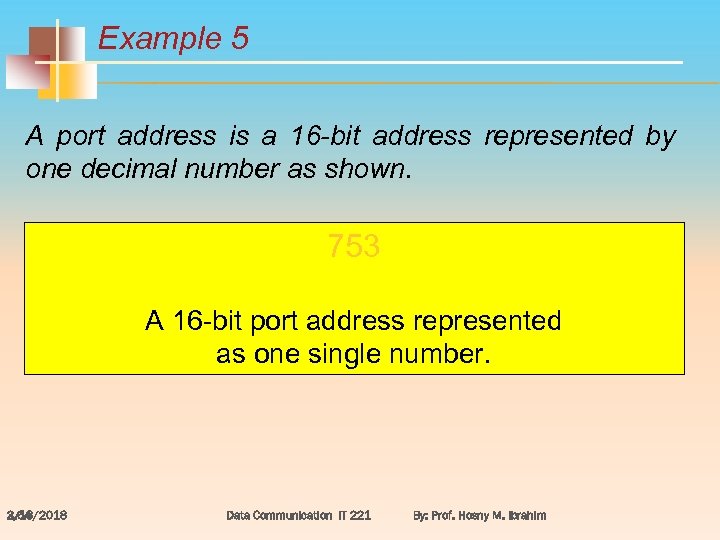
Example 5 A port address is a 16 -bit address represented by one decimal number as shown. 753 A 16 -bit port address represented as one single number. 3/18/2018 2. 64 Data Communication IT 221 By: Prof. Hosny M. Ibrahim
Note The physical addresses change from hop to hop, but the logical and port addresses usually remain the same. 3/18/2018 2. 65 Data Communication IT 221 By: Prof. Hosny M. Ibrahim
Thank 3/18/2018 Data Communication IT 221 You By: Prof. Hosny M. Ibrahim 66
Скачать презентацию Prof Hosny Ibrahim Text book TX
e350359ad907f99109ab9234bd298d09.ppt