


 Скачать презентацию Prof A V Koonin s classification of phraseological units
Проект.pptx
- Количество слайдов: 10
 Prof. A. V. Koonin’s classification of phraseological units. Group: 33 “A” Student: Korobova Svetlana
 Phraseological units are word-groups that cannot be made in the process of speech, they exist in the language as ready-made units. They are compiled in special dictionaries. Like words, phraseological units express a single notion and are used in a sentence as one part of it. American and British lexicographers call such units idioms. Phraseological units can be classified according to the ways they are formed, according to the degree of motivation of their meaning, according to their structure and according to their part-of-speech meaning.
 The classification system of phraseological units suggested by Professor A. V. Koonin is the latest outstanding achievement in the Russian theory of phraseology. The classification is based on the combined structural-semantic principle and it also considers the quotient of stability of phraseological units.
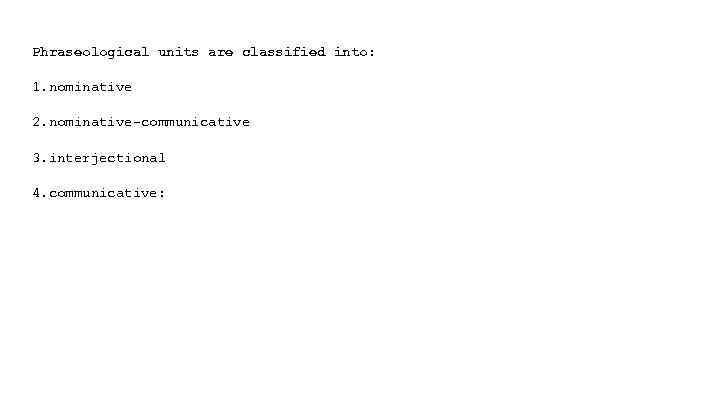 Phraseological units are classified into: 1. nominative 2. nominative-communicative 3. interjectional 4. communicative:
 Nominative phraseological units 1. Nominative phraseological units are units denoting objects, phenomena, actions, states, qualities. They can be: a) substantive – a snake in the grass (змея подколодная), a bitter pill to swallow; b) adjectival – long in the tooth (старый); c) adverbial – out of a blue sky, as quick as a flash; d) prepositional – with an eye to (с намерением), at the head of.
 Nominative-communicative phraseological units include verbal word-groups which are transformed into a sentence when the verb is used in the Passive Voice, E. g. to break the ice ‘to make people feel more friendly and willing to talk to each other’ – the ice is broken.
 Interjectional phraseological units include interjectional word-groups and some interjections with predicative structure. These phraseological units which express feelings and intentions. They are neither nominative nor communicative but stable lingual units by nature, E. g. by George! – ‘really, indeed’, a fine (nice, pretty) kettle of fish – ‘used to say that a situation is very different from one that you have just mentioned’.
 Communicative phraseological units are represented by proverbs and sayings. Phraseological units of this class are sentences in form, E. g. Queen Ann in dead! – ‘to say well-known truths’, What will Mrs. Grundy say! – ‘what will people say? ’
 These four classes are divided into sub-groups according to the type of structure of the phraseological unit. The classification system is based on truly scientific and modern criteria.
 Thank you for attention!