 Скачать презентацию Productivity Perspectives 2007 Canberra 17 December 2007 Productivity
eaddc32ed4a4ecec65fab54acbeb81be.ppt
- Количество слайдов: 14




Productivity Perspectives 2007 Canberra, 17 December 2007 Productivity developments – the International Picture Paul Schreyer, OECD
Outline • A look at labour productivity… • …and MFP • Is there a common productivity story to OECD countries? • Ongoing work and productivity-related projects at the OECD
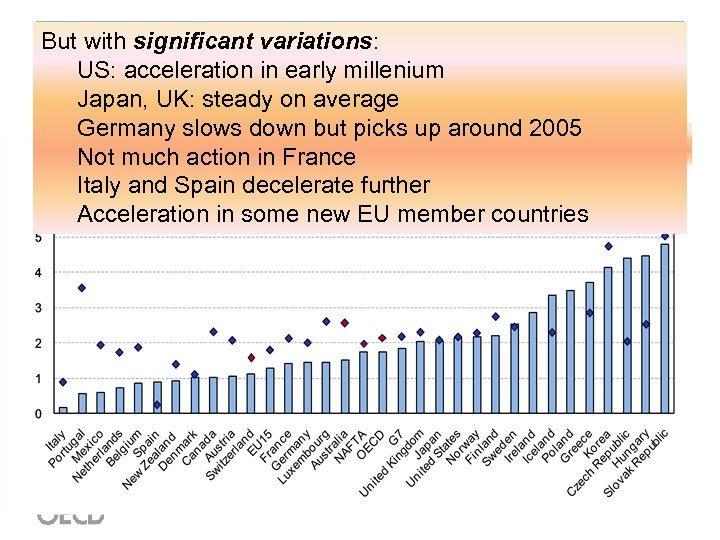
But with significant variations: US: acceleration in early millenium Japan, UK: steady on average Germany slows down but picks up around 2005 OECD action in France Not muchtotal: slowing in 2000 -06 over 1995 -00 Italy and Spain decelerate further Acceleration in some new EU member countries Labour productivity
LP growth in the first half of the millenium • Productivity growth led by new entrants to European Union (Slovak Republic, Poland, Czech Republic, Hungary), but from low levels • And the usual suspects for sustained LP growth in Europe: Sweden, Finland, Ireland • Australia: right in the middle, and doing pretty well by way of labour utilisation:
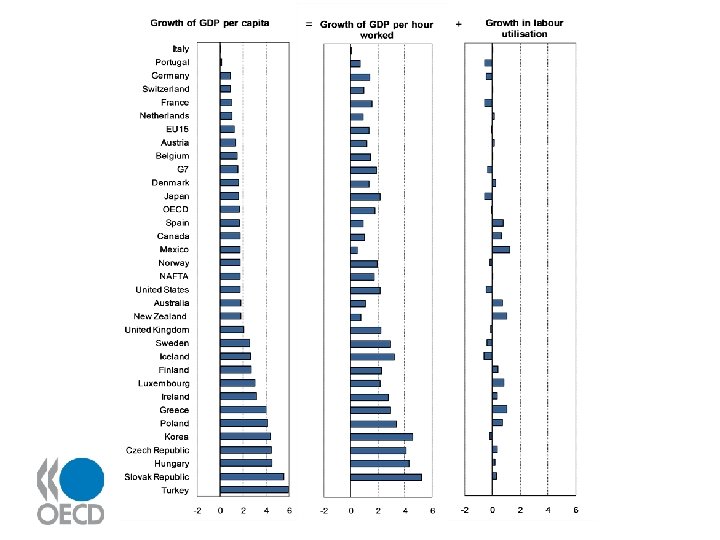
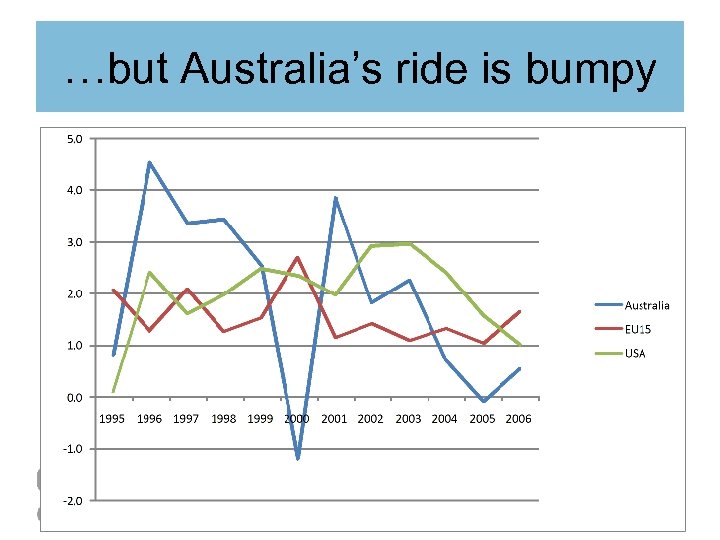
…but Australia’s ride is bumpy
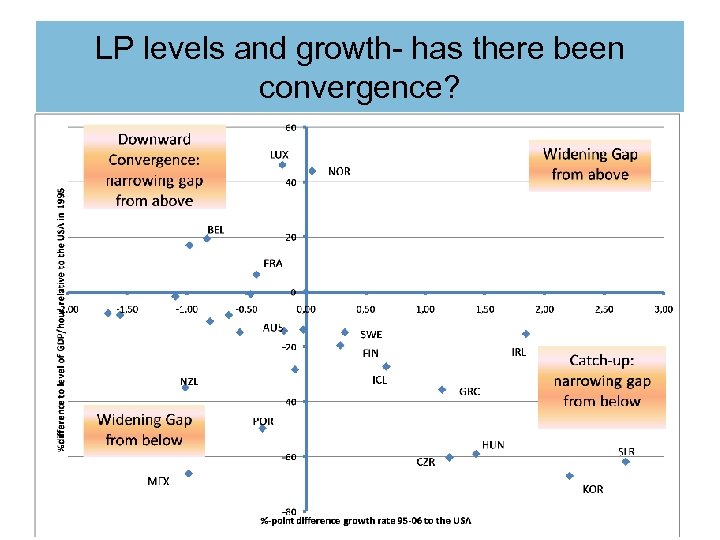
LP levels and growth- has there been convergence?
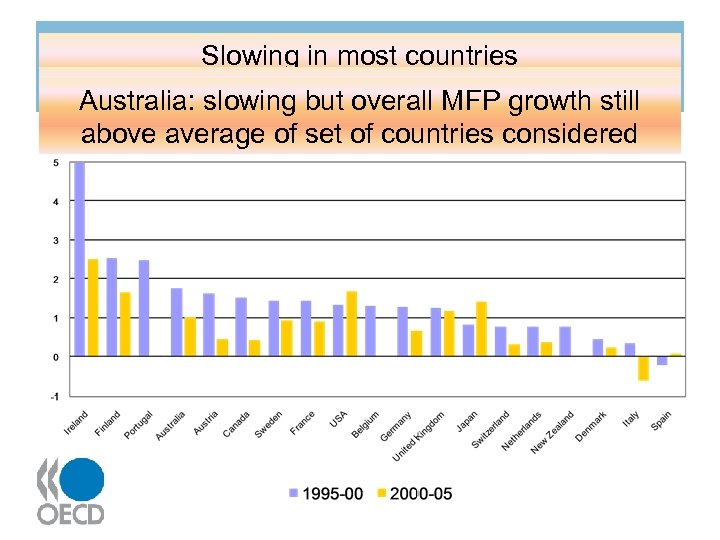
Slowing in most countries Multi-factorinproductivity EU Except most probably overall MFP growth still Negative slowing but Italy, around zero Australia: MFP growth inre-structuring new in countriesinof countries considered Acceleration Spain Japan and above average of set(but no data)USA
Is there a story to tell? • No single story for all or most of the OECD countries, except for overall slowing of productivity growth compared to 2 nd half of 90 s • But there may be several stories: 1. Productivity pick-up in services • • USA: IT-boom; Dot. com bust, MFP acceleration among service industries and IT users (Jorgenson), decreasing capital intensification Ireland, Finland (IT producers) and UK (service orientation) may also fit that picture
Is there a story to tell? 2. Catch-up and restructuring: productivity growth in new EU member countries, manufacturing important 3. Services MFP does not pick up: – Large European countries -Italy, France – Germany: interesting – some labour market reforms seem to take on, unit labour costs have fallen and the manufacturing industry has been doing well despite the high € – Japan, Korea: productivity gains are in manufacturing
Is there a story to tell? 4. Primary industries shape productivity: – Australia, Norway, Canada: primary and resource industries shape much of the productivity picture. Australia has a good record of product market reform and service sector productivity has been steady.
OECD recommendations • 3 main policy areas – Reduction of regulatory barriers to competition in particular in service industries – Reduction of distortionary agricultural subsidies – Fostering of human capital and innovation • Depending on the ‘story’, a different policy mix is needed for different countries
To finish: some OECD projects related to productivity • In the context of SNA 1993 revision – Manual on capital measurement: advanced draft available and comments welcome! – Manual on measuring R&D capital: full draft by end 2008 • In the context of complementing GDP by welfare-based considerations – Set of indicators on net basis – Research on holding gains/losses and concepts of income
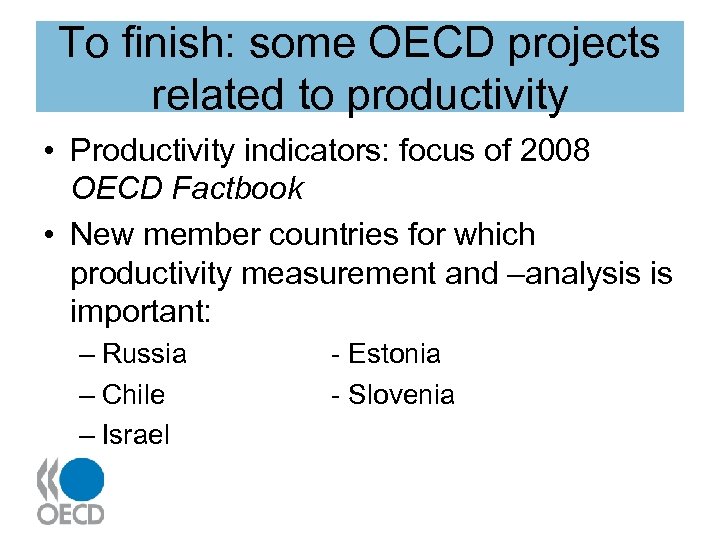
To finish: some OECD projects related to productivity • Productivity indicators: focus of 2008 OECD Factbook • New member countries for which productivity measurement and –analysis is important: – Russia – Chile – Israel - Estonia - Slovenia
Скачать презентацию Productivity Perspectives 2007 Canberra 17 December 2007 Productivity
eaddc32ed4a4ecec65fab54acbeb81be.ppt