


 Скачать презентацию Productivity and schools IA 2008 Summary Pawel Wargocki
e0e268b426c9c2edc3575fe9ae3b70ce.ppt
- Количество слайдов: 43
 Productivity and schools IA 2008 Summary Pawel Wargocki
 Summary • 3 technical sessions – Mo 10 T 2: Productivity – Th 13 T 5: IEQ in schools – TH 15 T 5: Ventilation of school classrooms – Tu 15 T 1: Thermal comfort responses • 2 forums – Mo 13 F 8: Effects of IEQ on performance – The need for future research – Th 17 F 6: Strategic IEQ improvement for schools • 40 papers (5%)
 Performance of office work, single factors • Laboratory experiments with simulated office work • Significant effects of increased ventilation rate (improved IAQ) on performance (up to 20%) • No significant effects of thermal discomfort on performance but significant effects on general symptoms • No effects of drifting temperature on performance but significant effects on general symptoms • Increased temperature may affect short term memory (easy questions) and long-term memory (medium difficult questions)
 Performance of office work, combined factors • Laboratory experiments • Temperature and ventilation: – Office work performed less well the lower subjectively rated indoor environment • Office noise and temperature: – only noise affected performance of simulated office work – increased temperature increased intensity of general symptoms even more with noise present • Traffic noise, temperature and air quality: – noise increased anxiety and stress while increased temperature increased anxiety – no interaction between factors – noise dominated the effects on anxiety and stress – IAQ and temperature particularly important in noisy environments
 Possible mechanisms by which IEQ affects the performance • Increased thermal discomfort cause the increase in mental demand subjective effort to maintain performance • The higher hemoglobin levels in brain (cerebral blood flow measurements) the higher mental work load • Increased temperature results in increased complaints of fatigue • The higher dissatisfaction with air quality the higher fatigue • The higher temperature swings the higher fatigue. • The higher satisfaction with the environment and the lower fatigue the higher performance • The gaseous pollutants rather than particles reduce the performance of schoolwork
 Methods & predictors of the effects of IEQ on performance • Self-estimated performance, depending on how you ask the question • Fatigue and satisfaction better predictors of performance • Cerebral blood flow – a mean of determining the cost of overcoming the environmental stress • Neurobehavioral test
 Consequences of reduced performance, modelling • Providing mesh chairs, desk fans and air conditioning allows the temperatures to be increased from 25 to 28 o. C (COOLBIZ): cost to benefit 1/340 if performance reduction assumed to be 5% • ID Build programme: cooling of air from 30 to 25 o. C will incur energy costs but benefits of increased performance will be 4 times higher
 Performance of schoolwork • Field experiments in actual schools (interventions or cross-sectional) • Performance measured using embedded tasks simulating schoolwork or standardized math/language tests • Increased ventilation rate up to 6 -8 L/s/p improved performance of schoolwork • Self-reported health problems had greater effect on performance than self estimated exposure to poor IEQ • Reduced particle concentrations outside pollen season did not affect performance of schoolwork
 It is hard to be a child. . • CO 2 levels in naturally ventilated classrooms up to 5, 000 ppm (Italy, China, UK, USA) • Large spatial variation in CO 2 levels • Human odors most dominating • BTEX levels high in naturally ventilated classrooms • Noise levels in classrooms up to 20 d. B(A) higher when windows opened (Korea) • Symptoms of fatigue, absence of mind, headaches, dry skin, draughts, unpleasant odors and too low temperatures prevalent
 The good news. . • Radon levels in schools are decreasing mainly because ventilation is increased (Sweden)
 Not all solutions work. . • Sustainable school design with hybrid ventilation reduce energy use for ventilation by 15% but has no additional positive effect on IAQ • Hydronic Radiant Heating Systems do not improve thermal comfort compared with traditional systems • Provision of cooling systems reduce temperature but reduce IAQ as air change rates are significantly reduced compared with cross-ventilation • Operable windows do not guarantee improved classroom IAQ • Natural ventilation can not achieve thermal and air quality requirements with high internal thermal even at outdoor temperatures of 5 o. C
 Not all solutions work. . • An excessive noise absorption in openplan offices may have a negative impact on occupants’ perception of noise, the acceptability of noise and the performance of office work; background noise may be beneficial
 What does work? • Cross-ventilation with proper windows/doors opening – up to 2 h-1 even with temperatures up to 14 o. C and wind speed down to 1 m/s • Fan-assisted natural ventilation • Mechanical ventilation, displacement ventilation • Diffuse ceiling ventilation (perforated ceiling), flows up to 11 L/s/p, t=18 K, low fan energy and low noise
 The cost can be high… • Forecast of energy use due to installation of airconditioners in Japan suggests 54% increase by 2030 (100% schools have AC); the following measures are suggested to keep the energy low: natural ventilation, use of heat exchangers, low. E -glass, window roof and 15% increase in efficiency of air conditioners • To reduce temperatures (without cooling) in Nordic countries below 25 o. C ventilation rates should be at least 10 L/s/p, supply temp. down to 14 o. C and demand controlled ventilation; in summer the night ventilation is needed
 Moderation in what we do….
 What was missing? • No studies on the performance of office work in field, thus no information on differences between simulated work and real work • No studies on the effects on complicated work (creative work) • No systematic data on short-term and long-term effects • Only few studies explaining possible mechanisms behind the observed effects, but still no information on e. g. which pollutants are important
 Challenge…. • To which extent are suboptimal working conditions economically justified? • How much energy can be conserved in buildings before it begins affect the national economy?
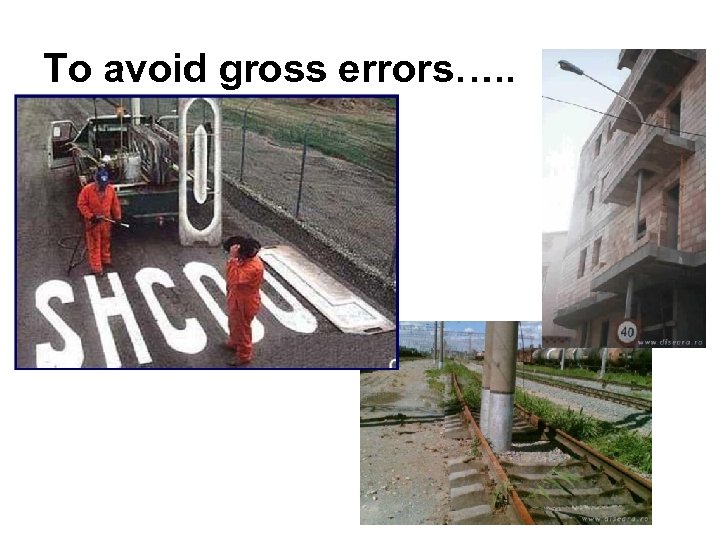 To avoid gross errors…. .
 To avoid misunderstanding…. .

 Detailed summaries…. .
 Kim et al. (532) • Laboratory experiments • 24 subjects exposed for 8 hrs. to 5, 10 and 20 L/s/p and performed simulated office work • Increased ventilation rate improved the performance by 7 to 20% • Strong learning effects observed within one day of exposure
 Nakao et al. (948) • Laboratory experiments • Subjects exposed for 60 minutes to toluene concentrations with and without foliage plants • Plants reduced the toluene concentration and the exposures with plants were more preferred by the subjects but no effect on performance of simulated office work was observed
 Iwashita et al. (384) • Laboratory experiment • 50 subjects watched video for 30 min in the university classroom having warm to cool environment (29 -2522 o. C) • Thermal sensation may affect memory, suggestive • Short term memory better with lower temperture but only when the questions regarding wathed programme are easy • Long term memory better with lower temperature but only when the questions regarding watched programme have medium difficulty • Metabolic CO 2 lower at higher temperature (but not significantly)
 Lan et al. (272) • Laboratory experiment • 24 subjects exposed for 80 min to 19 -2427 -32 o. C at 0. 6 clo • Perfromed neurobehaviral tests in the last 40 min of exposure • No effects on performance
 Kolarik et al. (429) • Laboratory experiments • 52 subjects exposed to different temperature ramps from 0. 6 K/h to 4. 8 K/h (8 to 1 hour exposure); temperature range 18 -27 o. C; 0. 5 and 0. 7 clo • Ramps increased significantly general SBS symptoms but there was no effect on the performance of simulated office work • Linear model independently of ramps suggested that increasing temperatures reduced speed and precision in addition and proof-reading
 Tsutsumi et al. (656) • Laboratory experiments • 8 subjects were exposed for 2 hrs to 28 o. C without and with two temperature swings of 1. 7 & 3. 5 K at two different absolute humidity levels, 2 &12 g/kg • Complaints of fatigue were greater at the temperature swing of 3. 5 K and at the higher absolute humidity w/o temperature swing
 Nishihara et al. (138) • Laboratory experiments • 12 subjects exposed for 2. 8 hrs. to increased thermal discomfort with increasing operative temperature (25. 5, 28. 5 & 31. 5 o. C) • Performed 3 -digit addition • The higher hemoglobin levels in brain (by cerebral blood flow measurements) the higher mental work load (as expected) • The mental demand to maintain performance increased with increased thermal discomfort • Towards the end of exposure the performance at 25. 5 o. Cwas higher than at the other two temperatures
 Balazova et al. (703) • Laboratory experiment • 15 subjects exposed for 6 hrs to combination of open-plan office and temperature (23 o. C and 28 o. C) and open-plan office with 2 different noise reduction methods • Office noise reduced performance of text typing • Noise absorption reduced performance of text typing (intervention overdone) • Increased temperature did not affect the performance of simulated office work but affected ability to concentrate, even more when noise was present
 Haneda et al. (108) • Laboratory experiment • 11 subjects exposed for 5. 8 hrs. to combination of operative temperature (25. 5 & 28 o. C) and ventilation rates (3 & 25 L/s/p) • No effects on the performance of 3 -digit multiplication task • Subjects were more fatigued at higher temperature • The higher dissatisfaction with air quality the higher fatigue • The higher satisfaction with the environment and the lower fatigue the higher performance
 Choi et al. (148) • Laboratory experiment • 12 subjects exposed to combinations of temperature (20 -25 -30 o. C), air quality (with-w/o tiled carpets) and noise (nature vs. traffic) • Exposure 25 min to 1 hr • Increased temperature increased anxiety but only during extended exposure but not on stress • No effect of air quality on anxiety/stress • Traffic noise increased anxity and stress • No interactions between the factors – noise dominated
 Nakamura et al. (129) • Modelling of the economic consequences of cool -bizz (set points at 28 o. C, no dress code – light clo) • Installation of mesh chairs, desk fans and airconditioning shirts if temperature is increased from 25 to 28 o. C reduces running costs by 10 yen/m 2 but provides benefits of 3400 yen/m 2 assuming increase in productivity by 5% • Theoretical relation between PPD and decreament in productivity was created
 Jensen et al. (1013) • Modelling economic consequences when changing thermal/air quality conditions in buildings • IDBuild programme developed • Cost-to-benefit analysis of modifications to improve IEQ vs. performance • Case analysis indicate that installation of mechanical cooling (30 to 25 o. C) increase the cost of enrgy but the benefit of improved performance will 4 times higher
 Bako-Biro et al. (880) • Field intervention study in primary schools in UK • Ventilation improved on average from 1. 5 to 7 L/s/p (0. 8 to 4 h-1) • Performance of computerized tests by 910 -year–old pupils improved at higher ventilation rate • Improvements were 3 -15%
 Shaughnessy et al. (605) • Cross-sectional studies in 100 primary schools in 2 districts in the U. S. A. • Ventilation rates estimated using the measurements of CO 2 • Standardized tests in math and reading used as a measure of perfomance • Models controlling for confounding factors suggest that increasing ventilation rate improves the performance • The effects level-off at ventilation rates of 6 -8 L/s/p
 Haverinen-Shaughnessy et al. (607) • Cross-sectional study in 359 elementary schools in Finland • Performance of the 6 th grade pupils evaluated using standardized math tests • Detailed technical inspections in 60 schools • Self-estimated health-status linked with math results • Self-reported IEQ in schools not related to performance
 Wargocki et al. (120) • Field intervention experiment in 5 elementary schools in DK and SWE • Concentrations of particles in classrooms reduced by means of electrostatic air cleaners • No effects on performance of schoolwork by 10 -12 -year-old children • The higher outdoor air supply trate the lower concentration of particles
 Conditions in schools • CO 2 measurements in naturally ventilated classrooms; one sensor not enough – large spatial fluctuations; CO 2>1000 ppm (791) • BTEX levels high in classrooms in Portugal (678) • CO 2 levels in naturally ventilated classrooms in Italy in summer 600 -3, 600 ppm (avg. 1, 500 ppm) and in winter 1, 000 -5, 300 ppm (avg. 2, 900 ppm); human odors most dominating pollution (824) • Sustainable design of schools by using hybrid ventilation systems to reduce energy use by 15% for ventilation did not show any positive effect on IAQ (high CO 2 levels) in schools in the Netherlands (10)
 Conditions in schools • Numerous VOCs are present in classrooms in Japan although at the levels below Japanese air quality guidelines (85) • Noise levels in classrooms in Korea are 20 d. B(A) above the standards independently of whether the classrooms are traditional or joint; in the latter the reverberation time is longer (261) • Hydronic Radiant Heating Systems were not shown to improve thermal comfort of occupants in schools in the Netherlands compared to schools with traditional heating systems (11) • Forecast of energy use due to installation of airconditioners in Japan suggests 54% increase by 2030 (100% schools hav AC); the following measures are suggested to keep the energy low: natural ventilation, use of heat exchangers, low. Eglass, window roof and 15% increase in efficiency of air conditioners (358)
 IEQ in schools • In newly established classrooms in Korea ? ? with mechannical ventilation? ? CO 2<600 ppm (1052) • Changes in coarse particles (>5 µm) follow CO 2 concentrations in classrooms suggesting that students and their activities are their source (546) • Measurements of radon levels in schools show that number of schools with 200 Bq/m 2 decreased from 19% in 1999 to 8% in 2007 and that all schools will be below this traget by 2010 (why reduced, which measures implemented? ) (548)
 Classroom ventilation – how? • Windows were opened more frequently when the temperature rose in classrooms but not when the outdoor air supply rate was low; operable windows do not guarantee improved classroom IAQ (119) • Diffuse ceiling ventilation (perforated ceiling) allow up to 11 L/s/p and t=18 K without comfort problems; allow fan energy consumption and low noise with modest investments (3) • Studies with automated windows (to be used in older buildings w/o mech. vent. ) suggest that with high internal thermal loads natural ventilation can not achieve thermal and air quality requirements even if outdoor air temperatures are down to 5 o. C (939)
 Classroom ventilation – how? • Parametric simulations for Finnish classrooms indicate that to reduce temperatures (without cooling) below 25 o. C ventilation rates should be at least 10 L/s/p, supply temp. down to 14 o. C and demand controlled ventilation; in summer the night ventilation is needed (809) • CO 2 levels in schools in Lithuania up to 5, 000 ppm; fatigue, dry skin and draughts and too low temperatures (319) • CFD simulations show that natural ventilation in classrooms may create problems with outdoor temperatures <0 o. C; displacement ventilation seems the best solution (ach reduced and CO 2 low) (319) • Proper windows/doors opening guarantees up to 2 h-1 in classrooms even with outdoor temps of up to 14 o. C and the wind speed down to 1 m/s (1075)
 Classroom temperature – how? • The effect of fan-assisted natural ventilation on classroom ventilation show that when all openings opened as intended required flows attained; care should be take for return openings to avoid reverse flows (541) • Thermal comfort of pupils in Japanese schools improved after installation of air cooling system but air quality reduced due to significant reduction in air change rates compared with cross-ventilation in classrooms (386) • CO 2 levels in Chinese classrooms up to 4, 600 ppm accompanied with several complaints of fatigue, absence of mind, unpleasant odors and headaches (680)