


 Скачать презентацию Production processes The design of the most appropriate
d51e585b29c0fef465a1651e0c23c8e3.ppt
- Количество слайдов: 38
 Production processes The design of the most appropriate processes depend substantially of course on the operations strategy an organisation is trying to execute.
 Introduction • And not, only must it design the operations processes but also design a procedure for monitoring and controlling them in case they become ineffective or need to be changed to reflect changes in the market, environment or the organisation’s strategy. Overtime, we know we will have to improve our processes, both in terms of their variability, to make the outputs more consistent or less costly, and in terms of reducing waste in all forms (including time and human effort).
 Introduction contd • Operations Managers should select and design transformation processes that can deliver those factors such as low cost, high quality, enhanced functionality, speed and so on – in an efficient and effective manner. If an organisation is using the wrong transformation process, either because the organisation has changed or the market has changed, the organisation will not be competitive on these critical value factors.
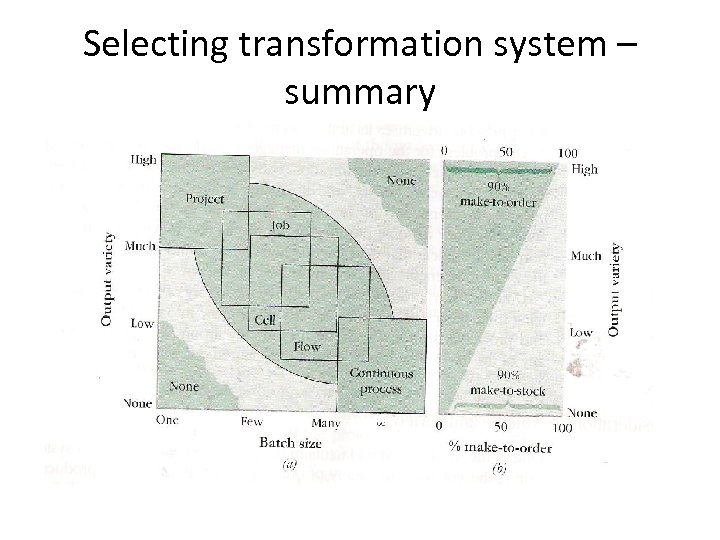
 Types of Transformation Systems • There are 5 basic forms of transformation systems which are: • Continuous process • Flow shop • Job shop • Cellular • Project
 Explanation • The continuous process industries are in many ways the most advanced, moving fluid material continuously through vats and pipes until a final product is obtained. • Flow shop produce discrete, usually standardized outputs on a continuous basis by means of assembly lines or mass production, often using automated equipment. • Cellular shops produce “families” of outputs within a variety of flow cells, but numerous cells within the plant can offer a range of families of outputs. • Job shops offer a wide range of possible outputs usually in batches by individualised processing departments. These departments typically consist of a set of largely identical equipment, as well as highly skilled workers. • Finally, projects are temporary endeavors to achieve a unique outcome. The most commonly known projects are those performed on a massive scale when the labour and equipment are brought to each site rather than to a fixed production facility, such as dams, buildings, roadways, etc.
 Choosing transformation systems • The major considerations, to designing the transformation system – efficiency, volume, effectiveness, capacity, lead time, flexibility and so on – are so interdependent that changing the system to alter one will change the others as well. The layout of the operations is another aspect that must be considered in the selection of the transformation system. The main purpose of layout analysis is to maximize the efficiency (costorientation) or effectiveness (e. g. quality, lead time, flexibility) of operations.
 Process selection contd. . • In laying out service operations, the emphasis may be on accommodating the customer rather than on operations per-se. Moreover, capacity and layout analyses are frequently conducted simultaneously by analyzing service operations and the wait that the customer must endure. • The layout of parking lots, entry zones, reception rooms, waiting areas, service facilities and other points of customer, contact are top priority in service –oriented organisations such as clinics, stores, nightclubs, restaurants and banks. In a frequently changing environment, the transformation system and its layout will have to be constantly monitored and occasionally redesigned to cope with new demands, new products and services, new government regulations and new technology.
 Layout of the flow shop • The work flow should be subdivided sufficiently so that labour and equipment are utilized smoothly throughout the processing operations. If for example, one operation takes longer than all the others, this single operation (perhaps a machine) will become a bottleneck, delaying all the operations following it and restricting the output rate of the entire process. • Obtaining smooth utilization of workers and equipment across all operations involves assigning to groups tasks that take about the same amount of time to complete. This balancing applies to production lines where parts or outputs are produced, as well as to assembly lines where parts are assembled into final products.
 Paced and Unpaced lines • Final assembly operations usually have more labour input and fewer fixed-equipment cycles and can therefore be subdivided more easily for smooth flow. Either two types of lines can be used. • A paced line uses some sort of conveyor and moves the output along at a continuous rate, and operators do their work as the output passes by them. For longer operations the worker may walk or ride alongside the conveyor and then have to walk back to the starting workstation.
 Unpaced lines • In unpaced lines, the workers build up queues between workstations and can then vary their pace to meet the needs of the job or their personal desires, however, average daily output must remain the same. The advantage of unpaced line is that a worker can spend longer on the more difficult tasks or output and balance this with the easier outputs. Similarly, workers can vary their pace to add variety to a boring task. For example, a worker may work fat to get ahead of the pace for a few seconds before returning to the tasks.
 Balancing the production line • Long-form Credit receives 1200 credit applications a day, on the average. Long Form competes on the basis of its ability to process applications within hours. Daily application processing tasks (tasks that must be completed before the next task) are listed below.
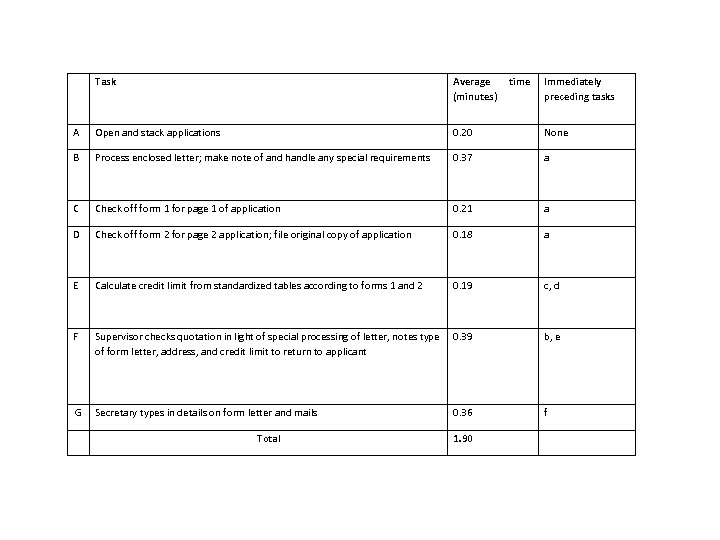 Task Average (minutes) A Open and stack applications 0. 20 None B Process enclosed letter; make note of and handle any special requirements 0. 37 a C Check off form 1 for page 1 of application 0. 21 a D Check off form 2 for page 2 application; file original copy of application 0. 18 a E Calculate credit limit from standardized tables according to forms 1 and 2 0. 19 c, d F Supervisor checks quotation in light of special processing of letter, notes type of form letter, address, and credit limit to return to applicant 0. 39 b, e G Secretary types in details on form letter and mails 0. 36 f Total 1. 90 time Immediately preceding tasks
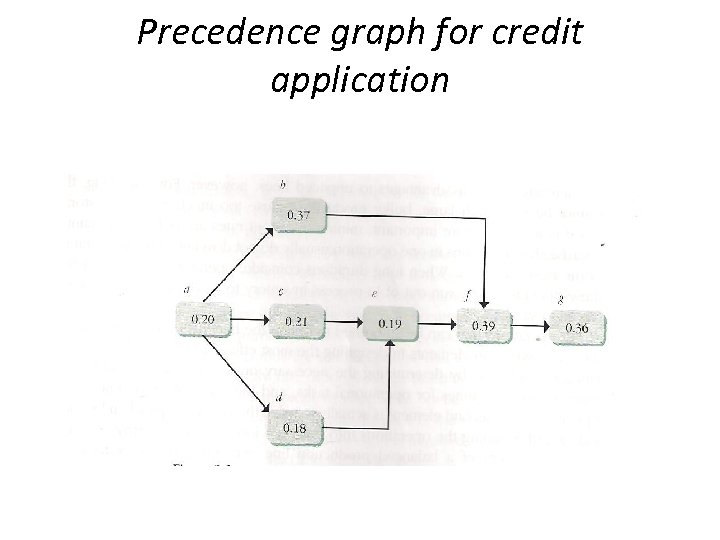 Precedence graph for credit application
 Explanation • In balancing the line, the intent is to find a cycle time in which workstation can complete its tasks. A work station is usually a single person, but it may include any number of people responsible for completing all the tasks associated with the job for that station. Conceptually, at the end of this time every workstation passes its part on to the next station and of course, one item comes off the end of the line fully complete.
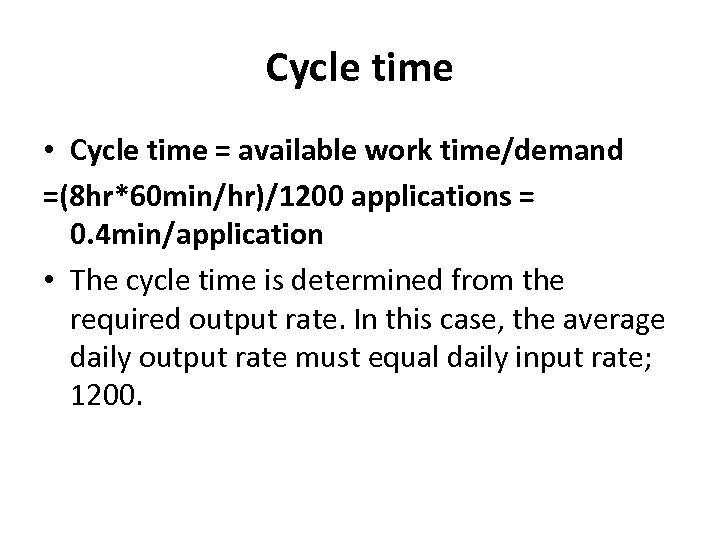 Cycle time • Cycle time = available work time/demand =(8 hr*60 min/hr)/1200 applications = 0. 4 min/application • The cycle time is determined from the required output rate. In this case, the average daily output rate must equal daily input rate; 1200.
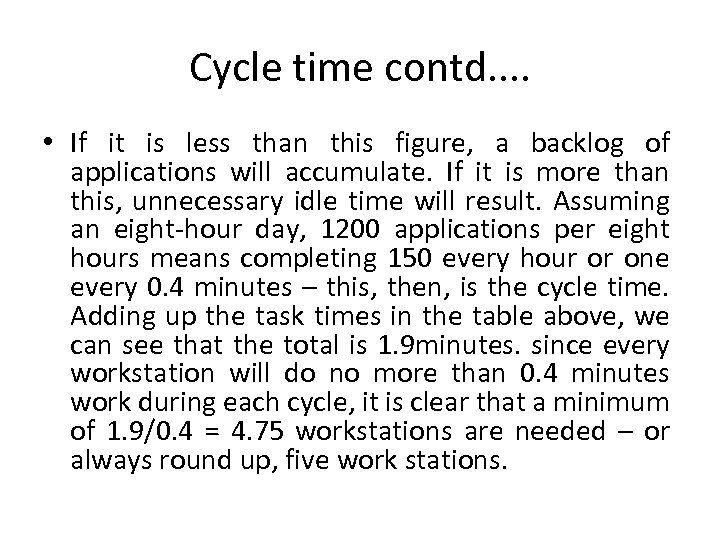 Cycle time contd. . • If it is less than this figure, a backlog of applications will accumulate. If it is more than this, unnecessary idle time will result. Assuming an eight-hour day, 1200 applications per eight hours means completing 150 every hour or one every 0. 4 minutes – this, then, is the cycle time. Adding up the task times in the table above, we can see that the total is 1. 9 minutes. since every workstation will do no more than 0. 4 minutes work during each cycle, it is clear that a minimum of 1. 9/0. 4 = 4. 75 workstations are needed – or always round up, five work stations.
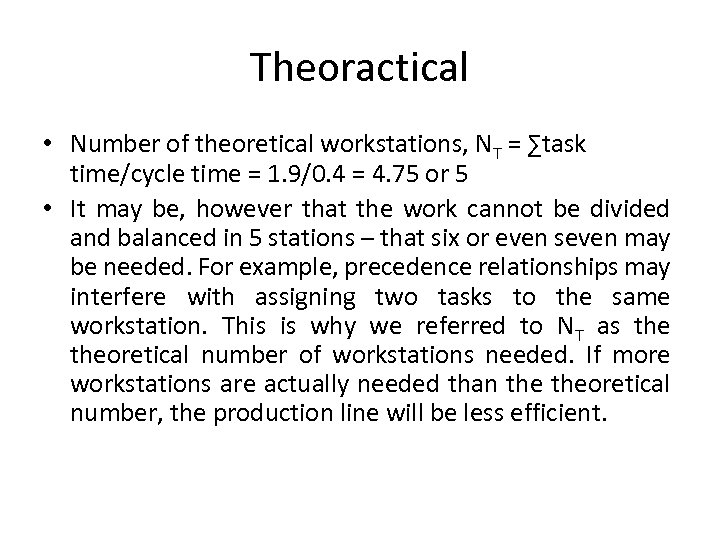 Theoractical • Number of theoretical workstations, NT = ∑task time/cycle time = 1. 9/0. 4 = 4. 75 or 5 • It may be, however that the work cannot be divided and balanced in 5 stations – that six or even seven may be needed. For example, precedence relationships may interfere with assigning two tasks to the same workstation. This is why we referred to NT as theoretical number of workstations needed. If more workstations are actually needed than theoretical number, the production line will be less efficient.
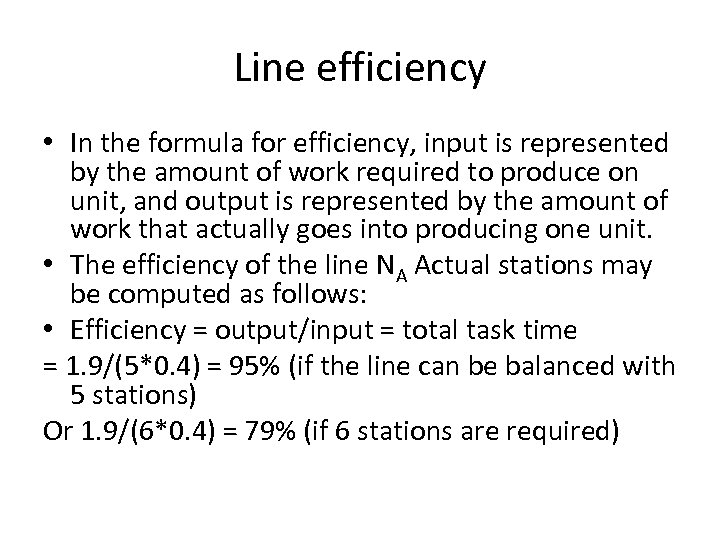 Line efficiency • In the formula for efficiency, input is represented by the amount of work required to produce on unit, and output is represented by the amount of work that actually goes into producing one unit. • The efficiency of the line NA Actual stations may be computed as follows: • Efficiency = output/input = total task time = 1. 9/(5*0. 4) = 95% (if the line can be balanced with 5 stations) Or 1. 9/(6*0. 4) = 79% (if 6 stations are required)
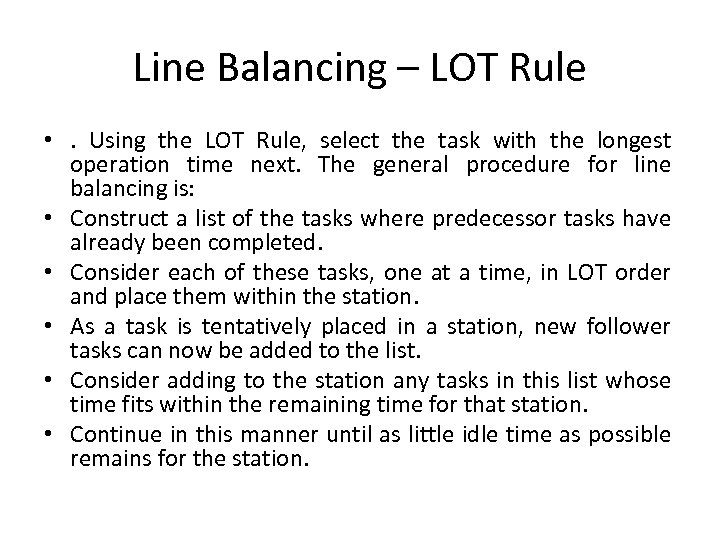 Line Balancing – LOT Rule • . Using the LOT Rule, select the task with the longest operation time next. The general procedure for line balancing is: • Construct a list of the tasks where predecessor tasks have already been completed. • Consider each of these tasks, one at a time, in LOT order and place them within the station. • As a task is tentatively placed in a station, new follower tasks can now be added to the list. • Consider adding to the station any tasks in this list whose time fits within the remaining time for that station. • Continue in this manner until as little idle time as possible remains for the station.
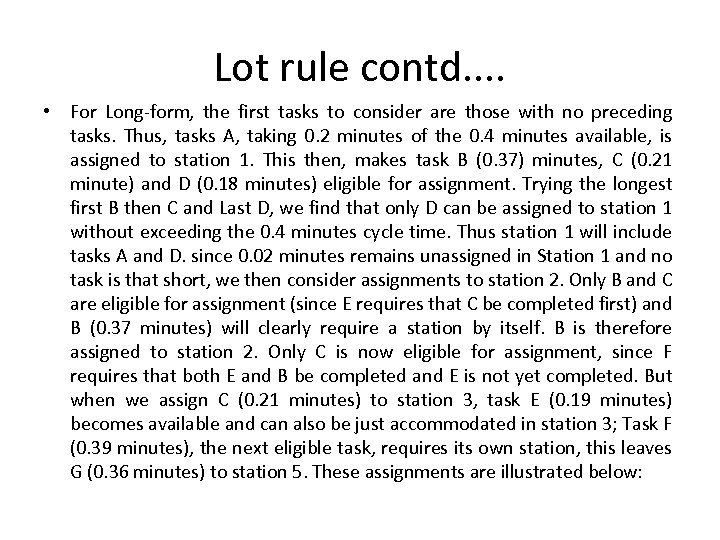 Lot rule contd. . • For Long-form, the first tasks to consider are those with no preceding tasks. Thus, tasks A, taking 0. 2 minutes of the 0. 4 minutes available, is assigned to station 1. This then, makes task B (0. 37) minutes, C (0. 21 minute) and D (0. 18 minutes) eligible for assignment. Trying the longest first B then C and Last D, we find that only D can be assigned to station 1 without exceeding the 0. 4 minutes cycle time. Thus station 1 will include tasks A and D. since 0. 02 minutes remains unassigned in Station 1 and no task is that short, we then consider assignments to station 2. Only B and C are eligible for assignment (since E requires that C be completed first) and B (0. 37 minutes) will clearly require a station by itself. B is therefore assigned to station 2. Only C is now eligible for assignment, since F requires that both E and B be completed and E is not yet completed. But when we assign C (0. 21 minutes) to station 3, task E (0. 19 minutes) becomes available and can also be just accommodated in station 3; Task F (0. 39 minutes), the next eligible task, requires its own station, this leaves G (0. 36 minutes) to station 5. These assignments are illustrated below:
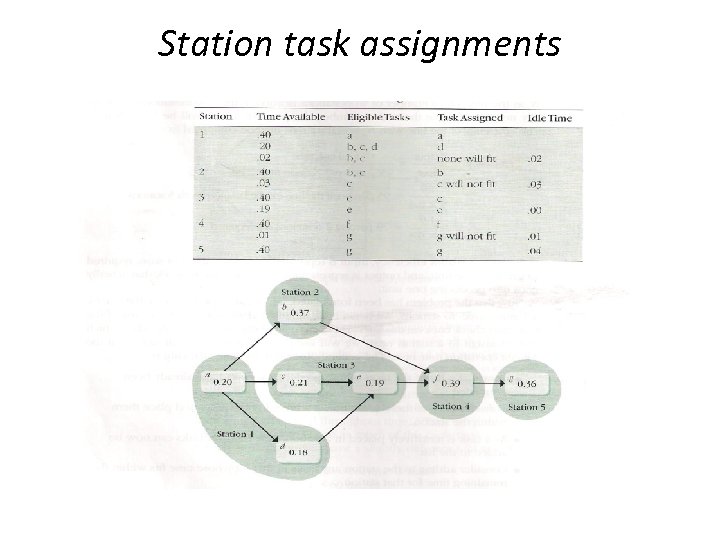 Station task assignments
 Job Shop • It gets its name because unique jobs must be produced. In this form of transformation system each output, or each small batch of outputs is processed differently. Therefore the flow of work through the facility tends to be intermittent. The general characteristics of the job shop are groupings of staff and equipment according to function, a large variety of outputs; a considerable amount of transport of staff, materials or recipients and large variations in system flow times (the time it takes for a complete job). • In general, each output takes a different route through the organisation, requires different operations, uses different inputs and takes a different amount of time.
 Job shop contd. . . • The transformation system is common when the inputs differ significantly in form, structure, materials or processing required. Specific examples that produces product and service in jobs include, hospitals, automobile repair shops, criminal justice system etc. by and large the job shop is especially appropriate for service organisations because services are often customized and hence, each service requires different operations.
 Job shop layout • Clearly, the efficient management of a job shop is a difficult task, since every output must be treated differently. Furthermore, managers must also be sure that the available resources are being efficiently utilized. Often there is a difficulty trade-off between efficiency and flexibility of operations. Job based processes tend to emphasize flexibility over efficiency. • The figure below represents the flow through a job shop. Each particular job travels from one area to another and so on, according to the unique routing until it is fully processed. Temporary in process storage may occur between various operations while jobs are waiting for subsequent processing (standing in line for the coffee machine, in shops, banks,
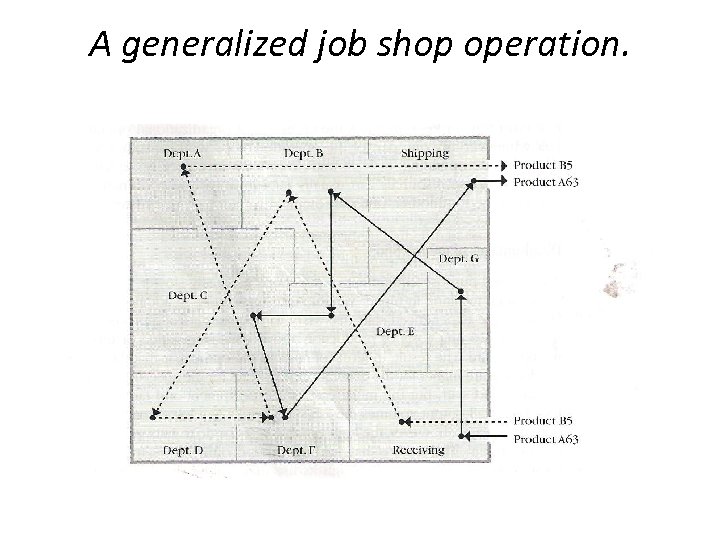 A generalized job shop operation.
 Layout contd. . • Because of the relative permanence, the layout of operations is probably one of the most crucial elements affecting the efficiency of a job shop. In general the problem of laying out operations in a job shop is quite complex. The difficulty stems from the variety of outputs and the constant changes in outputs that are characteristic of organisations with an intermittent transformation system. The optimal layout of the existing set of outputs may be relatively inefficient for the outputs to be produced six months from now.
 Directly specified closeness preferences • Consider the table below where 6 departments have been analyzed for the desirability of closeness to each other. Assuming we are given the organisation’s closeness preferences indicated by letter A, E, I, O, U and X with the meaning given in the table.
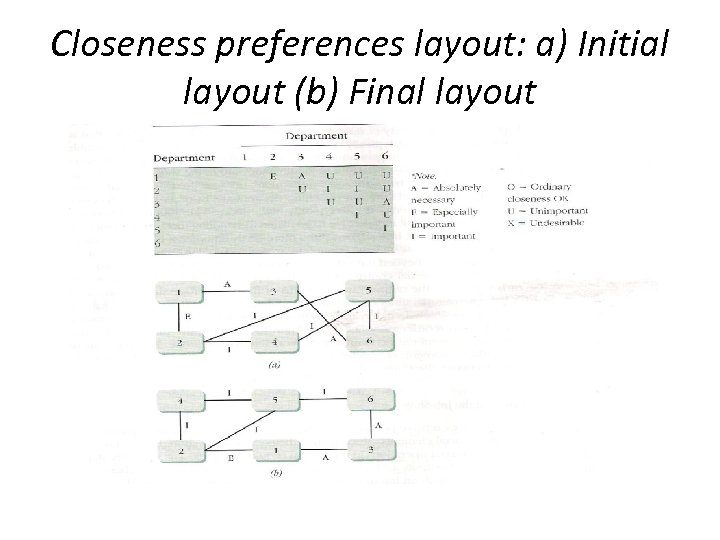 Closeness preferences layout: a) Initial layout (b) Final layout
 Cost Volume Distance Model (CVD) • In the CVD approach, the desirability of closeness is based on the total cost of moving material or people between departments. Clearly, a layout can never be completely reduced to just one such objective, but where the cost of movement is significantly, this approach produces reasonable first approximations.
 CVD explanation • The objective is to minimize the costs of interrelations among operations by locating those operations that interrelate extensively close to one another. If we label one of the departments I and another department J, then the cost of moving materials between departments I and J depends on the distance between I and J, Dij. In addition, the cost will usually depend on the amount or volume moving from I to J, such as trips, case, volume, weight, or some other such measure, which we will denote by Vij. Then, if the cost of the flow from I to J per-unit amount per-unit distance is Cij, the total cost of I relating with J is Cij. Vij. Dij. Not that C, V and D may have different values for different types of flows and that they need not have the same values from J to I as from I to J, since the flow in opposite directions may be of an entirely different nature. For example, information may be flowing from I to J, following a certain paperwork path; but sheet steel may flow from J to I, following a lift truck or conveyor belt path.
 CVD Formula
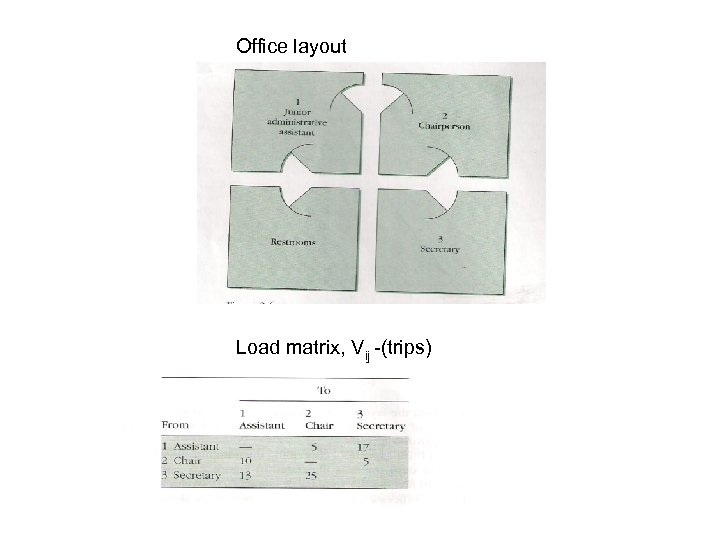
 Example: • The section of Business school containing the administrative offices of the operations management department is illustrated in the figure below. Each office approximately 10 m by 10 m, so the walking distance D between adjacent offices (i. e. , office 1 and 2 and offices 2 and 3) is 10 m, whereas the distance between diagonal offices (office 1 and 3) is approximately 15 m. The average number of interpersonal trips made each day is given in a travel or load matrix as shown below. According to the load matrix, each day the assistant makes 5 trips to the Chairperson’s office and 17 trips to the secretary’s office. Thus, the assistant would travel 305 m (10 m*5 trips*17 trips) each day.
 Example contd. . • Assuming that the Chairperson is paid approximately twice as much as the secretary and the junior administrative assistant, determine if the current arrangement is best (i. e. , least costly) in terms of transit time and if not, what arrangement would be better. • Before calculating total costs of all possible arrangements, some preliminary analysis is worthwhile. First, because of special utility connections, restrooms are usually not considered relocatable. Second, many arrangements are mirror images of other arrangements and thus need not be evaluated, since their cost will be the same, for example, interchanging offices 1 and 3 will result in the same cost as the current layout. • The essence of the problem is, then to determine which office should be located diagonally across from the restrooms. There are 3 alternatives Chairperson, assistant or secretary.
 Office layout Load matrix, Vij (trips)
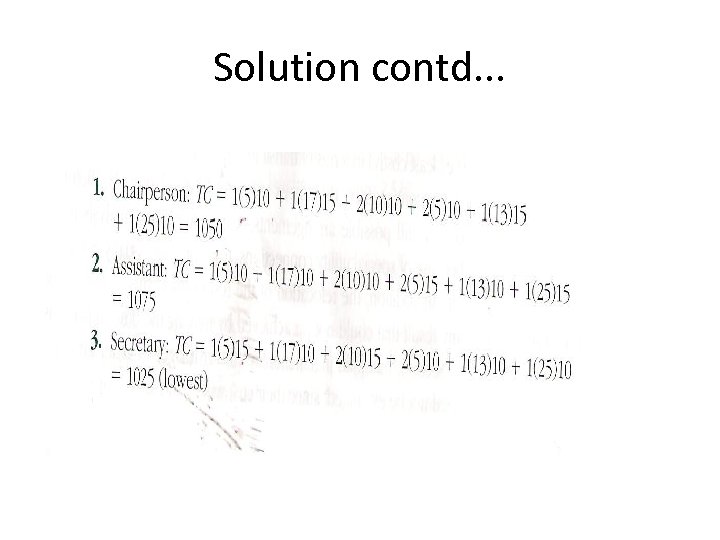
 Solution • Now, let us evaluate each of the three possibilities as the “diagonal office” – first the chairperson, then the assistant, and last the secretary. The costs will simply be denoted as 1 for the assistant and the secretary or 2 for the chairperson (who earns twice as much as the others). As noted, the Vij “volumes” will be the number of trips from I to J taken from the load matrix, and the distances will depend on who has the diagonal office across the restrooms. The calculations for each arrangement are shown below:
 Solution contd. . .
 Solution Analysis • To better understand these calculations, consider the current arrangement in which the chair has the office diagonal to the restrooms. In this case, the assistant must travel 305 m each day, as each day the chair would have to travel 150 m (10 m*10 trips to the assistant) + (10 m*5 trips to the secretary). Finally, the secretary would have to travel 445 m each day (15 m*13 trips to the assistant) + (10 m*25 trips to the chair). Because the chair is paid twice as much as the secretary and the assistant, we weight the chair’s travel distance as twice that of the other two workers. Using this weighting scheme provides a total cost of the current office arrangement of 1050: that is 305 + (2*150) + 445. The best arrangement is to put the secretary in the office diagonal to the restrooms for a relative cost of 1025.
 Selecting transformation system – summary