 Скачать презентацию PRODUCTION POSSIBILITIES PRACTICE Graph the following Possibilities T-Shirts
9484de934db711735634e6649f438eed.ppt
- Количество слайдов: 28



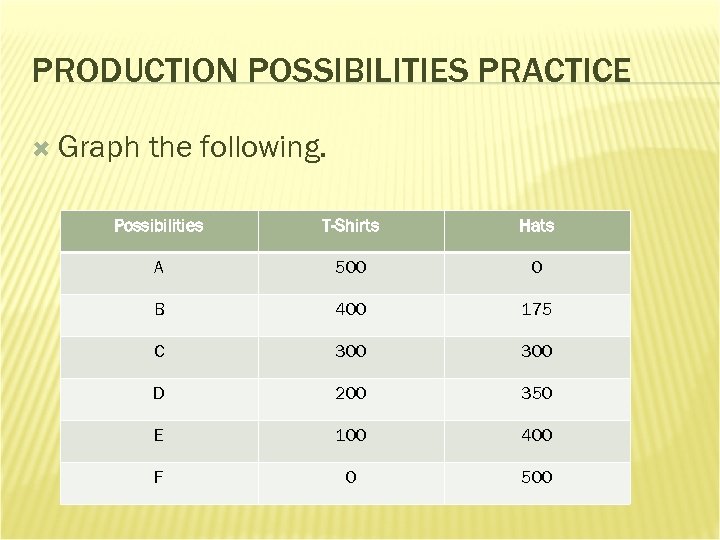
PRODUCTION POSSIBILITIES PRACTICE Graph the following. Possibilities T-Shirts Hats A 500 0 B 400 175 C 300 D 200 350 E 100 400 F 0 500
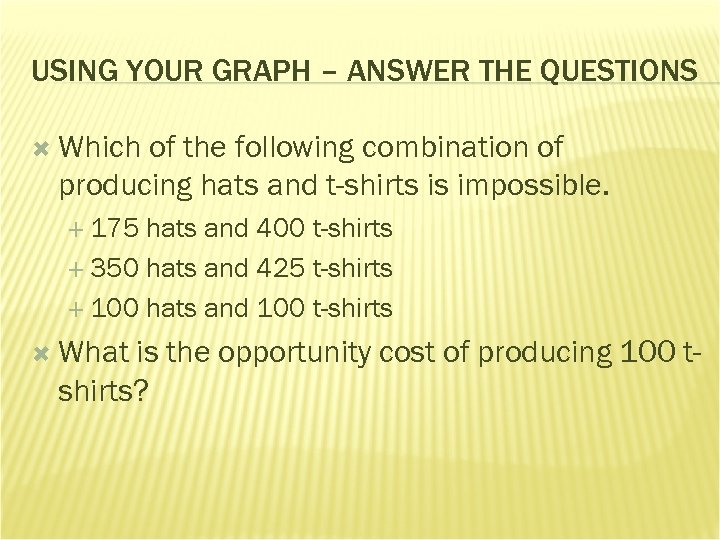
USING YOUR GRAPH – ANSWER THE QUESTIONS Which of the following combination of producing hats and t-shirts is impossible. 175 hats and 400 t-shirts 350 hats and 425 t-shirts 100 hats and 100 t-shirts What is the opportunity cost of producing 100 tshirts?
Economic Systems and the American System ECONOMIC PERSPECTIVES - CHAPTER 2
Section 1 ECONOMIC SYSTEMS
MAIN IDEA: All economic systems face the same basic questions. But first… What is an economic system? The way in which a nation uses its resources to satisfy its people’s needs and wants
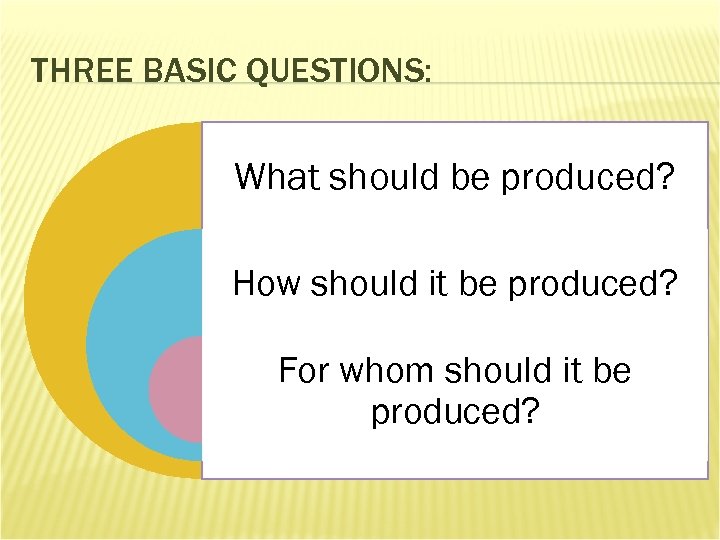
THREE BASIC QUESTIONS: What should be produced? How should it be produced? For whom should it be produced?
MAIN IDEA: ECONOMIC DECISIONS ALWAYS HAVE COSTS Trade-off: sacrificing one good or service to purchase or produce another Example: if you choose to buy an i. Pod, you are exchanging your income for the right to own the i. Pod. The Cost of Trade-Offs Opportunity Cost: the value of the next best alternative given up for the alternative that was chosen
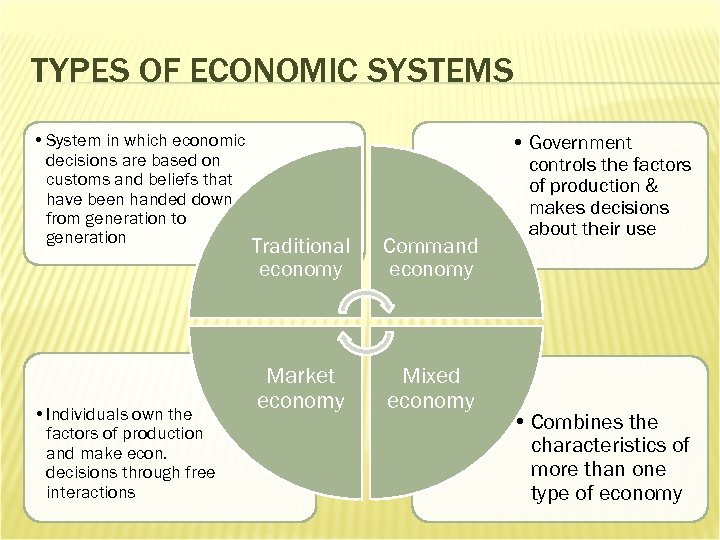
TYPES OF ECONOMIC SYSTEMS • System in which economic decisions are based on customs and beliefs that have been handed down from generation to generation Traditional economy • Individuals own the factors of production and make econ. decisions through free interactions Command economy Market economy Mixed economy • Government controls the factors of production & makes decisions about their use • Combines the characteristics of more than one type of economy
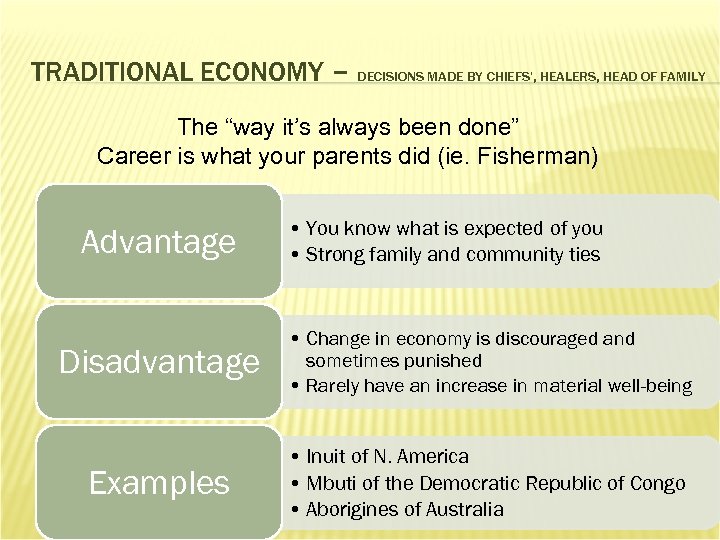
TRADITIONAL ECONOMY – DECISIONS MADE BY CHIEFS', HEALERS, HEAD OF FAMILY The “way it’s always been done” Career is what your parents did (ie. Fisherman) Advantage • You know what is expected of you • Strong family and community ties Disadvantage • Change in economy is discouraged and sometimes punished • Rarely have an increase in material well-being Examples • Inuit of N. America • Mbuti of the Democratic Republic of Congo • Aborigines of Australia
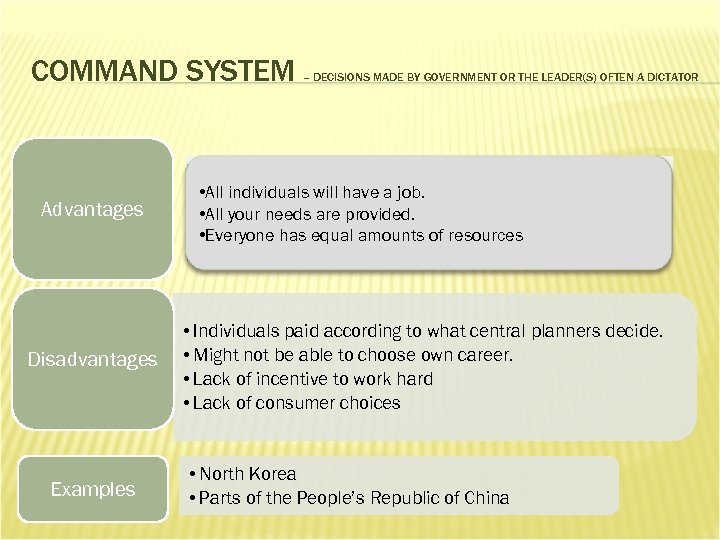
COMMAND SYSTEM Advantages Disadvantages Examples – DECISIONS MADE BY GOVERNMENT OR THE LEADER(S) OFTEN A DICTATOR • All individuals will have a job. • All your needs are provided. • Everyone has equal amounts of resources • Individuals paid according to what central planners decide. • Might not be able to choose own career. • Lack of incentive to work hard • Lack of consumer choices • North Korea • Parts of the People’s Republic of China
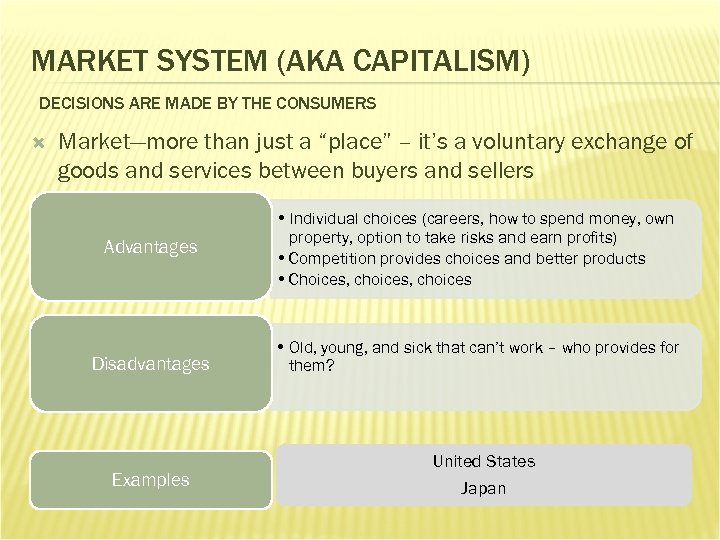
MARKET SYSTEM (AKA CAPITALISM) DECISIONS ARE MADE BY THE CONSUMERS Market—more than just a “place” – it’s a voluntary exchange of goods and services between buyers and sellers Advantages • Individual choices (careers, how to spend money, own property, option to take risks and earn profits) • Competition provides choices and better products • Choices, choices Disadvantages • Old, young, and sick that can’t work – who provides for them? Examples United States Japan
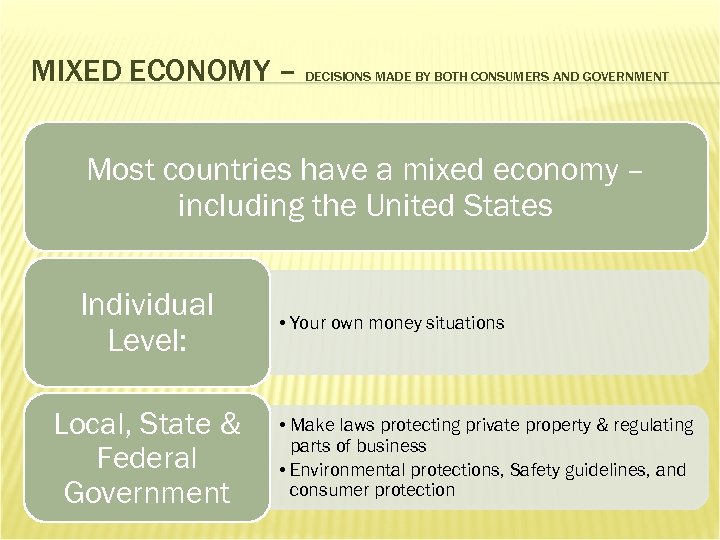
MIXED ECONOMY – DECISIONS MADE BY BOTH CONSUMERS AND GOVERNMENT Most countries have a mixed economy – including the United States Individual Level: Local, State & Federal Government • Your own money situations • Make laws protecting private property & regulating parts of business • Environmental protections, Safety guidelines, and consumer protection

BELL RINGER #4 1. 2. 3. What type of Economic system does the United States follow most closely to? Give an example of a country that is primarily a command economy. Who controls the factors of production in a market economy?
You will be divided into groups. Remember your number. SCARCITY ACTIVITY
BELL RINGER #8 1. 2. 3. What type of Economic system does the United States lean most closely to? Give an example of a country that is primarily a command economy. Who controls the factors of production in a market economy?
SCENARIO Follow Along as I read the handout allowed. Be sure to take notes about any added information that I give you. You will have about 10 – 15 minutes to develop a specific plan for your groups survival. All 3 questions must be answered in great detail. Each item should be used within the plan!!!
DISCUSSION • Be able to answer the following once you hear everyone’s plan: – – – What were some trade offs you made? Were everyone in the groups wants and needs satisfied equally? How? Were there any problems or things you forgot to do that may have hindered your survival? What shortages did you have? How did you overcome those shortages?
CIRCULAR FLOW OF INCOME AND OUTPUT Charts in Motion http: //glencoe. com/sites/common_assets/socialstudies/in_motion_08/ett/Figure 2 -2. swf
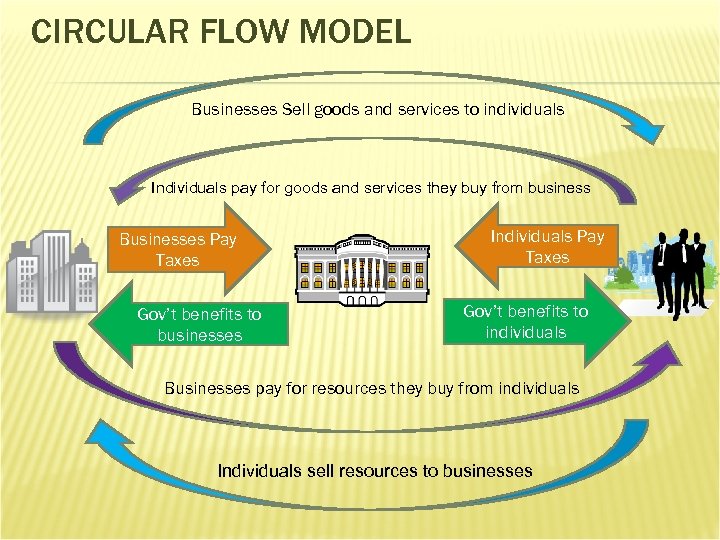
CIRCULAR FLOW MODEL Businesses Sell goods and services to individuals Individuals pay for goods and services they buy from business Businesses Pay Taxes Gov’t benefits to businesses Individuals Pay Taxes Gov’t benefits to individuals Businesses pay for resources they buy from individuals Individuals sell resources to businesses
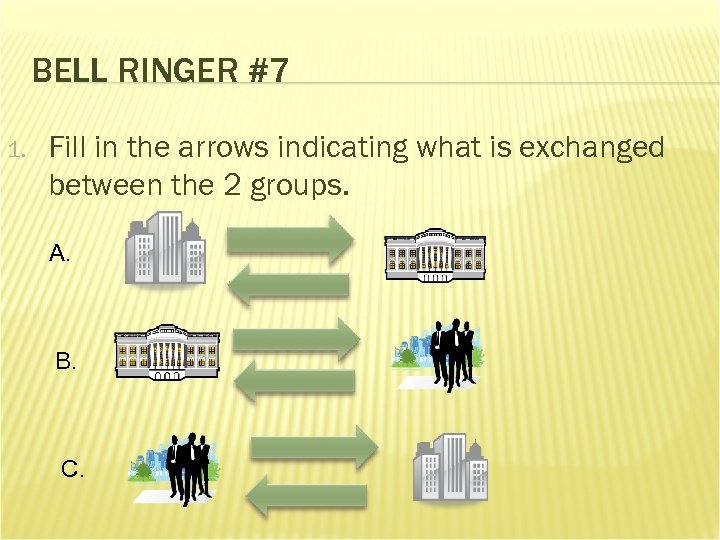
BELL RINGER #7 1. Fill in the arrows indicating what is exchanged between the 2 groups. A. B. C.
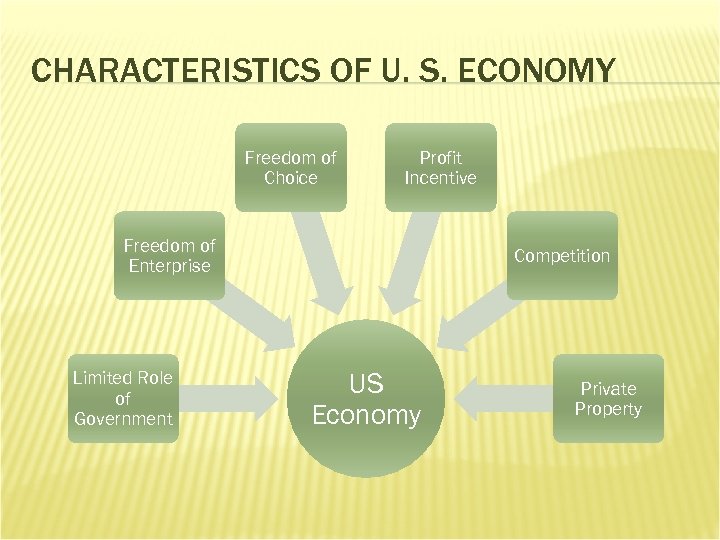
CHARACTERISTICS OF U. S. ECONOMY Freedom of Choice Profit Incentive Freedom of Enterprise Limited Role of Government Competition US Economy Private Property
LIMITED ROLE OF GOVERNMENT Governmental Role has increased since 1880’s in the U. S. Often called “Laissez Faire” when pure capitalism exists which means let them do as they choose in French Includes regulations, laws and taxation
FREEDOM OF ENTERPRISE You are allowed to own your own business You are able to earn a profit or lose everything You must still follow government guidelines and regulations Name 5 businesses in Lincoln that are privately owned.
FREEDOM OF CHOICE Buyers make the decisions about what should be produced Government has little say in what is produced Think of something you have purchased that you did not like. Did you ever purchase that item again? Have you ever wanted to purchase something but could no longer find the product? What was it?
PROFIT INCENTIVE Profit is what is left when all of the businesses costs have been paid If profits are not realized the business will fail Can you think of two or three similar products sold by different companies that have the same or similar prices?
COMPETITION Profits encourage others to be competitive Competition leads to efficient use of resources Name a product that has a lot of competition. Name a product that has little or no competition.
PRIVATE PROPERTY Allows individuals to own property Protected by the Constitution Make a list of 5 items that you own. Which of these items could be used to generate wealth?
FOR EACH EXAMPLE CHOOSE WHICH CHARACTERISTIC OF A MARKET ECONOMY IT DESCRIBES 1. 2. 3. 4. 5. 6. Horatio has purchased a new car. He wants to use it to deliver pizzas while he works. In my neighborhood, we have a Hy-Vee grocery store and a Russ’s IGA. Cindy has decided to open her own coffee house near the community college. Hank runs a taco stand downtown during lunch. He earns about $200 per day. He would like to make even more money and is thinking about opening another stand near the mall. Buster has been told by the health inspector that he and his employees must wear gloves and hair nets when serving ice cream at his business or they will be shut down. Vanessa was going to go to Subway for lunch today instead she decided to go to Taco Inn because they were having a sale on Taco’s.
Скачать презентацию PRODUCTION POSSIBILITIES PRACTICE Graph the following Possibilities T-Shirts
9484de934db711735634e6649f438eed.ppt