


 Скачать презентацию Production Costs Goal To make sense of
b0c858c4899f188da6dcf6c3775dc28a.ppt
- Количество слайдов: 16
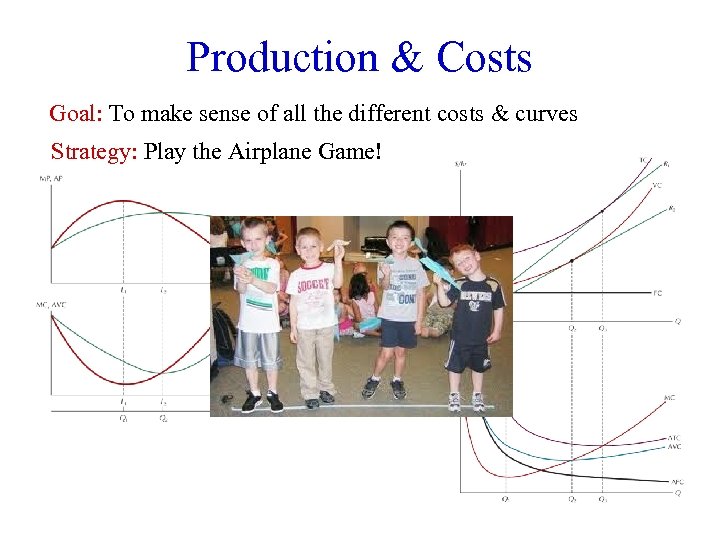 Production & Costs Goal: To make sense of all the different costs & curves Strategy: Play the Airplane Game!
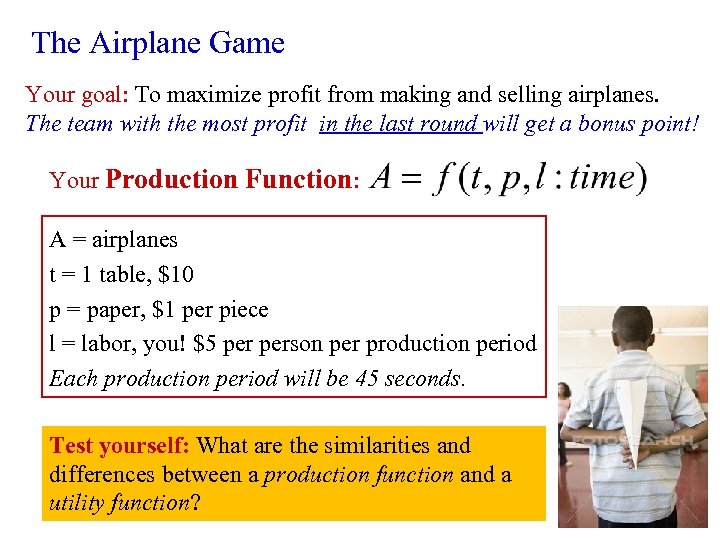 The Airplane Game Your goal: To maximize profit from making and selling airplanes. The team with the most profit in the last round will get a bonus point! Your Production Function: A = airplanes t = 1 table, $10 p = paper, $1 per piece l = labor, you! $5 person per production period Each production period will be 45 seconds. Test yourself: What are the similarities and differences between a production function and a utility function?
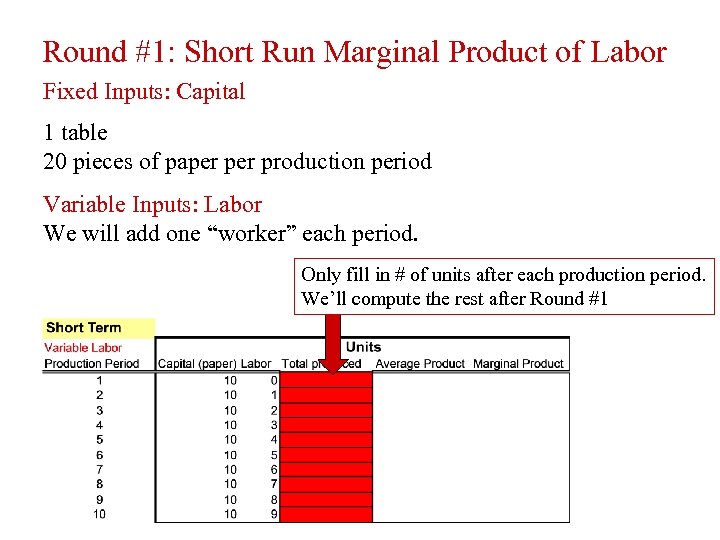 Round #1: Short Run Marginal Product of Labor Fixed Inputs: Capital 1 table 20 pieces of paper production period Variable Inputs: Labor We will add one “worker” each period. Only fill in # of units after each production period. We’ll compute the rest after Round #1
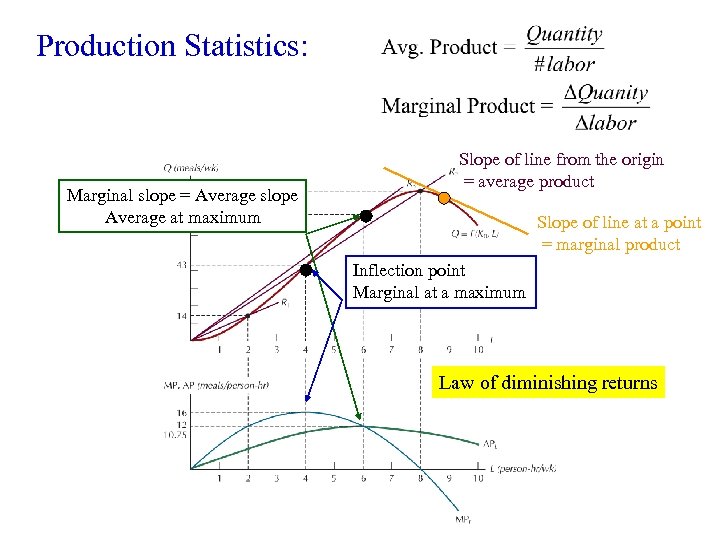 Production Statistics: Marginal slope = Average slope Average at maximum Slope of line from the origin = average product Slope of line at a point = marginal product Inflection point Marginal at a maximum Law of diminishing returns
 Key Question: If you owned all of the facilities, should you re-allocate labor to maximize total output? Key Point: allocate resources to the highest marginal product! Key Question: When should you hire more labor? Should you pay the value of the Average or Marginal Product? If MP > 0 then hire more if the price is right REMEMBER: MC = MB=Price!. If MP < AP you want to pay MP but worker wants AP!
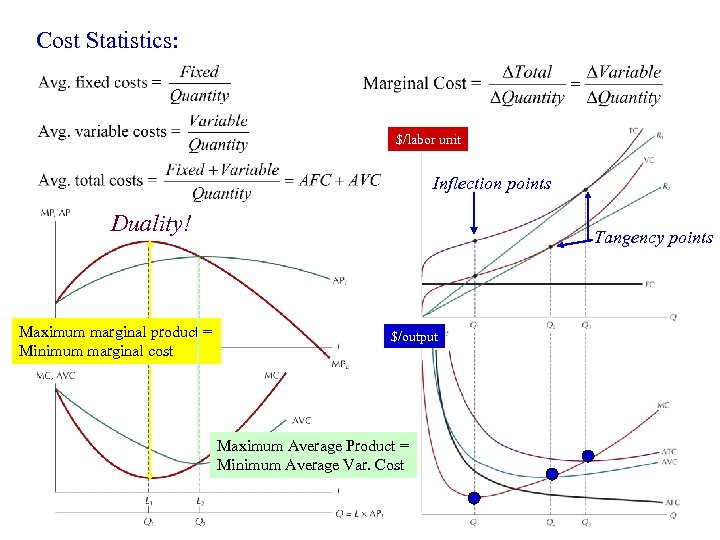 Cost Statistics: $/labor unit Inflection points Duality! Maximum marginal product = Minimum marginal cost Tangency points $/output Maximum Average Product = Minimum Average Var. Cost
 Key Question: If you owned all of the facilities, should you re-allocate labor to minimize the total cost of producing X# of planes? Key Point: allocate resources so that the marginal costs are equal! Key Question: In the short run (e. g. fixed costs are sunk) what is the minimum you should charge for the Xth plane? Marginal cost = marginal benefit Charge marginal cost even if it is less than average variable cost! In the short run, if you have to charge the same amount for all planes, how much should you charge for X planes? Average variable cost
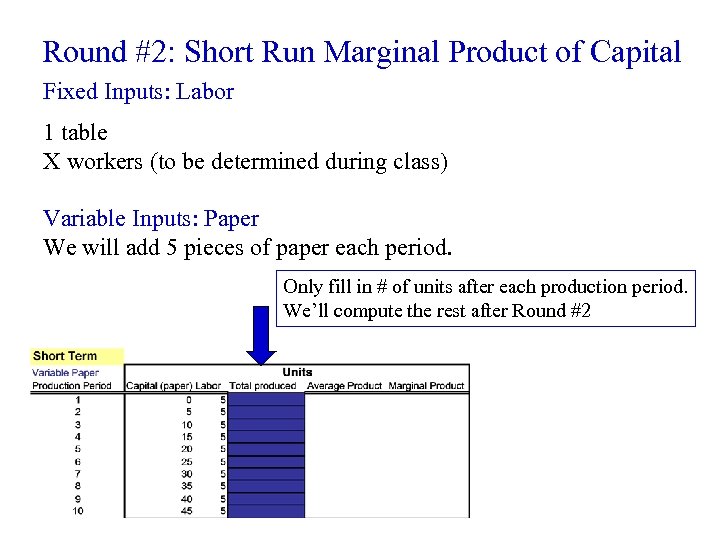 Round #2: Short Run Marginal Product of Capital Fixed Inputs: Labor 1 table X workers (to be determined during class) Variable Inputs: Paper We will add 5 pieces of paper each period. Only fill in # of units after each production period. We’ll compute the rest after Round #2
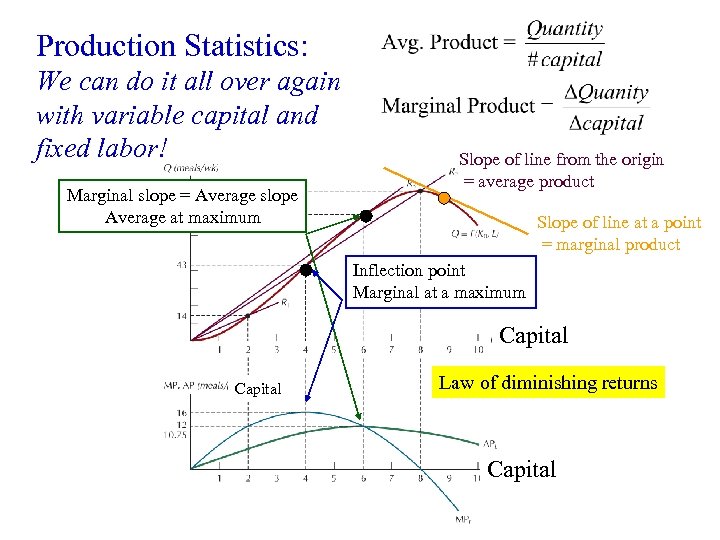 Production Statistics: We can do it all over again with variable capital and fixed labor! Marginal slope = Average slope Average at maximum Slope of line from the origin = average product Slope of line at a point = marginal product Inflection point Marginal at a maximum Capital Law of diminishing returns Capital
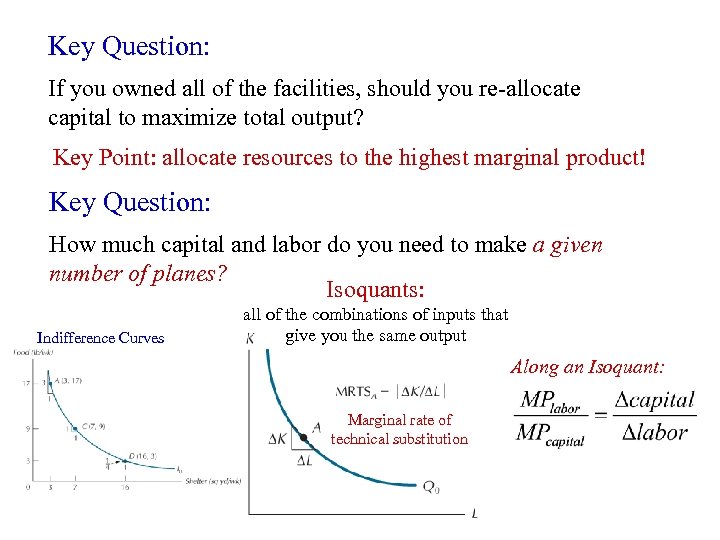 Key Question: If you owned all of the facilities, should you re-allocate capital to maximize total output? Key Point: allocate resources to the highest marginal product! Key Question: How much capital and labor do you need to make a given number of planes? Isoquants: Indifference Curves all of the combinations of inputs that give you the same output Along an Isoquant: Marginal rate of technical substitution
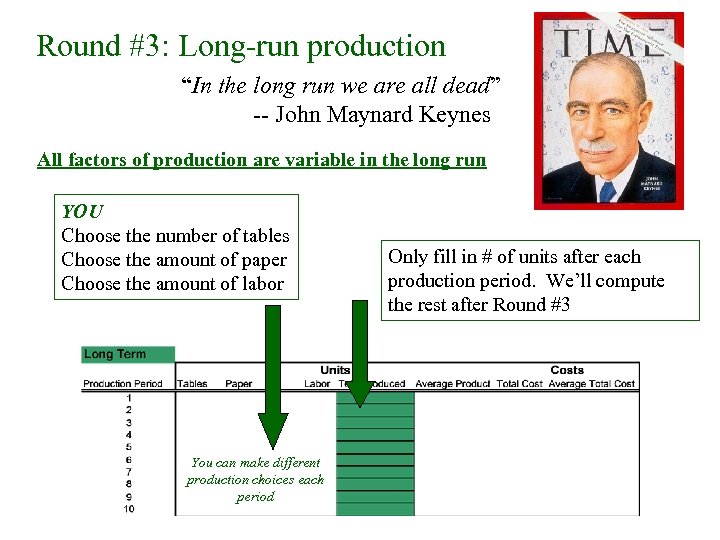 Round #3: Long-run production “In the long run we are all dead” -- John Maynard Keynes All factors of production are variable in the long run YOU Choose the number of tables Choose the amount of paper Choose the amount of labor You can make different production choices each period Only fill in # of units after each production period. We’ll compute the rest after Round #3
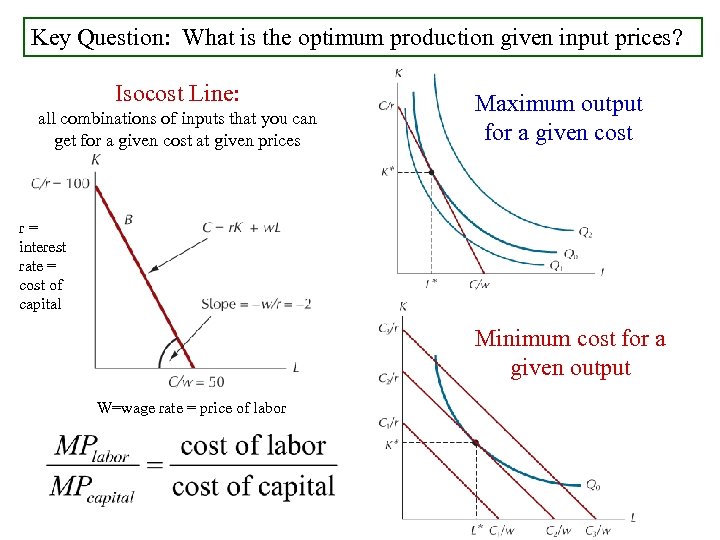 Key Question: What is the optimum production given input prices? Isocost Line: all combinations of inputs that you can get for a given cost at given prices Maximum output for a given cost r= interest rate = cost of capital Minimum cost for a given output W=wage rate = price of labor
 What is a KEY difference between CONSUMER & PRODUCER theory? No finite budget constraint…NO SLUTSKY!
 Round #4: Bonus Point Round YOU determine how big your factory is (how many tables) YOU determine how much raw materials (paper) to buy YOU determine how much labor (fixed labor rate!) YOU determine the PRICE to sell your planes. I will purchase X units of acceptable quality starting with the lowest price (fixed market size). The team with the most profit gets the point – good luck!
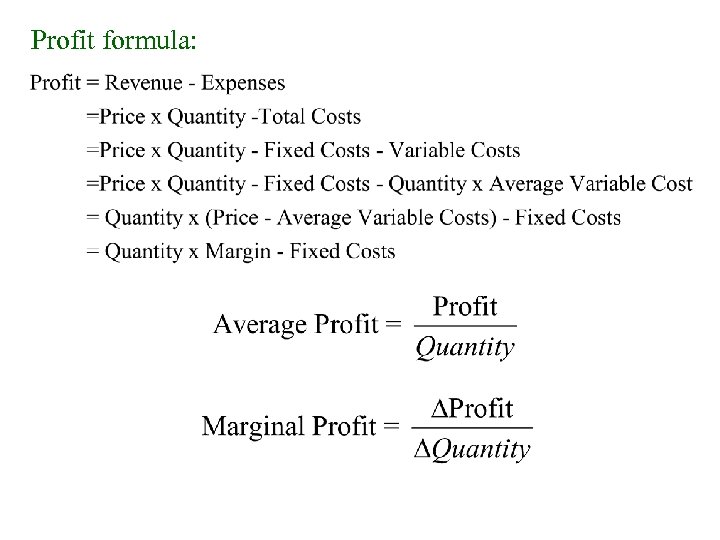 Profit formula:
 That was fun but… what should I remember about the Airplane Game? 1. The ratios and graphs tell a story about the production technology. 2. The answer is where marginal cost = marginal benefit. 3. Allocate resources between labor and capital to equalize marginal products per dollar of cost. 4. In the long term all inputs are variable. 5. You can’t say anything about “optimal” without knowing market prices which means knowing your customers!