 Скачать презентацию Production compactly Susanne Tochtermann-Wenzel 2008 Bases
4d513d6db88c59399c4ca051bb4714ab.ppt
- Количество слайдов: 46



Production compactly © Susanne Tochtermann-Wenzel 2008
Bases of the book design/ typografy • typography und design as communication • check list for design • Typsetting and page make-up • Assumption of supplied author data • Usual typsetting programs © Susanne Tochtermann-Wenzel 2008
Typography and design as communication Read kinds • Linear reading A goal: „serving typography“, which does not disturb during reading • Informing reading A goal: as clearly as possible • Differentiating reading A goal: as unequivocal as possible • Selecting reading A goal: as distinctly as possible • Consulting reading A goal: as distinctly as necesssary © Susanne Tochtermann-Wenzel 2008
Check list • • • contents? function? target group? / aim? Book and read type? market defaults/ Corporate Design defaults? budget? Time situation? Layout/ design • • typesetting Proportions Picture/ text integration Employment of grafic means Employment of color paper binding © Susanne Tochtermann-Wenzel 2008
Typesetting and page make-up Preliminary stage processes realign themselves • . . . the material supplied by the author • . . . agreed upon cooperation with the author • . . . number of titles, which flow over a certain standard • . . . the calculatory framework of the product • . . . the claim of quality of the publishing house • . . . the strategic goals (e. g. data multipe use) © Susanne Tochtermann-Wenzel 2008
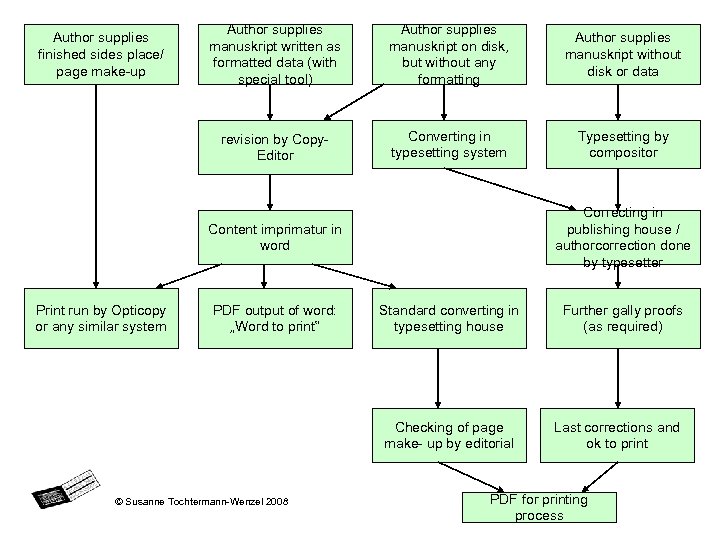
Author supplies manuskript written as formatted data (with special tool) Author supplies manuskript on disk, but without any formatting Author supplies manuskript without disk or data revision by Copy. Editor Author supplies finished sides place/ page make-up Converting in typesetting system Typesetting by compositor Correcting in publishing house / authorcorrection done by typesetter Content imprimatur in word Print run by Opticopy or any similar system PDF output of word: „Word to print“ Standard converting in typesetting house Checking of page make- up by editorial © Susanne Tochtermann-Wenzel 2008 Further gally proofs (as required) Last corrections and ok to print PDF for printing process
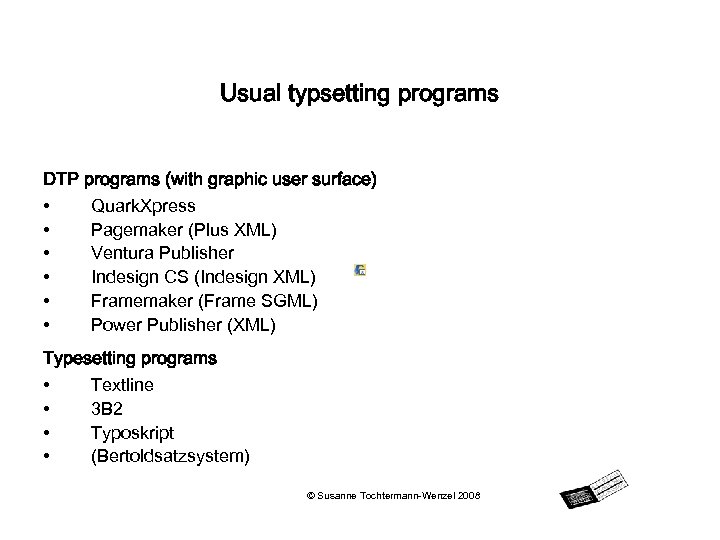
Usual typsetting programs DTP programs (with graphic user surface) • Quark. Xpress • Pagemaker (Plus XML) • Ventura Publisher • Indesign CS (Indesign XML) • Framemaker (Frame SGML) • Power Publisher (XML) Typesetting programs • Textline • 3 B 2 • Typoskript • (Bertoldsatzsystem) © Susanne Tochtermann-Wenzel 2008
Offset printing • Basic principle of offset printing • Schematic representation • Evaluation of printing quality • CTF/CTP • Digital printing © Susanne Tochtermann-Wenzel 2008
Basic principle of offset printing • • Printing and non-printing places (of the printing plate) are on one level Offset printing is based on the repulsion of fat and water Nonprinting places are moistened with water in the damping unit printing places are able to take up greased color Impact: the color will be transfered from the printing plate to a rubber blanket. From there it will print indirectly on the paper Because of this offset printing is called a „indirectly printing process“ We have to distinct in sheet fed offset and rotary offset (dependet on the print run) © Susanne Tochtermann-Wenzel 2008
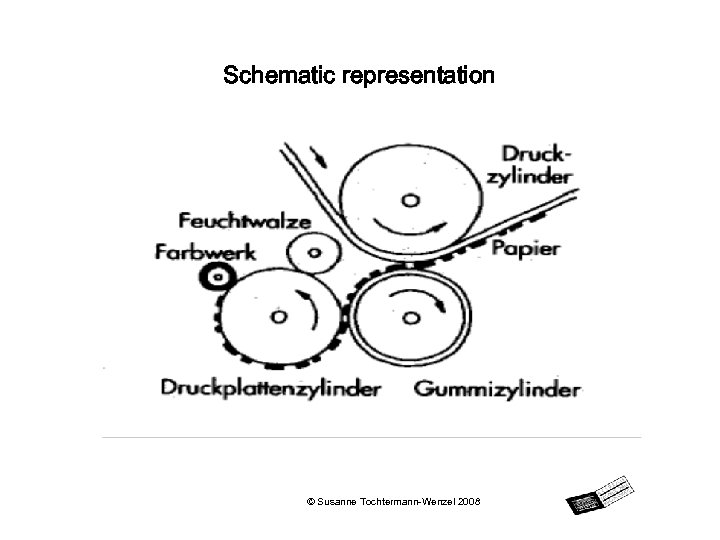
Schematic representation © Susanne Tochtermann-Wenzel 2008
The evaluation of printing quality Black-white printing • Correct colour matching: no letters smeared up (too much color) or to serifs thin lines broken out and/or characters look grey instead of black (too little color) • Correct halftone reproduction: halftone dots have to look good and clear on the paper. That means: no picture appears „dull and indistinct“ • Even colouring: grey value must be correct by the whole work through • Ghosting: letters get easy shade • Scumming: More easily grey veils on the whole side – reason: to small discharge © Susanne Tochtermann-Wenzel 2008
The evaluation of printing quality Colour printing • • Register accuracy: Picture appears indistinct and/or has the edges incolored „projections“ Correct colour (ink feeding): Each individual printing ink must be proportioned in the correct quantity, otherwise falsified colours result © Susanne Tochtermann-Wenzel 2008
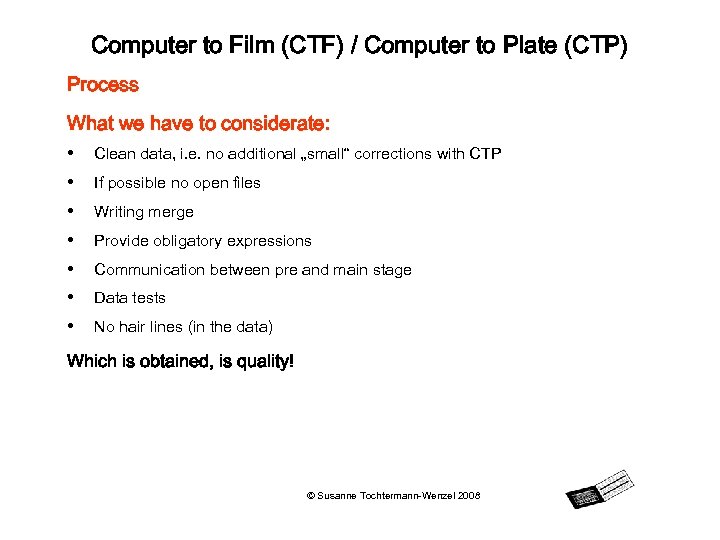
Computer to Film (CTF) / Computer to Plate (CTP) Process What we have to considerate: • Clean data, i. e. no additional „small“ corrections with CTP • If possible no open files • Writing merge • Provide obligatory expressions • Communication between pre and main stage • Data tests • No hair lines (in the data) Which is obtained, is quality! © Susanne Tochtermann-Wenzel 2008
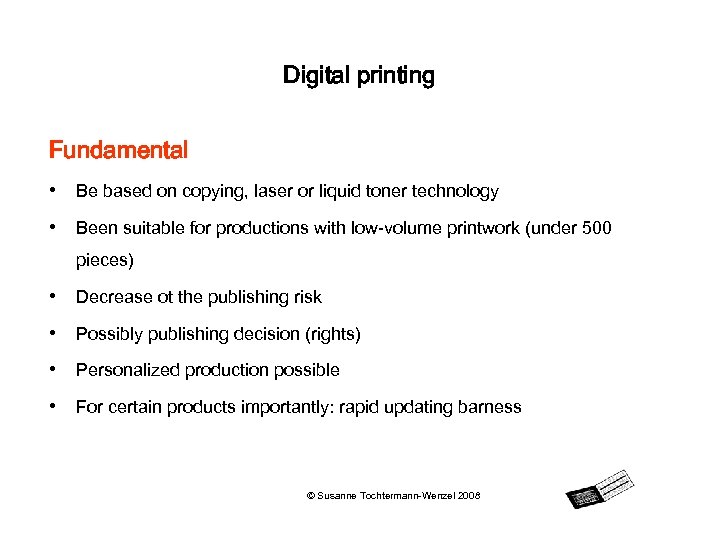
Digital printing Fundamental • Be based on copying, laser or liquid toner technology • Been suitable for productions with low-volume printwork (under 500 pieces) • Decrease ot the publishing risk • Possibly publishing decision (rights) • Personalized production possible • For certain products importantly: rapid updating barness © Susanne Tochtermann-Wenzel 2008
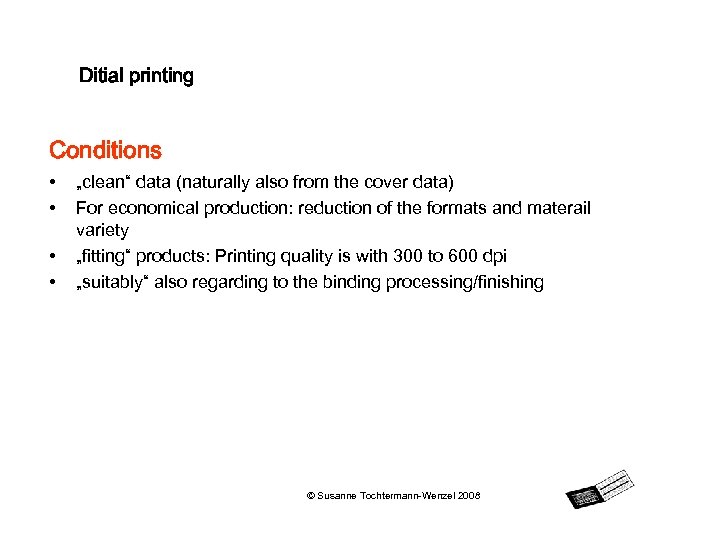
Ditial printing Conditions • • „clean“ data (naturally also from the cover data) For economical production: reduction of the formats and materail variety „fitting“ products: Printing quality is with 300 to 600 dpi „suitably“ also regarding to the binding processing/finishing © Susanne Tochtermann-Wenzel 2008
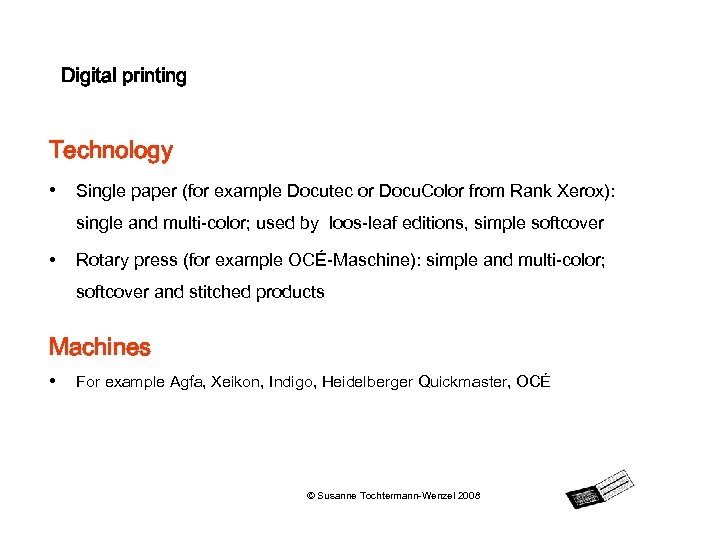
Digital printing Technology • Single paper (for example Docutec or Docu. Color from Rank Xerox): single and multi-color; used by loos-leaf editions, simple softcover • Rotary press (for example OCÉ-Maschine): simple and multi-color; softcover and stitched products Machines • For example Agfa, Xeikon, Indigo, Heidelberger Quickmaster, OCÉ © Susanne Tochtermann-Wenzel 2008
Finishing • Binding methods • covers • Process steps • Complaint reasons © Susanne Tochtermann-Wenzel 2008
Four large groups of binding methods • Thread-stitching/thread-sealin • Adhesive binding - dispersion - PUR - Hotmelt • Wire-stitching • loos-leaf edition © Susanne Tochtermann-Wenzel 2008
Difference of binding styles • Hardcover • softcover Process-steps The representation of the individual production steps, which are necessary during the binding prodessing, see next side (on the basis of sheet fed offset) © Susanne Tochtermann-Wenzel 2008
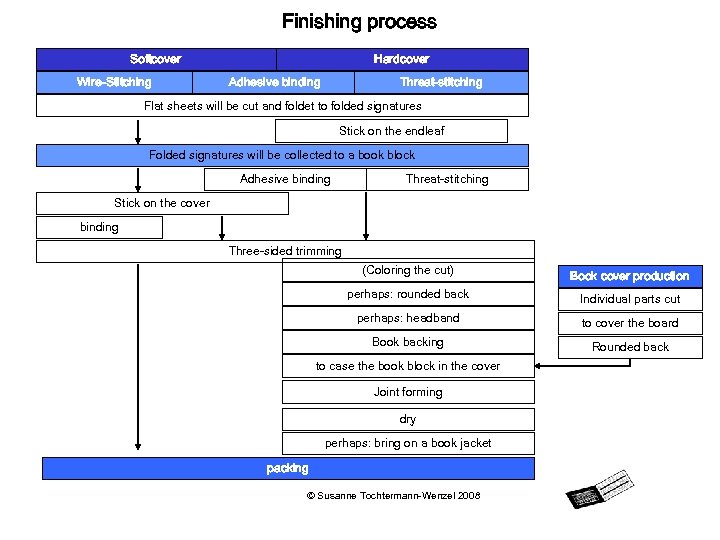
Finishing process Softcover Wire-Stitching Hardcover Adhesive binding Threat-stitching Flat sheets will be cut and foldet to folded signatures Stick on the endleaf Folded signatures will be collected to a book block Adhesive binding Threat-stitching Stick on the cover binding Three-sided trimming (Coloring the cut) Book cover production perhaps: rounded back Individual parts cut perhaps: headband to cover the board Book backing Rounded back to case the book block in the cover Joint forming dry perhaps: bring on a book jacket packing © Susanne Tochtermann-Wenzel 2008
Product planing/ product management • Product management • „the magical triangle“: date, cost, quality • obligatory planing I und II • Quality assurance I und II © Susanne Tochtermann-Wenzel 2008
Product management Components of the product management • Manufacture/ production knowledge • Clear objective • Clear division of responsibility • Good communication • Obligatory planning © Susanne Tochtermann-Wenzel 2008
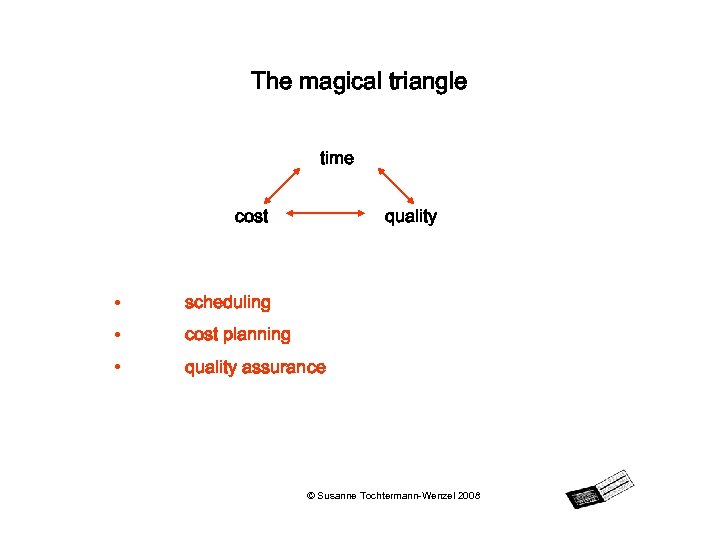
The magical triangle time cost quality • scheduling • cost planning • quality assurance © Susanne Tochtermann-Wenzel 2008
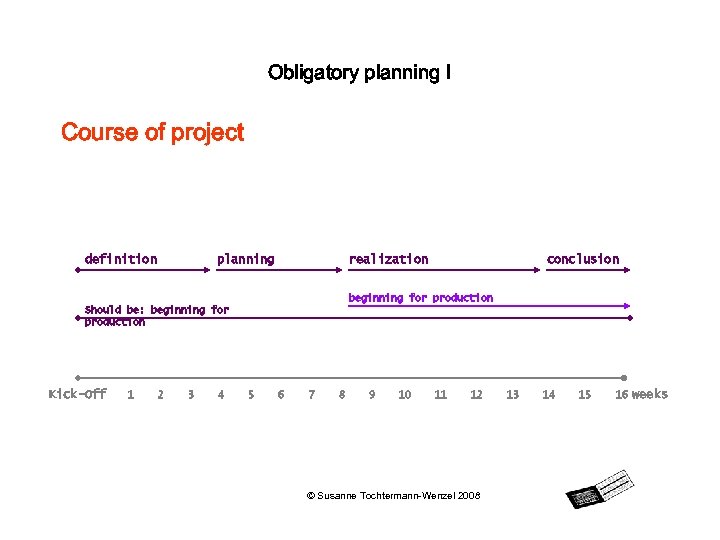
Obligatory planning I Course of project definition planning realization conclusion beginning for production Should be: beginning for production Kick-Off 1 2 3 4 5 6 7 8 9 10 11 12 © Susanne Tochtermann-Wenzel 2008 13 14 15 16 weeks
Obligatory planning II § Scheduling § Resource planning § Cost planning § Quality assurance © Susanne Tochtermann-Wenzel 2008
Quality assurance I Criteria § Smooth operational sequence § Reach the desired product equipment § Keeping of the adopted budget § Appearance in time Possible sources of error § Unrealistic planning § Deviation from planning § Unclear authority (internal) § Missing information to the product § Bad manuscript condition § Problematic product equipment § Unreliable suppliers © Susanne Tochtermann-Wenzel 2008
Quality assurance II measures of the prevention Organizational § Definition of the product equipment with program planner § Provide a flow diagram § buffers take into account § Information flow guarantee § Constant comparison target/ actual data § Regular examination of the course of the project Technical § Author guidelines and quidelines for data structure § Arrangement of first tests § Selection of competent suppliers © Susanne Tochtermann-Wenzel 2008
Costs/ calculation and costs-controlling • calculation – costs-controlling during the production/calculation • Manufacturing calculation/ marginal costing • Concepts/wording of calculation • Structure of offer concerning manufacturing costs • How can I reduce/avoid costs before? © Susanne Tochtermann-Wenzel 2008
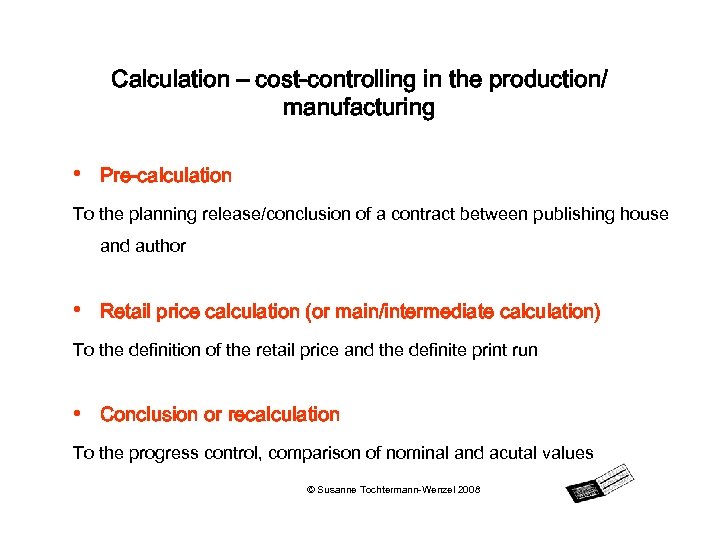
Calculation – cost-controlling in the production/ manufacturing • Pre-calculation To the planning release/conclusion of a contract between publishing house and author • Retail price calculation (or main/intermediate calculation) To the definition of the retail price and the definite print run • Conclusion or recalculation To the progress control, comparison of nominal and acutal values © Susanne Tochtermann-Wenzel 2008
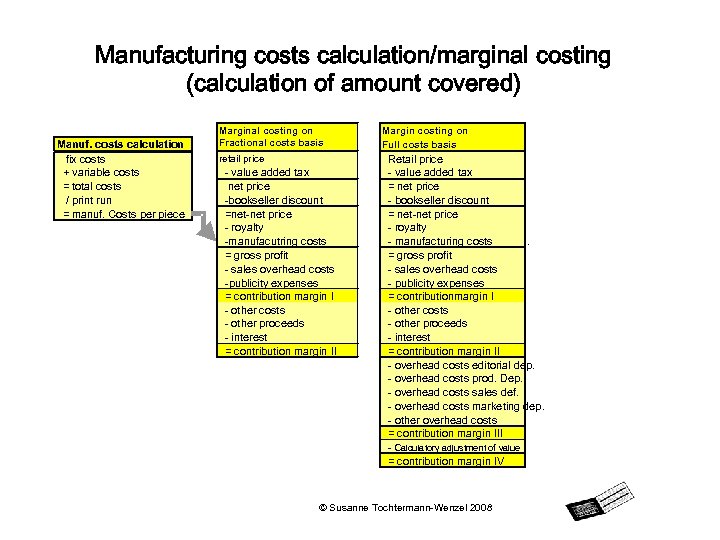
Manufacturing costs calculation/marginal costing (calculation of amount covered) Manuf. costs calculation fix costs + variable costs = total costs / print run = manuf. Costs per piece Marginal costing on Fractional costs basis retail price - value added tax net price -bookseller discount =net-net price - royalty -manufacutring costs = gross profit - sales overhead costs -publicity expenses = contribution margin I - other costs - other proceeds - interest = contribution margin II Margin costing on Full costs basis Retail price - value added tax = net price - bookseller discount = net-net price - royalty - manufacturing costs. = gross profit - sales overhead costs - publicity expenses = contributionmargin I - other costs - other proceeds - interest = contribution margin II - overhead costs editorial dep. - overhead costs prod. Dep. . - overhead costs sales def. - overhead costs marketing dep. - other overhead costs = contribution margin III - Calculatory adjustment of value = contribution margin IV © Susanne Tochtermann-Wenzel 2008
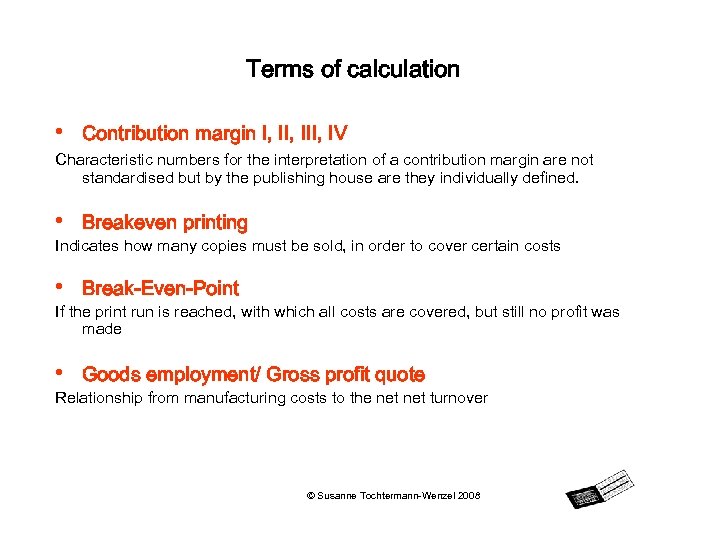
Terms of calculation • Contribution margin I, III, IV Characteristic numbers for the interpretation of a contribution margin are not standardised but by the publishing house are they individually defined. • Breakeven printing Indicates how many copies must be sold, in order to cover certain costs • Break-Even-Point If the print run is reached, with which all costs are covered, but still no profit was made • Goods employment/ Gross profit quote Relationship from manufacturing costs to the net turnover © Susanne Tochtermann-Wenzel 2008
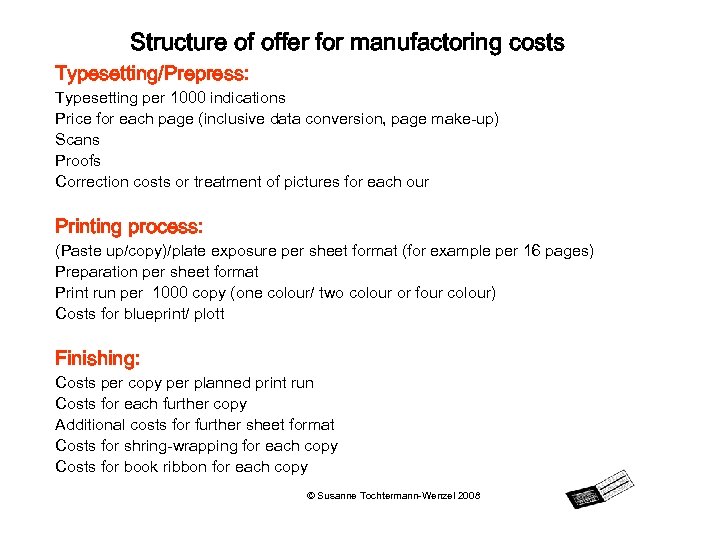
Structure of offer for manufactoring costs Typesetting/Prepress: Typesetting per 1000 indications Price for each page (inclusive data conversion, page make-up) Scans Proofs Correction costs or treatment of pictures for each our Printing process: (Paste up/copy)/plate exposure per sheet format (for example per 16 pages) Preparation per sheet format Print run per 1000 copy (one colour/ two colour or four colour) Costs for blueprint/ plott Finishing: Costs per copy per planned print run Costs for each further copy Additional costs for further sheet format Costs for shring-wrapping for each copy Costs for book ribbon for each copy © Susanne Tochtermann-Wenzel 2008
How can I avoid/ reduce costs before? • • • To provide a realistic time scedule (in knowledge for all involved ones) • Perhaps work with a author data guideline (it simplifies the conversion in the typesetting house and will reduce costs). Page references, illustration and table numberings, dynamics and so on can be generated automatically. • First clear conceptions/definition of the desired layout specify avoid Supply of clearly distinguished manuscripts (manuscript agrees with layout? ) Definition (in a first step) of employment of colour in the layout Illustrations: weighting of the illustrations clarify and relative importance specify Before manuscripte goes to the typesetter, it should be worked on the manuscript (editorialally finally) – perhaps give a list at the typesetter which termins must be corrected automated Clarification, like index production takes place – if index in the book available © Susanne Tochtermann-Wenzel 2008
How can I avoide/ reduce costs before? • • Clarifying with the typesetter, which achievemens can be taken over there automatically (e. g. automatic production of table of contents) Consideration (possibly with printing office), which figures could be economically be placed – for example color sheet How can existing colour in illustrations be used optimally for the layout? Does layout have to be really four colors? © Susanne Tochtermann-Wenzel 2008
Purchase • Standardisation • Advertisment • bundling • Skeleton agreements • Conduct of negotiations • Costs driver © Susanne Tochtermann-Wenzel 2008
Standardisation Prepress • Price list for typesetting • Price list for scanning (for difference sizes, one colour, four colour, line images, halfton images) simplified basic layout, which could be make-uped by the typesetter themself data-guideline concering the manuscript word-data (for authors) Correction costs per hour Manufacturing (page make-up completly) in word • • Standardisation of paper Format and equipment © Susanne Tochtermann-Wenzel 2008
Offer advertisement • Written advertisement • Depending upon order value at 3 to 5 suppliers • Precise product description as basis for comparability of the offers • Examination of the offers regarding advertisement text • Trading conditions © Susanne Tochtermann-Wenzel 2008
Bundling Production bundling Several titles in same equipment summarize Several covers printed together Reprint pachages with long running times as lock-ups with x% discount © Susanne Tochtermann-Wenzel 2008
Skeleton agreements Single contract Basic agreement with an order character Basic agreement over contingents (without title planning) Price list © Susanne Tochtermann-Wenzel 2008
Conduct of the negotiations Preparation of negotiation discussion • Comparability of the competition offers negotiation • Goal/estimated price • Starting points of talking about the princing Choice of the time Choice of the negotiation form Competition offerer • • name Detail costs Feasibilities Agreed upon prices (detailed) to confirm in writing leave © Susanne Tochtermann-Wenzel 2008
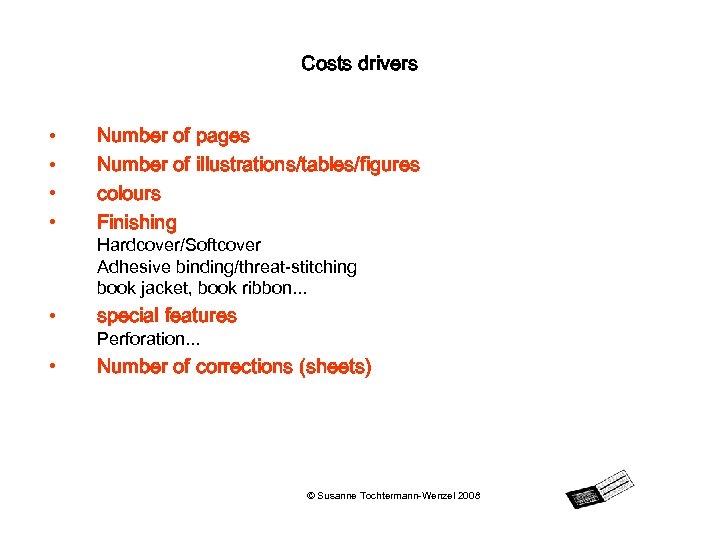
Costs drivers • • Number of pages Number of illustrations/tables/figures colours Finishing • special features • Number of corrections (sheets) Hardcover/Softcover Adhesive binding/threat-stitching book jacket, book ribbon. . . Perforation. . . © Susanne Tochtermann-Wenzel 2008
Medium neutral data retention • structured data • actions • Aged data assuption • Processing of aged datas © Susanne Tochtermann-Wenzel 2008
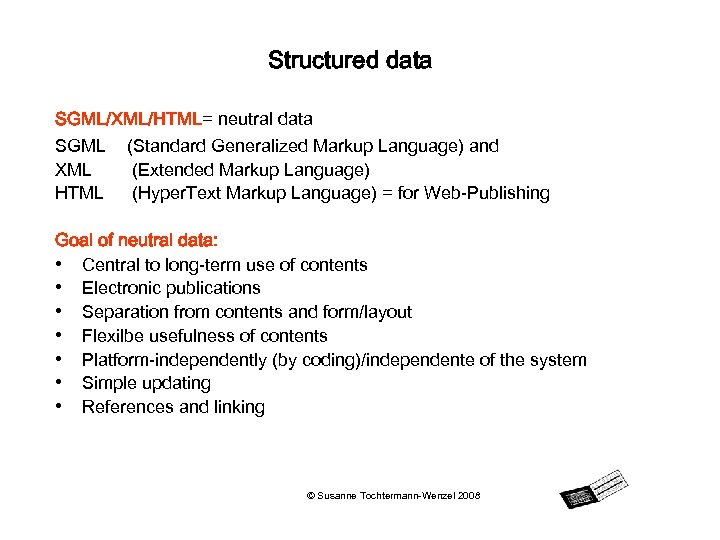
Structured data SGML/XML/HTML= neutral data SGML (Standard Generalized Markup Language) and XML (Extended Markup Language) HTML (Hyper. Text Markup Language) = for Web-Publishing Goal of neutral data: • Central to long-term use of contents • Electronic publications • Separation from contents and form/layout • Flexilbe usefulness of contents • Platform-independently (by coding)/independente of the system • Simple updating • References and linking © Susanne Tochtermann-Wenzel 2008
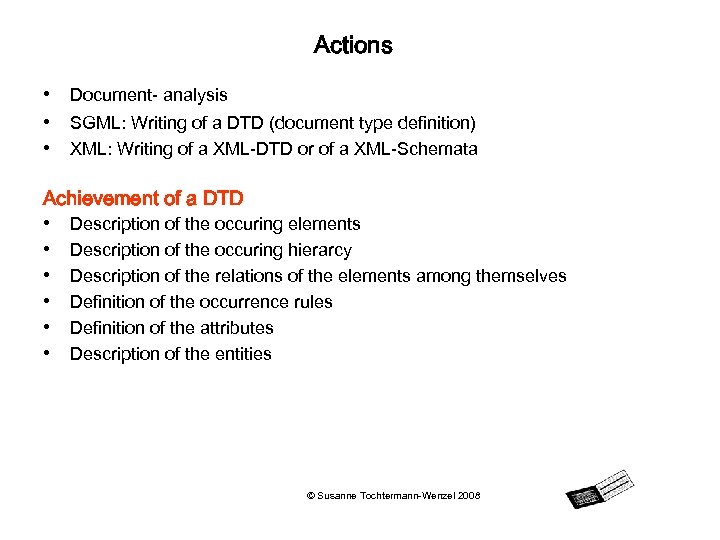
Actions • Document- analysis • SGML: Writing of a DTD (document type definition) • XML: Writing of a XML-DTD or of a XML-Schemata Achievement of a DTD • • • Description of the occuring elements Description of the occuring hierarcy Description of the relations of the elements among themselves Definition of the occurrence rules Definition of the attributes Description of the entities © Susanne Tochtermann-Wenzel 2008
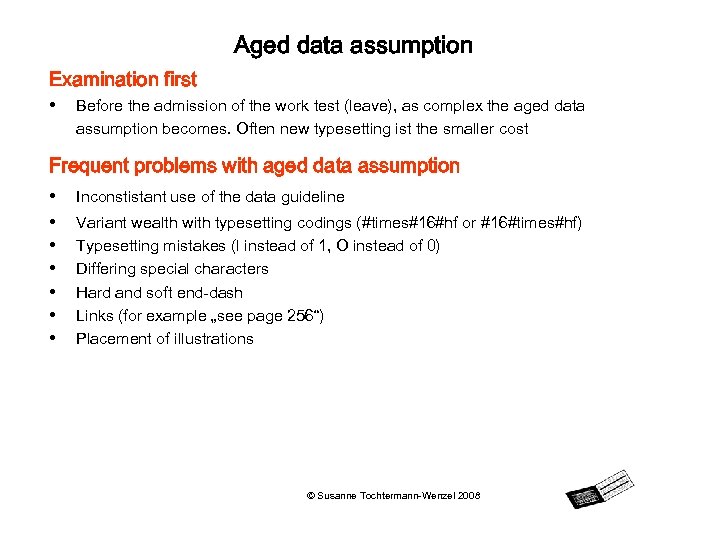
Aged data assumption Examination first • Before the admission of the work test (leave), as complex the aged data assumption becomes. Often new typesetting ist the smaller cost Frequent problems with aged data assumption • Inconstistant use of the data guideline • Variant wealth with typesetting codings (#times#16#hf or #16#times#hf) • Typesetting mistakes (l instead of 1, O instead of 0) • Differing special characters • Hard and soft end-dash • Links (for example „see page 256“) • Placement of illustrations © Susanne Tochtermann-Wenzel 2008
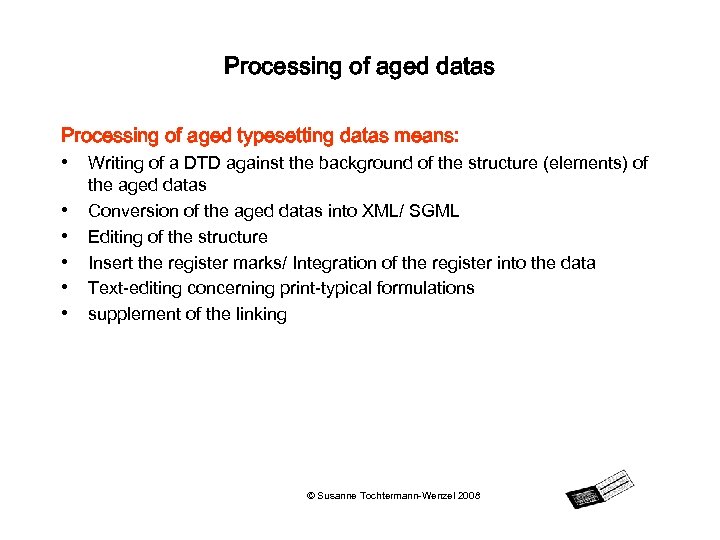
Processing of aged datas Processing of aged typesetting datas means: • Writing of a DTD against the background of the structure (elements) of • • • the aged datas Conversion of the aged datas into XML/ SGML Editing of the structure Insert the register marks/ Integration of the register into the data Text-editing concerning print-typical formulations supplement of the linking © Susanne Tochtermann-Wenzel 2008
Скачать презентацию Production compactly Susanne Tochtermann-Wenzel 2008 Bases
4d513d6db88c59399c4ca051bb4714ab.ppt