


 Скачать презентацию Production and supply chain process MIS 2101 Management
627febb8664f9a89ca8dc20738248ad8.ppt
- Количество слайдов: 25
 Production and supply chain process MIS 2101: Management Information Systems Based on material developed by C. J. Marselis
 The supply chain Recall from Part 7… In the sales process, the organization is the supplier ¢ In the purchasing process, the organization is the buyer ¢ The movement of goods from supplier to the end customer is the “supply chain” ¢ Supplier Organization Customer 2
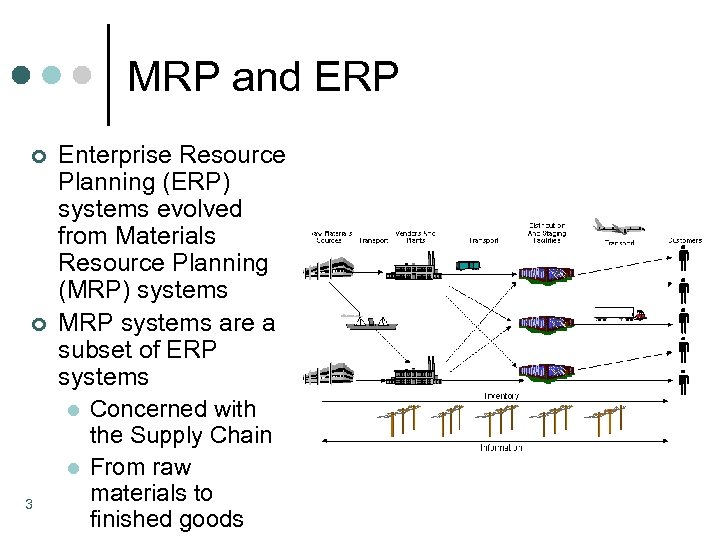 MRP and ERP ¢ ¢ 3 Enterprise Resource Planning (ERP) systems evolved from Materials Resource Planning (MRP) systems MRP systems are a subset of ERP systems l Concerned with the Supply Chain l From raw materials to finished goods
 Facilitating the production plan ¢ A production plan answers: Quantity of product to make? l When to make product? l How much raw materials to procure and when? l ¢ A successful company must be able to Develop a good production plan l Execute the plan l Make adjustments when customer demand differs from the forecast l 4
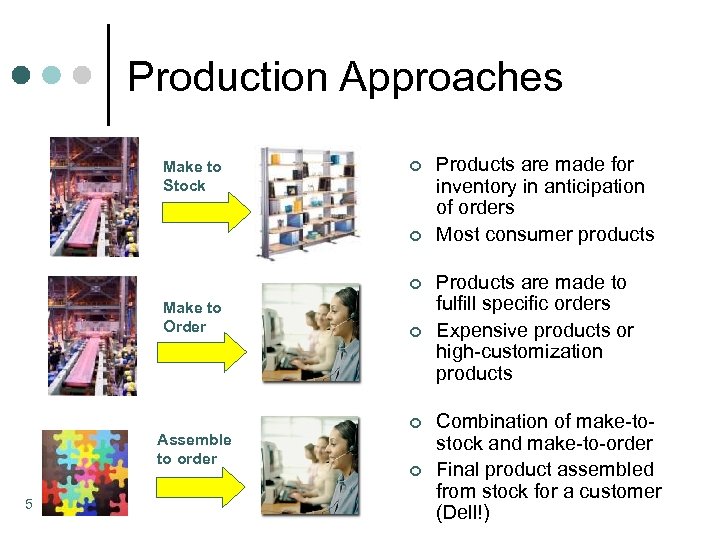 Production Approaches Make to Stock ¢ ¢ ¢ Make to Order Assemble to order 5 ¢ ¢ ¢ Products are made for inventory in anticipation of orders Most consumer products Products are made to fulfill specific orders Expensive products or high-customization products Combination of make-tostock and make-to-order Final product assembled from stock for a customer (Dell!)
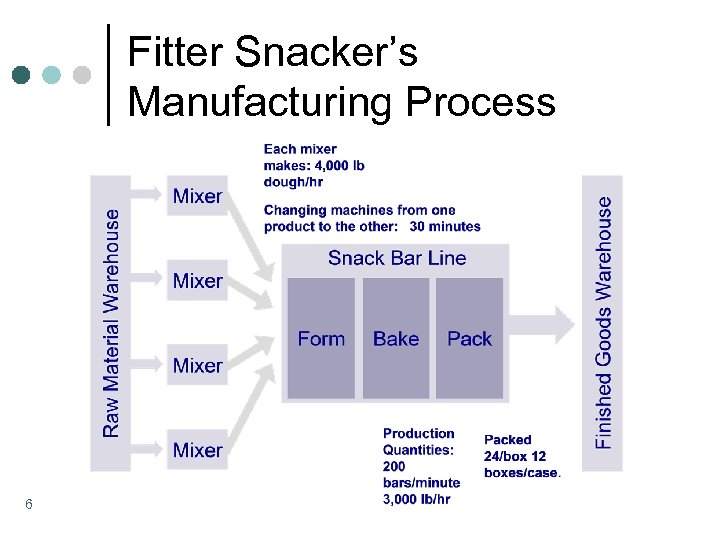 Fitter Snacker’s Manufacturing Process 6
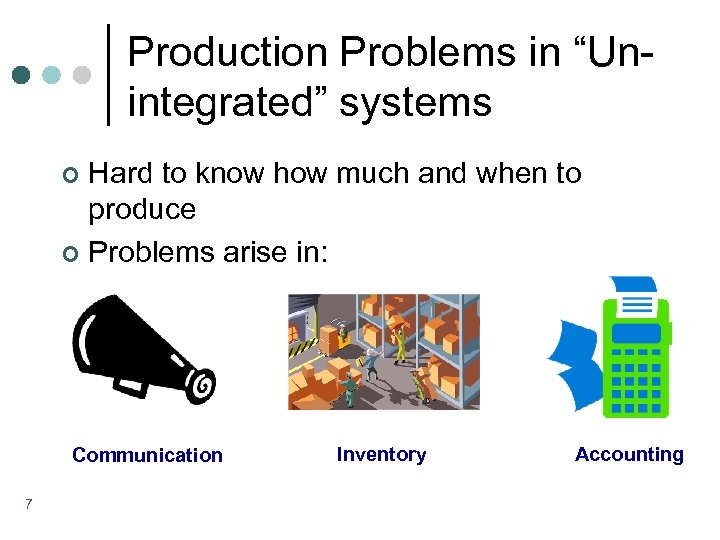 Production Problems in “Unintegrated” systems Hard to know how much and when to produce ¢ Problems arise in: ¢ Communication 7 Inventory Accounting
 Communication issues ¢ If production isn’t integrated with marketing: l Production doesn’t know about sales promotions or unexpected planned orders • Results: depleted inventory, overtime, expedited shipments, and material shortages ¢ Marketing doesn’t know about planned maintenance • Results: unexpected reduction in production and unmet demand 8
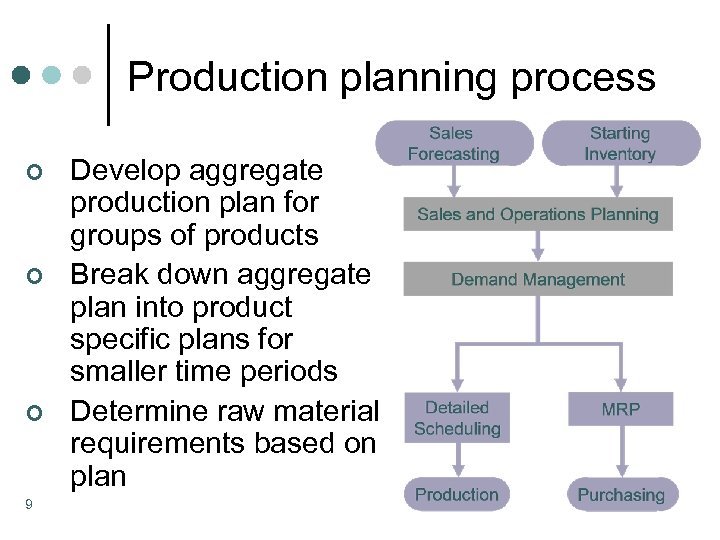 Production planning process ¢ ¢ ¢ 9 Develop aggregate production plan for groups of products Break down aggregate plan into product specific plans for smaller time periods Determine raw material requirements based on plan
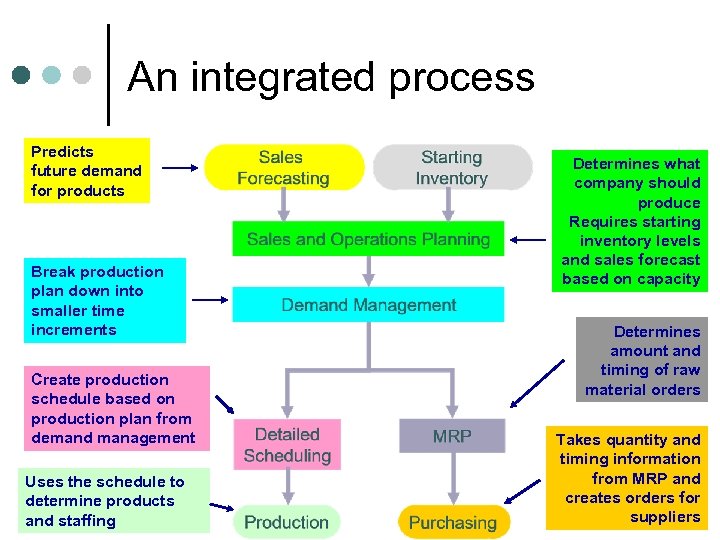 An integrated process Predicts future demand for products Break production plan down into smaller time increments Create production schedule based on production plan from demand management Uses the schedule to determine products 10 and staffing Determines what company should produce Requires starting inventory levels and sales forecast based on capacity Determines amount and timing of raw material orders Takes quantity and timing information from MRP and creates orders for suppliers
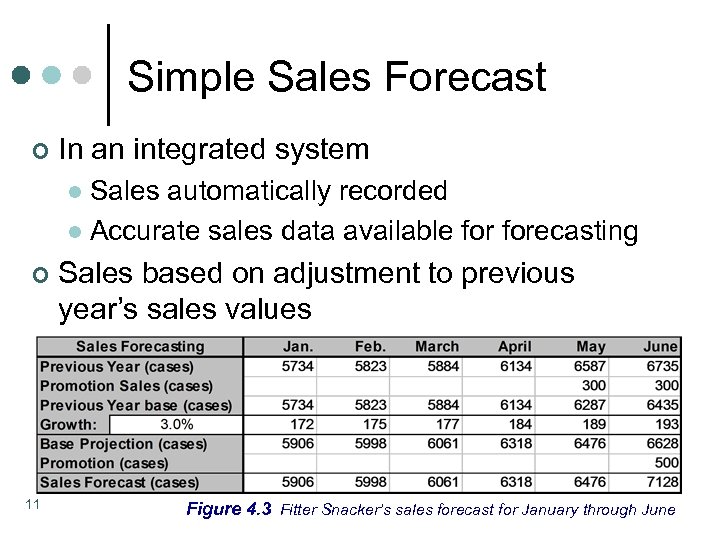 Simple Sales Forecast ¢ In an integrated system Sales automatically recorded l Accurate sales data available forecasting l ¢ 11 Sales based on adjustment to previous year’s sales values Figure 4. 3 Fitter Snacker’s sales forecast for January through June
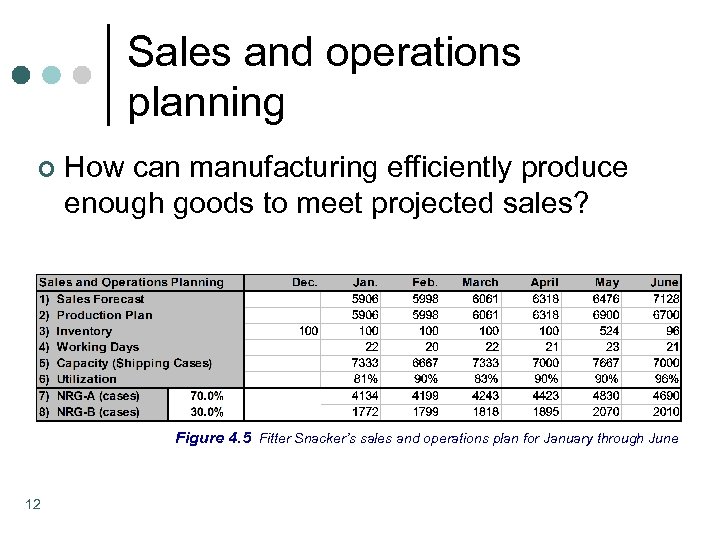 Sales and operations planning ¢ How can manufacturing efficiently produce enough goods to meet projected sales? Figure 4. 5 Fitter Snacker’s sales and operations plan for January through June 12
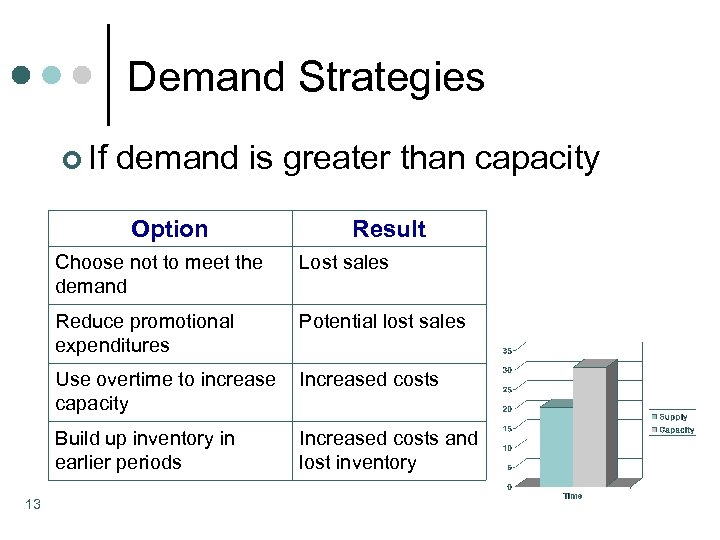 Demand Strategies ¢ If demand is greater than capacity Option Result Choose not to meet the demand Reduce promotional expenditures Potential lost sales Use overtime to increase capacity Increased costs Build up inventory in earlier periods 13 Lost sales Increased costs and lost inventory
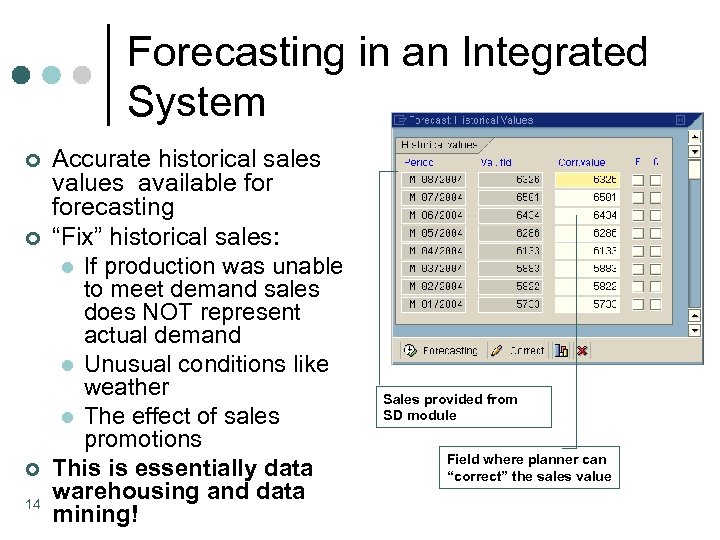 Forecasting in an Integrated System ¢ ¢ ¢ 14 Accurate historical sales values available forecasting “Fix” historical sales: l If production was unable to meet demand sales does NOT represent actual demand l Unusual conditions like weather l The effect of sales promotions This is essentially data warehousing and data mining! Sales provided from SD module Field where planner can “correct” the sales value
 Sales and Operations Planning (SOP) Case Study ¢ ¢ Kellogg’s achieved significant savings from coordinated sales and operations planning (SOP) Changed focus based on how they were evaluated l l l ¢ ¢ 15 Marketing and sales: Evaluated on tons of cereal sold Manufacturing: Evaluated on tons of cereal produced No one evaluated on profit! Kellogg’s new sales order process focused on profit Kellogg’s has reduced capacity, inventory and capital needs while increasing sales
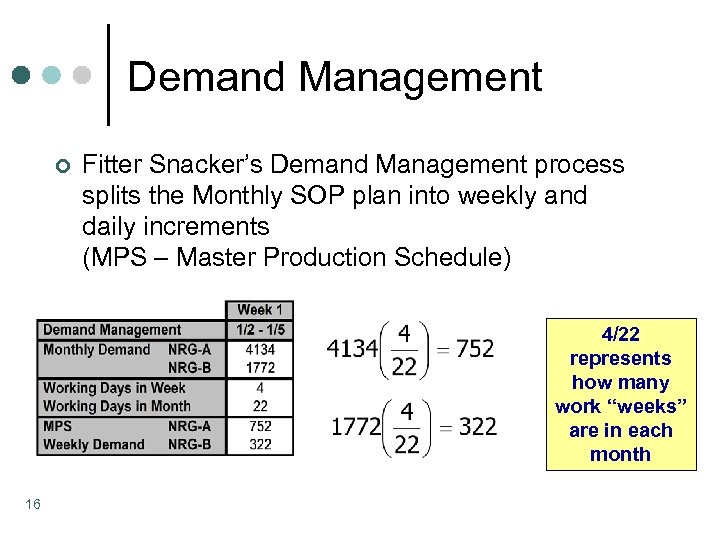 Demand Management ¢ Fitter Snacker’s Demand Management process splits the Monthly SOP plan into weekly and daily increments (MPS – Master Production Schedule) 4/22 represents how many work “weeks” are in each month 16
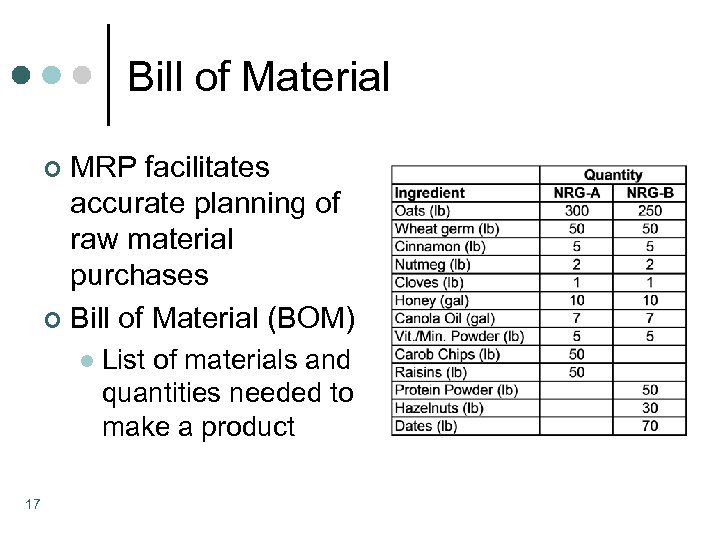 Bill of Material MRP facilitates accurate planning of raw material purchases ¢ Bill of Material (BOM) ¢ l 17 List of materials and quantities needed to make a product
 Lead Times and Lot Sizing ¢ ¢ To determine timing and quantity of purchases Lead time includes: l l l Time for supplier to receive and process order Time to take material out of stock, package it, load it on a truck and deliver it to the manufacturer Time required at manufacturer to receive the material: • Unload the truck, inspect the materials, move to storage location or production line ¢ Lot sizing: determining production or order quantities l 18 In many cases, lot sizes for purchased items are constrained by packaging and transportation
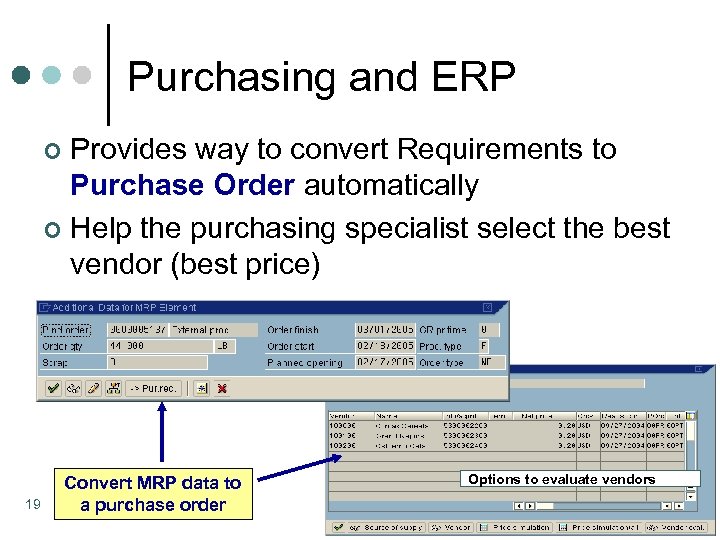 Purchasing and ERP Provides way to convert Requirements to Purchase Order automatically ¢ Help the purchasing specialist select the best vendor (best price) ¢ 19 Convert MRP data to a purchase order Options to evaluate vendors
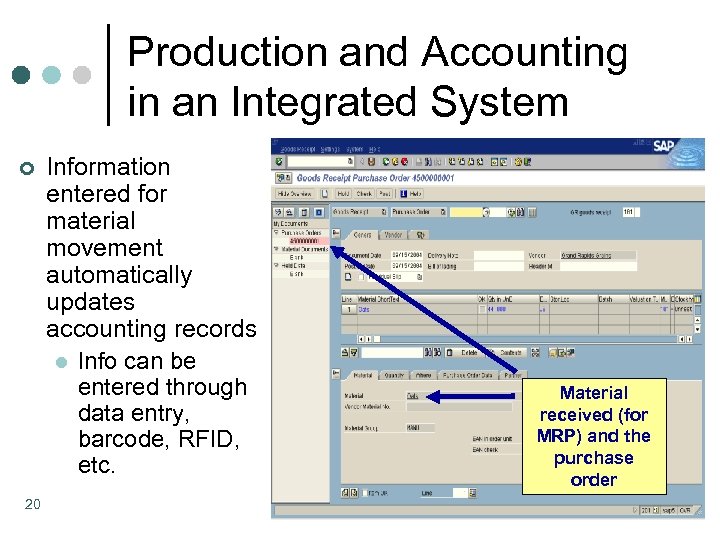 Production and Accounting in an Integrated System ¢ 20 Information entered for material movement automatically updates accounting records l Info can be entered through data entry, barcode, RFID, etc. Material received (for MRP) and the purchase order
 Implications for Supply Chain Management Supply chain participants often use competitive bidding to reach a “winning” prices by reacting ¢ Creates adversarial relationship among participants ¢ 21
 Supply Chain with ERP (Integration) ¢ ¢ ¢ Production plans can be shared along the supply chain in real time Managers can evaluate impact of plans on total cost across the supply chain Collaboration among participants leads to: l l 22 Improved product quality Reduced paperwork Reduced inventories Increased customer responsiveness
 Inventory Control Case Study – Hoyt Archery ¢ Pre ERP, complete inventory count two times each year l Closed plant for 3 days at cost of $5000 /day Post ERP, accurate, real-time inventory information and ongoing cycle- counting process: items are counted each day ¢ Hoyt also simplified customer interaction with its configure-to-order (CTO) process ¢ 23
 SCM with Customer Collaboration Case Study – Wal -Mart ¢ ¢ ¢ 24 POS data from bar code scanners is recorded in a massive data warehouse at Wal-Mart headquarters Wal-Mart uses data mining techniques to predict what customers will buy at different times of the year Data is shared with Wal-Mart suppliers to plan production Wal-Mart also allows its 5000 suppliers to directly access its data warehouse through its Retail Link program Wal-Mart is leading the effort to leverage RFID technology
 Summary An ERP system can improve the efficiency of production and purchasing processes ¢ Begins with Marketing sharing sales forecast ¢ Production plan is created based on forecast and shared with Purchasing so raw materials can be ordered properly. ¢ Production planning can be done without an integrated system, but integrated system that allows MRP and Production to be linked to Purchasing and Accounting ¢ 25