


 Скачать презентацию Production and Operations Management Systems Chapter 11 Innovation
1e72408539eea516ef49fde8af565bfe.ppt
- Количество слайдов: 49
 Production and Operations Management Systems Chapter 11: Innovation by P/OM for New Product Development (NPD) and Sustainability Sushil K. Gupta Martin K. Starr 2014 1
 NPD • Once upon a time, or should we say “In the old days” production was manufacturing and operations were what surgeons did to remove tonsils. There were also logistical, mathematical, and secret operations. • That changed as service operations became a fundamental part of P/OM. Operations has become an entirely proper way to describe activities intended to make a product or deliver a service whether for profit or not. • Once upon a time, NPD stood for narcissistic personality disorder. Today, it is the acronym for new product development. 2
 NPD • NPD is at the core of the competitive evolution of the business enterprise. That core must be sound so that the dynamics of evolution produce processes that are beneficial and sustainable in an entirely global society. • NPD is accelerating and accreting with global momentum. It must be understood because without planning—it obsoletes the present before the future can be designed. • This chapter provides an understanding of the role of innovation in new product development (NPD). 3
 Sustainability • Chapter 11 introduces recently developed material about new developments in the relationship of P/OM to the societal demand for sustainability. • What is sustainability? The unpleasant definitional answer is: “sustainability is the capacity to endure. ” We can do better than that. “It should be the capacity to flourish. ” • One might find a short-term solution that will be ok for tomorrow but not able to contain destructive forces indefinitely. Curing the symptoms but not the disease epitomizes this point. Sustainability definitely refers to the long-term future. • From Wikipedia: “Sustainability requires the reconciliation of Environmental, social Equity and Economic demands—referred to as the “three pillars. ” Also the 3 E’s. 4
 After reading this chapter, you should be able to: Make it clear why adaptability is essential for innovation. Explain why innovation is essential for successful sustainability. Detail how innovation applies to humanitarian operations and crisis management (HO&CM). Explain why HO&CM is relevant for sustainability. Discuss why sustainability has become an important goal for all organizations. Discuss the three pillars on which sustainability stands. Describe the application of patent protection for innovations. Make evident why continuous innovation is essential for success. Explicate how coordinated teamwork is critical for continuous innovation. 5
 After reading this chapter, you should be able to: (continued) Describe how product and service innovation failures can be avoided. Explain the importance of the lifetime value (LTV) of a loyal customer. Calculate LTVs and explain what Net Present Value (NPV) has to do with LTV. Describe the structure and importance of the product planning platform (PPP). Illuminate the benefits of product modularity. Explain mass customization and product life cycles. Describe the dynamics of the brand switching matrix and show calculations for equilibrium market shares. Explain blue versus red ocean strategies and how they relate to disruption. Detail the nature of closed-loop supply chains and explain why they are increasingly more important. Discuss the roles of imitators and innovators. 6
 Introduction P/OM uses innovation to design the processes which are new or adaptive (making incremental or major changes from old systems to new ones). Process design by P/OM has strong linkages to product design. The goal culmination is the responsibility of both marketing and P/OM working closely together—the appropriate idiom is—hand in glove. For proper coordination of functions—keep in mind that marketing and P/OM use different lingos. Managers of P/OM and marketing have hurdles that must be overcome to cooperate fully in every aspect of the transitions from original designs to new ones. Coordinated interactions are essential to deal competently with all NPD projects. 7
 Introduction (continued) • Decisions made by marketing and P/OM must be shared in a transparent environment to achieve organizational success. • Forecasting is often done separately by marketing and P/OM. This is unacceptable. Forecasting responsibilities must be cooperative. Competing forecasts are damaging and destructive—on paths that can collide. • Differences in P/OM and marketing expectations can be explained leading to acceptance of a common vision. Other aspects of coordination, including the critical importance of teamwork, will be addressed later on in this chapter. 8
 Organizational Adaptability • Success as defined by organizations dedicated to making a profit for their shareholders is measurably different from success defined by not-for-profit organizations. • Example 1: the U. S. Centers for Disease Control and Prevention (CDC) succeed when disease is eliminated and good health is pervasive. Why is vaccination so controversial? • Example 2: benefits (not profits) describe goals of the Red Cross, OXFAM, and The Salvation Army. They require money to operate. What measures their success? • Example 3: Profits define the goals of airlines, banks, cable companies, computer manufacturers, hotels, restaurants, supermarkets, etc. Airline bankruptcies have led to very successful resurrections. 9
 What are successful innovations? • Every student should be able to define financial success as it applies to profitmaking organizations. • Defining successful innovations for non-profit organizations is more difficult. • Often it means that costs have been reduced without any detrimental effect on services provided. • The connection to increased revenues (support) is not spelled out. • There is general agreement that innovations can provide a means to success for both profit and not-for-profit organizations. 10
 Organizations need to be able to change • Profit and non-profit organizations have a lot to learn from each other. • Industry specifics predominate in defining innovations that change the way things work (e. g. , smartphones, healthcare--MRIs, education—asynchronous). • The state of mind that encourages creative change by means of innovation is similar across the boards. At the root of successful innovations are competence in the field, confidence in management’s skills, and adaptability* to change. • Adaptability is strongly related to comfort in alteration of the status quo. * *Bureaucracy is never comfortable with alteration of the status quo. There is much relevant literature devoted to the attributes required for adaptability (e. g. , flexibility). Mc. Keown lists 17 rules. Rule 2 is All failure is failure to adapt. A cause of failure to adapt is inability to recognize the need for adaptation (see Adaptability, (Mc. Keown, 2012). Others have noted that adaptability and sustainability are closely related. This is an observation worthy of discussion. 11
 When humanity is challenged by catastrophe, innovation is crucial • Innovation is essential for success in humanitarian operations & crisis management (HO&CM) because each catastrophe is a unique project with domino-like impacts. • P/OM competence in achieving innovations to sustain “society” is essential. Disaster prevention (avoidable accidents*) and damage mitigation can be achieved. • P/OM is the master of processes needed for acquisition, storage, and transportation of critical materials and personnel—from and to—disaster zones. P/OM alone is capable of designing, implementing and monitoring supply chain operations. P/OM is solely knowledgeable about intelligent repair and maintenance. * Raising (parbuckling) the Costa Concordia on 9/17/13 should never have been required. 12
 When humanity is challenged…(continued) • The necessities of survival (physical and mental) must be addressed when disaster strikes. While each disaster is different, there are underlying patterns of similarity concerning what occurs, and what must be done. Only P/OM has the knowledge, experience, and connections to innovate appropriate solutions. * • Crisis managers are systems thinkers looking at the big picture of what must be accomplished with the resources at hand. The generic methodology (of supply and demand) has been applied by P/OM over many years, but the HO&CM application is a relatively new challenge. No pat answers exist. *This is a special genre (or category) of products and services that require new processes. 13
 When humanity is challenged…(continued) • Unique situations demand new approaches to ideation (i. e. , idea generation). These include group “brain storming, ” It will be useful to look at the Wikipedia entry for Brainstorming. • HO&CM solutions must be applicable to situations with specifics that have never been encountered before—even if the generic circumstances seem familiar. One flood is not the same as another to the crisis managers on the ground. Particularly important is the need to innovate with speed while avoiding the penalties of “making waste with haste. ” • Tradeoffs between speed and accuracy require new methods for making innovative decisions. 14
 Innovation for NPD • A large number of new product projects fail. The percent is significant even if elusive. A fair average of various reports might be about 70%. That is a lot of money lost and energy expended without a return. The opportunity costs (i. e. , lost opportunities to be successful) are staggering. • Innovative organizations must learn how to avoid failure. So, maintain the history of successes and failures. Retained memory promotes learning. Who are the successful innovators? What methods did they use? Conversely, who and what caused failures? A successful innovator in one area often fails miserably in another domain. • Data analytics will reveal success rates of organizational innovation. Every project should have forecasts of expected achievements to be compared with actual results. 15
 Innovation for Sustainability • Successful Sustainability requires Innovation • Managing world systems (controlling changes on a global scale) cannot be treated as a regional matter • The achievement of sustainability is an ongoing challenge involving many facets of global dynamics • Protecting the environment from critical disruptions is the first of the three pillars of sustainability. • Climate has always been in flux. Mark Twain said “climate is what we expect, weather is what we get. ” • Critical issue: are present-day changes caused by people (e. g. , increasing CO 2 levels in the atmosphere). 16
 Innovation for Sustainability • P/OM is not able to resolve such issues, however, it must adjust to these issues as possibilities. • A basic P/OM rule is to adapt to that which is inevitable (see Figure 11. 1). • Planning for the inevitable is one of five options; • Most planning is for what is not only possible but probable • Planning for the improbable takes courage. • It takes a Walt Disney to strive for the impossible. 17
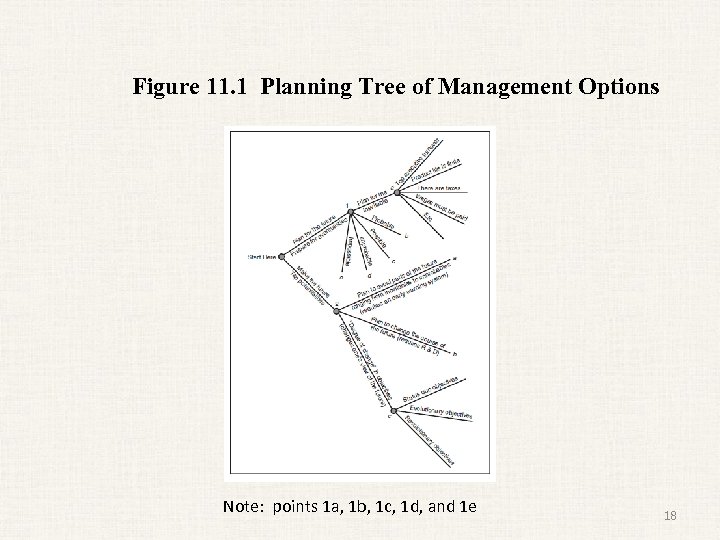 Figure 11. 1 Planning Tree of Management Options Note: points 1 a, 1 b, 1 c, 1 d, and 1 e 18
 Pillars of Sustainability • Define “satisfactory conditions that should be sustained” and define “not acceptable” changes. • P/OM, as the process-master, requires standards and methods to measure deviations from the acceptable levels. P/OM knows what levers regulate CO 2 emissions and it can determine how much it will cost to meet a new standard, and if that is feasible. Thus, the environment (Pillar 1) and economic factors (Pillar 2) are interdependent. • Pillar 2 refers to economic conditions. There are different theories about steps to take to shield economies from economic down turns. Protection from damage is a strong form of sustainability. • P/OM’s potential contribution is significant, both in helping to innovate new products that increase revenue generation and to innovate processes that are world-class competitively. 19
 Cycles and Sustainability • Kondratiev Waves are long-wave cycles of 45 to 60 years. • Long-waves reflect economic impacts of innovation (see Wikipedia for Nikolai Kondratiev). • Each major new invention (e. g. , steam engines, internal combustion engines, computers) attracts investors hoping to gain a return on replacing old-tech and improving new-tech. • After 5 or 6 decades, returns on investment in aging technology diminish markedly. • Investors switch from old marginal technology to high-return, high-risk investments in new technology (such as LEDs instead of tungsten filament bulbs). • P/OM’s role in guiding major long-wave economic global transitions is essential. 20
 Pillar 3—The Social Dimension • The third pillar of sustainability is more difficult to define than the prior two pillars. • How can P/OM address societal needs? Jesse Dillard and David Layzell write in Social Sustainability: One Company’s Story (p. 174, Dillard, 2009), “We describe how … Intel Corporation frames and responds to its perceived social responsibilities. Sustainability originates in manufacturing, has an operational flavor within the company, and is implemented and monitored through input/output ratios. ” The authors conclude, Intel uses the term corporate responsibility to address various aspects of social sustainability. • P/OM plays a crucial role in creating well-paid, steady jobs that raise the living standards of the world; maintain high levels of social health; contain environmental damage created by every human activity. • Destructive forces in nature, human malevolence and economic recessions are faced down by P/OMS, in coordination with others on the management team. • An ever-improving quality of life (QOL) is the preferred goal. Since technology development is moving faster and faster, P/OM project management must meet the challenge of a speeded-up world. • Accelerating speed of change is caused by extensive innovations in communication methods and transportation technologies. Transition management and innovation management become indistinguishable. 21
 Patent Protection of Innovations • 20 th Century concepts of the U. S. Patent Office do not apply to technological developments of the 21 st Century. There is increasing internationalization of the patent system. • Almost every country has its own patent laws and laws of many countries differ. There is a Patent Cooperation Treaty with many cases of disagreement in the courts. • A new patent law went into effect (Spring 2013) called America Invents Act. It marks fundamental shifts. The old first-to-invent rule is replaced by the international standard, first-to-file. It is too soon to predict the effect of this change. 22
 Continuous Innovation—Step 1 • Before powerful computer systems, technological diffusion took time. Now, copying is accomplished in days. What was once too complex to imitate is no longer so. Economic benefits of patent protection are underwhelming (at this time). Continuous innovation is the only sure way to stay ahead of the pack. • The first step is to cultivate an organizational culture that fosters creating new ideas to disrupt old ideas. • Organizational success at disruption requires cross-functional cooperation. Firms that embrace failure as a learning opportunity—are primed for success. Anxiety is a catalyst to force traditional organizations to change. • Anxiety is easy to come by; organizations are constantly challenged with extinction by outside competitors. Damage potential is not trivial. Management must act from inside to counter the attacks from outside. • Outsourcing is not innovation. Moving products and resources great distances is wasteful. It is done because low-cost producers seem to offer lower total costs despite wasteful transport costs. Low labor costs inevitably rise as more work is outsourced to a specific region. Lack of quality control and transition costs require systems perspectives to properly assess. If P/OM is not part of the team, poor decisions will be made. 23
 Continuous Innovation—Step 2 • Step 2: Rigorously and continuously test innovative ideas and prototypes to avoid new product failures. JC Penney undertook a major innovation of retailing starting in November of 2011. Without testing the new concepts, JC Penney launched into the altered strategies which reduced sales by 4. 3 billion and stock price by more than 50%. The CEO was fired in April of 2013. Testing the new plan might have allowed it to be modified or rejected as unworkable. Always test innovations before activating them. • The fashion industry is good at testing. Quick service restaurants have new product introductions on a regular basis to maintain the freshness of offerings but also to capture interest in new menu items for reasons of health or to “ride the wave” of interest in new foods. • The toy industry excels at making sensible commitments to new products in advance of the Christmas season. Knowing the “lay of the land” requires a market research and forecasting capability that not only tests new concepts but provides directions of trends for the future. P/OM acknowledges that market research is its closest ally in the firm. 24
 Continuous Innovation—Step 3 • Step 3 has three parts: v Synchronize, v Start early, v Develop the product planning platform (PPP) • NPD project teams move toward the goal of product release (launch) like a rugby team; it’s not a relay race. • All team members work together in synchronization (Takeuchi, 1986). Coordination is essential. One group does not wait for another to complete its work. • Teams rev up immediately. Know as much as you can as early as possible. Don’t postpone or delay. * • Costs of discovery about product and project weaknesses are relatively low at the starting point. • Costs increase rapidly after project directions are set—costs of reversals skyrocket in time and money. • Figure (11. 2)—next slide—shows typical advantages of early- resource utilization in P/OM projects. *Old and traditional project style 25
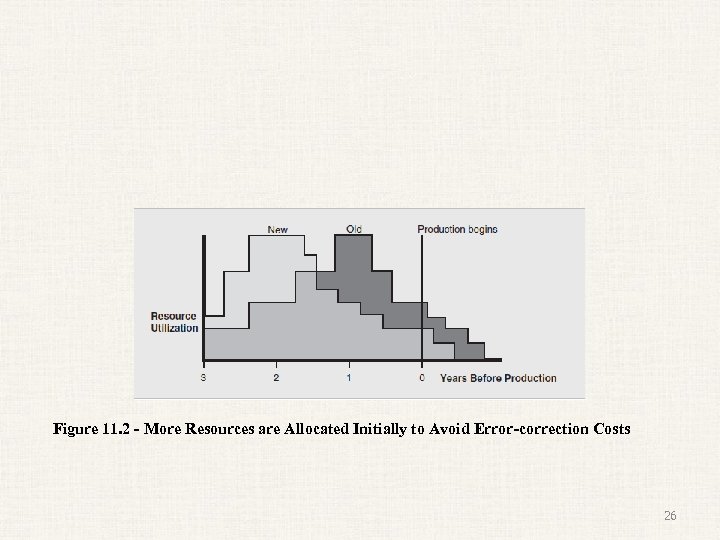 Figure 11. 2 - More Resources are Allocated Initially to Avoid Error-correction Costs 26
 Continuous Innovation—Step 3 (continued) • The Product Planning Platform (PPP) part of Step 3 is crucial. PPPs are the best competitive method for developing new products. PPP tests at every stage (concept, design, prototype, launch, next concept to launch). • PPP replaces planning for one product (goods and services) at a time with planning the product family’s evolution over time. Product families are not limited—the are extended families. • Concepts such as modular design and group technology have been like distant cousins to product family planning in the past. They are now recognized as full-fledged members of the product planning platform team. • PPP provides a home base for all such concept platforms. The old one-at-a-time product development concept is passé. (Figure 11. 3 helps bring it together in the next slide. ) • The PPP concept applies equally to goods and to services. As an example, a gym starts with a limited array of equipment. It plans to gradually expand the variety of machines to apply to a multitude of aerobic exercises. If it has a good PPP it will role out a stream of new activities, facilities, staff capabilities, and a few surprises. 27
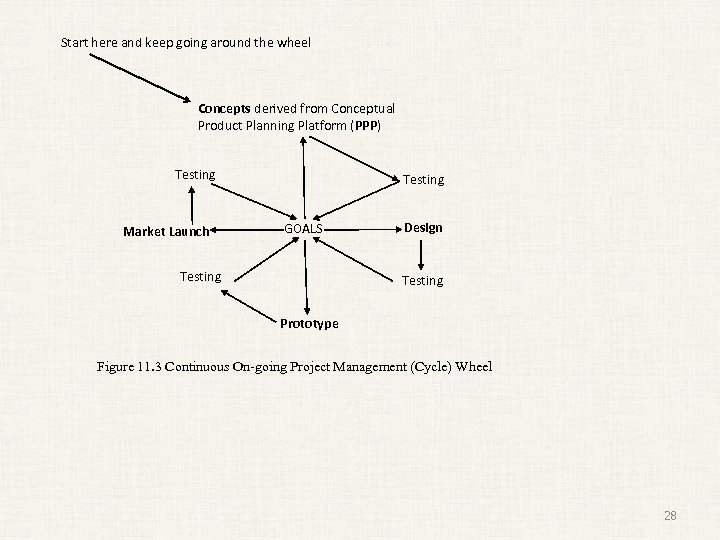 Start here and keep going around the wheel Concepts derived from Conceptual Product Planning Platform (PPP) Testing Market Launch Testing GOALS Testing Design Testing Prototype Figure 11. 3 Continuous On-going Project Management (Cycle) Wheel 28
 Explaining Figure 11. 3 Continuous On-going Project Management (Cycle) Wheel • Continuous on-going project management is a successful NPD innovation • NPD starts by creating a broad platform concept based on strategic goals. These concepts are (in part) derived from a menu of former successful products. • If done properly, this “conceptual product planning platform” coordinates organizational strengths in finance, marketing, P/OM, design and engineering. • New design proposals are evaluated always with the strategic goals in mind. These designs must be reviewed quickly. Speculation (about design alternatives) is leaked and broadcast widely through social media. • Decisions must be made rapidly to select designs best suited to the goals. Then, prototypes are created for consumer testing. If the test results align with the goals, the new products are launched into the market. • The project—started with product conception—enters its pre-launch stage. First, consumer tests (such as evaluation by focus groups) confirm that the prototypes will achieve the goals. Before the launch, test results must indicate design optimality (i. e. , tweaking will not improve it). 29
 About Market Launch • Speed is essential. Innovators are vulnerable to information leaks. There are many avenues for scientific and technical intelligence to be procured by potential competitors. This also applies to services. The gym previously mentioned could be stymied by a competitor being first to market. • Testing (e. g. , with focus groups) puts potential versions of the product in the hands of consumers who are not obliged to keep secrets. An industry of journalists tracking developments exists to feed information to competitors and stock market traders. • The final launch stage requires ramping up process outputs to satisfy expected demand. If not done properly, innovations can fail to achieve long-term market success. Problems of supply not being in sync with demand occur for a variety of reasons. • Customers, expecting a new model, will stop buying the prior model (e. g. , phones, cars, software) In anticipation, P/OM will reduce inventories of the outdated design to match the expected demand of the up-dated. Price can be used to move inventory sliding into obsolescence. 30
 Continuous Innovation—Step 3 (continued) • An alternative formulation is “New growth platforms (NGP’s) for innovation • Continuous new product development means projects are on-going. Teams are not halted and disbanded— teams start new projects. Project groups are committed to creating streams of upgrading innovations. This is described as creating “new growth platforms (NGP’s) by Laurie, Doz and Sheer (Laurie, 2006). • Timing between successive launches of upgrades will depend on evolution of demand in the marketplace. When a competitor attacks a recent innovation with improvements that disrupt the growth pattern of the original product, counter-moves are required. Success of the counter-attack depends on having a strong “platform. ” • Product development speed has accelerated at such a great rate that planning a product in isolation from its further updates and revisions is untenable. In this regard, read Planning for Product Platforms (Robertson and Ulrich, 1998 —a 15 page article). • The continuous project management cycle is replicated repeatedly. Revisiting the conceptual platform is essential to unleash pre-planned functionality—not yet activated by design decisions. This on-going NPD methodology is the new performance standard for competent project managers. The beginning and end of a project—with disassembly of the project group—is passé. 31
 A Crucial Issue for Innovators Greenfield or Brownfield? • New competitors have a greenfield advantage (i. e. , unencumbered by investments in earlier technologies). Older firms have put money into machines and programs that are called legacy technology. The term “legacy” means old and superseded but difficult to replace because of the hierarchy of commitments and unamortized capital expenditures. • Legacy problems define the burden of the brownfield competitor who cannot start from “scratch. ” • Innovation is reflected in the rate of change of new technologies replacing old legacy technology. • Legacy inheritances (from an earlier management era) are constraints on innovation. • Even if funds can be found to replace old software or hardware, it is often difficult because many employees are still committed to using what was once “the best. ” • Cost disruptions for retooling and relearning are only part of the trauma of switching from the familiar. The greenfield competitor enters the fray without the burden of previous commitments that foster hostile attitudes to change. 32
 Lifetime Value (LTV) of a Loyal Customer • P/OM and marketing know that customer disappointment caused by faulty product can diminish or even extinguish company (i. e. , brand) loyalty. • A spiral of decreasing loyalties can have grave long-term consequences for the sustainability of the system. Liability lawsuits for damage, injury and death are amplifications of LTV loses. They are potential killers of a company without sufficient reserves. Such penalties are not included in the normal derivation of the lifetime value of a loyal customer. • The analysis of lifetime value of loyal customers is valuable for managing sustainability. Loyalty is defined by repeat purchase of the goods and/or services. It is not required that loyal customers purchase one company brand exclusively. The Lifetime value (LTV) of an angry (lost) customer can amount to substantial revenue loss. • Slide 36 shows spreadsheet calculations of LTV—for a pizza buyer of average loyalty. • The spreadsheet in Figure 11. 4 depicts a 20 -year lifetime expenditure of a pizza buying family of average loyalty. Column B’s revenue sums to $10, 800 (i. e. , $540 per year times 20 years). $540 was derived from the assumption of 27 purchases per year at $20 per purchase. • Before refining this calculation note that if one such customer is lost every day then the pizza company could spend up to $10, 000 x 365 = $3, 650, 000 per year to right the wrong that lost this customer’s business. *Putting the Service-Profit Chain to Work, HBR (Heskett, et. al. 1994) 33
 Lifetime Value (LTV) of a Loyal Customer (continued) • Column D shows discounted revenues which sum to $8, 000. 51. The discounting is based on net present values (NPV) of each yearly payment with a prevailing interest rate of 3. 045%. • Net present value compares the value of a dollar in hand now with the value of that dollar in the future (e. g. , a year from now). If a dollar is paid every year for twenty years, NPV will calculate the sum of those values which will be less than $20. 00 when interest rates are greater than zero. The larger the interest rates, the smaller the sum will be—because delayed payments represent money which cannot be invested until the payment is received. Thus, the NPV of $1. 00 paid at the end of one year (rather than at the beginning) is $0. 97 with a 3% interest rate. • All payments in Figure 11. 4 are at the end of year with the interest rate of 3. 045%. • Figure 11. 4 (slide 36) is an Excel spreadsheet with Column C based on fx = NPV(0. 03045, B 1) = $524. 04 • For cell C 2, fx = NPV(0. 03045, B 1, B 2) = 1032. 6, and so forth for cell C 3, etc. • For Column D calculations: Dn = Cn – Cn-1. • With an interest rate of about 3%, the real present value of the time stream of money is significantly less than the undiscounted sum. To know how much can be spent to correct a cause of defection, use NPV. 34
 Lifetime Value (LTV) of a Loyal Customer (continued) • NPV calculations, such as the ones just used, are built into Excel spreadsheets. • Click the “insert function” icon (fx) in Excel. It will be found on the Formula Bar which appears above the row of column letters. The Insert Function box will pop up. Where it says “search for a function” write in NPV. • Then, click “Go. ” Select the function NPV and click on “ok. ” The Function Argument Box is shown with windows for Rate and Value 1, Value 2, etc. Type the interest rate in the Rate window. • In the Value 1 window, designate the column of values to which the NPV calculation will be applied (For example, B 1: B 20 in Figure 11. 4). There is no need to enter numbers for Value 2. The NPV result is shown in the Total Row, Column D, in Figure 11. 4. 35
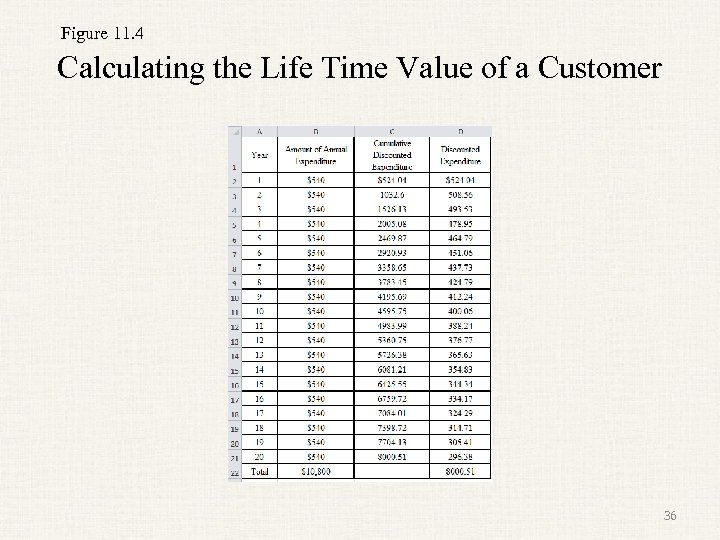 Figure 11. 4 Calculating the Life Time Value of a Customer 36
 Remedial Strategies to Counter LTV Losses • What strategies can stymie (prevent or hinder) customer switching (LTV losses) loyalties? • The two causes of switching are: A. Complaints and dissatisfaction with present affiliation B. Competitive persuasion to switch affiliations • First, find out the cause of switching. • For A, make amends. Deal with honest evaluations. Correct problems. • When a “severe” complaint arises, significant remediation must occur. Sincere efforts to remedy grievances often leads to significant re-bonding of customer and company with strengthened bonds of loyalty. For the prior pizza example, remedies should cost less than $8, 000. 51. Remedies should not cost more than the cure is worth. • For B, provide new product innovations including the concept of an ecosystem such as loyalty programs. • Frequent flyer programs are an innovation that has been a great success. Airline loyalty programs were considered a remarkable invention when in 1972 United Airlines gave plaques to their top-flight customers. Texas Airlines created the first real frequent-flyer program (1979) with mileage as the basis for rewards. • Price may be an issue that will have to be dealt with using discounts, coupons, etc. 37
 Holding vs Switching • Customers who stick with a brand are loyal. Non-loyal customers switch between brands (e. g. , restaurants, hotels, soap, cars, TV channels, etc. ) It is a fact that getting new customers is far more costly than holding on to existing customers. Therefore, methods for improving holding efficiency are worth pursuing. • Loyalty-enhancing programs exist in numerous industries. Innovations can increase the length of the loyal lifetime period—by offering rewards for staying year after year. Efforts to increase the value of the lifetime cash stream are also familiar (e. g. , Starbucks stars). • Further, companies try to increase their customers’ costs of switching brands. This is the cost of switching infrastructures (often called ecosystems). What is the cost of switching from an Apple to a Samsung? Firms try to make it difficult for those customers who contemplate switching to other brands. • Coupons are bestowed on loyal customers to keep them from wandering. Brands are continually innovating claiming their new formula can make teeth even whiter and brighter. Marketing reinforces loyal customers’ beliefs that they have selected the best brand. • Cognitive dissonance theory developed by social psychologist (Festinger, 1957) explains that people are strongly motivated to justify their purchase decisions as the best choice available—in spite of contrary evidence. 38
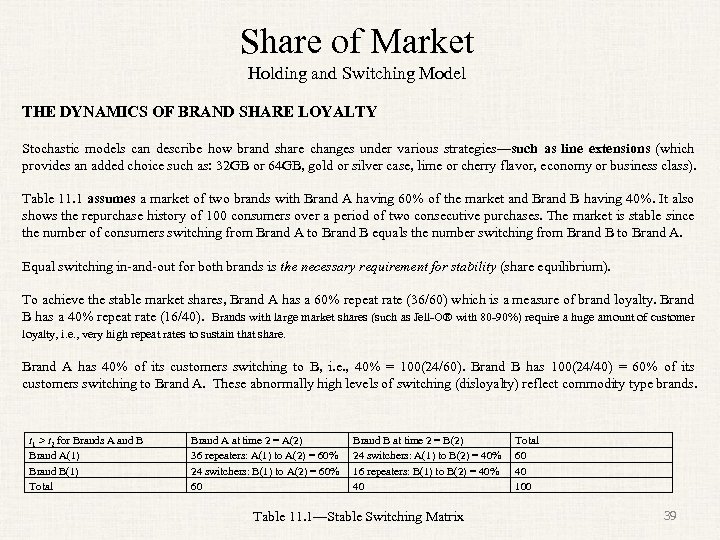 Share of Market Holding and Switching Model THE DYNAMICS OF BRAND SHARE LOYALTY Stochastic models can describe how brand share changes under various strategies—such as line extensions (which provides an added choice such as: 32 GB or 64 GB, gold or silver case, lime or cherry flavor, economy or business class). Table 11. 1 assumes a market of two brands with Brand A having 60% of the market and Brand B having 40%. It also shows the repurchase history of 100 consumers over a period of two consecutive purchases. The market is stable since the number of consumers switching from Brand A to Brand B equals the number switching from Brand B to Brand A. Equal switching in-and-out for both brands is the necessary requirement for stability (share equilibrium). To achieve the stable market shares, Brand A has a 60% repeat rate (36/60) which is a measure of brand loyalty. Brand B has a 40% repeat rate (16/40). Brands with large market shares (such as Jell-O® with 80 -90%) require a huge amount of customer loyalty, i. e. , very high repeat rates to sustain that share. Brand A has 40% of its customers switching to B, i. e. , 40% = 100(24/60). Brand B has 100(24/40) = 60% of its customers switching to Brand A. These abnormally high levels of switching (disloyalty) reflect commodity type brands. t 1 > t 2 for Brands A and B Brand A(1) Brand B(1) Total Brand A at time 2 = A(2) 36 repeaters: A(1) to A(2) = 60% 24 switchers: B(1) to A(2) = 60% 60 Brand B at time 2 = B(2) 24 switchers: A(1) to B(2) = 40% 16 repeaters: B(1) to B(2) = 40% 40 Table 11. 1—Stable Switching Matrix Total 60 40 100 39
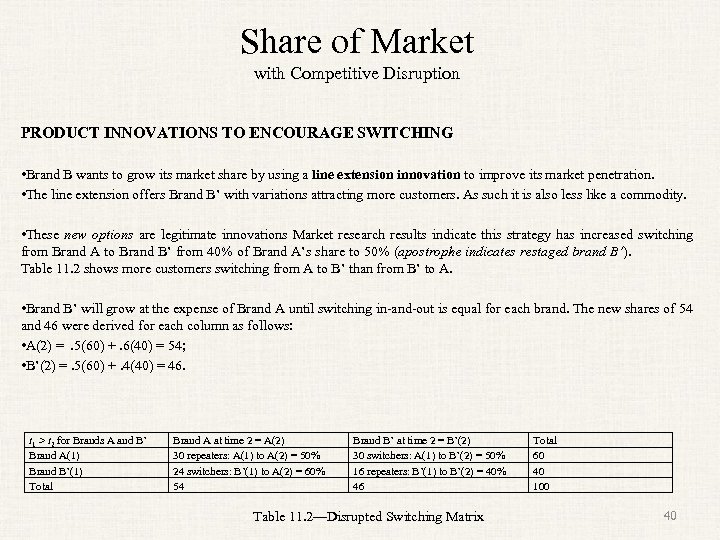 Share of Market with Competitive Disruption PRODUCT INNOVATIONS TO ENCOURAGE SWITCHING • Brand B wants to grow its market share by using a line extension innovation to improve its market penetration. • The line extension offers Brand B’ with variations attracting more customers. As such it is also less like a commodity. • These new options are legitimate innovations Market research results indicate this strategy has increased switching from Brand A to Brand B’ from 40% of Brand A’s share to 50% (apostrophe indicates restaged brand B’). Table 11. 2 shows more customers switching from A to B’ than from B’ to A. • Brand B’ will grow at the expense of Brand A until switching in-and-out is equal for each brand. The new shares of 54 and 46 were derived for each column as follows: • A(2) =. 5(60) +. 6(40) = 54; • B’(2) =. 5(60) +. 4(40) = 46. t 1 > t 2 for Brands A and B’ Brand A(1) Brand B’(1) Total Brand A at time 2 = A(2) 30 repeaters: A(1) to A(2) = 50% 24 switchers: B’(1) to A(2) = 60% 54 Brand B’ at time 2 = B’(2) 30 switchers: A(1) to B’(2) = 50% 16 repeaters: B’(1) to B’(2) = 40% 46 Table 11. 2—Disrupted Switching Matrix Total 60 40 100 40
 Product Rollovers and Line Extensions (useful definitions) • Preparation for solo-product rollovers involves having the replacement product ready to go to market. A good analogy is how critical it is to pass the baton without delay. The old product has done its job; the new product takes over—not as a line extension. Production delays for the replacement can be disastrous. Failures arise because the legacy market share of the old product may not be transferable to the new product. Innovation is crucial. • In the dual-product rollover situation the original product and its line extension provide choice options. It is critical to price old and new correctly. Otherwise, the new product might cannibalize demand for the old product. Poor market research can lead to strategic marketing blunders. Production delays can be deadly. • Properly done, line extensions have an opposite effect from cannibalization, i. e. , the total share of A (SA) and A’ (SA’) is larger than the original share of A alone. A is also better able to fend off competition. These two points are the underlying purposes of the dual-product rollover. • For example, Jell-O® was originally (1899) available in lemon, orange, strawberry, and raspberry. Lime was added in 1930. There are now about 30 flavors of gelatin and another 30 of different flavors of pudding. Many flavors are also available as sugar free or low calories mixtures. The estimate of 160 different Jell-O® products is variable. What is not variable is the fact that this huge variety sums to a very large and stable share of the gelatin and pudding market for Kraft Foods. • Estimates for Jell-O’s ® share of market vary between 80 and 90 percent. 41
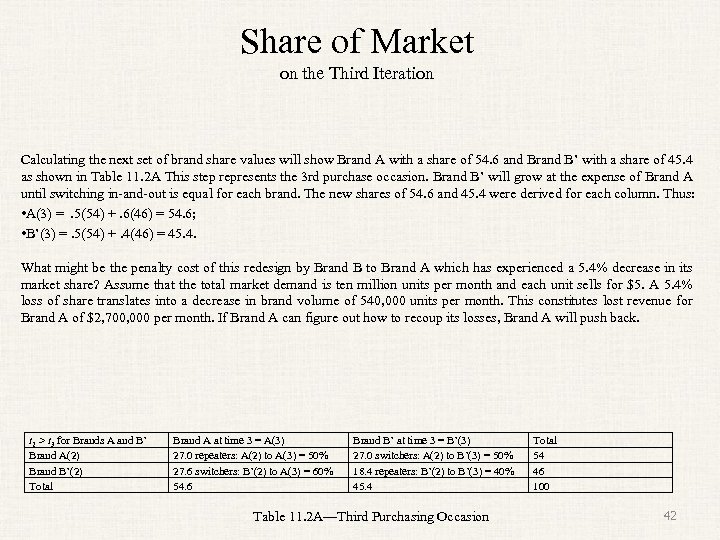 Share of Market on the Third Iteration Calculating the next set of brand share values will show Brand A with a share of 54. 6 and Brand B’ with a share of 45. 4 as shown in Table 11. 2 A This step represents the 3 rd purchase occasion. Brand B’ will grow at the expense of Brand A until switching in-and-out is equal for each brand. The new shares of 54. 6 and 45. 4 were derived for each column. Thus: • A(3) =. 5(54) +. 6(46) = 54. 6; • B’(3) =. 5(54) +. 4(46) = 45. 4. What might be the penalty cost of this redesign by Brand B to Brand A which has experienced a 5. 4% decrease in its market share? Assume that the total market demand is ten million units per month and each unit sells for $5. A 5. 4% loss of share translates into a decrease in brand volume of 540, 000 units per month. This constitutes lost revenue for Brand A of $2, 700, 000 per month. If Brand A can figure out how to recoup its losses, Brand A will push back. t 2 > t 3 for Brands A and B’ Brand A(2) Brand B’(2) Total Brand A at time 3 = A(3) 27. 0 repeaters: A(2) to A(3) = 50% 27. 6 switchers: B’(2) to A(3) = 60% 54. 6 Brand B’ at time 3 = B’(3) 27. 0 switchers: A(2) to B’(3) = 50% 18. 4 repeaters: B’(2) to B’(3) = 40% 45. 4 Table 11. 2 A—Third Purchasing Occasion Total 54 46 100 42
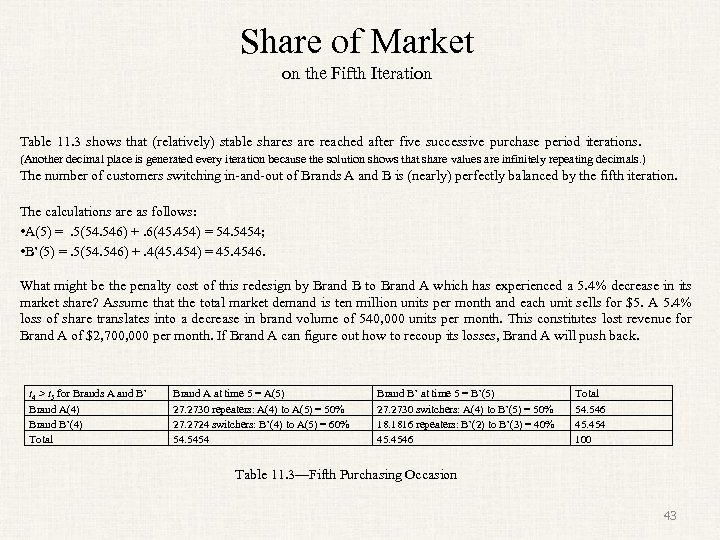 Share of Market on the Fifth Iteration Table 11. 3 shows that (relatively) stable shares are reached after five successive purchase period iterations. (Another decimal place is generated every iteration because the solution shows that share values are infinitely repeating decimals. ) The number of customers switching in-and-out of Brands A and B is (nearly) perfectly balanced by the fifth iteration. The calculations are as follows: • A(5) =. 5(54. 546) +. 6(45. 454) = 54. 5454; • B’(5) =. 5(54. 546) +. 4(45. 454) = 45. 4546. What might be the penalty cost of this redesign by Brand B to Brand A which has experienced a 5. 4% decrease in its market share? Assume that the total market demand is ten million units per month and each unit sells for $5. A 5. 4% loss of share translates into a decrease in brand volume of 540, 000 units per month. This constitutes lost revenue for Brand A of $2, 700, 000 per month. If Brand A can figure out how to recoup its losses, Brand A will push back. t 4 > t 5 for Brands A and B’ Brand A(4) Brand B’(4) Total Brand A at time 5 = A(5) 27. 2730 repeaters: A(4) to A(5) = 50% 27. 2724 switchers: B’(4) to A(5) = 60% 54. 5454 Brand B’ at time 5 = B’(5) 27. 2730 switchers: A(4) to B’(5) = 50% 18. 1816 repeaters: B’(2) to B’(3) = 40% 45. 4546 Total 54. 546 45. 454 100 Table 11. 3—Fifth Purchasing Occasion 43
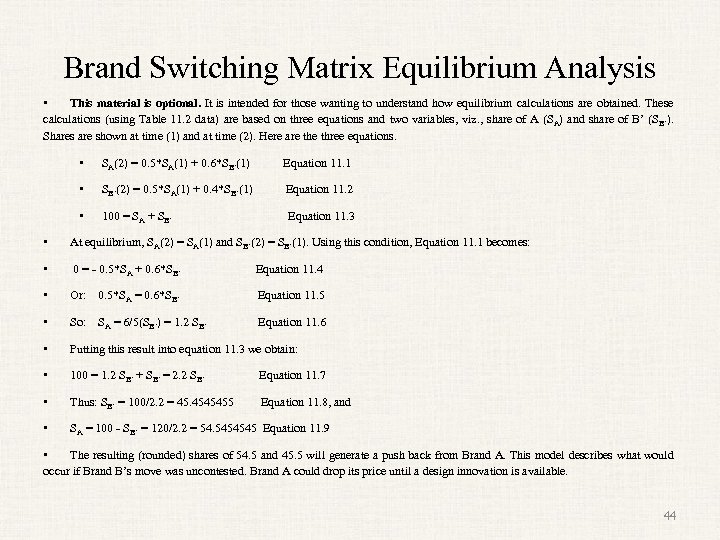 Brand Switching Matrix Equilibrium Analysis • This material is optional. It is intended for those wanting to understand how equilibrium calculations are obtained. These calculations (using Table 11. 2 data) are based on three equations and two variables, viz. , share of A (SA) and share of B’ (SB’). Shares are shown at time (1) and at time (2). Here are three equations. • SA(2) = 0. 5*SA(1) + 0. 6*SB’(1) Equation 11. 1 • SB’(2) = 0. 5*SA(1) + 0. 4*SB’(1) Equation 11. 2 • 100 = SA + SB’ Equation 11. 3 • At equilibrium, SA(2) = SA(1) and SB’(2) = SB’(1). Using this condition, Equation 11. 1 becomes: • 0 = - 0. 5*SA + 0. 6*SB’ Equation 11. 4 • Or: 0. 5*SA = 0. 6*SB’ Equation 11. 5 • So: SA = 6/5(SB’) = 1. 2 SB’ Equation 11. 6 • Putting this result into equation 11. 3 we obtain: • 100 = 1. 2 SB’ + SB’ = 2. 2 SB’ Equation 11. 7 • Thus: SB’ = 100/2. 2 = 45. 4545455 Equation 11. 8, and • SA = 100 - SB’ = 120/2. 2 = 54. 5454545 Equation 11. 9 • The resulting (rounded) shares of 54. 5 and 45. 5 will generate a push back from Brand A. This model describes what would occur if Brand B’s move was uncontested. Brand A could drop its price until a design innovation is available. 44
 The Innovation of Mass Customization (MC) • Suppose Brand B’s line extension is based on being able to deliver products to its customers that match each customer’s ideal profile. • We are taking the liberty of using 2 parts reality; 1 part imagination. • For example, a coffee drink made “just the way you like it, ” or a shirt that exactly fits each customer’s torso (shirt makers call that “custom-made” in the US or “bespoke” in the UK); or a car with the exact design features each potential buyer prefers. • It is essential that the cost to B’ for custom work is not higher than A’s production costs for “one size fits all. ” • How can that be achieved? Enter the innovation of mass customization (MC). • An advanced concept of planning product platforms (PPP) is the ability to offer product customization by using processes with mass customization capabilities. Mass customization is the polar opposite of mass production (a stream of identical items produced in minimum time and cost per unit). 45
 The Innovation of Mass Customization (continued) • Computer-assisted flexibility permits production that is called mass customization. It is a process that has the ability to create differentiation in products as they are being made without adding to the cost of the product. This contrasts with having all items of a given production run being as close to identical as statistical variation permits (i. e. , mass production). • As an alternative explanation of mass customization, it is a process in which production line efficiency is not compromised by changing one or more characteristics of the product output. • For example, if the—color of car, size of socks, motor power in vacuum, memory size in smartphone, salt in chicken soup, battery in laptop, can be varied on the production line with no increased cost, then a mass customization process exists. 46
 The Innovation of Mass Customization (continued) • What enables mass customization processes to work? Answer: Technological ability to make nano-speed shifts between product varieties—without slowing the production line. This has been achieved by computer-driven equipment designed to act like a flow shop process even though the production output is order-customized. • “Mass customization has been the ‘next big thing’ in product strategy…yet for years, mass customization has disappointed. ” This statement by Forrester Research (the consulting firm) is historically accurate for a variety of reasons. (See Zipkin, The Limits of Mass Customization, SMR, Spring 2001). • Now, Forrester says that mass customization has “hit an inflection point. ” Perhaps, it is better to say “tipping point. ” The reason: new technologies permit the fast setup changes required to “make to order” from menus of available possibilities. Customers are learning to order from the menu. Distributors are adapting their systems to deliver small amounts quickly (Amazon’s Prime delivery). The transformations are important examples of innovations with respect to product platform planning for increased use of mass customization. 47
 Additional Facts about Mass Customization Flexible process computerization for MC is usually very costly. For the most part, such systems have to be predesigned and do not lend themselves to later accomdations. Modular part design enables different components to be utilized on the line in accord with digitized assembly instructions. Modular design is an important part of the product planning platform. It is also an MC enabler. Postponement in production provides another way to achieve great variety for customers without increasing their costs. For example, just before shipping, printers are finalized with specific electrical fittings and instruction manuals—suitable for many different destinations and languages. Closed-loop supply chains are relatively indifferent to many characteristics of the parts and components of what is being returned for recycling, rework, and remanufacture. The processes are indifferent to the shape or color of the car door, the brand of soda in the aluminum can, etc. Because the return loop is indifferent, the costs of processing are very low. This is mass melding in contrast to mass customization. So mass customization does not have an increased cost effect on the return journey in the closed-loop supply chain. Mass customization processes are as economic to run (per unit made) as mass production processes. The advantage is that “you run what you need. ” There is no inventory with its idle value-added being put into storage. Straight-forward business analysis must be used to determine when mass customization is a good deal. 48
 Mass Customization of Learning • Traditional classrooms are not gone—but they are being replaced increasingly by smart, supportive on-line asynchronous systems. Asynchronous means that the teacher and the student can be on different schedules and yet communicate with each other. Asynchronous systems allow each student to decide when, where and what he or she wants to study. Students learn on their own time and a variety of methods including feedback loops are provided so that students customize their own learning. Huge classes can be accommodated which indicates that such teaching and learning innovations are a legitimate form of mass customization. • Teaching and learning methods on the Internet were originally called “distance learning” because they had been used in places where education was hard to come by such as Australia’s Outback. Overtime, it has been recognized that Internet on-line learning is not just a good alternative when nothing better can be done. It is, in fact, a superior method of education—under a great number of “nearby learning” circumstances. 49