


 Скачать презентацию Product Upgrade Segmentation ET T ore e F
Research Techniques .ppt
- Количество слайдов: 30
 Product Upgrade Segmentation ET T ore e. F im r la ene C re Sc Ha Pra bits ct & ice s Rejuvenation M FDGs Vo lum Co nc ep t. T es t ca stin g Product Launch * Pictures in this presentation for internal use only. Commercial Innovation Ret ail A udi t Household Panel ORS Initiative Tracking ICOM BISIP Product Development BSA Cut CMK’s Pre-Post Launch Techniques Share Loss MMM IHVs Co Storethoug PSA nc ep t& Competitive Reaction Formula Downgrade Need for Urgent Marketing Intervention ht Us e Te st
 Agenda • Research Basics – – – CMK’s Roles and Responsibilities Research Process Decision to Conduct a Research Study Qualitative and Quantitative Techniques Sampling Statistical Significance
 Agenda • Researches in Initiative Life Cycle – – – – Idea Generation Concept Development Concept Screening & Evaluating Packaging Development Pricing Communication In-Market Tracking • On-line Resources
 RESEARCH BASICS
 Roles and Responsibilities
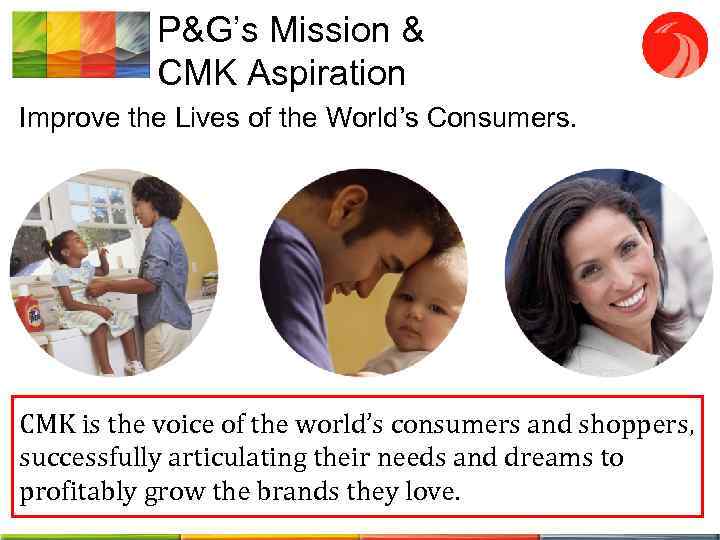 P&G’s Mission & CMK Aspiration Improve the Lives of the World’s Consumers. CMK is the voice of the world’s consumers and shoppers, successfully articulating their needs and dreams to profitably grow the brands they love.
 AWARDED CMK QUESTION Best answer to win P&G formed first market research department in 1924. We talk to about 4 million consumers in a year.
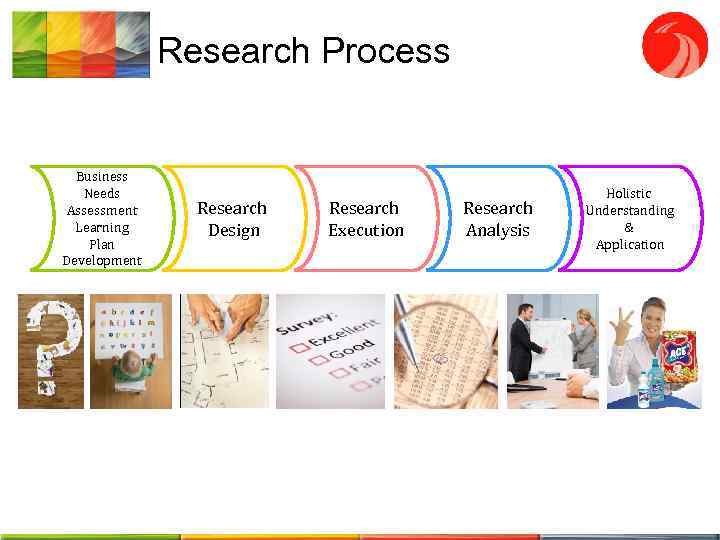 Research Process Business Needs Assessment Learning Plan Development Research Design Research Execution Research Analysis Holistic Understanding & Application
 Decision to Do a Research • When it is actionable: – Several alternative ways available to pursue. – Business question can be answered via research findings. • When there is no alternative way of learning: – Added value from the research will be higher than alternative learning ways. • When the research investment is substantially lower than the $ opportunity at risk.
 Decision to Do a Research • Whatever research learning is, course of action won’t change. • Unfortunately, research does not replace doing our own homework! – We shouldn’t ask consumers for ideas… • We don’t really know what we’re looking for… • It’s just too late.
 Research Methods Qualitative • Why? How? • Few people • Detailed • Free discussion flow • Insights, consumer inputs • Explanatory – Vague Quantitative • How Many? • Many People • Brief • Structured discussion flow • Numerical conclusions • Conclusive - Precise
 Qualitative Research • Answers: “Why? ” and “How? ” – Attitudes – Motivations – Behaviors Styles – Beliefs – Feelings – Life • Allows to stay close to consumers & consumer language. • Does not answer: How Many? • It is explanatory, only helps judgement. never call it a qualification
 Qualitative Research • Sample size is small. • Does not reflect a demographic structure never say x% of respondents. . . • Not representative. • Respondents influence each other. • Not comparable vs. other studies DON’T MAKE ANY DECISIONS BASED ON A QUALITATIVE RESEARCH OR DRAW CONCLUSIONS ABOUT THE
 When Qualitative Research? • Basic Category Assessment / Idea generation tool: – To provide first hand experience about what consumers think/feel and how they behave
 When Qualitative Research? • Preliminary step for quantitative research: – To develop hypothesis on how consumers think/feel/decide – To explore consumer issues related to a subject – To learn about new target groups – To learn consumer language – To build and improve concepts – To reduce number of concept alternatives before concept test.
 When Qualitative Research? • To understand the results of quantitative research: – To understand unexpected findings – To understand the reasons for certain trends – To explore why a product/copy is performing different vs. expectations.
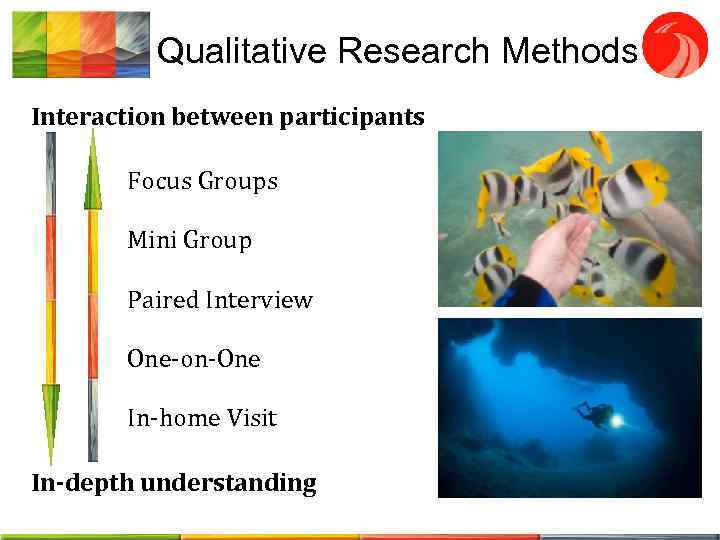 Qualitative Research Methods Interaction between participants Focus Groups Mini Group Paired Interview One-on-One In-home Visit In-depth understanding
 Focus Groups (6 -8 interviewees) Used to: – Generate ideas/insights for new concepts/products. – Check general appeal of concepts/product ideas. (NOT to measure trial generated by concept) – Reduce number of concepts/ideas. Learn about: – Likes/dislikes – Perceptions – Behavior – Motivations – Needs – Frustrations
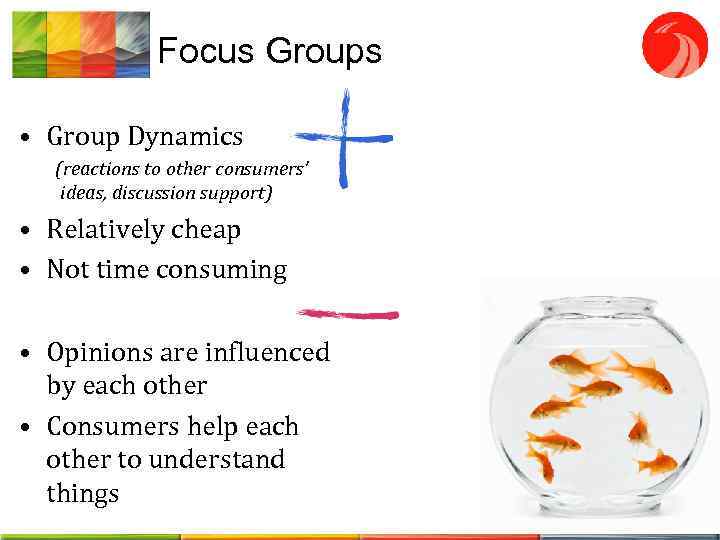 Focus Groups • Group Dynamics (reactions to other consumers’ ideas, discussion support) • Relatively cheap • Not time consuming • Opinions are influenced by each other • Consumers help each other to understand things
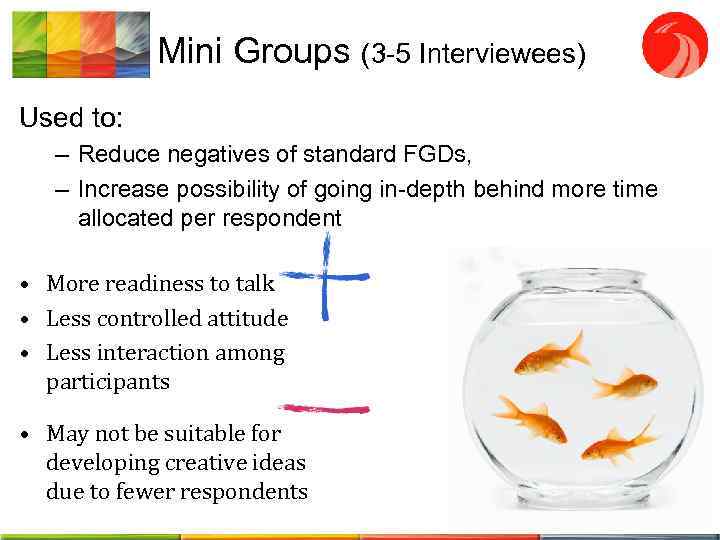 Mini Groups (3 -5 Interviewees) Used to: – Reduce negatives of standard FGDs, – Increase possibility of going in-depth behind more time allocated per respondent • More readiness to talk • Less controlled attitude • Less interaction among participants • May not be suitable for developing creative ideas due to fewer respondents
 Individual In-Depth Interview Used to: – – Gain in-depth learning Understand sensitive topics Have specialists’ opinions on certain subjects Check clarity of message • More spontaneous information • More in-depth information • Respondents are not influenced by others • Needs more time and effort • Not creative
 Paired Interview (2 interviewees) • Can be considered instead of individual interviews/one-on-ones • It’s a compromise between group and one-on-one • It’s not very often used (in comparison with individual interviews) • Additional stimulus by a second person • Less monotonous than individuals
 In-Home Visits Used to: – Be in consumers’ shoes – Get information that we can’t get in a studio (HOW do respondents perform their habits, how apply products etc) • More relaxed atmosphere • First hand information • Helps your empathy • Needs more time and effort
 Quantitative Research Methods • Answers: HOW MANY? • Large sample • Reflects the demographic structure of the society. • Representative You can say x% of respondents… • Comparable b/t legs, groups, over time and countries, in case key research methodology is not changed. • Provides “hard” data to support a decision!
 Quantitative Research Methods • Do not give deep information on: Why? , How? • Questionniare is structured, limited possibility to: – Go into details on motivations, attitudes (as in qualitative research) – Give answers beyond proposed alternatives (closed questions) • Provides numbers, hard to see the real life person behind the data. • Followed up with a qualitative research to explain deeper reasons behind findings.
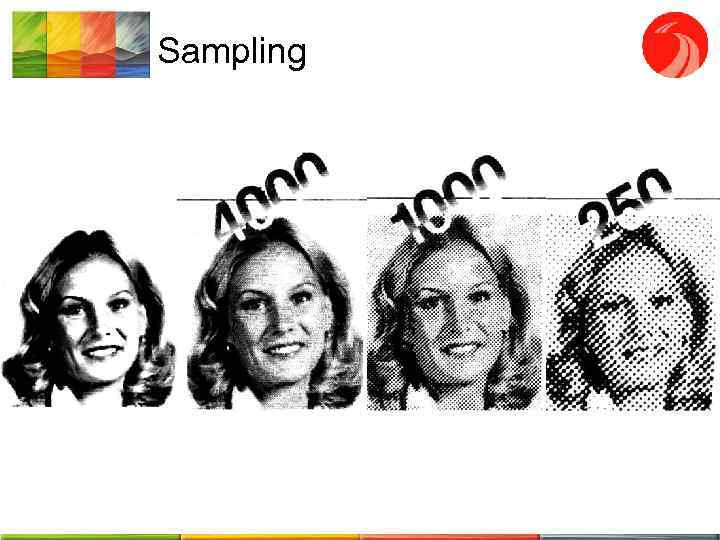 Sampling
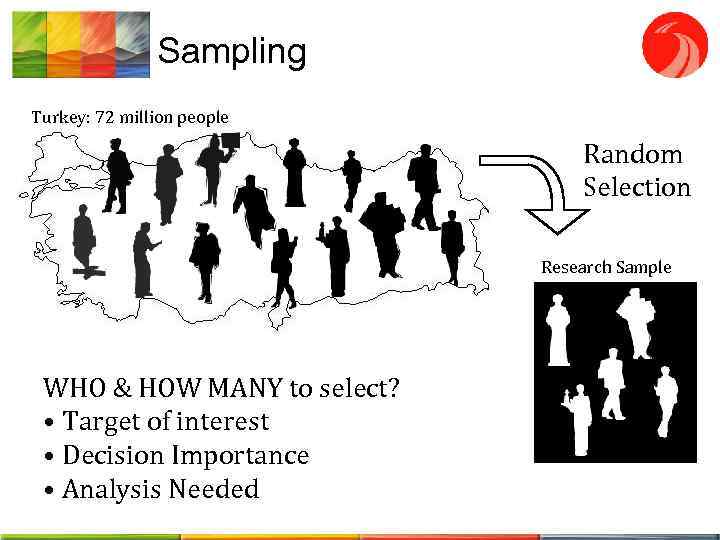 Sampling Turkey: 72 million people Random Selection Research Sample WHO & HOW MANY to select? • Target of interest • Decision Importance • Analysis Needed
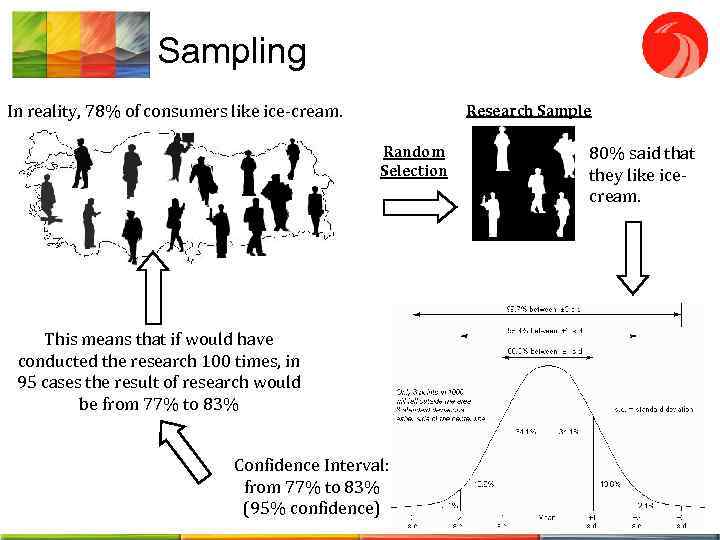 Sampling In reality, 78% of consumers like ice-cream. Research Sample Random Selection This means that if would have conducted the research 100 times, in 95 cases the result of research would be from 77% to 83% Confidence Interval: from 77% to 83% (95% confidence) 80% said that they like icecream.
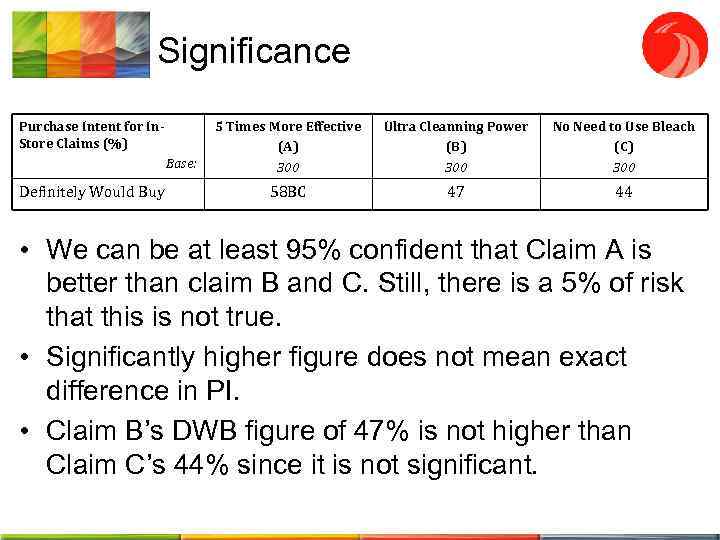 Significance Purchase Intent for In. Store Claims (%) Base: Definitely Would Buy 5 Times More Effective (A) 300 Ultra Cleanning Power (B) 300 No Need to Use Bleach (C) 300 58 BC 47 44 • We can be at least 95% confident that Claim A is better than claim B and C. Still, there is a 5% of risk that this is not true. • Significantly higher figure does not mean exact difference in PI. • Claim B’s DWB figure of 47% is not higher than Claim C’s 44% since it is not significant.
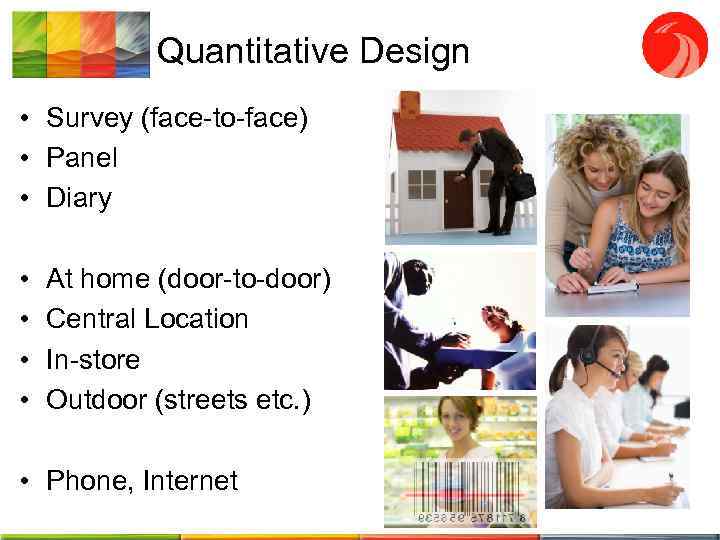 Quantitative Design • Survey (face-to-face) • Panel • Diary • • At home (door-to-door) Central Location In-store Outdoor (streets etc. ) • Phone, Internet