


 Скачать презентацию Product Life Cycle Assessment Life Cycle Flowchart
20c9fa0ec55a4eaa848d4b77c524f207.ppt
- Количество слайдов: 30
 Product Life Cycle Assessment
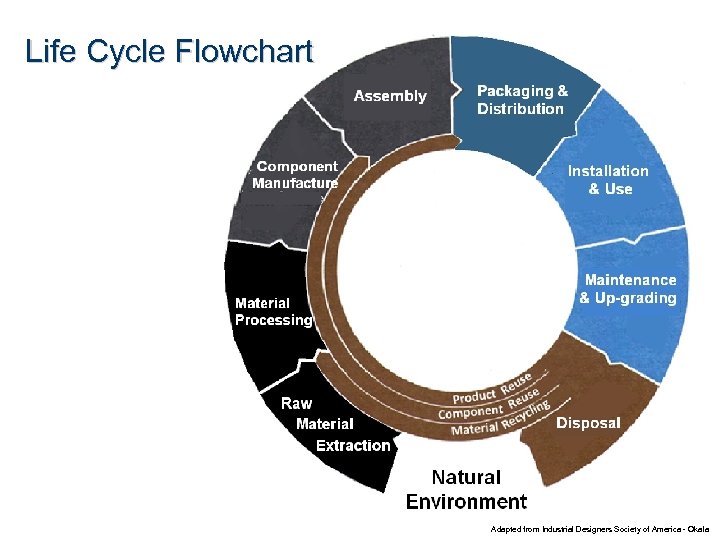 Life Cycle Flowchart Adapted from Industrial Designers Society of America - Okala
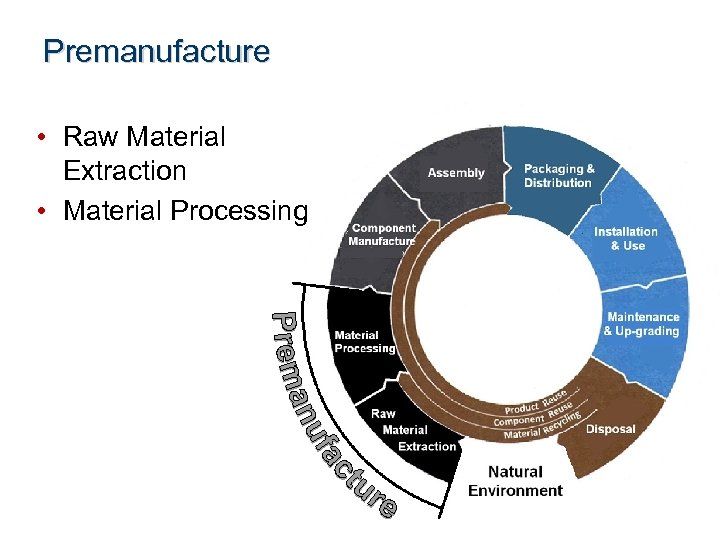 Premanufacture • Raw Material Extraction • Material Processing
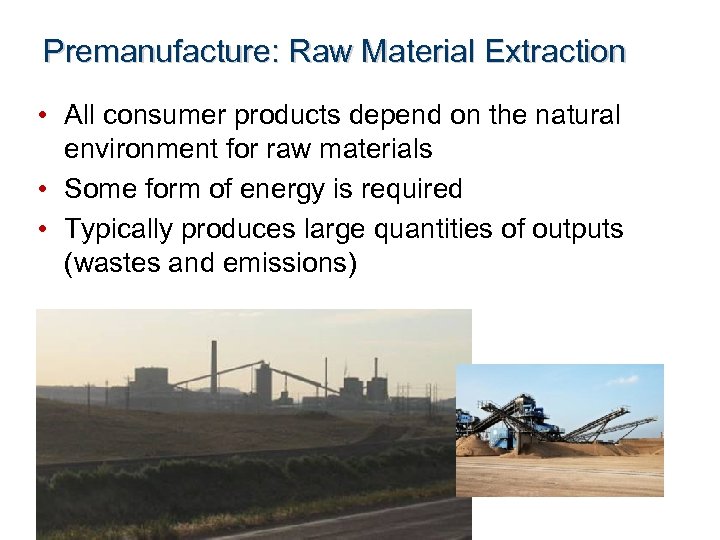 Premanufacture: Raw Material Extraction • All consumer products depend on the natural environment for raw materials • Some form of energy is required • Typically produces large quantities of outputs (wastes and emissions)
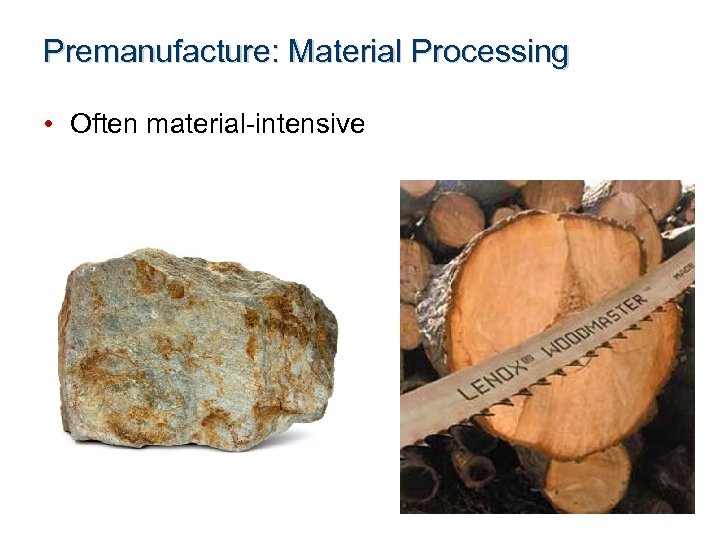 Premanufacture: Material Processing • Often material-intensive
 Premanufacture: Material Processing • Often material-intensive • Energy is required Material Titanium Aluminum Polystyrene Polyvinylchloride (PVC) Paper Glass Wood Energy Cost Extracted from (MJ/kg) 900 - 940 227 -342 87 - 115 85 - 107 25 -50 18 -35 3– 7 Ore concentrate Bauxite Crude oil Standing timber Sand, etc. Standing timber
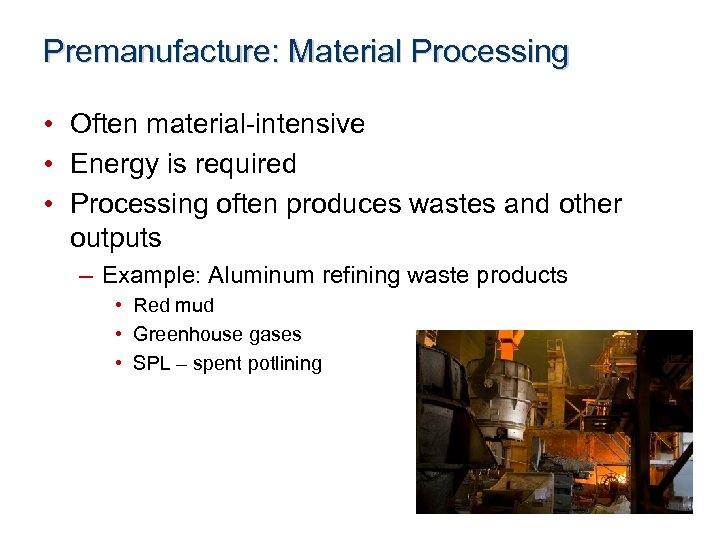 Premanufacture: Material Processing • Often material-intensive • Energy is required • Processing often produces wastes and other outputs – Example: Aluminum refining waste products • Red mud • Greenhouse gases • SPL – spent potlining
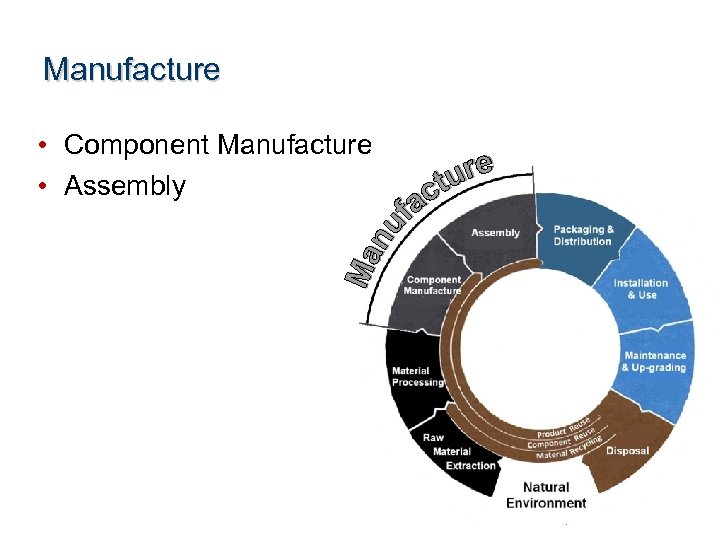 Manufacture • Component Manufacture • Assembly
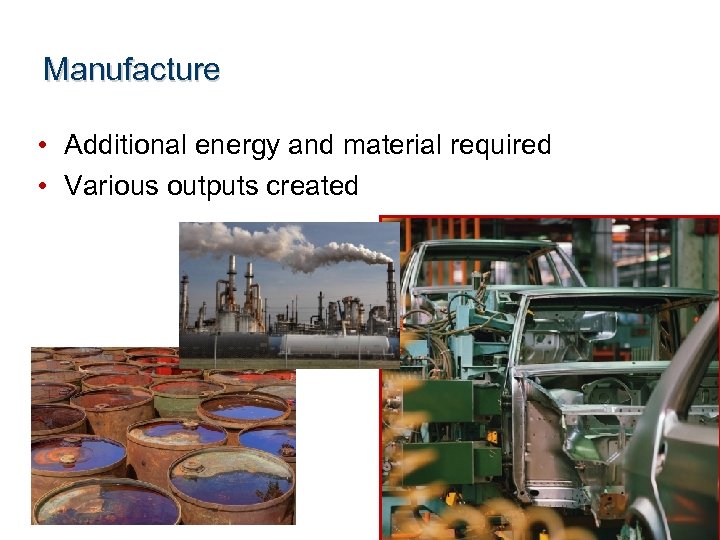 Manufacture • Additional energy and material required • Various outputs created
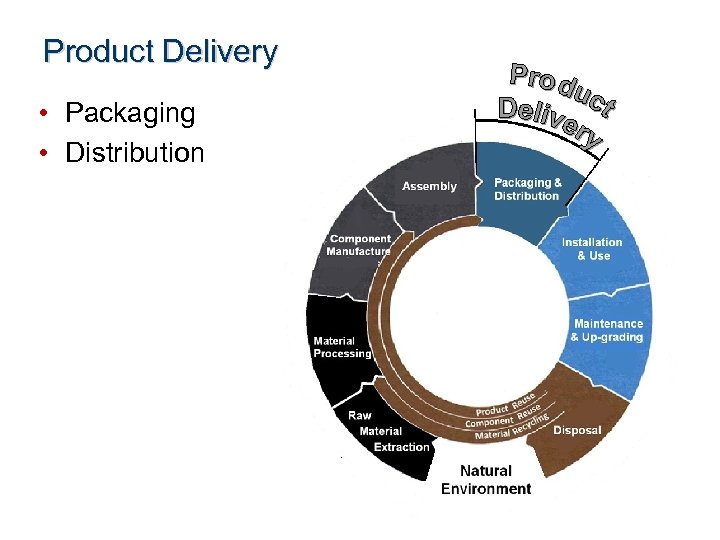 Product Delivery • Packaging • Distribution
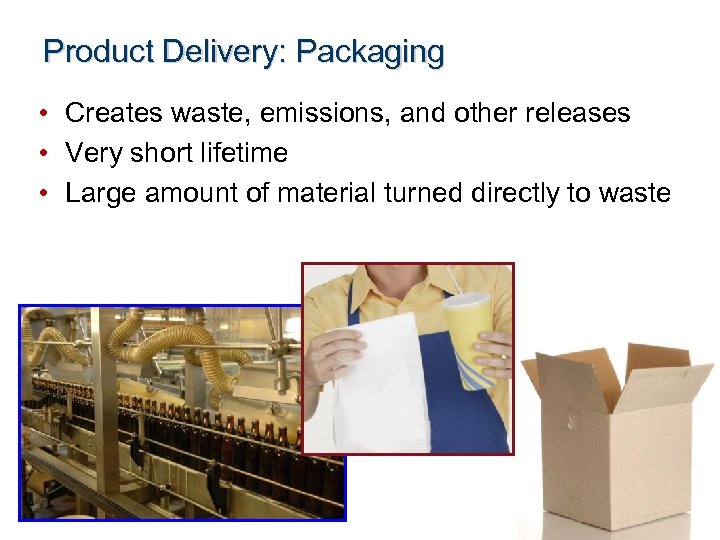 Product Delivery: Packaging • Creates waste, emissions, and other releases • Very short lifetime • Large amount of material turned directly to waste
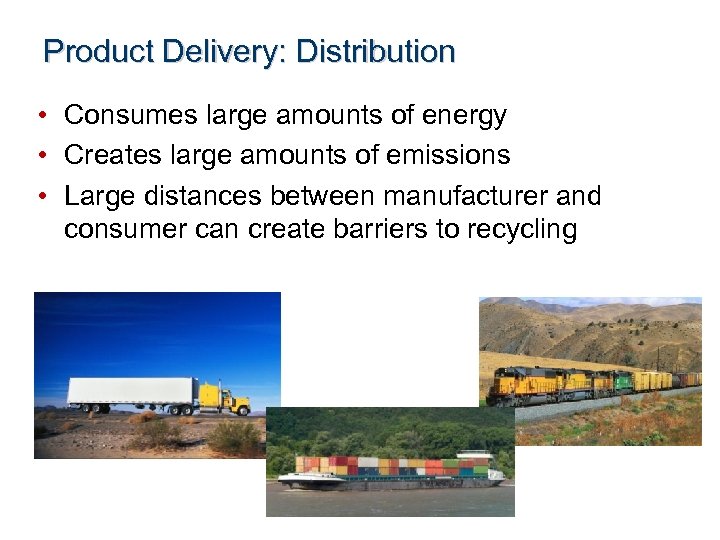 Product Delivery: Distribution • Consumes large amounts of energy • Creates large amounts of emissions • Large distances between manufacturer and consumer can create barriers to recycling
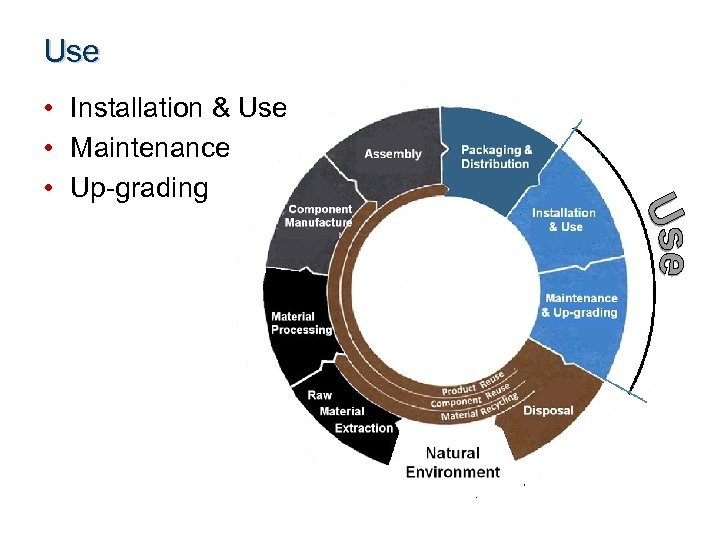 Use • Installation & Use • Maintenance • Up-grading
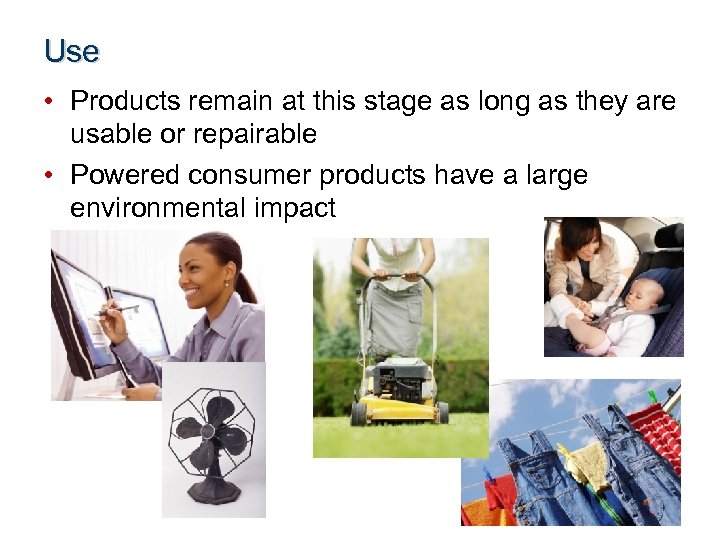 Use • Products remain at this stage as long as they are usable or repairable • Powered consumer products have a large environmental impact
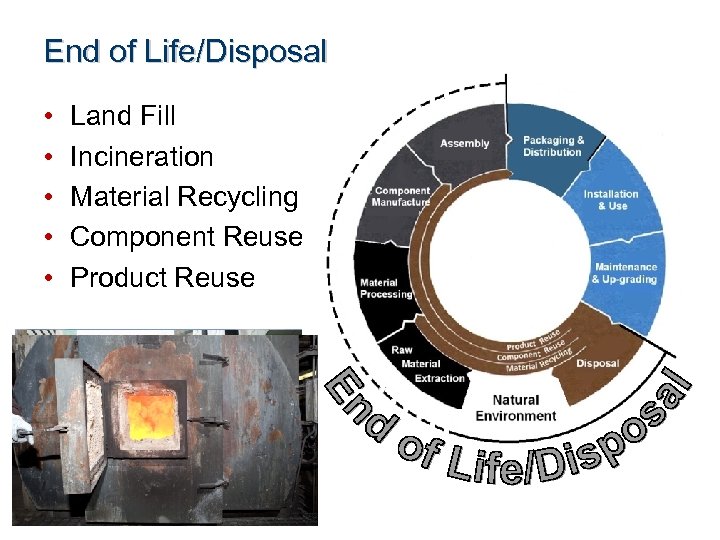 End of Life/Disposal • • • Land Fill Incineration Material Recycling Component Reuse Product Reuse
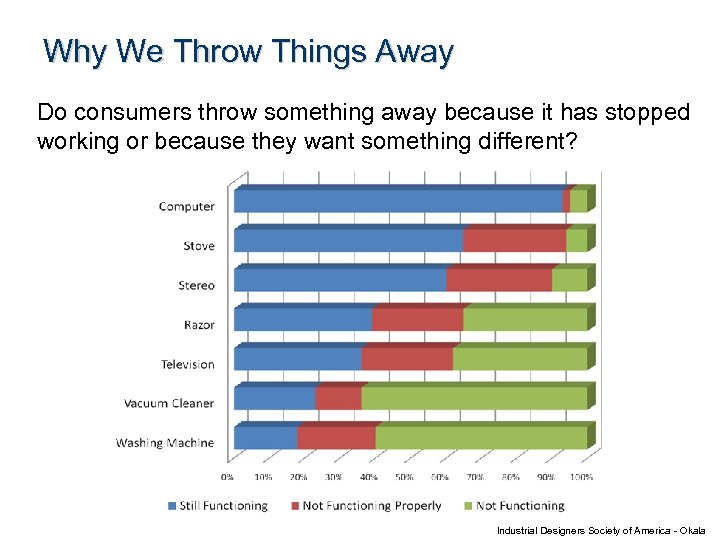 Why We Throw Things Away Do consumers throw something away because it has stopped working or because they want something different? Industrial Designers Society of America - Okala
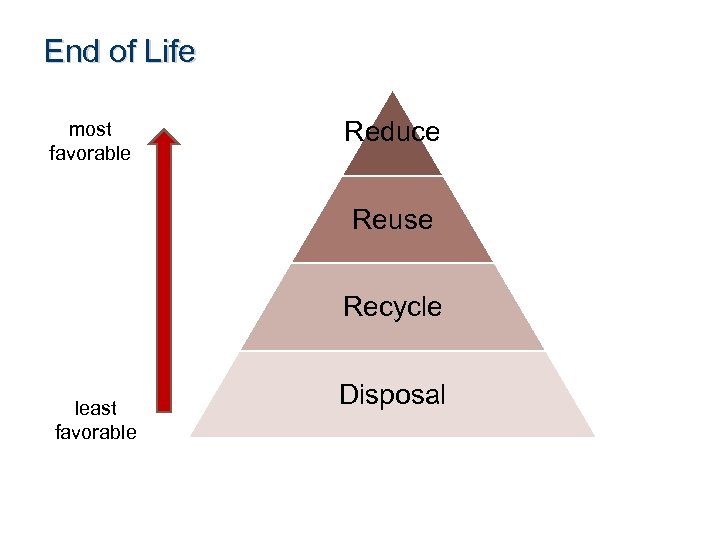 End of Life most favorable Reduce Reuse Recycle least favorable Disposal
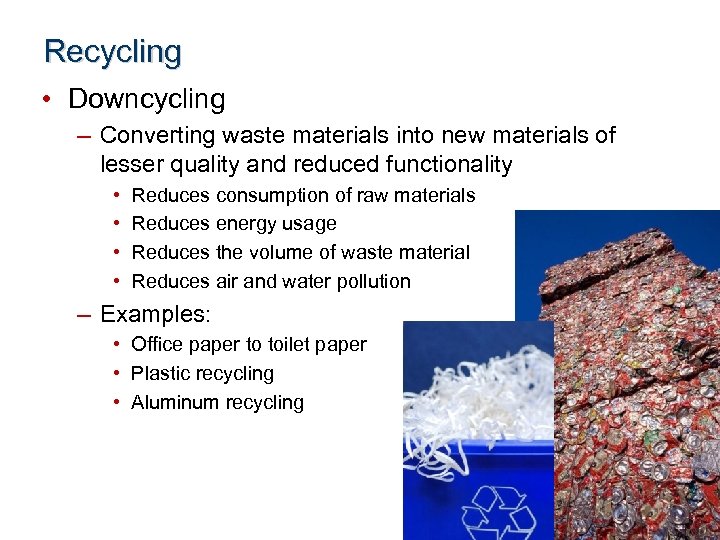 Recycling • Downcycling – Converting waste materials into new materials of lesser quality and reduced functionality • • Reduces consumption of raw materials Reduces energy usage Reduces the volume of waste material Reduces air and water pollution – Examples: • Office paper to toilet paper • Plastic recycling • Aluminum recycling
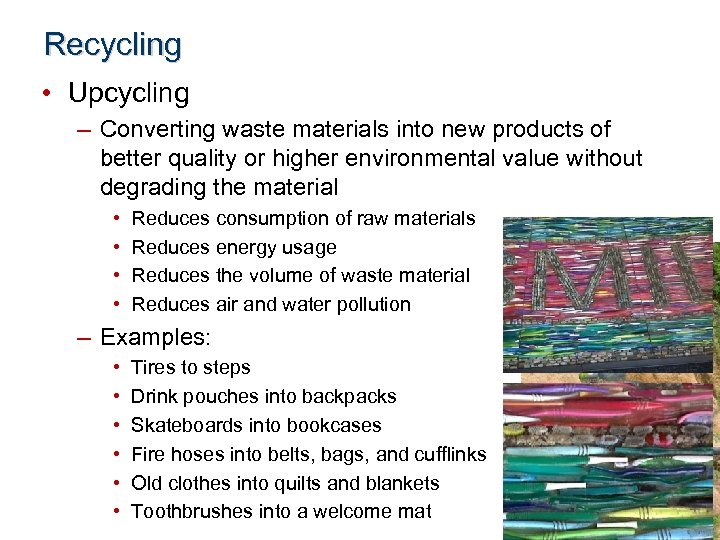 Recycling • Upcycling – Converting waste materials into new products of better quality or higher environmental value without degrading the material • • Reduces consumption of raw materials Reduces energy usage Reduces the volume of waste material Reduces air and water pollution – Examples: • • • Tires to steps Drink pouches into backpacks Skateboards into bookcases Fire hoses into belts, bags, and cufflinks Old clothes into quilts and blankets Toothbrushes into a welcome mat
 Environmental Concerns • • • Global climate change Human organism damage Water availability and quality Depletion of fossil fuels Loss of biodiversity Stratospheric ozone depletion Land use patterns Depletion of non-fossil fuel resources Acid disposition
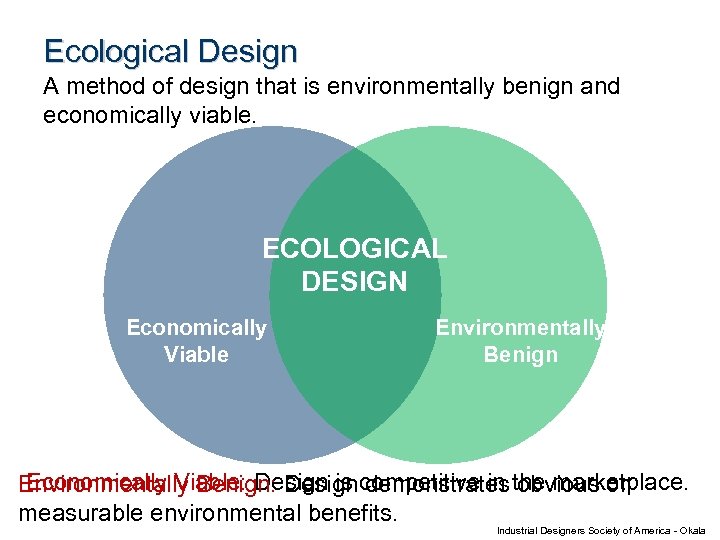 Ecological Design A method of design that is environmentally benign and economically viable. ECOLOGICAL DESIGN Economically Viable Environmentally Benign Economically Viable: Design is demonstrates obvious or Environmentally Benign: Design competitive in the marketplace. measurable environmental benefits. Industrial Designers Society of America - Okala
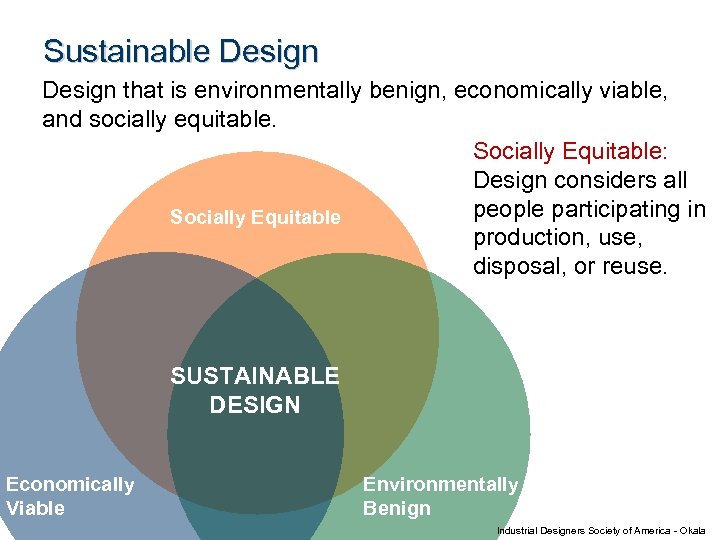 Sustainable Design that is environmentally benign, economically viable, and socially equitable. Socially Equitable: Design considers all people participating in Socially Equitable production, use, disposal, or reuse. SUSTAINABLE DESIGN Economically Viable Environmentally Benign Industrial Designers Society of America - Okala
 Design for Sustainability • Sustainable product design involves. . . – Minimizing the consumption of materials, energy, and water – Avoiding. Social or hazardous materials and processes toxic Equity – Recycling or reusing materials SUSTAINABLE DESIGN Economically Viable Environmentally Benign
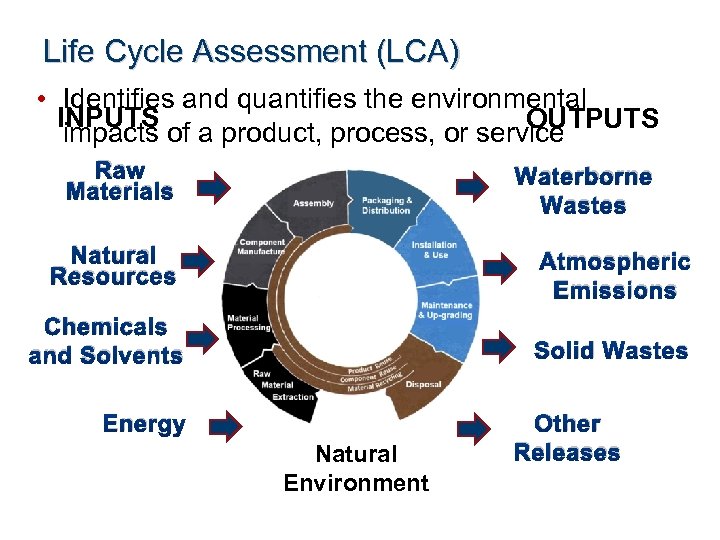 Life Cycle Assessment (LCA) • Identifies and quantifies the environmental INPUTS OUTPUTS impacts of a product, process, or service Raw Materials Waterborne Wastes Natural Resources Atmospheric Emissions Chemicals and Solvents Solid Wastes Energy Natural Environment Other Releases
 Life Cycle Assessment (LCA) • A technique used to assess the environmental aspects and potential impacts of a product, process, or service throughout the life of a product • LCA includes: – – Goal definition and scoping Inventory analysis of inputs and outputs Environmental impacts assessment Interpretation SUSTAINABLE DESIGN Economically Viable Environmentally Benign
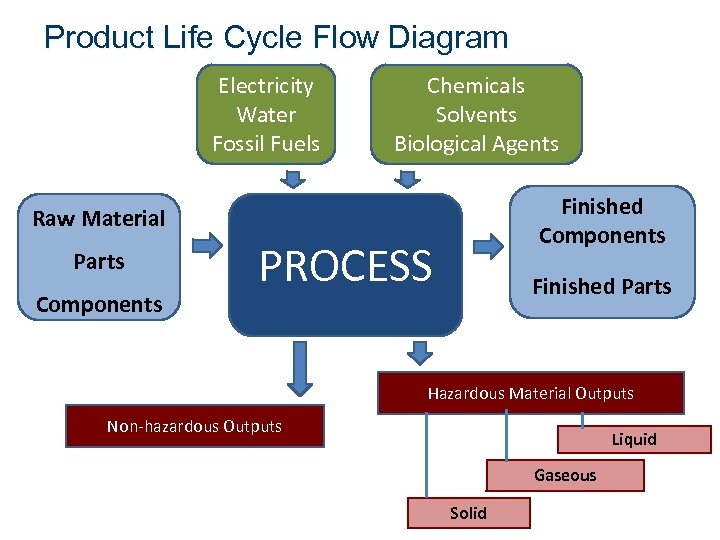 Product Life Cycle Flow Diagram Electricity Water Fossil Fuels Chemicals Solvents Biological Agents Finished Components Raw Material Parts Components PROCESS Finished Parts Hazardous Material Outputs Non-hazardous Outputs Liquid Gaseous Solid
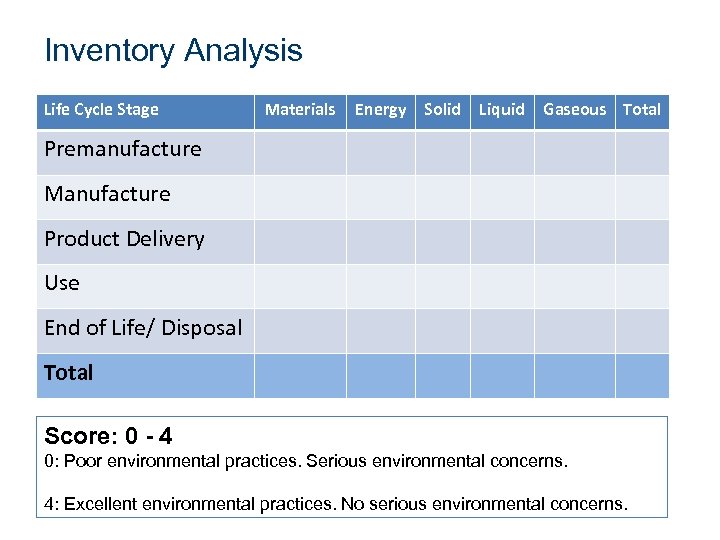 Inventory Analysis Life Cycle Stage Materials Energy Solid Liquid Gaseous Total Premanufacture Manufacture Product Delivery Use End of Life/ Disposal Total Score: 0 - 4 0: Poor environmental practices. Serious environmental concerns. 4: Excellent environmental practices. No serious environmental concerns.
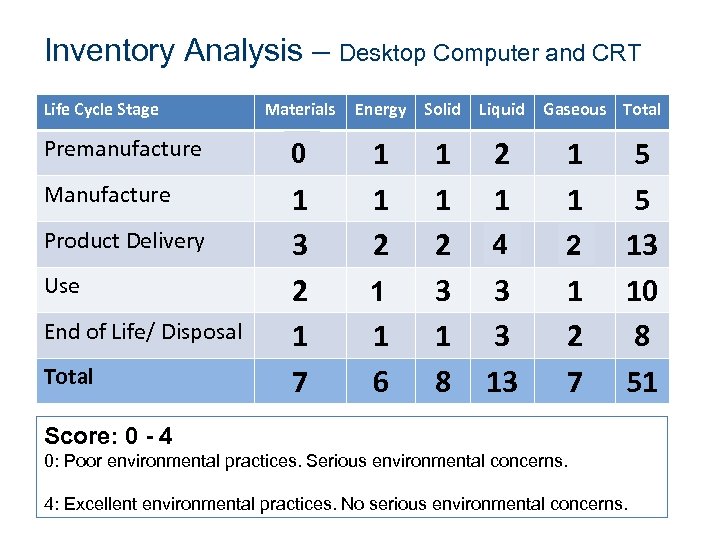 Inventory Analysis – Desktop Computer and CRT Life Cycle Stage Materials Energy Solid Liquid Premanufacture 0 Manufacture 1 3 2 1 7 1 1 2 1 1 1 6 1 1 2 3 1 8 2 1 4 4 3 3 13 Product Delivery Use End of Life/ Disposal Total Gaseous Total 1 1 2 7 5 5 13 10 8 51 Score: 0 - 4 0: Poor environmental practices. Serious environmental concerns. 4: Excellent environmental practices. No serious environmental concerns.
 Image Resources Industrial Designers Society of America. (2009). Okala: Learning ecological design. Phoenix, AZ Microsoft, Inc. (n. d. ). Clip art. Retrieved from http: //office. microsoft. com/en-us/clipart/default. aspx
 Resources Gutowski, T. G. Design and manufacturing for the environment. (2004). Retrieved from http: //web. mit. edu/ebm/www/Publications/Gutowski%20 Mech%20 En g%20 Handbook%20 Ch%20 Dec%206%2020041. pdf Scientific Applications International Corporation. (2006). Life cycle assessment: Principles and practice. Retrieved from http: //www. epa. gov/nrmrl/lcaccess/lca 101. html.