


 Скачать презентацию Product and technology assessment Agenda Product and
Lecture 10_LIFE CYCLE ANALYSES.ppt
- Количество слайдов: 42
 Product and technology assessment
 Agenda Product and technology assessment Life Cycle Assessment
 Product and technology assessment (PATA) It is a systematic assessment of primary, secondary, and tertiary impacts of products and technologies with respect to: Health Safety Environment & Society That covers the life cycle from raw materials to final disposal.
 PATA is used for: Designing regulations and guidelines; Approving new products & technologies; Designing & improving products; Making purchasing decisions.
 Sources and perspectives of PATA Science, engineering, technology Economics and finance Political, cultural and social sources Ideological & political thought Religious organisations. PATA is a process that relies on a set of different assessment approaches, in particular, Life Cycle Assessment (LCA). PATA differs from LCA by including health, safety, social and cultural factors and by not having an established methodology. Other tools in the set include: Risk Management, Environmental Impact Assessment, Human Factors, and Environmental Communications.
 Life Cycle Assessment (LCA) An LCA is an assessment of the environmental effects a product or service has during its lifetime, from cradle to grave. In an LCA all the important processes during the products lifecycle is included. An LCA can for example be used for assessing how much greenhouse gas is emitted to the environment during the production of one litre milk.
 Understanding a life-cycle approach Exploring eco-efficiency
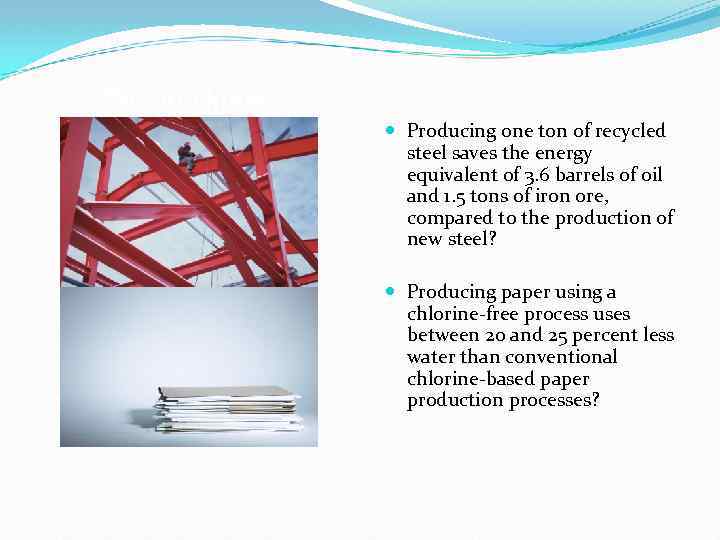 Did you know… Producing one ton of recycled steel saves the energy equivalent of 3. 6 barrels of oil and 1. 5 tons of iron ore, compared to the production of new steel? Producing paper using a chlorine-free process uses between 20 and 25 percent less water than conventional chlorine-based paper production processes?
 Learning objectives Recognize where products come from and where they go after use = life-cycle Think about a product’s impacts on the environment and economy throughout Qualify impacts Quantify impacts
 Structure Life-cycle – what is it? Choosing boundaries and shifting issues A life-cycle approach Life-cycle assessment – one tool Segue to life-cycle exercise
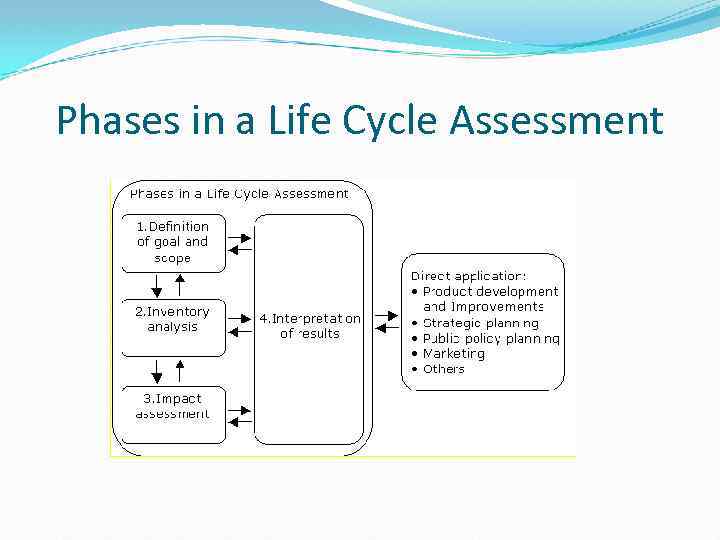 Phases in a Life Cycle Assessment
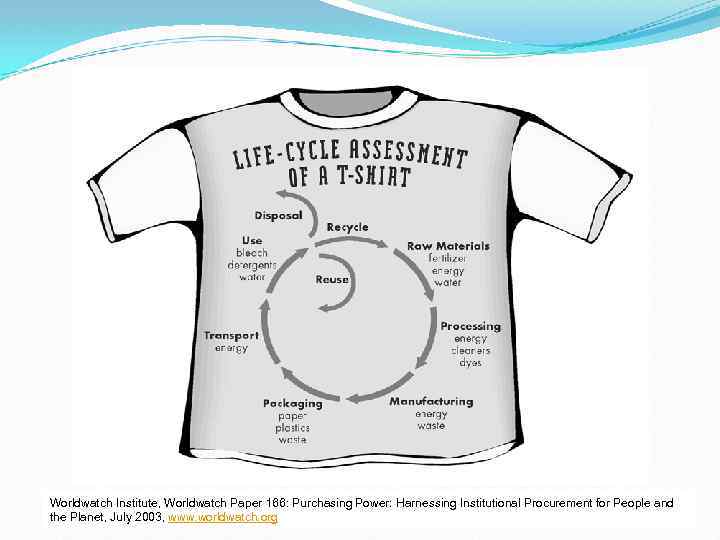 Worldwatch Institute, Worldwatch Paper 166: Purchasing Power: Harnessing Institutional Procurement for People and the Planet, July 2003, www. worldwatch. org
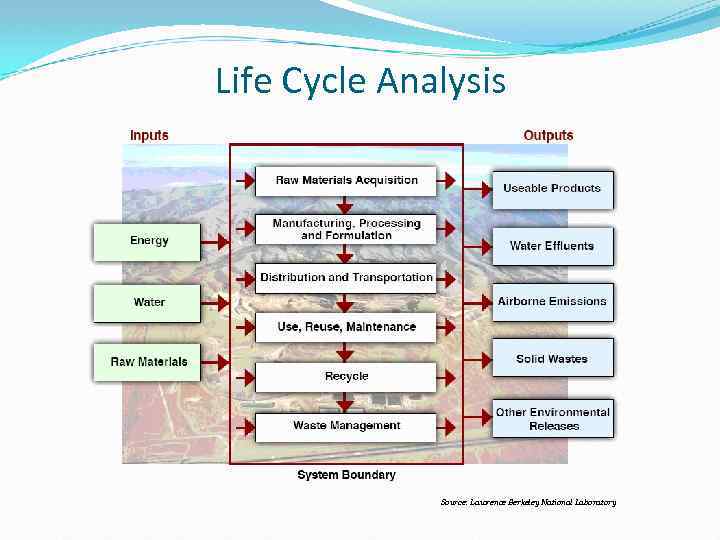
 Life-cycle stages Products can be evaluated through each stage of their lifecycle: Extraction or acquisition of raw materials Manufacturing and processing Distribution and transportation Use and reuse Recycling Disposal For each stage, identify inputs of materials and energy received; outputs of useful product and waste emissions Find optimal points for improvement – eco-efficiency
 Ensures companies identify the multiple environmental A life-cycle approach and resource issues across the entire life-cycle of the product Knowledge of these issues informs business activities: planning, procurement, design, marketing & sales Rather than just looking at the amount of waste that ends up in a landfill or an incinerator, a life-cycle approach identifies energy use, material inputs and waste generated from the time raw materials are obtained to the final disposal of the product * * Product Life-Cycle Analysis: Environmental activities for the classroom, Waste Management and Research Center, Champaign, IL, 1999
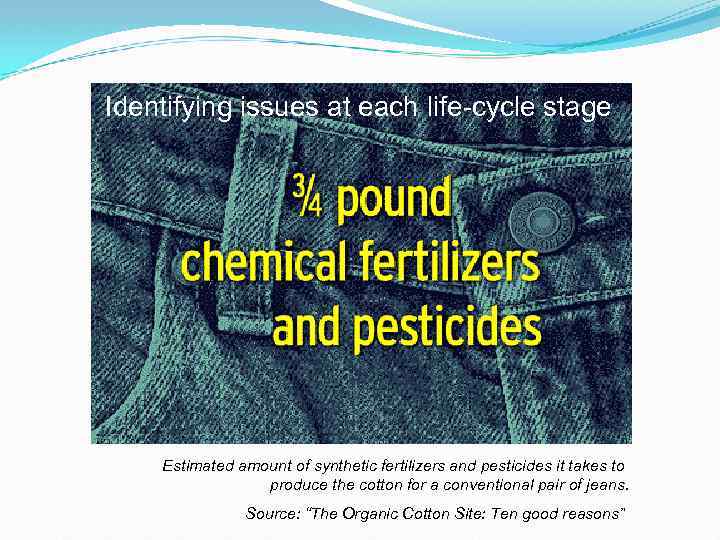 Identifying issues at each life-cycle stage Estimated amount of synthetic fertilizers and pesticides it takes to produce the cotton for a conventional pair of jeans. Source: “The Organic Cotton Site: Ten good reasons”

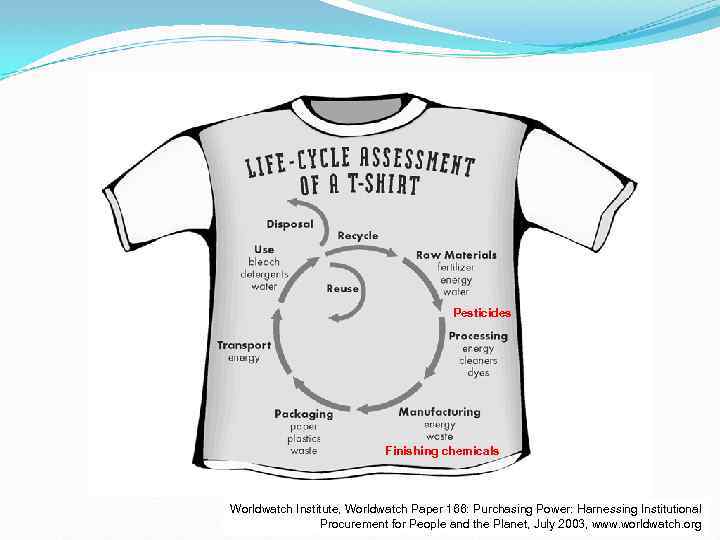 Pesticides Finishing chemicals Worldwatch Institute, Worldwatch Paper 166: Purchasing Power: Harnessing Institutional Procurement for People and the Planet, July 2003, www. worldwatch. org
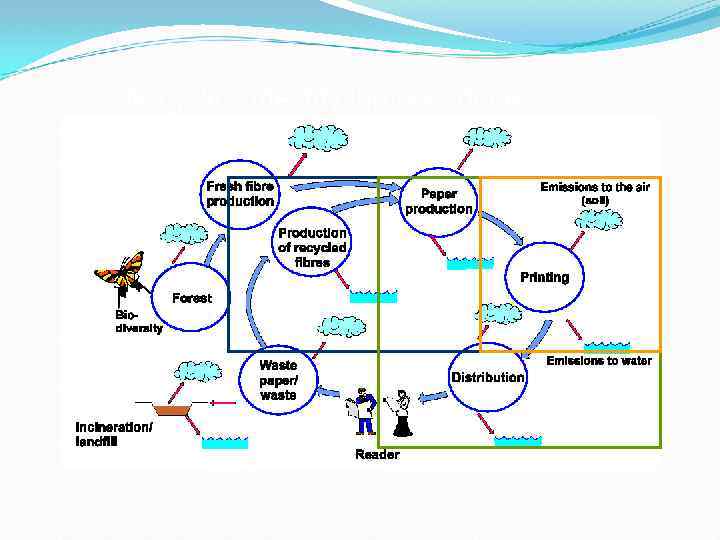 Life-cycle – identify the boundaries
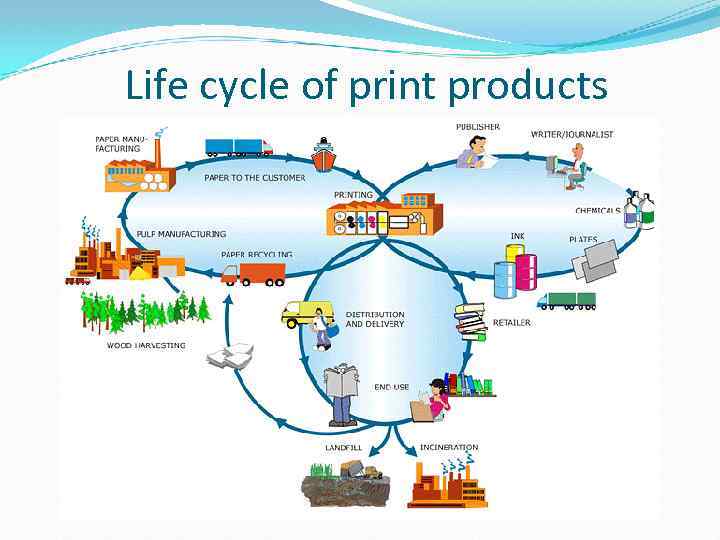 Life cycle of print products
 Looking at the entire life-cycle helps ensure reducing Life-cycle – helps avoid shifting the issues waste at one point does not simply create more waste at another point in the life-cycle Issues may be shifted – intentionally or inadvertently – among: Processes or manufacturing sites Geographic location Different budgets and planning cycles (first cost) Environmental media – air, water, soil Sustainability dimension: economic, social, environmental burdens Depends on “boundaries” Be conscious of what is shifted and to where!
 Methyl tertiary butyl ether - MTBE
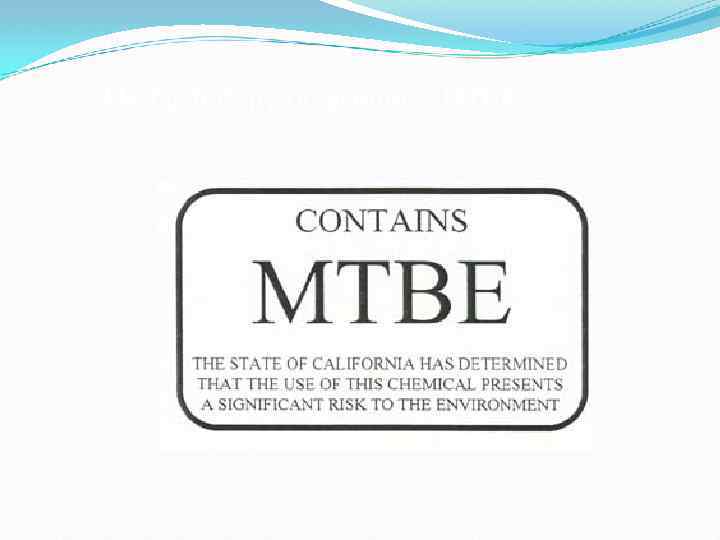 Methyl tertiary butyl ether - MTBE
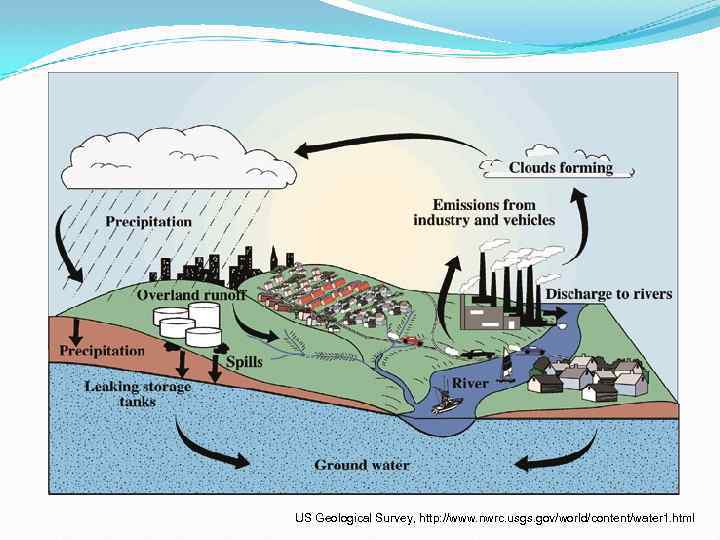 US Geological Survey, http: //www. nwrc. usgs. gov/world/content/water 1. html
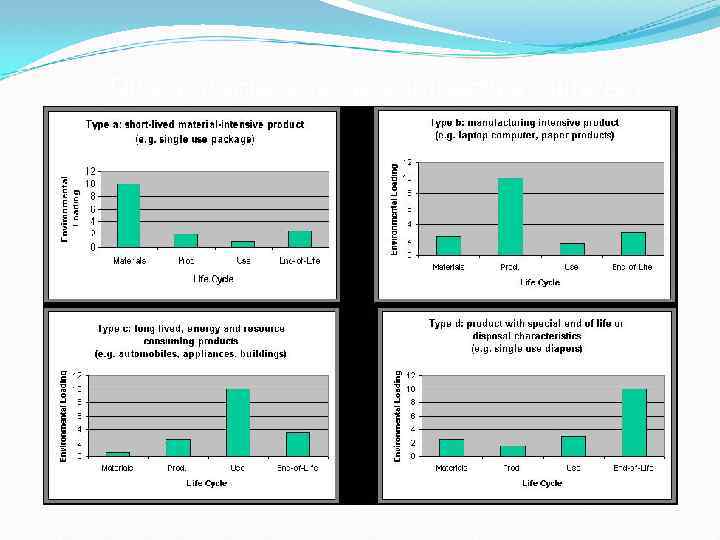 Different products have impacts at different life-cycle stages
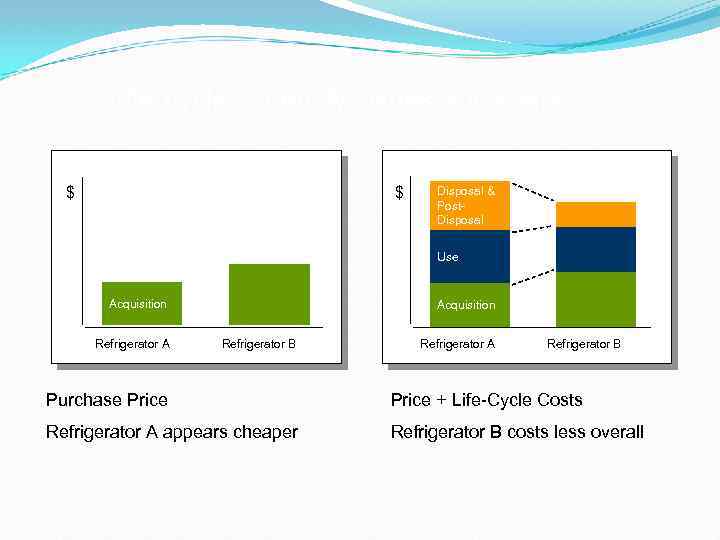 Life-cycle – identify issues and costs $ $ Disposal & Post. Disposal Use Acquisition Refrigerator A Acquisition Refrigerator B Refrigerator A Refrigerator B Purchase Price + Life-Cycle Costs Refrigerator A appears cheaper Refrigerator B costs less overall
 A life-cycle approach With a life-cycle approach, companies employ the tools they need to: Reduce impacts across the life-cycle Capitalize on opportunities for their business Tools range from simple mapping of life-cycle stages to comprehensive quantitative assessments
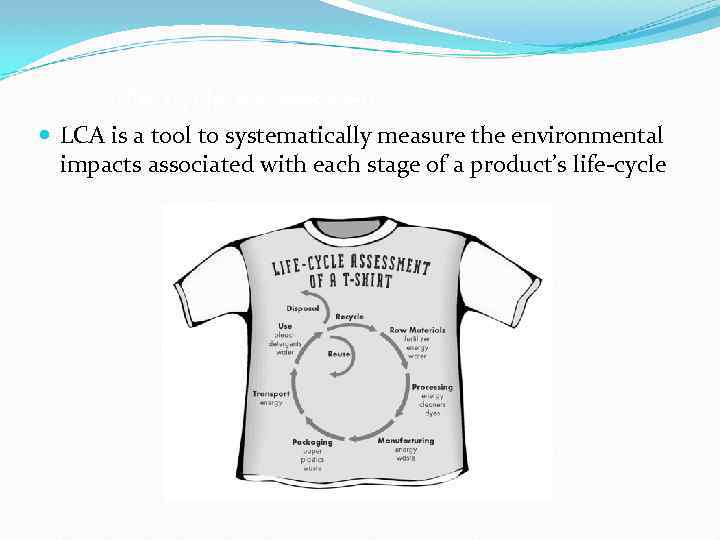 Life-cycle assessment LCA is a tool to systematically measure the environmental impacts associated with each stage of a product’s life-cycle
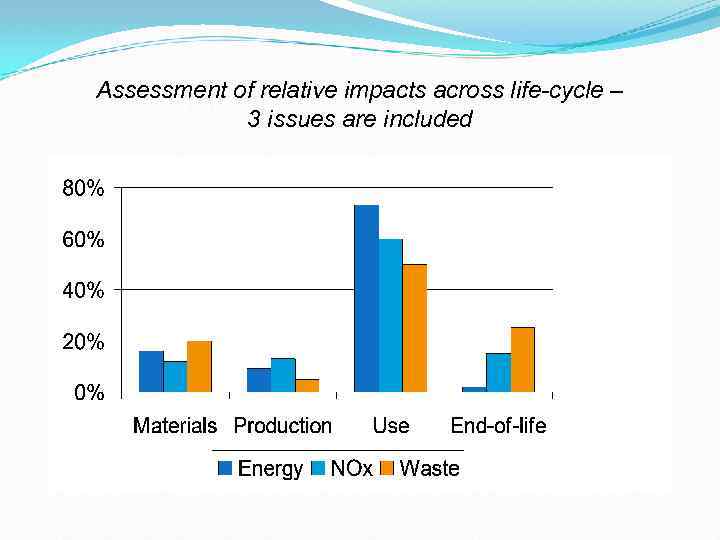 Assessment of relative impacts across life-cycle – Life-cycle assessment 3 issues are included
 Life-cycle assessment Two attributes make LCA distinct and useful as an analytical tool: whole system consideration of the total product life-cycle presentation of tradeoffs among multiple environmental issues LCA is quantitative
 1. 2. 3. 4. 5. Determine scope and system boundaries How to do LCA functional unit life-cycle stages define “unit processes” Data collection Analysis of inputs and outputs Assessment of numerous environmental issues Interpretation LCA principles and framework are standardized by the Organization for International Standardization’s 14040 series of standards (ISO 14040)
 Conclusions – why take a life-cycle approach? Systems perspective Integrates environment into core business issues Efficiency Innovation Better return on investment – identify point of “biggest bang for the buck” * Engage stakeholders – investors, customers, employees Environment is not a cost center for the company, but a business opportunity * www. ciwmb. ca. gov/EPP/Life. Cycle/default. htm
 Systems perspective – why take a life-cycle approach? Conclusions Integrates environment into core business issues Efficiency Innovation Better return on investment Engage stakeholders Environment is not a cost center for the company, but a business opportunity Look beyond the company’s gate Expose trade-offs and opportunities Expand analysis of products, projects, policies and programs – what is the function, what are the boundaries, what are the impacts, where are the opportunities?
 Purpose of LCAs A company can use LCAs for several purposes: To give the company an overview of the environmental impacts internally, which gives the company foundation for making environmental improvements and thereby decreasing their environmental impacts. To put pressure on the company's suppliers to make more environmentally friendly raw materials. In marketing, where the company can market one or more of their products on its environmental profile or they can market their products compared to other similar products on the market. In product development phase, eco-design. In eco-design an LCA can be used for assessing the possible environmental impacts from a product that is under development. The LCA results can this way be used to change parameters in the product or the production here of.
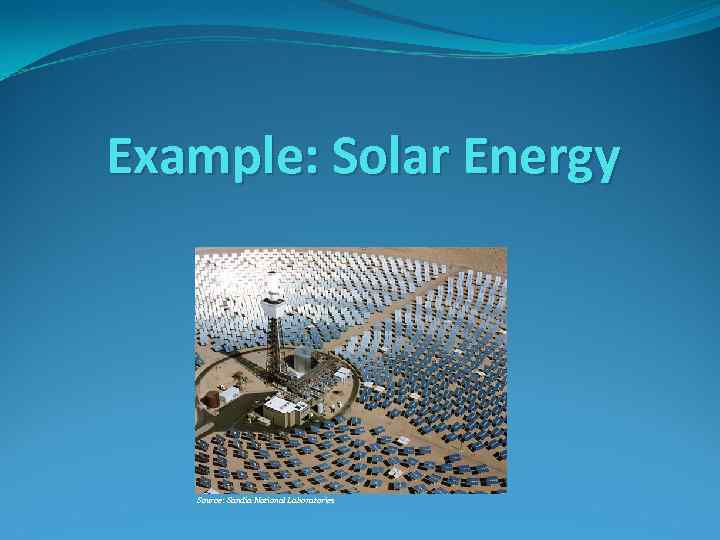 Example: Solar Energy Source: Sandia National Laboratories
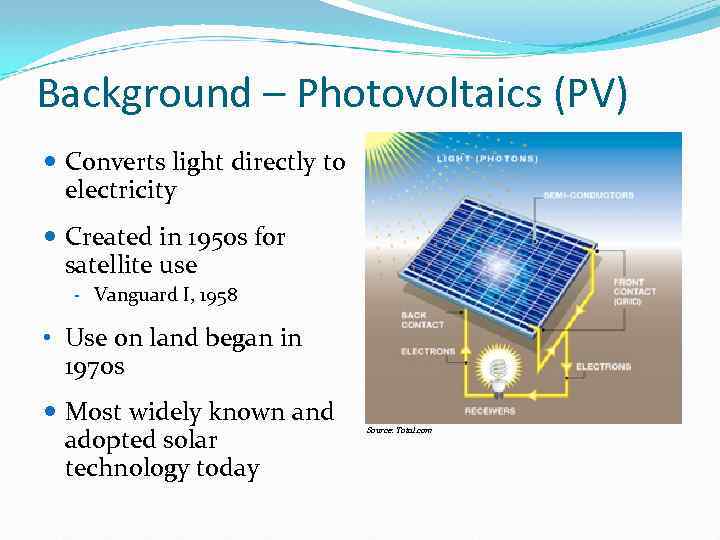 Background – Photovoltaics (PV) Converts light directly to electricity Created in 1950 s for satellite use - Vanguard I, 1958 • Use on land began in 1970 s Most widely known and adopted solar technology today Source: Total. com
 Life Cycle Analysis (LCA) Traditional evaluations only consider the “use” phase of life More accurate and comprehensive analyses consider a product "from cradle to grave” Each phase of life factors into the LCA: Raw Material Acquisition Manufacturing Transport Use/Maintenance Recycle/Waste Management
 Life Cycle Analysis Source: Lawrence Berkeley National Laboratory
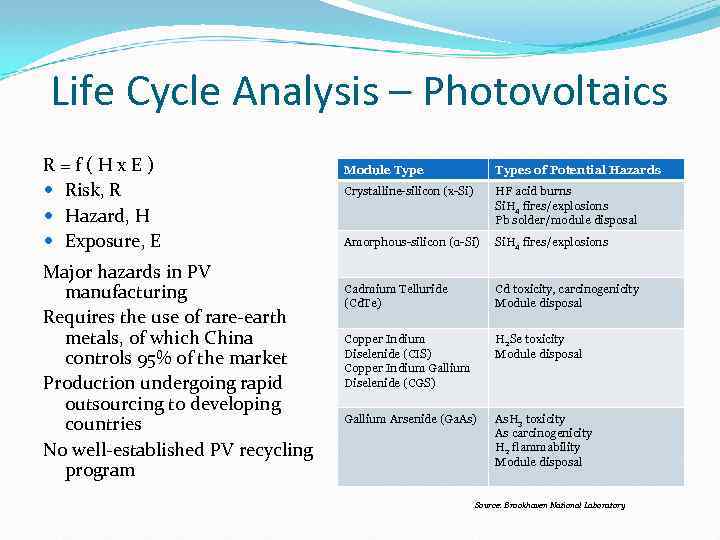 Life Cycle Analysis – Photovoltaics R = f ( H x E ) Risk, R Hazard, H Exposure, E Major hazards in PV manufacturing Requires the use of rare-earth metals, of which China controls 95% of the market Production undergoing rapid outsourcing to developing countries No well-established PV recycling program Module Types of Potential Hazards Crystalline-silicon (x-Si) HF acid burns Si. H 4 fires/explosions Pb solder/module disposal Amorphous-silicon (α-Si) Si. H 4 fires/explosions Cadmium Telluride (Cd. Te) Cd toxicity, carcinogenicity Module disposal Copper Indium Diselenide (CIS) Copper Indium Gallium Diselenide (CGS) H 2 Se toxicity Module disposal Gallium Arsenide (Ga. As) As. H 3 toxicity As carcinogenicity H 2 flammability Module disposal Source: Brookhaven National Laboratory
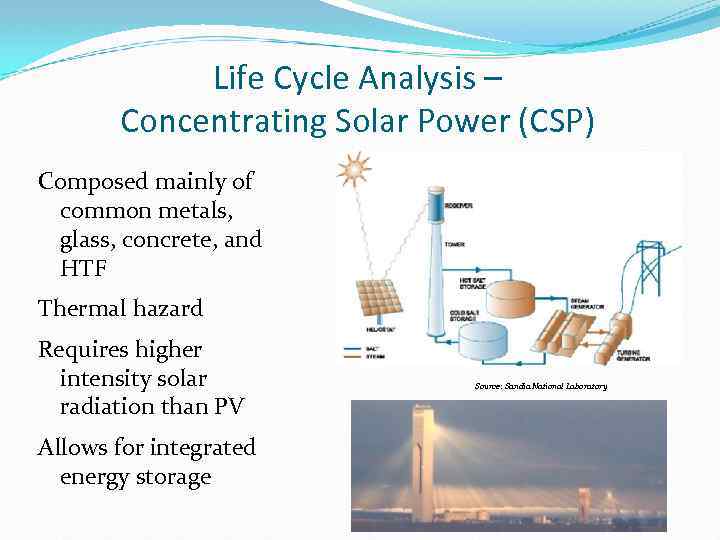 Life Cycle Analysis – Concentrating Solar Power (CSP) Composed mainly of common metals, glass, concrete, and HTF Thermal hazard Requires higher intensity solar radiation than PV Allows for integrated energy storage Source: Sandia National Laboratory
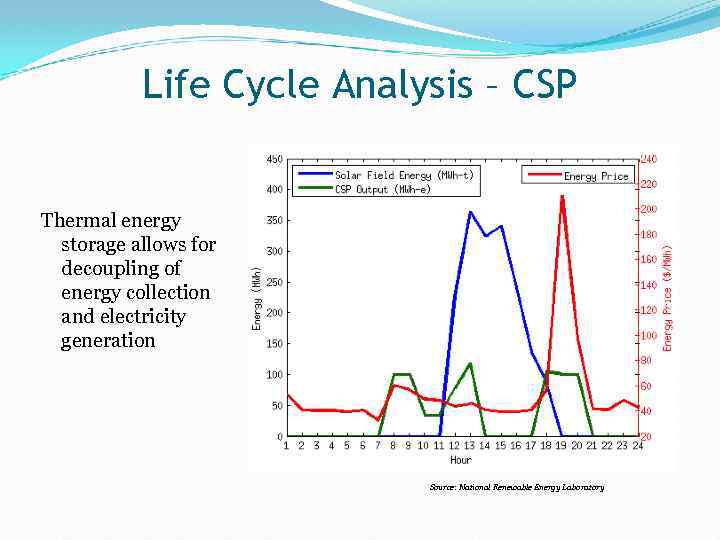 Life Cycle Analysis – CSP Thermal energy storage allows for decoupling of energy collection and electricity generation Source: National Renewable Energy Laboratory
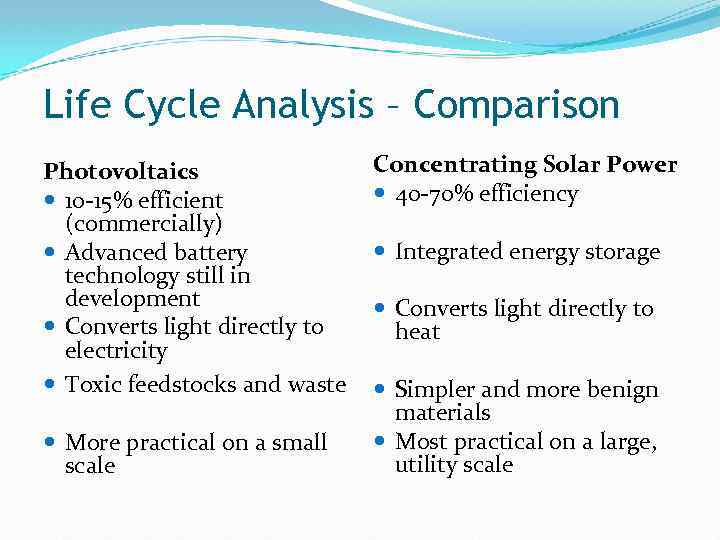 Life Cycle Analysis – Comparison Photovoltaics 10 -15% efficient (commercially) Advanced battery technology still in development Converts light directly to electricity Toxic feedstocks and waste More practical on a small scale Concentrating Solar Power 40 -70% efficiency Integrated energy storage Converts light directly to heat Simpler and more benign materials Most practical on a large, utility scale
 Hamburger exercise – life-cycle stages, inputs, outputs and issues …