


 Скачать презентацию Product analysis Learning ladder You must identify
b02ebb360be2a2059dad3323470a8304.ppt
- Количество слайдов: 9
 Product analysis Learning ladder You must: • identify ways of remembering how to analyse a product, e. g. ACCESS FM. • explain why product analysis is done in industry. You should: • disassemble products. • compare products and rank their customer appeal. You could: • evaluate products from a range of points of view. © Folens 2009
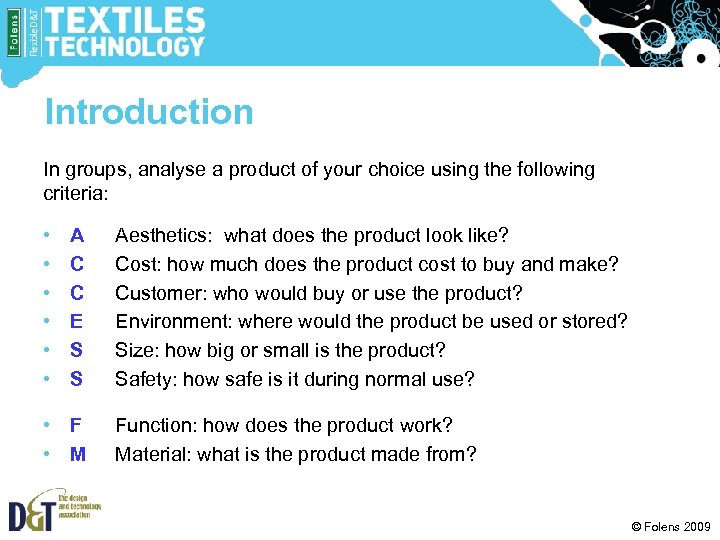 Introduction In groups, analyse a product of your choice using the following criteria: • • • A C C E S S • F • M Aesthetics: what does the product look like? Cost: how much does the product cost to buy and make? Customer: who would buy or use the product? Environment: where would the product be used or stored? Size: how big or small is the product? Safety: how safe is it during normal use? Function: how does the product work? Material: what is the product made from? © Folens 2009
 Product analysis (1) • A product analysis helps designers to examine products in detail. • Designers often buy products from competitors or buy inspirational products. • A designer might also look at products from the past. • They examine and evaluate products as well as take them apart (disassembly). • Designers might also look at products from the past. • Also time and research costs are reduced as another company has already done this work. © Folens 2009
 Product analysis (2) • A disadvantage of doing this could be that the market is already saturated with the idea and the product might not sell. • A company also has to be careful not to break copyright laws and ensure their new product is significantly different from the original. • There are many different ways of analysing a product including using the ACCESS FM format you have used in the introduction. • The letters are a quick and easy way of remembering the key things you need to look for. • This Power. Point® will show you other ways of analysing products. © Folens 2009
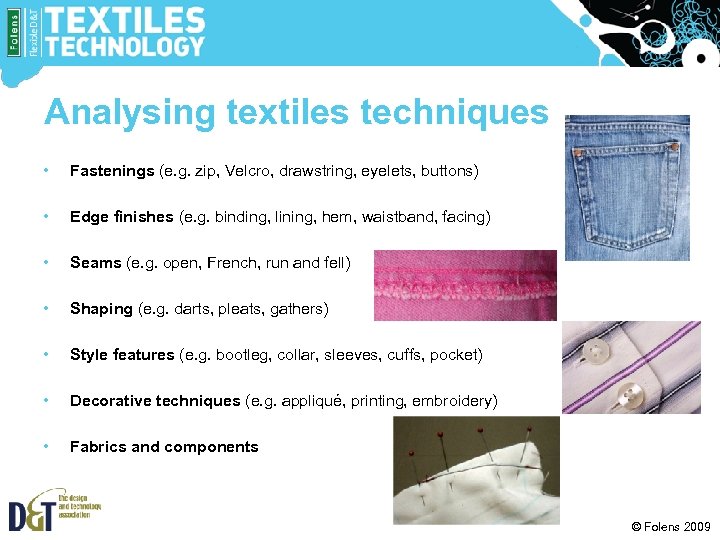 Analysing textiles techniques • Fastenings (e. g. zip, Velcro, drawstring, eyelets, buttons) • Edge finishes (e. g. binding, lining, hem, waistband, facing) • Seams (e. g. open, French, run and fell) • Shaping (e. g. darts, pleats, gathers) • Style features (e. g. bootleg, collar, sleeves, cuffs, pocket) • Decorative techniques (e. g. appliqué, printing, embroidery) • Fabrics and components © Folens 2009
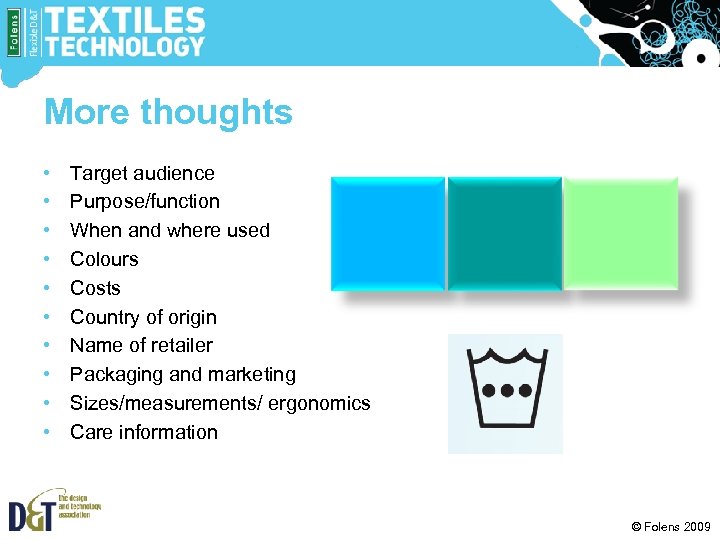 More thoughts • • • Target audience Purpose/function When and where used Colours Costs Country of origin Name of retailer Packaging and marketing Sizes/measurements/ ergonomics Care information © Folens 2009
 Higher level analysis (1) • • • Number of component parts (e. g. sleeves, front, back collar) Order of manufacture Areas for improvement Good/bad points Industrial practice (e. g. industrial machines, scale of production, workers’ pay) • Safety issues (e. g. no food-style buttons on baby wear, length of cords on baby wear) © Folens 2009
 Higher level analysis (2) • Laws and regulations • Moral issues (e. g. animal fur, offensive slogans/styles) • Environmental impact (e. g. winners and losers, use of recycled materials, packaging, fibre, dyes, lifecycle analysis) • Social issues (e. g. cost, gender, brands, celebrity influence, image product gives user) • Cultural issues (e. g. traditional techniques/designs) © Folens 2009
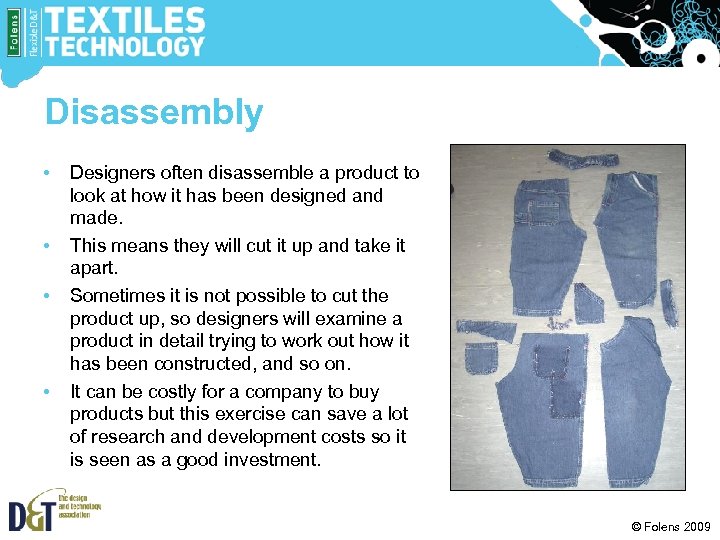 Disassembly • • Designers often disassemble a product to look at how it has been designed and made. This means they will cut it up and take it apart. Sometimes it is not possible to cut the product up, so designers will examine a product in detail trying to work out how it has been constructed, and so on. It can be costly for a company to buy products but this exercise can save a lot of research and development costs so it is seen as a good investment. © Folens 2009