


 Скачать презентацию Prodera PRODERA SYSTEMS FOR MODAL ANALYSIS PRODERA —
51652fc6c22eefeca8257711b5f8e61b.ppt
- Количество слайдов: 78
 Prodera PRODERA SYSTEMS FOR MODAL ANALYSIS PRODERA - 2006
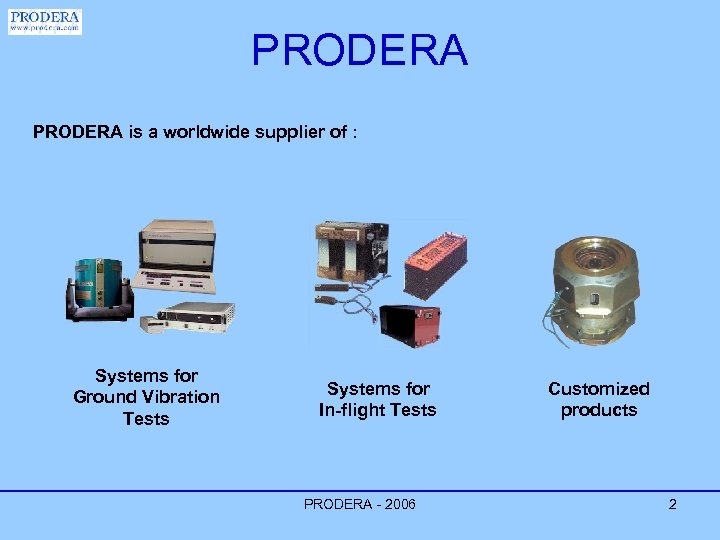 PRODERA is a worldwide supplier of : Systems for Ground Vibration Tests Systems for In-flight Tests PRODERA - 2006 Customized products 2
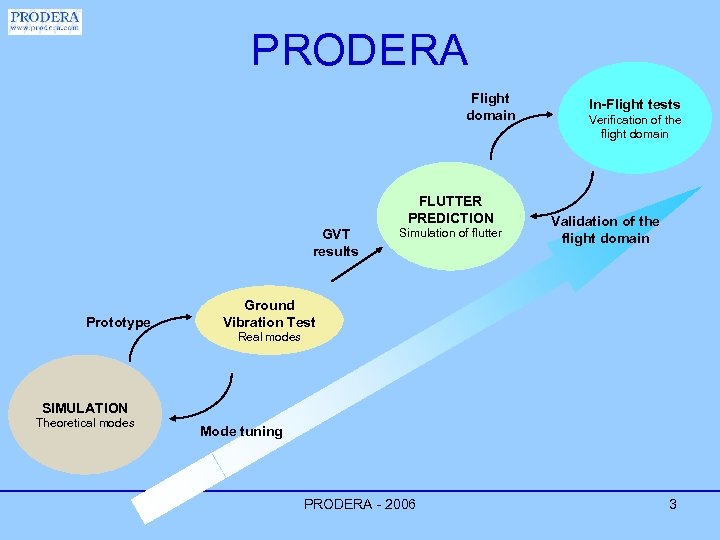 PRODERA Flight domain FLUTTER PREDICTION GVT results Prototype Simulation of flutter In-Flight tests Verification of the flight domain Validation of the flight domain Ground Vibration Test Real modes SIMULATION Theoretical modes Mode tuning PRODERA - 2006 3
 GROUND VIBRATION TESTS ü Power amplifiers ü Electrodynamics shakers ü Accelerometers and charge amplifiers ü P-Sys-Modal® ü Suspension systems ü Others … PRODERA - 2006 4
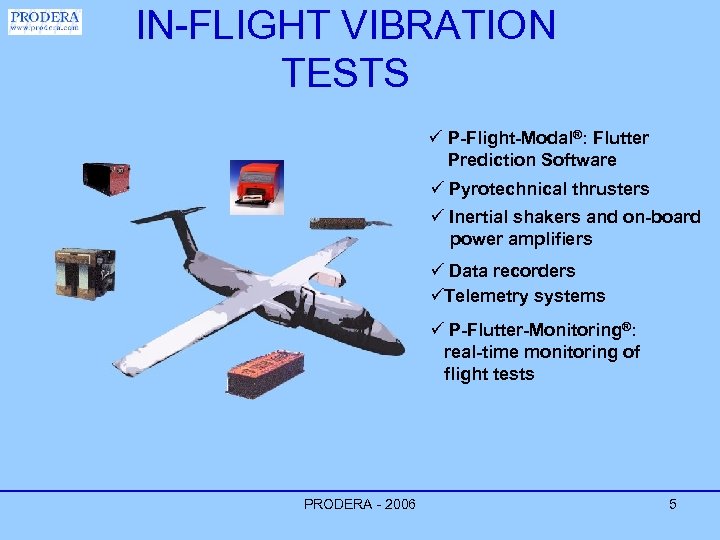 IN-FLIGHT VIBRATION TESTS ü P-Flight-Modal®: Flutter Prediction Software ü Pyrotechnical thrusters ü Inertial shakers and on-board power amplifiers ü Data recorders üTelemetry systems ü P-Flutter-Monitoring®: real-time monitoring of flight tests PRODERA - 2006 5
 SOME REFERENCES AERMACCHI, ALSTOM, ANTONOV, ASTRIUM, CEA, DASSAULT AVIATION, D. L. R. , EADS AIRBUS, EADS CASA, EADS LAUNCH VEHICULES, EDF, EMBRAER, EUROCOPTER, INTESPACE, ISRAEL AIRCRAFT INDUSTRIES, MBDA, MIG, O. N. E. R. A. , RAFAEL, RKK ENERGIA, SOPEMEA, SUKHOI, TAI, THALES, TSAGI, TSNIIMACH, TUPOLEV, VZLU, … PRODERA - 2006 6
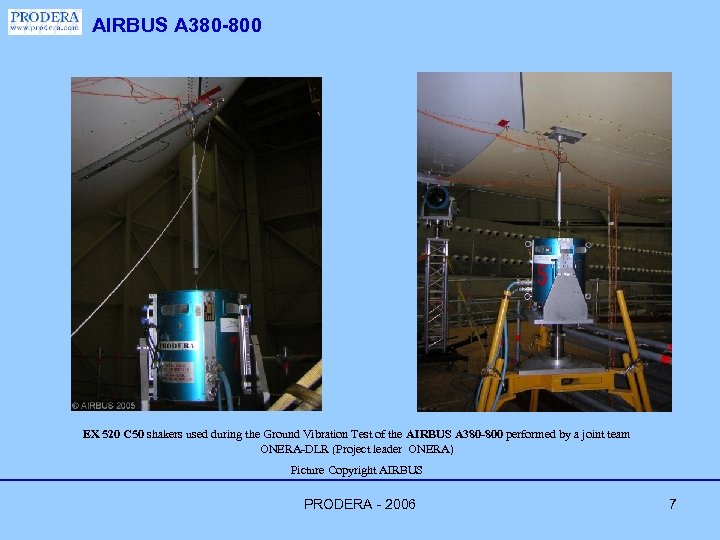 AIRBUS A 380 -800 EX 520 C 50 shakers used during the Ground Vibration Test of the AIRBUS A 380 -800 performed by a joint team ONERA-DLR (Project leader ONERA) Picture Copyright AIRBUS PRODERA - 2006 7
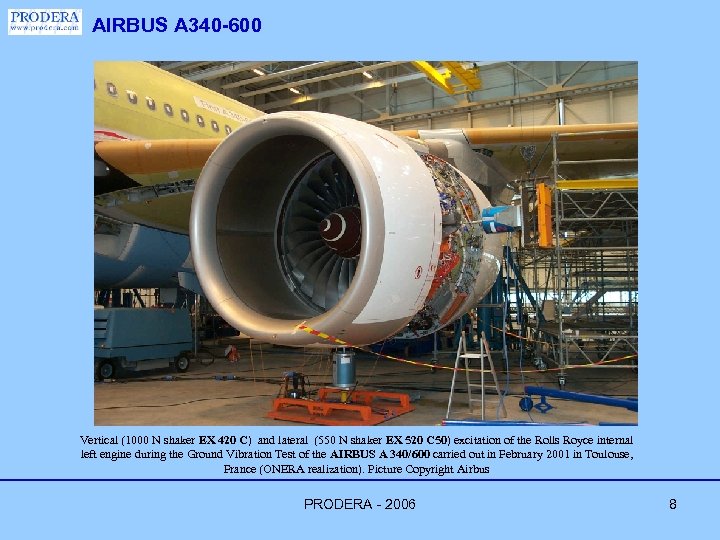 AIRBUS A 340 -600 Vertical (1000 N shaker EX 420 C) and lateral (550 N shaker EX 520 C 50) excitation of the Rolls Royce internal left engine during the Ground Vibration Test of the AIRBUS A 340/600 carried out in February 2001 in Toulouse, France (ONERA realization). Picture Copyright Airbus PRODERA - 2006 8
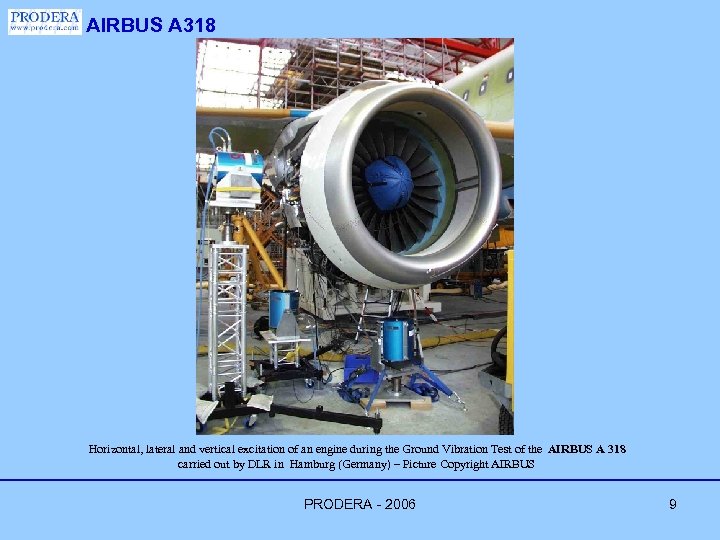 AIRBUS A 318 Horizontal, lateral and vertical excitation of an engine during the Ground Vibration Test of the AIRBUS A 318 carried out by DLR in Hamburg (Germany) – Picture Copyright AIRBUS PRODERA - 2006 9
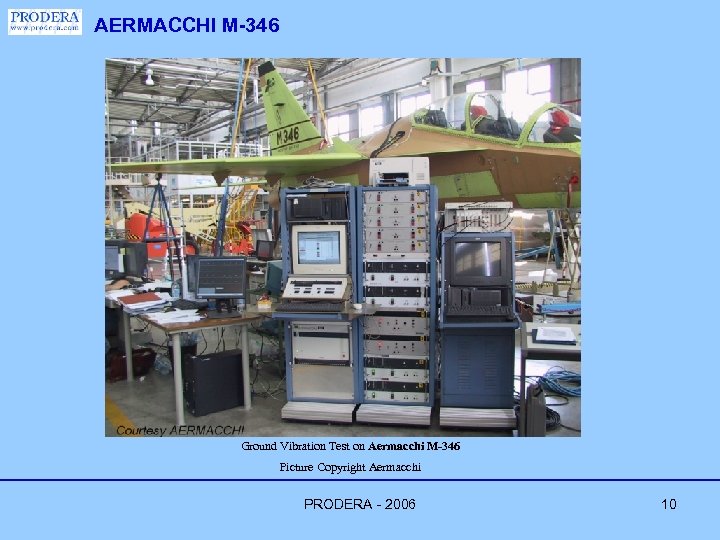 AERMACCHI M-346 Ground Vibration Test on Aermacchi M-346 Picture Copyright Aermacchi PRODERA - 2006 10
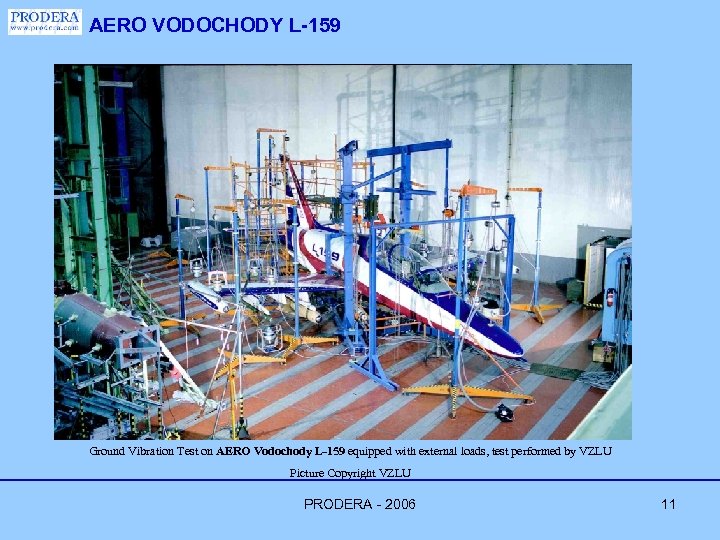 AERO VODOCHODY L-159 Ground Vibration Test on AERO Vodochody L-159 equipped with external loads, test performed by VZLU Picture Copyright VZLU PRODERA - 2006 11
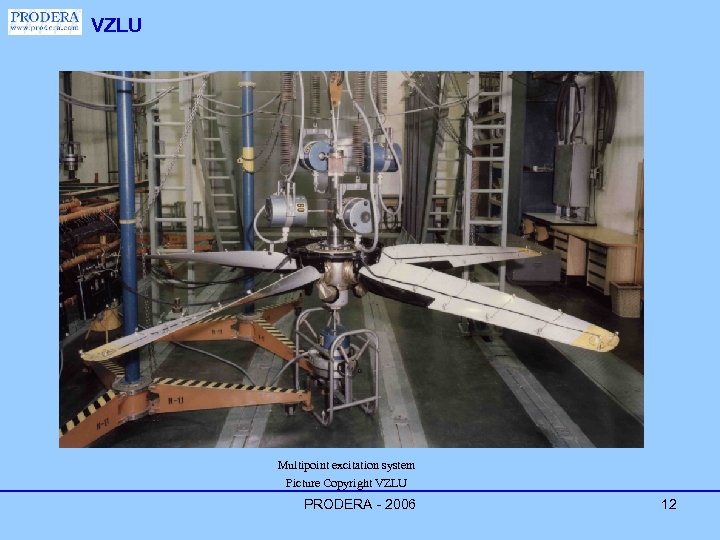 VZLU Multipoint excitation system Picture Copyright VZLU PRODERA - 2006 12
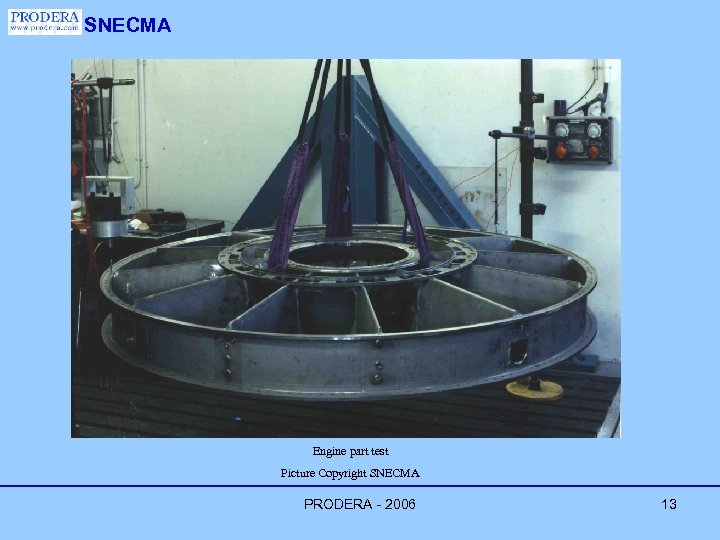 SNECMA Engine part test Picture Copyright SNECMA PRODERA - 2006 13
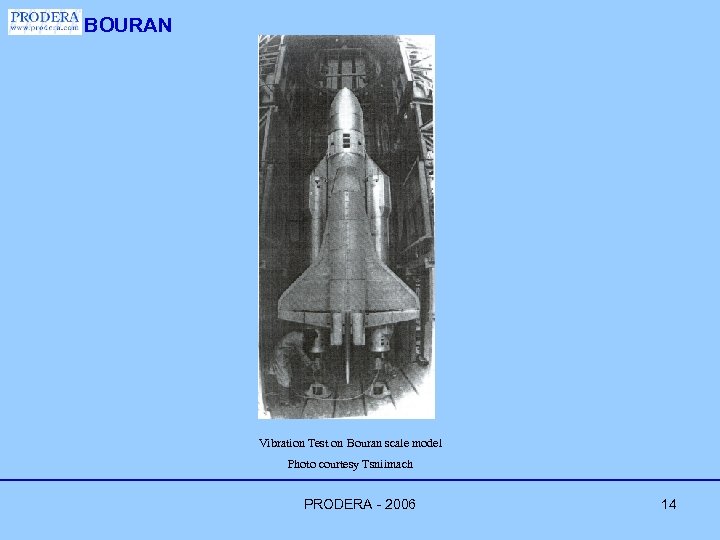 BOURAN Vibration Test on Bouran scale model Photo courtesy Tsniimach PRODERA - 2006 14
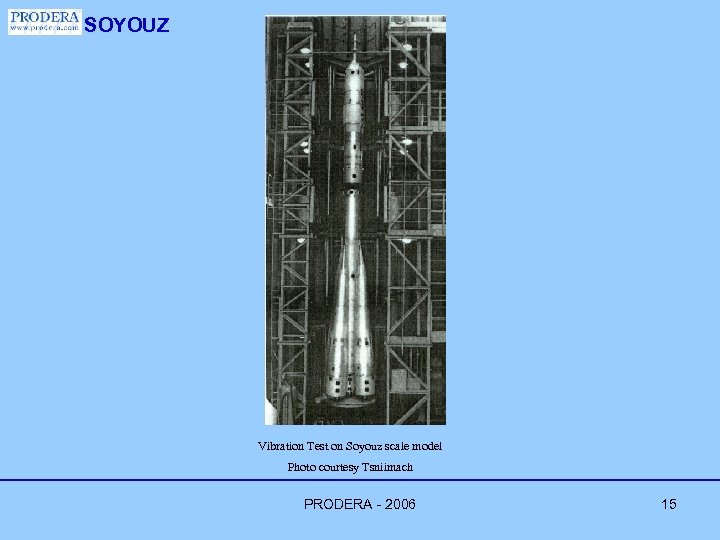 SOYOUZ Vibration Test on Soyouz scale model Photo courtesy Tsniimach PRODERA - 2006 15
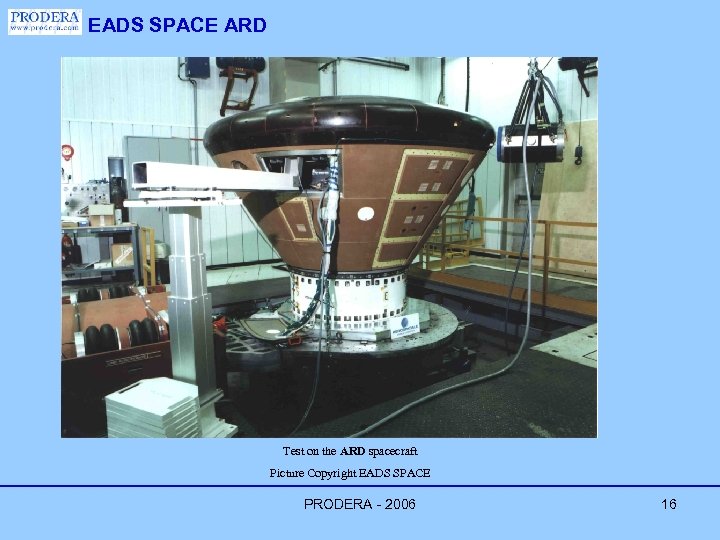 EADS SPACE ARD Test on the ARD spacecraft Picture Copyright EADS SPACE PRODERA - 2006 16
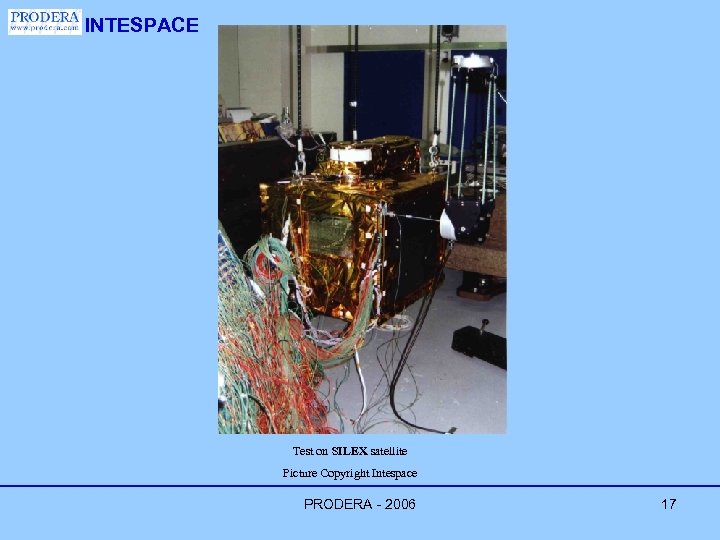 INTESPACE Test on SILEX satellite Picture Copyright Intespace PRODERA - 2006 17
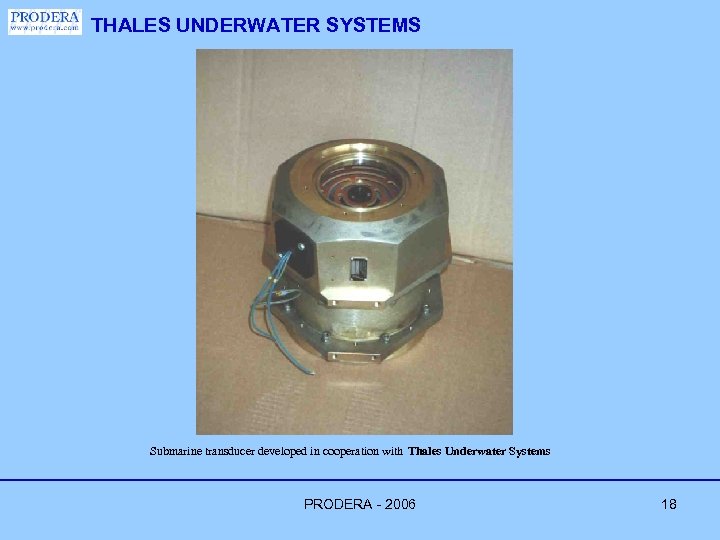 THALES UNDERWATER SYSTEMS Submarine transducer developed in cooperation with Thales Underwater Systems PRODERA - 2006 18
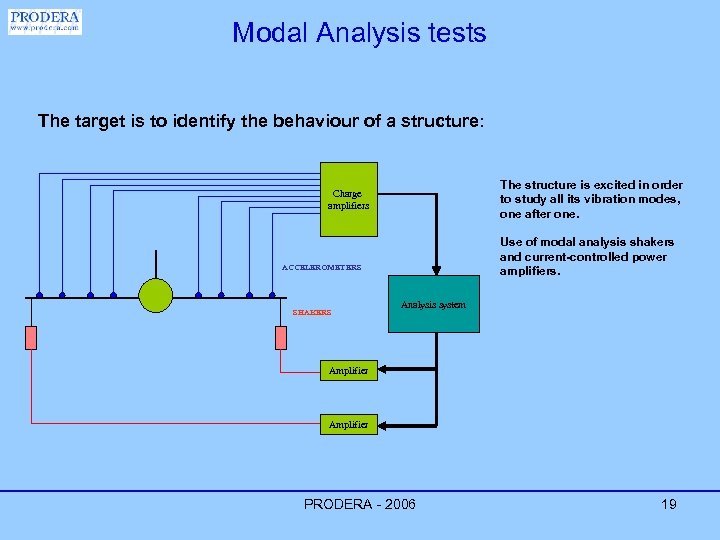 Modal Analysis tests The target is to identify the behaviour of a structure: The structure is excited in order to study all its vibration modes, one after one. Charge amplifiers Use of modal analysis shakers and current-controlled power amplifiers. ACCELEROMETERS SHAKERS Analysis system Amplifier PRODERA - 2006 19
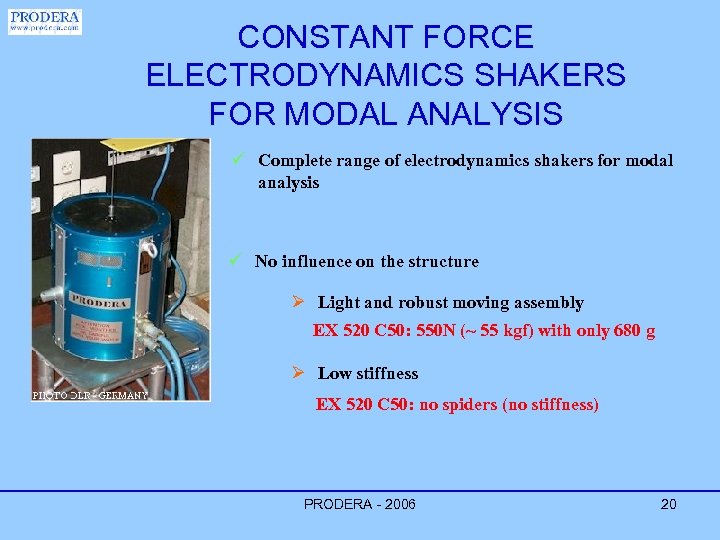 CONSTANT FORCE ELECTRODYNAMICS SHAKERS FOR MODAL ANALYSIS ü Complete range of electrodynamics shakers for modal analysis ü No influence on the structure Ø Light and robust moving assembly EX 520 C 50: 550 N (~ 55 kgf) with only 680 g Ø Low stiffness EX 520 C 50: no spiders (no stiffness) PRODERA - 2006 20
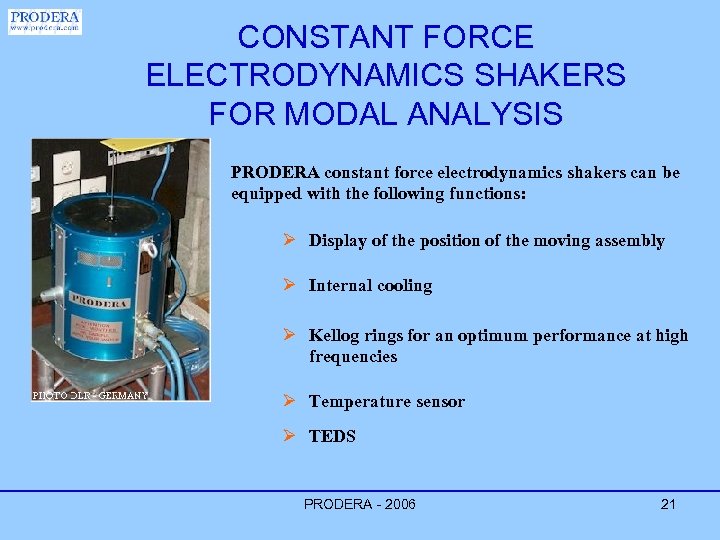 CONSTANT FORCE ELECTRODYNAMICS SHAKERS FOR MODAL ANALYSIS PRODERA constant force electrodynamics shakers can be equipped with the following functions: Ø Display of the position of the moving assembly Ø Internal cooling Ø Kellog rings for an optimum performance at high frequencies Ø Temperature sensor Ø TEDS PRODERA - 2006 21
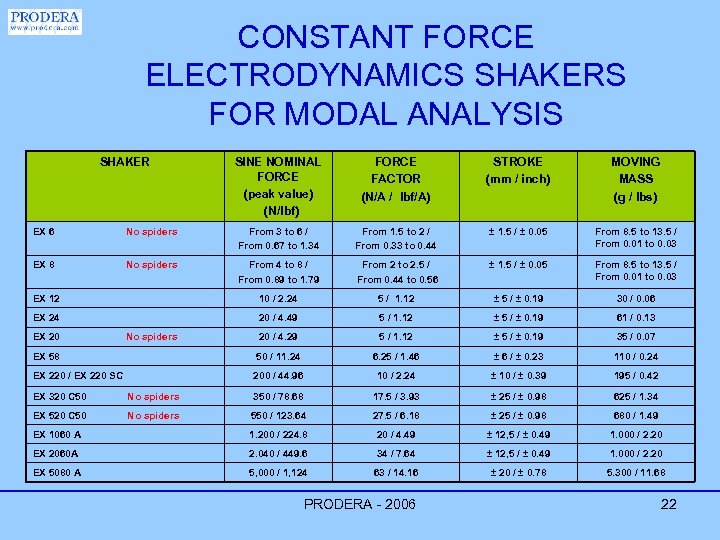 CONSTANT FORCE ELECTRODYNAMICS SHAKERS FOR MODAL ANALYSIS SHAKER SINE NOMINAL FORCE (peak value) (N/lbf) FORCE FACTOR (N/A / lbf/A) STROKE (mm / inch) MOVING MASS (g / lbs) EX 6 No spiders From 3 to 6 / From 0. 67 to 1. 34 From 1. 5 to 2 / From 0. 33 to 0. 44 ± 1. 5 / ± 0. 05 From 8. 5 to 13. 5 / From 0. 01 to 0. 03 EX 8 No spiders From 4 to 8 / From 0. 89 to 1. 79 From 2 to 2. 5 / From 0. 44 to 0. 56 ± 1. 5 / ± 0. 05 From 8. 5 to 13. 5 / From 0. 01 to 0. 03 EX 12 10 / 2. 24 5 / 1. 12 ± 5 / ± 0. 19 30 / 0. 06 EX 24 20 / 4. 49 5 / 1. 12 ± 5 / ± 0. 19 61 / 0. 13 20 / 4. 29 5 / 1. 12 ± 5 / ± 0. 19 35 / 0. 07 EX 58 50 / 11. 24 6. 25 / 1. 46 ± 6 / ± 0. 23 110 / 0. 24 EX 220 / EX 220 SC 200 / 44. 96 10 / 2. 24 ± 10 / ± 0. 39 195 / 0. 42 EX 20 No spiders EX 320 C 50 No spiders 350 / 78. 68 17. 5 / 3. 93 ± 25 / ± 0. 98 625 / 1. 34 EX 520 C 50 No spiders 550 / 123. 64 27. 5 / 6. 18 ± 25 / ± 0. 98 680 / 1. 49 EX 1060 A 1. 200 / 224. 8 20 / 4. 49 ± 12, 5 / ± 0. 49 1. 000 / 2. 20 EX 2060 A 2. 040 / 449. 6 34 / 7. 64 ± 12, 5 / ± 0. 49 1. 000 / 2. 20 EX 5080 A 5, 000 / 1, 124 63 / 14. 16 ± 20 / ± 0. 78 5. 300 / 11. 68 PRODERA - 2006 22
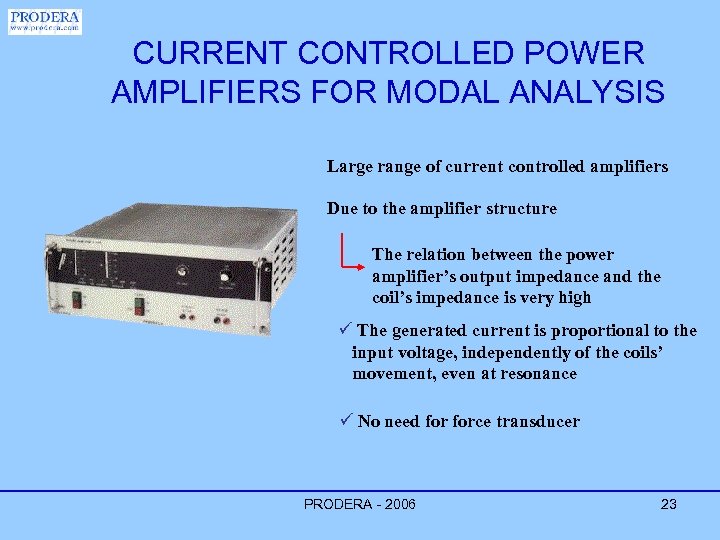 CURRENT CONTROLLED POWER AMPLIFIERS FOR MODAL ANALYSIS Large range of current controlled amplifiers Due to the amplifier structure The relation between the power amplifier’s output impedance and the coil’s impedance is very high ü The generated current is proportional to the input voltage, independently of the coils’ movement, even at resonance ü No need force transducer PRODERA - 2006 23
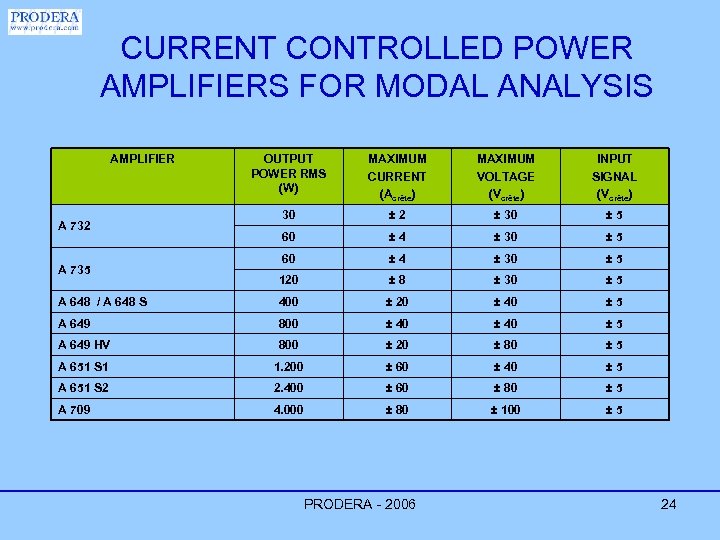 CURRENT CONTROLLED POWER AMPLIFIERS FOR MODAL ANALYSIS AMPLIFIER OUTPUT POWER RMS (W) MAXIMUM CURRENT (Acrête) MAXIMUM VOLTAGE (Vcrête) INPUT SIGNAL (Vcrête) 30 ± 2 ± 30 ± 5 60 ± 4 ± 30 ± 5 120 ± 8 ± 30 ± 5 A 648 / A 648 S 400 ± 20 ± 40 ± 5 A 649 800 ± 40 ± 5 A 649 HV 800 ± 20 ± 80 ± 5 A 651 S 1 1. 200 ± 60 ± 40 ± 5 A 651 S 2 2. 400 ± 60 ± 80 ± 5 A 709 4. 000 ± 80 ± 100 ± 5 A 732 A 735 PRODERA - 2006 24
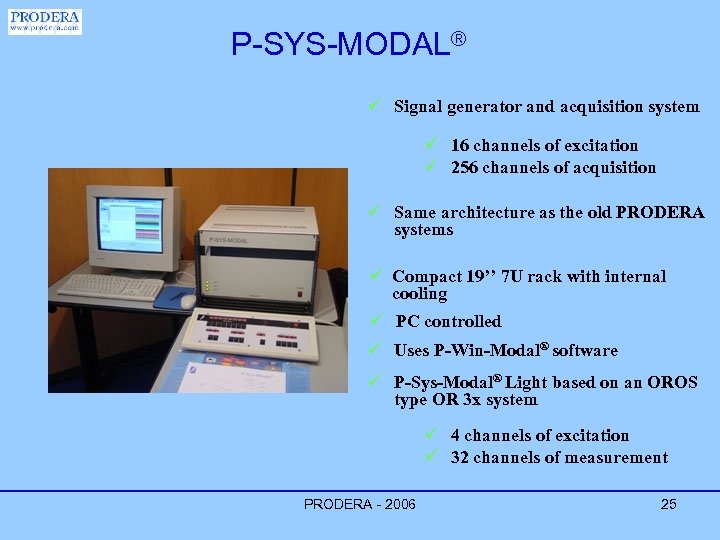 P-SYS-MODAL® ü Signal generator and acquisition system ü 16 channels of excitation ü 256 channels of acquisition ü Same architecture as the old PRODERA systems ü Compact 19’’ 7 U rack with internal cooling ü PC controlled ü Uses P-Win-Modal® software ü P-Sys-Modal® Light based on an OROS type OR 3 x system ü 4 channels of excitation ü 32 channels of measurement PRODERA - 2006 25
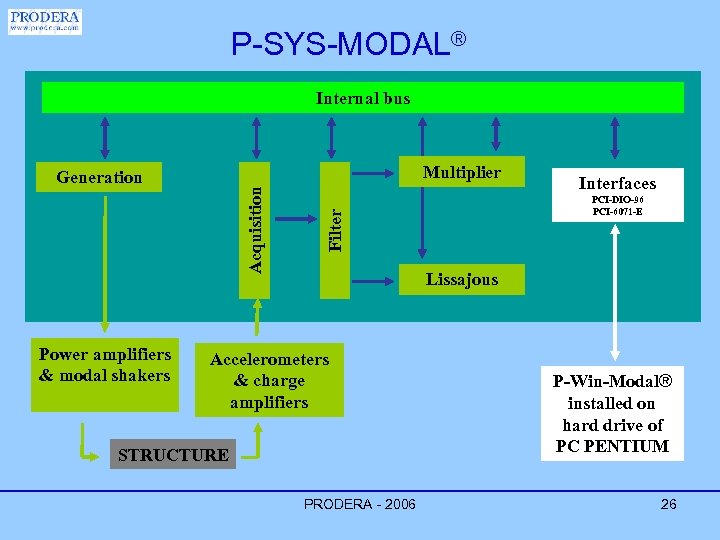 P-SYS-MODAL® Internal bus Multiplier Power amplifiers & modal shakers Interfaces PCI-DIO-96 PCI-6071 -E Filter Acquisition Generation Lissajous Accelerometers & charge amplifiers STRUCTURE PRODERA - 2006 P-Win-Modal® installed on hard drive of PC PENTIUM 26
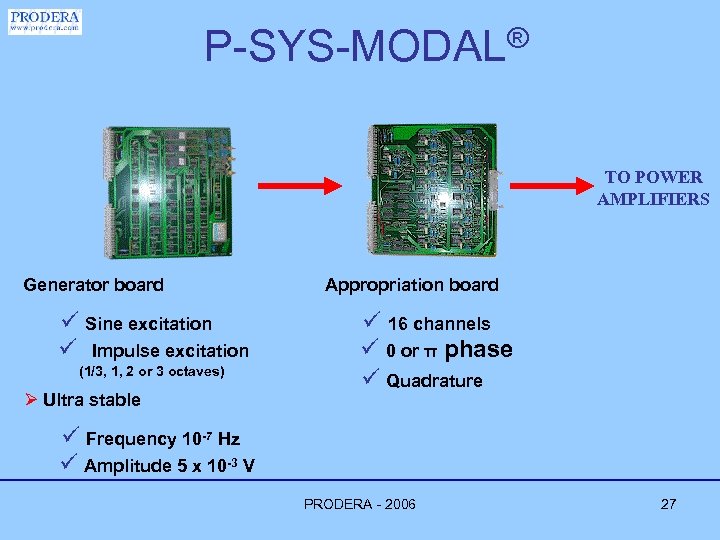 P-SYS-MODAL® TO POWER AMPLIFIERS Generator board ü Sine excitation ü Impulse excitation (1/3, 1, 2 or 3 octaves) Ø Ultra stable Appropriation board ü 16 channels ü 0 or π phase ü Quadrature ü Frequency 10 -7 Hz ü Amplitude 5 x 10 -3 V PRODERA - 2006 27
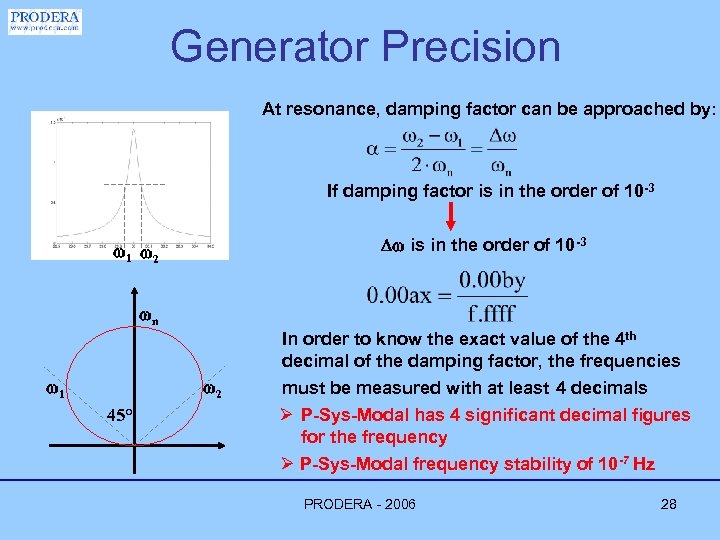 Generator Precision At resonance, damping factor can be approached by: If damping factor is in the order of 10 -3 1 2 n In order to know the exact value of the 4 th decimal of the damping factor, the frequencies 1 2 45° must be measured with at least 4 decimals Ø P-Sys-Modal has 4 significant decimal figures for the frequency Ø P-Sys-Modal frequency stability of 10 -7 Hz PRODERA - 2006 28
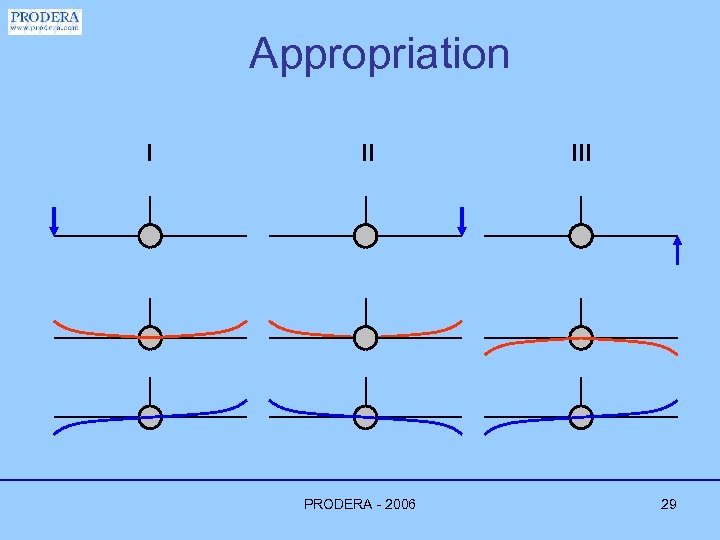 Appropriation I II PRODERA - 2006 III 29
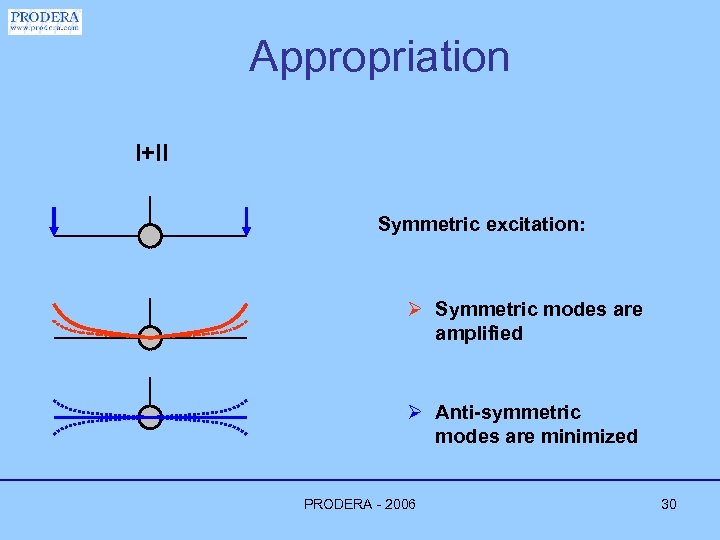 Appropriation I+II Symmetric excitation: Ø Symmetric modes are amplified Ø Anti-symmetric modes are minimized PRODERA - 2006 30
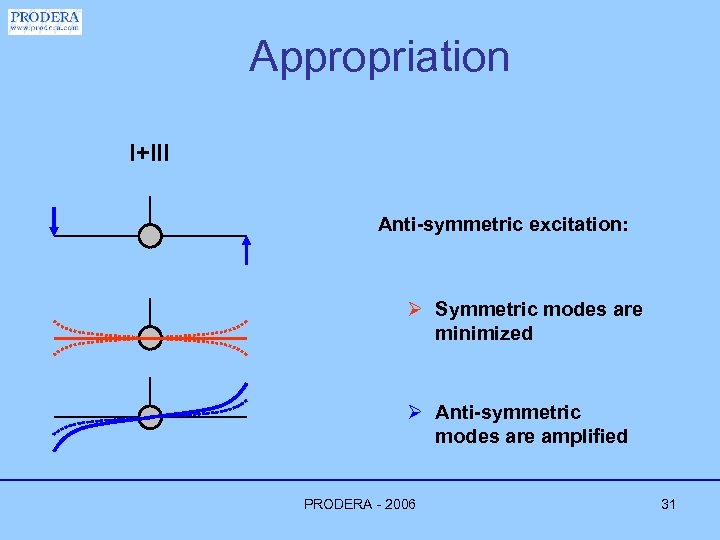 Appropriation I+III Anti-symmetric excitation: Ø Symmetric modes are minimized Ø Anti-symmetric modes are amplified PRODERA - 2006 31
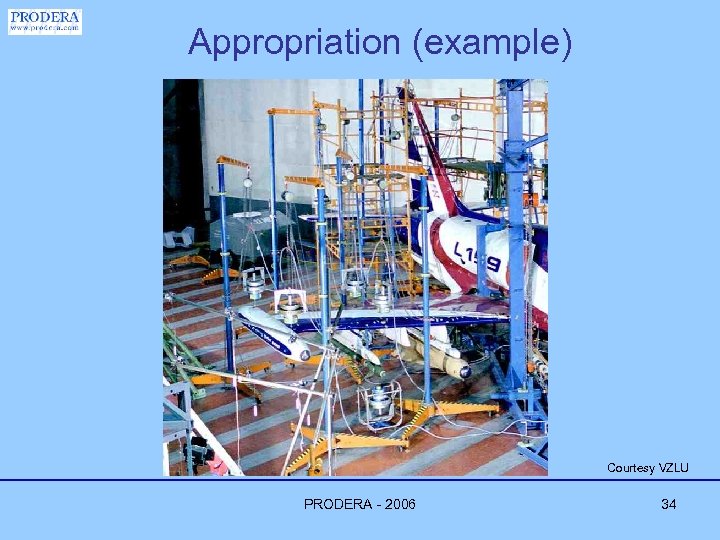
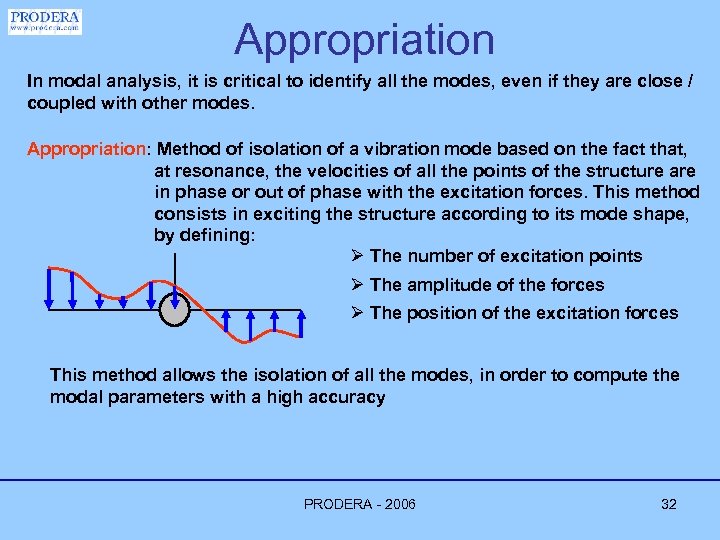 Appropriation In modal analysis, it is critical to identify all the modes, even if they are close / coupled with other modes. Appropriation: Method of isolation of a vibration mode based on the fact that, at resonance, the velocities of all the points of the structure are in phase or out of phase with the excitation forces. This method consists in exciting the structure according to its mode shape, by defining: Ø The number of excitation points Ø The amplitude of the forces Ø The position of the excitation forces This method allows the isolation of all the modes, in order to compute the modal parameters with a high accuracy PRODERA - 2006 32
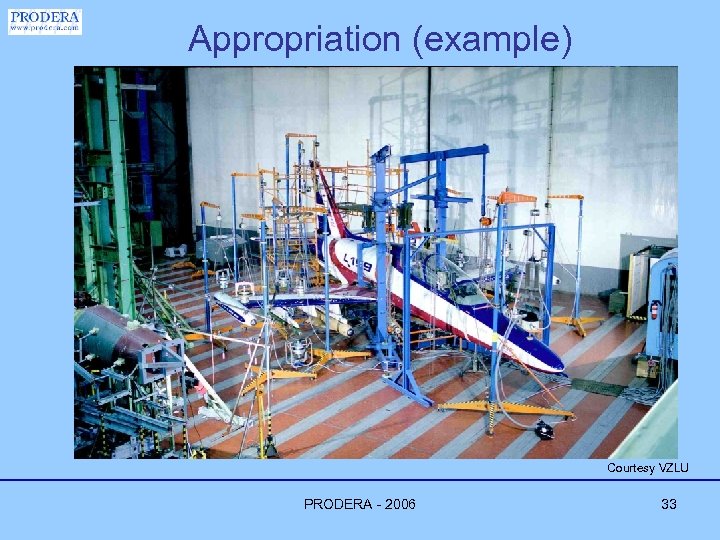 Appropriation (example) Courtesy VZLU PRODERA - 2006 33
 Appropriation (example) Courtesy VZLU PRODERA - 2006 34
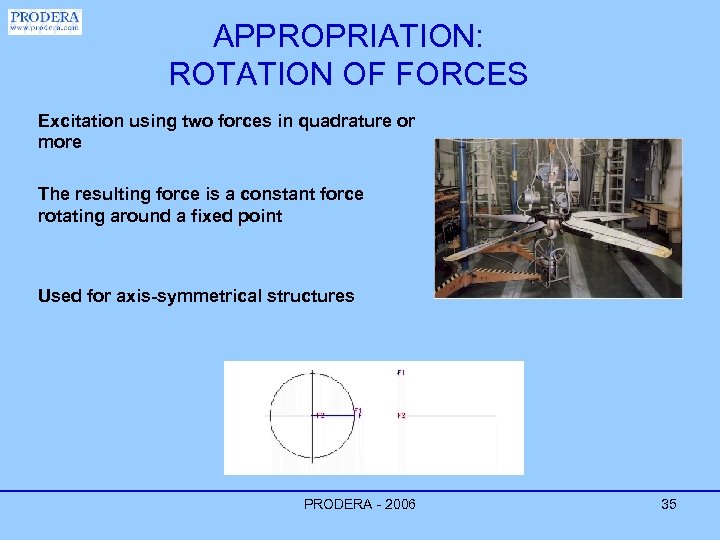 APPROPRIATION: ROTATION OF FORCES Excitation using two forces in quadrature or more The resulting force is a constant force rotating around a fixed point Used for axis-symmetrical structures PRODERA - 2006 35
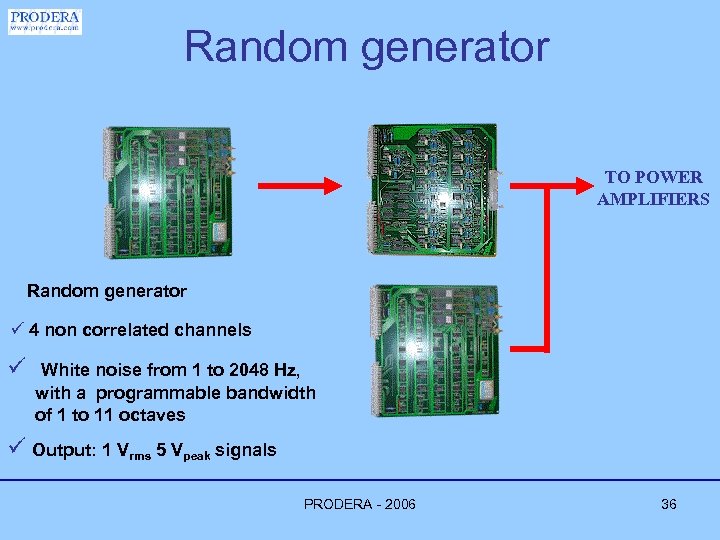 Random generator TO POWER AMPLIFIERS Random generator ü 4 non correlated channels ü White noise from 1 to 2048 Hz, with a programmable bandwidth of 1 to 11 octaves ü Output: 1 Vrms 5 Vpeak signals PRODERA - 2006 36
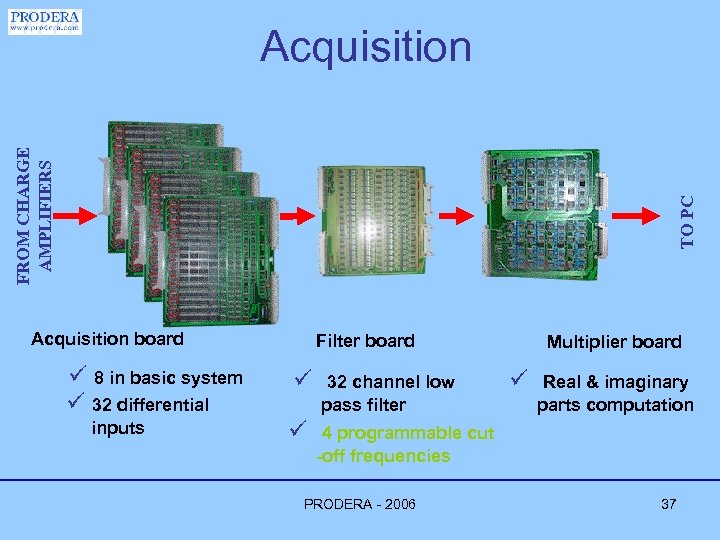 TO PC FROM CHARGE AMPLIFIERS Acquisition board ü 8 in basic system ü 32 differential inputs Filter board ü 32 channel low pass filter ü Multiplier board 4 programmable cut -off frequencies PRODERA - 2006 ü Real & imaginary parts computation 37
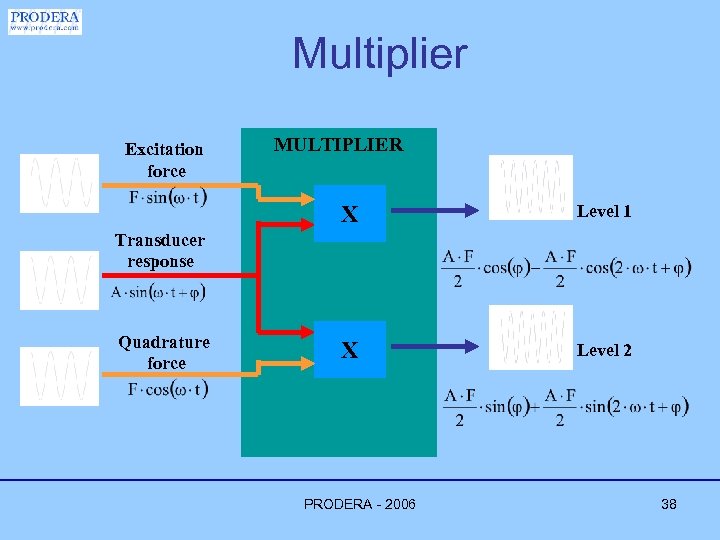 Multiplier Excitation force MULTIPLIER X Level 1 X Level 2 Transducer response Quadrature force PRODERA - 2006 38
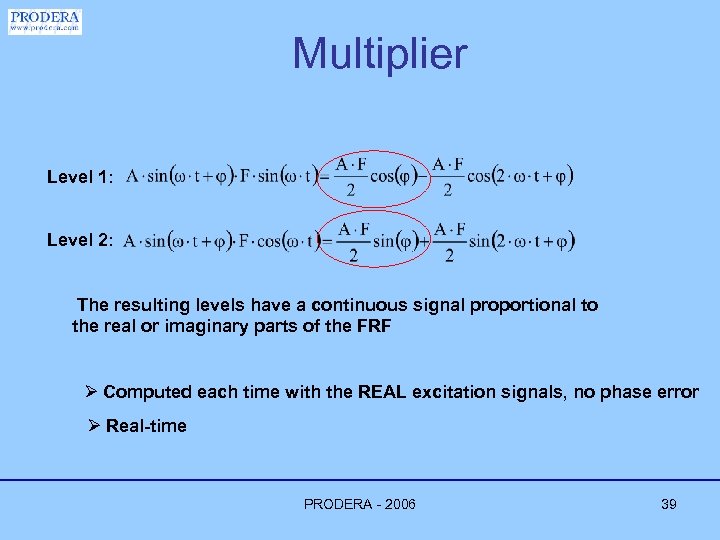 Multiplier Level 1: Level 2: The resulting levels have a continuous signal proportional to the real or imaginary parts of the FRF Ø Computed each time with the REAL excitation signals, no phase error Ø Real-time PRODERA - 2006 39
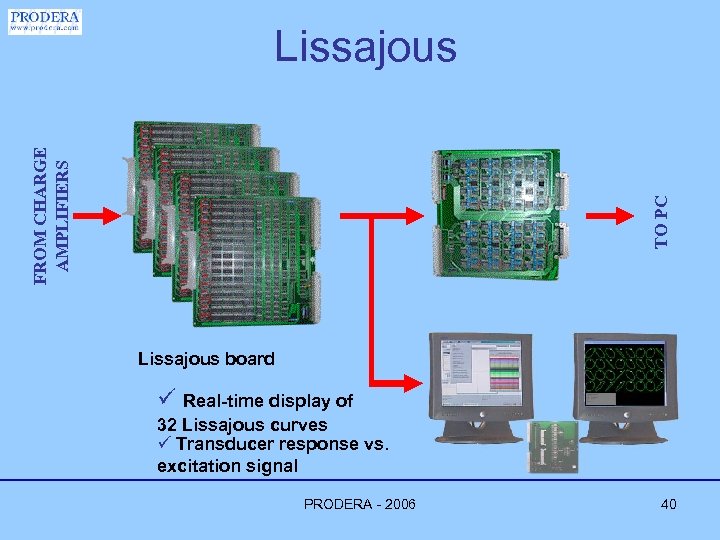 TO PC FROM CHARGE AMPLIFIERS Lissajous board ü Real-time display of 32 Lissajous curves ü Transducer response vs. excitation signal PRODERA - 2006 40
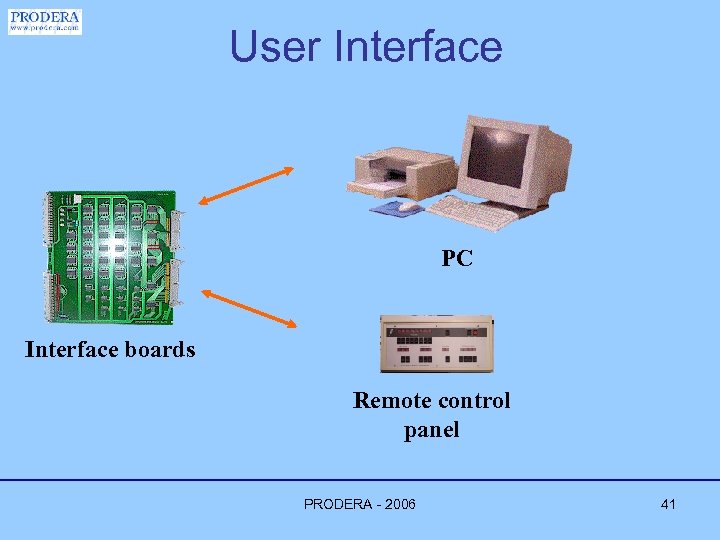 User Interface PC Interface boards Remote control panel PRODERA - 2006 41
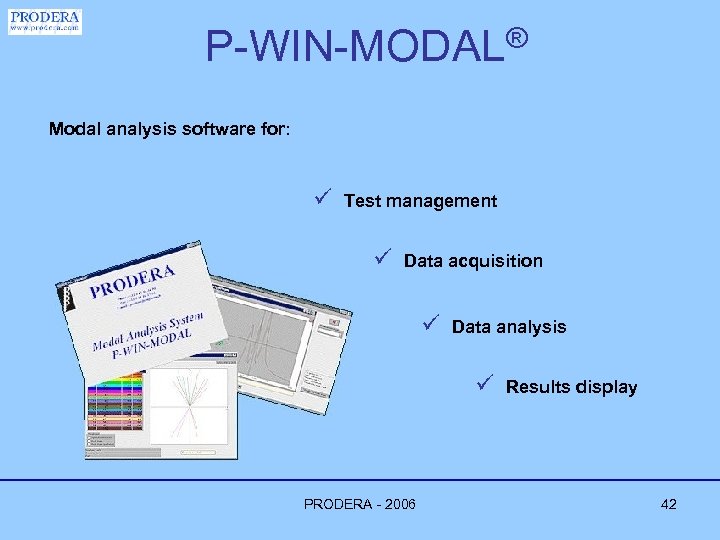 P-WIN-MODAL® Modal analysis software for: ü Test management ü Data acquisition ü Data analysis ü PRODERA - 2006 Results display 42
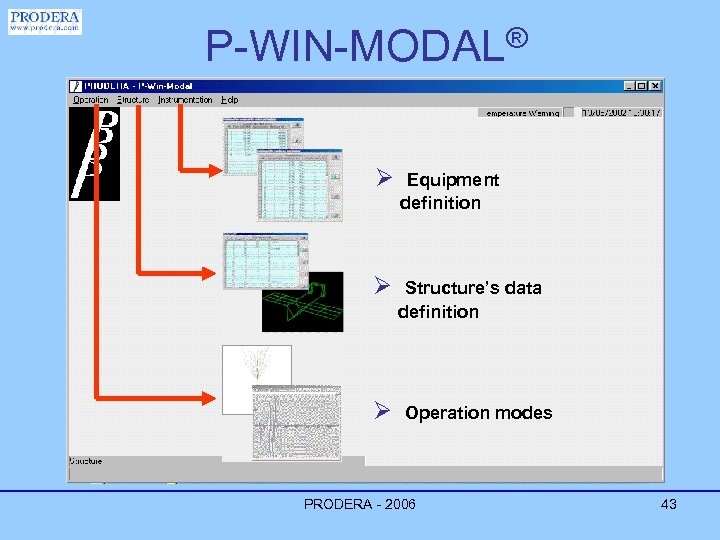 P-WIN-MODAL® Ø Equipment definition Ø Structure’s data definition Ø Operation modes PRODERA - 2006 43
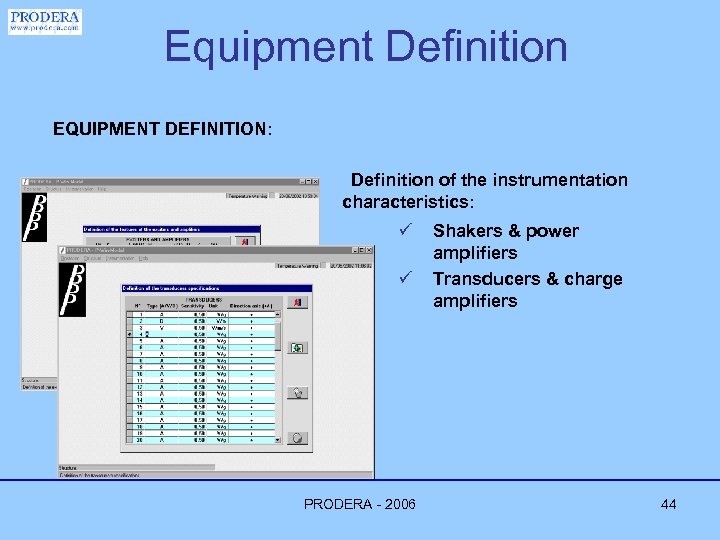 Equipment Definition EQUIPMENT DEFINITION: Definition of the instrumentation characteristics: ü ü PRODERA - 2006 Shakers & power amplifiers Transducers & charge amplifiers 44
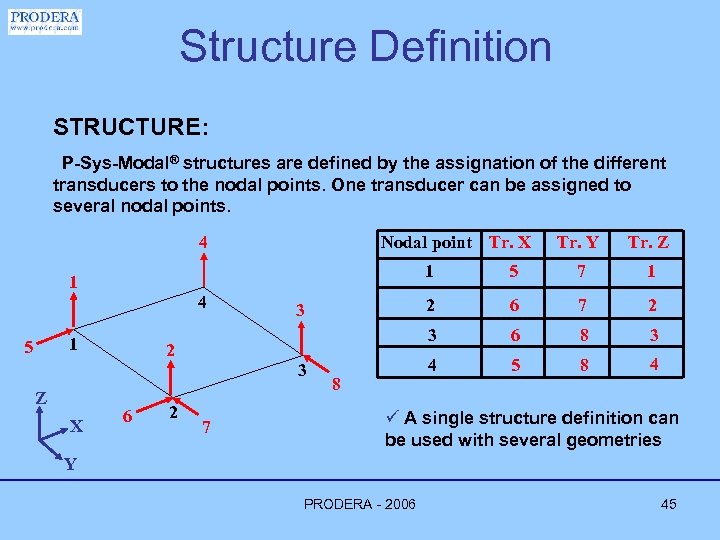 Structure Definition STRUCTURE: P-Sys-Modal® structures are defined by the assignation of the different transducers to the nodal points. One transducer can be assigned to several nodal points. Nodal point Tr. X 4 X 2 6 2 3 7 1 6 7 2 6 8 3 4 8 7 2 3 5 3 4 1 Z Tr. Z 1 1 5 Tr. Y 5 8 4 ü A single structure definition can be used with several geometries Y PRODERA - 2006 45
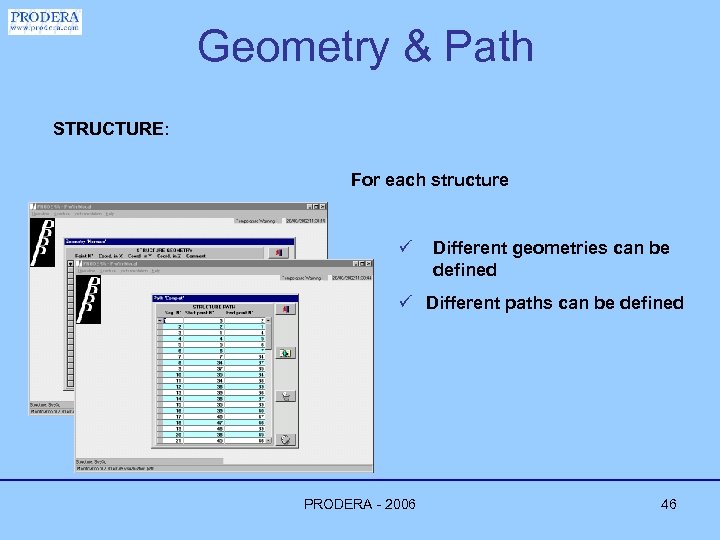 Geometry & Path STRUCTURE: For each structure ü Different geometries can be defined ü Different paths can be defined PRODERA - 2006 46
 Impulse Test IMPULSE TEST: Multipoint impulse excitation. Different kinds of excitations: üUp to the excitation frequency with different bandwidth • 3 octaves • 2 octaves • 1 octave üAround the excitation frequency • Bandwidth 1/3 of octave 1/3 Octaves PRODERA - 2006 47
 Impulse Test IMPULSE TEST: Acquisition of the transducer’s responses and display of: ü Temporal signals ü FFT ü Frequency Response Functions ü Power spectra ü Signed spectra Identification of the vibration modes PRODERA - 2006 48
 Random Test RANDOM TEST: Acquisition of the transducer’s responses and display of: ü Temporal signals üAuto-spectra & Cross-spectra ü Coherence functions ü Possibility of windowing Identification of the vibration modes PRODERA - 2006 49
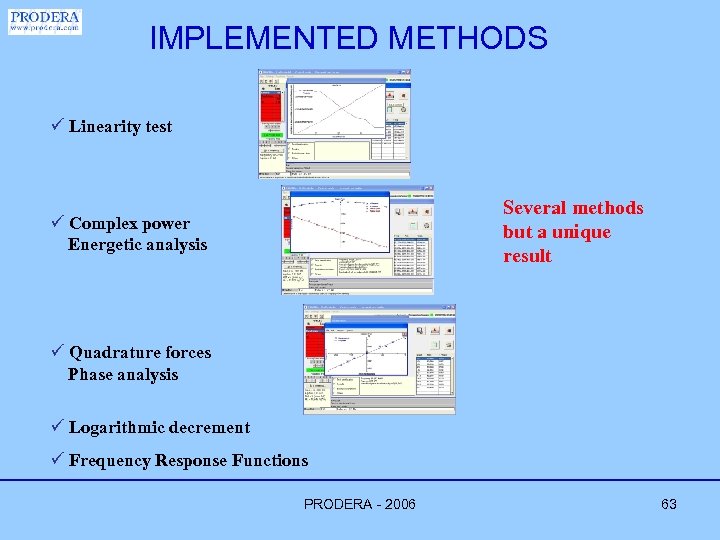
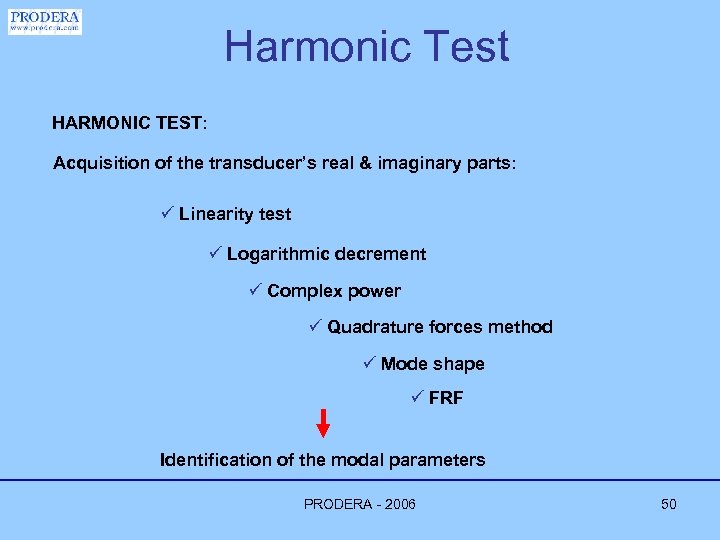 Harmonic Test HARMONIC TEST: Acquisition of the transducer’s real & imaginary parts: ü Linearity test ü Logarithmic decrement ü Complex power ü Quadrature forces method ü Mode shape ü FRF Identification of the modal parameters PRODERA - 2006 50
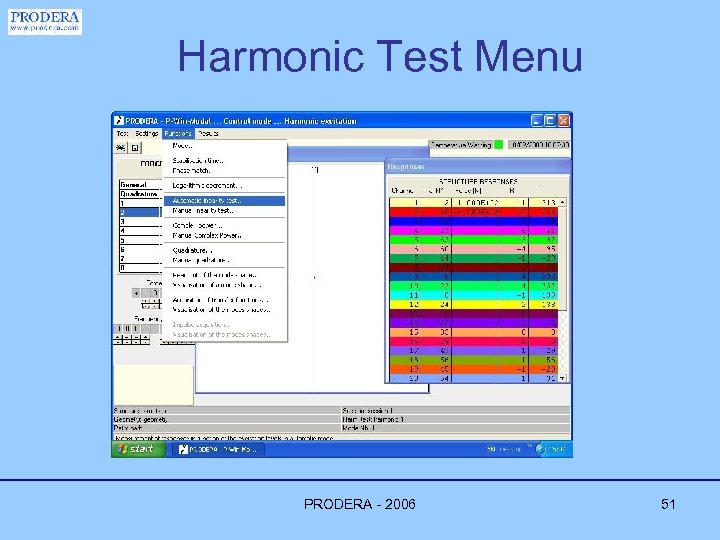 Harmonic Test Menu PRODERA - 2006 51
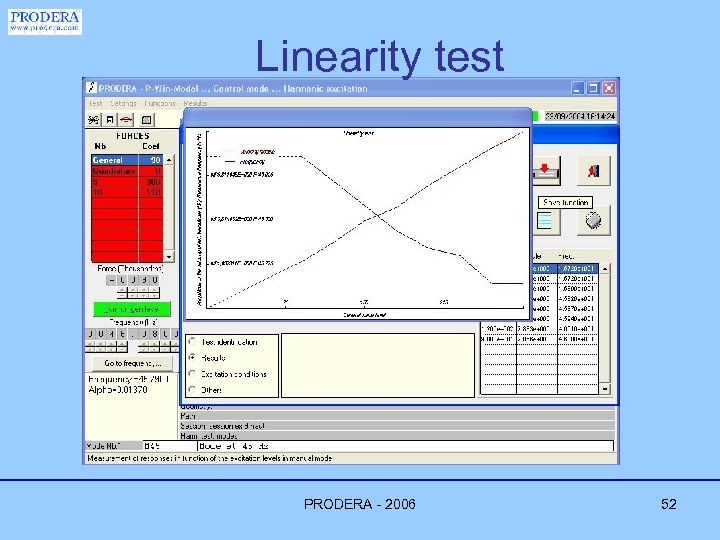 Linearity test PRODERA - 2006 52
 Linearity test LINEARITY TEST: Verifies the linearity supposition by measuring the resonance frequency for different force levels PRODERA - 2006 53
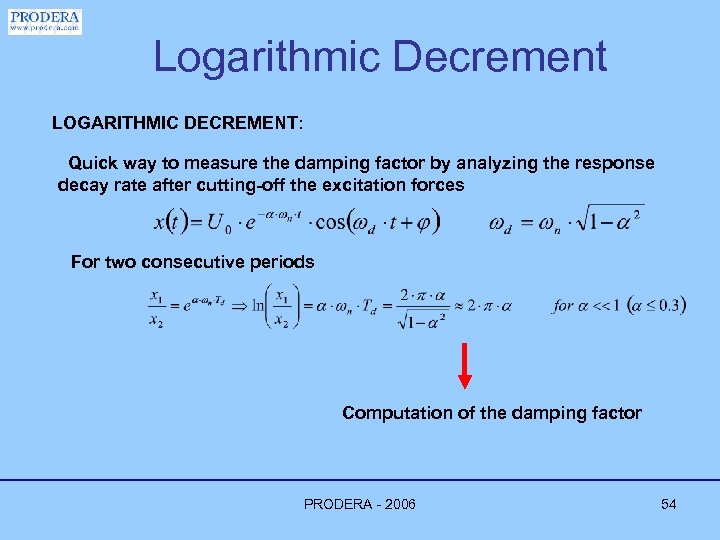 Logarithmic Decrement LOGARITHMIC DECREMENT: Quick way to measure the damping factor by analyzing the response decay rate after cutting-off the excitation forces For two consecutive periods Computation of the damping factor PRODERA - 2006 54
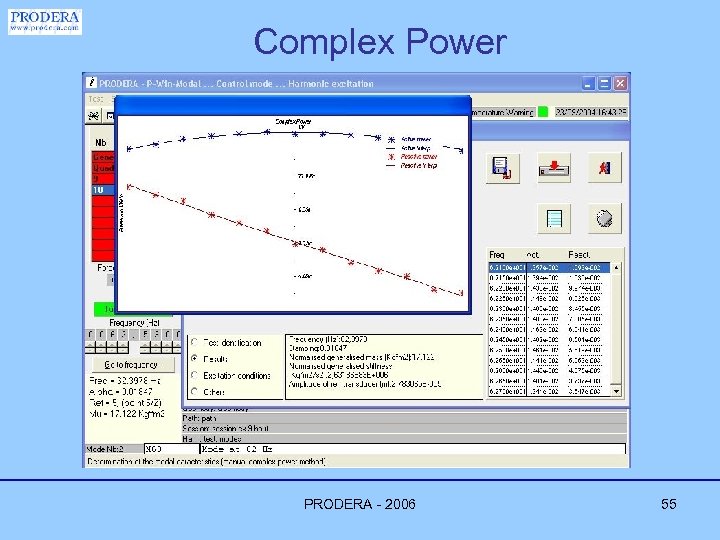 Complex Power PRODERA - 2006 55
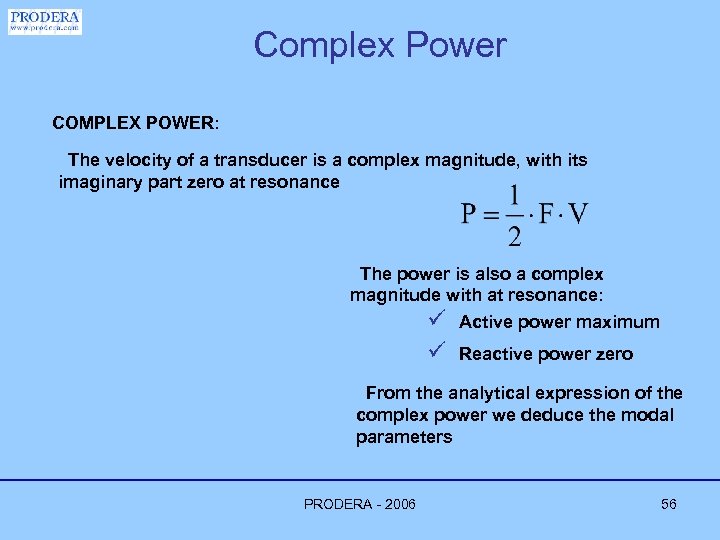 Complex Power COMPLEX POWER: The velocity of a transducer is a complex magnitude, with its imaginary part zero at resonance The power is also a complex magnitude with at resonance: ü Active power maximum ü Reactive power zero From the analytical expression of the complex power we deduce the modal parameters PRODERA - 2006 56
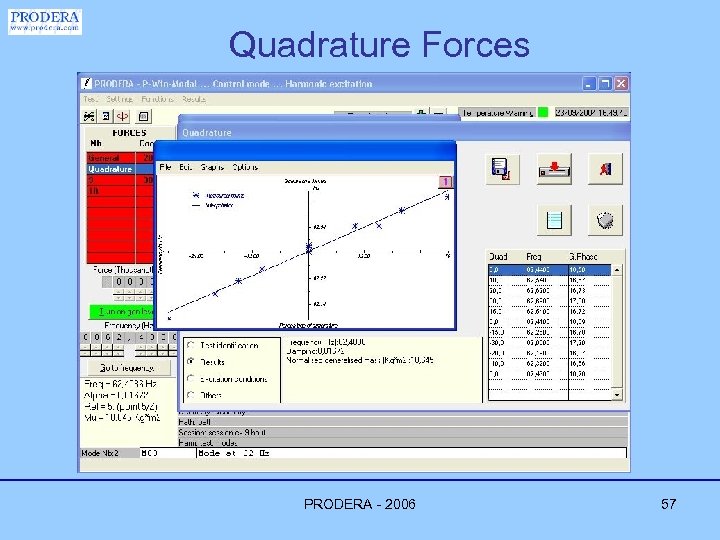 Quadrature Forces PRODERA - 2006 57
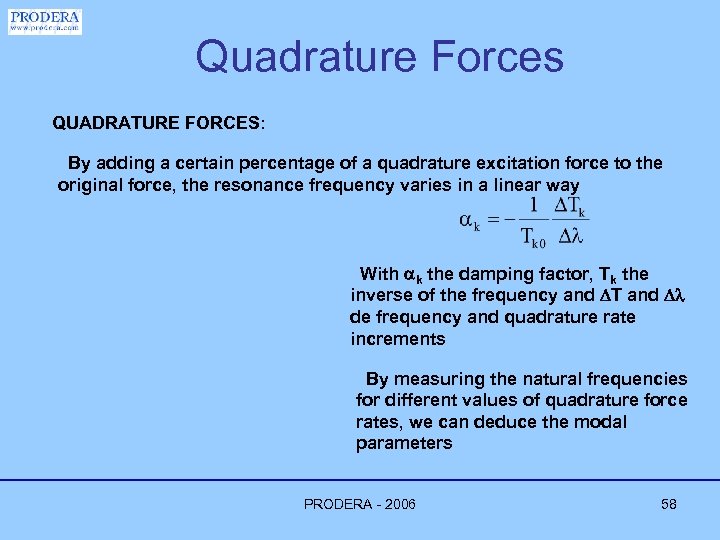 Quadrature Forces QUADRATURE FORCES: By adding a certain percentage of a quadrature excitation force to the original force, the resonance frequency varies in a linear way With k the damping factor, Tk the inverse of the frequency and T and de frequency and quadrature rate increments By measuring the natural frequencies for different values of quadrature force rates, we can deduce the modal parameters PRODERA - 2006 58
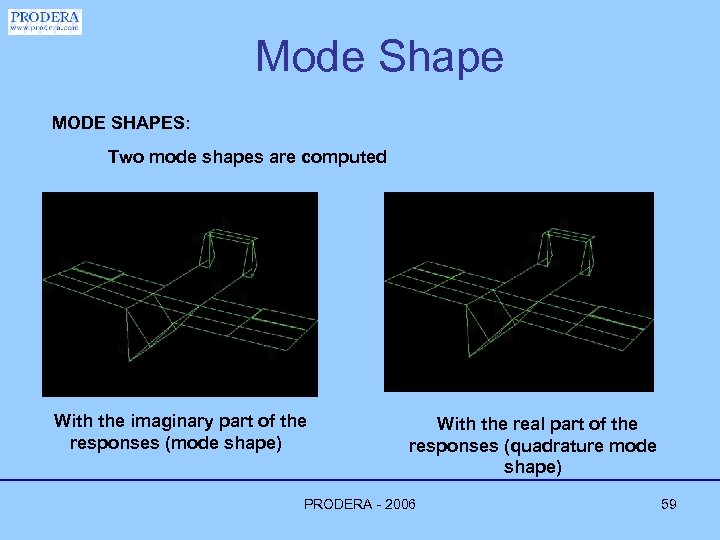 Mode Shape MODE SHAPES: Two mode shapes are computed With the imaginary part of the responses (mode shape) With the real part of the responses (quadrature mode shape) PRODERA - 2006 59
 Frequency Response Functions: Acquisition of the Frequency Response Functions by performing a sine sweep PRODERA - 2006 60
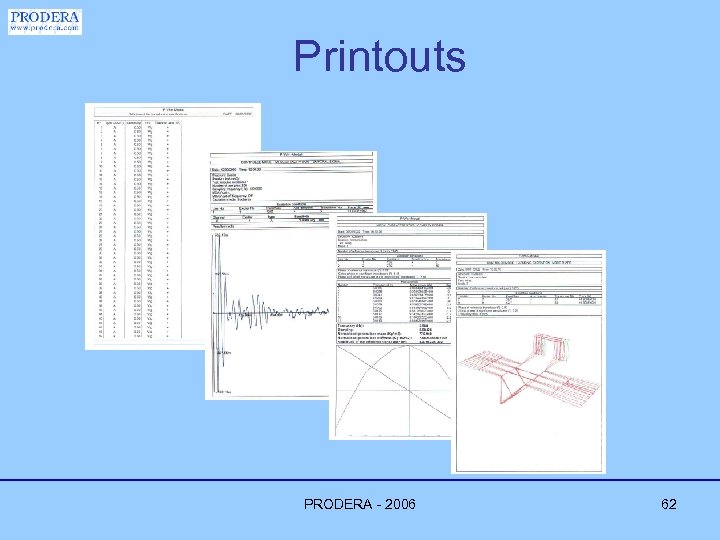
![Output Files [Linearity] Mode nb=1 Date=12/09/2000 Time=12: 20: 36 [Complex Power] Structure=Sve 3 d](https://present5.com/presentation/51652fc6c22eefeca8257711b5f8e61b/image-61.jpg "Output Files [Linearity] Mode nb=1 Date=12/09/2000 Time=12: 20: 36 [Complex Power] Structure=Sve 3 d") Output Files [Linearity] Mode nb=1 Date=12/09/2000 Time=12: 20: 36 [Complex Power] Structure=Sve 3 d Session=test sve 3 d Mode nb=1 Date=12/09/2000 Test=harmonic exciter Time=12: 27: 46 ###1=Ref. Transducer Nb; Point/Axis Structure=Sve 3 d Ref. transducer=2; 12/Z Session=test sve 3 d ###2=Exciter Nb; Point/Axis; Direction; Transducer Test=harmonic exciter Nb; Force (N) ###1=Ref. [Quadrature] Line_1=1; 12/Z; +; 2; +1, 600 E+001 Transducer Nb; Point/Axis Ref. transducer=2; 12/Z nb=1 Mode Line_2=2; 27/Z; +; 18; +1, 600 E+001 ###3=General force; ###2=Exciter Nb; Point/Axis; Direction; Transducer Nb; Modulus; Frequency Date=12/09/2000 Force (N) Time=12: 31: 46 Step_1=400; 2, 89736614 E+001; 5, 0098 Line_1=1; 12/Z; +; 2; +3, 200 E+001 Structure=Sve 3 d Step_2=525; 3, 83054733 E+001; 5, 0117 Line_2=2; 27/Z; +; 18; +3, 200 E+001 sve 3 d Session=test Step_3=650; 4, 82711258 E+001; 5, 0117 Phase of ref. Test=harmonic Step_4=775; 5, 66796417 E+001; 5, 0117 transducer (°)=0, 00 exciter Global phase of ###1=Ref. Transducer Nb; Point/Axis [Mode shape] Step_5=900; 6, 66452942 E+001; 5, 0117 significant transducers (°)=3, 58 Phase shift of ref. Ref. transducer=2; 12/ZMode nb=1 the transducer at the beginning of sweep (°)=15, 34 ###2=Exciter Nb; Point/Axis; Direction; Transducer Nb; Force (N) Date=12/09/2000 ###3=Frequency; Active power; Reactive power Line_1=1; 12/Z; +; 2; +3, 200 E+001 Time=12: 32: 12 Step_1=4, 9831; 8, 79504967 E+000; +2, 45559788 E+000 Line_2=2; 27/Z; +; 18; +3, 200 E+001 Structure=Sve 3 d Step_2=4, 9888; 9, 03528595 E+000; +2, 02730799 E+000 Phase of ref. transducer (°)=0, 00 sve 3 d Session=test Step_3=4, 9945; 9, 12497425 E+000; +1, 52499557 E+000 transducers (°)=3, 30 Global phase of significant Test=harmonic exciter Step_4=5, 0003; 9, 31415749 E+000; +9, 98837292 E-001 ###3=% Quadrature force; Frequency; Global Nb; Point/Axistransd. ; ###1=Ref. Transducer phase signif. Step_5=5, 0060; 9, 37837982 E+000; +5, 48734963 E-001 transducer=2; 12/Z Response level Ref. Step_6=5, 0117; 9, 41754055 E+000; +2, 49141287 E-002 Step_1=-30, 0; 4, 9872; 3, 68; Steady ###2=Exciter Nb; Point/Axis; Direction; Transducer Nb; Force (N) Step_7=5, 0174; 9, 35706997 E+000; -4, 72830713 E-001 Step_2=-20, 0; 4, 9944; 4, 14; Steady Line_1=1; 12/Z; +; 2; +3, 200 E+001 Step_8=5, 0231; 9, 29673672 E+000; -9, 44588304 E-001 Step_3=-10, 0; 5, 0040; 3, 16; Steady Line_2=2; 27/Z; +; 18; +3, 200 E+001 Step_9=5, 0289; 9, 13704205 E+000; -1, 48973513 E+000 of ref. transducer (°)=0, 00 Step_4=+0, 0; 5, 0117; 3, 30; Steady Phase Step_10=5, 0346; 8, 97789192 E+000; -1, 95926368 E+000 phase of significant transducers (°)=3, 48 Step_5=+10, 0; 5, 0207; 3, 55; Steady Global Step_11=5, 0403; 8, 72001171 E+000; -2, 40295792 E+000 Step_6=+20, 0; 5, 0286; 3, 56; Steady (Hz)=5, 0117 Frequency Step_7=+30, 0; 5, 0365; 4, 24; Steady ###3=Response of the ref. transducer; Mode shape; Quadrature Frequency (Hz)=5, 012 Response of ref. transducer (m)=9, 41856019 E-003; 6, 02664222 E-005 Damping=0, 01660 ###4=Normalised responses of the transducers; Mode shape; Quadrature Normalised generalised. Transducer_1=+0, 005; +0, 007 mass (Kg*m 2)=206, 862 Transducer_2=+1, 000; +0, 006 Transducer_3=+0, 897; -0, 039 PRODERA - 2006 61 CH : FILE
Output Files [Linearity] Mode nb=1 Date=12/09/2000 Time=12: 20: 36 [Complex Power] Structure=Sve 3 d Session=test sve 3 d Mode nb=1 Date=12/09/2000 Test=harmonic exciter Time=12: 27: 46 ###1=Ref. Transducer Nb; Point/Axis Structure=Sve 3 d Ref. transducer=2; 12/Z Session=test sve 3 d ###2=Exciter Nb; Point/Axis; Direction; Transducer Test=harmonic exciter Nb; Force (N) ###1=Ref. [Quadrature] Line_1=1; 12/Z; +; 2; +1, 600 E+001 Transducer Nb; Point/Axis Ref. transducer=2; 12/Z nb=1 Mode Line_2=2; 27/Z; +; 18; +1, 600 E+001 ###3=General force; ###2=Exciter Nb; Point/Axis; Direction; Transducer Nb; Modulus; Frequency Date=12/09/2000 Force (N) Time=12: 31: 46 Step_1=400; 2, 89736614 E+001; 5, 0098 Line_1=1; 12/Z; +; 2; +3, 200 E+001 Structure=Sve 3 d Step_2=525; 3, 83054733 E+001; 5, 0117 Line_2=2; 27/Z; +; 18; +3, 200 E+001 sve 3 d Session=test Step_3=650; 4, 82711258 E+001; 5, 0117 Phase of ref. Test=harmonic Step_4=775; 5, 66796417 E+001; 5, 0117 transducer (°)=0, 00 exciter Global phase of ###1=Ref. Transducer Nb; Point/Axis [Mode shape] Step_5=900; 6, 66452942 E+001; 5, 0117 significant transducers (°)=3, 58 Phase shift of ref. Ref. transducer=2; 12/ZMode nb=1 the transducer at the beginning of sweep (°)=15, 34 ###2=Exciter Nb; Point/Axis; Direction; Transducer Nb; Force (N) Date=12/09/2000 ###3=Frequency; Active power; Reactive power Line_1=1; 12/Z; +; 2; +3, 200 E+001 Time=12: 32: 12 Step_1=4, 9831; 8, 79504967 E+000; +2, 45559788 E+000 Line_2=2; 27/Z; +; 18; +3, 200 E+001 Structure=Sve 3 d Step_2=4, 9888; 9, 03528595 E+000; +2, 02730799 E+000 Phase of ref. transducer (°)=0, 00 sve 3 d Session=test Step_3=4, 9945; 9, 12497425 E+000; +1, 52499557 E+000 transducers (°)=3, 30 Global phase of significant Test=harmonic exciter Step_4=5, 0003; 9, 31415749 E+000; +9, 98837292 E-001 ###3=% Quadrature force; Frequency; Global Nb; Point/Axistransd. ; ###1=Ref. Transducer phase signif. Step_5=5, 0060; 9, 37837982 E+000; +5, 48734963 E-001 transducer=2; 12/Z Response level Ref. Step_6=5, 0117; 9, 41754055 E+000; +2, 49141287 E-002 Step_1=-30, 0; 4, 9872; 3, 68; Steady ###2=Exciter Nb; Point/Axis; Direction; Transducer Nb; Force (N) Step_7=5, 0174; 9, 35706997 E+000; -4, 72830713 E-001 Step_2=-20, 0; 4, 9944; 4, 14; Steady Line_1=1; 12/Z; +; 2; +3, 200 E+001 Step_8=5, 0231; 9, 29673672 E+000; -9, 44588304 E-001 Step_3=-10, 0; 5, 0040; 3, 16; Steady Line_2=2; 27/Z; +; 18; +3, 200 E+001 Step_9=5, 0289; 9, 13704205 E+000; -1, 48973513 E+000 of ref. transducer (°)=0, 00 Step_4=+0, 0; 5, 0117; 3, 30; Steady Phase Step_10=5, 0346; 8, 97789192 E+000; -1, 95926368 E+000 phase of significant transducers (°)=3, 48 Step_5=+10, 0; 5, 0207; 3, 55; Steady Global Step_11=5, 0403; 8, 72001171 E+000; -2, 40295792 E+000 Step_6=+20, 0; 5, 0286; 3, 56; Steady (Hz)=5, 0117 Frequency Step_7=+30, 0; 5, 0365; 4, 24; Steady ###3=Response of the ref. transducer; Mode shape; Quadrature Frequency (Hz)=5, 012 Response of ref. transducer (m)=9, 41856019 E-003; 6, 02664222 E-005 Damping=0, 01660 ###4=Normalised responses of the transducers; Mode shape; Quadrature Normalised generalised. Transducer_1=+0, 005; +0, 007 mass (Kg*m 2)=206, 862 Transducer_2=+1, 000; +0, 006 Transducer_3=+0, 897; -0, 039 PRODERA - 2006 61 CH : FILE
 Printouts PRODERA - 2006 62
 IMPLEMENTED METHODS ü Linearity test Several methods but a unique result ü Complex power Energetic analysis ü Quadrature forces Phase analysis ü Logarithmic decrement ü Frequency Response Functions PRODERA - 2006 63
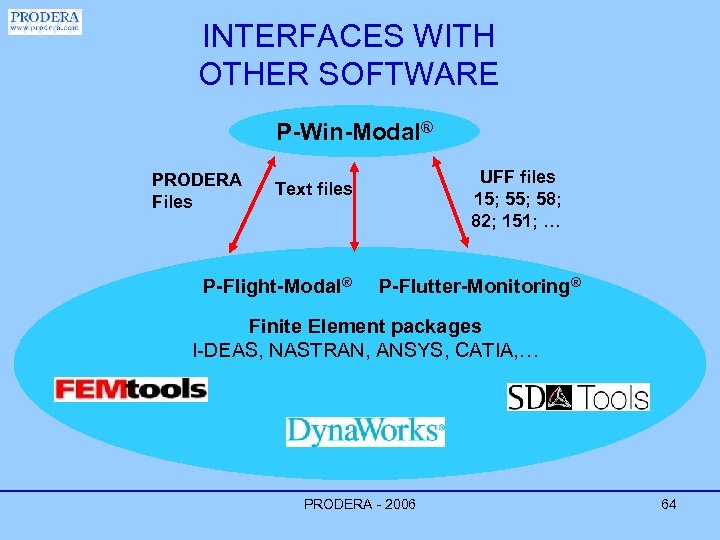 INTERFACES WITH OTHER SOFTWARE P-Win-Modal® PRODERA Files UFF files 15; 58; 82; 151; … Text files P-Flight-Modal® P-Flutter-Monitoring® Finite Element packages I-DEAS, NASTRAN, ANSYS, CATIA, … PRODERA - 2006 64
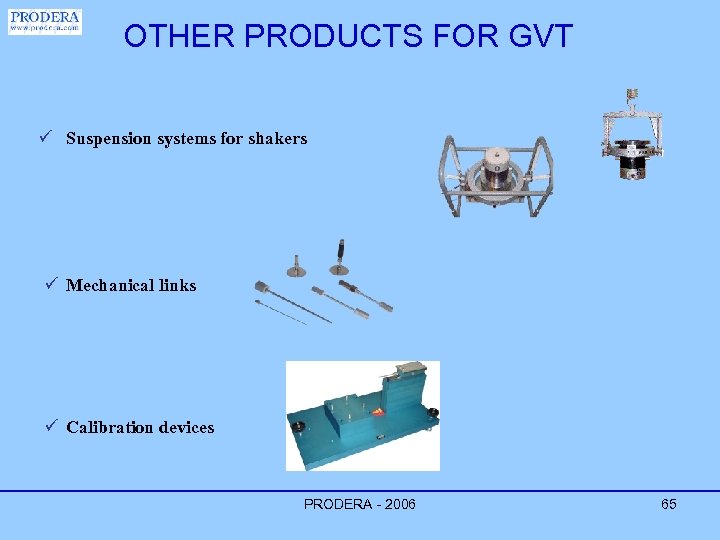 OTHER PRODUCTS FOR GVT ü Suspension systems for shakers ü Mechanical links ü Calibration devices PRODERA - 2006 65
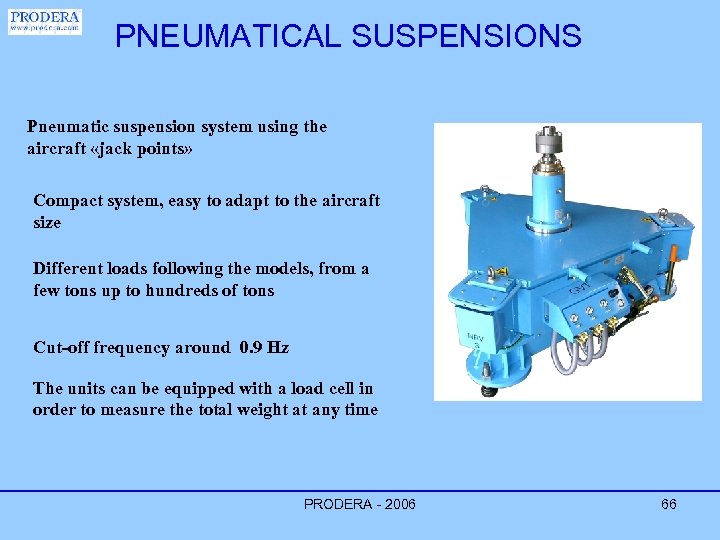 PNEUMATICAL SUSPENSIONS Pneumatic suspension system using the aircraft «jack points» Compact system, easy to adapt to the aircraft size Different loads following the models, from a few tons up to hundreds of tons Cut-off frequency around 0. 9 Hz The units can be equipped with a load cell in order to measure the total weight at any time PRODERA - 2006 66
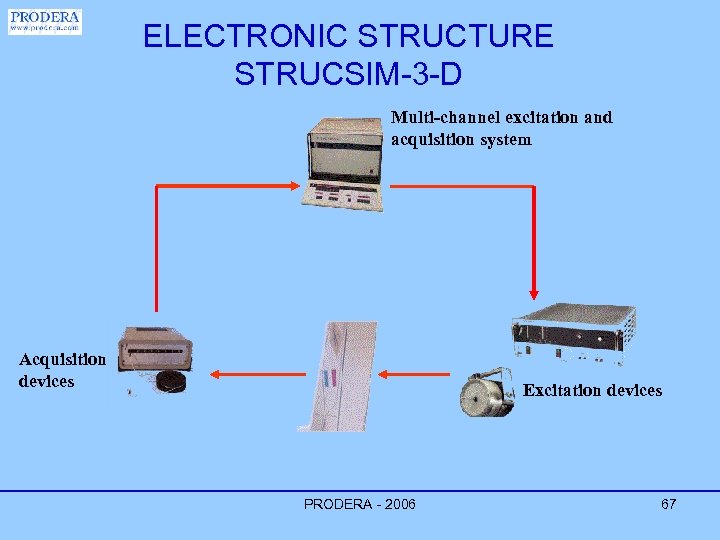 ELECTRONIC STRUCTURE STRUCSIM-3 -D Multi-channel excitation and acquisition system Acquisition devices Excitation devices PRODERA - 2006 67
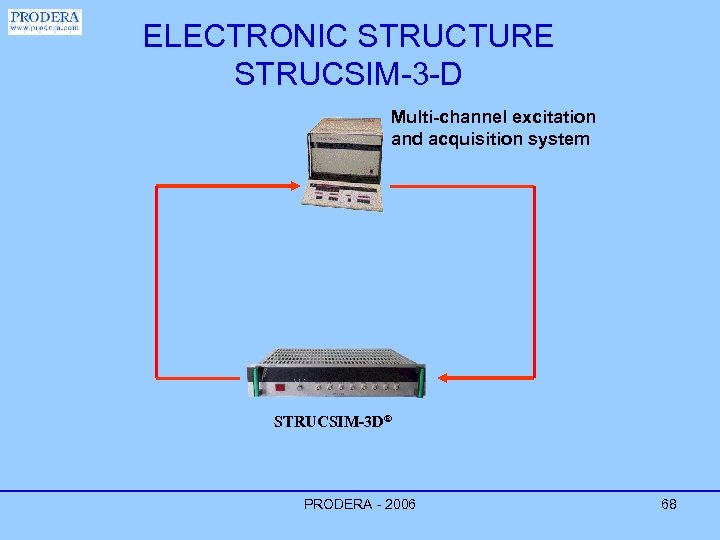 ELECTRONIC STRUCTURE STRUCSIM-3 -D Multi-channel excitation and acquisition system STRUCSIM-3 D® PRODERA - 2006 68
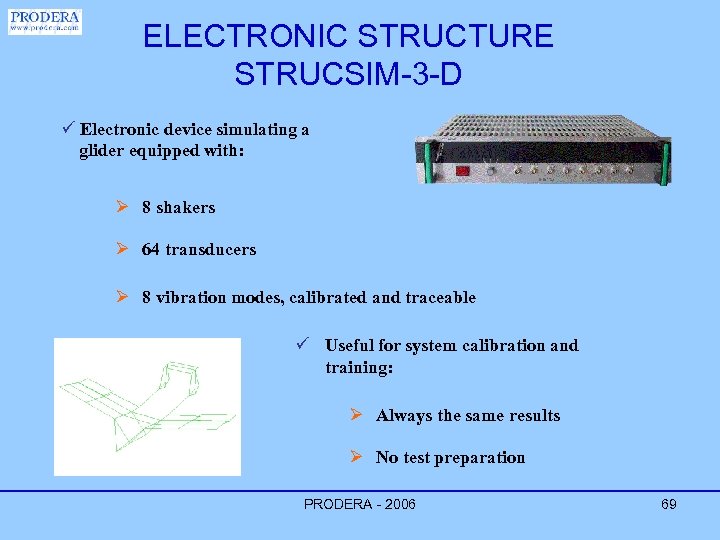 ELECTRONIC STRUCTURE STRUCSIM-3 -D ü Electronic device simulating a glider equipped with: Ø 8 shakers Ø 64 transducers Ø 8 vibration modes, calibrated and traceable ü Useful for system calibration and training: Ø Always the same results Ø No test preparation PRODERA - 2006 69
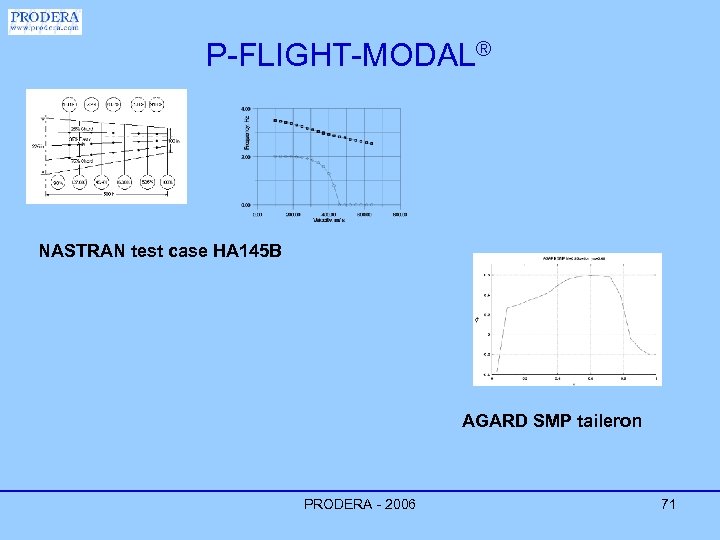
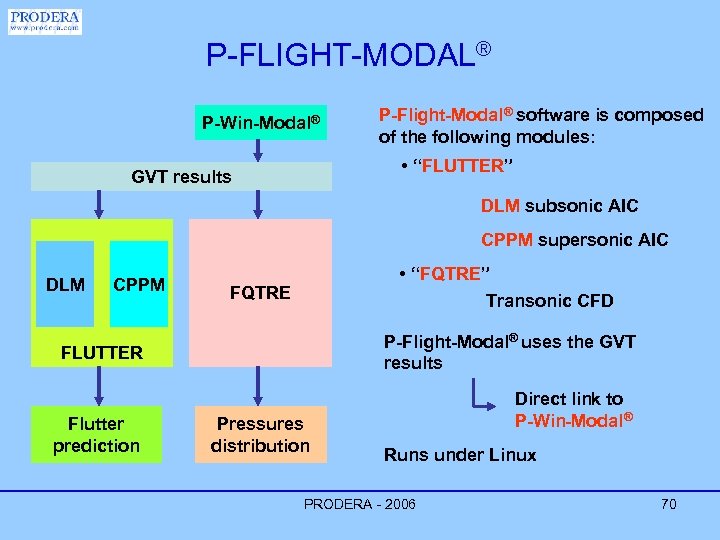 P-FLIGHT-MODAL® P-Win-Modal® P-Flight-Modal® software is composed of the following modules: • “FLUTTER” GVT results DLM subsonic AIC CPPM supersonic AIC DLM CPPM • “FQTRE” Transonic CFD FQTRE P-Flight-Modal® uses the GVT results FLUTTER Flutter prediction Pressures distribution Direct link to P-Win-Modal® Runs under Linux PRODERA - 2006 70
 P-FLIGHT-MODAL® NASTRAN test case HA 145 B AGARD SMP taileron PRODERA - 2006 71
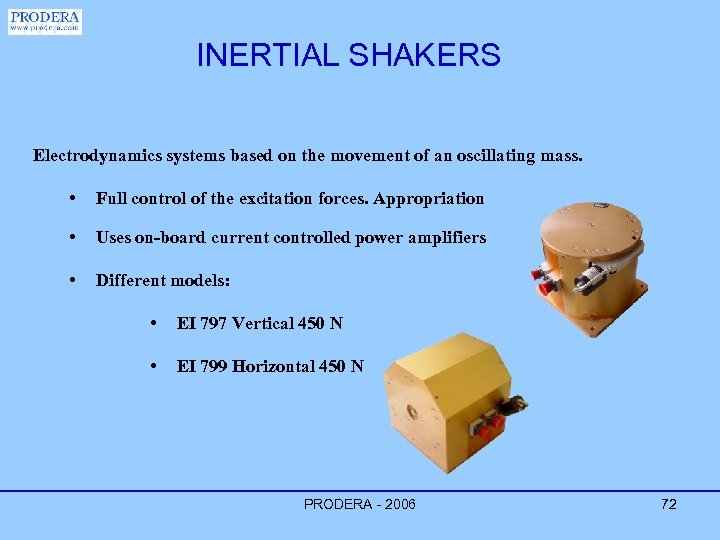 INERTIAL SHAKERS Electrodynamics systems based on the movement of an oscillating mass. • Full control of the excitation forces. Appropriation • Uses on-board current controlled power amplifiers • Different models: • EI 797 Vertical 450 N • EI 799 Horizontal 450 N PRODERA - 2006 72
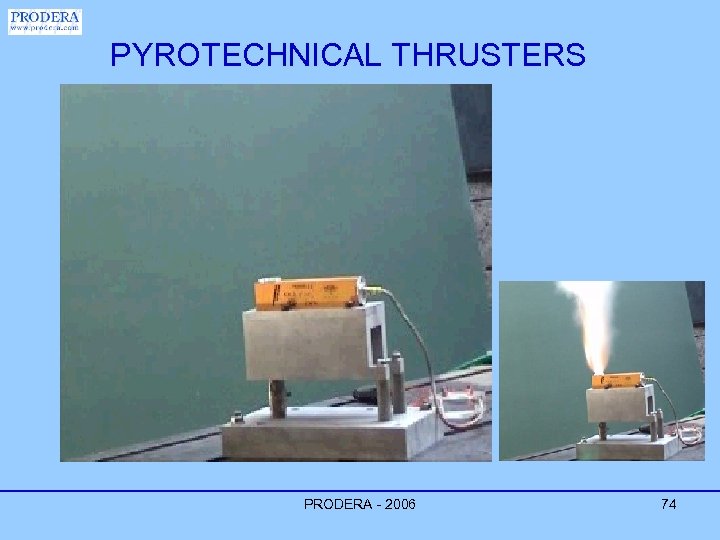
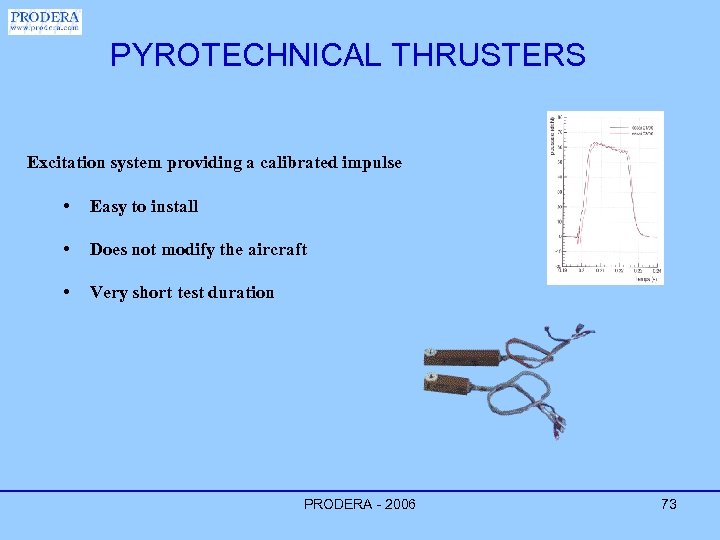 PYROTECHNICAL THRUSTERS Excitation system providing a calibrated impulse • Easy to install • Does not modify the aircraft • Very short test duration PRODERA - 2006 73
 PYROTECHNICAL THRUSTERS PRODERA - 2006 74
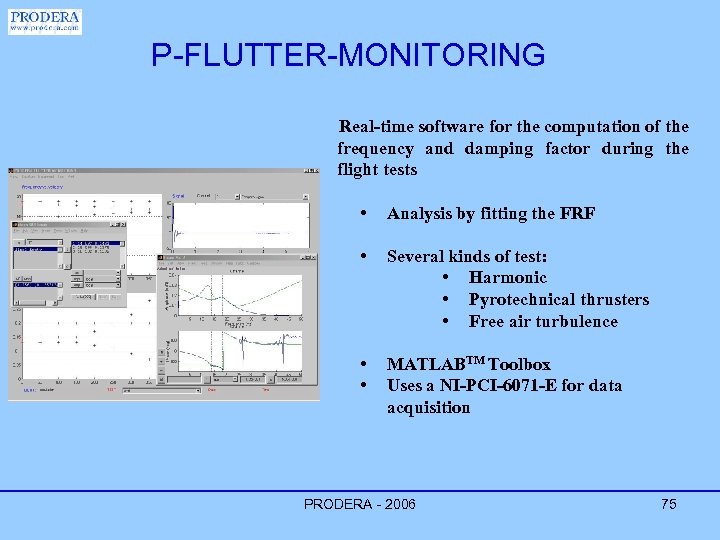 P-FLUTTER-MONITORING Real-time software for the computation of the frequency and damping factor during the flight tests • Analysis by fitting the FRF • Several kinds of test: • Harmonic • Pyrotechnical thrusters • Free air turbulence • • MATLABTM Toolbox Uses a NI-PCI-6071 -E for data acquisition PRODERA - 2006 75
 In conclusion … ü Force transducers not required ü Generator frequency stability of 10 -7 Hz ü Frequency precision of 10 -4 Hz, from DC up to 2 k. Hz ü Harmonic, Impulse and Random ü Forces appropriation method ü 2 modal analysis methods: complex power and quadrature forces ü Interfaces PRODERA - 2006 76
 In conclusion … ü Full range of constant force modal shakers with no influence on the structure by their low moving weight and stiffness ü Full range of current controlled power amplifiers with zero phase shift even at resonance ü In-House system (software & hardware) ü Customizable products ü Robust products, no need for special maintenance ü Experience, more than 40 years manufacturing GVT systems ü Reactive company, quick reaction 24 hours a day PRODERA - 2006 77
 Thank you for your attention … PRODERA - 2006 78