


 Скачать презентацию Process Understanding and PAT D Christopher Watts Ph
07539eebff296b2ff970f25665c41f24.ppt
- Количество слайдов: 19
 Process Understanding and PAT D. Christopher Watts, Ph. D. Office of Pharmaceutical Science, CDER, FDA ACPS, Manufacturing Subcommittee July 21, 2004
 The Questions • What is PAT? • Who is involved with PAT? – Engine for Success • How will PAT benefit? – Industry – Agency – Public Health • Where are we going with PAT?
 What is PAT? A system for: – designing, analyzing, and controlling manufacturing – timely measurements (i. e. , during processing) – critical quality and performance attributes – raw and in-process materials – processes “Analytical“ includes: – chemical, physical, microbiological, mathematical, and risk analysis – conducted in an integrated manner
 PAT = Process Understanding • A process is well understood when: – all critical sources of variability are identified and explained – variability is managed by the process – product quality attributes can be accurately and reliably predicted • Accurate and Reliable predictions reflect process understanding • Process Understanding inversely proportional to risk
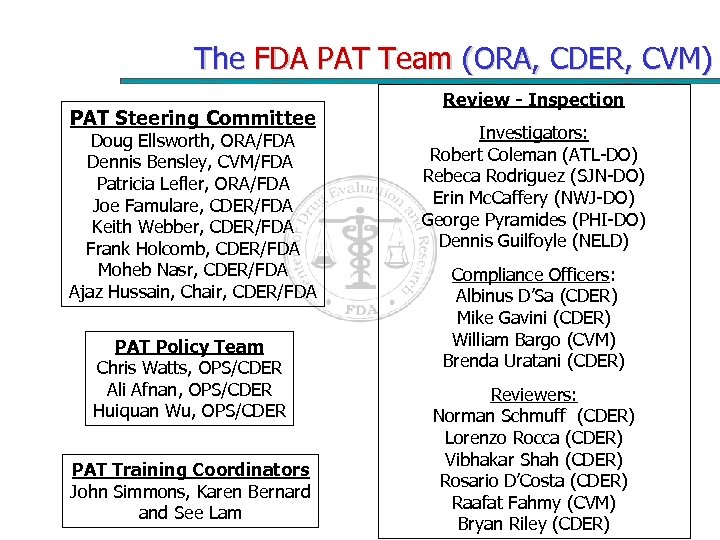 The FDA PAT Team (ORA, CDER, CVM) PAT Steering Committee Doug Ellsworth, ORA/FDA Dennis Bensley, CVM/FDA Patricia Lefler, ORA/FDA Joe Famulare, CDER/FDA Keith Webber, CDER/FDA Frank Holcomb, CDER/FDA Moheb Nasr, CDER/FDA Ajaz Hussain, Chair, CDER/FDA PAT Policy Team Chris Watts, OPS/CDER Ali Afnan, OPS/CDER Huiquan Wu, OPS/CDER PAT Training Coordinators John Simmons, Karen Bernard and See Lam Review - Inspection Investigators: Robert Coleman (ATL-DO) Rebeca Rodriguez (SJN-DO) Erin Mc. Caffery (NWJ-DO) George Pyramides (PHI-DO) Dennis Guilfoyle (NELD) Compliance Officers: Albinus D’Sa (CDER) Mike Gavini (CDER) William Bargo (CVM) Brenda Uratani (CDER) Reviewers: Norman Schmuff (CDER) Lorenzo Rocca (CDER) Vibhakar Shah (CDER) Rosario D’Costa (CDER) Raafat Fahmy (CVM) Bryan Riley (CDER)
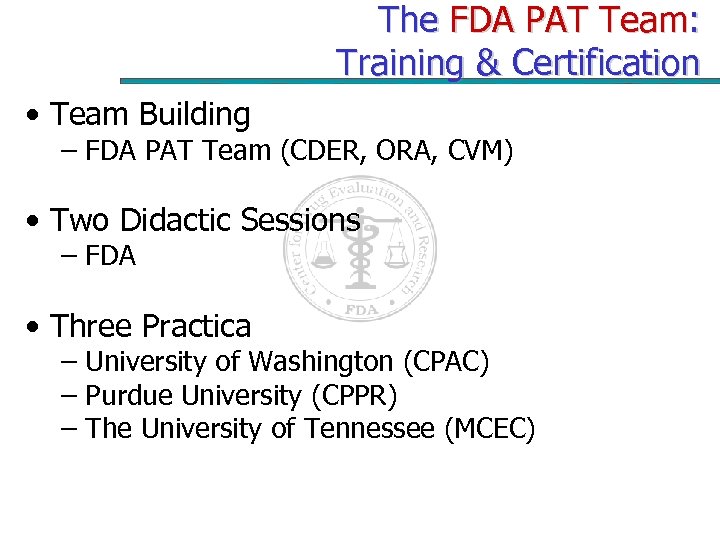 The FDA PAT Team: Training & Certification • Team Building – FDA PAT Team (CDER, ORA, CVM) • Two Didactic Sessions – FDA • Three Practica – University of Washington (CPAC) – Purdue University (CPPR) – The University of Tennessee (MCEC)
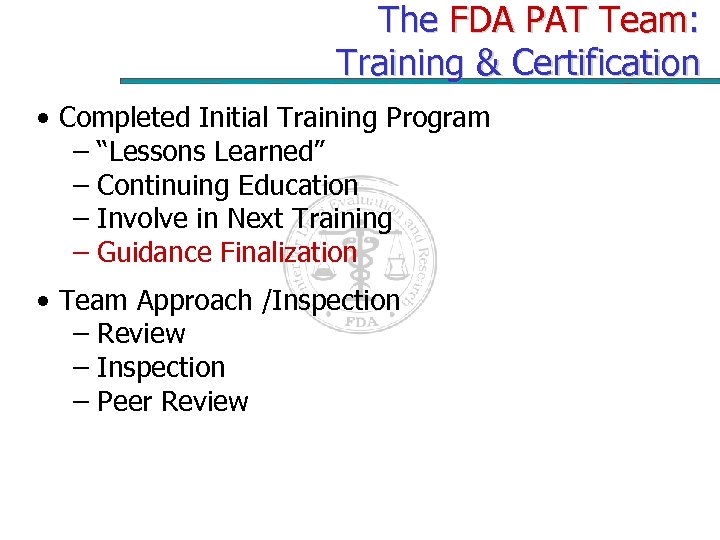 The FDA PAT Team: Training & Certification • Completed Initial Training Program – “Lessons Learned” – Continuing Education – Involve in Next Training – Guidance Finalization • Team Approach /Inspection – Review – Inspection – Peer Review
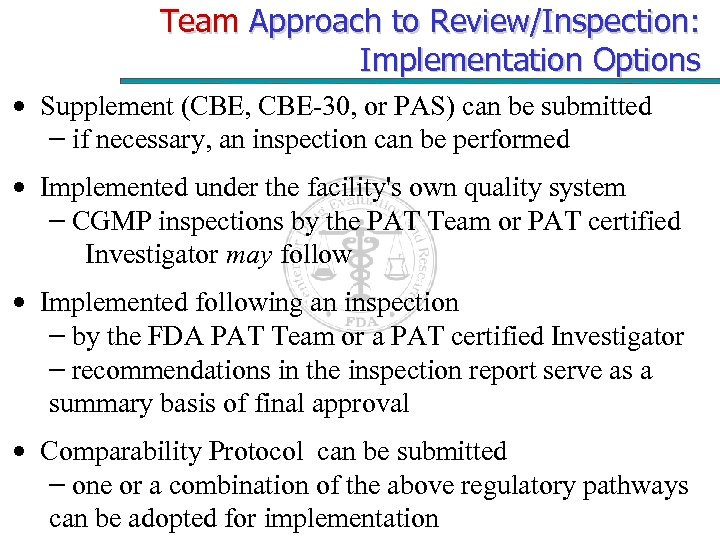 Team Approach to Review/Inspection: Implementation Options • Supplement (CBE, CBE-30, or PAS) can be submitted – if necessary, an inspection can be performed • Implemented under the facility's own quality system – CGMP inspections by the PAT Team or PAT certified Investigator may follow • Implemented following an inspection – by the FDA PAT Team or a PAT certified Investigator – recommendations in the inspection report serve as a summary basis of final approval • Comparability Protocol can be submitted – one or a combination of the above regulatory pathways can be adopted for implementation
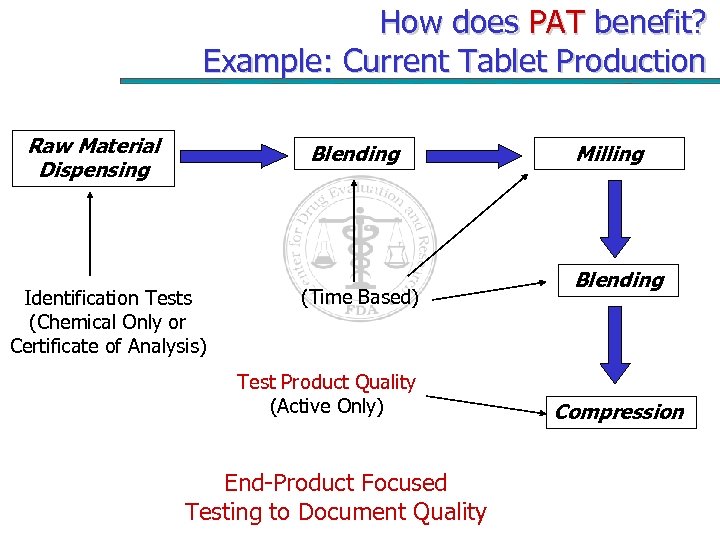 How does PAT benefit? Example: Current Tablet Production Raw Material Dispensing Blending Identification Tests (Chemical Only or Certificate of Analysis) (Time Based) Test Product Quality (Active Only) End-Product Focused Testing to Document Quality Milling Blending Compression
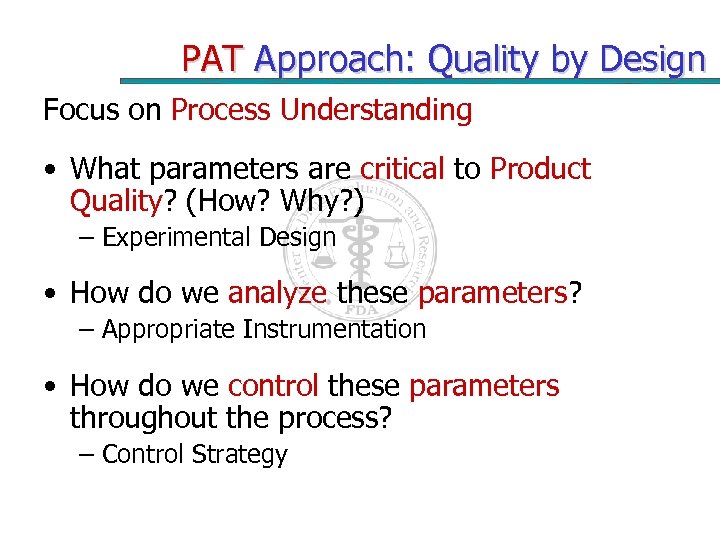 PAT Approach: Quality by Design Focus on Process Understanding • What parameters are critical to Product Quality? (How? Why? ) – Experimental Design • How do we analyze these parameters? – Appropriate Instrumentation • How do we control these parameters throughout the process? – Control Strategy
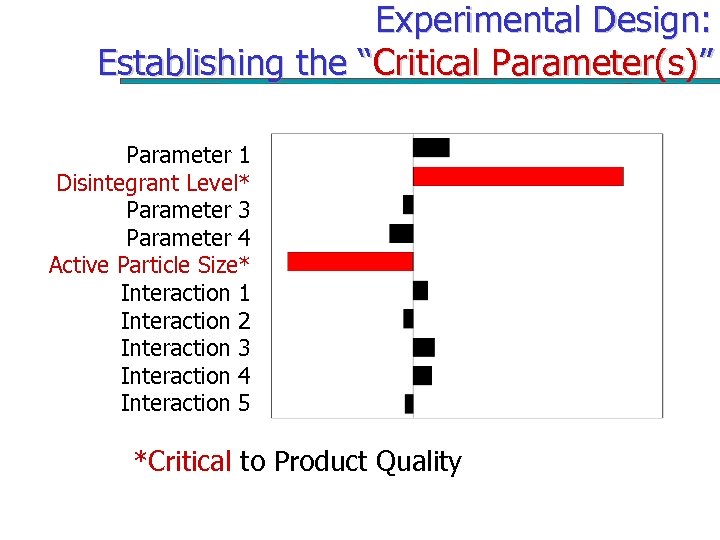 Experimental Design: Establishing the “Critical Parameter(s)” Parameter 1 Disintegrant Level* Parameter 3 Parameter 4 Active Particle Size* Interaction 1 Interaction 2 Interaction 3 Interaction 4 Interaction 5 *Critical to Product Quality
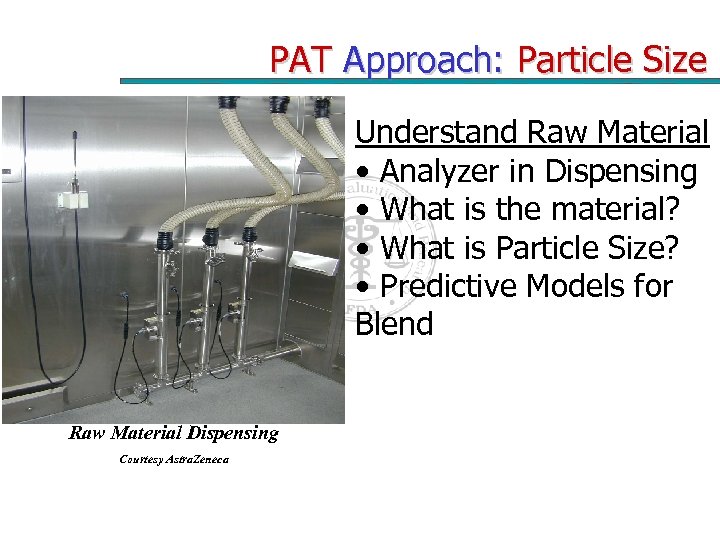 PAT Approach: Particle Size Understand Raw Material • Analyzer in Dispensing • What is the material? • What is Particle Size? • Predictive Models for Blend Raw Material Dispensing Courtesy Astra. Zeneca
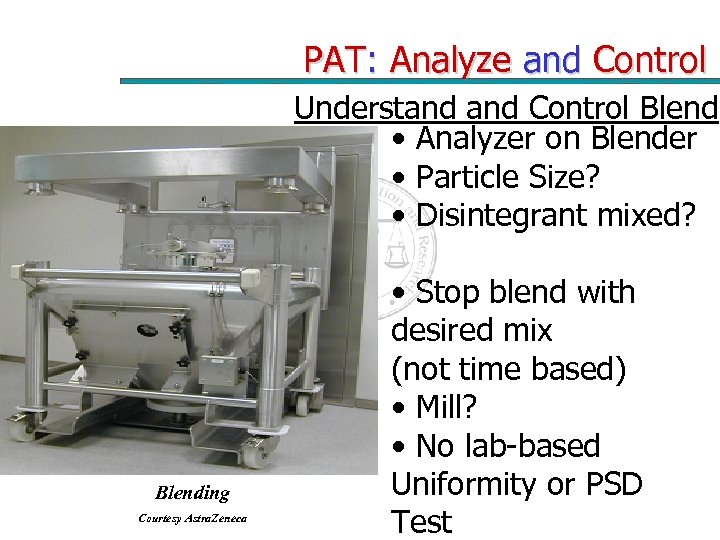 PAT: Analyze and Control Understand Control Blend • Analyzer on Blender • Particle Size? • Disintegrant mixed? Blending Courtesy Astra. Zeneca • Stop blend with desired mix (not time based) • Mill? • No lab-based Uniformity or PSD Test
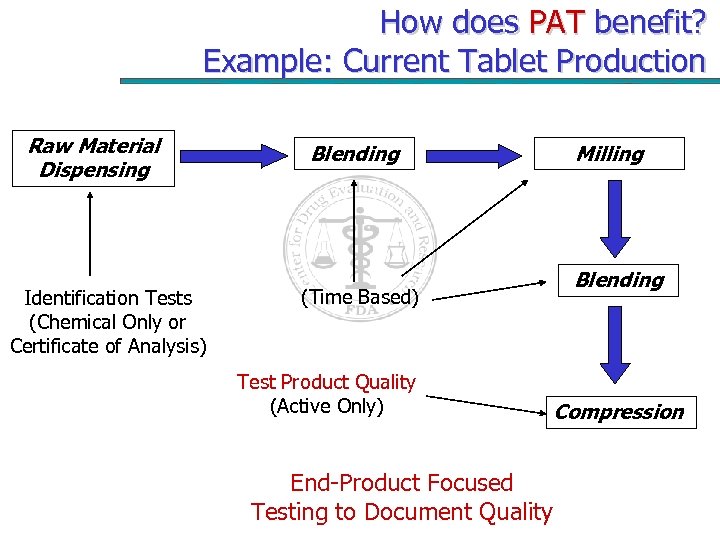 How does PAT benefit? Example: Current Tablet Production Raw Material Dispensing Identification Tests (Chemical Only or Certificate of Analysis) Blending (Time Based) Test Product Quality (Active Only) End-Product Focused Testing to Document Quality Milling Blending Compression
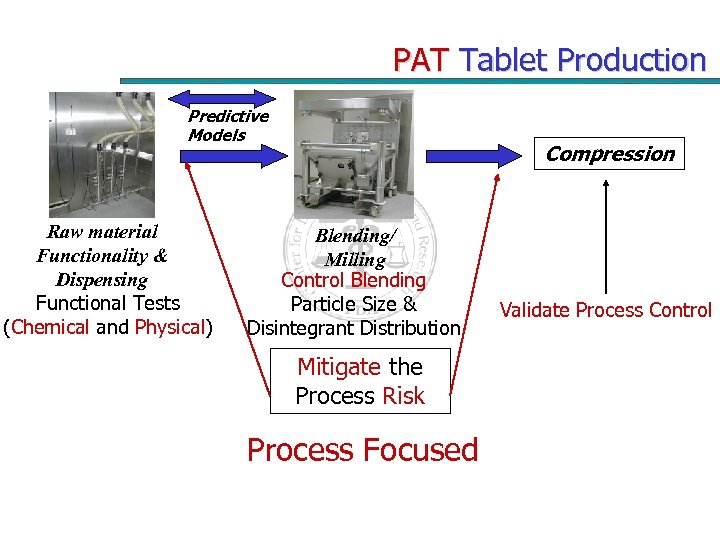 PAT Tablet Production Predictive Models Raw material Functionality & Dispensing Functional Tests (Chemical and Physical) Compression Blending/ Milling Control Blending Particle Size & Disintegrant Distribution Mitigate the Process Risk Process Focused Validate Process Control
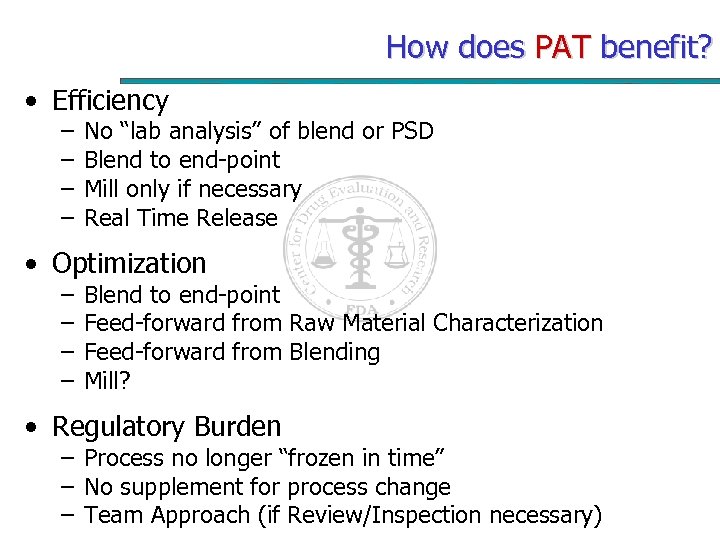 How does PAT benefit? • Efficiency – – No “lab analysis” of blend or PSD Blend to end-point Mill only if necessary Real Time Release • Optimization – – Blend to end-point Feed-forward from Raw Material Characterization Feed-forward from Blending Mill? • Regulatory Burden – Process no longer “frozen in time” – No supplement for process change – Team Approach (if Review/Inspection necessary)
 Summary: Process Understanding and PAT • Inverse relationship between the level of process understanding and the risk of producing a poor quality product • Well understood process less restrictive regulatory approaches to manage change • Focus on process understanding can facilitate riskmanaged regulatory decisions and innovation • Team Approach to Review/Inspection – Several Options for Implementation
 Next Steps for PAT • Finalize PAT Guidance • Expand the Scope of PAT – Office of Biotechnology Products • Continued Training of FDA Staff • ASTM Technical Committee • Research (Intra- and Extramural) – – Office of Testing and Research Pfizer CRADA NSF IAG Support Policy Development and Training
 Contact • Email: – PAT@cder. fda. gov – wattsc@cder. fda. gov • PAT on the Web: – http: //www. fda. gov/cder/OPS/PAT. htm • Phone: – (301)-443 -5197