


 Скачать презентацию Process and impact of commercialisation privatisation Worldwide trends Dr
a1cd410f6aa55296dddc91bc24e4bdce.ppt
- Количество слайдов: 32
 Process and impact of commercialisation/privatisation: Worldwide trends Dr Tim Kelly, ITU Tuesday Session 2 CTO Senior management seminar: Telecoms restructuring and business change Malta, 17 -21 May, 1999 The views expressed in this paper are those of the author and do not necessarily reflect the opinions of the ITU or its membership. Dr Kelly can be contacted at Tim. Kelly@itu. int.
 Agenda l Privatisation / Corporatisation: Trends ð Why? Where? When? ð How much? l Case studies: ð Telkom South Africa, Tel. Mex (Mexico) l Developing country concerns ð Universal service obligations ð Loss of strategic control over sector ð Repatriation of profits to foreign country l Identifying and avoiding pitfalls l Does privatisation bring the expected benefits?
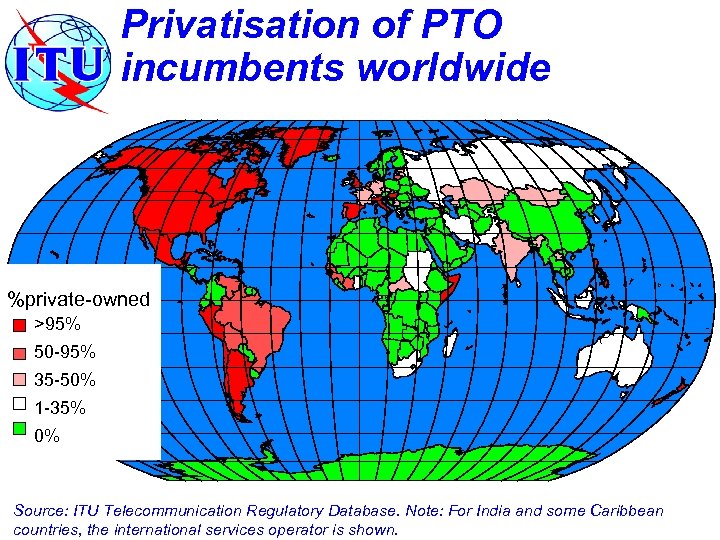 Privatisation of PTO incumbents worldwide %private-owned >95% 50 -95% 35 -50% 1 -35% 0% Source: ITU Telecommunication Regulatory Database. Note: For India and some Caribbean countries, the international services operator is shown.
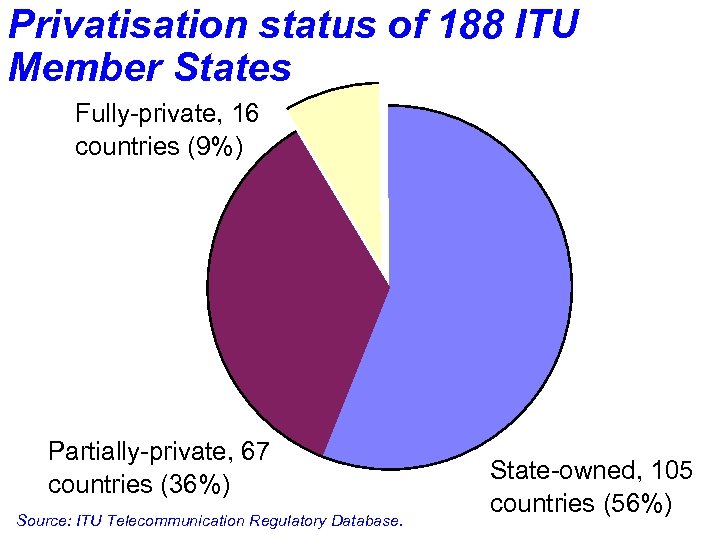 Privatisation status of 188 ITU Member States Fully-private, 16 countries (9%) Partially-private, 67 countries (36%) Source: ITU Telecommunication Regulatory Database. State-owned, 105 countries (56%)
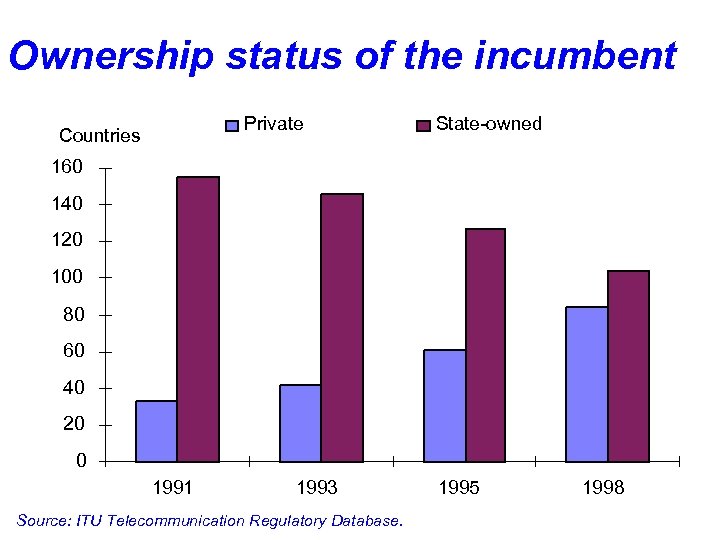 Ownership status of the incumbent Private Countries State-owned 160 140 120 100 80 60 40 20 0 1991 1993 Source: ITU Telecommunication Regulatory Database. 1995 1998
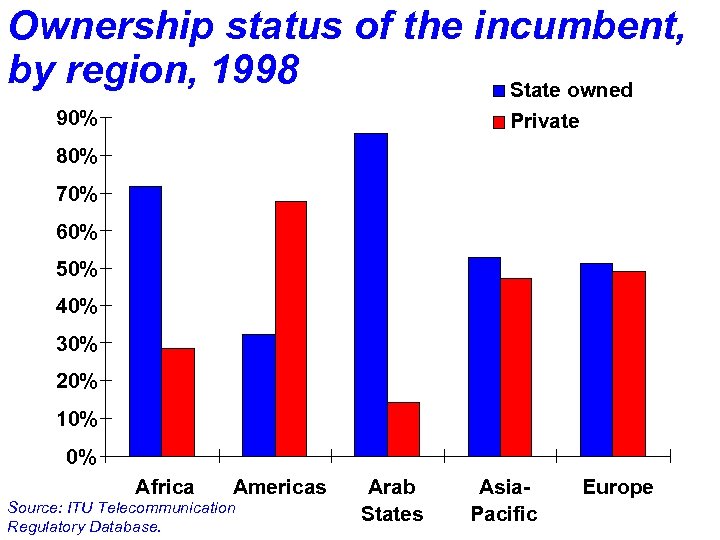 Ownership status of the incumbent, by region, 1998 State owned 90% Private 80% 70% 60% 50% 40% 30% 20% 10% 0% Africa Americas Source: ITU Telecommunication Regulatory Database. Arab States Asia. Pacific Europe
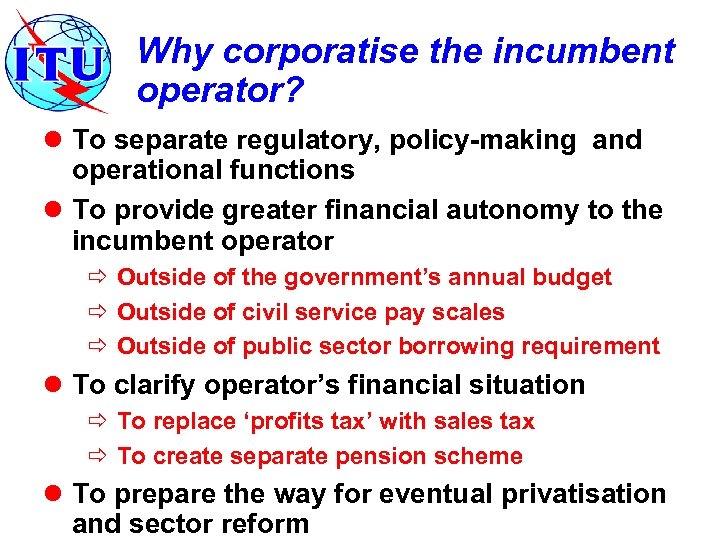 Why corporatise the incumbent operator? l To separate regulatory, policy-making and operational functions l To provide greater financial autonomy to the incumbent operator ð Outside of the government’s annual budget ð Outside of civil service pay scales ð Outside of public sector borrowing requirement l To clarify operator’s financial situation ð To replace ‘profits tax’ with sales tax ð To create separate pension scheme l To prepare the way for eventual privatisation and sector reform
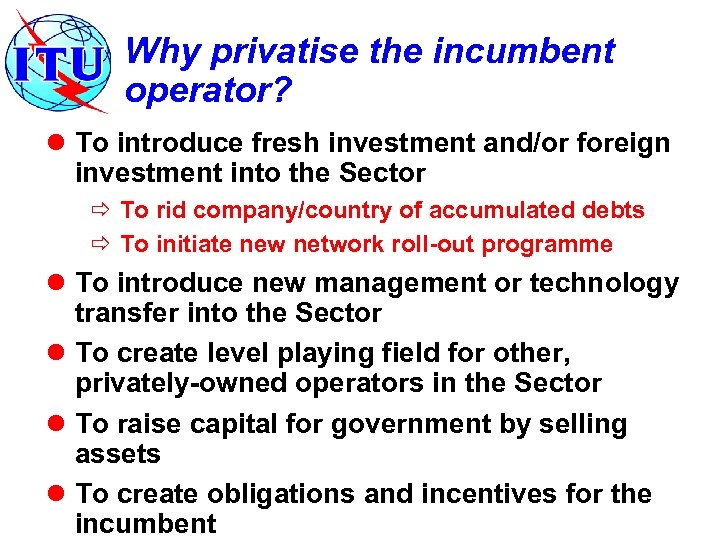 Why privatise the incumbent operator? l To introduce fresh investment and/or foreign investment into the Sector ð To rid company/country of accumulated debts ð To initiate new network roll-out programme l To introduce new management or technology transfer into the Sector l To create level playing field for other, privately-owned operators in the Sector l To raise capital for government by selling assets l To create obligations and incentives for the incumbent
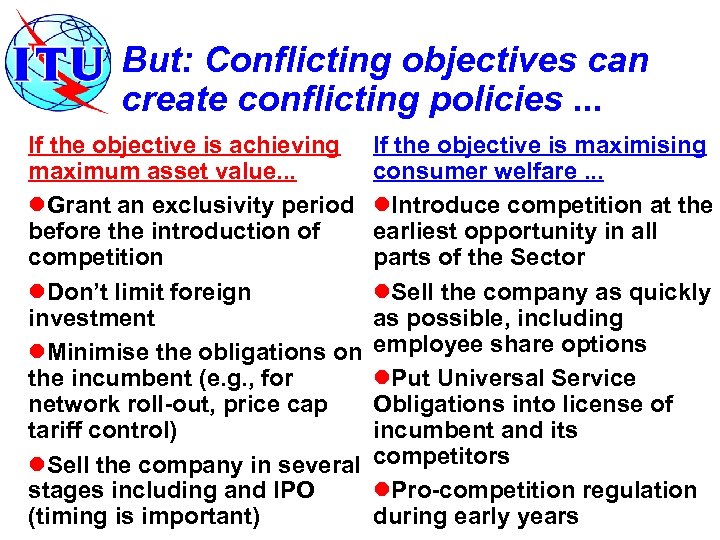 But: Conflicting objectives can create conflicting policies. . . If the objective is achieving maximum asset value. . . l. Grant an exclusivity period before the introduction of competition l. Don’t limit foreign investment l. Minimise the obligations on the incumbent (e. g. , for network roll-out, price cap tariff control) l. Sell the company in several stages including and IPO (timing is important) If the objective is maximising consumer welfare. . . l. Introduce competition at the earliest opportunity in all parts of the Sector l. Sell the company as quickly as possible, including employee share options l. Put Universal Service Obligations into license of incumbent and its competitors l. Pro-competition regulation during early years
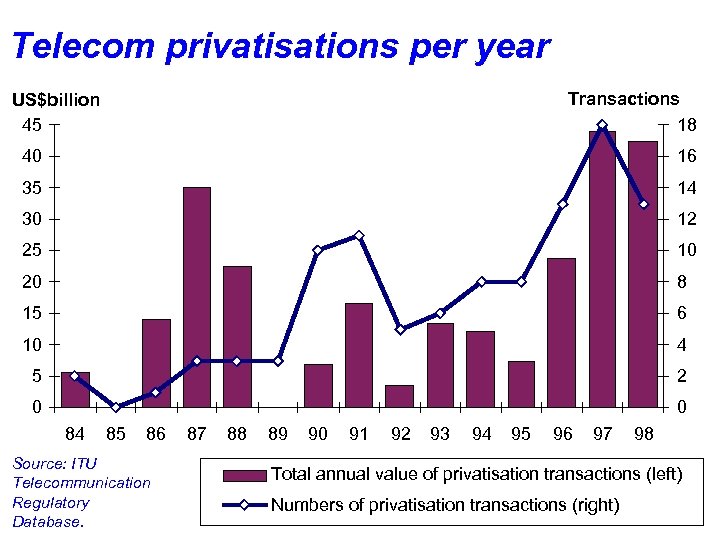 Telecom privatisations per year Transactions 18 US$billion 45 40 16 35 14 30 12 25 10 20 8 15 6 10 4 5 2 0 0 84 85 86 Source: ITU Telecommunication Regulatory Database. 87 88 89 90 91 92 93 94 95 96 97 98 Total annual value of privatisation transactions (left) Numbers of privatisation transactions (right)
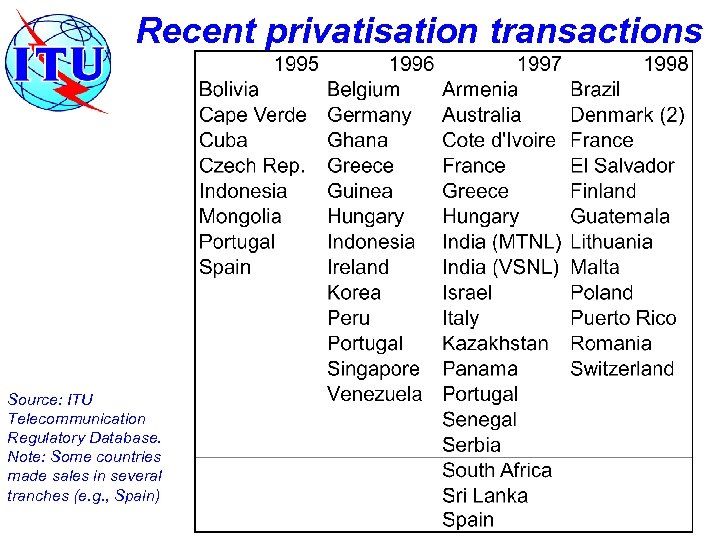 Recent privatisation transactions Source: ITU Telecommunication Regulatory Database. Note: Some countries made sales in several tranches (e. g. , Spain)
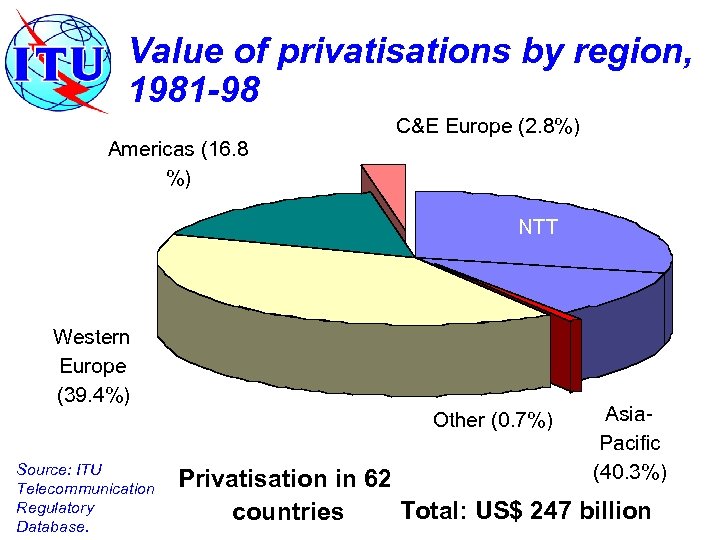 Value of privatisations by region, 1981 -98 Americas (16. 8 %) C&E Europe (2. 8%) NTT Western Europe (39. 4%) Other (0. 7%) Source: ITU Telecommunication Regulatory Database. Asia. Pacific (40. 3%) Privatisation in 62 Total: US$ 247 billion countries
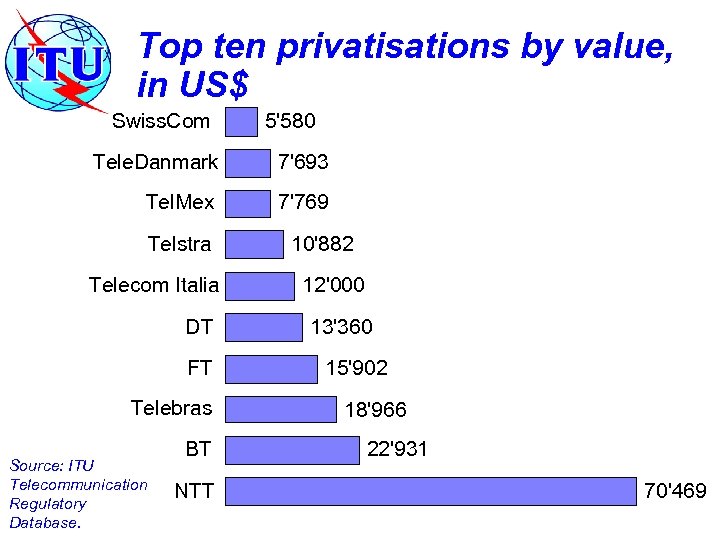 Top ten privatisations by value, in US$ Swiss. Com 5'580 Tele. Danmark 7'693 Tel. Mex 7'769 Telstra Telecom Italia DT FT Telebras Source: ITU Telecommunication Regulatory Database. BT NTT 10'882 12'000 13'360 15'902 18'966 22'931 70'469
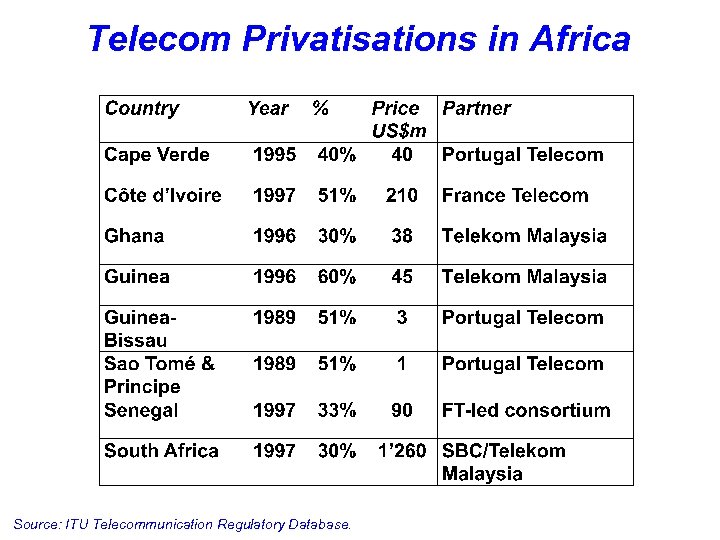 Telecom Privatisations in Africa Source: ITU Telecommunication Regulatory Database.
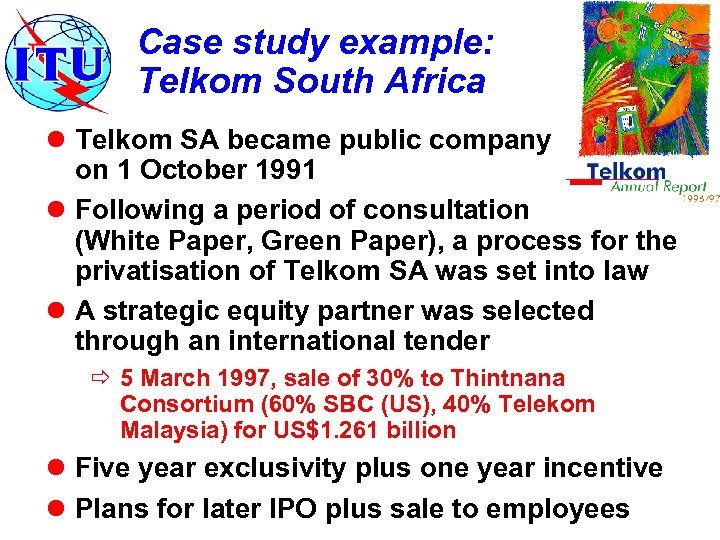 Case study example: Telkom South Africa l Telkom SA became public company on 1 October 1991 l Following a period of consultation (White Paper, Green Paper), a process for the privatisation of Telkom SA was set into law l A strategic equity partner was selected through an international tender ð 5 March 1997, sale of 30% to Thintnana Consortium (60% SBC (US), 40% Telekom Malaysia) for US$1. 261 billion l Five year exclusivity plus one year incentive l Plans for later IPO plus sale to employees
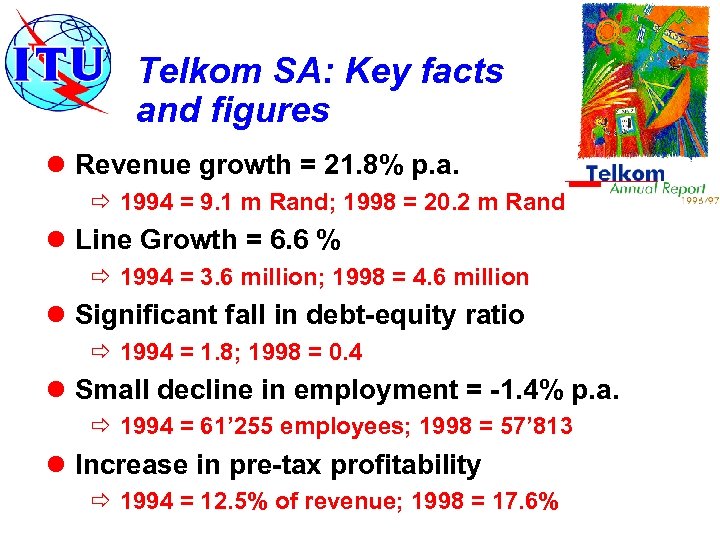 Telkom SA: Key facts and figures l Revenue growth = 21. 8% p. a. ð 1994 = 9. 1 m Rand; 1998 = 20. 2 m Rand l Line Growth = 6. 6 % ð 1994 = 3. 6 million; 1998 = 4. 6 million l Significant fall in debt-equity ratio ð 1994 = 1. 8; 1998 = 0. 4 l Small decline in employment = -1. 4% p. a. ð 1994 = 61’ 255 employees; 1998 = 57’ 813 l Increase in pre-tax profitability ð 1994 = 12. 5% of revenue; 1998 = 17. 6%
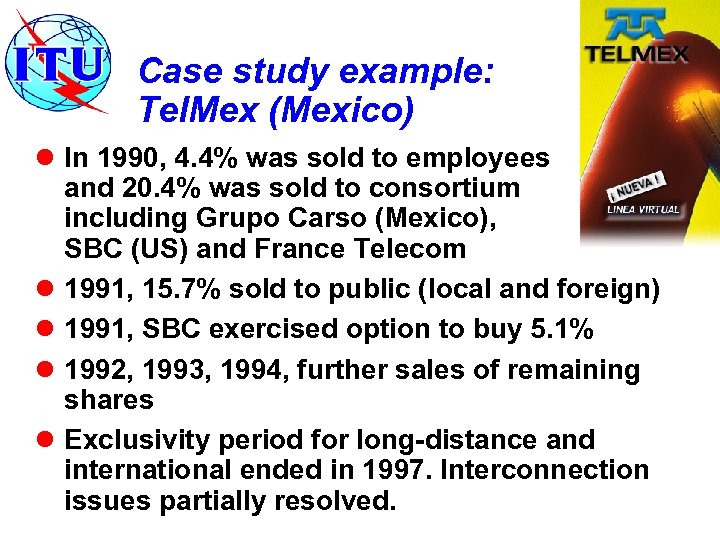 Case study example: Tel. Mex (Mexico) l In 1990, 4. 4% was sold to employees and 20. 4% was sold to consortium including Grupo Carso (Mexico), SBC (US) and France Telecom l 1991, 15. 7% sold to public (local and foreign) l 1991, SBC exercised option to buy 5. 1% l 1992, 1993, 1994, further sales of remaining shares l Exclusivity period for long-distance and international ended in 1997. Interconnection issues partially resolved.
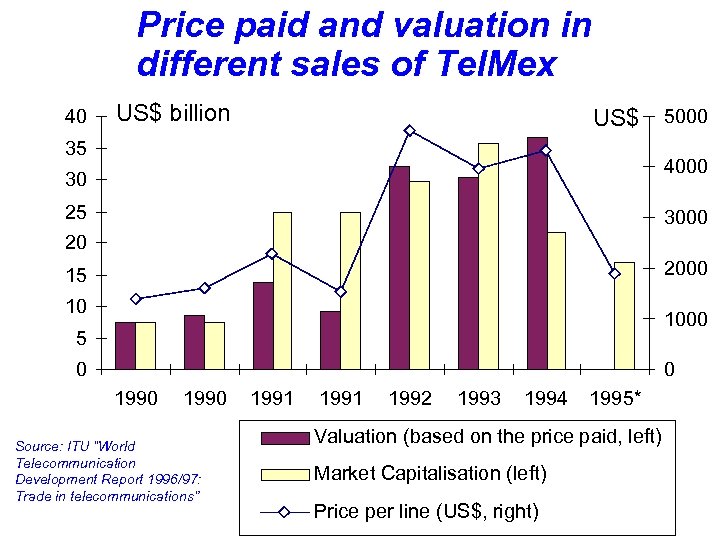 Price paid and valuation in different sales of Tel. Mex 40 US$ billion US$ 35 5000 4000 30 25 3000 20 2000 15 10 1000 5 0 0 1990 Source: ITU “World Telecommunication Development Report 1996/97: Trade in telecommunications” 1991 1992 1993 1994 1995* Valuation (based on the price paid, left) Market Capitalisation (left) Price per line (US$, right)
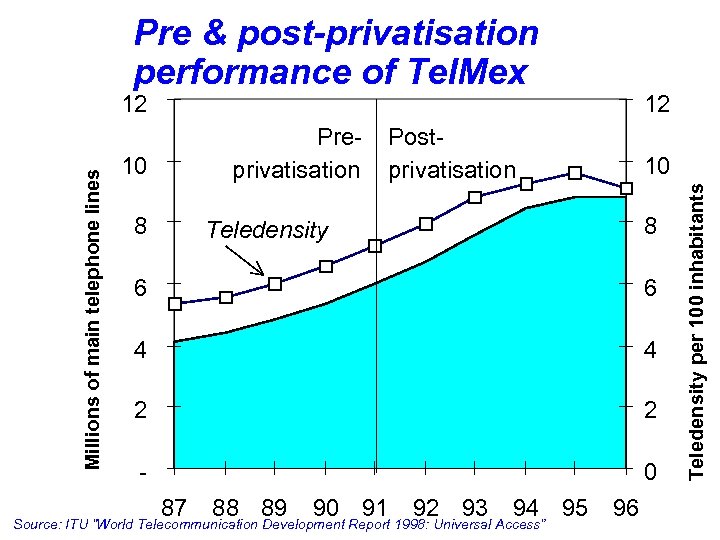 Pre & post-privatisation performance of Tel. Mex Preprivatisation 10 8 12 Postprivatisation 10 8 Teledensity 6 6 4 4 2 2 - 0 87 88 89 90 91 92 93 94 95 Source: ITU “World Telecommunication Development Report 1998: Universal Access” 96 Teledensity per 100 inhabitants Millions of main telephone lines 12
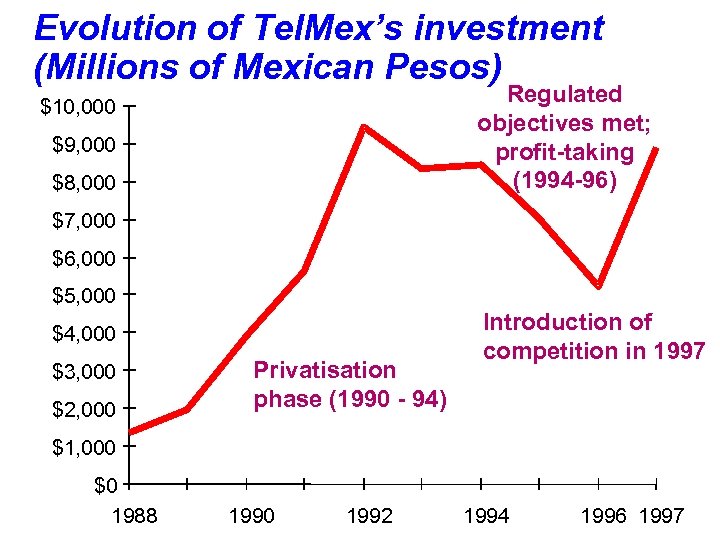 Evolution of Tel. Mex’s investment (Millions of Mexican Pesos) Regulated objectives met; profit-taking (1994 -96) $10, 000 $9, 000 $8, 000 $7, 000 $6, 000 $5, 000 $4, 000 $3, 000 $2, 000 Privatisation phase (1990 - 94) Introduction of competition in 1997 $1, 000 $0 1988 1990 1992 1994 1996 1997
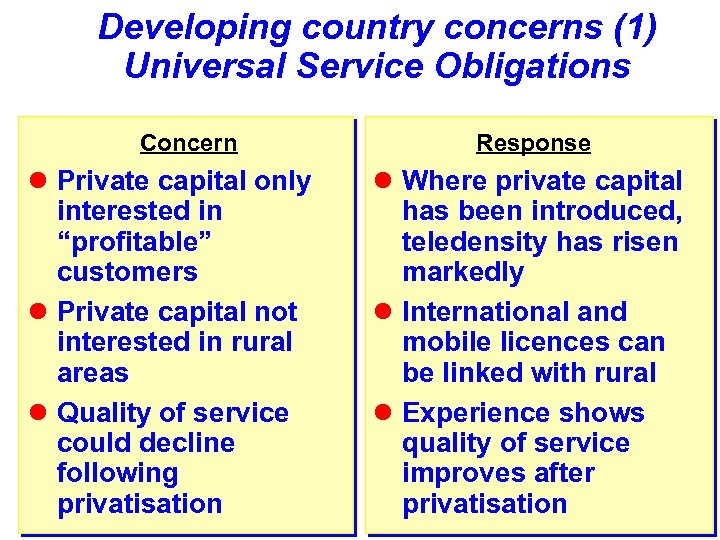 Developing country concerns (1) Universal Service Obligations Concern l Private capital only interested in “profitable” customers l Private capital not interested in rural areas l Quality of service could decline following privatisation Response l Where private capital has been introduced, teledensity has risen markedly l International and mobile licences can be linked with rural l Experience shows quality of service improves after privatisation
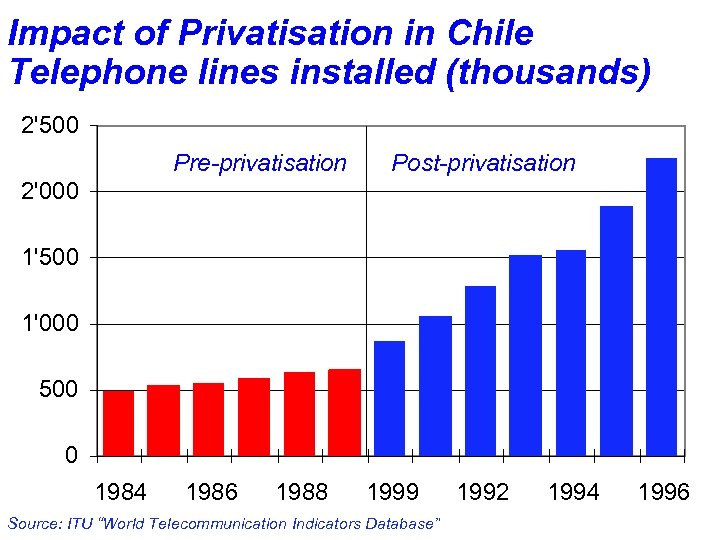 Impact of Privatisation in Chile Telephone lines installed (thousands) 2'500 Pre-privatisation Post-privatisation 2'000 1'500 1'000 500 0 1984 1986 1988 1999 Source: ITU “World Telecommunication Indicators Database” 1992 1994 1996
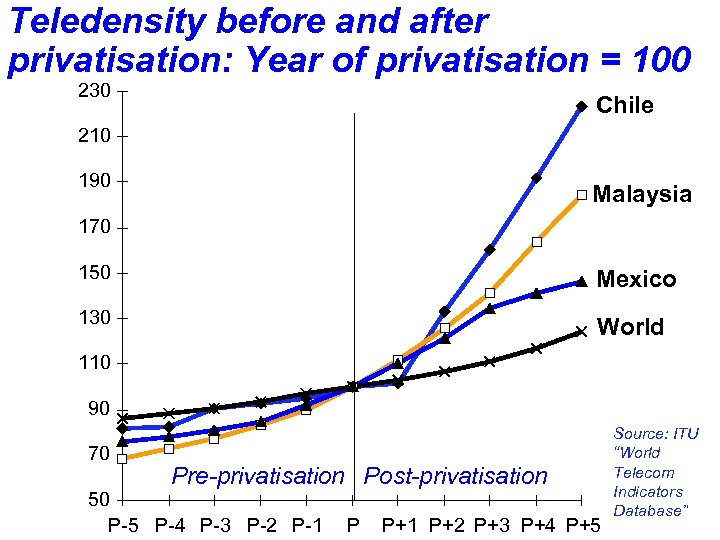 Teledensity before and after privatisation: Year of privatisation = 100 230 Chile 210 190 Malaysia 170 150 Mexico 130 World 110 90 70 Pre-privatisation Post-privatisation 50 P-5 P-4 P-3 P-2 P-1 P P+1 P+2 P+3 P+4 P+5 Source: ITU “World Telecom Indicators Database”
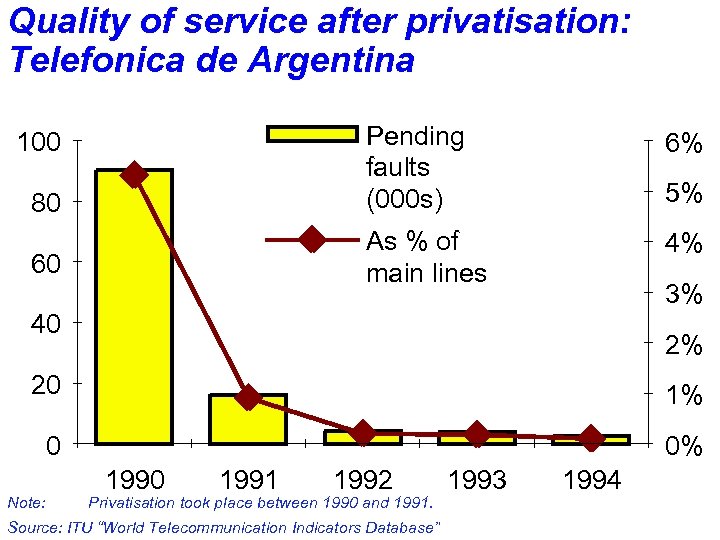 Quality of service after privatisation: Telefonica de Argentina 6% 80 Pending faults (000 s) 60 As % of main lines 4% 100 5% 3% 40 2% 20 1% 0 0% Note: 1990 1991 1992 Privatisation took place between 1990 and 1991. Source: ITU “World Telecommunication Indicators Database” 1993 1994
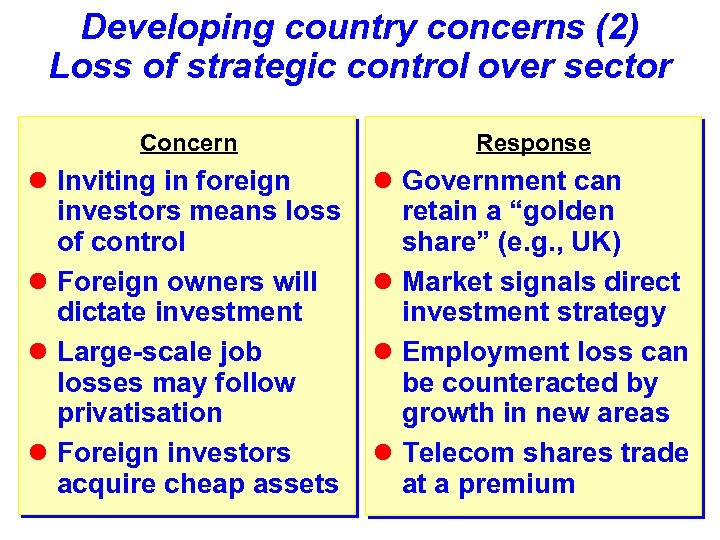 Developing country concerns (2) Loss of strategic control over sector Concern Response l Inviting in foreign investors means loss of control l Foreign owners will dictate investment l Large-scale job losses may follow privatisation l Foreign investors acquire cheap assets l Government can retain a “golden share” (e. g. , UK) l Market signals direct investment strategy l Employment loss can be counteracted by growth in new areas l Telecom shares trade at a premium
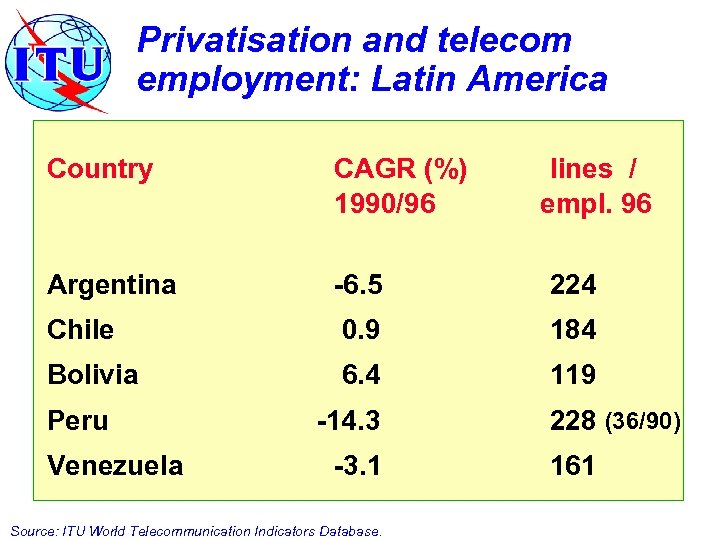 Privatisation and telecom employment: Latin America Country CAGR (%) 1990/96 Argentina -6. 5 224 Chile 0. 9 184 Bolivia 6. 4 119 Peru Venezuela -14. 3 -3. 1 Source: ITU World Telecommunication Indicators Database. lines / empl. 96 228 (36/90) 161
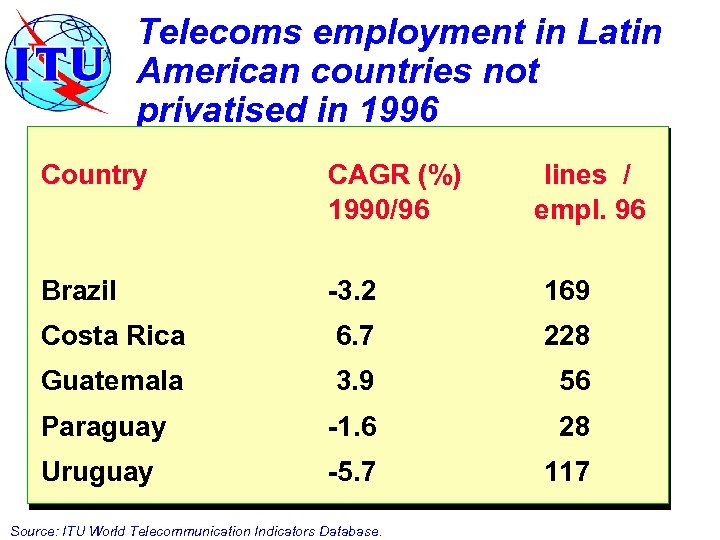 Telecoms employment in Latin American countries not privatised in 1996 Country CAGR (%) 1990/96 Brazil -3. 2 169 Costa Rica 6. 7 228 Guatemala 3. 9 56 Paraguay -1. 6 28 Uruguay -5. 7 117 Source: ITU World Telecommunication Indicators Database. lines / empl. 96
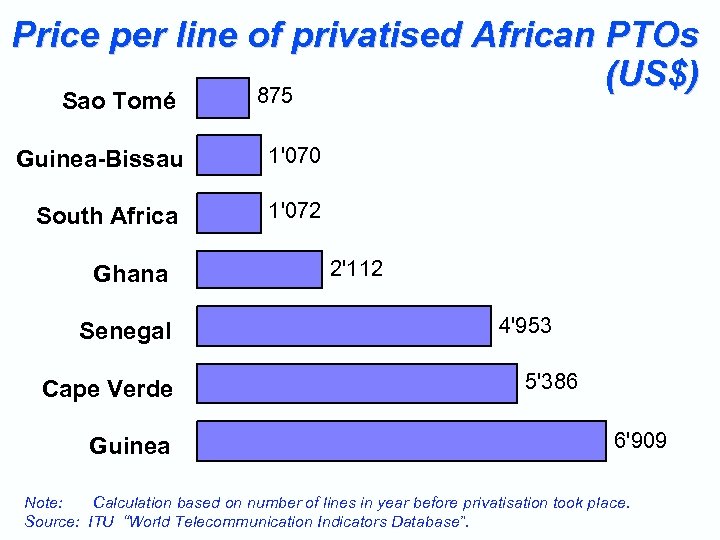 Price per line of privatised African PTOs (US$) 875 Sao Tomé Guinea-Bissau 1'070 South Africa 1'072 Ghana Senegal Cape Verde Guinea 2'112 4'953 5'386 6'909 Note: Calculation based on number of lines in year before privatisation took place. Source: ITU “World Telecommunication Indicators Database”.
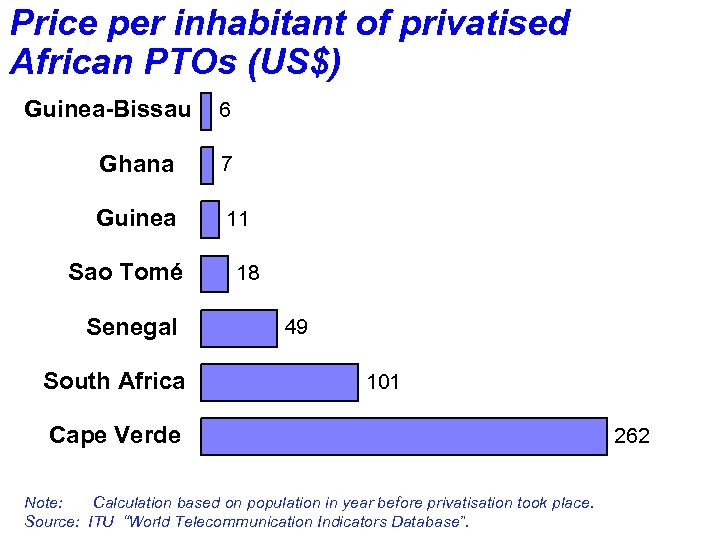 Price per inhabitant of privatised African PTOs (US$) Guinea-Bissau 6 Ghana 7 Guinea 11 Sao Tomé Senegal South Africa 18 49 101 Cape Verde Note: Calculation based on population in year before privatisation took place. Source: ITU “World Telecommunication Indicators Database”. 262
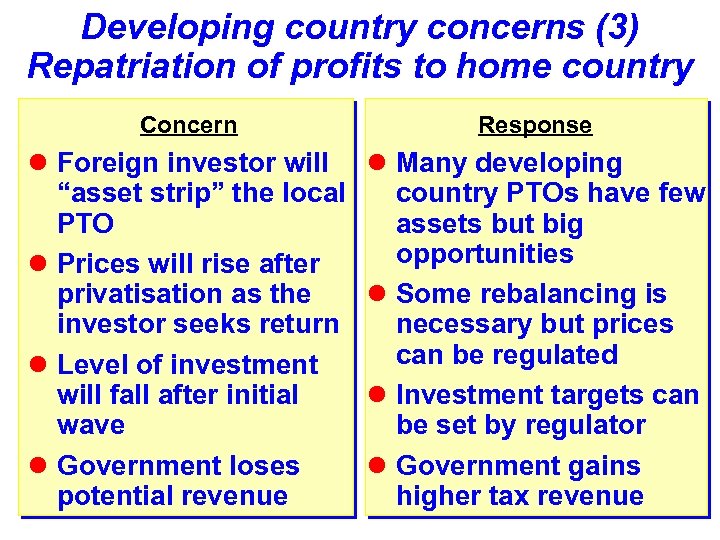 Developing country concerns (3) Repatriation of profits to home country Concern Response l Foreign investor will “asset strip” the local PTO l Prices will rise after privatisation as the investor seeks return l Level of investment will fall after initial wave l Government loses potential revenue l Many developing country PTOs have few assets but big opportunities l Some rebalancing is necessary but prices can be regulated l Investment targets can be set by regulator l Government gains higher tax revenue
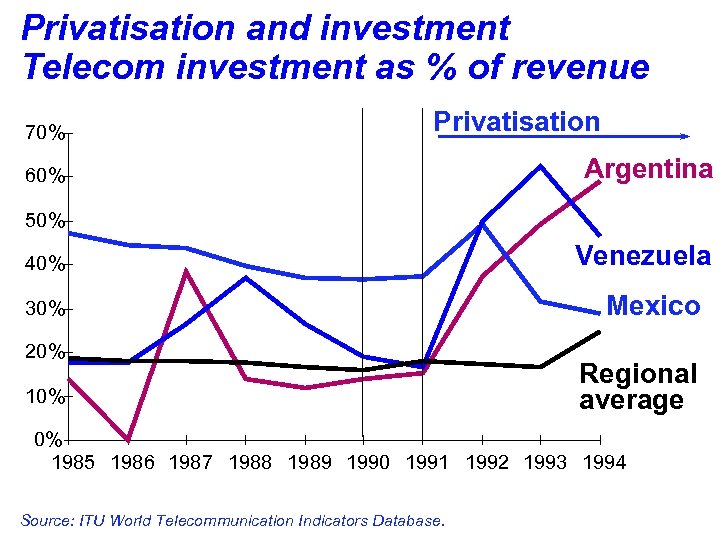 Privatisation and investment Telecom investment as % of revenue 70% Privatisation 60% Argentina 50% 40% 30% 20% 10% Venezuela Mexico Regional average 0% 1985 1986 1987 1988 1989 1990 1991 1992 1993 1994 Source: ITU World Telecommunication Indicators Database.
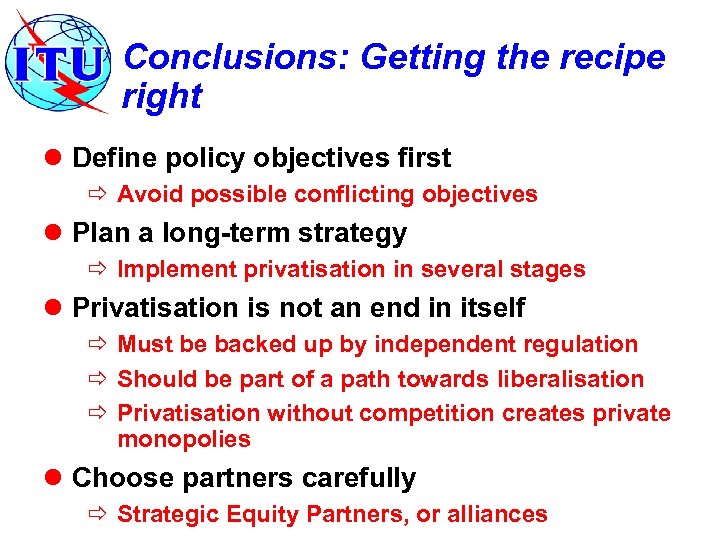 Conclusions: Getting the recipe right l Define policy objectives first ð Avoid possible conflicting objectives l Plan a long-term strategy ð Implement privatisation in several stages l Privatisation is not an end in itself ð Must be backed up by independent regulation ð Should be part of a path towards liberalisation ð Privatisation without competition creates private monopolies l Choose partners carefully ð Strategic Equity Partners, or alliances