 Скачать презентацию Problems of Economic Consequences of Privatization with special
53e716060311e014acfac1744afe4b13.ppt
- Количество слайдов: 63



Problems of Economic Consequences of Privatization (with special reference to the Czech Republic and Russia) Presented by Prof. Michal Mejstrik Institute of Economic Studies, Charles University, FSV Prague Prepared as Preliminary version for the 58 th Congress of the International Institute of Public Finance (IIPF) to be held in Helsinki on August 27, 2002 Paper is based on grant of GAČR No. 402/99/06066 and the results of EPI-EWMI project. 1
Content 1. 2. 3. 4. 5. 6. 7. 8. 9. Institute of Economic Studies Charles University in Prague -FSV Opletalova 26 CZ-110 00 Prague 1 Czech Republic Tel: +420 -2 -22 112 305 Fax: +420 -2 -22 112 304 e-mail: mejstrik@mbox. fsv. cuni. cz Comparative Macroeconomic Data The First Stage Transformation Features. . . Creative Destruction The Second Stage Transformation Features Privatization and Corporate Governance – „Ownership matters, but institutions as well“ Privatisation as One-off Game Adjustment of foreign investors – FDI Inflow and Performance Privatization of Strategic Network Companies (Gas and Water) Development of Private Financial Sector , Bank Privatizations and Improved Regulation: Towards the EU integration Privatization Costs and Proceeds and their Allocation 2
Basic Macroeconomic Data- CR vs. Russia 1999 GDP per capita (1999 ex. r) (€ P. P. S. bn) CR 5 200 Russia 1 250 2001 Inflation CR Russia 4. 7% 22. 4 % Population (mil. ) 13 018 7 473 10. 3 145. 6 Unemployment Cur. Acount/GDP 8. 9% 10. 0% GDP (2001/1989)est. FX reserves ($ bn) after depression +% 14. 5 CR around – 35% Russia -4. 7% 10. 2% FDI (%GDP) 9. 0% Source: Cz. St. Of. , UN, Sibirianova, Earle (2001), Svejnar (2002) 3
The First Stage Transformation Features. . . Creative Destruction • Transition economy abandoning the rigid and stagnating (0. 8% in 1980´s ) system of central planning and institutions and contracts associated with it and moving gradually towards institutions of nontotalitarian society and market economy • Mejstrik (1999), Svejnar (2002) 4
. . . creative destruction (Cont. ) – Microdistortions abandoned • Liberalization of Prices, Trade (incl. Small Privatization), Foreign Trade and Investment Model, • Gradual Reduction of Subsidies • Removal of barriers to the creation of New firms • Corporatization • Break-up of Administrative Trusts and the Monobank System, Mc. Dermott, Mejstrik (1993) 5
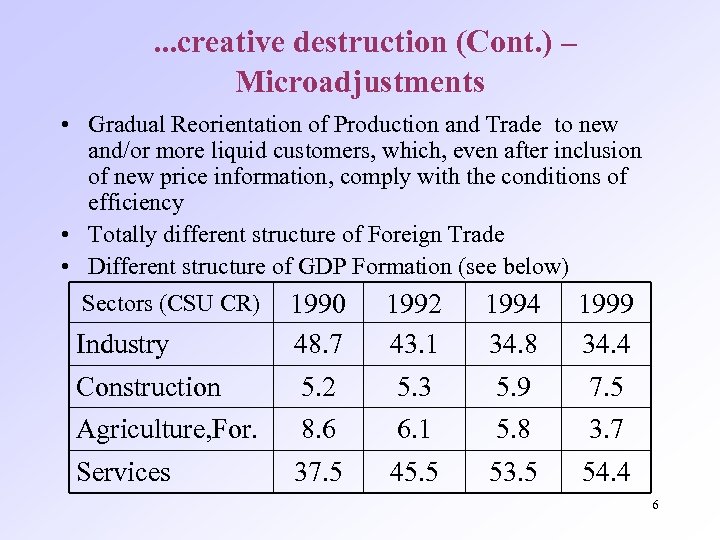
. . . creative destruction (Cont. ) – Microadjustments • Gradual Reorientation of Production and Trade to new and/or more liquid customers, which, even after inclusion of new price information, comply with the conditions of efficiency • Totally different structure of Foreign Trade • Different structure of GDP Formation (see below) 1990 48. 7 1992 43. 1 1994 34. 8 1999 34. 4 Construction 5. 2 5. 3 5. 9 7. 5 Agriculture, For. 8. 6 6. 1 5. 8 3. 7 Services 37. 5 45. 5 53. 5 54. 4 Sectors (CSU CR) Industry 6
. . . creative destruction (cont. ) – Development of New Private Sector as the Bottom-up Privatization, Liberalization of Labor Market and Introduction of Social Safety Net • Flow of Start-ups and Green-field Investments (FDI) as „the Bottom-up Privatization“ • Structural Changes in GDP Formation supported by the newly developed private sector (see above) absorbed part of growing unemployment and changed the employment pattern • Mc. Dermott, Mejstrik (1993), Benacek (2001) 7
. . . creative destruction (cont. ) – Macroeconomic (fiscal and monetary) stabilization 8
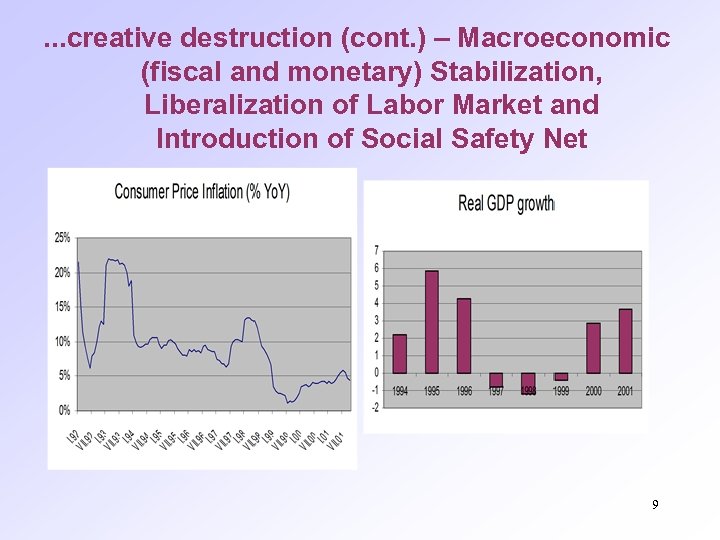
. . . creative destruction (cont. ) – Macroeconomic (fiscal and monetary) Stabilization, Liberalization of Labor Market and Introduction of Social Safety Net 9
The Second Stage Transformation Features • Large Scale Corporate Privatization (Both Updown and Bottom-up) • Development and Cultivation of Private Financial Sector, Capital and Money Market • Perfectioning the institutions of non-totalitarian society and market economy, law enforcement • Reconstruction of the Tax System • Creation of limited number of Regional and Selective Economic Policies such as FDI incentive system, zone policies for SME clusters etc. 10
Privatization and Corporate Governance - „not only ownership matters, but institutions as well“ Mlcoch(1994), Mejstrik(1997, 1999), Sachs, Zinnes, Eilat (2000), Kikeri, Nellis(2002) 11
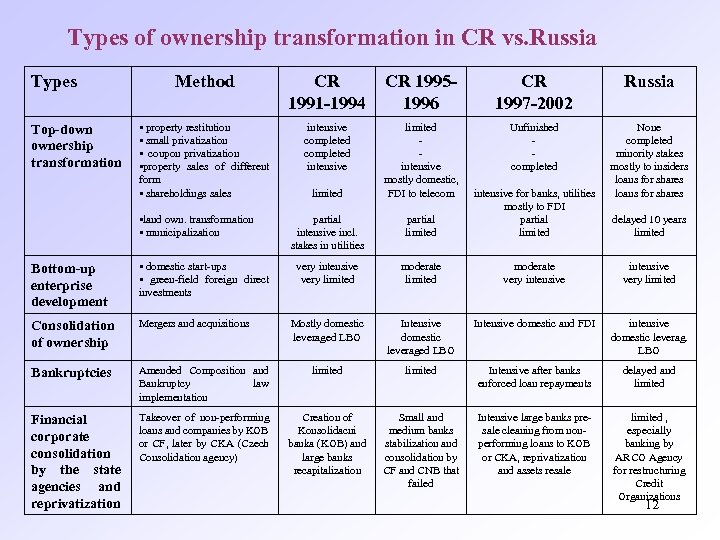
Types of ownership transformation in CR vs. Russia Types Top-down ownership transformation Method CR 1991 -1994 • property restitution • small privatization • coupon privatization • property sales of different form • shareholdings sales intensive completed intensive • land own. transformation • municipalization Bottom-up enterprise development • domestic start-ups • green-field foreign direct investments Consolidation of ownership Mergers and acquisitions Bankruptcies Financial corporate consolidation by the state agencies and reprivatization limited partial intensive incl. stakes in utilities CR 19951996 CR 1997 -2002 limited Unfinished intensive completed mostly domestic, FDI to telecom intensive for banks, utilities mostly to FDI partial limited Russia None completed minority stakes mostly to insiders loans for shares delayed 10 years limited very intensive very limited moderate limited moderate very intensive very limited Mostly domestic leveraged LBO Intensive domestic and FDI intensive domestic leverag. LBO Amended Composition and Bankruptcy law implementation limited Intensive after banks enforced loan repayments delayed and limited Takeover of non-performing loans and companies by KOB or CF, later by CKA (Czech Consolidation agency) Creation of Konsolidacni banka (KOB) and large banks recapitalization Small and medium banks stabilization and consolidation by CF and CNB that failed Intensive large banks presale cleaning from nonperforming loans to KOB or CKA, reprivatization and assets resale limited , especially banking by ARCO Agency for restructuring Credit Organizations 12
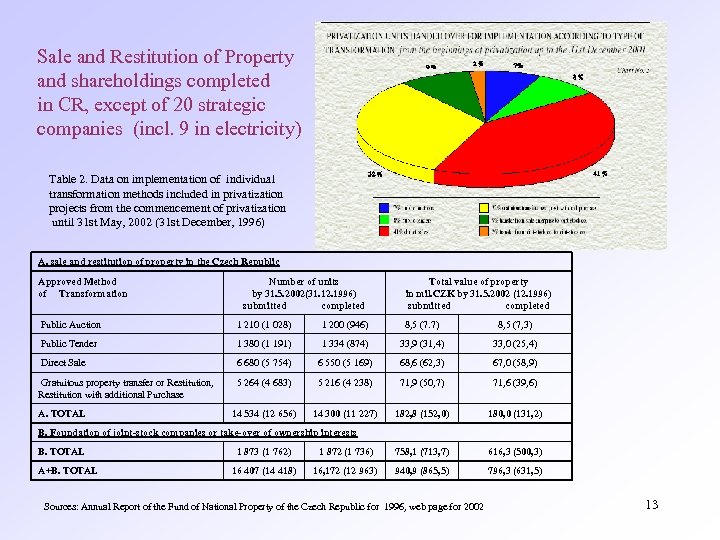
Sale and Restitution of Property and shareholdings completed in CR, except of 20 strategic companies (incl. 9 in electricity) Table 2. Data on implementation of individual transformation methods included in privatization projects from the commencement of privatization until 31 st May, 2002 (31 st December, 1996) A. sale and restitution of property in the Czech Republic Approved Method of Transformation Number of units by 31. 5. 2002(31. 12. 1996) submitted completed Total value of property in mil. CZK by 31. 5. 2002 (12. 1996) submitted completed Public Auction 1 210 (1 028) 1 200 (946) 8, 5 (7. 7) 8, 5 (7, 3) Public Tender 1 380 (1 191) 1 334 (874) 33, 9 (31, 4) 33, 0 (25, 4) Direct Sale 6 680 (5 754) 6 550 (5 169) 68, 6 (62, 3) 67, 0 (58, 9) Gratuitous property transfer or Restitution, Restitution with additional Purchase 5 264 (4 683) 5 216 (4 238) 71, 9 (50, 7) 71, 6 (39, 6) 14 534 (12 656) 14 300 (11 227) 182, 8 (152, 0) 180, 0 (131, 2) A. TOTAL B. Foundation of joint-stock companies or take-over of ownership interests B. TOTAL A+B. TOTAL 1 873 (1 762) 1 872 (1 736) 758, 1 (713, 7) 616, 3 (500, 3) 16 407 (14 418) 16, 172 (12 963) 940, 9 (865, 5) 796, 3 (631, 5) Sources: Annual Report of the Fund of National Property of the Czech Republic for 1996, web page for 2002 13
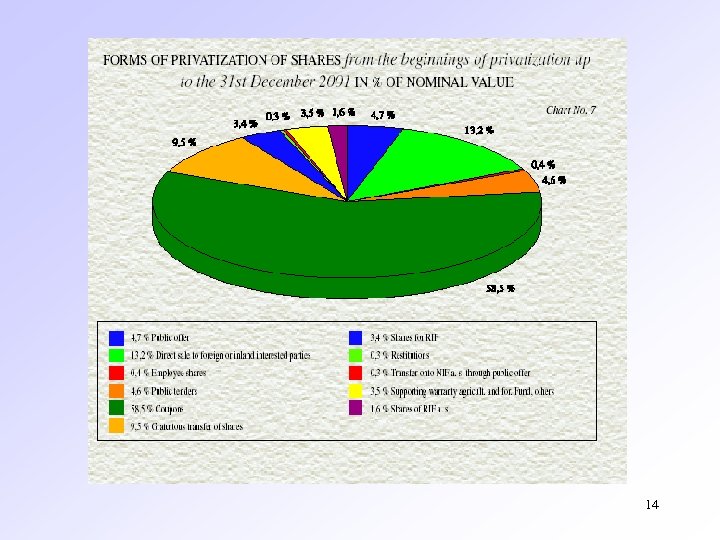
14
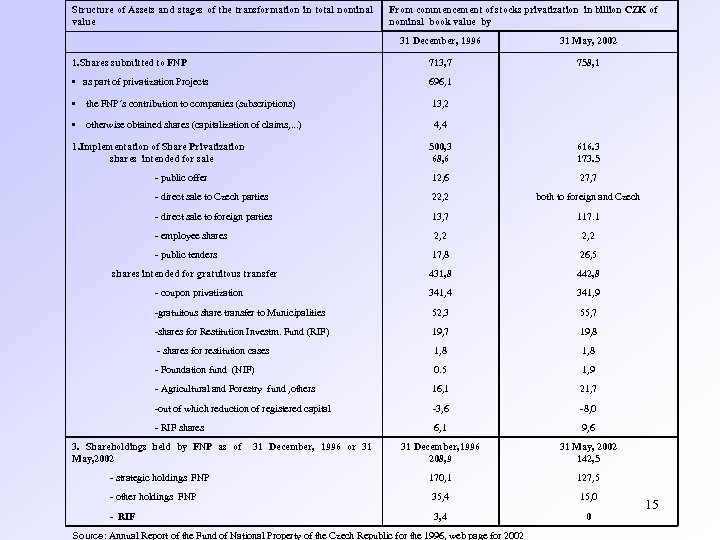
Structure of Assets and stages of the transformation in total nominal value From commencement of stocks privatization in billion CZK of nominal book value by 31 December, 1996 31 May, 2002 1. Shares submitted to FNP 713, 7 758, 1 • as part of privatization Projects 696, 1 • the FNP´s contribution to companies (subscriptions) 13, 2 • otherwise obtained shares (capitalization of claims, . . . ) 4, 4 1. Implementation of Share Privatization shares intended for sale 500, 3 68, 6 616. 3 173. 5 - public offer 12, 6 27, 7 - direct sale to Czech parties 22, 2 both to foreign and Czech - direct sale to foreign parties 13, 7 117. 1 - employee shares 2, 2 - public tenders 17, 8 26, 5 431, 8 442, 8 - coupon privatization 341, 4 341, 9 -gratuitous share transfer to Municipalities 52, 3 55, 7 -shares for Restitution Investm. Fund (RIF) 19, 7 19, 8 - shares for restitution cases 1, 8 - Foundation fund (NIF) 0. 5 1, 9 - Agricultural and Forestry fund , others 16, 1 21, 7 -out of which reduction of registered capital -3, 6 -8, 0 - RIF shares 6, 1 9, 6 31 December, 1996 208, 9 31 May, 2002 142, 5 - strategic holdings FNP 170, 1 127, 5 - other holdings FNP 35, 4 15, 0 3, 4 0 shares intended for gratuitous transfer 3. Shareholdings held by FNP as of May, 2002 - RIF 31 December, 1996 or 31 Source: Annual Report of the Fund of National Property of the Czech Republic for the 1996, web page for 2002 15
Privatization (both Coupon and Sales) and Imperfect Institutional Framework · In coupon privatization the government administratively enforced the artificial initial public offering of large number of nearly two thousand share issues and their public tradability. Among most of participants it has created expectation about overnight emergence of liquid and functioning market with shares for all investors, no matter how small. Naturally, those expectations could hardly be met at once. The government, however, had resigned for quite a long time to supplemented administrative rules applied in centralized, “laboratory phase” of share distribution by implementation of institutional market framework that would generate involvement of at least the best corporates in their public tradability and a willingness of investors to invest into them and form standard capital market. · The assumptions of well-functioning markets - particularly the markets for capital, managerial labour, and corporate control - had not been met. · Banking institutions effective either in Anglo-Saxon or in German sense had been absent. · Underdeveloped institutional and legal frameworks meant that important necessary conditions for effective corporate governance had been absent. For example § Most contracts had incomplete character and it was difficult to enforce them (around 40%vel by Pistor(2000)), CGR indices. . . ; § Non-banking financial institutions were left without proper regulation and supervision. These were the collective investment vehicles (mutual or investment funds, pension funds, insurance companies), the decisive domestic “investors” born mostly by share redistribution in coupon privatization. No political will to enforce even the limited existing law was shown (Hanousek , Roland (2001)). § Monitoring and accountability procedures have been weakly performed inside the company (the compliance officers as a part of selfgovernance process absent) and outside. Superficial auditing rules (e. g. absence of any explanatory notes to the accounts) led to superficial and misleading audits provided even for the most important corporates such as CKD, Skoda. . . with Enron-like impact for the shareholders (95%lost) § Rating quotes by recognized rating agencies have been unavailable and external investors had to decide under conditions of inefficient capital markets, monitoring- significant uncertainty. It is not surprising that portfolio investors both domestic and from abroad have lost their appetite. The field was thus left open to insider investors and insider trading and this development has been neither monitored nor sanctioned. § Business courts were flooded by minor cases that should have been dealt with in a different manner. Cumbersome rules of procedure and evidence mean that cases take too long to resolve, while the backlog keeps increasing and exceeds several years. First-come-first-served system means major cases are dealt with only after long delays unless intensive lobbying is applied. Judges apprehensive about making a decision can further delay these cases by abusing the procedural rules. Judicial independence and irremovability has in practice often meant that even blatant misbehaviour of judges was punished only rarely. Czech judges are not bound by decisions reached in similar cases by their colleagues. There is little attempt to judge the cases in light of the intention of the legislation. Formalistic approach by the judges has meant that collusion or intention to defraud was virtually impossible to establish except where the accused confessed, an outcome which is naturally quite rare § Business courts registering changes in statutory bodies only with long delays increased the lack of transparency. Challenges to registering changes in registered share capital, many of which have been nothing more than blackmail, have also been dealt with slowly. This hampers 16 financial restructuring or initial public offering of new equity. § Bankruptcy code has been incomplete and was not being fully enforced until 1999.
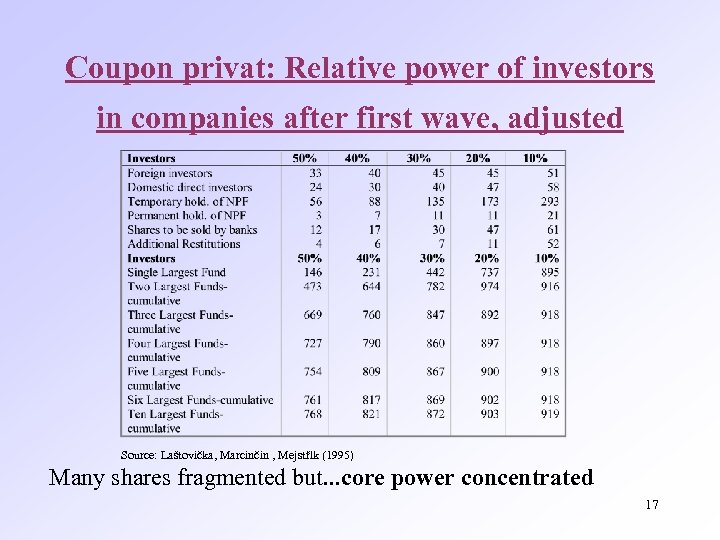
Coupon privat: Relative power of investors in companies after first wave, adjusted Source: Laštovička, Marcinčin , Mejstřík (1995) Many shares fragmented but. . . core power concentrated 17
The Privatization as one-off Game Privatization and Corporate Governance - „not only ownership matters, but institutions as well“ Privatization is an one-off process and has conflicting economic, financial and political objectives of particular interest groups (foreign vs. domestic buyers – either insiders or outsiders). Given the unrepeatable character of privatization and incompleteness of most of contracts and of institutional framework itself, many actors in the corporate sector, not just the managers but also investment funds and asset management companies, played a one-shot game at the expense of managed companies and their own minority shareholders as well. The rational behavior in such a game is well described by „the prisoners dilemna“. Then to no surprise there was a temptation for a dominant short term strategy of “cheating”- i. e. exploiting any contractual incompleteness in largely unregulated environment of privatization to one´s own advantage. Such a model describes wider Eastern Europe environment (both Czech and Russian) of recent past. 18
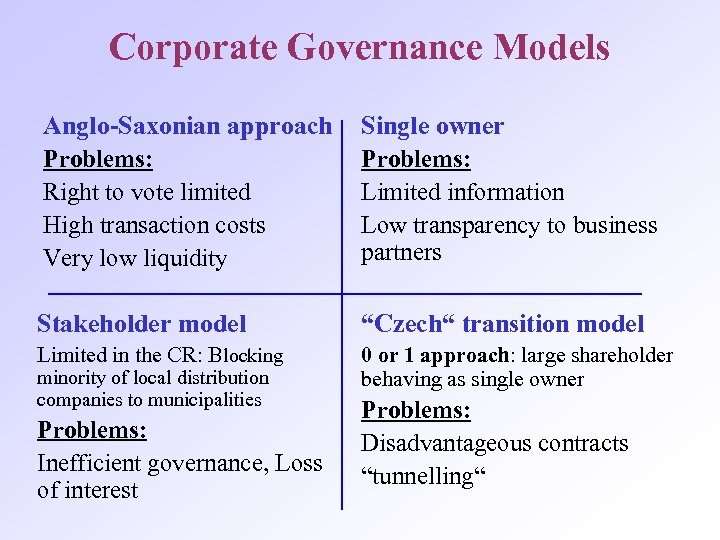
Corporate Governance Models Anglo-Saxonian approach Problems: Right to vote limited High transaction costs Very low liquidity Single owner Problems: Limited information Low transparency to business partners Stakeholder model “Czech“ transition model Limited in the CR: Blocking 0 or 1 approach: large shareholder behaving as single owner minority of local distribution companies to municipalities Problems: Inefficient governance, Loss of interest Problems: Disadvantageous contracts “tunnelling“
Coupon Privatization and Imperfect Institutional Framework Main Results : - No financial proceeds but temporary Political Gains due to the giving away. . . but later social contract with small investors broken and Political Loss - instead of large functioning capital market overnight high transaction costs for quasisecurities industry, non-transparent ownership structure with dominating funds´ ownership and insider trading – loss of confindence to non-bank financial sector and collective investment vehicles(CIVs) prevailing in pension, insurence and savings deposit systems in mature economis as well as loss of foreign portfolio investors ; (blocking pension reform etc. ) - without a proper institutional framework the corporate governance in the biased form causes (more? than in mature markets) huge loss of value of traded companies to the shareholders (Black(2001) estimated for Russian large companies multiple of 2 -10 mostly due to selfdealing risk subfactors such as risk of assets stripping, share transfer pricing (as there is a room for managers to loot the value of minority shareholders, siphon off the profits or tunnel). 20
Bank Lending Failure with Asset Bubles followed by the Poor Performance of Large Industrial Customers Within given corporate governance model number of banks provided Privatization and Acquisition Lending to highly leveraged related conglomerates in order to create TBTF groups with soft budget constraint backed by the state. Czech Asset Bubles broke in the first 1997 recession and resulted into huge NPLs and fall of many businessmen. 71% of related lending in Russia was not repaid according to Laeven (2001)- result? Possible solutions: support by the government – inefficient but keeps -mergers with other domestic companies – a lack of domestic capital ----reprivatisation to foreign owners – often positive results, but not always (inadequate investor, lack of knowledge of the local environment, etc. ) -bankruptcy procedure with going concern sale (to Siemens) or liquidation In the CR, Czech Konsolidacni agency owns the majority of non-performing loans. It is preparing sales of those assets in selected packages on the market. Other instruments: debt-to-equity swap 21
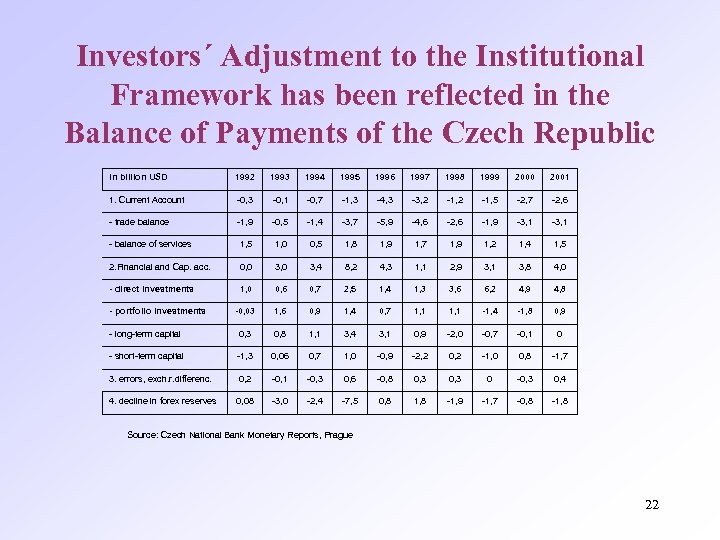
Investors´ Adjustment to the Institutional Framework has been reflected in the Balance of Payments of the Czech Republic In billion USD 1992 1993 1994 1995 1996 1997 1998 1999 2000 2001 1. Current Account -0, 3 -0, 1 -0, 7 -1, 3 -4, 3 -3, 2 -1, 5 -2, 7 -2, 6 - trade balance -1, 9 -0, 5 -1, 4 -3, 7 -5, 9 -4, 6 -2, 6 -1, 9 -3, 1 - balance of services 1, 5 1, 0 0, 5 1, 8 1, 9 1, 7 1, 9 1, 2 1, 4 1, 5 2. Financial and Cap. acc. 0, 0 3, 4 8, 2 4, 3 1, 1 2, 9 3, 1 3, 8 4, 0 - direct investments 1, 0 0, 6 0, 7 2, 5 1, 4 1, 3 3, 6 6, 2 4, 9 4, 8 -0, 03 1, 6 0, 9 1, 4 0, 7 1, 1 -1, 4 -1, 8 0, 9 - long-term capital 0, 3 0, 8 1, 1 3, 4 3, 1 0, 9 -2, 0 -0, 7 -0, 1 0 - short-term capital -1, 3 0, 06 0, 7 1, 0 -0, 9 -2, 2 0, 2 -1, 0 0, 8 -1, 7 3. errors, exch. r. differenc. 0, 2 -0, 1 -0, 3 0, 6 -0, 8 0, 3 0 -0, 3 0, 4 4. decline in forex reserves 0, 08 -3, 0 -2, 4 -7, 5 0, 8 1, 8 -1, 9 -1, 7 -0, 8 -1, 8 - portfolio investments Source: Czech National Bank Monetary Reports, Prague 22
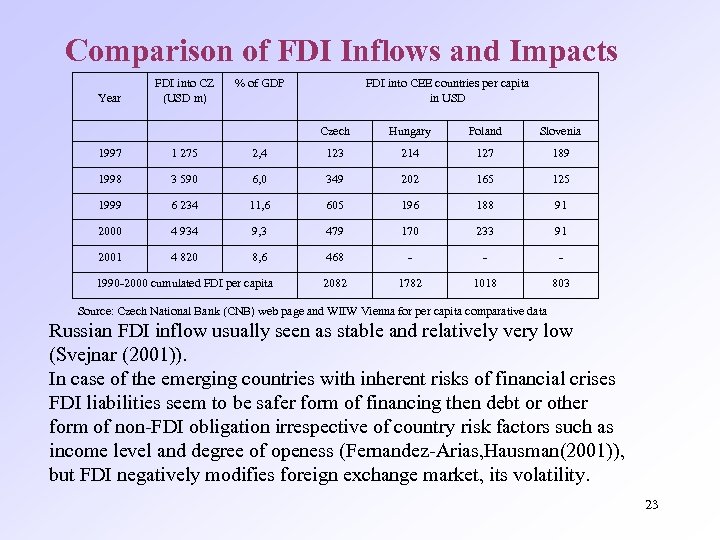
Comparison of FDI Inflows and Impacts Year FDI into CZ (USD m) % of GDP FDI into CEE countries per capita in USD Czech Hungary Poland Slovenia 1997 1 275 2, 4 123 214 127 189 1998 3 590 6, 0 349 202 165 125 1999 6 234 11, 6 605 196 188 91 2000 4 934 9, 3 479 170 233 91 2001 4 820 8, 6 468 - - - 2082 1782 1018 803 1990 -2000 cumulated FDI per capita Source: Czech National Bank (CNB) web page and WIIW Vienna for per capita comparative data Russian FDI inflow usually seen as stable and relatively very low (Svejnar (2001)). In case of the emerging countries with inherent risks of financial crises FDI liabilities seem to be safer form of financing then debt or other form of non-FDI obligation irrespective of country risk factors such as income level and degree of openess (Fernandez-Arias, Hausman(2001)), but FDI negatively modifies foreign exchange market, its volatility. 23
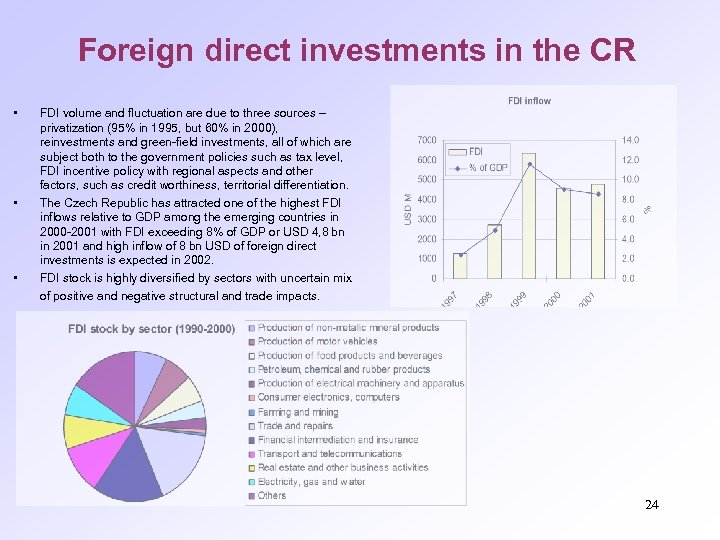
Foreign direct investments in the CR • • • FDI volume and fluctuation are due to three sources – privatization (95% in 1995, but 60% in 2000), reinvestments and green-field investments, all of which are subject both to the government policies such as tax level, FDI incentive policy with regional aspects and other factors, such as credit worthiness, territorial differentiation. The Czech Republic has attracted one of the highest FDI inflows relative to GDP among the emerging countries in 2000 -2001 with FDI exceeding 8% of GDP or USD 4, 8 bn in 2001 and high inflow of 8 bn USD of foreign direct investments is expected in 2002. FDI stock is highly diversified by sectors with uncertain mix of positive and negative structural and trade impacts. 24
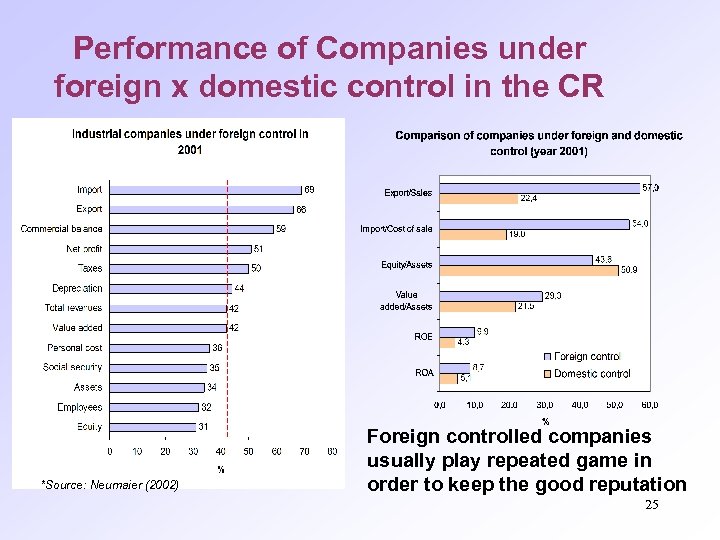
Performance of Companies under foreign x domestic control in the CR *Source: Neumaier (2002) Foreign controlled companies usually play repeated game in order to keep the good reputation 25
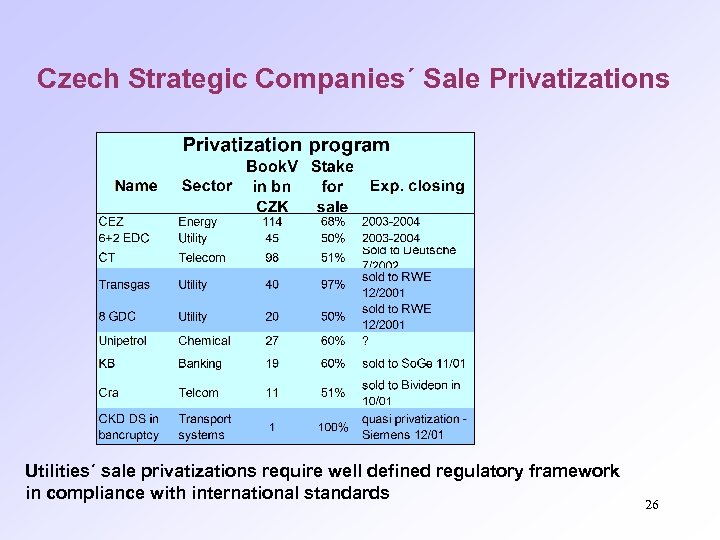
Czech Strategic Companies´ Sale Privatizations Utilities´ sale privatizations require well defined regulatory framework in compliance with international standards 26
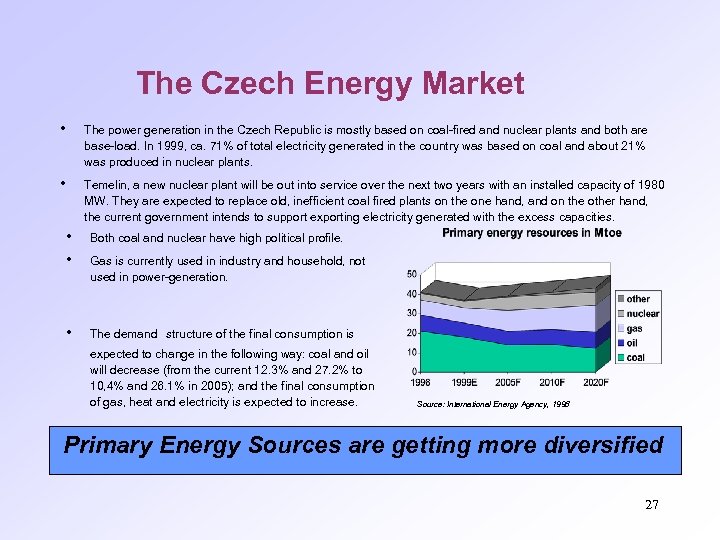
The Czech Energy Market h The power generation in the Czech Republic is mostly based on coal-fired and nuclear plants and both are base-load. In 1999, ca. 71% of total electricity generated in the country was based on coal and about 21% was produced in nuclear plants. h Temelin, a new nuclear plant will be out into service over the next two years with an installed capacity of 1980 MW. They are expected to replace old, inefficient coal fired plants on the one hand, and on the other hand, the current government intends to support exporting electricity generated with the excess capacities. h Both coal and nuclear have high political profile. h Gas is currently used in industry and household, not used in power-generation. h The demand structure of the final consumption is expected to change in the following way: coal and oil will decrease (from the current 12. 3% and 27. 2% to 10, 4% and 26. 1% in 2005); and the final consumption of gas, heat and electricity is expected to increase. Source: International Energy Agency, 1998 Primary Energy Sources are getting more diversified 27
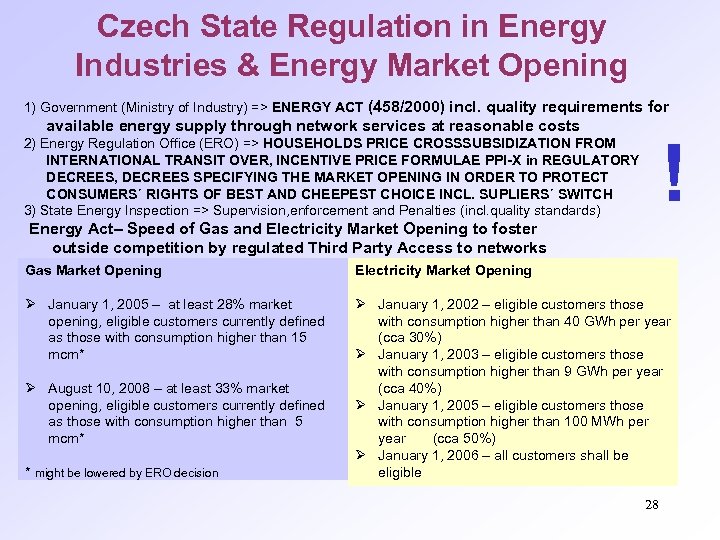
Czech State Regulation in Energy Industries & Energy Market Opening 1) Government (Ministry of Industry) => ENERGY ACT (458/2000) incl. quality requirements for available energy supply through network services at reasonable costs ! 2) Energy Regulation Office (ERO) => HOUSEHOLDS PRICE CROSSSUBSIDIZATION FROM INTERNATIONAL TRANSIT OVER, INCENTIVE PRICE FORMULAE PPI-X in REGULATORY DECREES, DECREES SPECIFYING THE MARKET OPENING IN ORDER TO PROTECT CONSUMERS´ RIGHTS OF BEST AND CHEEPEST CHOICE INCL. SUPLIERS´ SWITCH 3) State Energy Inspection => Supervision, enforcement and Penalties (incl. quality standards) Energy Act– Speed of Gas and Electricity Market Opening to foster outside competition by regulated Third Party Access to networks Gas Market Opening Electricity Market Opening Ø January 1, 2005 – at least 28% market opening, eligible customers currently defined as those with consumption higher than 15 mcm* Ø January 1, 2002 – eligible customers those with consumption higher than 40 GWh per year (cca 30%) Ø January 1, 2003 – eligible customers those with consumption higher than 9 GWh per year (cca 40%) Ø January 1, 2005 – eligible customers those with consumption higher than 100 MWh per year (cca 50%) Ø January 1, 2006 – all customers shall be eligible Ø August 10, 2008 – at least 33% market opening, eligible customers currently defined as those with consumption higher than 5 mcm* * might be lowered by ERO decision 28
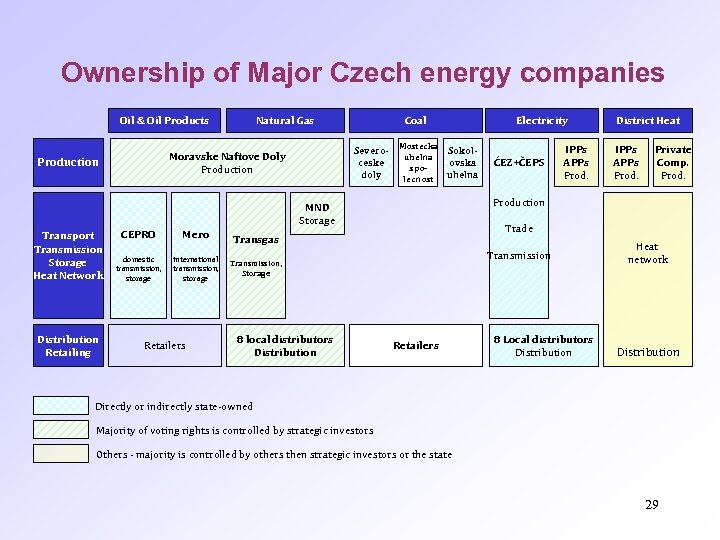
Ownership of Major Czech energy companies Oil & Oil Products Natural Gas Severoceske doly Moravske Naftove Doly Production Coal Mostecka Sokoluhelna ovska spouhelna lecnost Distribution Retailing CEPRO Mero domestic transmission, storage international transmission, storage Retailers IPPs APPs Prod. Private Comp. Prod. Trade Transgas Transmission, Storage 8 local distributors Distribution ĆEZ+ČEPS District Heat Production MND Storage Transport Transmission Storage Heat Network Electricity Retailers 8 Local distributors Distribution Heat network Distribution Directly or indirectly state-owned Majority of voting rights is controlled by strategic investors Others - majority is controlled by others then strategic investors or the state 29
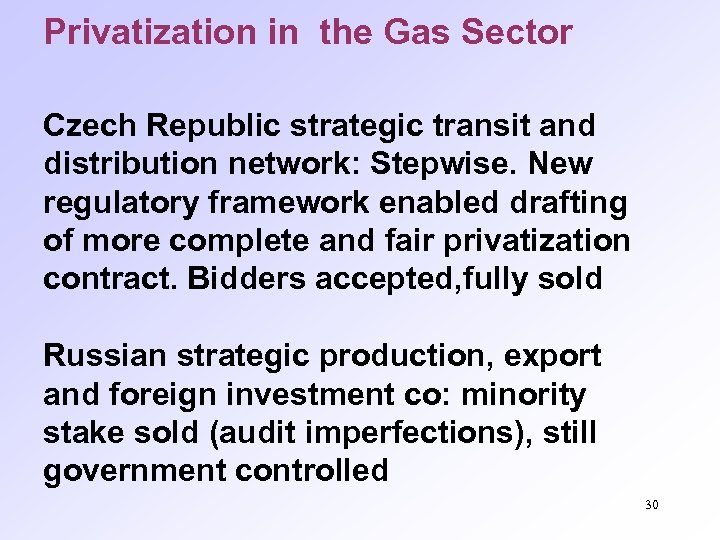
Privatization in the Gas Sector Czech Republic strategic transit and distribution network: Stepwise. New regulatory framework enabled drafting of more complete and fair privatization contract. Bidders accepted, fully sold Russian strategic production, export and foreign investment co: minority stake sold (audit imperfections), still government controlled 30
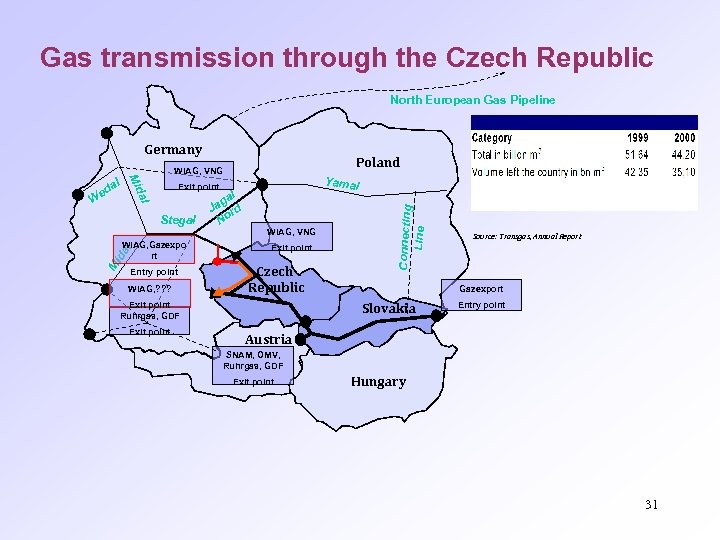
Gas transmission through the Czech Republic North European Gas Pipeline Germany Poland WIAG, VNG al W Stegal da l WIAG, Gazexpo rt Mi Yamal Exit point Entry point WIAG, ? ? ? al ag d J r No WIAG, VNG Exit point Czech Republic Source: Transgas, Annual Report Gazexport Slovakia Exit point Ruhrgas, GDF Exit point Connecting Line Mid al ed Entry point Austria SNAM, OMV, Ruhrgas, GDF Exit point Hungary 31
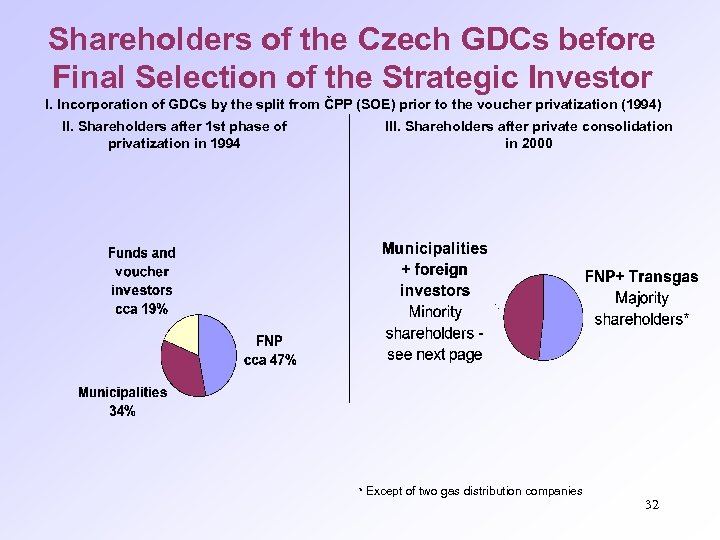
Shareholders of the Czech GDCs before Final Selection of the Strategic Investor I. Incorporation of GDCs by the split from ČPP (SOE) prior to the voucher privatization (1994) II. Shareholders after 1 st phase of privatization in 1994 III. Shareholders after private consolidation in 2000 * Except of two gas distribution companies 32
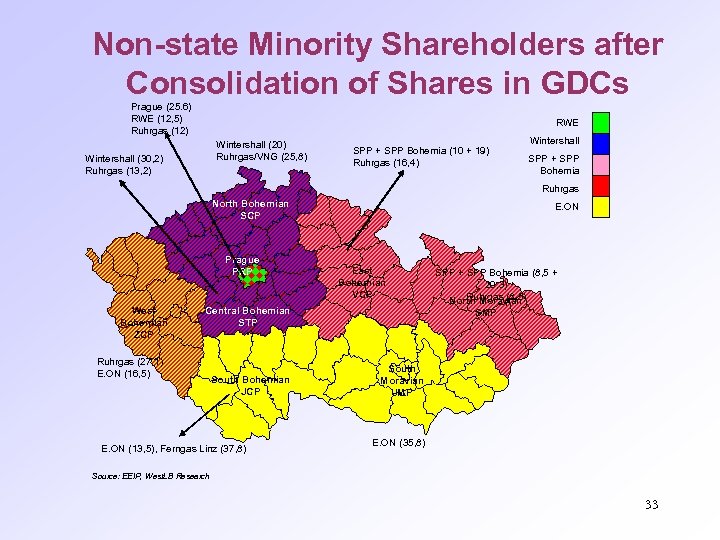
Non-state Minority Shareholders after Consolidation of Shares in GDCs Prague (25. 6) RWE (12, 5) Ruhrgas (12) RWE Wintershall (20) Ruhrgas/VNG (25, 8) Wintershall (30, 2) Ruhrgas (13, 2) SPP + SPP Bohemia (10 + 19) Ruhrgas (16, 4) Wintershall SPP + SPP Bohemia Ruhrgas North Bohemian SCP Prague PRP West Bohemian ZCP E. ON East Bohemian VCP Central Bohemian STP Ruhrgas (27, 1) E. ON (16, 5) South Bohemian JCP E. ON (13, 5), Ferngas Linz (37, 8) SPP + SPP Bohemia (8, 5 + 20, 3) Ruhrgas (8. 5) North Moravian SMP South Moravian JMP E. ON (35, 8) Source: EEIP, West. LB Research 33
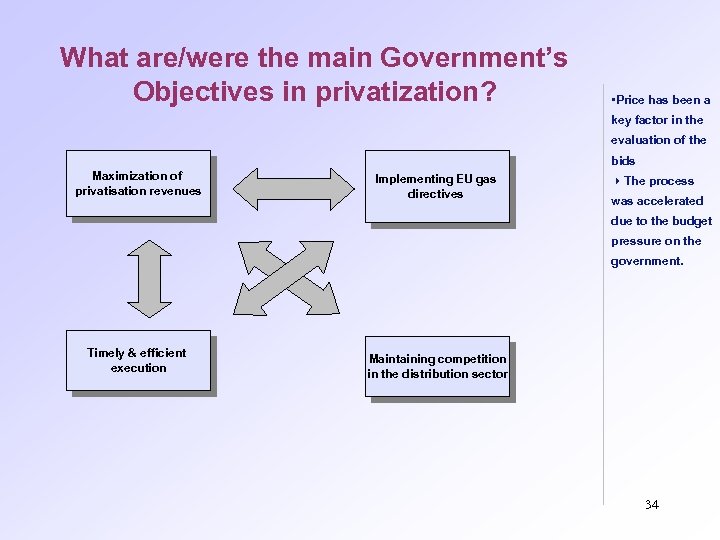
What are/were the main Government’s Objectives in privatization? • Price has been a key factor in the evaluation of the bids Maximization of privatisation revenues Implementing EU gas directives 4 The process was accelerated due to the budget pressure on the government. Timely & efficient execution Maintaining competition in the distribution sector 34
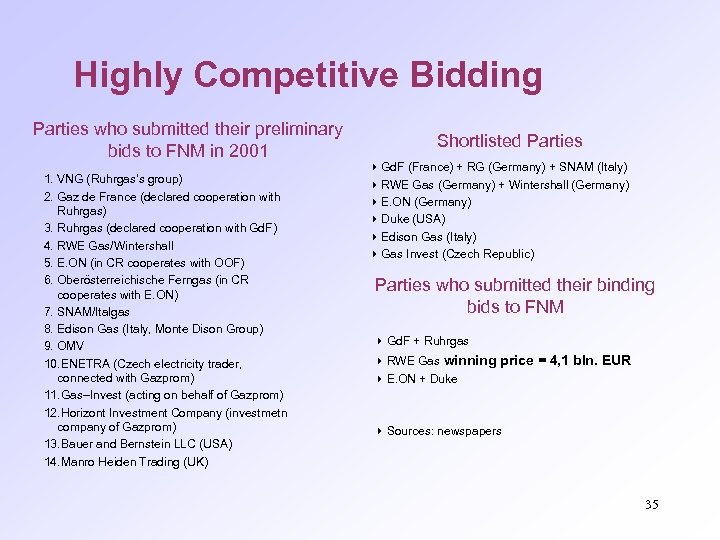
Highly Competitive Bidding Parties who submitted their preliminary bids to FNM in 2001 1. VNG (Ruhrgas’s group) 2. Gaz de France (declared cooperation with Ruhrgas) 3. Ruhrgas (declared cooperation with Gd. F) 4. RWE Gas/Wintershall 5. E. ON (in CR cooperates with OOF) 6. Oberösterreichische Ferngas (in CR cooperates with E. ON) 7. SNAM/Italgas 8. Edison Gas (Italy, Monte Dison Group) 9. OMV 10. ENETRA (Czech electricity trader, connected with Gazprom) 11. Gas–Invest (acting on behalf of Gazprom) 12. Horizont Investment Company (investmetn company of Gazprom) 13. Bauer and Bernstein LLC (USA) 14. Manro Heiden Trading (UK) Shortlisted Parties 4 Gd. F (France) + RG (Germany) + SNAM (Italy) 4 RWE Gas (Germany) + Wintershall (Germany) 4 E. ON (Germany) 4 Duke (USA) 4 Edison Gas (Italy) 4 Gas Invest (Czech Republic) Parties who submitted their binding bids to FNM 4 Gd. F + Ruhrgas 4 RWE Gas winning price = 4, 1 bln. EUR 4 E. ON + Duke 4 Sources: newspapers 35
Waterworks and Sewage Systems Privatization in the CR 36
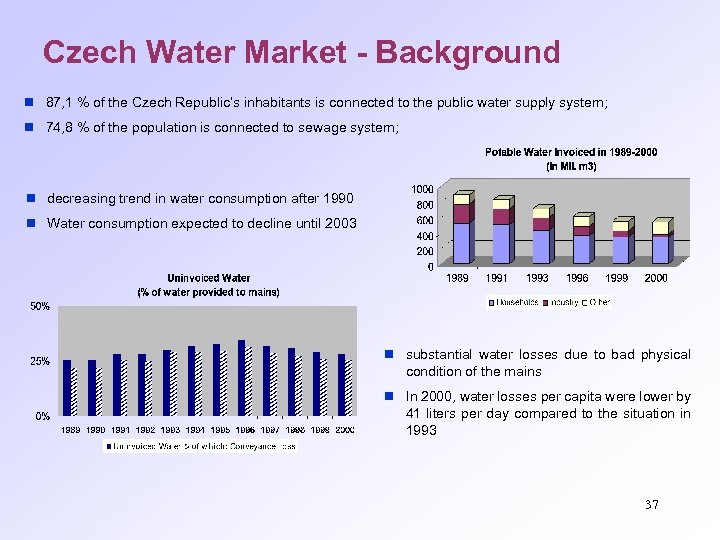
Czech Water Market - Background n 87, 1 % of the Czech Republic‘s inhabitants is connected to the public water supply system; n 74, 8 % of the population is connected to sewage system; n decreasing trend in water consumption after 1990 n Water consumption expected to decline until 2003 n substantial water losses due to bad physical condition of the mains n In 2000, water losses per capita were lower by 41 liters per day compared to the situation in 1993 37
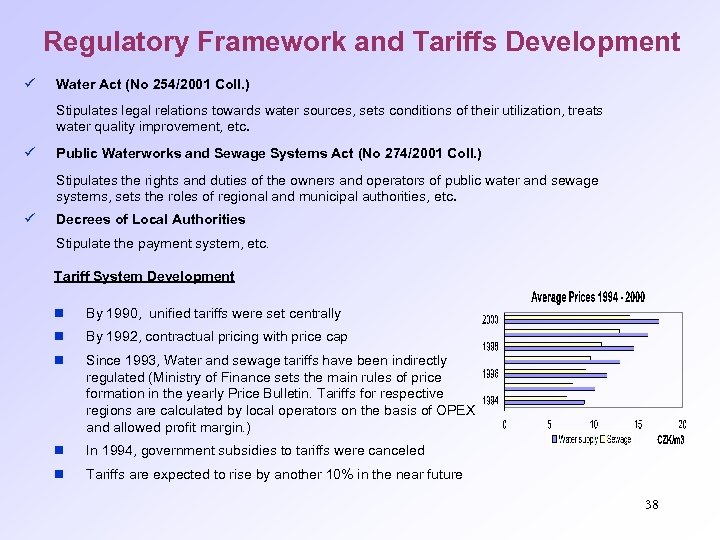
Regulatory Framework and Tariffs Development ü Water Act (No 254/2001 Coll. ) Stipulates legal relations towards water sources, sets conditions of their utilization, treats water quality improvement, etc. ü Public Waterworks and Sewage Systems Act (No 274/2001 Coll. ) Stipulates the rights and duties of the owners and operators of public water and sewage systems, sets the roles of regional and municipal authorities, etc. ü Decrees of Local Authorities Stipulate the payment system, etc. Tariff System Development n By 1990, unified tariffs were set centrally n By 1992, contractual pricing with price cap n Since 1993, Water and sewage tariffs have been indirectly regulated (Ministry of Finance sets the main rules of price formation in the yearly Price Bulletin. Tariffs for respective regions are calculated by local operators on the basis of OPEX and allowed profit margin. ) n In 1994, government subsidies to tariffs were canceled n Tariffs are expected to rise by another 10% in the near future 38
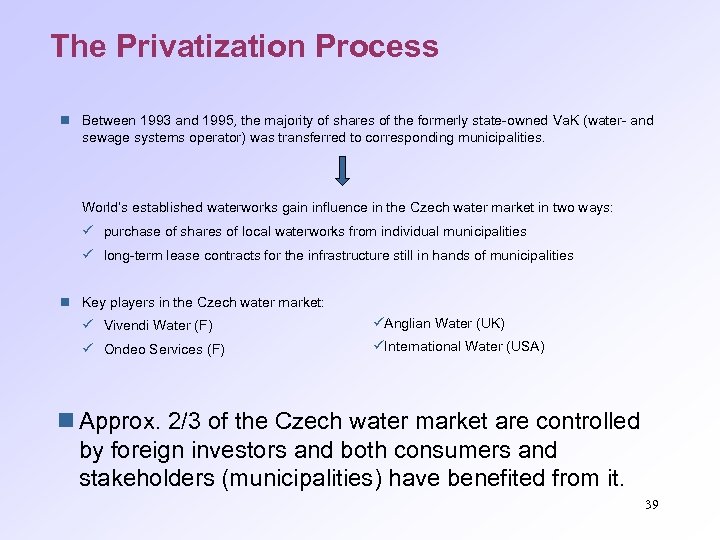
The Privatization Process n Between 1993 and 1995, the majority of shares of the formerly state-owned Va. K (water- and sewage systems operator) was transferred to corresponding municipalities. World’s established waterworks gain influence in the Czech water market in two ways: ü purchase of shares of local waterworks from individual municipalities ü long-term lease contracts for the infrastructure still in hands of municipalities n Key players in the Czech water market: ü Vivendi Water (F) üAnglian Water (UK) ü Ondeo Services (F) üInternational Water (USA) n Approx. 2/3 of the Czech water market are controlled by foreign investors and both consumers and stakeholders (municipalities) have benefited from it. 39
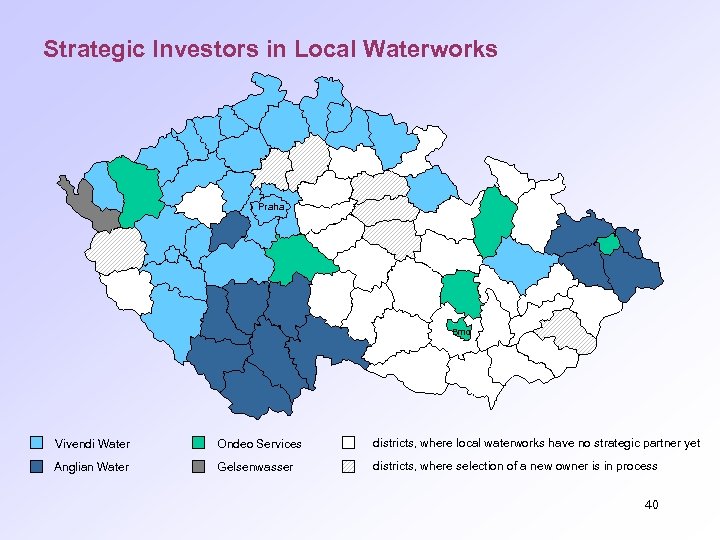
Strategic Investors in Local Waterworks Praha Brno Vivendi Water Ondeo Services districts, where local waterworks have no strategic partner yet Anglian Water Gelsenwasser districts, where selection of a new owner is in process 40
Development of the Private Financial Sector – especially here not only ownership matters but institutions as well. High level financial intermediation in the CR with bank domination („Bank-dependent economy“) at the competitive market Relatively low level financial intermediation in Russia with highly concentrated deposit market 41
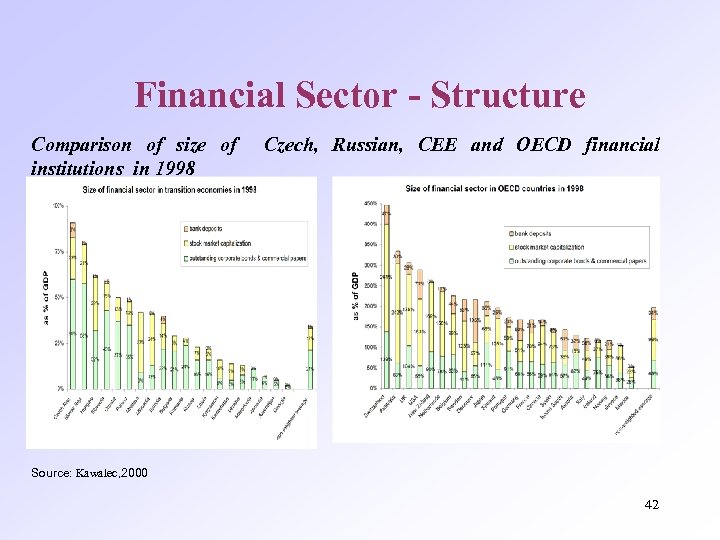
Financial Sector - Structure Comparison of size of institutions in 1998 Czech, Russian, CEE and OECD financial Source: Kawalec, 2000 42
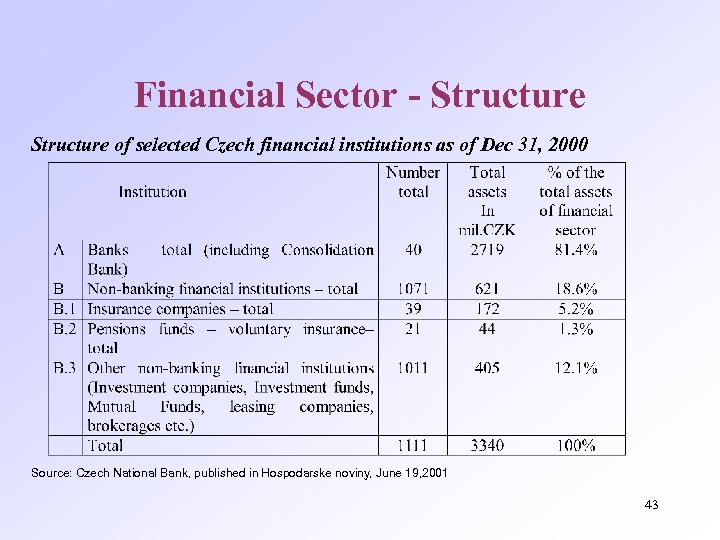
Financial Sector - Structure of selected Czech financial institutions as of Dec 31, 2000 Source: Czech National Bank, published in Hospodarske noviny, June 19, 2001 43
Joint Features • • Credit crunch Voucher privatization and corporate governance Poor performance of large industrial customers Ownership rights in banks and banks privatization NPLs and Failure of a high number of banks Necessity to increase the reliability Post-privatization phase in the banking sector Establishment of new regulations and institutional framework • Orientation towards the EU 44
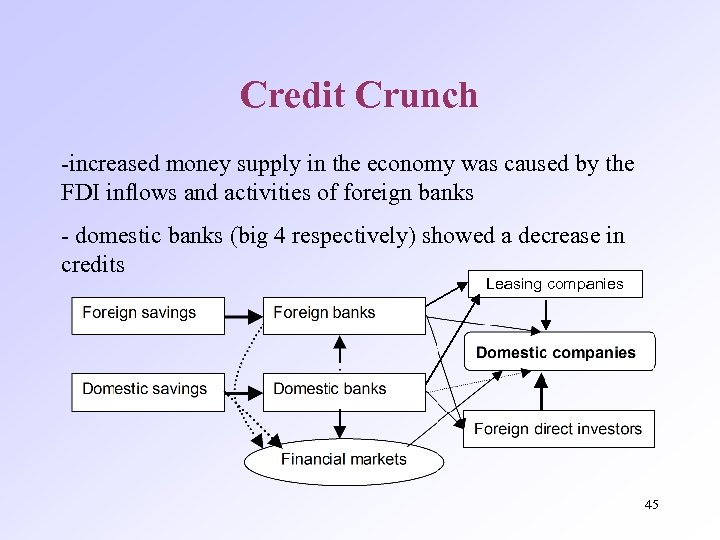
Credit Crunch -increased money supply in the economy was caused by the FDI inflows and activities of foreign banks - domestic banks (big 4 respectively) showed a decrease in credits Leasing companies 45
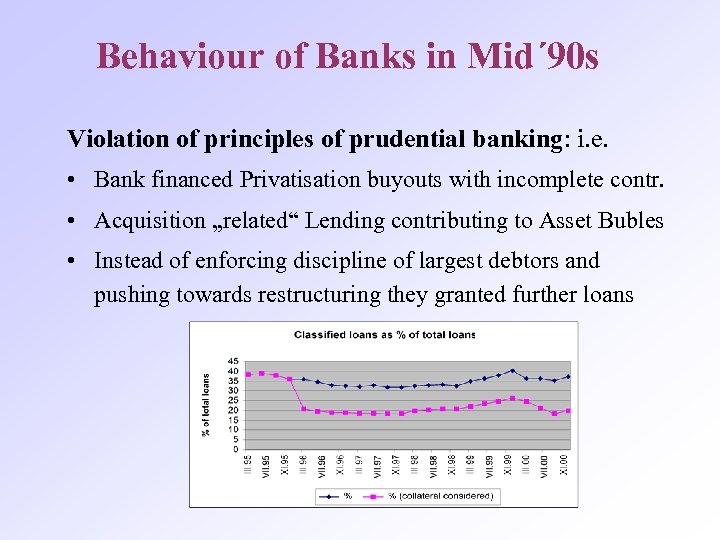
Behaviour of Banks in Mid´ 90 s Violation of principles of prudential banking: i. e. • Bank financed Privatisation buyouts with incomplete contr. • Acquisition „related“ Lending contributing to Asset Bubles • Instead of enforcing discipline of largest debtors and pushing towards restructuring they granted further loans
Reasons for Poor Performance of Banks a) General = Institutional framework • Economic transition – unstable environment – mainly at the beginning of transformation • Missing or improper regulatory framework (too late, often amended) • Inefficient central bank supervision and audit – in early ´ 90 s • in 1996 -1999: macroeconomic problems + tight monetary policy • Late privatisation, forms of privatisation b) Commercial banks • Lack of bank management skills • Moral hazard, High level of corruption, bank fraud, dishonesty • Lack of capital
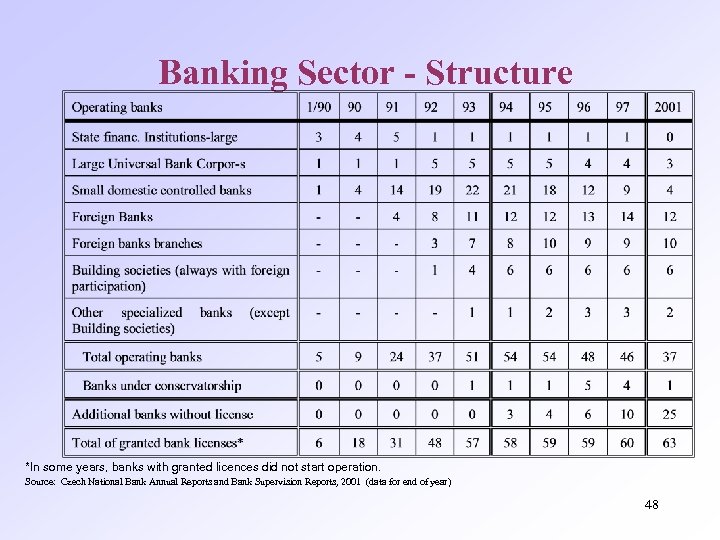
Banking Sector - Structure *In some years, banks with granted licences did not start operation. Source: Czech National Bank Annual Reports and Bank Supervision Reports, 2001 (data for end of year) 48
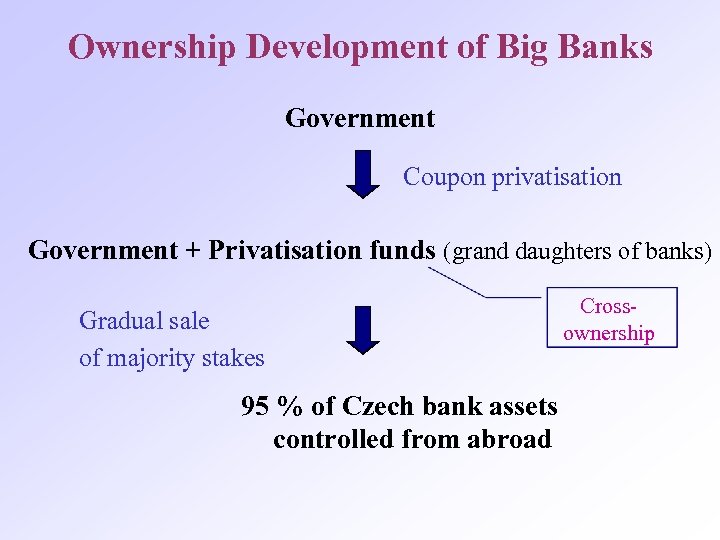
Ownership Development of Big Banks Government Coupon privatisation Government + Privatisation funds (grand daughters of banks) Gradual sale of majority stakes 95 % of Czech bank assets controlled from abroad Crossownership
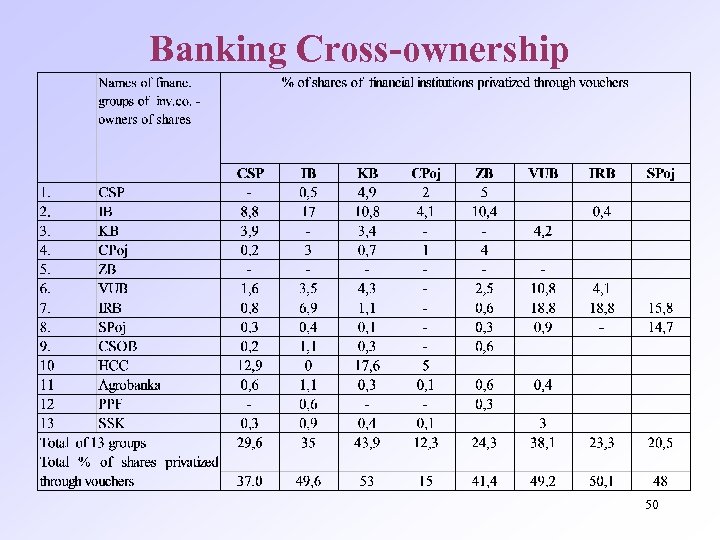
Banking Cross-ownership 50
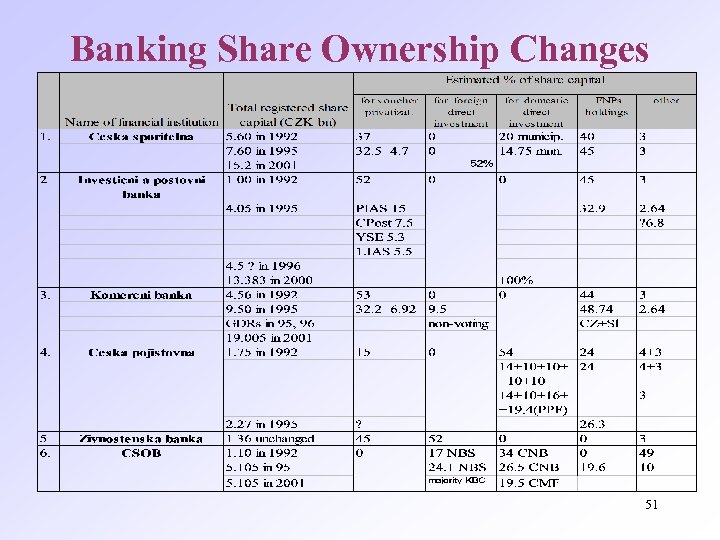
Banking Share Ownership Changes 51
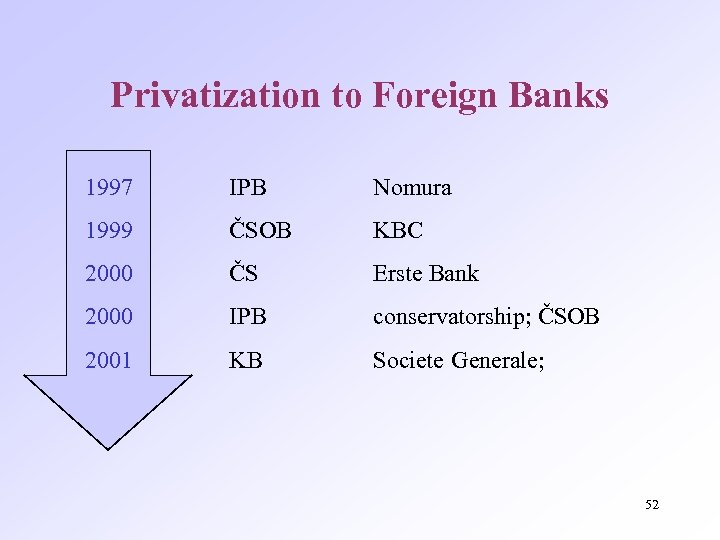
Privatization to Foreign Banks 1997 IPB Nomura 1999 ČSOB KBC 2000 ČS Erste Bank 2000 IPB conservatorship; ČSOB 2001 KB Societe Generale; 52
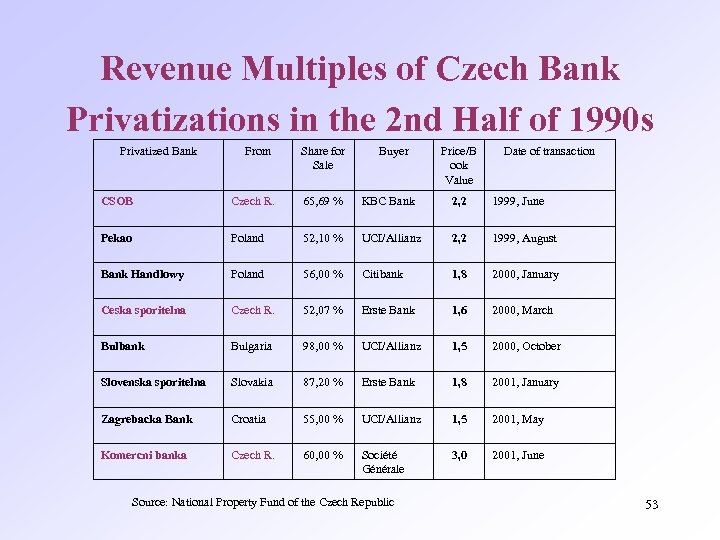
Revenue Multiples of Czech Bank Privatizations in the 2 nd Half of 1990 s Privatized Bank From Share for Sale Buyer Price/B ook Value Date of transaction CSOB Czech R. 65, 69 % KBC Bank 2, 2 1999, June Pekao Poland 52, 10 % UCI/Allianz 2, 2 1999, August Bank Handlowy Poland 56, 00 % Citibank 1, 8 2000, January Ceska sporitelna Czech R. 52, 07 % Erste Bank 1, 6 2000, March Bulbank Bulgaria 98, 00 % UCI/Allianz 1, 5 2000, October Slovenska sporitelna Slovakia 87, 20 % Erste Bank 1, 8 2001, January Zagrebacka Bank Croatia 55, 00 % UCI/Allianz 1, 5 2001, May Komercni banka Czech R. 60, 00 % Société Générale 3, 0 2001, June Source: National Property Fund of the Czech Republic 53
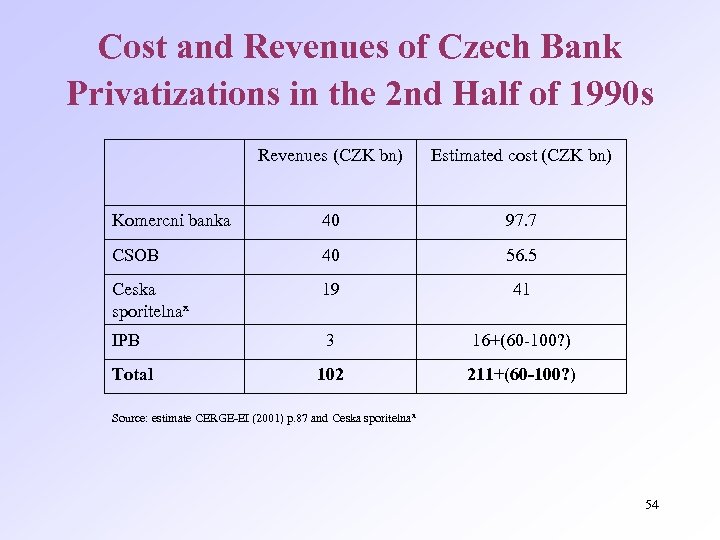
Cost and Revenues of Czech Bank Privatizations in the 2 nd Half of 1990 s Revenues (CZK bn) Estimated cost (CZK bn) Komercni banka 40 97. 7 CSOB 40 56. 5 19 41 3 16+(60 -100? ) 102 211+(60 -100? ) Ceska sporitelnax IPB Total Source: estimate CERGE-EI (2001) p. 87 and Ceska sporitelnax 54
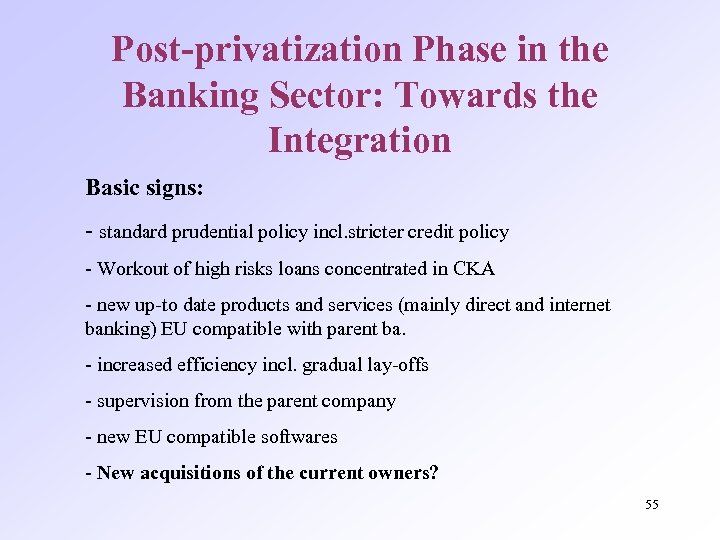
Post-privatization Phase in the Banking Sector: Towards the Integration Basic signs: - standard prudential policy incl. stricter credit policy - Workout of high risks loans concentrated in CKA - new up-to date products and services (mainly direct and internet banking) EU compatible with parent ba. - increased efficiency incl. gradual lay-offs - supervision from the parent company - new EU compatible softwares - New acquisitions of the current owners? 55
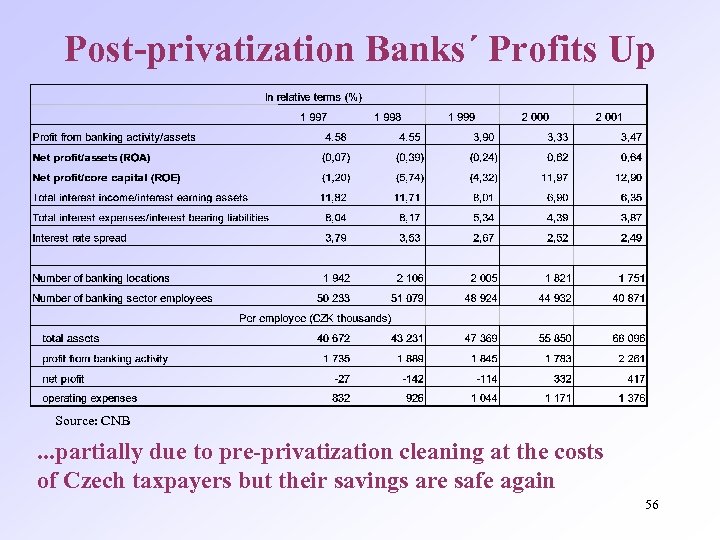
Post-privatization Banks´ Profits Up Source: CNB . . . partially due to pre-privatization cleaning at the costs of Czech taxpayers but their savings are safe again 56
Supervision and Regulation New trends: - supervision on a consolidated basis - harmonization with the EU and BIS - accounting in banks in line with international accounting standards (IAS) - new rules on capital adequacy and exposure, provision creating Challenges: - improvement of co-operation among different supervisory bodies on both domestic and international fields and staff education and stabilization - further harmonization and up-dating on the basis on market development 57
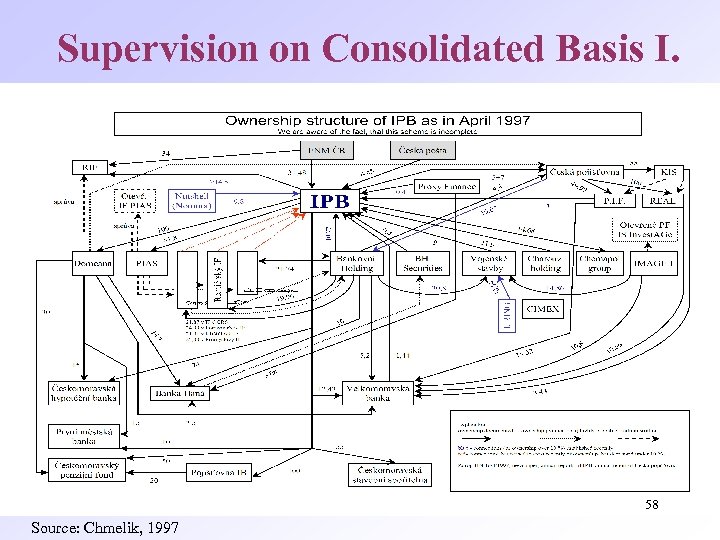
Supervision on Consolidated Basis I. 58 Source: Chmelik, 1997
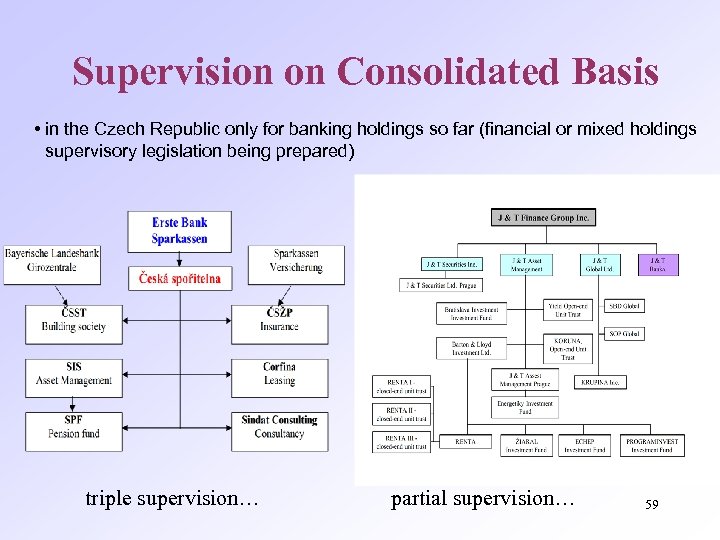
Supervision on Consolidated Basis • in the Czech Republic only for banking holdings so far (financial or mixed holdings supervisory legislation being prepared) triple supervision… partial supervision… 59
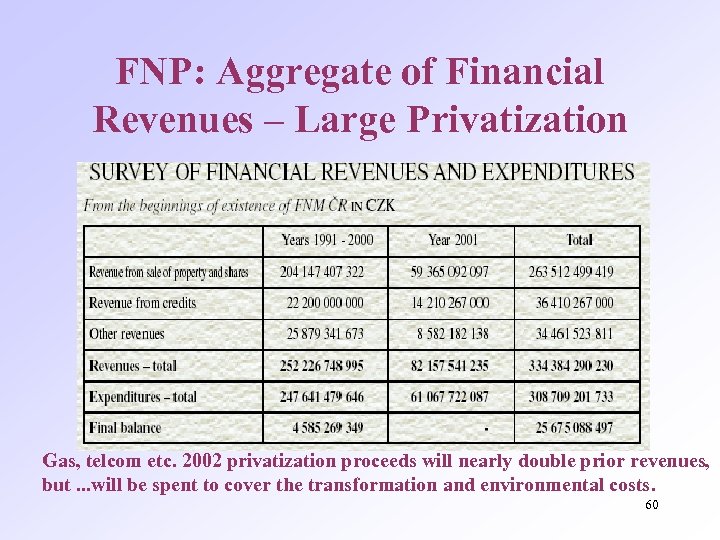
FNP: Aggregate of Financial Revenues – Large Privatization Gas, telcom etc. 2002 privatization proceeds will nearly double prior revenues, but. . . will be spent to cover the transformation and environmental costs. 60
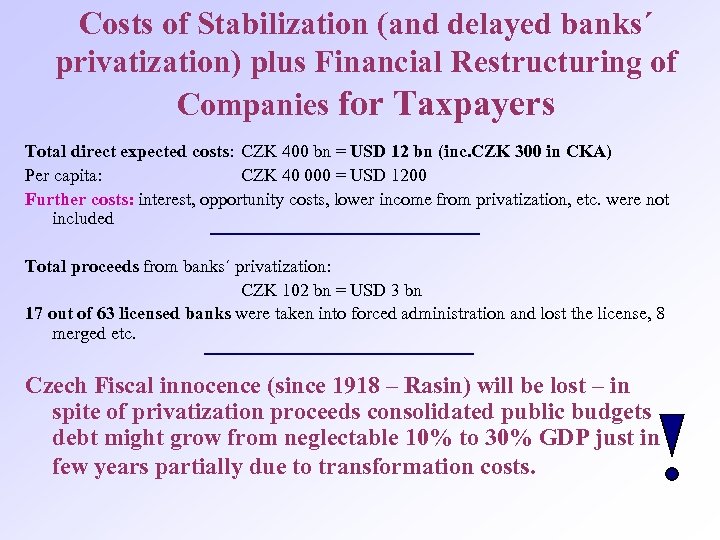
Costs of Stabilization (and delayed banks´ privatization) plus Financial Restructuring of Companies for Taxpayers Total direct expected costs: CZK 400 bn = USD 12 bn (inc. CZK 300 in CKA) Per capita: CZK 40 000 = USD 1200 Further costs: interest, opportunity costs, lower income from privatization, etc. were not included Total proceeds from banks´ privatization: CZK 102 bn = USD 3 bn 17 out of 63 licensed banks were taken into forced administration and lost the license, 8 merged etc. Czech Fiscal innocence (since 1918 – Rasin) will be lost – in spite of privatization proceeds consolidated public budgets debt might grow from neglectable 10% to 30% GDP just in few years partially due to transformation costs.
References Benacek, V. (2001), The Generic Private Sector in an Economy of Transition: Developments and Impacts on the Czech Economy, Research Report IR 01 -046, Laxenburg: IIASA Black, B. (2001), „The Corporate Governance Behavior and Market Value of Russian Firms“, Emerging Market Review 2, pp. 89 -108 Black, B. , Kraakma, R. , Rarassova, A. (2000), „Russian Privatization and Corporate Governance: What Went Wrong? “, Sanford Law Review 52 and William Davidson WP No. 269 a Brabant, j. Van, (1992), „Privatizing Eastern Europe: the Role of Markets and Ownership in the Transition“ Dordrecht-Boston-London: Kluwer Academic Publishers Carlin, W. , Aghion, P. , (1996), Restructuring Outcomes and the Evolution of Ownership Patterns in Central and Eastern Europe, Economics of Transition, 4(2), pp. 371 -388. Christodoulakis, N. (1992) „Privatization, Public Debt and Government Policy: Discussion of Issues“, Sixth CERGE lecture on Practical Aspects of Privatization, Prague Czech Republic 2001: Mixed Blessings, (2001), Prague: CERGE- EI Estrin, S. (2001), „Competition and Corporate Governance in Transition“, J. of Ec. Persp(forth), WDIWP 431 Fernandez-Arias, Hausmann, R. (2001), „Is Foreign Investment a Safer Form of Financing? “, Emerging Market review 2, pp. 34 -49, Elsevier Keasey K, Thompson, s. , Wright M. (1997), Corporate Governance: Economic and Financial Issues, New York : Oxford University Press Kemme, D. (2001), „Russian Financial transition: The development of Institutions and Markets for Growth“, William Davidson WP 455, October Kikeri, s. , Nellis, j. (2002), „Privatization in Competitive Sectors: The Record to Date“, world Bank Policy Research WP 2860, June Laporta, R. , Lopez-De-Silanes, F. , Shleifer, A. Vishny, R. W. (2000), „Investor Protection and Corporate Governance“, J. of Financial Economics, 58, pp. 3 -27 Laštovicka, r. , Marcincin, a. , Mejstrík, m. , (1995), “Corporate Governance and Share Prices in Voucher Privatized Companies”, in The Czech Republic and Economic Transition in Eastern Europe (Švejnar, J. Ed. ). New York: Academic Press. Mc Dermott G. , Mejstrik M. (1993), „Czechoslovak Competitiveness and the Role of Small Firms“, In: Small Firms and Entrepreneurship, (Ed. Audretsch D. , Acz Z. ), Cambridge: Cambridge Un. Press 62
References (Cont. ) Megginson, W. , Netter, J. (2001), „From State to Market: A Survey of Empirical Studies on Privatization“, Journal of Economic Literature, Vol. 39 (2), June Mejstrik M. (1990), "Where Are We Headed: The Case of Czechoslovakia, In: Claudon M. P. (Ed. ), Comrades Go Private, New York: New York University Press Mejstrík, M. , Zemplinerová, A. , Dervis, A. (Eds. ) (1997 a), The Privatization Process in East-central Europe: The Evolutionary Process of Czech Privatization. Dordrecht -Boston-London: Kluwer Academic Publishers Mejstrík, M. , (1997 b): Privatization in the Czech Republic and Russia: The Voucher Model. In: Giersch H. . (ed. ) Privatization at the End of the Century, Berlin: Springer Verlag Mejstrík, M. , (1999), „The Restructuring after Privatization in the Czech Republic“, Prague Economic Papers, 3, pp. 233 - 260 Mlcoch, L. (1994), ”Economic Transformation and the Notion of the Order”, Politická ekonomie, 42, 3, Praha: Economia, pp. 314 -317. Neumaier I. , (2002), „Are we going to be just an Assembly Line“, Ekonom weekly, No. 25, Prague Privatization Newsletter of the Czech and Slovak Republics (ed. Michal Mejstrik), 1991 - 1995, Issues 1 -35, Prague: Institute of Economic Studies Sachs, J. , Zinner, C. , Eilat, Y, (2000), „The Gains from Privatization in Transition Economies: Is Change of Ownership Enough ? “ , CAER II Discussion Paper 63, HIIID, Cambridge, MA Shleifer, A. , Vishny, R. W. , (1997), “A Survey of Corporate Governance”, The Journal of Finance, 52 (2), pp. 737 -783. Svejnar, J. , (2002), „Transition Economies: Performance and Challenges“, Journal of Economic Perspectives, 16 (2), February Transition Report 1995, Investment and Enterprise Development (Economic Transition in Eastern Europe and the former Soviet Union). London: EBRD. 63
Скачать презентацию Problems of Economic Consequences of Privatization with special
53e716060311e014acfac1744afe4b13.ppt