 Скачать презентацию Problems faced by black people Ku Klux Klan
ec027803cc3e5d5c1dabb02733d57351.ppt
- Количество слайдов: 1



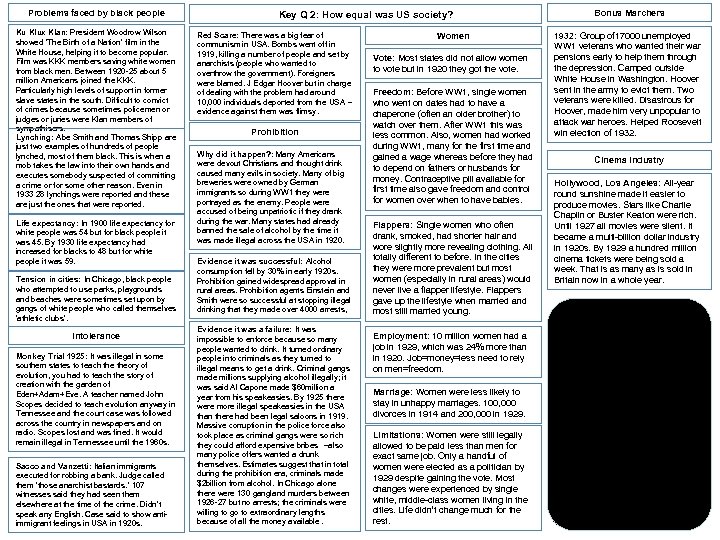
Problems faced by black people Ku Klux Klan: President Woodrow Wilson showed ‘The Birth of a Nation’ film in the White House, helping it to become popular. Film was KKK members saving white women from black men. Between 1920 -25 about 5 million Americans joined the KKK. Particularly high levels of support in former slave states in the south. Difficult to convict of crimes because sometimes policemen or judges or juries were Klan members of sympathisers. Lynching: Abe Smith and Thomas Shipp are just two examples of hundreds of people lynched, most of them black. This is when a mob takes the law into their own hands and executes somebody suspected of committing a crime or for some other reason. Even in 1933 28 lynchings were reported and these are just the ones that were reported. Life expectancy: In 1900 life expectancy for white people was 54 but for black people it was 45. By 1930 life expectancy had increased for blacks to 48 but for white people it was 59. Tension in cities: In Chicago, black people who attempted to use parks, playgrounds and beaches were sometimes set upon by gangs of white people who called themselves ‘athletic clubs’. Intolerance Monkey Trial 1925: It was illegal in some southern states to teach theory of evolution, you had to teach the story of creation with the garden of Eden+Adam+Eve. A teacher named John Scopes decided to teach evolution anyway in Tennessee and the court case was followed across the country in newspapers and on radio. Scopes lost and was fined. It would remain illegal in Tennessee until the 1960 s. Sacco and Vanzetti: Italian immigrants executed for robbing a bank. Judge called them ‘those anarchist bastards. ’ 107 witnesses said they had seen them elsewhere at the time of the crime. Didn ’t speak any English. Case said to show antiimmigrant feelings in USA in 1920 s. Key Q 2: How equal was US society? Red Scare: There was a big fear of communism in USA. Bombs went off in 1919, killing a number of people and set by anarchists (people who wanted to overthrow the government). Foreigners were blamed. J Edgar Hoover but in charge of dealing with the problem had around 10, 000 individuals deported from the USA – evidence against them was flimsy. Prohibition Why did it happen? : Many Americans were devout Christians and thought drink caused many evils in society. Many of big breweries were owned by German immigrants so during WW 1 they were portrayed as the enemy. People were accused of being unpatriotic if they drank during the war. Many states had already banned the sale of alcohol by the time it was made illegal across the USA in 1920. Evidence it was successful: Alcohol consumption fell by 30% in early 1920 s. Prohibition gained widespread approval in rural areas. Prohibition agents Einstein and Smith were so successful at stopping illegal drinking that they made over 4000 arrests, Evidence it was a failure: It was impossible to enforce because so many people wanted to drink. It turned ordinary people into criminals as they turned to illegal means to get a drink. Criminal gangs made millions supplying alcohol illegally; it was said Al Capone made $60 million a year from his speakeasies. By 1925 there were more illegal speakeasies in the USA than there had been legal saloons in 1919. Massive corruption in the police force also took place as criminal gangs were so rich they could afford expensive bribes –also many police offers wanted a drunk themselves. Estimates suggest that in total during the prohibition era, criminals made $2 billion from alcohol. In Chicago alone there were 130 gangland murders between 1926 -27 but no arrests; the criminals were willing to go to extraordinary lengths because of all the money available. Women Vote: Most states did not allow women to vote but in 1920 they got the vote. Freedom: Before WW 1, single women who went on dates had to have a chaperone (often an older brother) to watch over them. After WW 1 this was less common. Also, women had worked during WW 1, many for the first time and gained a wage whereas before they had to depend on fathers or husbands for money. Contraceptive pill available for first time also gave freedom and control for women over when to have babies. Flappers: Single women who often drank, smoked, had shorter hair and wore slightly more revealing clothing. All totally different to before. In the cities they were more prevalent but most women (especially in rural areas) would never live a flapper lifestyle. Flappers gave up the lifestyle when married and most still married young. Employment: 10 million women had a job in 1929, which was 24% more than in 1920. Job=money=less need to rely on men=freedom. Marriage: Women were less likely to stay in unhappy marriages. 100, 000 divorces in 1914 and 200, 000 in 1929. Limitations: Women were still legally allowed to be paid less than men for exact same job. Only a handful of women were elected as a politician by 1929 despite gaining the vote. Most changes were experienced by single white, middle-class women living in the cities. Life didn’t change much for the rest. Bonus Marchers 1932: Group of 17000 unemployed WW 1 veterans who wanted their war pensions early to help them through the depression. Camped outside White House in Washington. Hoover sent in the army to evict them. Two veterans were killed. Disastrous for Hoover, made him very unpopular to attack war heroes. Helped Roosevelt win election of 1932. Cinema Industry Hollywood, Los Angeles: All-year round sunshine made it easier to produce movies. Stars like Charlie Chaplin or Buster Keaton were rich. Until 1927 all movies were silent. It became a multi-billion dollar industry in 1920 s. By 1929 a hundred million cinema tickets were being sold a week. That is as many as is sold in Britain now in a whole year.
Скачать презентацию Problems faced by black people Ku Klux Klan
ec027803cc3e5d5c1dabb02733d57351.ppt