 Скачать презентацию Problem Computer systems provide crucial services
944354215984c59e81d12bfefdd05891.ppt
- Количество слайдов: 56



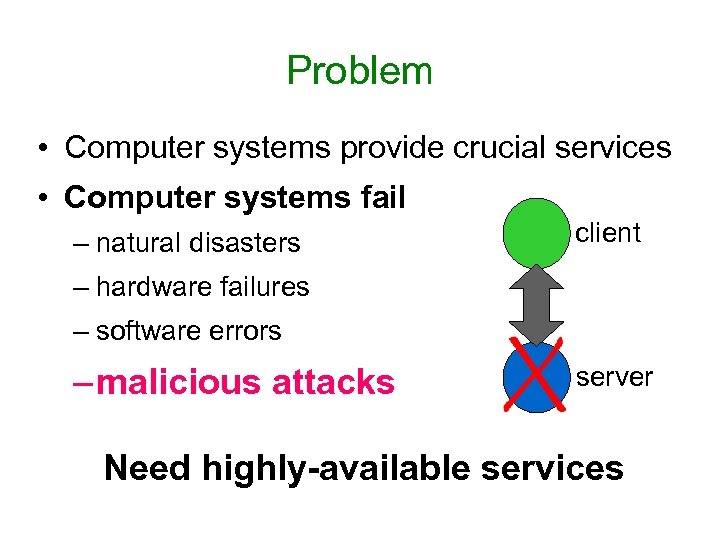
Problem • Computer systems provide crucial services • Computer systems fail – natural disasters client – hardware failures – software errors – malicious attacks server Need highly-available services
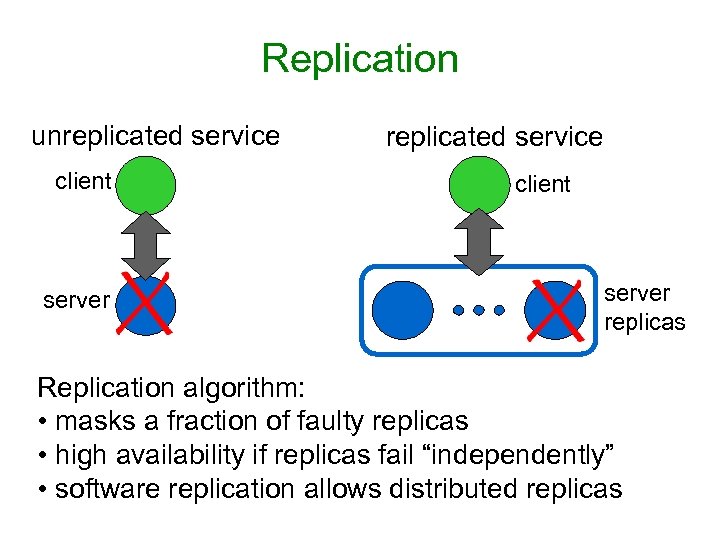
Replication unreplicated service client server replicas Replication algorithm: • masks a fraction of faulty replicas • high availability if replicas fail “independently” • software replication allows distributed replicas
Assumptions are a Problem • Replication algorithms make assumptions: – behavior of faulty processes – synchrony – bound on number of faults • Service fails if assumptions are invalid – attacker will work to invalidate assumptions Most replication algorithms assume too much
Contributions • Practical replication algorithm: – weak assumptions tolerates attacks – good performance • Implementation – BFT: a generic replication toolkit – BFS: a replicated file system • Performance evaluation BFS is only 3% slower than a standard file system
Talk Overview • Problem • Assumptions • Algorithm • Implementation • Performance • Conclusions
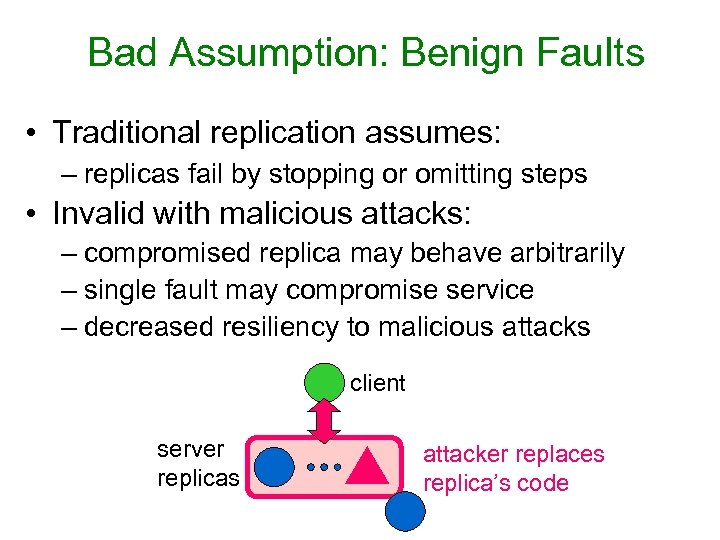
Bad Assumption: Benign Faults • Traditional replication assumes: – replicas fail by stopping or omitting steps • Invalid with malicious attacks: – compromised replica may behave arbitrarily – single fault may compromise service – decreased resiliency to malicious attacks client server replicas attacker replaces replica’s code
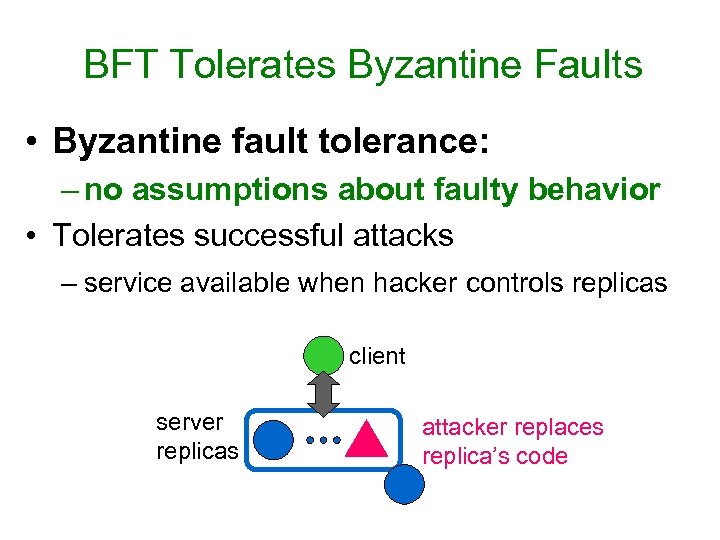
BFT Tolerates Byzantine Faults • Byzantine fault tolerance: – no assumptions about faulty behavior • Tolerates successful attacks – service available when hacker controls replicas client server replicas attacker replaces replica’s code
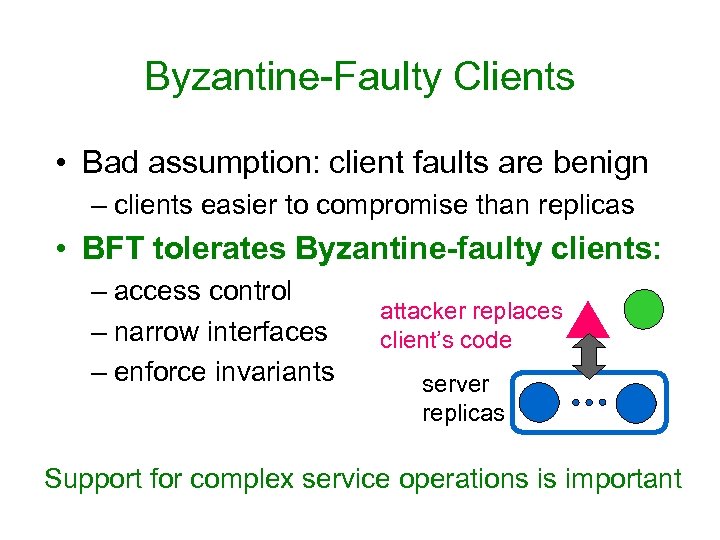
Byzantine-Faulty Clients • Bad assumption: client faults are benign – clients easier to compromise than replicas • BFT tolerates Byzantine-faulty clients: – access control – narrow interfaces – enforce invariants attacker replaces client’s code server replicas Support for complex service operations is important
Bad Assumption: Synchrony • Synchrony known bounds on: – delays between steps – message delays • Invalid with denial-of-service attacks: – bad replies due to increased delays • Assumed by most Byzantine fault tolerance
Asynchrony • No bounds on delays • Problem: replication is impossible Solution in BFT: • provide safety without synchrony – guarantees no bad replies • assume eventual time bounds for liveness – may not reply with active denial-of-service attack – will reply when denial-of-service attack ends
Talk Overview • Problem • Assumptions • Algorithm • Implementation • Performance • Conclusions
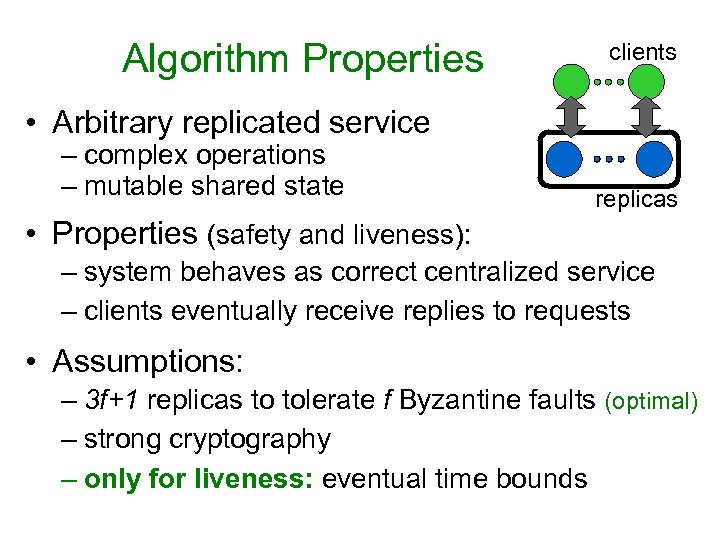
Algorithm Properties clients • Arbitrary replicated service – complex operations – mutable shared state replicas • Properties (safety and liveness): – system behaves as correct centralized service – clients eventually receive replies to requests • Assumptions: – 3 f+1 replicas to tolerate f Byzantine faults (optimal) – strong cryptography – only for liveness: eventual time bounds
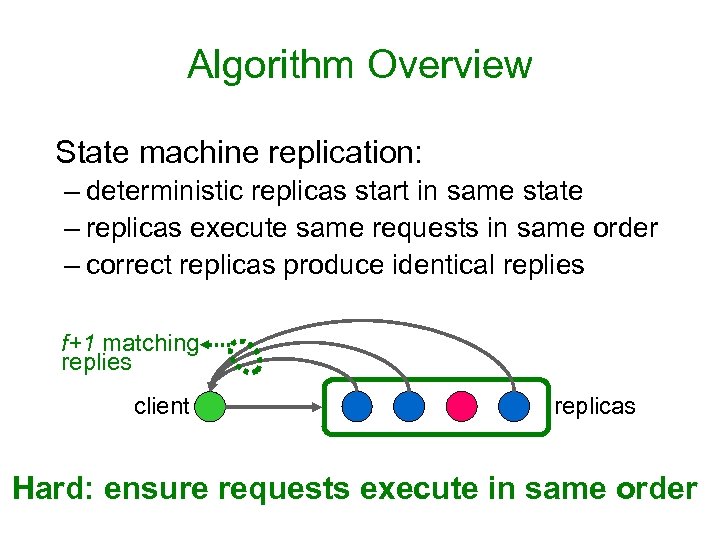
Algorithm Overview State machine replication: – deterministic replicas start in same state – replicas execute same requests in same order – correct replicas produce identical replies f+1 matching replies client replicas Hard: ensure requests execute in same order
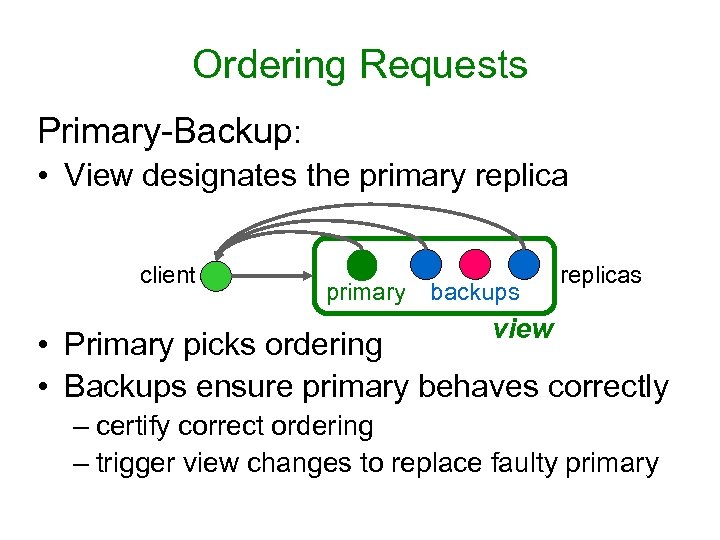
Ordering Requests Primary-Backup: • View designates the primary replica client primary backups replicas view • Primary picks ordering • Backups ensure primary behaves correctly – certify correct ordering – trigger view changes to replace faulty primary
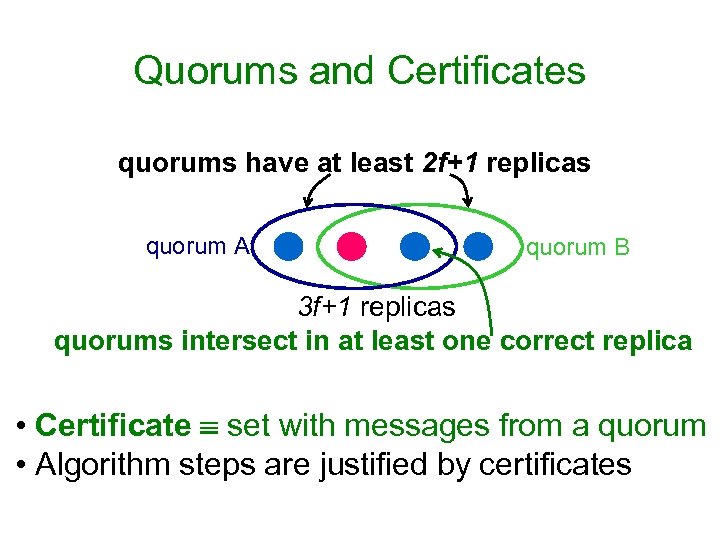
Quorums and Certificates quorums have at least 2 f+1 replicas quorum A quorum B 3 f+1 replicas quorums intersect in at least one correct replica • Certificate set with messages from a quorum • Algorithm steps are justified by certificates
Algorithm Components • Normal case operation • View changes • Garbage collection • Recovery All have to be designed to work together
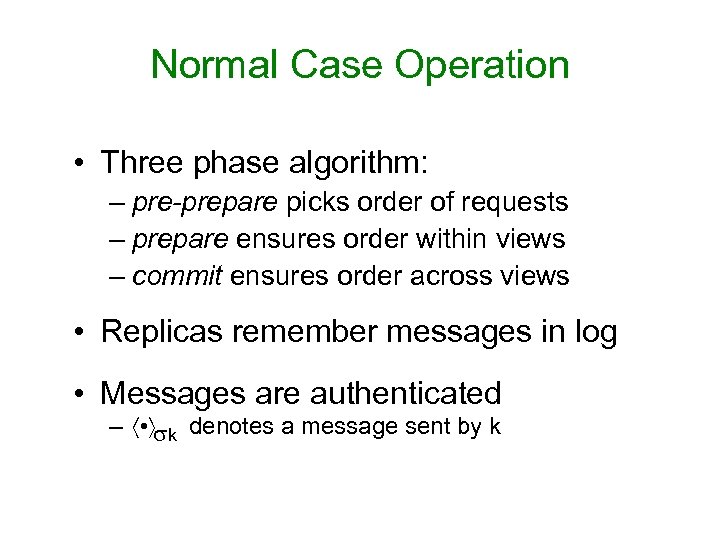
Normal Case Operation • Three phase algorithm: – pre-prepare picks order of requests – prepare ensures order within views – commit ensures order across views • Replicas remember messages in log • Messages are authenticated – • k denotes a message sent by k
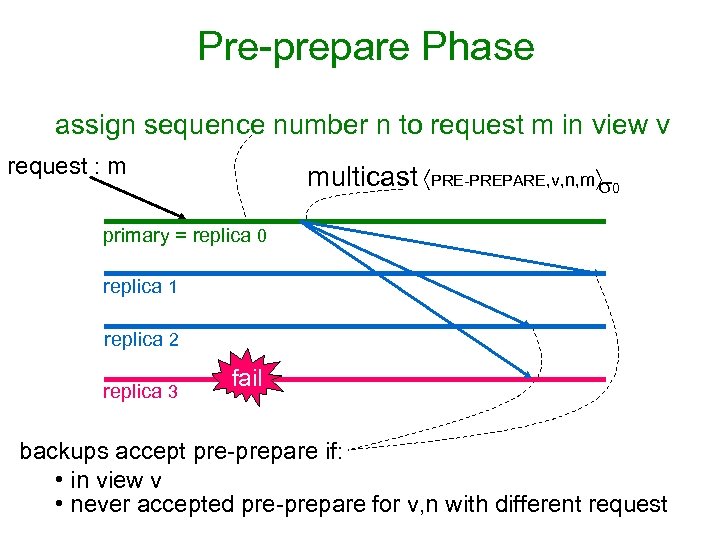
Pre-prepare Phase assign sequence number n to request m in view v request : m multicast PRE-PREPARE, v, n, m 0 primary = replica 0 replica 1 replica 2 replica 3 fail backups accept pre-prepare if: • in view v • never accepted pre-prepare for v, n with different request
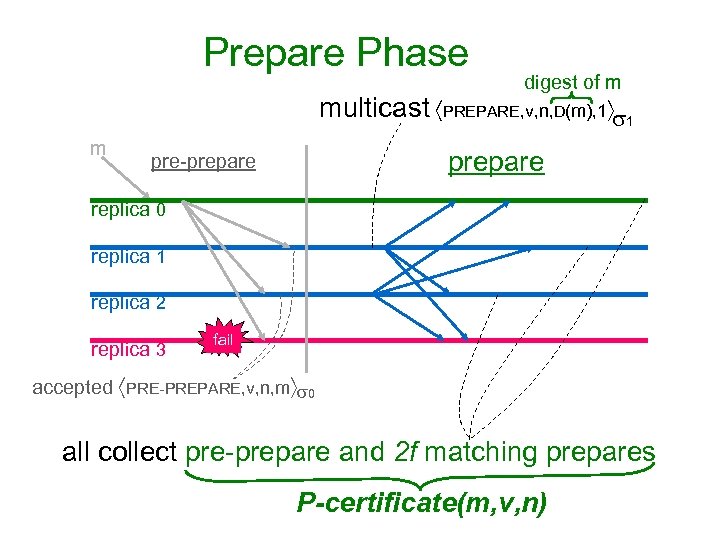
Prepare Phase digest of m multicast PREPARE, v, n, D(m), 1 1 m prepare pre-prepare replica 0 replica 1 replica 2 replica 3 fail accepted PRE-PREPARE, v, n, m 0 all collect pre-prepare and 2 f matching prepares P-certificate(m, v, n)
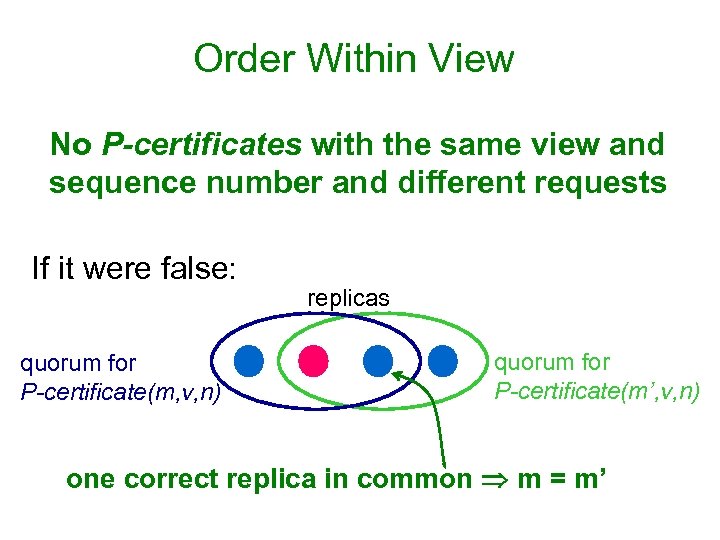
Order Within View No P-certificates with the same view and sequence number and different requests If it were false: quorum for P-certificate(m, v, n) replicas quorum for P-certificate(m’, v, n) one correct replica in common m = m’
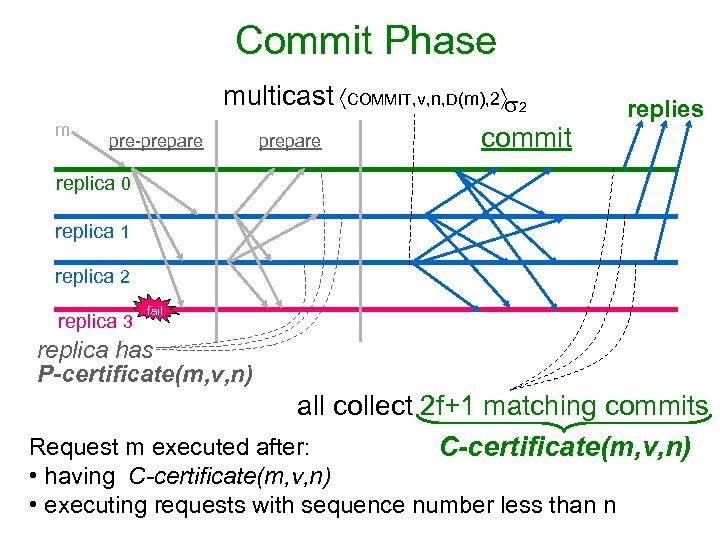
Commit Phase m pre-prepare multicast COMMIT, v, n, D(m), 2 2 commit prepare replies replica 0 replica 1 replica 2 replica 3 fail replica has P-certificate(m, v, n) all collect 2 f+1 matching commits Request m executed after: C-certificate(m, v, n) • having C-certificate(m, v, n) • executing requests with sequence number less than n
View Changes • Provide liveness when primary fails: – timeouts trigger view changes – select new primary ( view number mod 3 f+1) • But also need to: – preserve safety – ensure replicas are in the same view long enough – prevent denial-of-service attacks
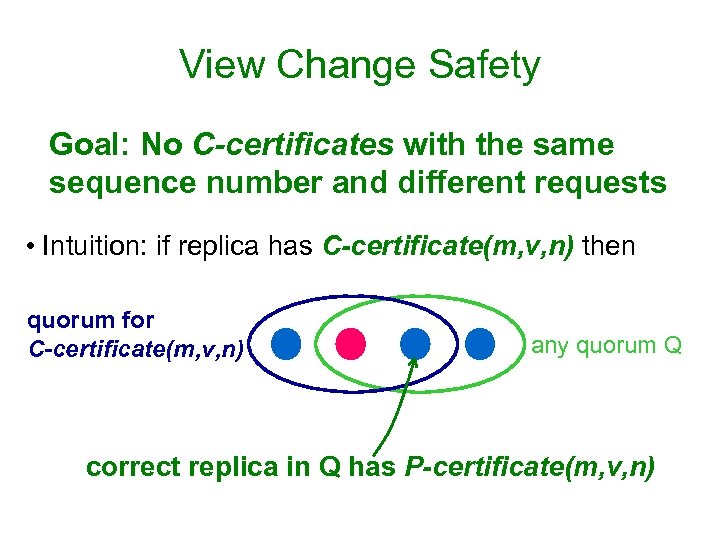
View Change Safety Goal: No C-certificates with the same sequence number and different requests • Intuition: if replica has C-certificate(m, v, n) then quorum for C-certificate(m, v, n) any quorum Q correct replica in Q has P-certificate(m, v, n)
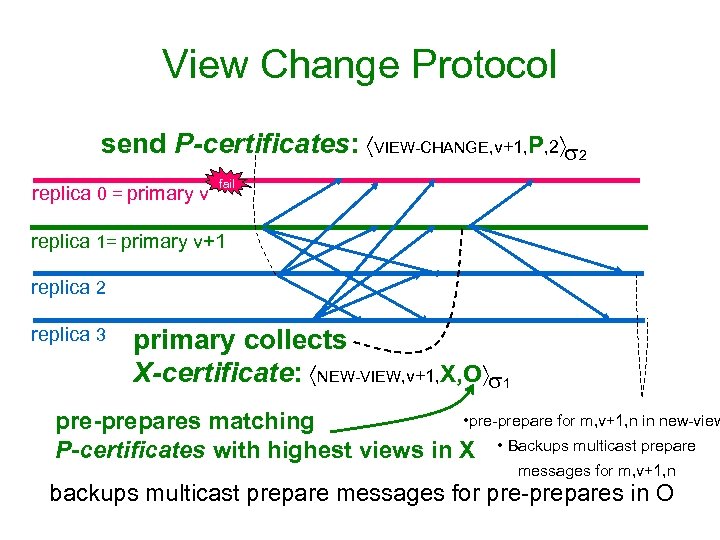
View Change Protocol send P-certificates: VIEW-CHANGE, v+1, P, 2 2 replica 0 = primary v fail replica 1= primary v+1 replica 2 replica 3 primary collects X-certificate: NEW-VIEW, v+1, X, O 1 • pre-prepare for m, v+1, n in new-view pre-prepares matching P-certificates with highest views in X • Backups multicast prepare messages for m, v+1, n backups multicast prepare messages for pre-prepares in O
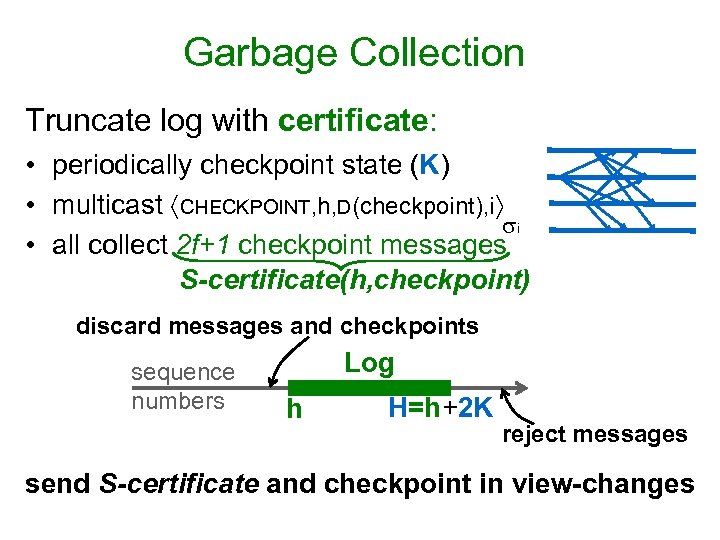
Garbage Collection Truncate log with certificate: • periodically checkpoint state (K) • multicast CHECKPOINT, h, D(checkpoint), i i • all collect 2 f+1 checkpoint messages S-certificate(h, checkpoint) discard messages and checkpoints sequence numbers Log h H=h+2 K reject messages send S-certificate and checkpoint in view-changes
Formal Correctness Proofs • Complete safety proof with I/O automata – invariants – simulation relations • Partial liveness proof with timed I/O automata – invariants
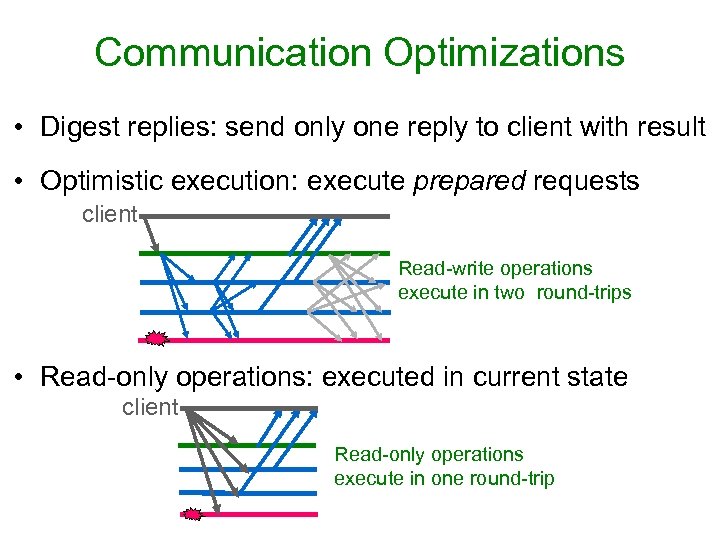
Communication Optimizations • Digest replies: send only one reply to client with result • Optimistic execution: execute prepared requests client Read-write operations execute in two round-trips • Read-only operations: executed in current state client Read-only operations execute in one round-trip
Talk Overview • Problem • Assumptions • Algorithm • Implementation • Performance • Conclusions
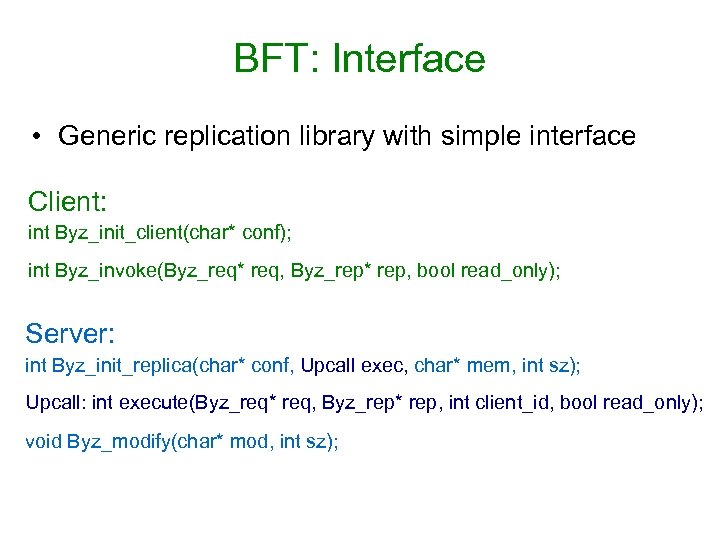
BFT: Interface • Generic replication library with simple interface Client: int Byz_init_client(char* conf); int Byz_invoke(Byz_req* req, Byz_rep* rep, bool read_only); Server: int Byz_init_replica(char* conf, Upcall exec, char* mem, int sz); Upcall: int execute(Byz_req* req, Byz_rep* rep, int client_id, bool read_only); void Byz_modify(char* mod, int sz);
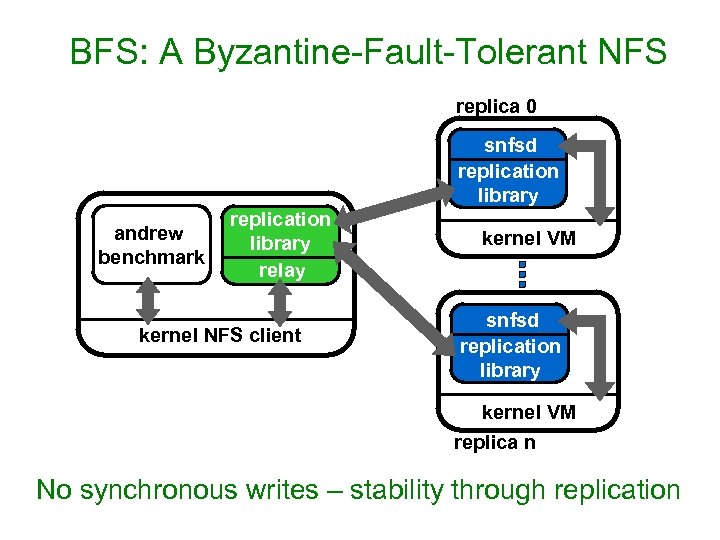
BFS: A Byzantine-Fault-Tolerant NFS replica 0 snfsd replication library andrew benchmark replication library relay kernel NFS client kernel VM snfsd replication library kernel VM replica n No synchronous writes – stability through replication
Talk Overview • Problem • Assumptions • Algorithm • Implementation • Performance • Conclusions
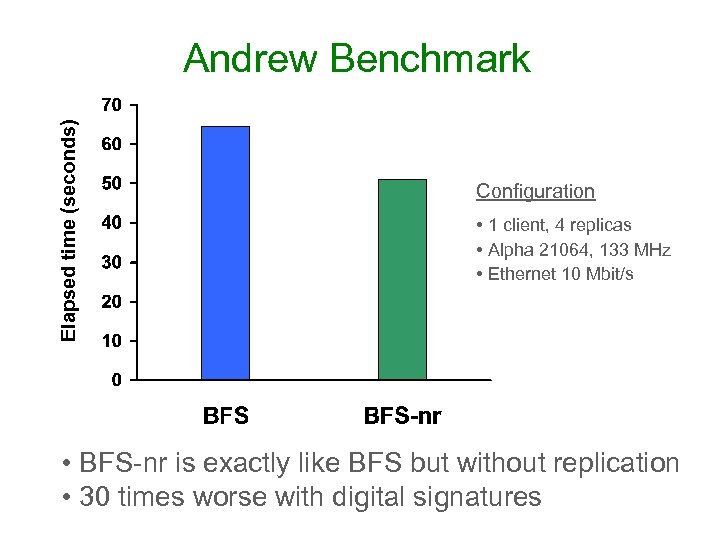
Elapsed time (seconds) Andrew Benchmark Configuration • 1 client, 4 replicas • Alpha 21064, 133 MHz • Ethernet 10 Mbit/s • BFS-nr is exactly like BFS but without replication • 30 times worse with digital signatures
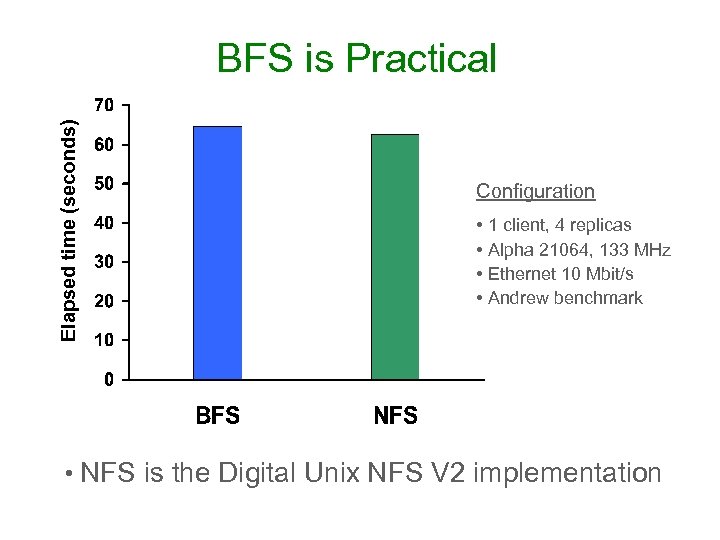
Elapsed time (seconds) BFS is Practical Configuration • 1 client, 4 replicas • Alpha 21064, 133 MHz • Ethernet 10 Mbit/s • Andrew benchmark • NFS is the Digital Unix NFS V 2 implementation
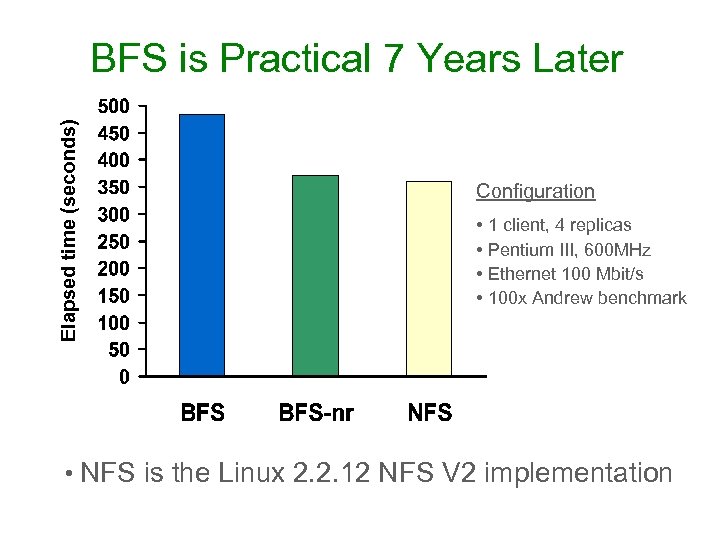
Elapsed time (seconds) BFS is Practical 7 Years Later Configuration • 1 client, 4 replicas • Pentium III, 600 MHz • Ethernet 100 Mbit/s • 100 x Andrew benchmark • NFS is the Linux 2. 2. 12 NFS V 2 implementation
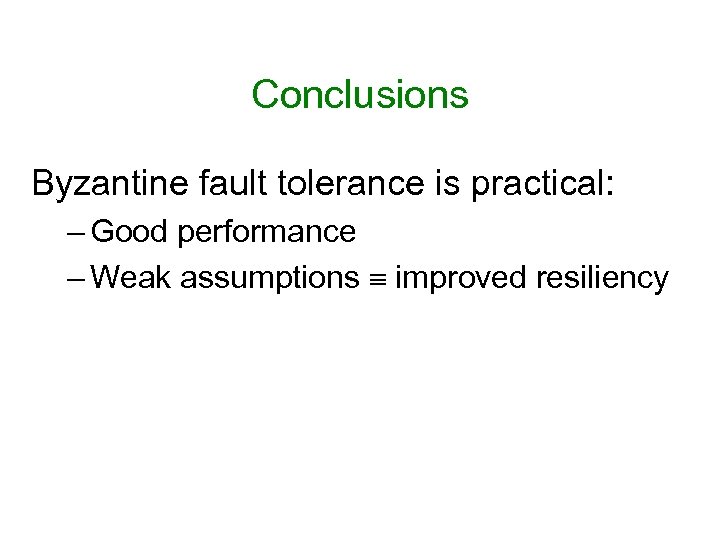
Conclusions Byzantine fault tolerance is practical: – Good performance – Weak assumptions improved resiliency
BASE: Using Abstraction to Improve Fault Tolerance Rodrigo Rodrigues, Miguel Castro, and Barbara Liskov MIT Laboratory for Computer Science and Microsoft Research http: //www. pmg. lcs. mit. edu/bft
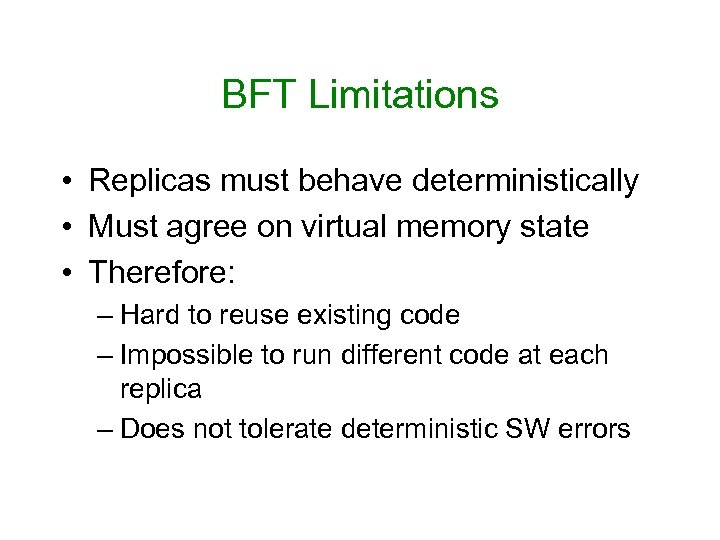
BFT Limitations • Replicas must behave deterministically • Must agree on virtual memory state • Therefore: – Hard to reuse existing code – Impossible to run different code at each replica – Does not tolerate deterministic SW errors
Talk Overview • • • Introduction BASE Replication Technique Example: File System (BASEFS) Evaluation Conclusion
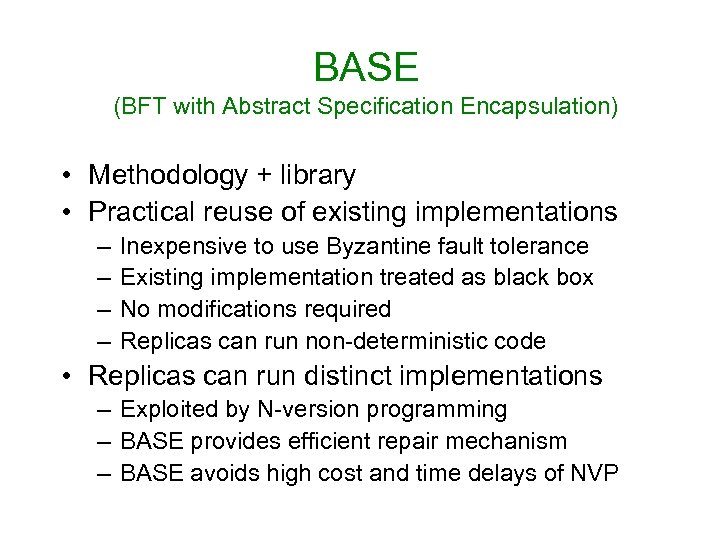
BASE (BFT with Abstract Specification Encapsulation) • Methodology + library • Practical reuse of existing implementations – – Inexpensive to use Byzantine fault tolerance Existing implementation treated as black box No modifications required Replicas can run non-deterministic code • Replicas can run distinct implementations – Exploited by N-version programming – BASE provides efficient repair mechanism – BASE avoids high cost and time delays of NVP
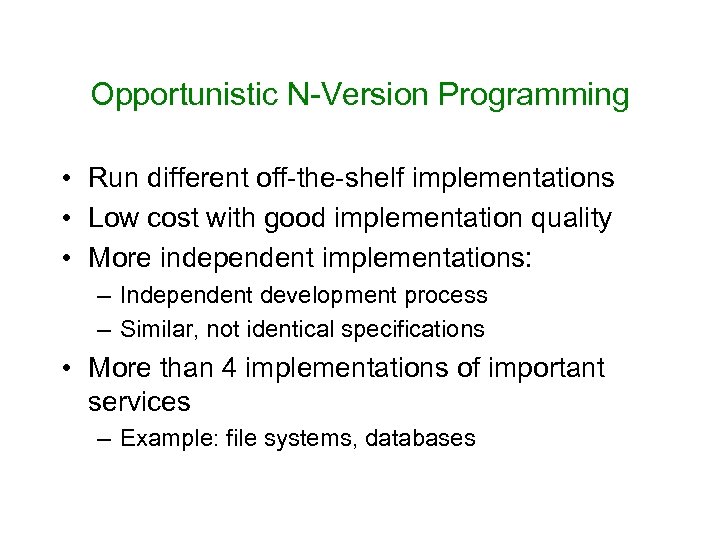
Opportunistic N-Version Programming • Run different off-the-shelf implementations • Low cost with good implementation quality • More independent implementations: – Independent development process – Similar, not identical specifications • More than 4 implementations of important services – Example: file systems, databases
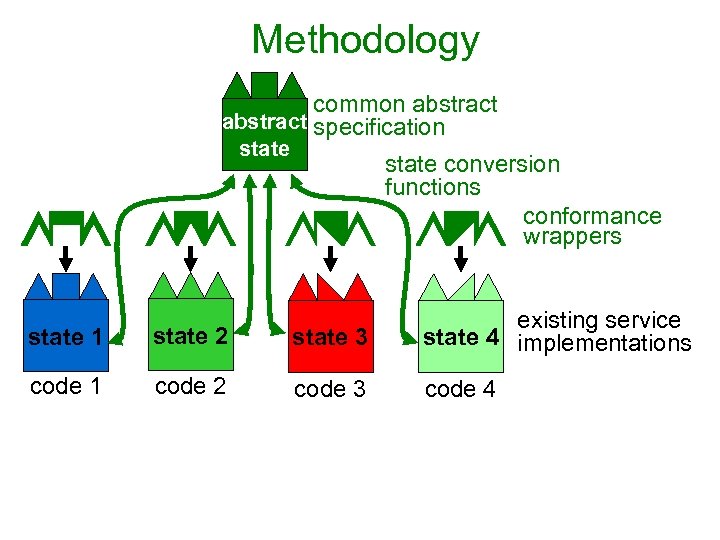
Methodology common abstract specification state conversion functions conformance wrappers state 1 state 2 state 3 existing service state 4 implementations code 1 code 2 code 3 code 4
Talk Overview • • • Introduction BASE Replication Technique Example: File System (BASEFS) Evaluation Conclusion
Abstract Specification • Defines abstract behavior + abstract state • BASEFS – abstract behavior: – Based on NFS RFC – Non-determinism problems in NFS: • File handle assignment • Timestamp assignment • Order of directory entries
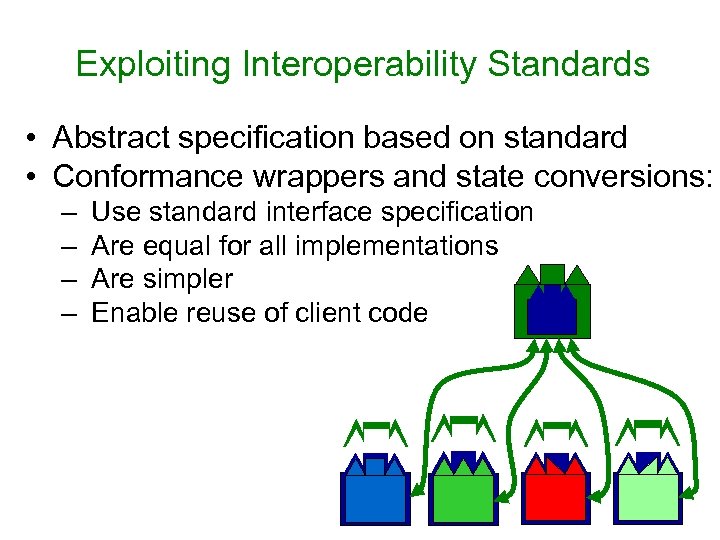
Exploiting Interoperability Standards • Abstract specification based on standard • Conformance wrappers and state conversions: – – Use standard interface specification Are equal for all implementations Are simpler Enable reuse of client code
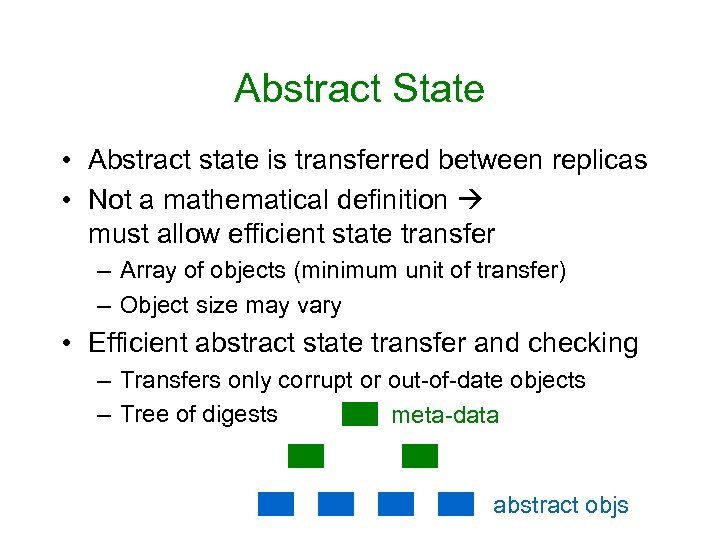
Abstract State • Abstract state is transferred between replicas • Not a mathematical definition must allow efficient state transfer – Array of objects (minimum unit of transfer) – Object size may vary • Efficient abstract state transfer and checking – Transfers only corrupt or out-of-date objects – Tree of digests meta-data abstract objs
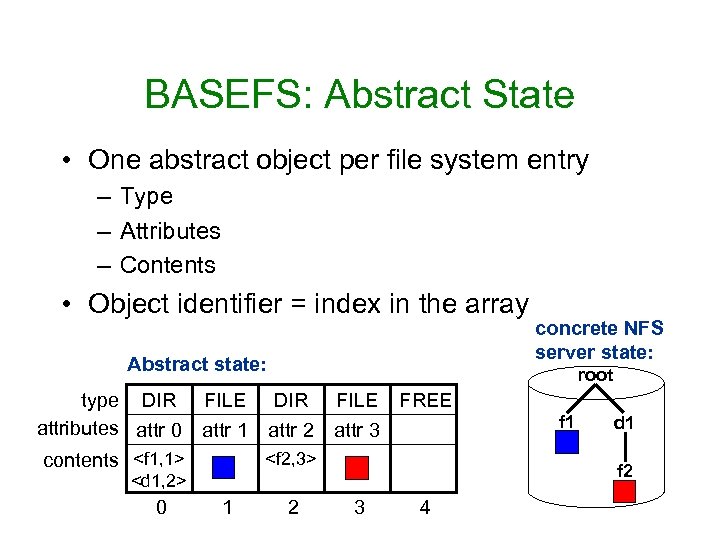
BASEFS: Abstract State • One abstract object per file system entry – Type – Attributes – Contents • Object identifier = index in the array Abstract state: root type DIR FILE FREE attributes attr 0 attr 1 attr 2 attr 3 <f 2, 3> contents <f 1, 1> <d 1, 2> 0 1 concrete NFS server state: 2 3 4 f 1 d 1 f 2
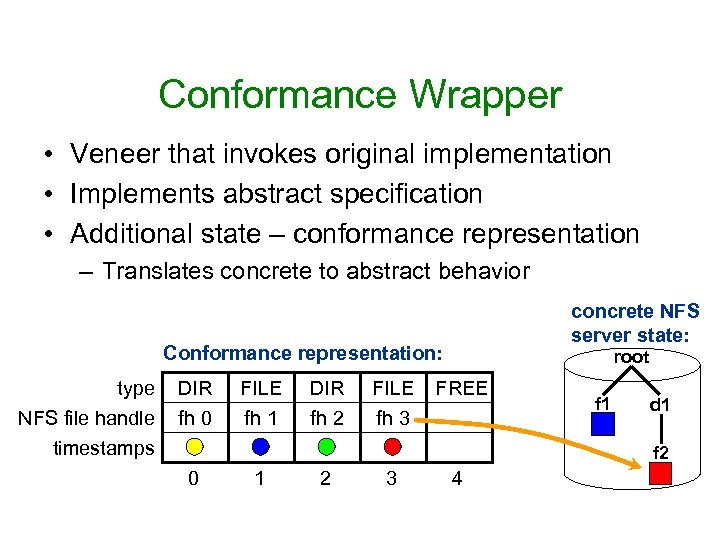
Conformance Wrapper • Veneer that invokes original implementation • Implements abstract specification • Additional state – conformance representation – Translates concrete to abstract behavior concrete NFS server state: Conformance representation: type NFS file handle DIR fh 0 FILE fh 1 DIR fh 2 FILE fh 3 root FREE timestamps f 1 d 1 f 2 0 1 2 3 4
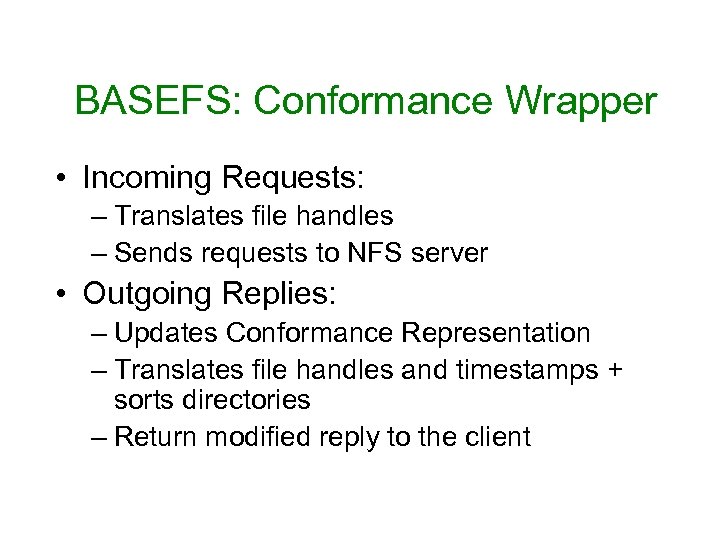
BASEFS: Conformance Wrapper • Incoming Requests: – Translates file handles – Sends requests to NFS server • Outgoing Replies: – Updates Conformance Representation – Translates file handles and timestamps + sorts directories – Return modified reply to the client
State Conversions • Abstraction function – Concrete state Abstract state – Supplies BASE abstract objects • Inverse abstraction function – Invoked by BASE to repair concrete state • Perform conversions at object granularity • Simple interface: int get_obj(int index, char** obj); void put_objs(int nobjs, char** objs, int* indices, int* sizes);
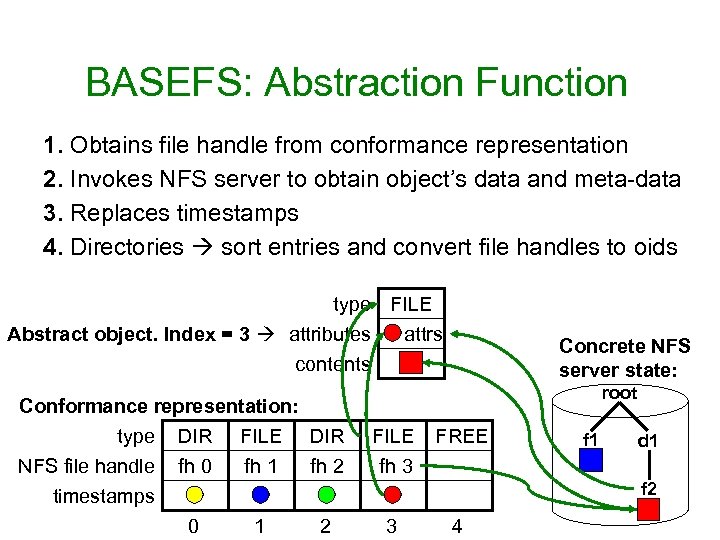
BASEFS: Abstraction Function 1. Obtains file handle from conformance representation 2. Invokes NFS server to obtain object’s data and meta-data 3. Replaces timestamps 4. Directories sort entries and convert file handles to oids type FILE Abstract object. Index = 3 attributes attrs contents Conformance representation: type DIR FILE DIR NFS file handle fh 0 fh 1 fh 2 timestamps 0 1 2 Concrete NFS server state: root FILE fh 3 FREE f 1 d 1 f 2 3 4
Talk Overview • • • Introduction BASE Replication Technique Example: File System (BASEFS) Evaluation Conclusion
Evaluation • Code complexity – Simple code is unlikely to introduce bugs – Simple code costs less to write • Overhead of wrapping and state conversions
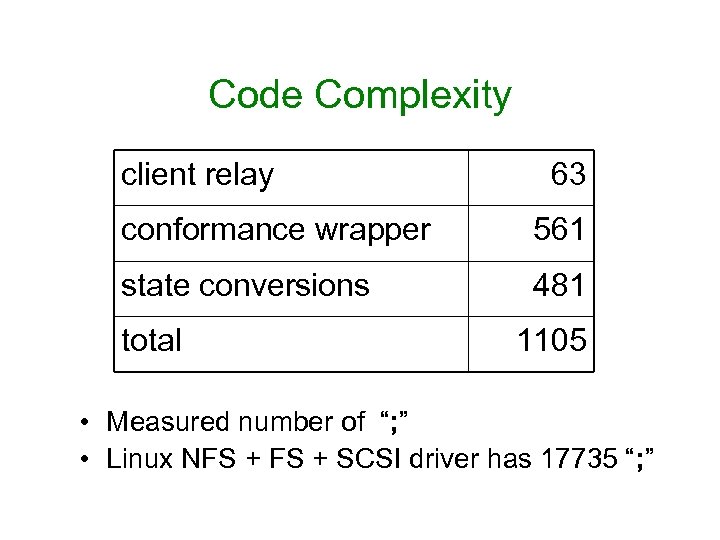
Code Complexity client relay 63 conformance wrapper 561 state conversions 481 total 1105 • Measured number of “; ” • Linux NFS + SCSI driver has 17735 “; ”
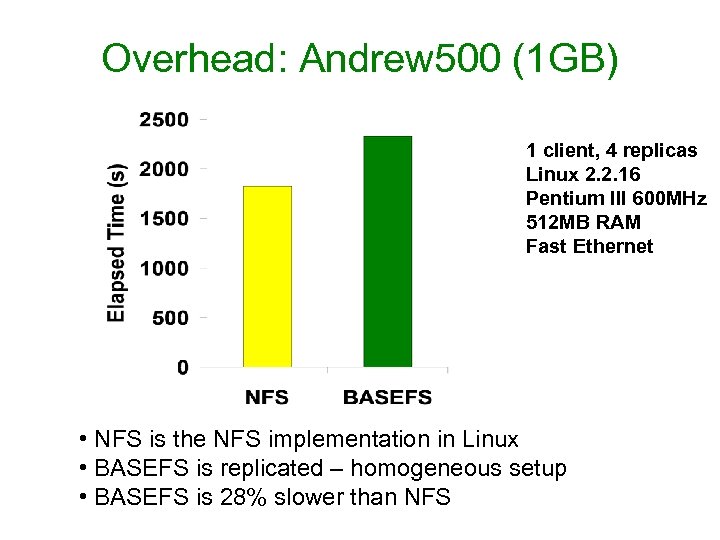
Overhead: Andrew 500 (1 GB) 1 client, 4 replicas Linux 2. 2. 16 Pentium III 600 MHz 512 MB RAM Fast Ethernet • NFS is the NFS implementation in Linux • BASEFS is replicated – homogeneous setup • BASEFS is 28% slower than NFS
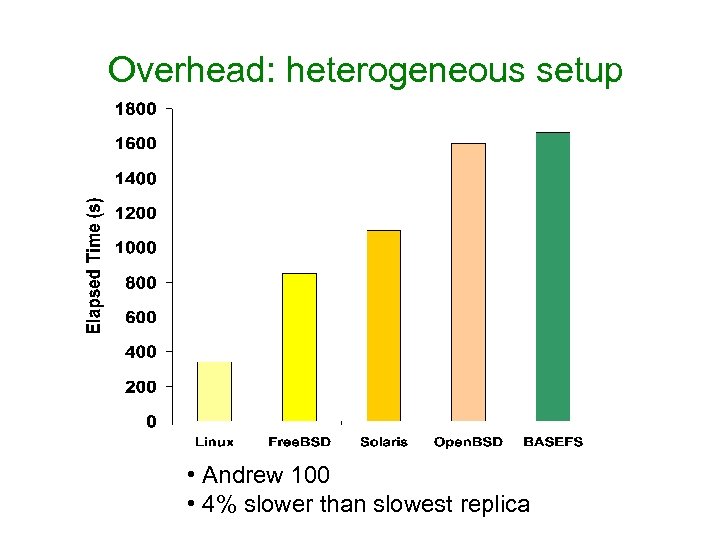
Overhead: heterogeneous setup • Andrew 100 • 4% slower than slowest replica
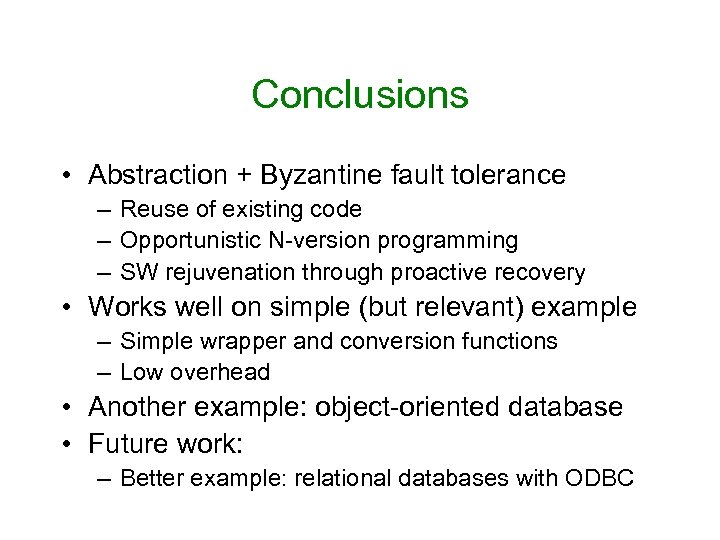
Conclusions • Abstraction + Byzantine fault tolerance – Reuse of existing code – Opportunistic N-version programming – SW rejuvenation through proactive recovery • Works well on simple (but relevant) example – Simple wrapper and conversion functions – Low overhead • Another example: object-oriented database • Future work: – Better example: relational databases with ODBC
Скачать презентацию Problem Computer systems provide crucial services
944354215984c59e81d12bfefdd05891.ppt