 Скачать презентацию Probabilistic Polynomial-Time Process Calculus for Security Protocol Analysis
e3b1a81acaaec57364b349293ce320fb.ppt
- Количество слайдов: 32



Probabilistic Polynomial-Time Process Calculus for Security Protocol Analysis J. Mitchell, A. Ramanathan, A. Scedrov, V. Teague Partially supported by ONR CIP/SW URI
Outline Security protocols u. Research goals u. Specific process calculus • • Probabilistic semantics & complexity Asymptotic equivalence & bisimulation Equational proof system Examples – Computational indistinguishability – Decision Diffie-Hellman & El. Gamal encryption
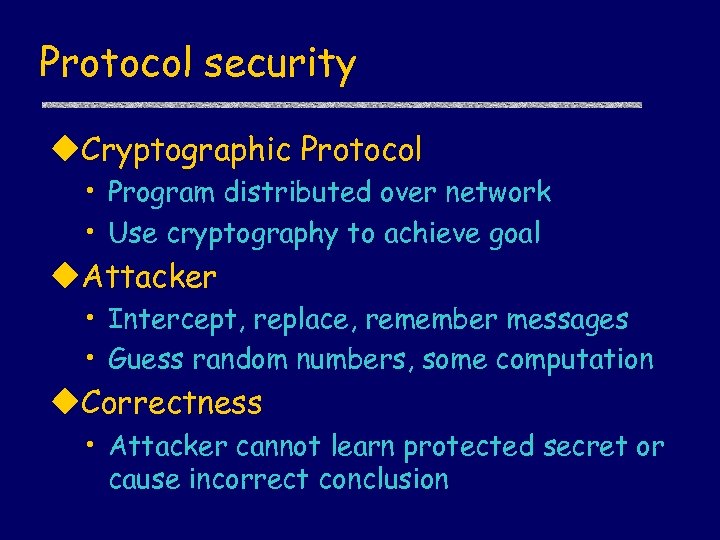
Protocol security u. Cryptographic Protocol • Program distributed over network • Use cryptography to achieve goal u. Attacker • Intercept, replace, remember messages • Guess random numbers, some computation u. Correctness • Attacker cannot learn protected secret or cause incorrect conclusion
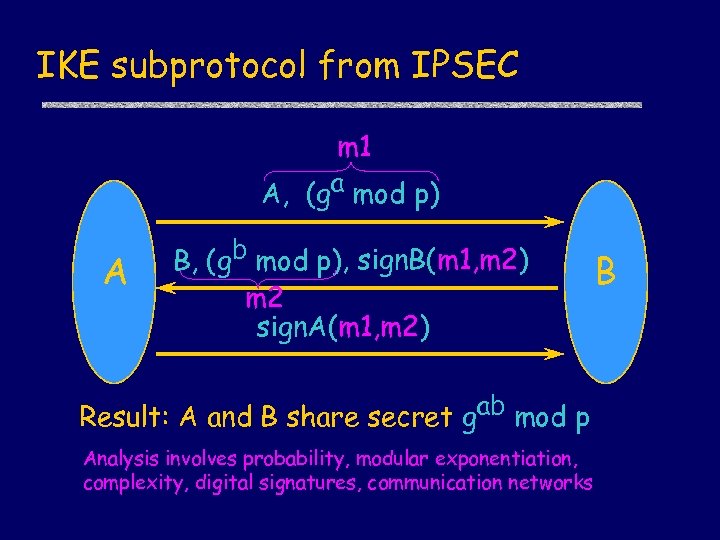
IKE subprotocol from IPSEC m 1 A, (ga mod p) A B, (gb mod p), sign. B(m 1, m 2) m 2 sign. A(m 1, m 2) Result: A and B share secret gab mod p Analysis involves probability, modular exponentiation, complexity, digital signatures, communication networks B
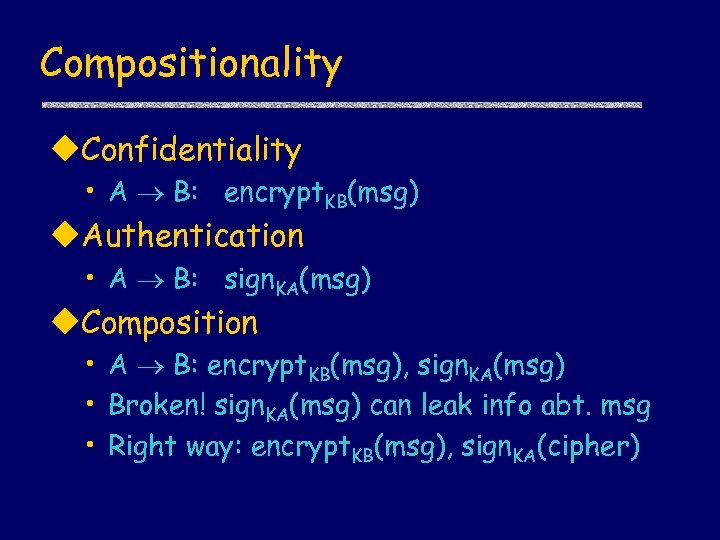
Compositionality u. Confidentiality • A B: encrypt. KB(msg) u. Authentication • A B: sign. KA(msg) u. Composition • A B: encrypt. KB(msg), sign. KA(msg) • Broken! sign. KA(msg) can leak info abt. msg • Right way: encrypt. KB(msg), sign. KA(cipher)
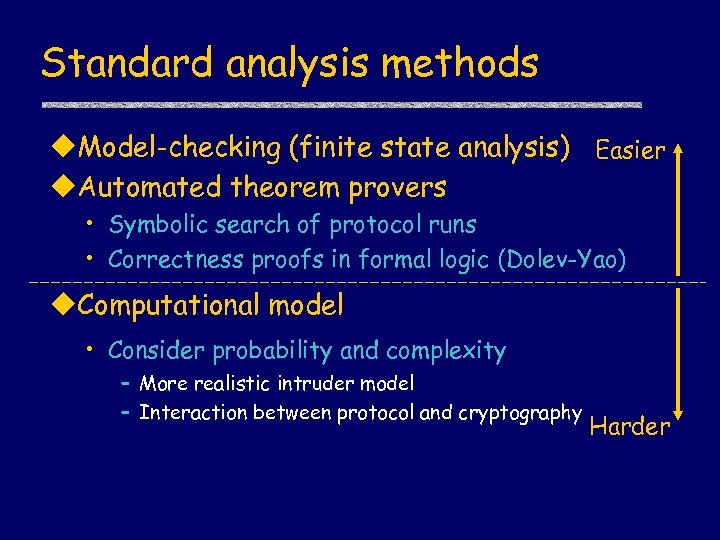
Standard analysis methods u. Model-checking (finite state analysis) Easier u. Automated theorem provers • Symbolic search of protocol runs • Correctness proofs in formal logic (Dolev-Yao) u. Computational model • Consider probability and complexity – More realistic intruder model – Interaction between protocol and cryptography Harder
Outline u. Security protocols Research goals u. Specific process calculus • • Probabilistic semantics & complexity Asymptotic equivalence & bisimulation Equational proof system Examples – Computational indistinguishability – Decision Diffie-Hellman & El. Gamal encryption
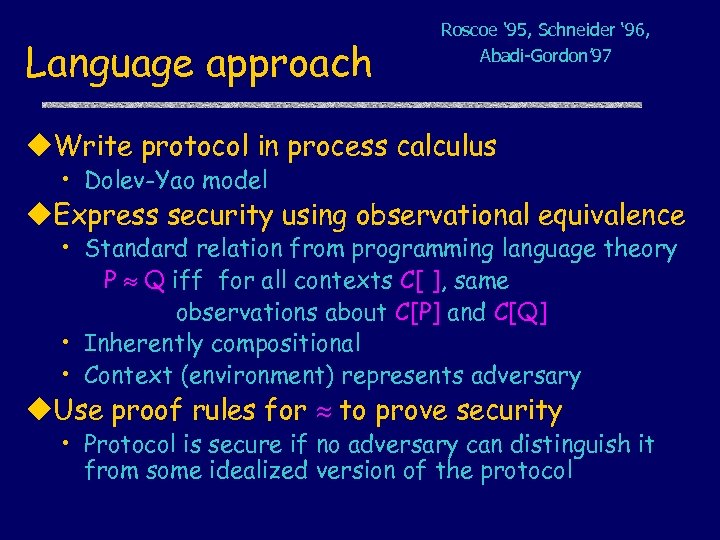
Language approach Roscoe ‘ 95, Schneider ‘ 96, Abadi-Gordon’ 97 u. Write protocol in process calculus • Dolev-Yao model u. Express security using observational equivalence • Standard relation from programming language theory P Q iff for all contexts C[ ], same observations about C[P] and C[Q] • Inherently compositional • Context (environment) represents adversary u. Use proof rules for to prove security • Protocol is secure if no adversary can distinguish it from some idealized version of the protocol
Probabilistic poly-time process calculus u Probabilistic polynomial-time execution model u Specify security via equivalence to “ideal” protocol u Also state cryptographic assumptions via equivalences u Leads to new proof system • Equational reasoning • Based on probabilistic bisimulation, asymptotic equivalence u Connections with modern crypto • Characterize computational indistinguishability • Formal derivation of semantic security from computational assumption DDH (both stated as equations) and vice versa (indistinguishability of encryptions)
Outline u. Security protocols u. Research goals Specific process calculus • • Probabilistic semantics & complexity Asymptotic equivalence & bisimulation Equational proof system Examples – Computational indistinguishability – Decision Diffie-Hellman & El. Gamal encryption
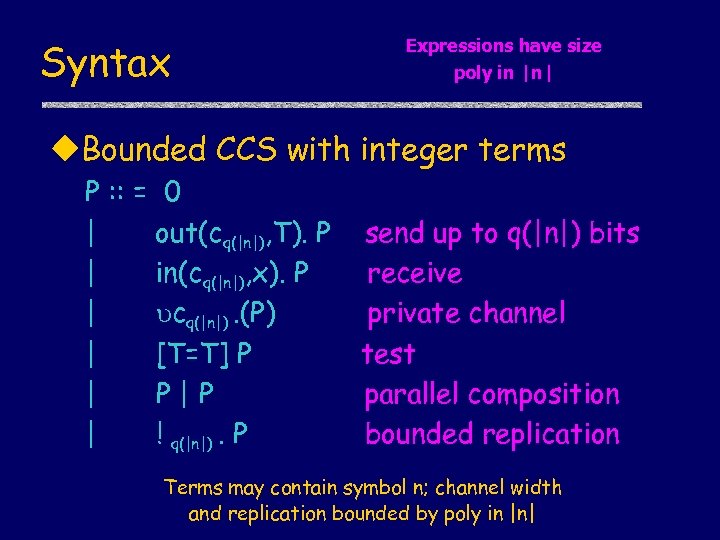
Syntax Expressions have size poly in |n| u. Bounded CCS with integer terms P : : = 0 | out(cq(|n|), T). P | in(cq(|n|), x). P | cq(|n|). (P) | [T=T] P | P|P | ! q(|n|). P send up to q(|n|) bits receive private channel test parallel composition bounded replication Terms may contain symbol n; channel width and replication bounded by poly in |n|
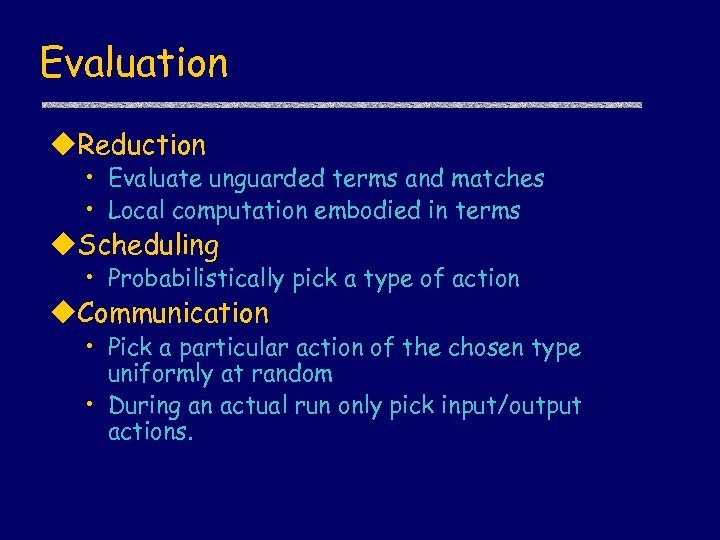
Evaluation u. Reduction • Evaluate unguarded terms and matches • Local computation embodied in terms u. Scheduling • Probabilistically pick a type of action u. Communication • Pick a particular action of the chosen type uniformly at random • During an actual run only pick input/output actions.
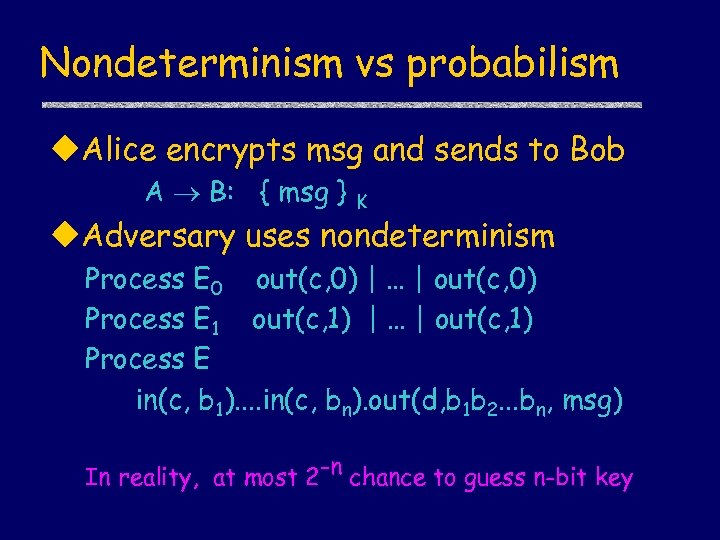
Nondeterminism vs probabilism u. Alice encrypts msg and sends to Bob A B: { msg } K u. Adversary uses nondeterminism Process E 0 out(c, 0) | … | out(c, 0) Process E 1 out(c, 1) | … | out(c, 1) Process E in(c, b 1). . in(c, bn). out(d, b 1 b 2. . . bn, msg) In reality, at most 2 -n chance to guess n-bit key
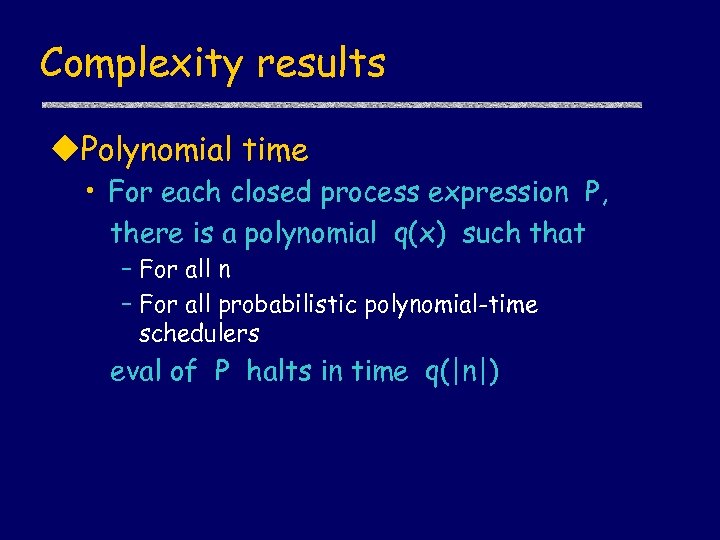
Complexity results u. Polynomial time • For each closed process expression P, there is a polynomial q(x) such that – For all n – For all probabilistic polynomial-time schedulers eval of P halts in time q(|n|)
Outline u. Security protocols u. Research goals u. Specific process calculus • • Probabilistic semantics & complexity Asymptotic equivalence & bisimulation Equational proof system Examples – Computational indistinguishability – Decision Diffie-Hellman & El. Gamal encryption
![How to define process equivalence? u. Intuition • | Prob{ C[P] o } -](https://present5.com/presentation/e3b1a81acaaec57364b349293ce320fb/image-16.jpg "How to define process equivalence? u. Intuition • | Prob{ C[P] o } -")
How to define process equivalence? u. Intuition • | Prob{ C[P] o } - Prob{ C[Q] o } | < u. Difficulty • How do we choose ? – Less than 1/2, 1/4, … ? (not equiv relation) – Vanishingly small ? As a function of what? u. Solution • Use security parameter – Protocol is family { Pn } n>0 indexed by key length • Asymptotic form of process equivalence P Q if for all polynomials p, observables < 1/p(n)
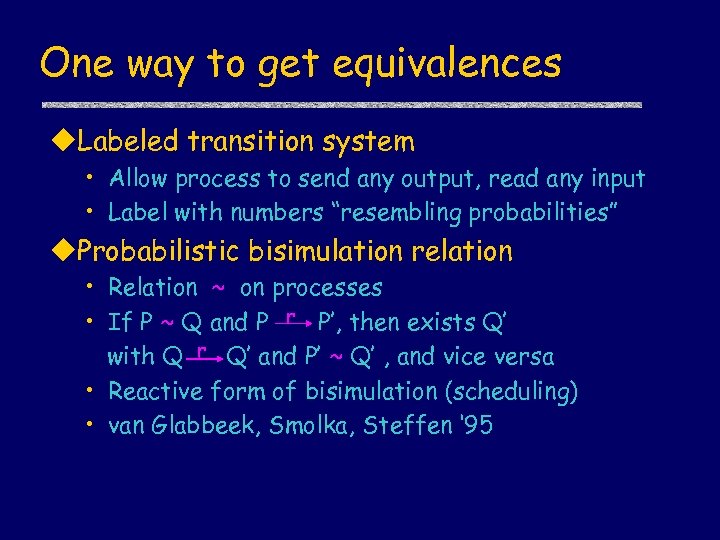
One way to get equivalences u. Labeled transition system • Allow process to send any output, read any input • Label with numbers “resembling probabilities” u. Probabilistic bisimulation relation • Relation ~ on processes • If P ~ Q and P r P’, then exists Q’ with Q r Q’ and P’ ~ Q’ , and vice versa • Reactive form of bisimulation (scheduling) • van Glabbeek, Smolka, Steffen ‘ 95
Outline u. Security protocols u. Research goals u. Specific process calculus • • Probabilistic semantics & complexity Asymptotic equivalence & bisimulation Equational proof system Examples – Computational indistinguishability – Decision Diffie-Hellman & El. Gamal encryption
![Provable equivalences • Assume scheduler is stable under bisimulation u P ~ Q C[P]](https://present5.com/presentation/e3b1a81acaaec57364b349293ce320fb/image-19.jpg "Provable equivalences • Assume scheduler is stable under bisimulation u P ~ Q C[P]")
Provable equivalences • Assume scheduler is stable under bisimulation u P ~ Q C[P] ~ C[Q] u. P~Q P Q u P | (Q | R) (P | Q) | R u. P|Q Q|P u. P|0 P
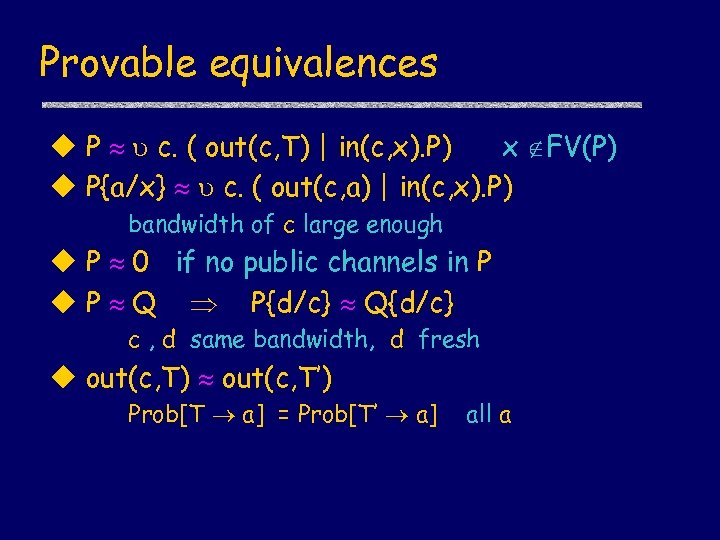
Provable equivalences u P c. ( out(c, T) | in(c, x). P) x FV(P) u P{a/x} c. ( out(c, a) | in(c, x). P) bandwidth of c large enough u P 0 if no public channels in P u P Q P{d/c} Q{d/c} c , d same bandwidth, d fresh u out(c, T) out(c, T’) Prob[T a] = Prob[T’ a] all a
Outline u. Security protocols u. Research goals u. Specific process calculus • • Probabilistic semantics & complexity Asymptotic equivalence & bisimulation Equational proof system Examples – Computational indistinguishability – Decision Diffie-Hellman & El. Gamal encryption
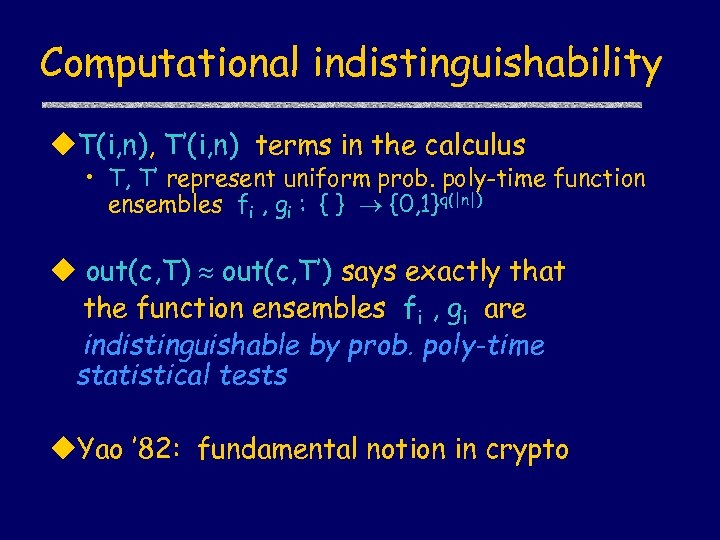
Computational indistinguishability u. T(i, n), T’(i, n) terms in the calculus • T, T’ represent uniform prob. poly-time function ensembles fi , gi : { } {0, 1}q(|n|) u out(c, T) out(c, T’) says exactly that the function ensembles fi , gi are indistinguishable by prob. poly-time statistical tests u. Yao ’ 82: fundamental notion in crypto
Outline u. Security protocols u. Research goals u. Specific process calculus • • Probabilistic semantics & complexity Asymptotic equivalence & bisimulation Equational proof system Examples – Computational indistinguishability – Decision Diffie-Hellman & El. Gamal encryption
Connections with modern crypto u. Ciphersystem consists of three parts • • Key generation Encryption (often probabilistic) Decryption Formal derivation of semantic security of El. Gamal from DDH and vice versa – Well known fact in crypto [Tsiounis & Yung ’ 98]
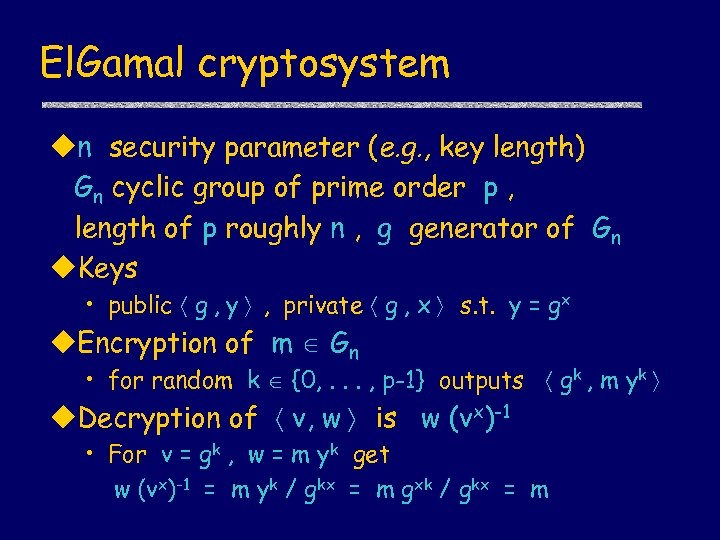
El. Gamal cryptosystem un security parameter (e. g. , key length) Gn cyclic group of prime order p , length of p roughly n , g generator of Gn u. Keys • public g , y , private g , x s. t. y = gx u. Encryption of m Gn • for random k {0, . . . , p-1} outputs gk , m yk u. Decryption of v, w is w (vx)-1 • For v = gk , w = m yk get w (vx)-1 = m yk / gkx = m gxk / gkx = m
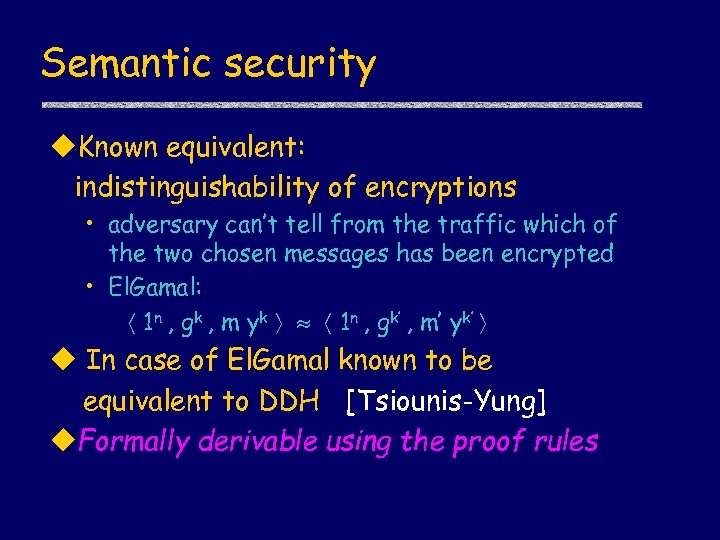
Semantic security u. Known equivalent: indistinguishability of encryptions • adversary can’t tell from the traffic which of the two chosen messages has been encrypted • El. Gamal: 1 n , gk , m yk 1 n , gk’ , m’ yk’ u In case of El. Gamal known to be equivalent to DDH [Tsiounis-Yung] u. Formally derivable using the proof rules
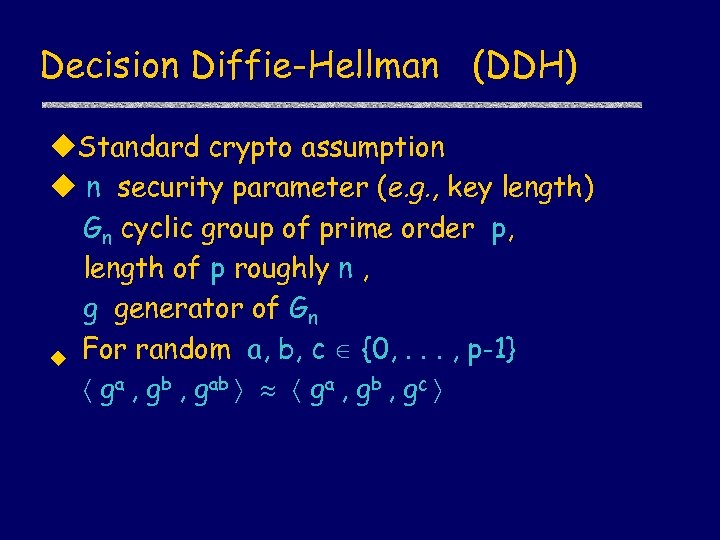
Decision Diffie-Hellman (DDH) u. Standard crypto assumption u n security parameter (e. g. , key length) Gn cyclic group of prime order p, length of p roughly n , g generator of Gn u For random a, b, c {0, . . . , p-1} ga , gb , gab ga , gb , gc
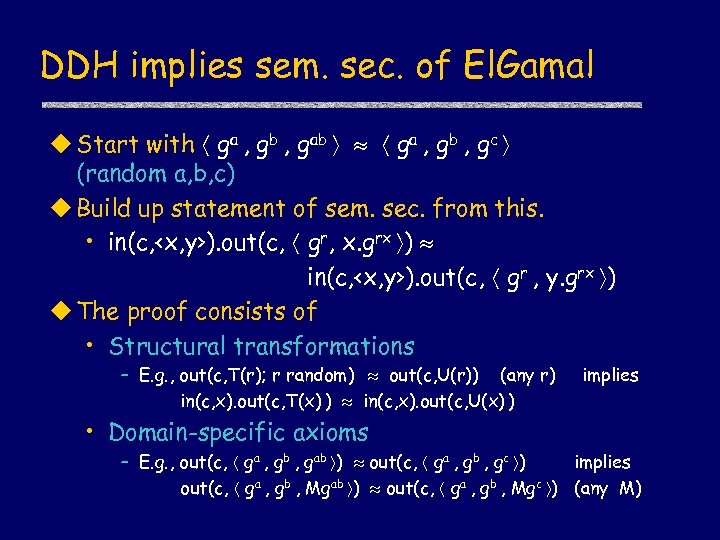
DDH implies sem. sec. of El. Gamal u Start with ga , gb , gab ga , gb , gc (random a, b, c) u Build up statement of sem. sec. from this. • in(c, <x, y>). out(c, gr, x. grx ) in(c, <x, y>). out(c, gr , y. grx ) u The proof consists of • Structural transformations – E. g. , out(c, T(r); r random) out(c, U(r)) (any r) in(c, x). out(c, T(x) ) in(c, x). out(c, U(x) ) • Domain-specific axioms implies – E. g. , out(c, ga , gb , gab ) out(c, ga , gb , gc ) implies out(c, ga , gb , Mgab ) out(c, ga , gb , Mgc ) (any M)
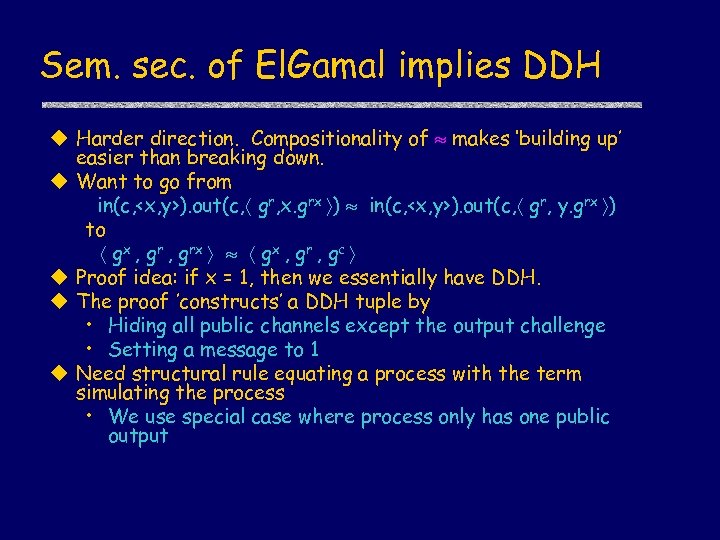
Sem. sec. of El. Gamal implies DDH u Harder direction. Compositionality of makes ‘building up’ easier than breaking down. u Want to go from in(c, <x, y>). out(c, gr, x. grx ) in(c, <x, y>). out(c, gr, y. grx ) to gx , grx gx , gr , gc u Proof idea: if x = 1, then we essentially have DDH. u The proof ’constructs’ a DDH tuple by • Hiding all public channels except the output challenge • Setting a message to 1 u Need structural rule equating a process with the term simulating the process • We use special case where process only has one public output
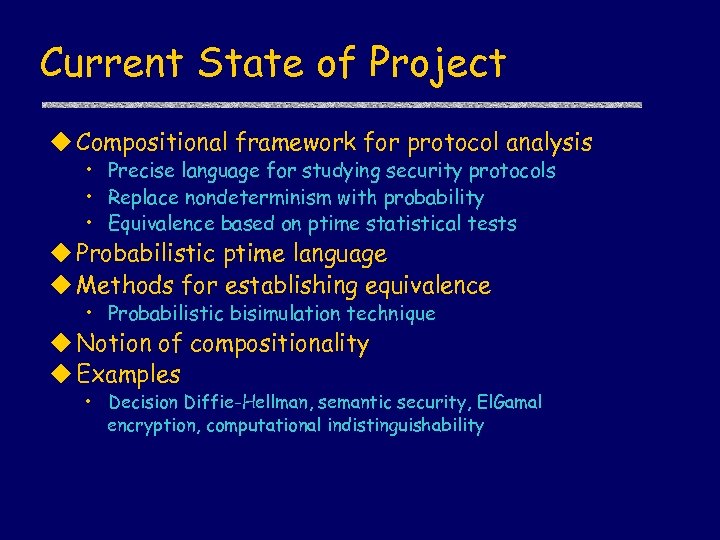
Current State of Project u Compositional framework for protocol analysis • Precise language for studying security protocols • Replace nondeterminism with probability • Equivalence based on ptime statistical tests u Probabilistic ptime language u Methods for establishing equivalence • Probabilistic bisimulation technique u Notion of compositionality u Examples • Decision Diffie-Hellman, semantic security, El. Gamal encryption, computational indistinguishability
Conclusion u. Future work • Simplify semantics • Weaken bisimulation technique to generate asymptotic equivalences • Apply to more complex protocols – Bellare-Rogaway, Oblivious Transfer, Computational Zero Knowledge, … • Studying various models of compositionality for security protocols (WITS ‘ 04) – Canetti (ITMs), Pfitzmann-Waidner (IOAs)
Probabilistic Polynomial-Time Process Calculus for Security Protocol Analysis J. Mitchell, A. Ramanathan, A. Scedrov, V. Teague Partially supported by ONR CIP/SW URI
Скачать презентацию Probabilistic Polynomial-Time Process Calculus for Security Protocol Analysis
e3b1a81acaaec57364b349293ce320fb.ppt