


 Скачать презентацию Proactive vs Reactive Latency of route discovery
Lecture_8_Ad_Hoc_routing.ppt
- Количество слайдов: 43
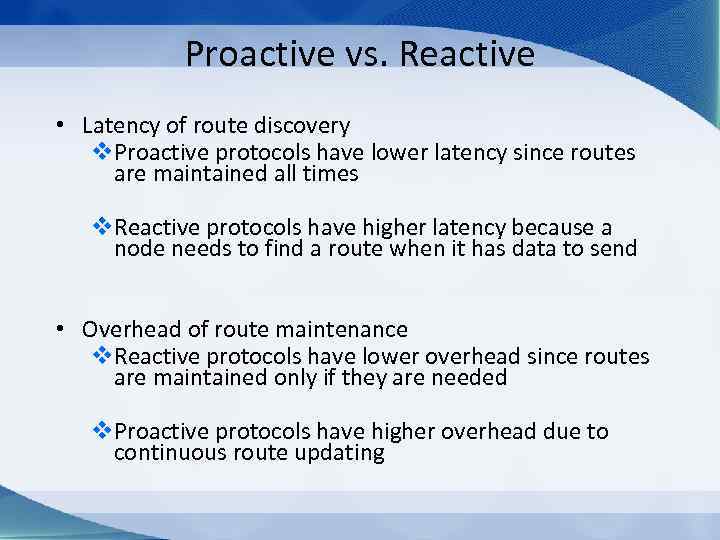 Proactive vs. Reactive • Latency of route discovery v. Proactive protocols have lower latency since routes are maintained all times v. Reactive protocols have higher latency because a node needs to find a route when it has data to send • Overhead of route maintenance v. Reactive protocols have lower overhead since routes are maintained only if they are needed v. Proactive protocols have higher overhead due to continuous route updating
 Reactive Protocols • Dynamic Source Routing (DSR) • Ad Hoc On-Demand Distance Vector (AODV) • Temporally Ordered Routing Algorithm(TORA)
![Dynamic Source Routing (DSR) DATA[S, E, F, J, D] Y S B A E](https://present5.com/presentation/72553422_270706915/image-3.jpg "Dynamic Source Routing (DSR) DATA[S, E, F, J, D] Y S B A E") Dynamic Source Routing (DSR) DATA[S, E, F, J, D] Y S B A E Z F C J G H I M K L D N • When S sends a data packet to D, the entire route is included in the packet header • Intermediate nodes use the source route embedded in the packet’s header to determine to whom the packet should be forwarded
Dynamic Source Routing (DSR) DATA[S, E, F, J, D] Y S B A E Z F C J G H I M K L D N • When S sends a data packet to D, the entire route is included in the packet header • Intermediate nodes use the source route embedded in the packet’s header to determine to whom the packet should be forwarded
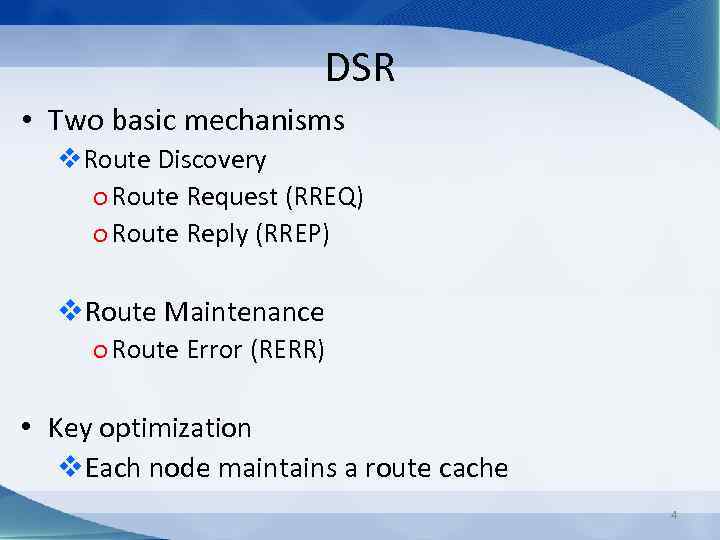 DSR • Two basic mechanisms v. Route Discovery o Route Request (RREQ) o Route Reply (RREP) v. Route Maintenance o Route Error (RERR) • Key optimization v. Each node maintains a route cache 4
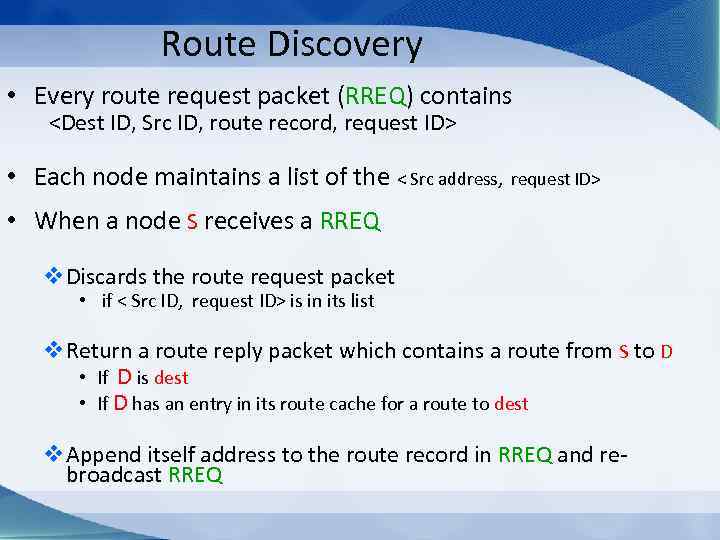 Route Discovery • Every route request packet (RREQ) contains
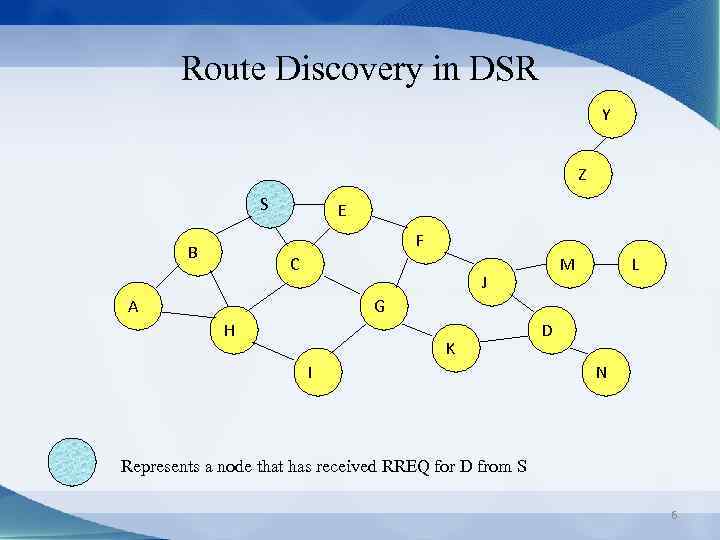 Route Discovery in DSR Y Z S E F B C M J A L G H K I D N Represents a node that has received RREQ for D from S 6
![Route Discovery in DSR Y Broadcast [S] S Z E F B C M](https://present5.com/presentation/72553422_270706915/image-7.jpg "Route Discovery in DSR Y Broadcast [S] S Z E F B C M") Route Discovery in DSR Y Broadcast [S] S Z E F B C M J A L G H K I D N Represents transmission of RREQ [X, Y] Represents route record stored in RREQ 7
Route Discovery in DSR Y Broadcast [S] S Z E F B C M J A L G H K I D N Represents transmission of RREQ [X, Y] Represents route record stored in RREQ 7
![Route Discovery in DSR Y Z S [S, B] E [S, E] F B](https://present5.com/presentation/72553422_270706915/image-8.jpg "Route Discovery in DSR Y Z S [S, B] E [S, E] F B") Route Discovery in DSR Y Z S [S, B] E [S, E] F B C A M J [S, C] H L G K I D N • Node H receives packet RREQ from two neighbors: potential for collision 8
Route Discovery in DSR Y Z S [S, B] E [S, E] F B C A M J [S, C] H L G K I D N • Node H receives packet RREQ from two neighbors: potential for collision 8
![Route Discovery in DSR Y Z S [S, B, A] E F B C](https://present5.com/presentation/72553422_270706915/image-9.jpg "Route Discovery in DSR Y Z S [S, B, A] E F B C") Route Discovery in DSR Y Z S [S, B, A] E F B C A H M J [S, B, H] I • [S, E, F] L G [S, C, G] K D N C receives RREQ from G and H, but does not forward it again, because C has already forwarded RREQ once 9
Route Discovery in DSR Y Z S [S, B, A] E F B C A H M J [S, B, H] I • [S, E, F] L G [S, C, G] K D N C receives RREQ from G and H, but does not forward it again, because C has already forwarded RREQ once 9
![Route Discovery in DSR Y Z S E [S, E, F, J] F B](https://present5.com/presentation/72553422_270706915/image-10.jpg "Route Discovery in DSR Y Z S E [S, E, F, J] F B") Route Discovery in DSR Y Z S E [S, E, F, J] F B C A H M J [S, B, H, I] G K I L D [S, C, G, K] N J and K both broadcast RREQ to D Their transmissions may collide at D 10
Route Discovery in DSR Y Z S E [S, E, F, J] F B C A H M J [S, B, H, I] G K I L D [S, C, G, K] N J and K both broadcast RREQ to D Their transmissions may collide at D 10
![Route Discovery in DSR Y Z S E [S, E, F, J, M] F](https://present5.com/presentation/72553422_270706915/image-11.jpg "Route Discovery in DSR Y Z S E [S, E, F, J, M] F") Route Discovery in DSR Y Z S E [S, E, F, J, M] F B C M J A L G H K I D N D does not forward RREQ, because D is the intended target 11
Route Discovery in DSR Y Z S E [S, E, F, J, M] F B C M J A L G H K I D N D does not forward RREQ, because D is the intended target 11
 Route Reply in DSR • Destination D on receiving the first RREQ, sends a Route Reply (RREP) • RREP includes the route from S to D • Route Reply can be sent by reversing the route in Route Request (RREQ) o. If links are bi-directional 12
![Route Reply in DSR Y S E Z RREP [S, E, F, J, D]](https://present5.com/presentation/72553422_270706915/image-13.jpg "Route Reply in DSR Y S E Z RREP [S, E, F, J, D]") Route Reply in DSR Y S E Z RREP [S, E, F, J, D] F B C M J A L G H K I D N Represents RREP control message 13
Route Reply in DSR Y S E Z RREP [S, E, F, J, D] F B C M J A L G H K I D N Represents RREP control message 13
![An Example of Route Maintenance Y Route Error Packet : RERR [J-D] S Z](https://present5.com/presentation/72553422_270706915/image-14.jpg "An Example of Route Maintenance Y Route Error Packet : RERR [J-D] S Z") An Example of Route Maintenance Y Route Error Packet : RERR [J-D] S Z E F B C M J A L G H K I D N J sends a route error to S along route J-F-E-S when it finds link [J-D] broken Nodes hearing RERR update their route cache to remove all invalid routes related with link J-D 14
An Example of Route Maintenance Y Route Error Packet : RERR [J-D] S Z E F B C M J A L G H K I D N J sends a route error to S along route J-F-E-S when it finds link [J-D] broken Nodes hearing RERR update their route cache to remove all invalid routes related with link J-D 14
![Use of Route Caching Can Speed up Route Discovery [S, E, F, J, D]](https://present5.com/presentation/72553422_270706915/image-15.jpg "Use of Route Caching Can Speed up Route Discovery [S, E, F, J, D]") Use of Route Caching Can Speed up Route Discovery [S, E, F, J, D] [E, F, J, D] S [F, J, D], [F, E, S] E F B C [G, C, S] [C, S] A [J, F, E, S] M J L G H I [K, G, C, S] K RREQ D RREP N Z When node Z sends a route request for node C, node K sends back a route reply [Z, K, G, C] to node Z using a locally cached route 15
Use of Route Caching Can Speed up Route Discovery [S, E, F, J, D] [E, F, J, D] S [F, J, D], [F, E, S] E F B C [G, C, S] [C, S] A [J, F, E, S] M J L G H I [K, G, C, S] K RREQ D RREP N Z When node Z sends a route request for node C, node K sends back a route reply [Z, K, G, C] to node Z using a locally cached route 15
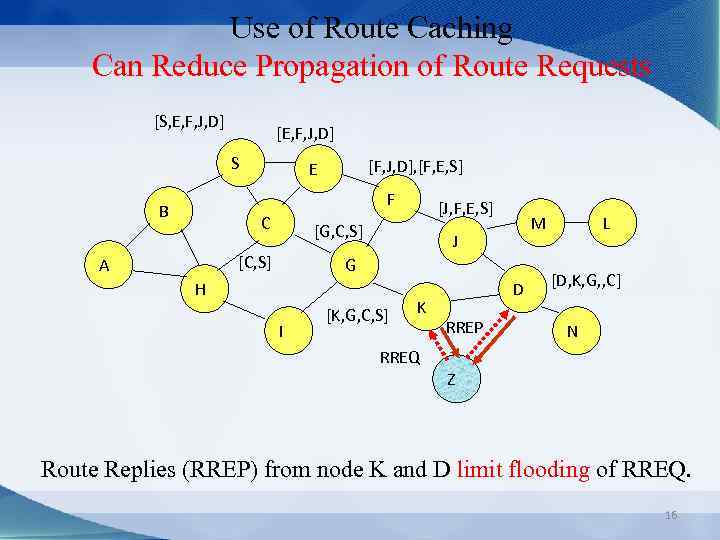 Use of Route Caching Can Reduce Propagation of Route Requests [S, E, F, J, D] [E, F, J, D] S [F, J, D], [F, E, S] E F B C [G, C, S] [C, S] A [J, F, E, S] M J G H I [K, G, C, S] K RREQ D RREP L [D, K, G, , C] N Z Route Replies (RREP) from node K and D limit flooding of RREQ. 16
 DSR • The diameter of an ad-hoc network will not be too larger v. Packet header will be bigger than payload if route is very longer 17
 Ad Hoc On-Demand Distance Vector Routing (AODV) Protocol • The Ad hoc On-Demand Distance Vector protocol is both an on-demand a tabledriven protocol. • The packet size in AODV is uniform unlike DSR. Unlike DSDV, there is no need for system-wide broadcasts due to local changes.
 AODV • Each route has a lifetime after which the route expires if it is not used. • A route is maintained only when it is used and hence old and expired routes are never used. 19
 AODV • DSR includes source routes in packet headers • Resulting large headers can sometimes degrade performance. • AODV attempts to improve on DSR by maintaining routing tables at the nodes, so that data packets do not have to contain routes. • AODV retains the desirable feature of DSR that routes are maintained only between nodes which need to communicate. 20
 AODV • Like DSR, this protocols uses two types of messages, route request (RREQ) and route reply (RREP). • Like DSDV, we use sequence numbers to keep track of recent routes. Every time a node sends a new message, it uses a new sequence number which increases monotonically. 21
 Route Request (RREQ) Message • When node S wants to send a message to node D, S searches its route table for a route to D. • If there is no route, S initiates a RREQ message with the following components : – The IP addresses of S and D – The current sequence number of S and the last known sequence number of D – A broadcast ID from S. This broadcast ID is incremented each time S sends a RREQ message. 22
 Processing a RREQ Message • The
 Processing a RREQ Message • If P has seen this RREQ from S already, P discards the RREQ. Otherwise, P processes the RREQ : – P sets up a reverse route entry in its route table for the source S. – This entry contains the IP address and current sequence number of S, number of hops to S and the address of the neighbour from whom P got the RREQ. 24
 Lifetime of a Route-Table Entry • A lifetime is associated with the entry in the route table. • This is an important feature of AODV. If a route entry is not used within the specified lifetime, it is deleted. • A route is maintained only when it is used. A route that is unused for a long time is assumed to be stale. 25
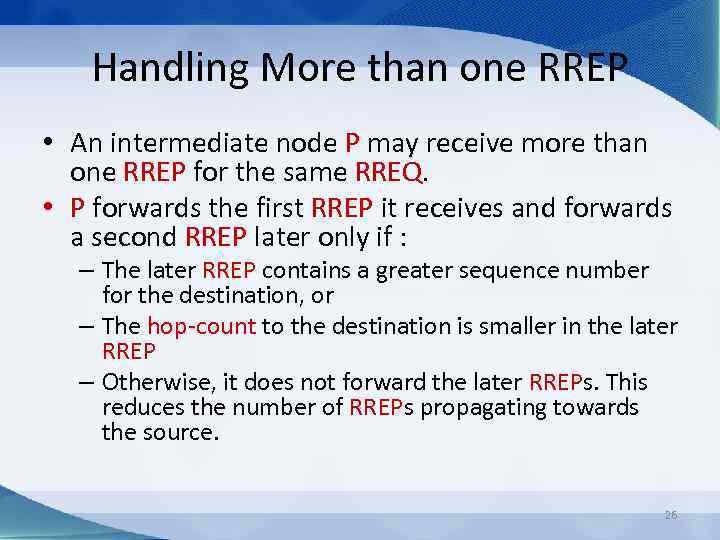 Handling More than one RREP • An intermediate node P may receive more than one RREP for the same RREQ. • P forwards the first RREP it receives and forwards a second RREP later only if : – The later RREP contains a greater sequence number for the destination, or – The hop-count to the destination is smaller in the later RREP – Otherwise, it does not forward the later RREPs. This reduces the number of RREPs propagating towards the source. 26
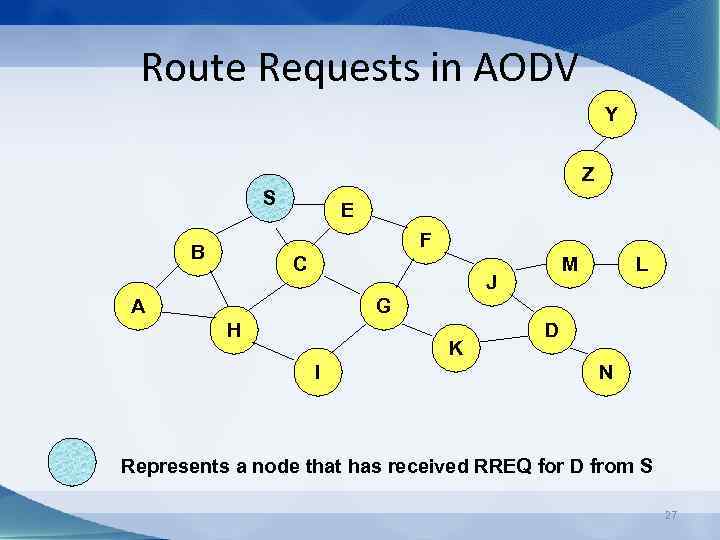 Route Requests in AODV Y Z S E F B C M J A L G H K I D N Represents a node that has received RREQ for D from S 27
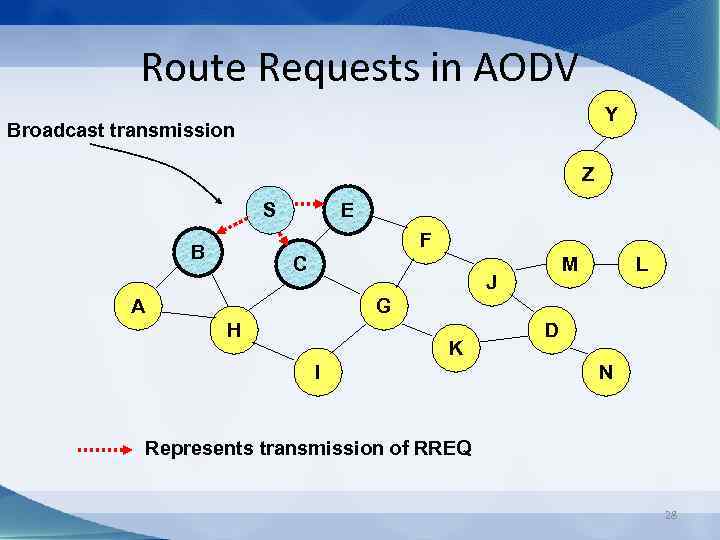 Route Requests in AODV Y Broadcast transmission Z S E F B C M J A L G H K I D N Represents transmission of RREQ 28
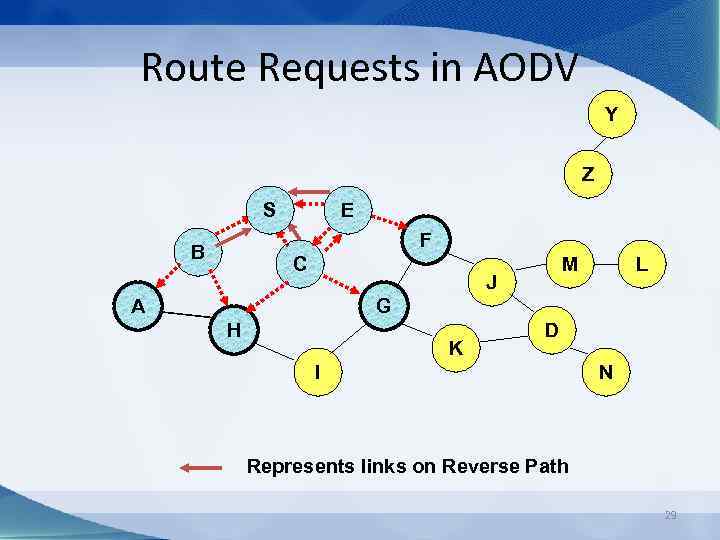 Route Requests in AODV Y Z S E F B C M J A L G H K D I N Represents links on Reverse Path 29
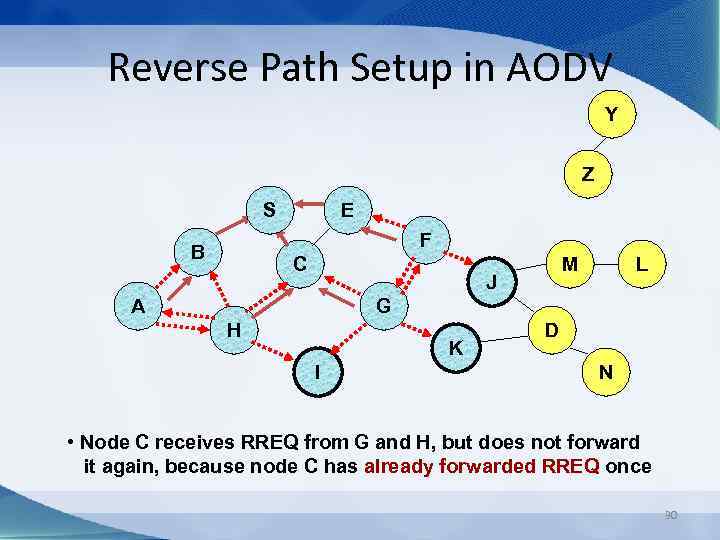 Reverse Path Setup in AODV Y Z S E F B C M J A L G H K I D N • Node C receives RREQ from G and H, but does not forward it again, because node C has already forwarded RREQ once 30
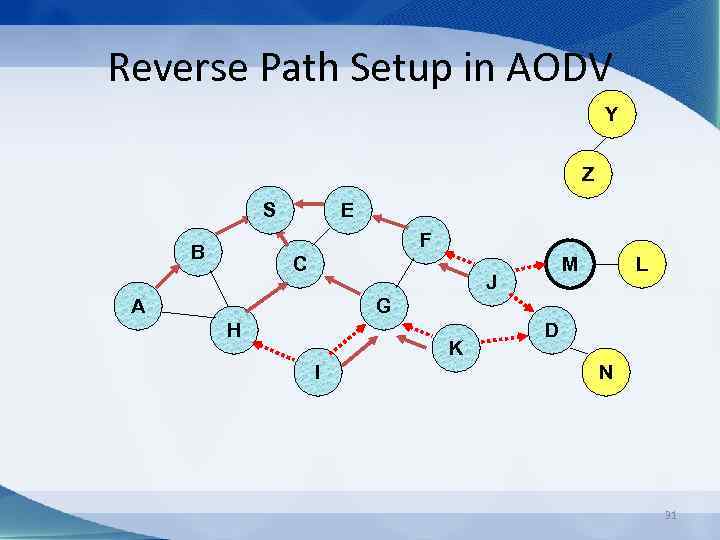 Reverse Path Setup in AODV Y Z S E F B C M J A L G H K I D N 31
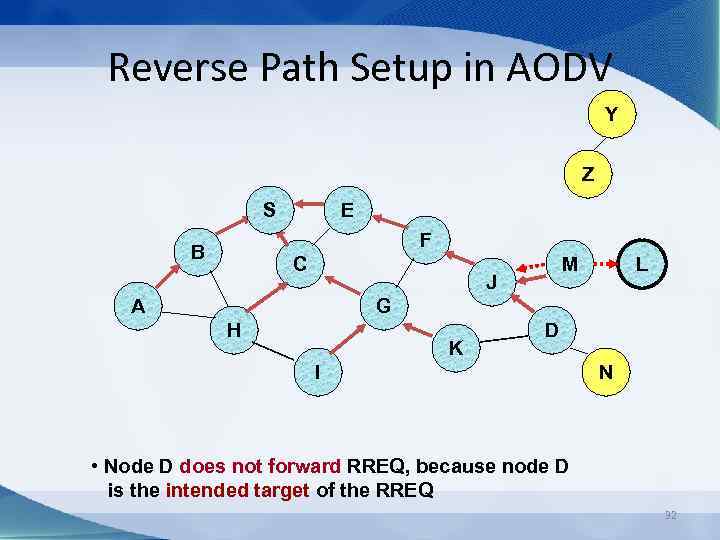 Reverse Path Setup in AODV Y Z S E F B C M J A L G H K D I N • Node D does not forward RREQ, because node D is the intended target of the RREQ 32
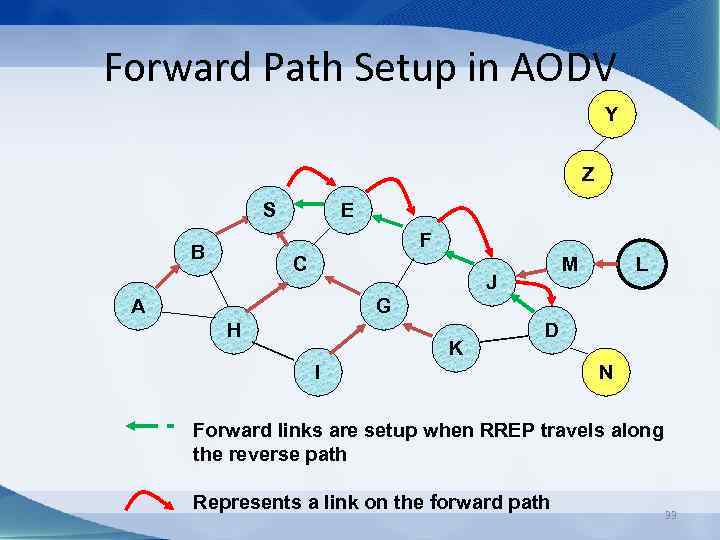 Forward Path Setup in AODV Y Z S E F B C M J A L G H K D I N Forward links are setup when RREP travels along the reverse path Represents a link on the forward path 33
 Route Maintenance • Once a unicast route has been established between two nodes S and D, it is maintained as long as S (source node) needs the route. • If S moves during an active session, it can reinitiate route discovery to establish a new route to D. • When D or an intermediate node moves, a route error (RERR) message is sent to S. 34
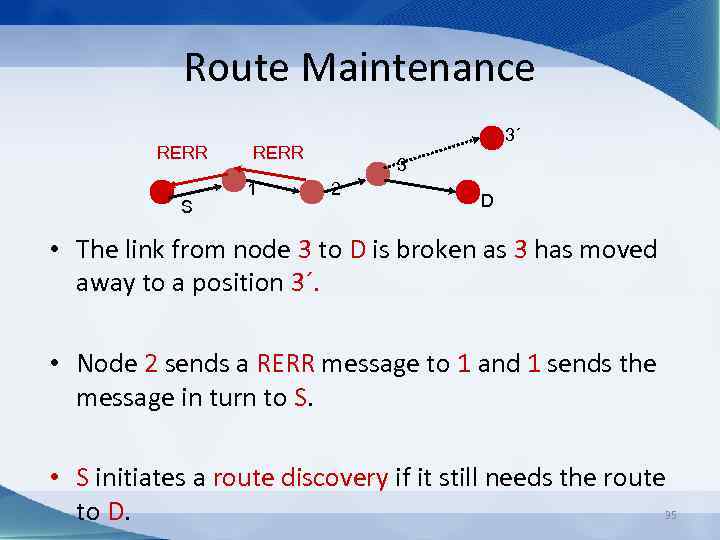 Route Maintenance RERR S 3´ RERR 1 3 2 D • The link from node 3 to D is broken as 3 has moved away to a position 3´. • Node 2 sends a RERR message to 1 and 1 sends the message in turn to S. • S initiates a route discovery if it still needs the route 35 to D.
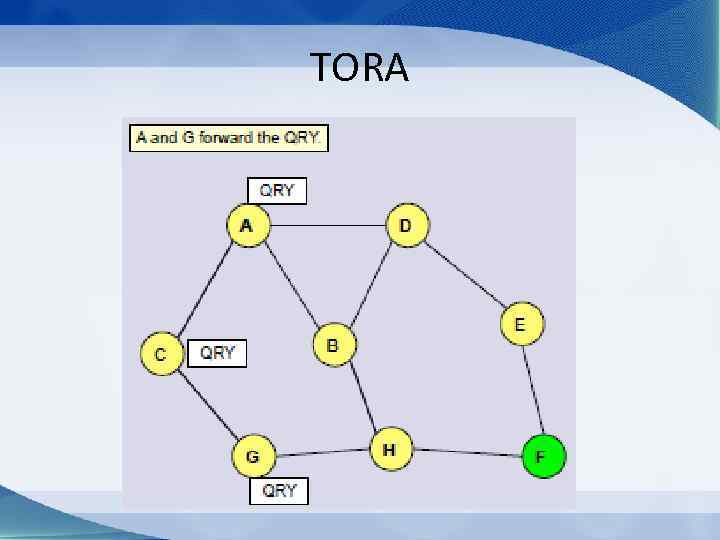
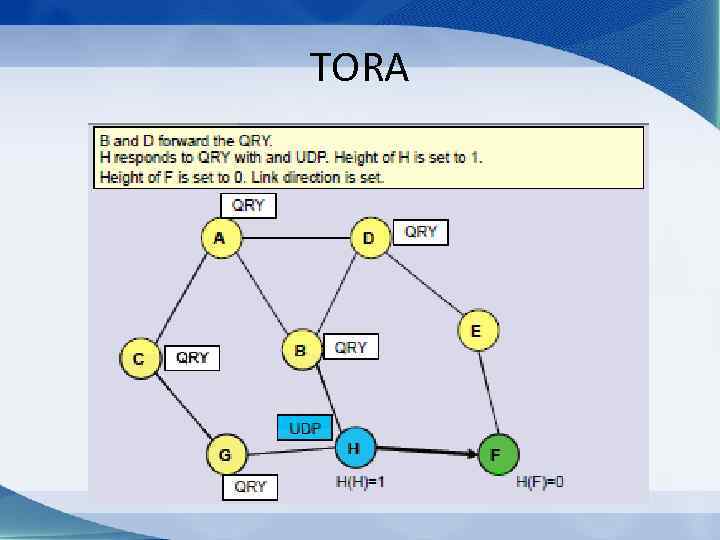
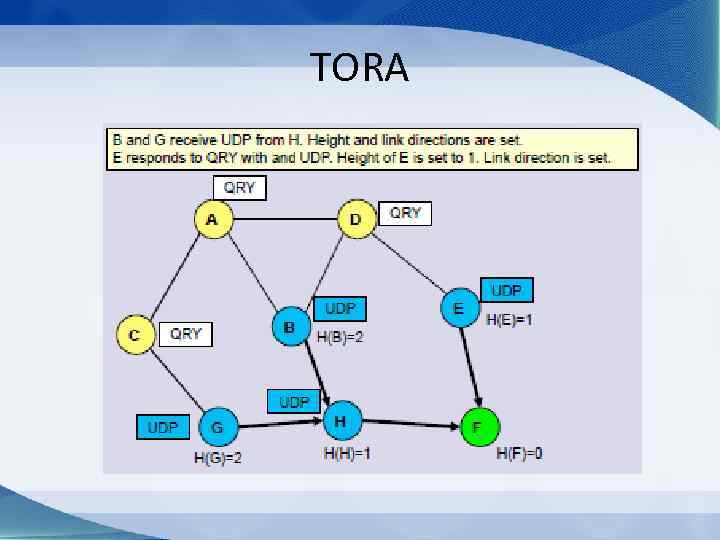
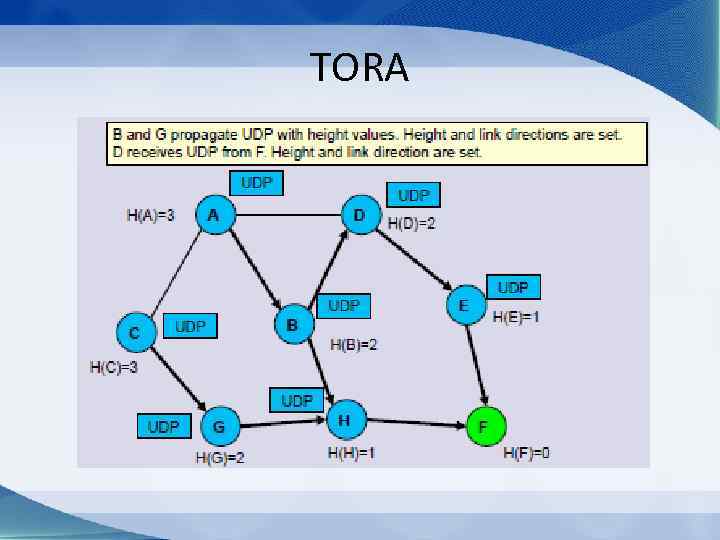
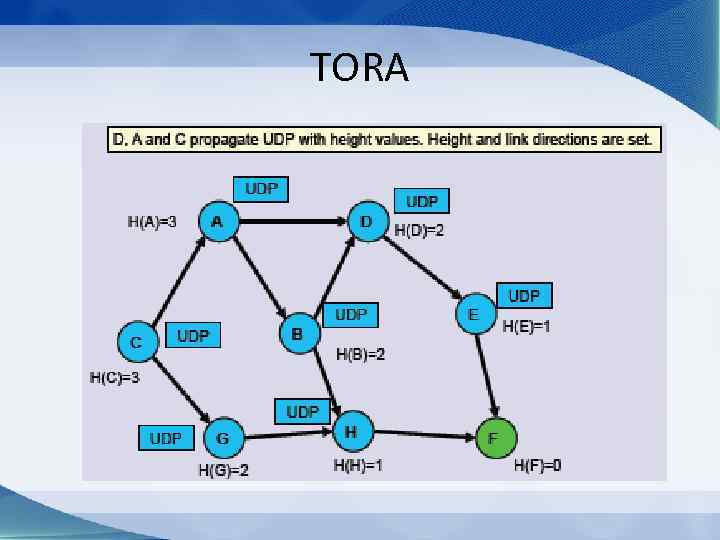
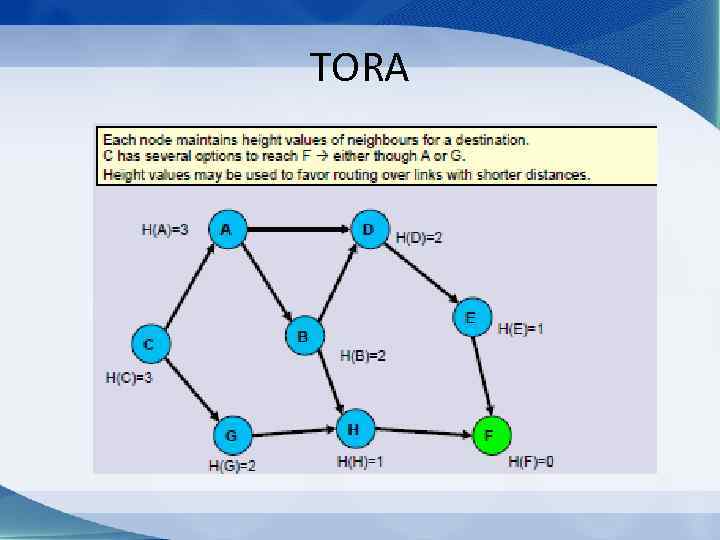
 Temporally Ordered Routing Algorithm(TORA) • Based on a destination oriented Directed Acyclic Graph (DAG) • The protocol has three basic functions : – Route creation (QRY) – Route maintenance (UPD) – Route erasure (CLR)
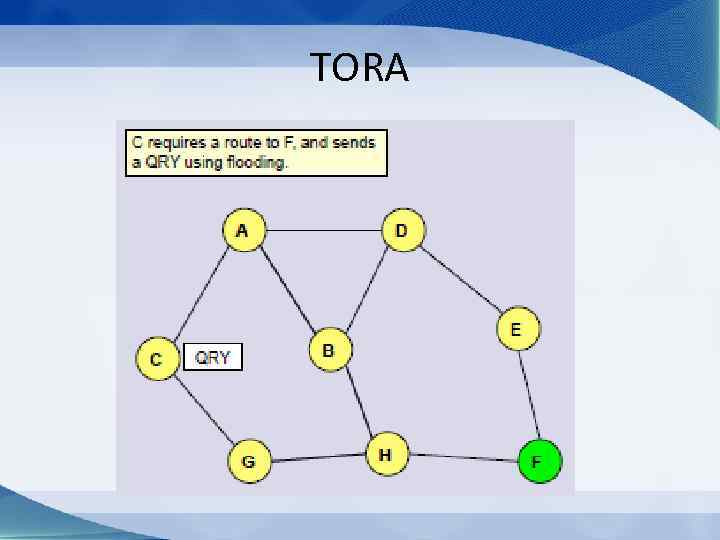 TORA
TORA
 TORA
TORA
 TORA
TORA
 TORA
TORA
 TORA
TORA
 TORA
TORA
 TORA
TORA