


 Скачать презентацию Proactive Password Checking Analyze proposed password for
a358f2fc186a7203db06cc5c3d58944f.ppt
- Количество слайдов: 41
 Proactive Password Checking • Analyze proposed password for “goodness” – Always invoked – Can detect, reject bad passwords for an appropriate definition of “bad” – Discriminate on per-user, per-site basis – Needs to do pattern matching on words – Needs to execute subprograms and use results • Spell checker, for example – Easy to set up and integrate into password selection system May 20, 2004 ECS 235 1
 Example: OPUS • Goal: check passwords against large dictionaries quickly – Run each word of dictionary through k different hash functions h 1, …, hk producing values less than n – Set bits h 1, …, hk in OPUS dictionary – To check new proposed word, generate bit vector and see if all corresponding bits set • If so, word is in one of the dictionaries to some degree of probability • If not, it is not in the dictionaries May 20, 2004 ECS 235 2
 Example: passwd+ • Provides little language to describe proactive checking – test length(“$p”) < 6 • If password under 6 characters, reject it – test infile(“/usr/dict/words”, “$p”) • If password in file /usr/dict/words, reject it – test !inprog(“spell”, “$p”) • If password not in the output from program spell, given the password as input, reject it (because it’s a properly spelled word) May 20, 2004 ECS 235 3
 Salting • Goal: slow dictionary attacks • Method: perturb hash function so that: – Parameter controls which hash function is used – Parameter differs for each password – So given n password hashes, and therefore n salts, need to hash guess n May 20, 2004 ECS 235 4
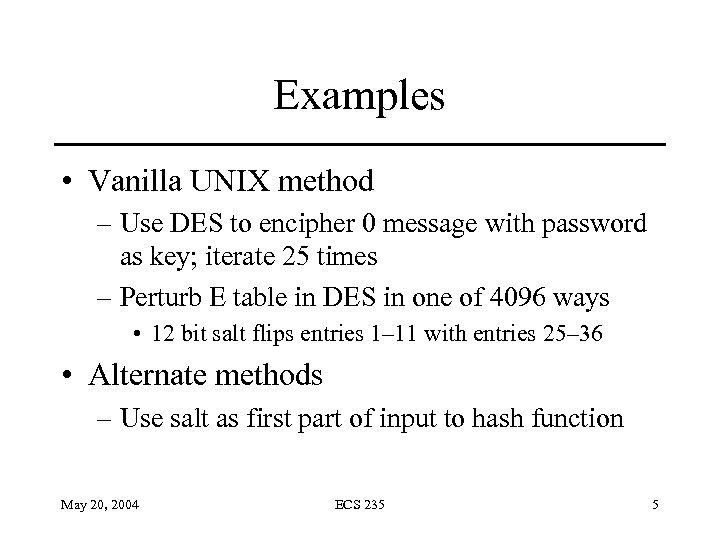 Examples • Vanilla UNIX method – Use DES to encipher 0 message with password as key; iterate 25 times – Perturb E table in DES in one of 4096 ways • 12 bit salt flips entries 1– 11 with entries 25– 36 • Alternate methods – Use salt as first part of input to hash function May 20, 2004 ECS 235 5
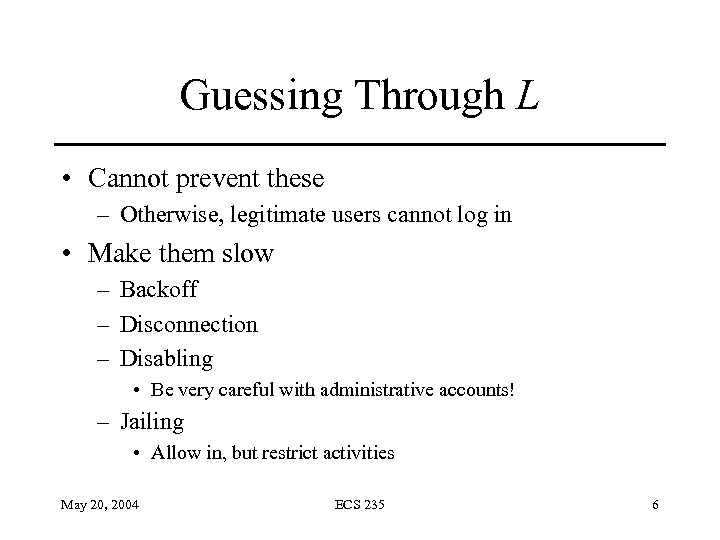 Guessing Through L • Cannot prevent these – Otherwise, legitimate users cannot log in • Make them slow – Backoff – Disconnection – Disabling • Be very careful with administrative accounts! – Jailing • Allow in, but restrict activities May 20, 2004 ECS 235 6
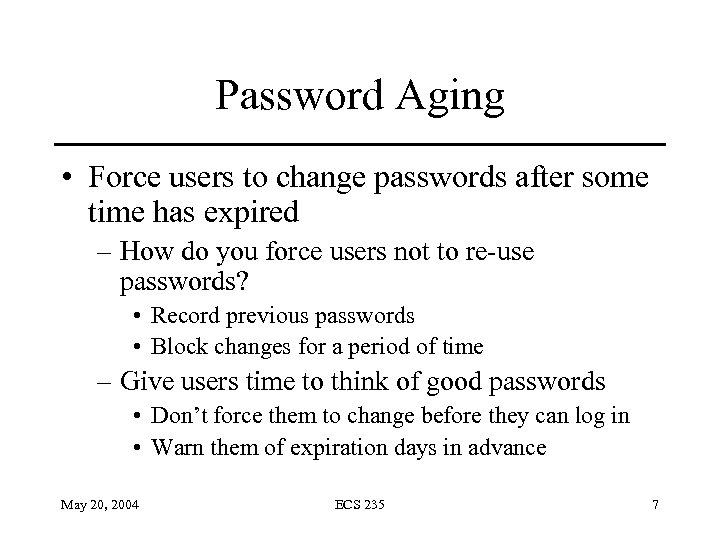 Password Aging • Force users to change passwords after some time has expired – How do you force users not to re-use passwords? • Record previous passwords • Block changes for a period of time – Give users time to think of good passwords • Don’t force them to change before they can log in • Warn them of expiration days in advance May 20, 2004 ECS 235 7
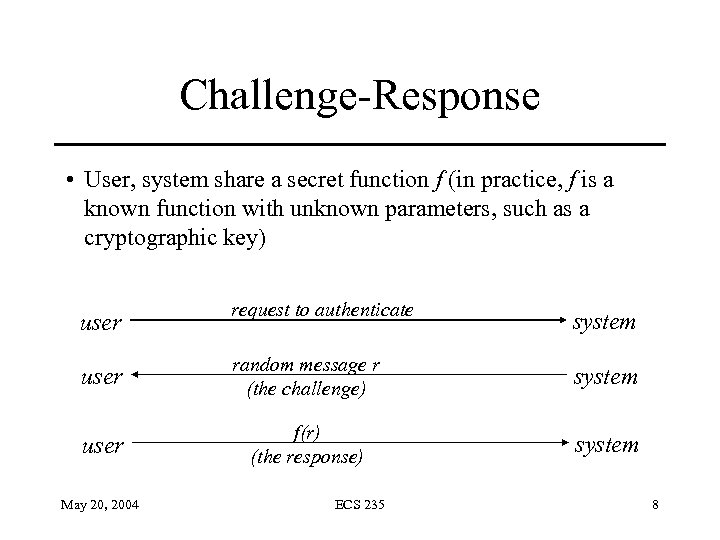 Challenge-Response • User, system share a secret function f (in practice, f is a known function with unknown parameters, such as a cryptographic key) request to authenticate system user random message r (the challenge) system user f(r) (the response) system user May 20, 2004 ECS 235 8
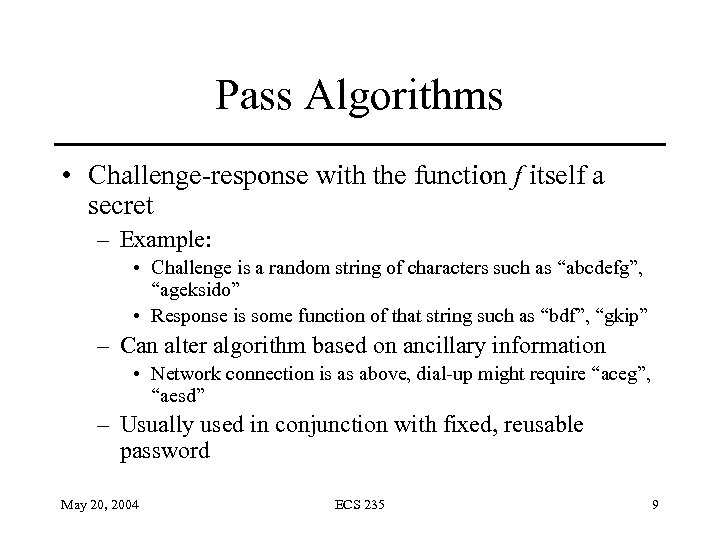 Pass Algorithms • Challenge-response with the function f itself a secret – Example: • Challenge is a random string of characters such as “abcdefg”, “ageksido” • Response is some function of that string such as “bdf”, “gkip” – Can alter algorithm based on ancillary information • Network connection is as above, dial-up might require “aceg”, “aesd” – Usually used in conjunction with fixed, reusable password May 20, 2004 ECS 235 9
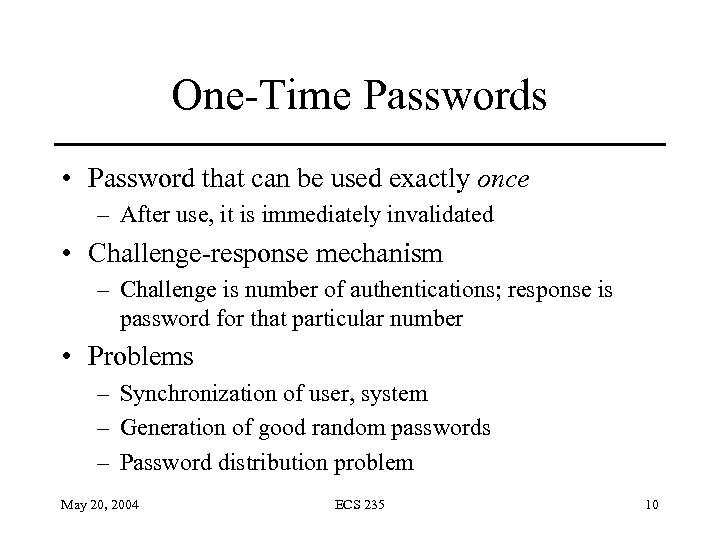 One-Time Passwords • Password that can be used exactly once – After use, it is immediately invalidated • Challenge-response mechanism – Challenge is number of authentications; response is password for that particular number • Problems – Synchronization of user, system – Generation of good random passwords – Password distribution problem May 20, 2004 ECS 235 10
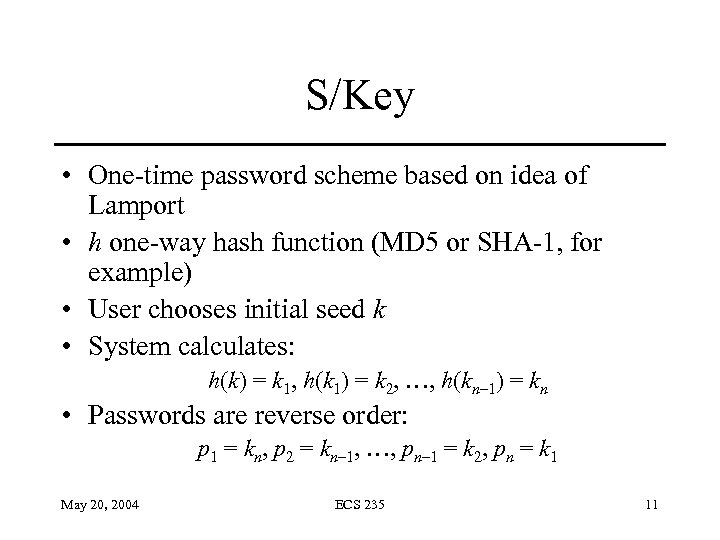 S/Key • One-time password scheme based on idea of Lamport • h one-way hash function (MD 5 or SHA-1, for example) • User chooses initial seed k • System calculates: h(k) = k 1, h(k 1) = k 2, …, h(kn– 1) = kn • Passwords are reverse order: p 1 = kn, p 2 = kn– 1, …, pn– 1 = k 2, pn = k 1 May 20, 2004 ECS 235 11
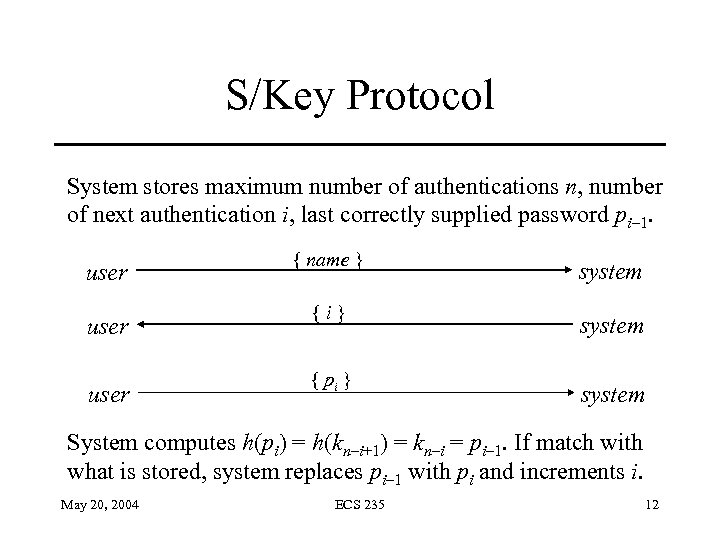 S/Key Protocol System stores maximum number of authentications n, number of next authentication i, last correctly supplied password pi– 1. user { name } {i} { pi } system System computes h(pi) = h(kn–i+1) = kn–i = pi– 1. If match with what is stored, system replaces pi– 1 with pi and increments i. May 20, 2004 ECS 235 12
 Hardware Support • Token-based – Used to compute response to challenge • May encipher or hash challenge • May require PIN from user • Temporally-based – Every minute (or so) different number shown • Computer knows what number to expect when – User enters number and fixed password May 20, 2004 ECS 235 13
 C-R and Dictionary Attacks • Same as for fixed passwords – Attacker knows challenge r and response f(r); if f encryption function, can try different keys • May only need to know form of response; attacker can tell if guess correct by looking to see if deciphered object is of right form • Example: Kerberos Version 4 used DES, but keys had 20 bits of randomness; Purdue attackers guessed keys quickly because deciphered tickets had a fixed set of bits in some locations May 20, 2004 ECS 235 14
 Encrypted Key Exchange • Defeats off-line dictionary attacks • Idea: random challenges enciphered, so attacker cannot verify correct decipherment of challenge • Assume Alice, Bob share secret password s • In what follows, Alice needs to generate a random public key p and a corresponding private key q • Also, k is a randomly generated session key, and RA and RB are random challenges May 20, 2004 ECS 235 15
 EKE Protocol { Alice || Es(p) } Alice {Es(Ep(k)) } Alice Bob Now Alice, Bob share a randomly generated secret session key k Alice May 20, 2004 { Ek(RA) } {Ek(RARB) } { Ek(RB) } ECS 235 Bob Bob 16
 Biometrics • Automated measurement of biological, behavioral features that identify a person – Fingerprints, voices, eyes, faces – Keystrokes, timing intervals between commands – Combinations • Cautions: can be fooled! – Assumes biometric device accurate in the environment it is being used in! – Transmission of data to validator is tamperproof, correct May 20, 2004 ECS 235 17
 Location • If you know where user is, validate identity by seeing if person is where the user is – Requires special-purpose hardware to locate user • GPS (global positioning system) device gives location signature of entity • Host uses LSS (location signature sensor) to get signature for entity May 20, 2004 ECS 235 18
 Multiple Methods • Example: “where you are” also requires entity to have LSS and GPS, so also “what you have” • Can assign different methods to different tasks – As users perform more and more sensitive tasks, must authenticate in more and more ways (presumably, more stringently) File describes authentication required • Also includes controls on access (time of day, etc. ), resources, and requests to change passwords – Pluggable Authentication Modules May 20, 2004 ECS 235 19
 PAM • Idea: when program needs to authenticate, it checks central repository for methods to use • Library call: pam_authenticate – Accesses file with name of program in /etc/pam_d • Modules do authentication checking – sufficient: succeed if module succeeds – required: fail if module fails, but all required modules executed before reporting failure – requisite: like required, but don’t check all modules – optional: invoke only if all previous modules fail May 20, 2004 ECS 235 20
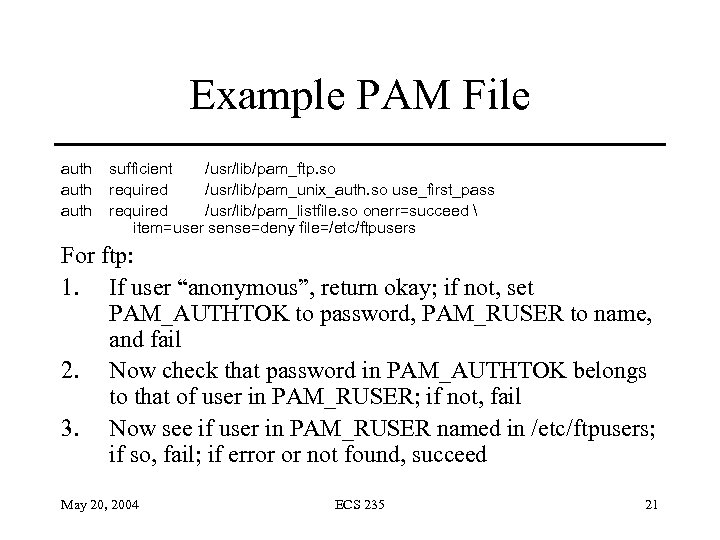 Example PAM File auth sufficient /usr/lib/pam_ftp. so required /usr/lib/pam_unix_auth. so use_first_pass required /usr/lib/pam_listfile. so onerr=succeed item=user sense=deny file=/etc/ftpusers For ftp: 1. If user “anonymous”, return okay; if not, set PAM_AUTHTOK to password, PAM_RUSER to name, and fail 2. Now check that password in PAM_AUTHTOK belongs to that of user in PAM_RUSER; if not, fail 3. Now see if user in PAM_RUSER named in /etc/ftpusers; if so, fail; if error or not found, succeed May 20, 2004 ECS 235 21
 Key Points • Authentication is not cryptography – You have to consider system components • Passwords are here to stay – They provide a basis for most forms of authentication • Protocols are important – They can make masquerading harder • Authentication methods can be combined – Example: PAM May 20, 2004 ECS 235 22
 Overview • • • Access control lists Capability lists Locks and keys Rings-based access control Propagated access control lists May 20, 2004 ECS 235 23
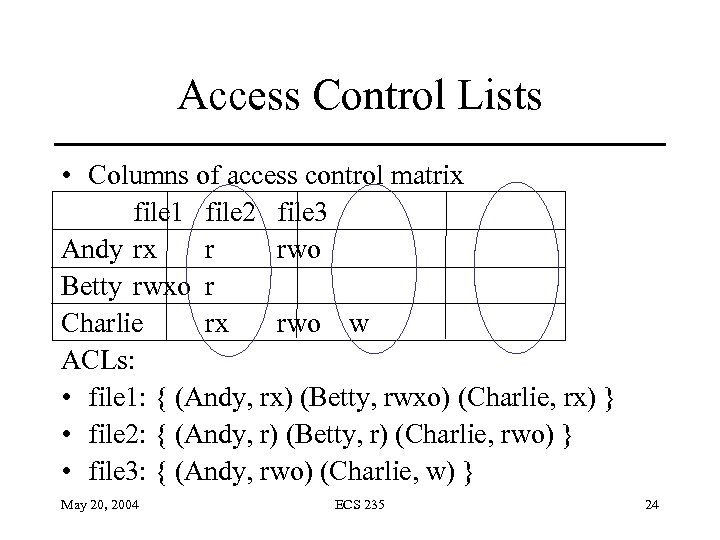 Access Control Lists • Columns of access control matrix file 1 file 2 file 3 Andy rx r rwo Betty rwxo r Charlie rx rwo w ACLs: • file 1: { (Andy, rx) (Betty, rwxo) (Charlie, rx) } • file 2: { (Andy, r) (Betty, r) (Charlie, rwo) } • file 3: { (Andy, rwo) (Charlie, w) } May 20, 2004 ECS 235 24
 Default Permissions • Normal: if not named, no rights over file – Principle of Fail-Safe Defaults • If many subjects, may use groups or wildcards in ACL – UNICOS: entries are (user, group, rights) • If user is in group, has rights over file • ‘*’ is wildcard for user, group – (holly, *, r): holly can read file regardless of her group – (*, gleep, w): anyone in group gleep can write file May 20, 2004 ECS 235 25
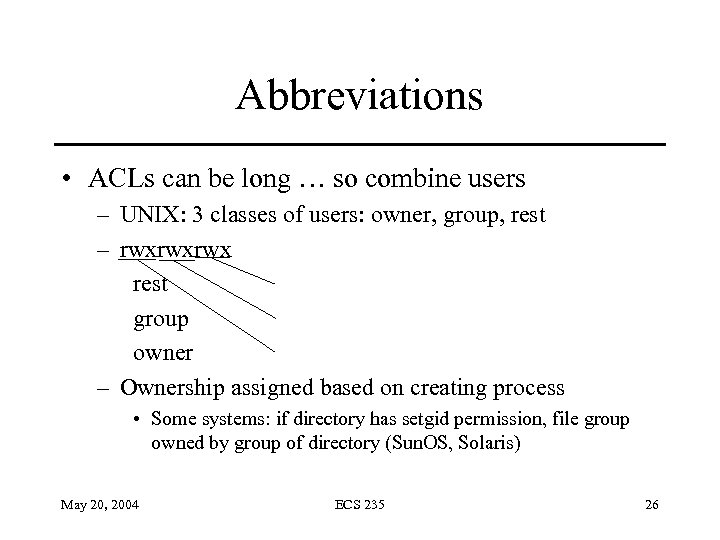 Abbreviations • ACLs can be long … so combine users – UNIX: 3 classes of users: owner, group, rest – rwxrwxrwx rest group owner – Ownership assigned based on creating process • Some systems: if directory has setgid permission, file group owned by group of directory (Sun. OS, Solaris) May 20, 2004 ECS 235 26
 ACLs + Abbreviations • Augment abbreviated lists with ACLs – Intent is to shorten ACL • ACLs override abbreviations – Exact method varies • Example: IBM AIX – Base permissions are abbreviations, extended permissions are ACLs with user, group – ACL entries can add rights, but on deny, access is denied May 20, 2004 ECS 235 27
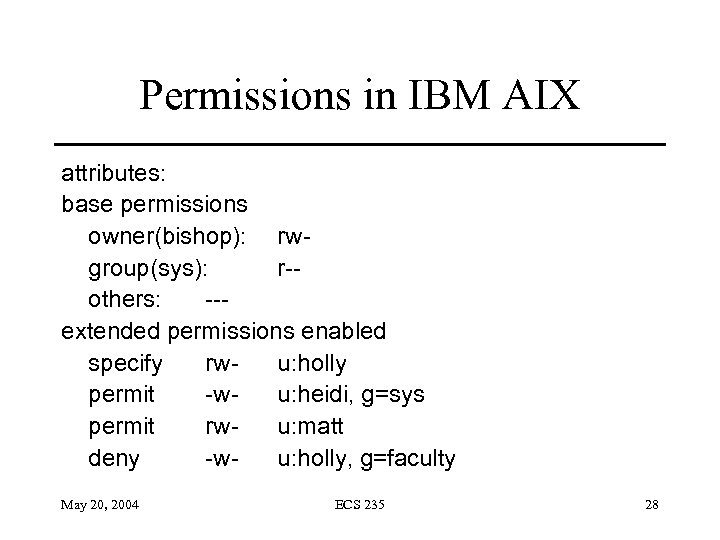 Permissions in IBM AIX attributes: base permissions owner(bishop): rwgroup(sys): r-others: --extended permissions enabled specify rwu: holly permit -wu: heidi, g=sys permit rwu: matt deny -wu: holly, g=faculty May 20, 2004 ECS 235 28
 ACL Modification • Who can do this? – Creator is given own right that allows this – System R provides a grant modifier (like a copy flag) allowing a right to be transferred, so ownership not needed • Transferring right to another modifies ACL May 20, 2004 ECS 235 29
 Privileged Users • Do ACLs apply to privileged users (root)? – Solaris: abbreviated lists do not, but full-blown ACL entries do – Other vendors: varies May 20, 2004 ECS 235 30
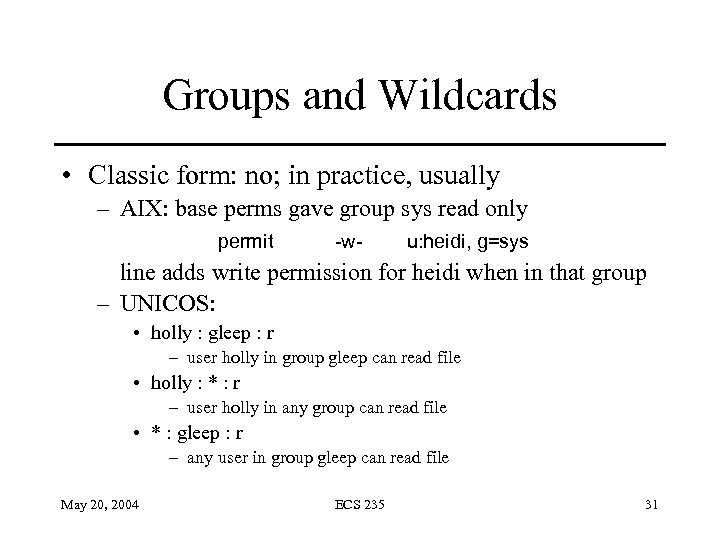 Groups and Wildcards • Classic form: no; in practice, usually – AIX: base perms gave group sys read only permit -w- u: heidi, g=sys line adds write permission for heidi when in that group – UNICOS: • holly : gleep : r – user holly in group gleep can read file • holly : * : r – user holly in any group can read file • * : gleep : r – any user in group gleep can read file May 20, 2004 ECS 235 31
 Conflicts • Deny access if any entry would deny access – AIX: if any entry denies access, regardless or rights given so far, access is denied • Apply first entry matching subject – Cisco routers: run packet through access control rules (ACL entries) in order; on a match, stop, and forward the packet; if no matches, deny • Note default is deny so honors principle of fail-safe defaults May 20, 2004 ECS 235 32
 Handling Default Permissions • Apply ACL entry, and if none use defaults – Cisco router: apply matching access control rule, if any; otherwise, use default rule (deny) • Augment defaults with those in the appropriate ACL entry – AIX: extended permissions augment base permissions May 20, 2004 ECS 235 33
 Revocation Question • How do you remove subject’s rights to a file? – Owner deletes subject’s entries from ACL, or rights from subject’s entry in ACL • What if ownership not involved? – Depends on system – System R: restore protection state to what it was before right was given • May mean deleting descendent rights too … May 20, 2004 ECS 235 34
 Windows NT ACLs • Different sets of rights – Basic: read, write, execute, delete, change permission, take ownership – Generic: no access, read (read/execute), change (read/write/execute/delete), full control (all), special access (assign any of the basics) – Directory: no access, read (read/execute files in directory), list, add and read, change (create, add, read, execute, write files; delete subdirectories), full control, special access May 20, 2004 ECS 235 35
 Accessing Files • User not in file’s ACL nor in any group named in file’s ACL: deny access • ACL entry denies user access: deny access • Take union of rights of all ACL entries giving user access: user has this set of rights over file May 20, 2004 ECS 235 36
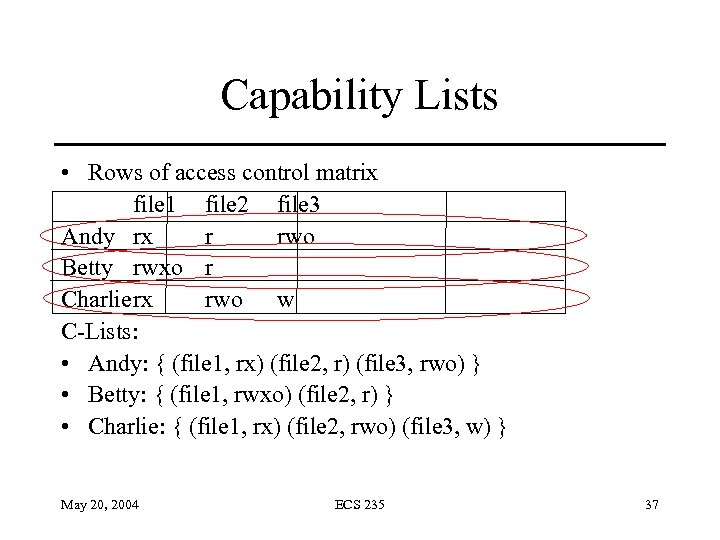 Capability Lists • Rows of access control matrix file 1 file 2 file 3 Andy rx r rwo Betty rwxo r Charlierx rwo w C-Lists: • Andy: { (file 1, rx) (file 2, r) (file 3, rwo) } • Betty: { (file 1, rwxo) (file 2, r) } • Charlie: { (file 1, rx) (file 2, rwo) (file 3, w) } May 20, 2004 ECS 235 37
 Semantics • Like a bus ticket – Mere possession indicates rights that subject has over object – Object identified by capability (as part of the token) • Name may be a reference, location, or something else – Architectural construct in capability-based addressing; this just focuses on protection aspects • Must prevent process from altering capabilities – Otherwise subject could change rights encoded in capability or object to which they refer May 20, 2004 ECS 235 38
 Implementation • Tagged architecture – Bits protect individual words • B 5700: tag was 3 bits and indicated how word was to be treated (pointer, type, descriptor, etc. ) • Paging/segmentation protections – Like tags, but put capabilities in a read-only segment or page • CAP system did this – Programs must refer to them by pointers • Otherwise, program could use a copy of the capability—which it could modify May 20, 2004 ECS 235 39
 Implementation (con’t) • Cryptography – Associate with each capability a cryptographic checksum enciphered using a key known to OS – When process presents capability, OS validates checksum – Example: Amoeba, a distributed capability-based system • Capability is (name, creating_server, rights, check_field) and is given to owner of object • check_field is 48 -bit random number; also stored in table corresponding to creating_server • To validate, system compares check_field of capability with that stored in creating_server table • Vulnerable if capability disclosed to another process May 20, 2004 ECS 235 40
 Copying • Copying: systems usually use copy flag • Other approaches possible – Example: Amoeba again; suppose Karl wants to let Matt read file Karl owns, but not propagate this right • Karl gives capability to server, requests restricted capability • Server creates new capability (read only here), and sets check_field of new capability to h(rights check_field) • Server gives this to Karl, who gives it to Matt • Matt presents it to server to read file • Server looks in table to get original check_field, recomputes new check_field from original one and rights in capability – If this matches the one in the capability, honor it – If not, don’t May 20, 2004 ECS 235 41