


 Скачать презентацию Pro-Poor Design of Projects involving Private Sector Participation
3259e937383c765459cf2417981f451f.ppt
- Количество слайдов: 33
 Pro-Poor Design of Projects involving Private Sector Participation in Infrastructure Kf. W PPP Workshop Jagdschloss Niederwald 13: 15 – 15: 15 Thursday 4 th September 2003 Katalyst Solutions
 Overview Introduction Katalyst team Focus of work for Kf. W The 3 stages of infrastructure assistance Designing propoor PSP Get the facts on the ground Informal providers & market structure Tariffs and subsidies Non-monetary barriers Access to finance Regulation and contract design Implementation & Monitoring Making it work Learning from experience
 Keith Stallard • Founding Director, Katalyst 21 • Water and environmental sector • PSP in industrialised and developing countries (Africa, Asia, Middle East) • Small-scale PSP in Ghana • Kf. W, World Bank David Ehrhardt • Director, Castalia • Reform of public services through PSP • Electricity, gas, telecommunications, water, transport • Joint author of book “Infrastructure for Poor people – Public Policy for Private Provision”, World Bank, 2003
 Focus of our work for Kf. W • When thinking of helping the poor, think about PSP • When thinking about PSP, think about helping the poor
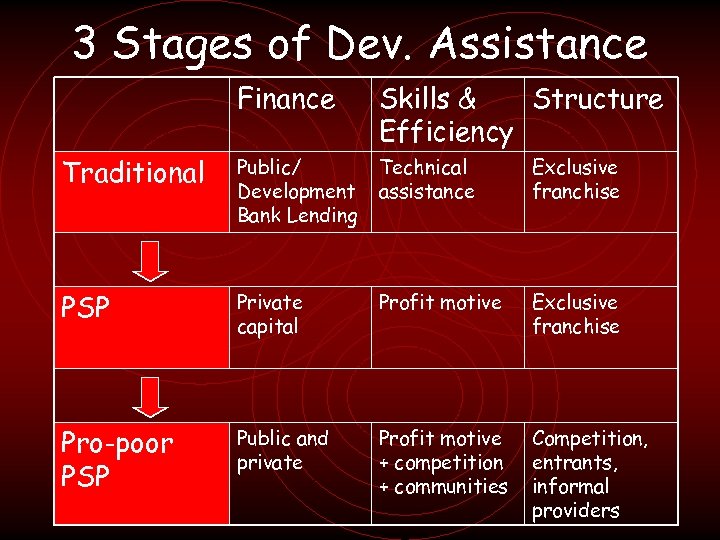 3 Stages of Dev. Assistance Finance Skills & Structure Efficiency Traditional Public/ Development Bank Lending Technical assistance Exclusive franchise PSP Private capital Profit motive Exclusive franchise Pro-poor PSP Public and private Profit motive + competition + communities Competition, entrants, informal providers
 Designing Pro-poor PSP Get the facts on the ground
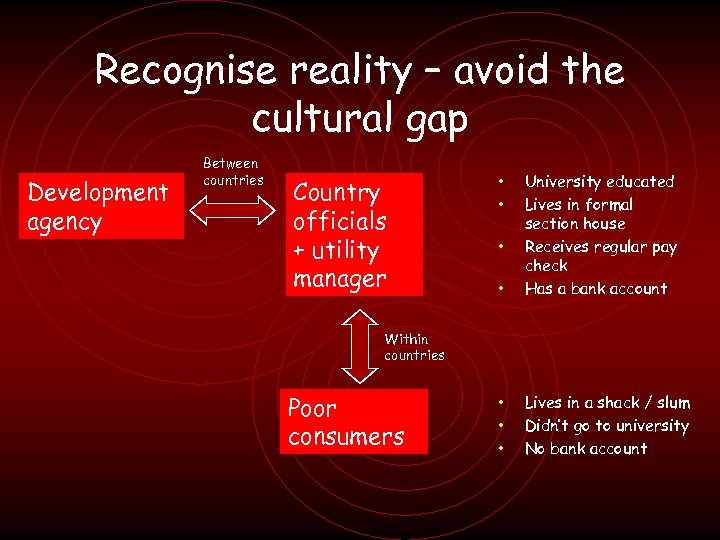 Recognise reality – avoid the cultural gap Development agency Between countries Country officials + utility manager • • • University educated Lives in formal section house Receives regular pay check Has a bank account • • • Lives in a shack / slum Didn’t go to university No bank account • Within countries Poor consumers
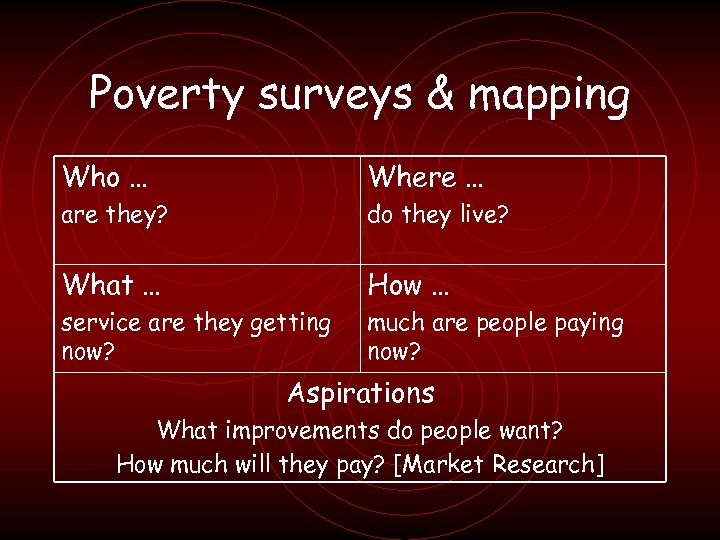 Poverty surveys & mapping Who … Where … are they? do they live? What … How … service are they getting now? much are people paying now? Aspirations What improvements do people want? How much will they pay? [Market Research]
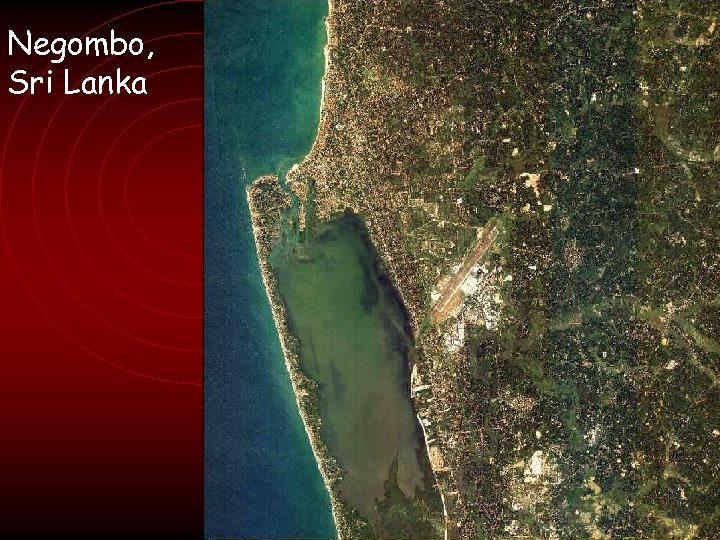 Negombo, Sri Lanka
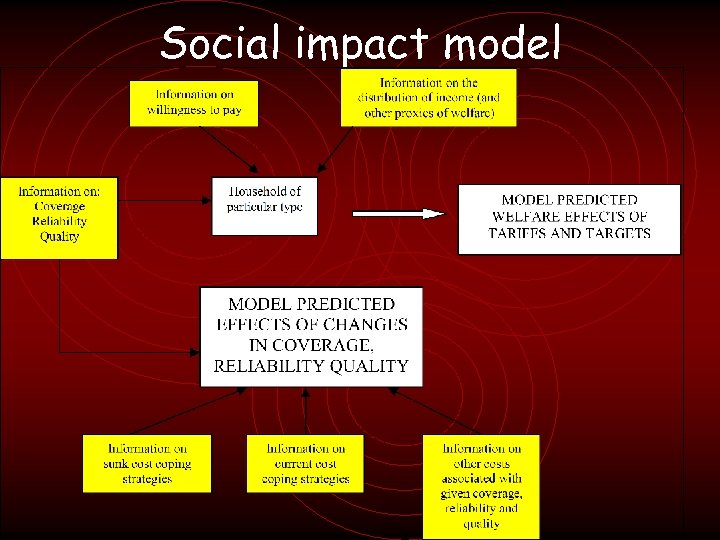 Social impact model
 Informal providers and competition a. k. a Market structure
 Pro-poor structures • Recognise reality on the ground • Be flexible (chaotic) in using competition to serve poor customers • Policy focus on promoting competition, helping small providers / entrants provide good service
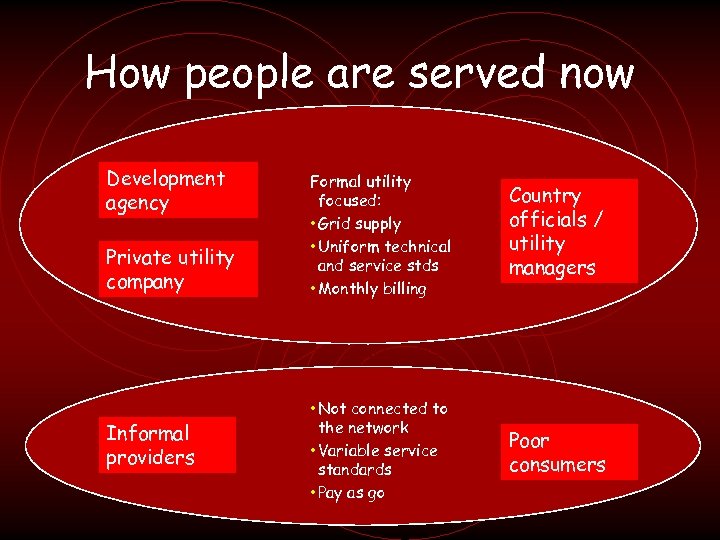 How people are served now Development agency Private utility company Informal providers Formal utility focused: • Grid supply • Uniform technical and service stds • Monthly billing Country officials / utility managers • Not connected to the network • Variable service standards • Pay as go Poor consumers
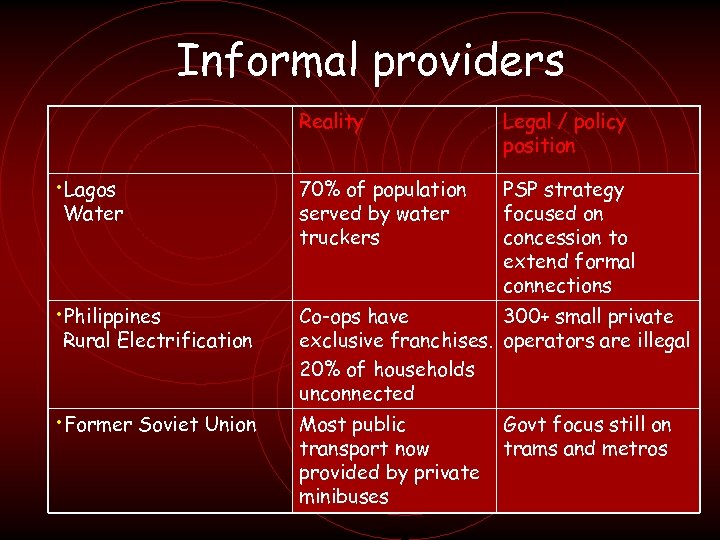 Informal providers Reality Legal / policy position • Lagos 70% of population served by water truckers PSP strategy focused on concession to extend formal connections • Philippines Co-ops have 300+ small private exclusive franchises. operators are illegal 20% of households unconnected • Former Soviet Union Most public transport now provided by private minibuses Water Rural Electrification Govt focus still on trams and metros
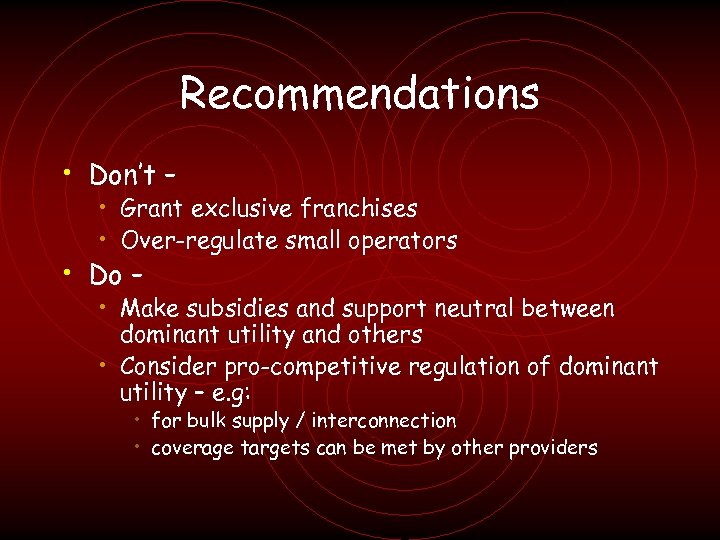 Recommendations • Don’t – • Grant exclusive franchises • Over-regulate small operators • Do – • Make subsidies and support neutral between dominant utility and others • Consider pro-competitive regulation of dominant utility – e. g: • for bulk supply / interconnection • coverage targets can be met by other providers
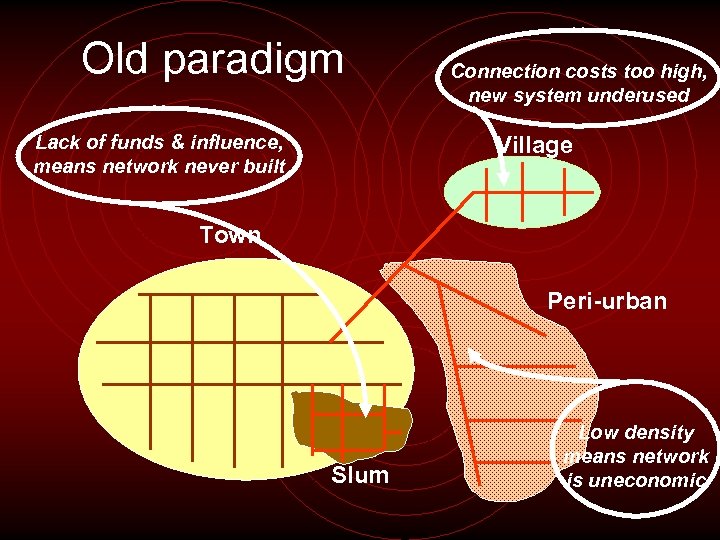 Old paradigm Lack of funds & influence, means network never built Connection costs too high, new system underused Village Town Peri-urban Slum Low density means network is uneconomic
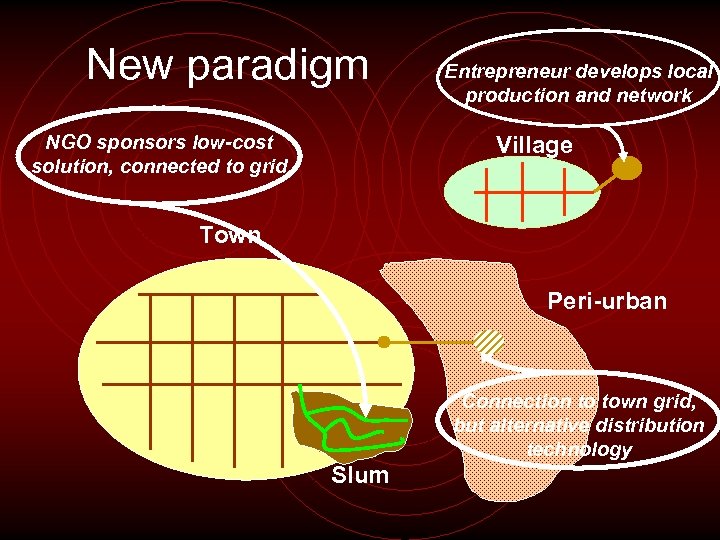 New paradigm NGO sponsors low-cost solution, connected to grid Entrepreneur develops local production and network Village Town Peri-urban Connection to town grid, but alternative distribution technology Slum
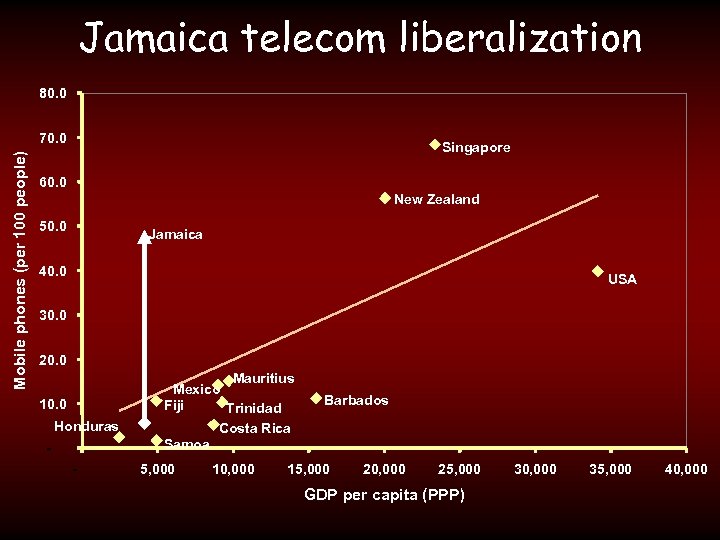 Jamaica telecom liberalization 80. 0 Mobile phones (per 100 people) 70. 0 Singapore 60. 0 New Zealand 50. 0 Jamaica 40. 0 USA 30. 0 20. 0 10. 0 Honduras - Mauritius Mexico Fiji Trinidad Costa Rica Samoa 5, 000 10, 000 Barbados 15, 000 20, 000 25, 000 GDP per capita (PPP) 30, 000 35, 000 40, 000
 Tariffs & Subsidies
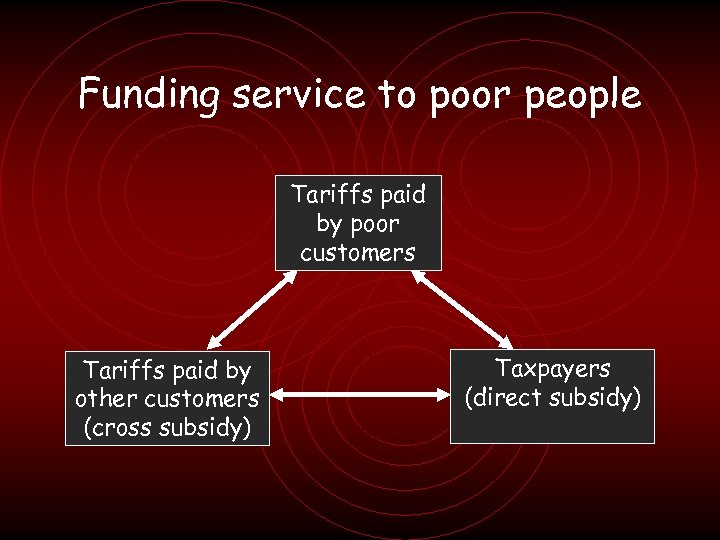 Funding service to poor people Tariffs paid by poor customers Tariffs paid by other customers (cross subsidy) Taxpayers (direct subsidy)
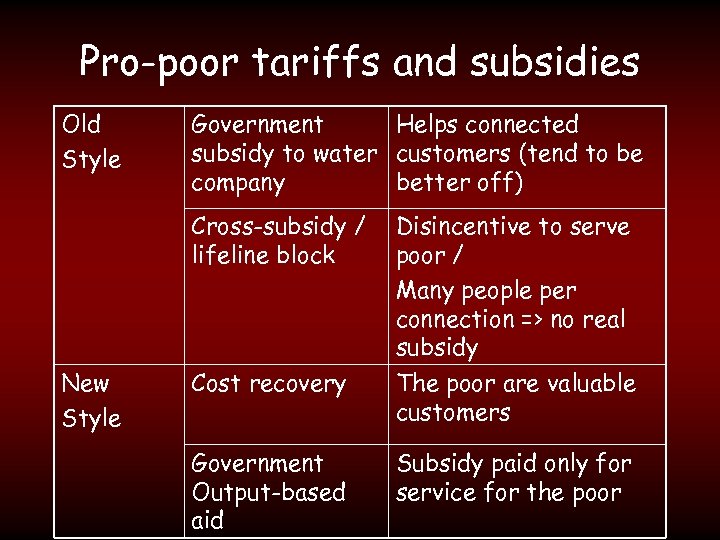 Pro-poor tariffs and subsidies Old Style Government Helps connected subsidy to water customers (tend to be company better off) Cross-subsidy / lifeline block New Style Disincentive to serve poor / Many people per connection => no real subsidy Cost recovery The poor are valuable customers Government Output-based aid Subsidy paid only for service for the poor
 Non-tariff barriers
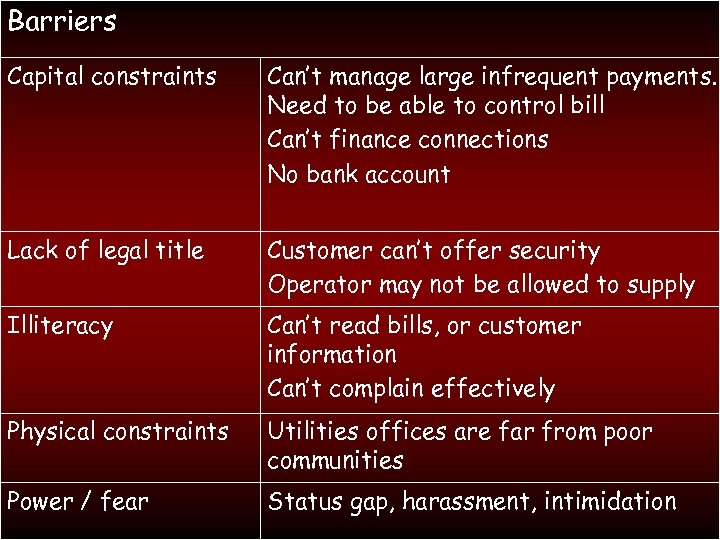 Barriers Capital constraints Can’t manage large infrequent payments. Need to be able to control bill Can’t finance connections No bank account Lack of legal title Customer can’t offer security Operator may not be allowed to supply Illiteracy Can’t read bills, or customer information Can’t complain effectively Physical constraints Utilities offices are far from poor communities Power / fear Status gap, harassment, intimidation
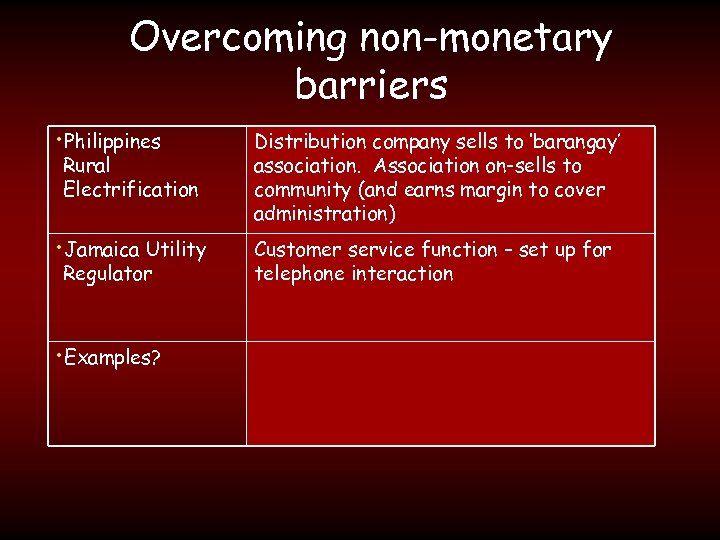 Overcoming non-monetary barriers • Philippines Distribution company sells to ‘barangay’ association. Association on-sells to community (and earns margin to cover administration) • Jamaica Utility Customer service function – set up for telephone interaction Rural Electrification Regulator • Examples?
 Access to finance
 Finance for incumbents • Development Bank finance needs to support PSP • Should be built into contract structure • Operator should control planning and implementation • Concessional finance should be targeted toward poor
 Finance for small operators Issues: • May not have accounts, business-plan, assets • Small capital needs Responses • Appropriate on-lending vehicle • Guarantees
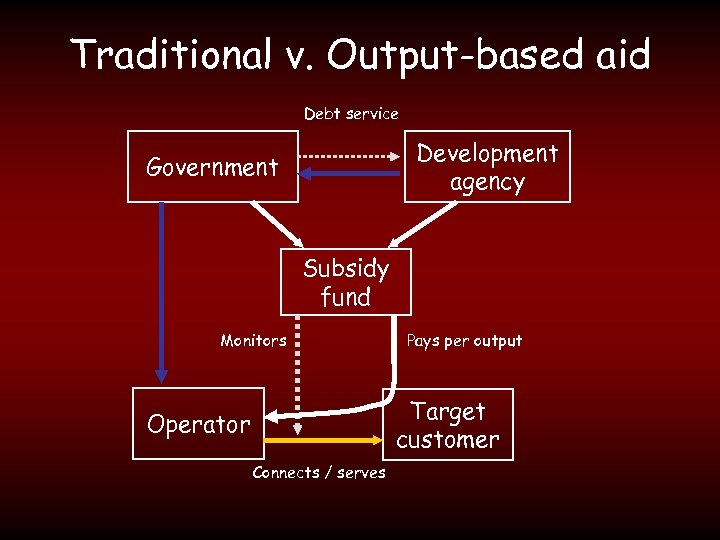 Traditional v. Output-based aid Debt service Development agency Government Subsidy fund Monitors Pays per output Target customer Operator Connects / serves
 Regulation and contract design
![Contract embodies policy Topic [Incumbent] Traditional Pro-poor Coverage Additional connections per year Add: -](https://present5.com/presentation/3259e937383c765459cf2417981f451f/image-30.jpg "Contract embodies policy Topic [Incumbent] Traditional Pro-poor Coverage Additional connections per year Add: -") Contract embodies policy Topic [Incumbent] Traditional Pro-poor Coverage Additional connections per year Add: - Micro-geo targets - Use of small providers - Tariff + subsidy = incentive Tariffs Average cost + lifeline block Make poor profitable: - Tariff + subsidy = cost + profit Billing Every 2 - 6 months - Frequent - Pre-pay / pay-as-you-go options Technical standards Uniform, first world, ‘good engineering’ - Flexible - Cost-benefit trade-off Service standards Uniform, first world Response to complaints - Targetted to customer - ‘Better than before’ - Outreach
Contract embodies policy Topic [Incumbent] Traditional Pro-poor Coverage Additional connections per year Add: - Micro-geo targets - Use of small providers - Tariff + subsidy = incentive Tariffs Average cost + lifeline block Make poor profitable: - Tariff + subsidy = cost + profit Billing Every 2 - 6 months - Frequent - Pre-pay / pay-as-you-go options Technical standards Uniform, first world, ‘good engineering’ - Flexible - Cost-benefit trade-off Service standards Uniform, first world Response to complaints - Targetted to customer - ‘Better than before’ - Outreach
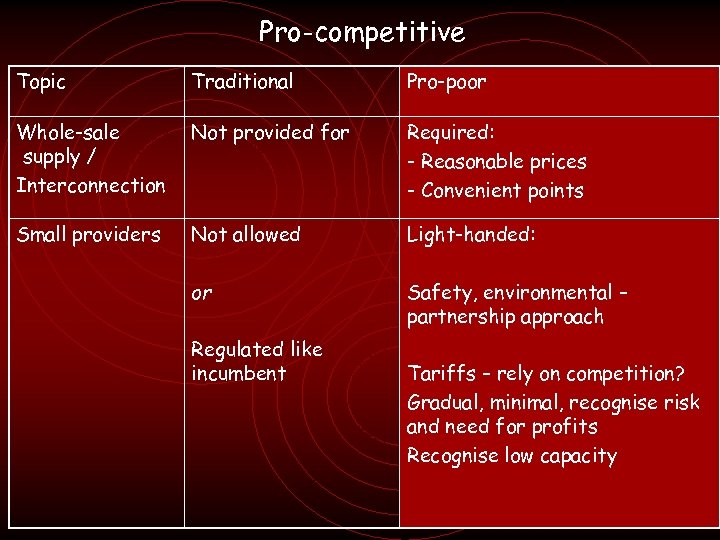 Pro-competitive Topic Traditional Pro-poor Whole-sale supply / Interconnection Not provided for Required: - Reasonable prices - Convenient points Small providers Not allowed Light-handed: or Safety, environmental – partnership approach Regulated like incumbent Tariffs – rely on competition? Gradual, minimal, recognise risk and need for profits Recognise low capacity
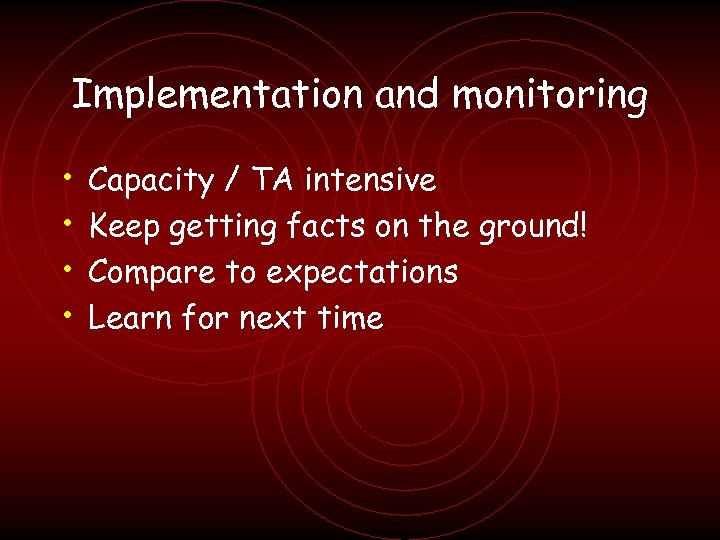 Implementation and monitoring • • Capacity / TA intensive Keep getting facts on the ground! Compare to expectations Learn for next time
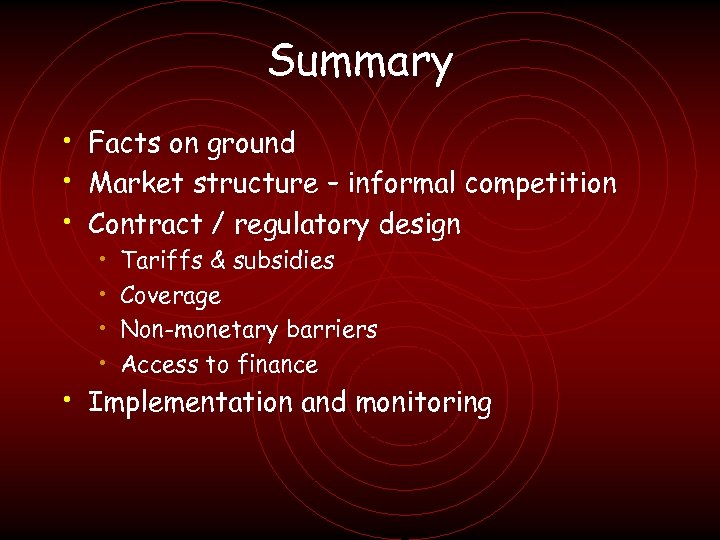 Summary • Facts on ground • Market structure – informal competition • Contract / regulatory design • Tariffs & subsidies • Coverage • Non-monetary barriers • Access to finance • Implementation and monitoring