 Скачать презентацию Pro Bono in the Philippines From Voluntary to
36d5fbbd2adc53f802ace9d1220405b8.ppt
- Количество слайдов: 32



Pro Bono in the Philippines: From Voluntary to Mandatory 3 rd Asia Pro Bono Conference & Workshop 2014 02 October 2014 Presented by Minerva M. B. Ambrosio juneamac@gmail. com Integrated Bar of the Philippines
Integrated Bar of the Philippines • The official national organization of all the lawyers in the country since 1973 • 2 major units: ØNational Center for Legal Aid (NCLA) ØCommission on Bar Discipline and Integrity (CBDI) • 85 Chapters all over the country
National Center for Legal Aid Ø One of the three objectives of the IBP is to "enable the Bar to discharge its responsibility more effectively. " Ø It is largely through the National Center (formerly Committee) on Legal Aid that the IBP carries out this objective. Ø The NCLA operates and manages the IBP Legal Aid Program which is also known as the "Chief Justice Roberto Concepcion Legal Aid Program" in honor of the first NCLA Chairman.
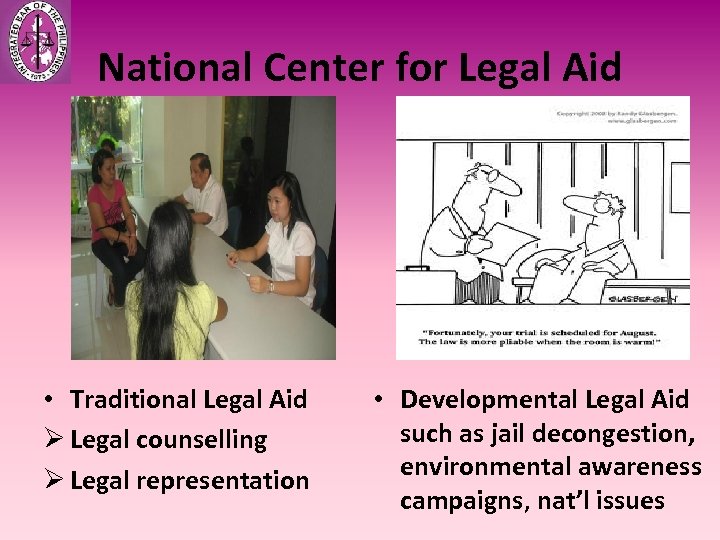
National Center for Legal Aid • Traditional Legal Aid Ø Legal counselling Ø Legal representation • Developmental Legal Aid such as jail decongestion, environmental awareness campaigns, nat’l issues
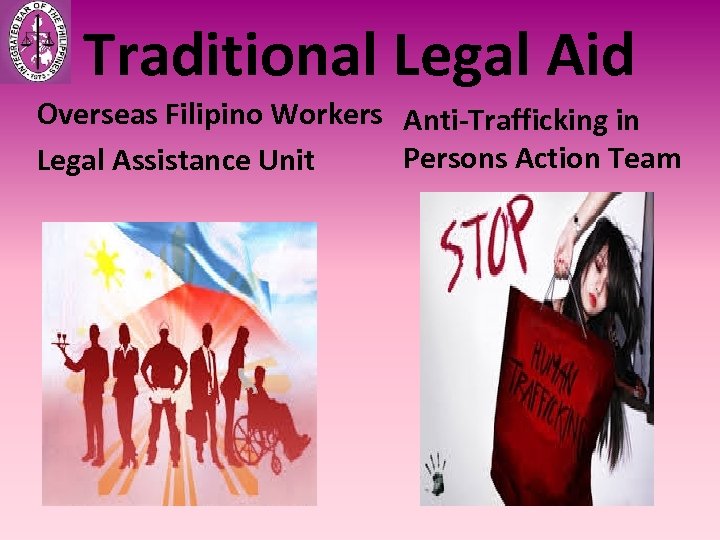
Traditional Legal Aid Overseas Filipino Workers Anti-Trafficking in Persons Action Team Legal Assistance Unit
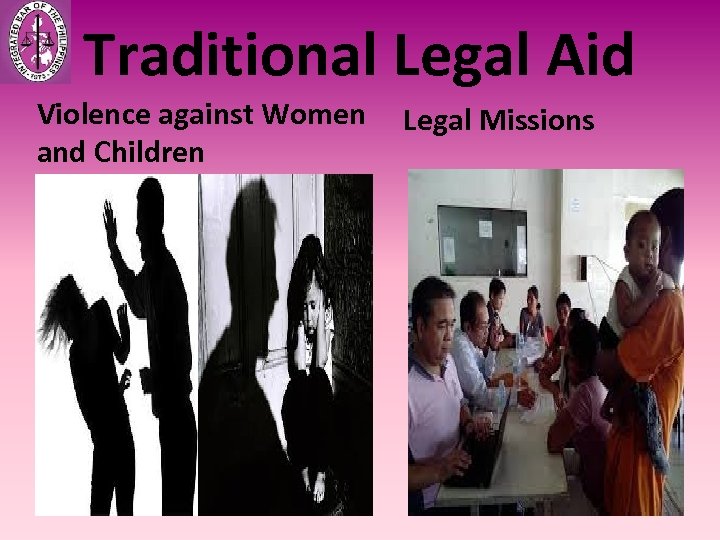
Traditional Legal Aid Violence against Women Legal Missions and Children
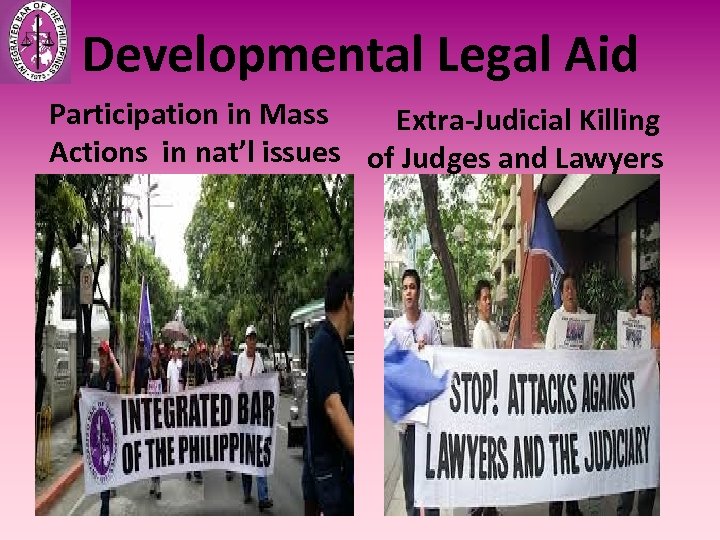
Developmental Legal Aid Participation in Mass Extra-Judicial Killing Actions in nat’l issues of Judges and Lawyers
In the Philippines, Pro Bono Work Is Voluntary but Will Be Mandatory • Bar Matter No 2012: Mandatory Legal Aid Service • Comprehensive Legal Aid Service (CLAS) is the Rule on Legal Aid (Pro Bono) as proposed by the IBP
MLAS Implementation On Hold • 01 July 2009: When MLAS should have taken effect • 01 January 2010: The Supreme Court (SC) deferred the implementation of the MLAS to this date, provided the IRR have been published prior to the said date. • 2014: The SC still has to table discussion of the IRR, after it conducts an independent roundtable discussion of the IRR among the lawyers.
Who are covered by the Rule? (1) (2) MLAS Practicing lawyers who shall render free legal aid services in all cases (civil, criminal or administrative) involving indigent and pauper litigants where the assistance of a lawyer is needed Other members of the legal profession who shall support the legal aid program of the IBP CLAS All members of the IBP shall render CLAS, except: (1) Government employees who are prohibited by law from engaging in private practice; (2) Lawyers who have officially retired from the practice of law
Who are considered other members of the legal profession under MLAS? (1) Government employees and incumbent elective officials not allowed by law to practice; (2) Lawyers who by law are not allowed to appear in court; (3) Supervising lawyers of students enrolled in law student practice in duly accredited legal clinics of law schools and lawyers of non-governmental organizations (NGOs) and peoples organizations (POs) like the Free Legal Assistance Group who by the nature of their work already render free legal aid to indigent and pauper litigants (4) Lawyers not covered under subparagraphs (i) to (iii) including those who are employed in the private sector but do not appear for and in behalf of parties in courts of law and quasi-judicial agencies.
How many hours of pro bono work? MLAS CLAS • A minimum of 60 hours of free legal aid services in a year. • 60 hours shall be spread within a period of 12 months, with a minimum of 5 hours of free legal aid services each month. • Excess hours of legal aid service may be credited to the succeeding periods. • Covered lawyers shall render a minimum of 20 hours of CLAS in a year.
Legal Aid Cases Ø Actions, disputes, and controversies ØCriminal, civil and administrative in nature Ø In whatever stage ØWherein indigent and pauper litigants need legal representation
Indigent Litigant* • (1) His gross income & that of his immediate family do not exceed an amount double the monthly minimum wage of an employee; and • (2) Who do not own real property with a fair market value as stated in the current tax declaration of more than Ph. P 300, 000. 00 (SGD 8, 613. 29) • Exempt from payment of legal fees * As defined under Rule 141, Section 19 of the Rules of Court and Algura v. The Local Government Unit of the City of Naga (G. R. No. 150135, 30 October 2006, 506 SCRA 81);
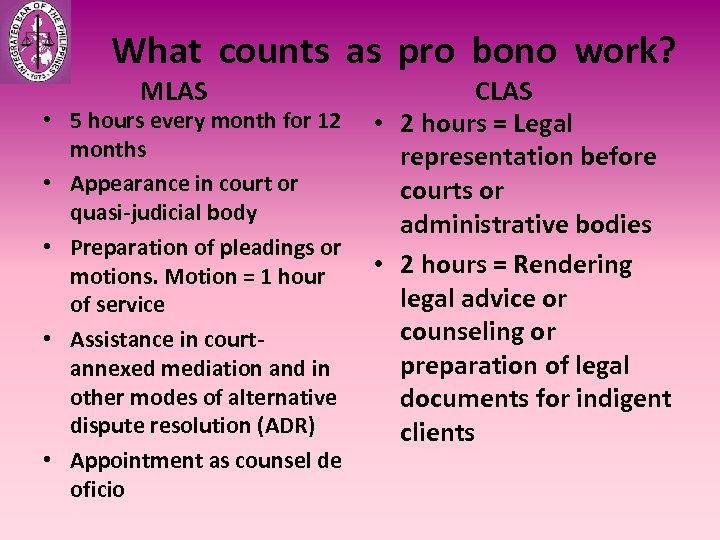
What counts as pro bono work? MLAS CLAS • 5 hours every month for 12 • 2 hours = Legal months representation before • Appearance in court or courts or quasi-judicial body administrative bodies • Preparation of pleadings or • 2 hours = Rendering motions. Motion = 1 hour legal advice or of service counseling or • Assistance in courtpreparation of legal annexed mediation and in other modes of alternative documents for indigent dispute resolution (ADR) clients • Appointment as counsel de oficio
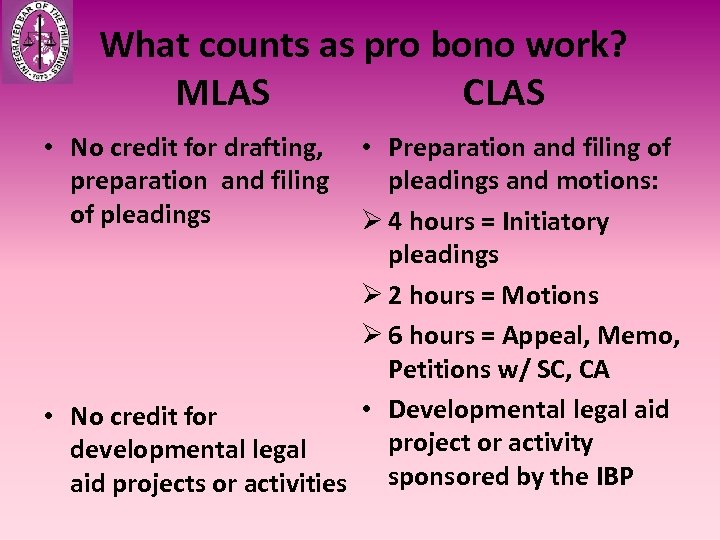
What counts as pro bono work? MLAS CLAS • No credit for drafting, • Preparation and filing of preparation and filing pleadings and motions: of pleadings Ø 4 hours = Initiatory pleadings Ø 2 hours = Motions Ø 6 hours = Appeal, Memo, Petitions w/ SC, CA • Developmental legal aid • No credit for project or activity developmental legal aid projects or activities sponsored by the IBP
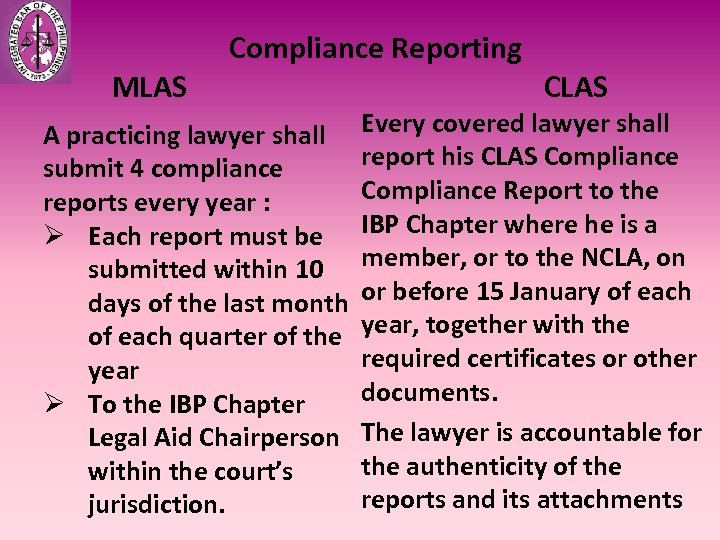
MLAS Compliance Reporting CLAS A practicing lawyer shall Every covered lawyer shall report his CLAS Compliance submit 4 compliance Compliance Report to the reports every year : Ø Each report must be IBP Chapter where he is a submitted within 10 member, or to the NCLA, on days of the last month or before 15 January of each quarter of the year, together with the required certificates or other year documents. Ø To the IBP Chapter Legal Aid Chairperson The lawyer is accountable for the authenticity of the within the court’s reports and its attachments jurisdiction.
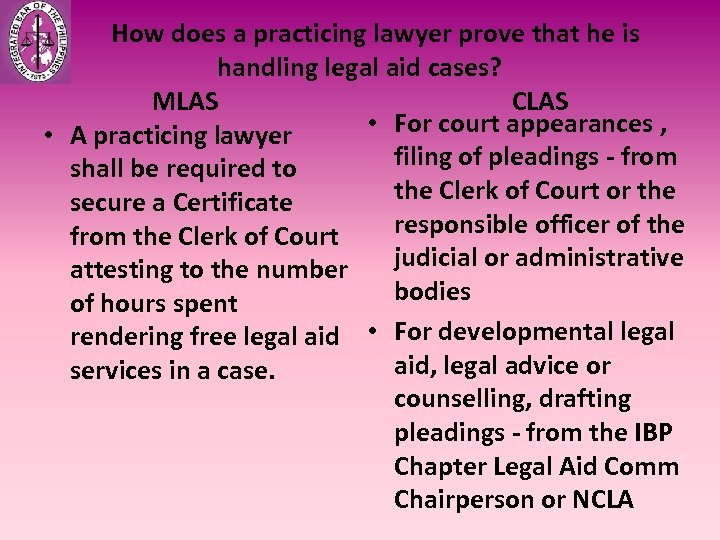
How does a practicing lawyer prove that he is handling legal aid cases? MLAS CLAS • For court appearances , • A practicing lawyer filing of pleadings - from shall be required to the Clerk of Court or the secure a Certificate responsible officer of the from the Clerk of Court attesting to the number judicial or administrative bodies of hours spent rendering free legal aid • For developmental legal aid, legal advice or services in a case. counselling, drafting pleadings - from the IBP Chapter Legal Aid Comm Chairperson or NCLA
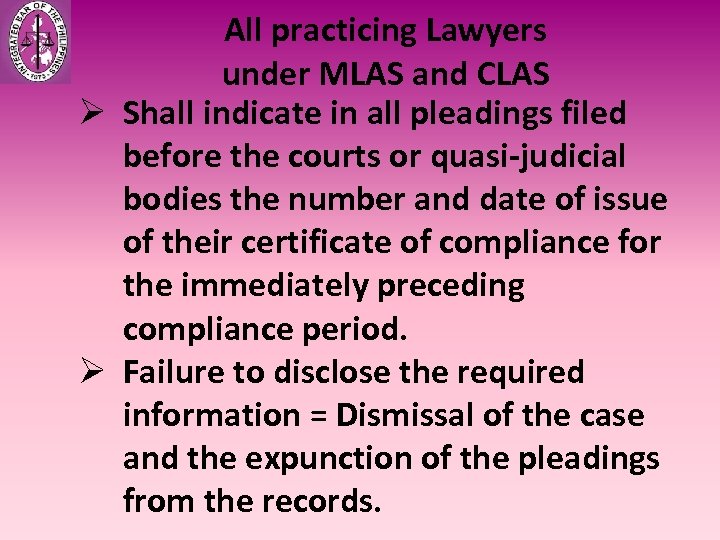
All practicing Lawyers under MLAS and CLAS Ø Shall indicate in all pleadings filed before the courts or quasi-judicial bodies the number and date of issue of their certificate of compliance for the immediately preceding compliance period. Ø Failure to disclose the required information = Dismissal of the case and the expunction of the pleadings from the records.
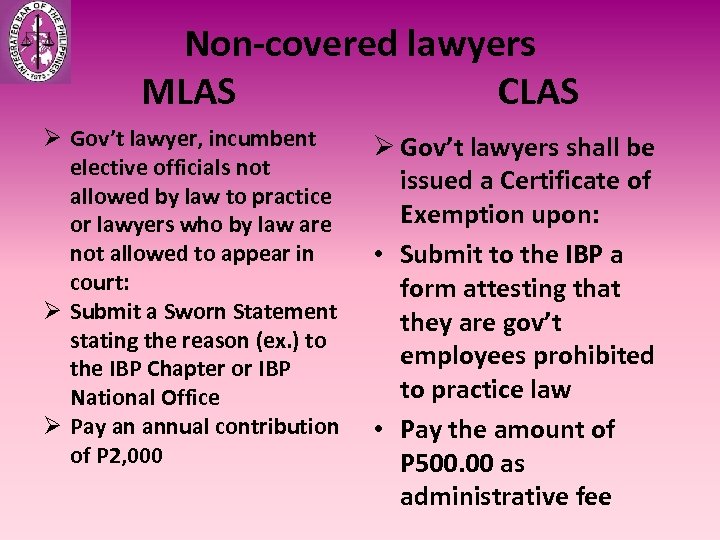
Non-covered lawyers MLAS CLAS Ø Gov’t lawyer, incumbent elective officials not allowed by law to practice or lawyers who by law are not allowed to appear in court: Ø Submit a Sworn Statement stating the reason (ex. ) to the IBP Chapter or IBP National Office Ø Pay an annual contribution of P 2, 000 Ø Gov’t lawyers shall be issued a Certificate of Exemption upon: • Submit to the IBP a form attesting that they are gov’t employees prohibited to practice law • Pay the amount of P 500. 00 as administrative fee
Non-covered lawyers MLAS CLAS • Legal Aid Clinic Supervising Lawyers, NGO/PO Lawyers > Secure a Certification from the Director of the Legal Aid Clinic, NGO or PO, stating that they have served as supervising lawyers in the legal aid clinic or actively participated in the NGO/PO’s free legal aid activities > Submit the certification to the IBP Chapter or IBP National Office. • Retired lawyers shall be exempt from compliance by: > Filing an application for retirement with IBP > Application to be approved by the IBP Board of Governors
Non-covered lawyers MLAS CLAS • Lawyers who are NOT practicing lawyers, gov’t lawyers, lawyers not allowed by law to practice, lawyers of legal aid clinics, NGOs, POs: Ø Submit a Sworn Statement to the IBP Chapter or IBP National Office Ø Pay an annual contribution of P 4, 000 • Lawyers are classified into only two classes
Sanctions for non-compliance MLAS CLAS • Failure to pay the annual contribution: • Any deficiency shall, at the end of each year, be assessed the amount of ØPay Ph. P 2, 000 Ph. P 200. 00 (SGD 5. 75) (SGD 57. 47) per hour of deficiency • Failure to meet the (the “Non-Compliance minimum prescribed 60 Fee) hours of legal aid • So any lawyer who did service each year: not render any CLAS at Ø Pay Ph. P 4, 000 (SGD all would have to pay 114. 97) Ph. P 4, 000 (SGD 114. 97)
Sanctions for non-compliance MLAS CLAS • Lawyer not allowed to practice if he is declared “not in good standing” which shall be effective for a 3 month period, may be extended until penalty is paid • Non-compliance for 3 consecutive years = 1 year suspension • Any covered lawyer who fails to comply with the CLAS requirements for 3 consecutive years shall be the subject of disciplinary proceedings to be instituted motu proprio by the CBDI. • If found administratively liable, lawyer shall be suspended for 1 year.
Special Fund MLAS CLAS Ø For the support of the • To be used solely and IBP free legal aid exclusively to support program the IBP Legal Aid Ø From the contributions Program of lawyers who do not • From the fees and render free legal aid contributions paid by services non-compliant lawyers Ø From the penalties paid by noncompliant/erring lawyers
Incentives to Lawyers MLAS CLAS Mandatory Continuing • No incentive provided Legal Education (MCLE) credits for lawyers who render MLAS for the required number of hours in a year for the 3 yearperiod covered by a compliance period under the MCLE Rules, with additional credits given for those who render MLAS for 2 consecutive years
What can State do to promote pro bono work? (1) Increase the Ph. P 30 M (SGD 861, 852. 20) subsidy given to the IBP Legal Aid Program (2) Make Legal Ethics a mandatory 5 unit course in all law schools, with a clinical component to observe what judges and justices do. (3) Scrap the Rule which imposes filing and docket fees for litigants which has led copycats like the DOJ to also collect fees for everything filed with it. (4) Law schools should institutionalize the rendition of free legal aid. (5) New lawyers must render pro bono work upon their signing of the roll of attorneys.
What can IBP do to promote pro bono? * (1) Consult with lawyers who are practicing in the different fields of law. (2) Walk your talk. Give lawyers and the public better and more inspiring examples of lawyering. (3) Bear in mind that one cannot legislate compassion or force passion. (4) Senior citizens, government employees, single parents, parents of children with special needs and those suffering from any physical disability and/or require medical supervision should be exempt from the coverage of BM No. 2012. (5) Reward, rather than punish, lawyers, by adding incentives and removing penalties. * Credit goes to Atty Teddy Te, SC spokesperson
What can IBP do to promote pro bono? * (1) Conduct or offer training/program for lawyers inexperienced in rendering legal aid services. (2) Conduct or offer training/program for law students who shall serve as legal interns with attorneys who handle legal aid cases. (3) Create and strengthen linkages among the various stakeholders in the establishment and promotion of access to justice network.
Challenges to the IBP • Mount a campaign to remove the mindset that mandatory legal aid = legal servitude • Create an infrastructure to facilitate reporting and compliance by lawyers • Establish a program that will make the lawyers and law students see the value of engaging in legal aid practice • Review the Means and Merit Tests • Strengthen current programs for overseas Filipino workers, victims of human trafficking victims, domestic violence, child abuse, human rights violation, CICL, jail decongestion,
Challenges to the IBP • Strengthen current programs for overseas Filipino workers, victims of human trafficking victims, domestic violence, child abuse, human rights violation, CICL, jail decongestion, extra-judicial killing and enforced disappearance of persons, especially lawyers/judges • Establish and create programs for indigenous peoples, senior citizens, urban poor, persons with disabilities, persons with HIV/AIDS, LGBTs
 Скачать презентацию Pro Bono in the Philippines From Voluntary to
36d5fbbd2adc53f802ace9d1220405b8.ppt