


 Скачать презентацию Private sector participation in water infrastructure OECD perspective
06e325a576fa97d171d340e7a1b33e69.ppt
- Количество слайдов: 26
 Private sector participation in water infrastructure OECD perspective Céline Kauffmann OECD Investment Division, Directorate for Financial and Enterprises Affairs
 Structure of the presentation 1. Recent trends 2. Checklist for Public Action 3. In country policy dialogues OECD 2
 Recent trends OECD 3
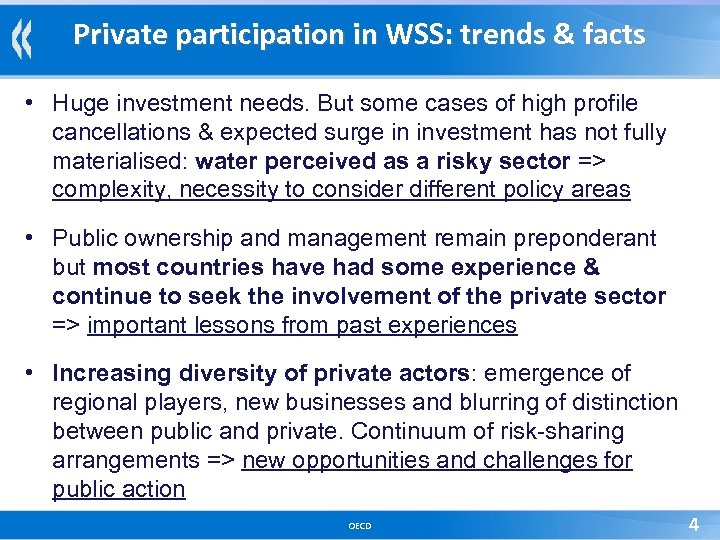 Private participation in WSS: trends & facts • Huge investment needs. But some cases of high profile cancellations & expected surge in investment has not fully materialised: water perceived as a risky sector => complexity, necessity to consider different policy areas • Public ownership and management remain preponderant but most countries have had some experience & continue to seek the involvement of the private sector => important lessons from past experiences • Increasing diversity of private actors: emergence of regional players, new businesses and blurring of distinction between public and private. Continuum of risk-sharing arrangements => new opportunities and challenges for public action OECD 4
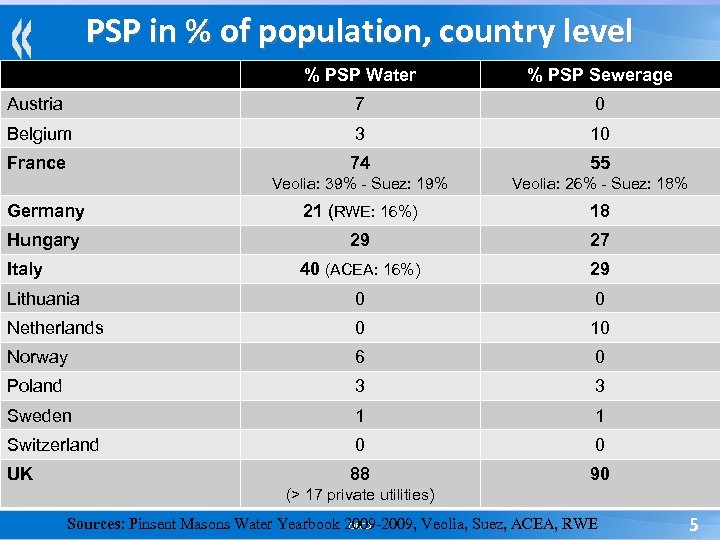 PSP in % of population, country level % PSP Water % PSP Sewerage Austria 7 0 Belgium 3 10 France 74 55 Veolia: 39% - Suez: 19% Veolia: 26% - Suez: 18% Germany 21 (RWE: 16%) 18 Hungary 29 27 40 (ACEA: 16%) 29 Lithuania 0 0 Netherlands 0 10 Norway 6 0 Poland 3 3 Sweden 1 1 Switzerland 0 0 UK 88 90 Italy (> 17 private utilities) OECD Sources: Pinsent Masons Water Yearbook 2009 -2009, Veolia, Suez, ACEA, RWE 5
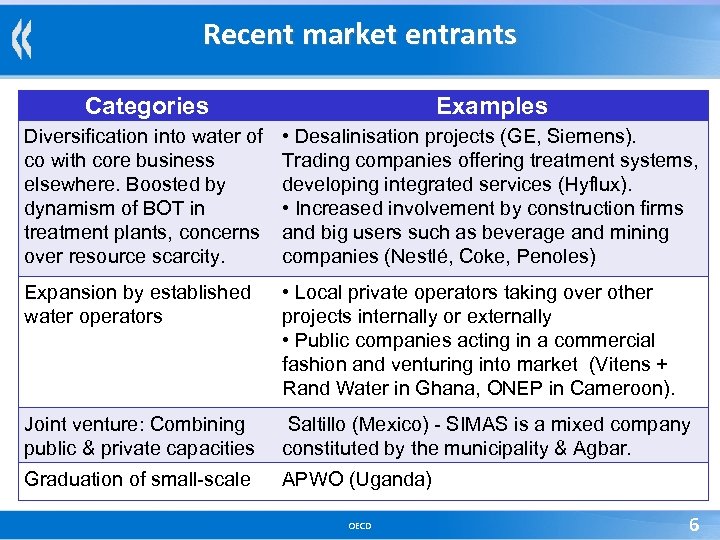 Recent market entrants Categories Examples Diversification into water of co with core business elsewhere. Boosted by dynamism of BOT in treatment plants, concerns over resource scarcity. • Desalinisation projects (GE, Siemens). Trading companies offering treatment systems, developing integrated services (Hyflux). • Increased involvement by construction firms and big users such as beverage and mining companies (Nestlé, Coke, Penoles) Expansion by established water operators • Local private operators taking over other projects internally or externally • Public companies acting in a commercial fashion and venturing into market (Vitens + Rand Water in Ghana, ONEP in Cameroon). Joint venture: Combining public & private capacities Saltillo (Mexico) - SIMAS is a mixed company constituted by the municipality & Agbar. Graduation of small-scale APWO (Uganda) OECD 6
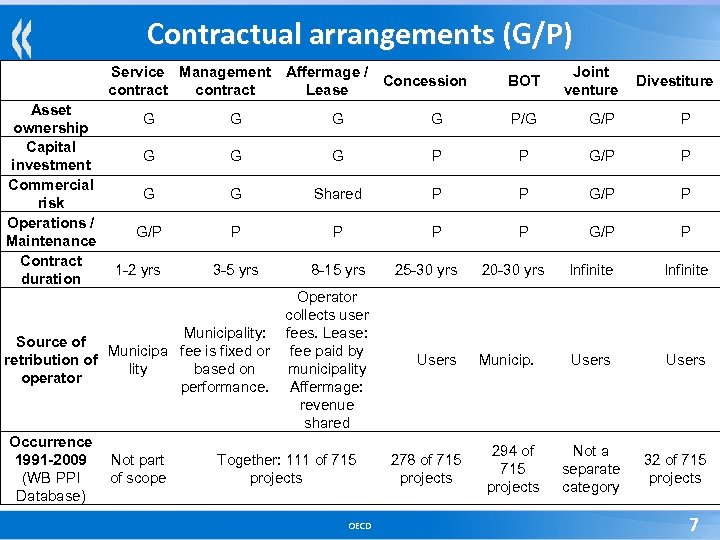 Contractual arrangements (G/P) Service Management Affermage / Concession contract Lease Asset ownership Capital investment Commercial risk Operations / Maintenance Contract duration Joint venture Divestiture G G P/G G/P P G G G P P G/P P G G Shared P P G/P P 3 -5 yrs 8 -15 yrs 25 -30 yrs Operator collects user fees. Lease: fee paid by municipality Affermage: revenue shared Users 1 -2 yrs Municipality: Source of Municipa fee is fixed or retribution of lity based on operator performance. Occurrence 1991 -2009 (WB PPI Database) BOT Not part of scope Together: 111 of 715 projects OECD 278 of 715 projects 20 -30 yrs Infinite Municip. Users 294 of 715 projects Not a separate category 32 of 715 projects 7
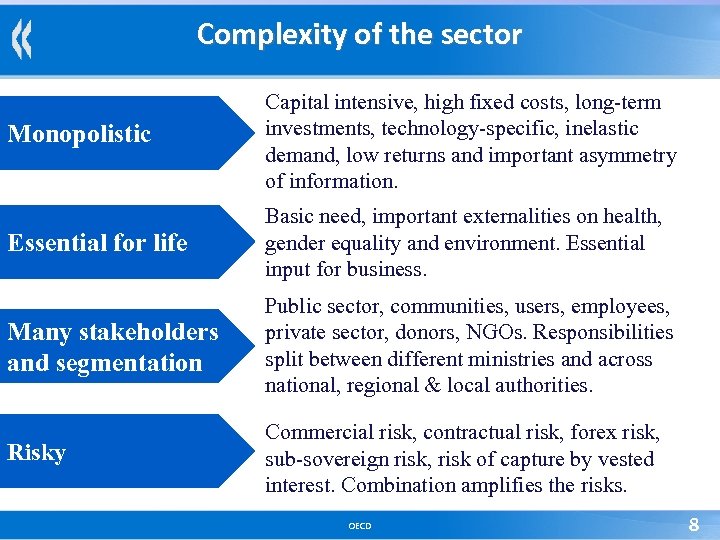 Complexity of the sector Monopolistic Capital intensive, high fixed costs, long-term investments, technology-specific, inelastic demand, low returns and important asymmetry of information. Essential for life Basic need, important externalities on health, gender equality and environment. Essential input for business. Many stakeholders and segmentation Public sector, communities, users, employees, private sector, donors, NGOs. Responsibilities split between different ministries and across national, regional & local authorities. Risky Commercial risk, contractual risk, forex risk, sub-sovereign risk, risk of capture by vested interest. Combination amplifies the risks. OECD 8
 OECD Checklist for Public Action OECD 9
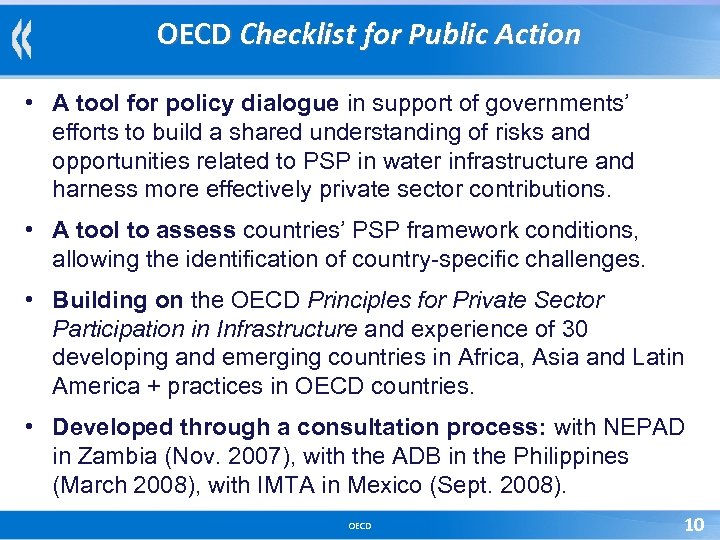 OECD Checklist for Public Action • A tool for policy dialogue in support of governments’ efforts to build a shared understanding of risks and opportunities related to PSP in water infrastructure and harness more effectively private sector contributions. • A tool to assess countries’ PSP framework conditions, allowing the identification of country-specific challenges. • Building on the OECD Principles for Private Sector Participation in Infrastructure and experience of 30 developing and emerging countries in Africa, Asia and Latin America + practices in OECD countries. • Developed through a consultation process: with NEPAD in Zambia (Nov. 2007), with the ADB in the Philippines (March 2008), with IMTA in Mexico (Sept. 2008). OECD 10
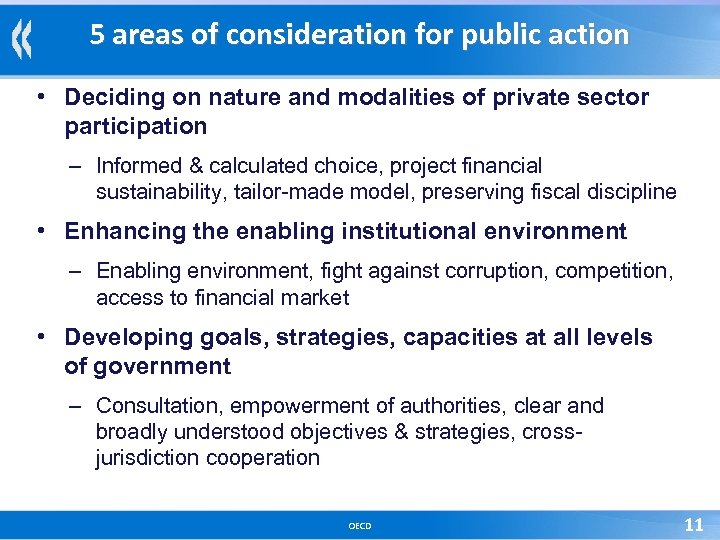 5 areas of consideration for public action • Deciding on nature and modalities of private sector participation – Informed & calculated choice, project financial sustainability, tailor-made model, preserving fiscal discipline • Enhancing the enabling institutional environment – Enabling environment, fight against corruption, competition, access to financial market • Developing goals, strategies, capacities at all levels of government – Consultation, empowerment of authorities, clear and broadly understood objectives & strategies, crossjurisdiction cooperation OECD 11
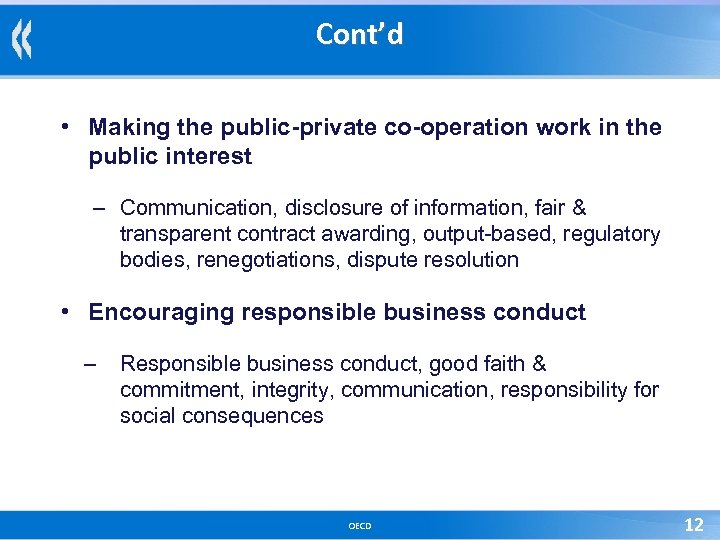 Cont’d • Making the public-private co-operation work in the public interest – Communication, disclosure of information, fair & transparent contract awarding, output-based, regulatory bodies, renegotiations, dispute resolution • Encouraging responsible business conduct – Responsible business conduct, good faith & commitment, integrity, communication, responsibility for social consequences OECD 12
 In country policy dialogues OECD 13
 Draft assessments under preparation • Egypt, Russia, Lebanon, Mexico and Tunisia • As part of on-going national dialogues, in partnership with national authorities & other institutions (GWP-Med) • Building on: – answers to the Checklist-based Questionnaire – publicly available material (academic papers, government information, OECD & other organisations’ publications) – Bilateral interviews during fact-finding missions • Structure: overview of recent developments and identification of areas for consideration by government. OECD 14
 Checklist: Enhancing the enabling environment • Clarifying public sector responsibilities: Principle 5. A sound and enabling environment for infrastructure investment, which implies high standards of public and corporate governance, transparency and the rule of law, including protection of property and contractual rights, is essential to attract the participation of the private sector. • Developing sound regulatory framework: Principle 17. Regulation of infrastructure services needs to be entrusted to specialised public authorities that are competent, well-resourced and shielded from undue influence by the parties to infrastructure contracts. OECD 15
 Institutional framework under development • Egypt: the regulatory framework is lagging behind – PPP Law just ratified by Parliament in June 2010. – Water Law (defining the responsibilities of regulatory body), is under development with no clear perspective for ratification. • Russia: legislation in transition, PSP in stagnation since 2006 – – New tariff regulation – • Amendments to the Concession Law: sector-specific provisions, asset registration & transition of old leases, competitive bidding Timeline of technical regulations under development unclear Lebanon: the legislative framework is not in place yet, current legislation does not allow PSP in the water sector, but draft laws are under development or approval. OECD 16
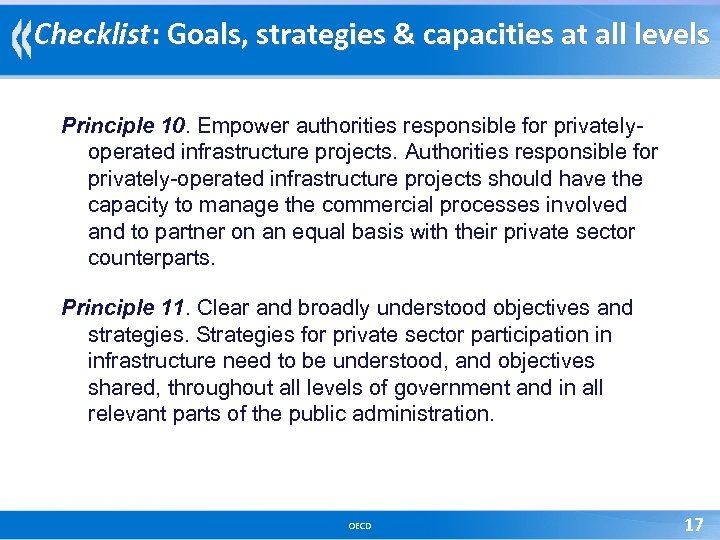 Checklist: Goals, strategies & capacities at all levels Principle 10. Empower authorities responsible for privatelyoperated infrastructure projects. Authorities responsible for privately-operated infrastructure projects should have the capacity to manage the commercial processes involved and to partner on an equal basis with their private sector counterparts. Principle 11. Clear and broadly understood objectives and strategies. Strategies for private sector participation in infrastructure need to be understood, and objectives shared, throughout all levels of government and in all relevant parts of the public administration. OECD 17
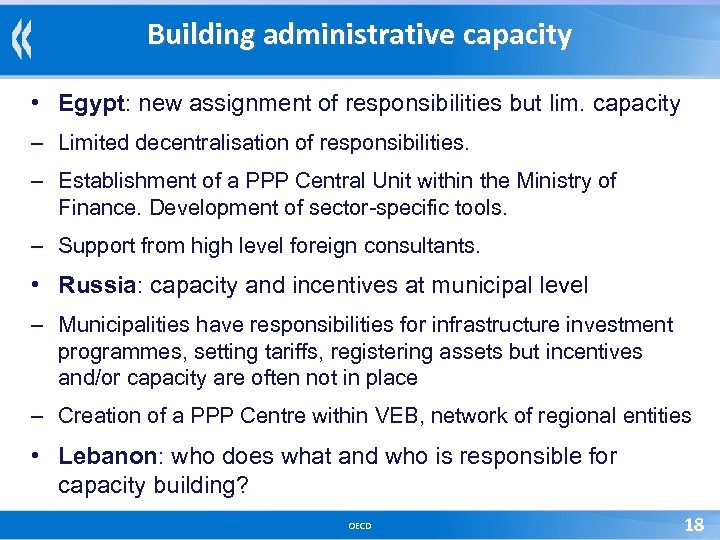 Building administrative capacity • Egypt: new assignment of responsibilities but lim. capacity – Limited decentralisation of responsibilities. – Establishment of a PPP Central Unit within the Ministry of Finance. Development of sector-specific tools. – Support from high level foreign consultants. • Russia: capacity and incentives at municipal level – Municipalities have responsibilities for infrastructure investment programmes, setting tariffs, registering assets but incentives and/or capacity are often not in place – Creation of a PPP Centre within VEB, network of regional entities • Lebanon: who does what and who is responsible for capacity building? OECD 18
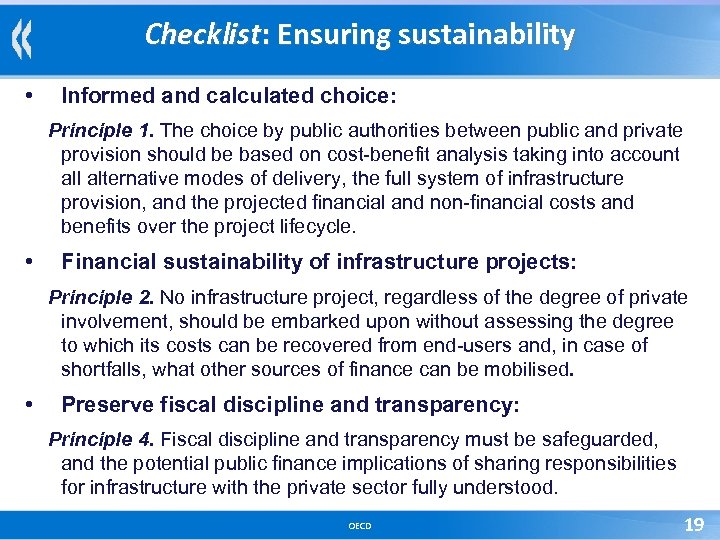 Checklist: Ensuring sustainability • Informed and calculated choice: Principle 1. The choice by public authorities between public and private provision should be based on cost-benefit analysis taking into account all alternative modes of delivery, the full system of infrastructure provision, and the projected financial and non-financial costs and benefits over the project lifecycle. • Financial sustainability of infrastructure projects: Principle 2. No infrastructure project, regardless of the degree of private involvement, should be embarked upon without assessing the degree to which its costs can be recovered from end-users and, in case of shortfalls, what other sources of finance can be mobilised. • Preserve fiscal discipline and transparency: Principle 4. Fiscal discipline and transparency must be safeguarded, and the potential public finance implications of sharing responsibilities for infrastructure with the private sector fully understood. OECD 19
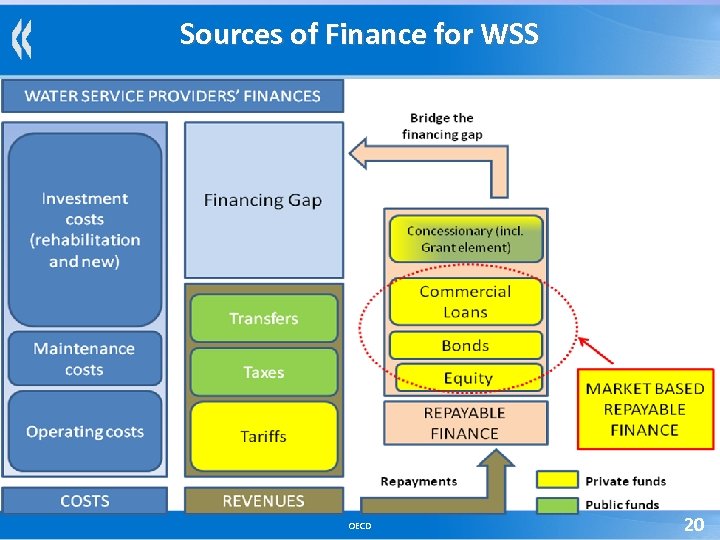 Sources of Finance for WSS OECD 20
 Financial sustainability of PPPs • Egypt: scalability & long-term affordability for governments – Limited scope of PPPs (demo BOTs for big projects). – Demand risk born by the public sector, sovereign guarantee – Forex risk & limited development of local financial market and banking sector. • Russia: establishing economic tariff regulation to balance diverse interests – Important potential market, but tariff regulation has been criticised as providing limited incentive to invest and raising important regulatory risk. • Lebanon: low cost recovery and high public debt. OECD 21
 Checklist: Making the cooperation work • Output/performance based contracts: Principle 16. The formal agreement between authorities and private sector participants should be specified in terms of verifiable infrastructure services to be provided to the public on the basis of output or performance based specifications. It should contain provision regarding responsibilities and risk allocation in the case of unforeseen events. • Consultation with stakeholders: Principle 9. Public authorities should ensure adequate consultation with end -users and other stakeholders including prior to the initiation of an infrastructure project. • Create a competitive environment: Principle 7. The benefits of private sector participation in infrastructure are enhanced by efforts to create a competitive environment, including by subjecting activities to appropriate commercial pressures, dismantling unnecessary barriers to entry and implementing and enforcing adequate competition laws. OECD 22
 The accountability mechanisms • Egypt: limited culture of performance based assessment; efforts to develop dispute resolution mechanisms. – Just starting the development of monitoring indicators – 3 -step dispute resolution mechanism • Russia: strengthening accountability in the public interest – – Improving the information base and monitoring – Strengthening the competitive environment – • Fighting corruption through limiting discretion, revising unrealistic regulation and establishing appropriate incentives Supporting accountability towards the end-users Lebanon: development of performance indicators. OECD 23
 Recent developments confirm need for strong focus on framework conditions • Demand for clearer forms of public support and risksharing arrangements – High level cancellations => less risk taking – Impact of financial crisis: “the age of easy money has ended” – Important needs and competition for financing (across countries and across sectors) • Low financial sustainability is a key bottleneck – Mixes of 3 Ts that do not cover costs – Inadequate tariff regulation • Change in “procurement” culture – new tools in the hands of policy makers to ensure accountability OECD 24
 Considerations for the future an agenda for future work • Making reform happen: mix of policy tools and institutional arrangements in support of implementation • Ensuring financial sustainability: understanding the dynamics of the 3 Ts, the role of repayable sources of finance, the importance of Strategic Financial Planning • Deep change in service delivery culture: democratic aspirations, decentralisation and territorial development are making users participation a priority. How to do this? OECD 25
 Thank You Directorate for Financial and Enterprise Affairs Investment Division Visit our website: www. oecd. org/daf/investment/water Contact: celine. kauffmann@oecd. org OECD 26