 Скачать презентацию Private money for public water A safe haven
5e82440b7374557a0c936f2603a4ae76.ppt
- Количество слайдов: 26



Private money for public water A safe haven in the midst of a financial storm? A presentation to ICEA, 16 th June 2009 Sophie Trémolet 1
Introduction n The problem Water and sanitation (WATSAN) are essential services ¨ High investment needs BUT ¨ Notoriously difficult to finance ¨ Perceived to be a highly political sector: high risks / low returns ¨ n n Question: what innovations are required to mobilise private sector finance for WATSAN in the current financial crisis? Based on recent work Innovative financing mechanisms for the water sector (draft available) ¨ Client: OECD (part of Horizontal Water Programme) ¨ Focus: OECD and developing countries (more on the latter) ¨ 2
Structure of presentation n n n Contextual elements A financing gap or a perception gap? Sources of finance: FCR is out, SCR is in Innovative approaches: from concept to reality but still short of scaling-up In the midst of a financial storm Going forward ¨ Leveraging, leveraging ¨ Building sustainable financial mechanisms 3
Contextual elements n Key drivers for investment OECD: renewals and upgrading to meet environmental standards (e. g. Water Framework Directive in EU) ¨ Developing countries: reduce losses, develop resources, increase access in line with MDGs (estimated cost = USD 18 bn/year) ¨ n 2003: Publication of “Camdessus Report” Panel of experts, chaired by Michel Camdessus (ex-IMF) – Rapporteur: Jim Winpenny ¨ First time that sector took a hard look at financing challenges ¨ Hostile reception at Kyoto World Water Forum ¨ n Six years on What has changed in the sector and beyond? ¨ What recommendations have been implemented? ¨ What recommendations are still valid / or not? ¨ 4
A financing gap or a perception gap? n n Early 1990 s: public sector cannot do it alone Water sector in England & Wales: not the norm PSP introduced via asset sale (only a handful) ¨ Private operations and private finance are combined ¨ Financial innovations to reduce Co. C as a result of tightening regulatory regime ¨ Mobilised considerable private financing (but EIB main lender) ¨ n 1990 s to early 2000 s elsewhere Hopes that private sector would fill the “financing gap” ¨ Private operation “naively” associated with private finance ¨ 5
Developing countries: PSP in question n Disillusions with PSP since 1997 Asian crisis ¨ Several high-profile concessions failed n n n ¨ n Bad design: Cochabamba (Bolivia) Impact of exchange rate crisis: Manila, Buenos Aires Political crisis: La Paz (Bolivia) Main market players have lost appetite and withdrawn to home markets, China and a few isolated transactions / contracts Expectations mis-match IFIs, donors and client governments keen to let concessions (most investment obligations, best to increase coverage) ¨ Private operators: “We are not bankers” ¨ n Preference for low-risk contracts (e. g. Management contracts, BOTs) 6
Current market structure n Mostly public operators (~ 95% of total market) and mostly decentralized (municipal / regional operators) ¨ Some have greatly improved (e. g. PPWSA in Cambodia) ¨ Renewed interest in improving public utilities n “Locally grown” private operators (40% private market) Medium size: China, Philippines, Colombia, South Africa, etc. . . ¨ Small scale water service providers (SSWSPs) ¨ n n n Can cover more than 50% in some countries, particularly in peri-urban areas in capital cities (e. g. Maputo – Mozambique or Lusaka – Zambia) Were not always reckoned with but are increasingly recognised Common features All have substantial financing needs and different constraints ¨ Common “critical mismatches” limit fund availability 7 ¨
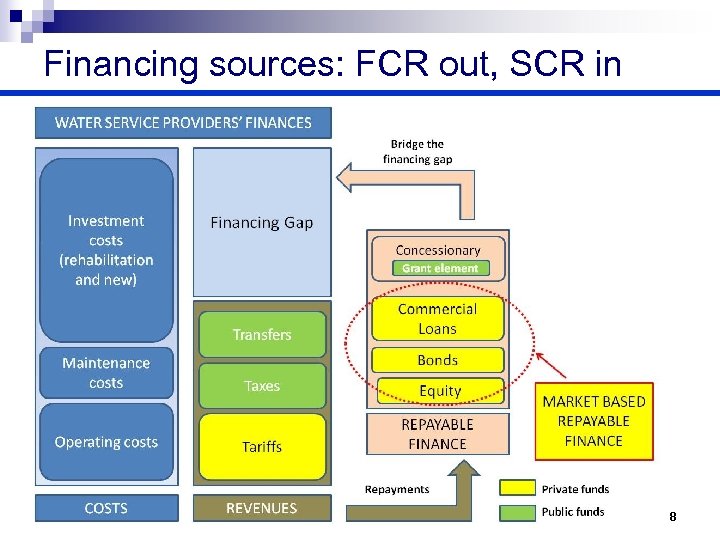
Financing sources: FCR out, SCR in 8
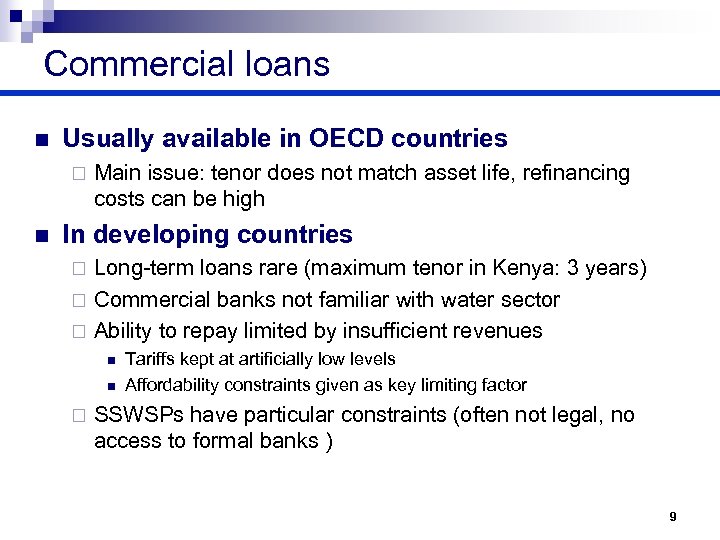
Commercial loans n Usually available in OECD countries ¨ n Main issue: tenor does not match asset life, refinancing costs can be high In developing countries Long-term loans rare (maximum tenor in Kenya: 3 years) ¨ Commercial banks not familiar with water sector ¨ Ability to repay limited by insufficient revenues ¨ n n ¨ Tariffs kept at artificially low levels Affordability constraints given as key limiting factor SSWSPs have particular constraints (often not legal, no access to formal banks ) 9
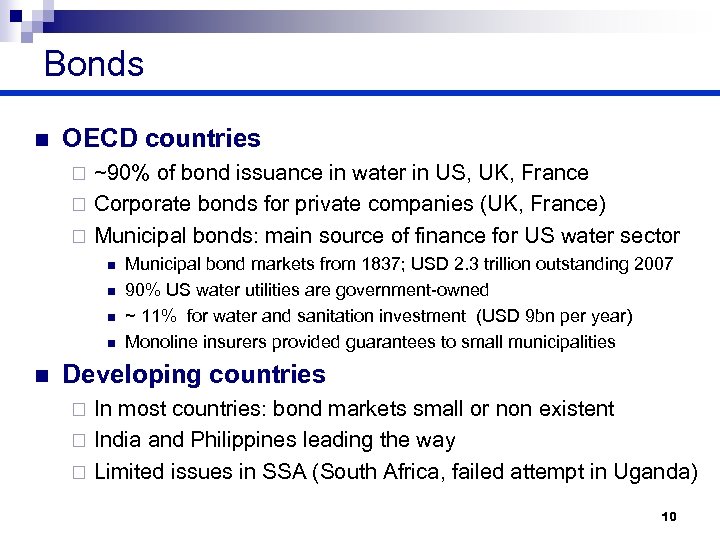
Bonds n OECD countries ~90% of bond issuance in water in US, UK, France ¨ Corporate bonds for private companies (UK, France) ¨ Municipal bonds: main source of finance for US water sector ¨ n n n Municipal bond markets from 1837; USD 2. 3 trillion outstanding 2007 90% US water utilities are government-owned ~ 11% for water and sanitation investment (USD 9 bn per year) Monoline insurers provided guarantees to small municipalities Developing countries In most countries: bond markets small or non existent ¨ India and Philippines leading the way ¨ Limited issues in SSA (South Africa, failed attempt in Uganda) ¨ 10
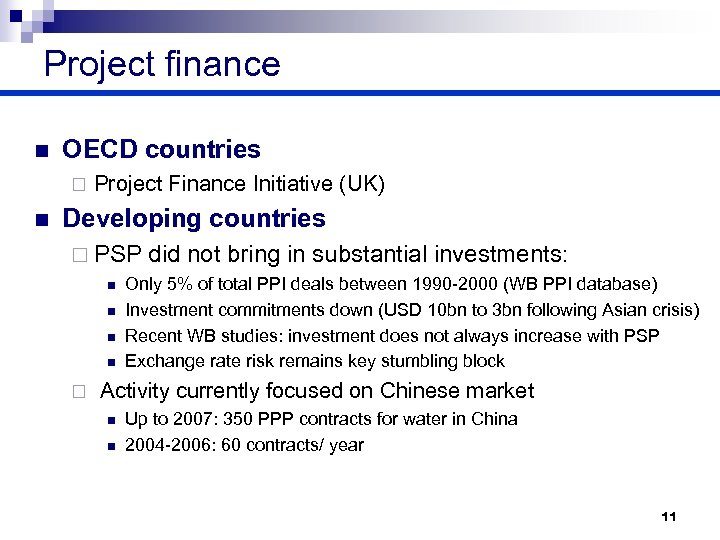
Project finance n OECD countries ¨ n Project Finance Initiative (UK) Developing countries ¨ PSP n n ¨ did not bring in substantial investments: Only 5% of total PPI deals between 1990 -2000 (WB PPI database) Investment commitments down (USD 10 bn to 3 bn following Asian crisis) Recent WB studies: investment does not always increase with PSP Exchange rate risk remains key stumbling block Activity currently focused on Chinese market n n Up to 2007: 350 PPP contracts for water in China 2004 -2006: 60 contracts/ year 11
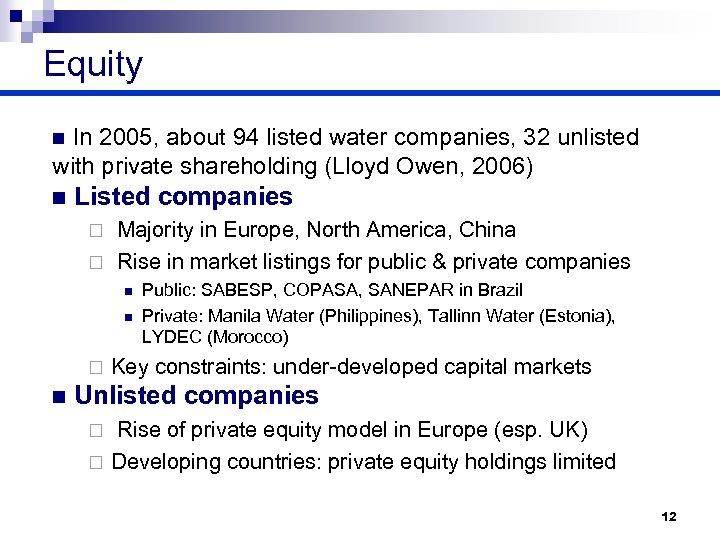
Equity In 2005, about 94 listed water companies, 32 unlisted with private shareholding (Lloyd Owen, 2006) n n Listed companies Majority in Europe, North America, China ¨ Rise in market listings for public & private companies ¨ n n ¨ n Public: SABESP, COPASA, SANEPAR in Brazil Private: Manila Water (Philippines), Tallinn Water (Estonia), LYDEC (Morocco) Key constraints: under-developed capital markets Unlisted companies Rise of private equity model in Europe (esp. UK) ¨ Developing countries: private equity holdings limited ¨ 12
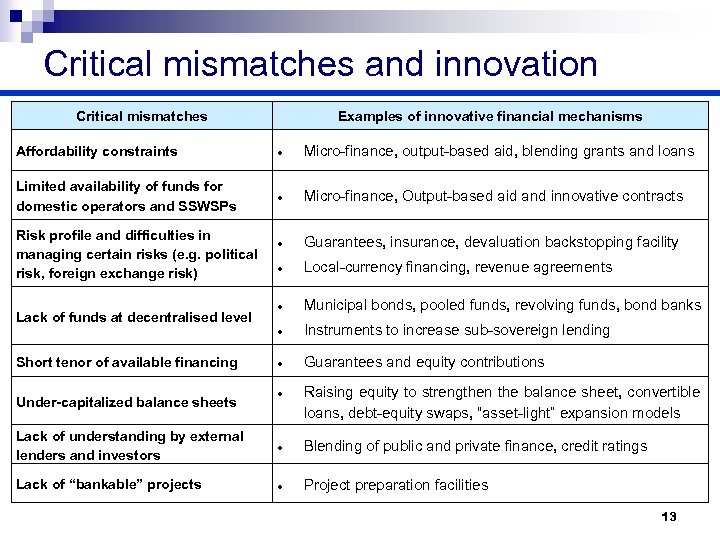
Critical mismatches and innovation Critical mismatches Examples of innovative financial mechanisms Affordability constraints Micro-finance, output-based aid, blending grants and loans Limited availability of funds for domestic operators and SSWSPs Micro-finance, Output-based aid and innovative contracts Guarantees, insurance, devaluation backstopping facility Local-currency financing, revenue agreements Municipal bonds, pooled funds, revolving funds, bond banks Instruments to increase sub-sovereign lending Guarantees and equity contributions Raising equity to strengthen the balance sheet, convertible loans, debt-equity swaps, “asset-light” expansion models Lack of understanding by external lenders and investors Blending of public and private finance, credit ratings Lack of “bankable” projects Project preparation facilities Risk profile and difficulties in managing certain risks (e. g. political risk, foreign exchange risk) Lack of funds at decentralised level Short tenor of available financing Under-capitalized balance sheets 13
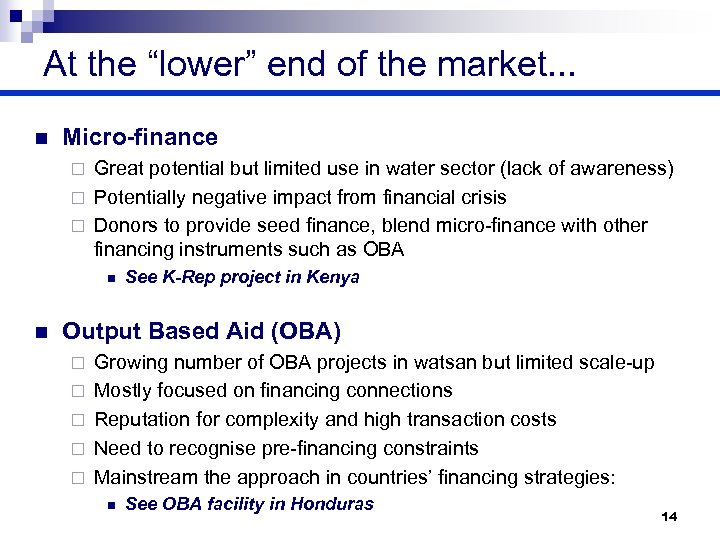
At the “lower” end of the market. . . n Micro-finance Great potential but limited use in water sector (lack of awareness) ¨ Potentially negative impact from financial crisis ¨ Donors to provide seed finance, blend micro-finance with other financing instruments such as OBA ¨ n n See K-Rep project in Kenya Output Based Aid (OBA) ¨ ¨ ¨ Growing number of OBA projects in watsan but limited scale-up Mostly focused on financing connections Reputation for complexity and high transaction costs Need to recognise pre-financing constraints Mainstream the approach in countries’ financing strategies: n See OBA facility in Honduras 14
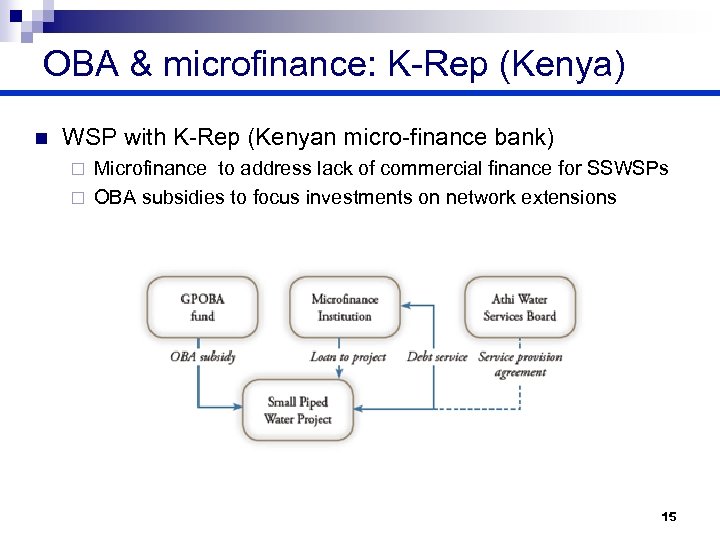
OBA & microfinance: K-Rep (Kenya) n WSP with K-Rep (Kenyan micro-finance bank) Microfinance to address lack of commercial finance for SSWSPs ¨ OBA subsidies to focus investments on network extensions ¨ 15
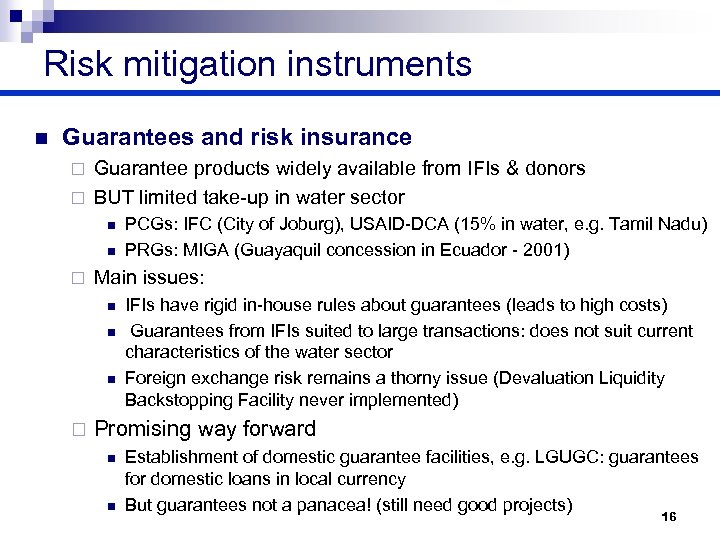
Risk mitigation instruments n Guarantees and risk insurance Guarantee products widely available from IFIs & donors ¨ BUT limited take-up in water sector ¨ n n ¨ Main issues: n n n ¨ PCGs: IFC (City of Joburg), USAID-DCA (15% in water, e. g. Tamil Nadu) PRGs: MIGA (Guayaquil concession in Ecuador - 2001) IFIs have rigid in-house rules about guarantees (leads to high costs) Guarantees from IFIs suited to large transactions: does not suit current characteristics of the water sector Foreign exchange risk remains a thorny issue (Devaluation Liquidity Backstopping Facility never implemented) Promising way forward n n Establishment of domestic guarantee facilities, e. g. LGUGC: guarantees for domestic loans in local currency But guarantees not a panacea! (still need good projects) 16
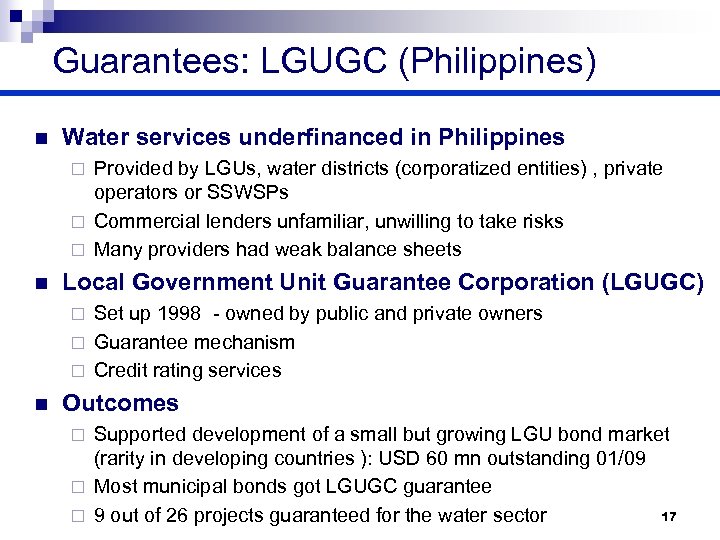
Guarantees: LGUGC (Philippines) n Water services underfinanced in Philippines Provided by LGUs, water districts (corporatized entities) , private operators or SSWSPs ¨ Commercial lenders unfamiliar, unwilling to take risks ¨ Many providers had weak balance sheets ¨ n Local Government Unit Guarantee Corporation (LGUGC) Set up 1998 - owned by public and private owners ¨ Guarantee mechanism ¨ Credit rating services ¨ n Outcomes Supported development of a small but growing LGU bond market (rarity in developing countries ): USD 60 mn outstanding 01/09 ¨ Most municipal bonds got LGUGC guarantee 17 ¨ 9 out of 26 projects guaranteed for the water sector ¨
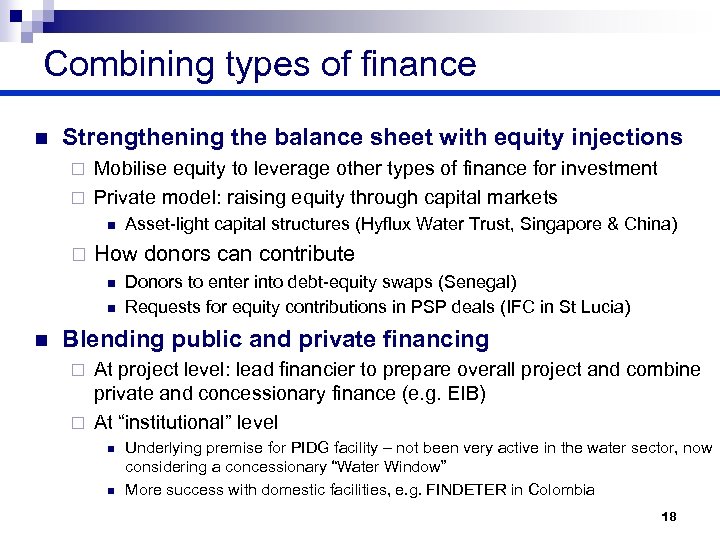
Combining types of finance n Strengthening the balance sheet with equity injections Mobilise equity to leverage other types of finance for investment ¨ Private model: raising equity through capital markets ¨ n ¨ How donors can contribute n n n Asset-light capital structures (Hyflux Water Trust, Singapore & China) Donors to enter into debt-equity swaps (Senegal) Requests for equity contributions in PSP deals (IFC in St Lucia) Blending public and private financing At project level: lead financier to prepare overall project and combine private and concessionary finance (e. g. EIB) ¨ At “institutional” level ¨ n n Underlying premise for PIDG facility – not been very active in the water sector, now considering a concessionary “Water Window” More success with domestic facilities, e. g. FINDETER in Colombia 18
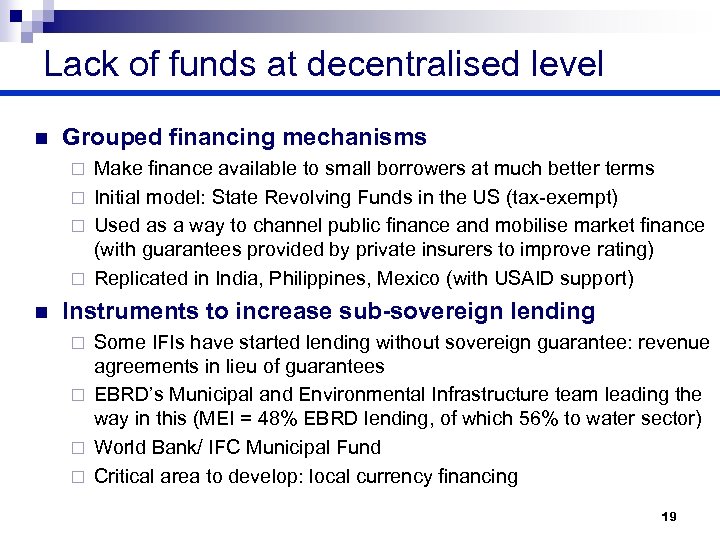
Lack of funds at decentralised level n Grouped financing mechanisms Make finance available to small borrowers at much better terms ¨ Initial model: State Revolving Funds in the US (tax-exempt) ¨ Used as a way to channel public finance and mobilise market finance (with guarantees provided by private insurers to improve rating) ¨ Replicated in India, Philippines, Mexico (with USAID support) ¨ n Instruments to increase sub-sovereign lending Some IFIs have started lending without sovereign guarantee: revenue agreements in lieu of guarantees ¨ EBRD’s Municipal and Environmental Infrastructure team leading the way in this (MEI = 48% EBRD lending, of which 56% to water sector) ¨ World Bank/ IFC Municipal Fund ¨ Critical area to develop: local currency financing ¨ 19
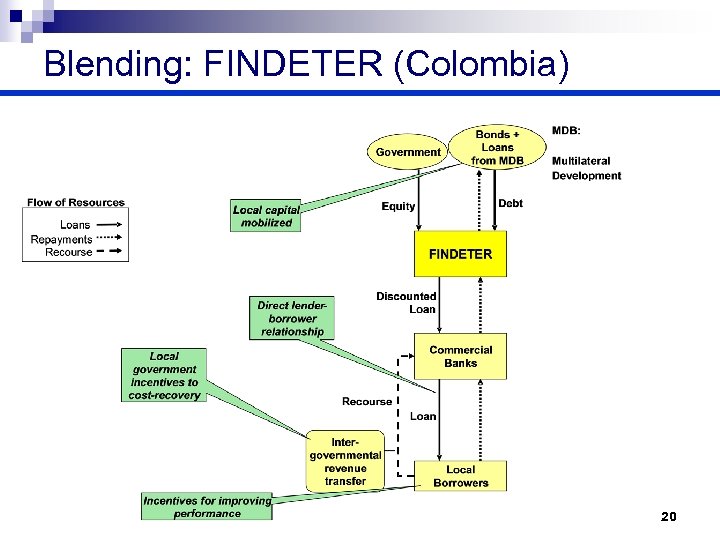
Blending: FINDETER (Colombia) 20
Improving information flows n Credit Ratings ¨ ¨ ¨ Limited use of credit ratings for water outside OECD countries India: significant development for local government bodies Philippines: grading municipal authorities based on credit-worthiness WSP /PPIAF supported “shadow ratings” for SSA water utilities Possible donor involvement: n n n Support demand for credit ratings Support development of credit agencies (and financial markets)? Project Preparation Facilities The lack of “good projects” remains the main constraint ¨ “Too much money chasing too few projects” ¨ A few attempts to redress this ¨ n n n ACP-EIB Water Project Preparation Facility (€ 3 mn over 3 years) PIDG facilities (TAF, Infra. Co) Establish project preparation facilities at national level? 21
Impact of crisis on market finance (1) n Commercial loans Sharp drop in lending volumes, increased cost of debt, reduced tenor (increases refinancing risk) ¨ Sovereign guarantees no panacea as sovereign credit risk increases ¨ Micro-finance institutions suffering as well ¨ n Bond markets ¨ Corporate bond markets “closed” in early 2008 but reopened for investment grade debt, at higher costs n n Isolated successes: over-subscribed issue for Manila Water with domestic Aaa rating (Oct 08) No high-yield bond issuance in water since SABESP (BB- ) in 2006 Municipal bond markets in US: sharp drop in issuance, massive downgrades following demise of monoline insurers in US ¨ Municipal bond markets elsewhere: increased costs 22 ¨ “Bond wrapping” practices no longer possible ¨
Impact of crisis on market finance (2) n Project finance Many projects stalled or put on hold ¨ Even in Middle East (e. g. Shuweihat in Abu Dhabi and Ad Dur in Bahrain), requires bridge financing or support from IFIs ¨ n Equity Listed water companies’ prices went down sharply in 2008 although have rebounced partly in early 2009 ¨ IPOs put on hold (e. g. Maynilad, AWW) ¨ Private equity model no longer viable ¨ Pension funds (who were interested in investing in water sector) may have to reallocate holdings to meet portfolio diversification needs ¨ 23
Impact of financial crisis on 3 Ts n Tariff revenues likely to remain low Economic crisis: reduced demand for traded goods (including agricultural and raw material), lower remittances, price inflation ¨ Increased poverty: 65 million more people < USD 2/day (WB) ¨ n Tax transfers to surge only where stimulus packages target water Substantial increases in public borrowing limit government transfers ¨ Some “green” stimulus packages include water programs ¨ n International transfers will increasingly be needed Research found that ODA usually falls during economic crisis ¨ IFIs going through a very busy period (fill in the gap) ¨ Major WB initiative to support infrastructure sector (INFRA) ¨ Support to all financial market segments e. g. IFC & Kf. W microfinance ¨ 24
Going forward n Market-based finance to the water sector: a safe haven in the midst of a financial storm? Can make a substantial contribution to public & private providers if sector can promote itself as “low risk / low but steady returns” ¨ Some innovation no longer viable following financial crisis ¨ All financing sources to be reflected and tracked (not only PPI) ¨ n Concessionary finance needed to get credit flowing but limited funds available Leveraging and targeting of public funds are key ¨ Viable innovations need to be scaled-up with donor support ¨ Emphasis should be placed on institution-building rather than “transaction-based” or pilot projects ¨ 25
Thank you! Contact sophie@tremolet. com Tel: +442076900090 Web: www. tremolet. com 26
Скачать презентацию Private money for public water A safe haven
5e82440b7374557a0c936f2603a4ae76.ppt