


 Скачать презентацию Private Law — Contract Unit 7 Preview
36bdcbb7ddff1aa490b953a3d23e6137.ppt
- Количество слайдов: 64
 Private Law - Contract Unit 7
 Preview § § § § § 1. Introduction: Law of contract: revision 1. 1. Private law: legal terms 3. Carlill v. Carbolic Smoke Ball Co 3. 1. First reading: understanding the contents and organisation of the text 3. 2. Reading for detail and language study: 3. 2. 1. The facts of the case 3. 2. 2. The defence 3. 2. 3. Understanding complex sentences 3. 2. 4. Role play 3. 2. 5. People in private law: word formation
 Assignment § Write a list of legal terms related to civil law
 Match each word to the correct definition: Plaintiff, to be entitled, to dismiss an appeal, case of first instance, damages, to hold § The first hearing of a case, not an appeal § Money given as legal compensation § To reject, or not accept an appeal § A person who brings an action in civil law § To have a right to something § To decide in legal proceedings
 Match each word to the correct definition: defendant, to hold, to be entitled, to dismiss an appeal, to sue, case of first instance, to deliver judgement, damages § A person who defends a civil or criminal action § To take legal action against someone in a civil case § To give a judicial decision
![Carlill v. Carbolic Smoke Ball Co. [1893] 1 Q. B. 256 § V. =](https://present5.com/presentation/36bdcbb7ddff1aa490b953a3d23e6137/image-6.jpg "Carlill v. Carbolic Smoke Ball Co. [1893] 1 Q. B. 256 § V. =") Carlill v. Carbolic Smoke Ball Co. [1893] 1 Q. B. 256 § V. = Versus § Co. = Company § 1 = volume 1 § Q. B. = the Queen’s Bench law reports § 256 = page 256
Carlill v. Carbolic Smoke Ball Co. [1893] 1 Q. B. 256 § V. = Versus § Co. = Company § 1 = volume 1 § Q. B. = the Queen’s Bench law reports § 256 = page 256
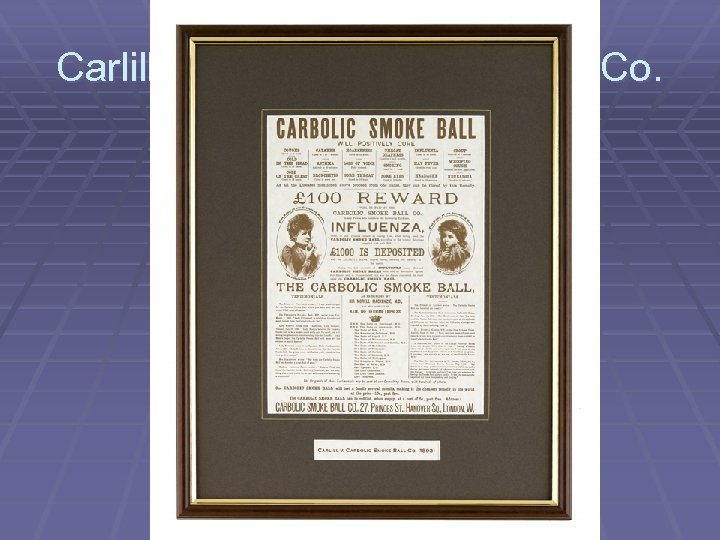 Carlill vs. Carbolic Smoke Ball Co.
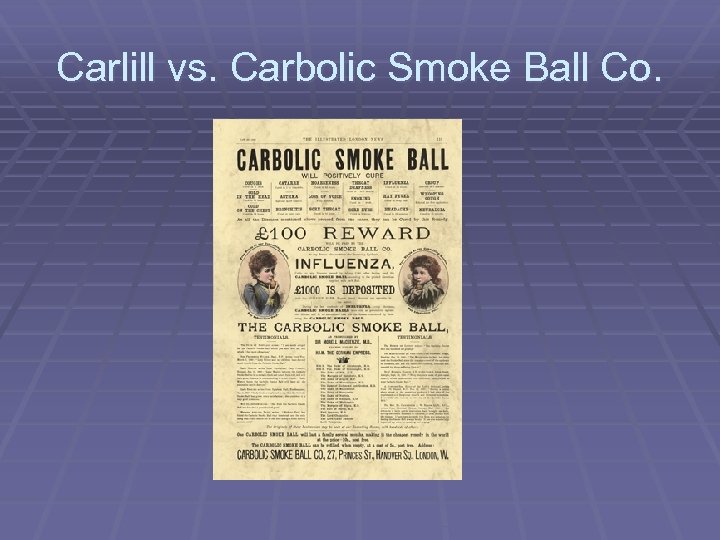 Carlill vs. Carbolic Smoke Ball Co.
 Divide the text into the following sections: § 1) legal principles decided in the case § 2) the facts of the case § 3) decision in the case of first instance § 4) first judge’s decision in the appeal § 5) second judge’s decision and judgment in the appeal: arguments for the defendant
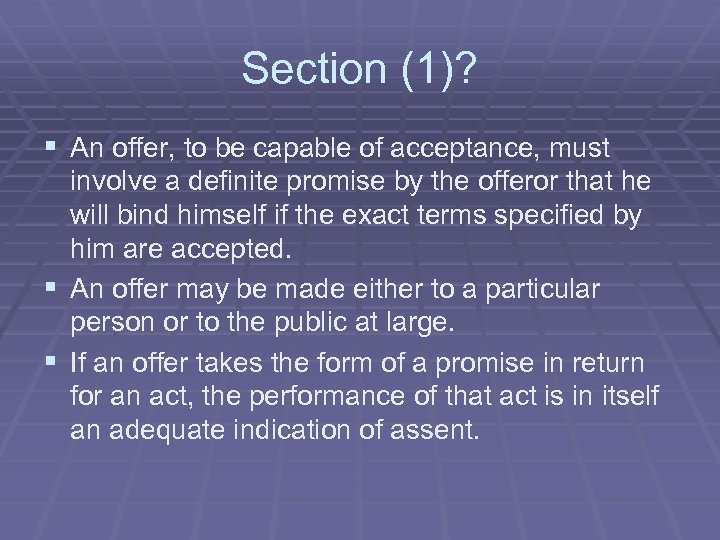 Section (1)? § An offer, to be capable of acceptance, must involve a definite promise by the offeror that he will bind himself if the exact terms specified by him are accepted. § An offer may be made either to a particular person or to the public at large. § If an offer takes the form of a promise in return for an act, the performance of that act is in itself an adequate indication of assent.
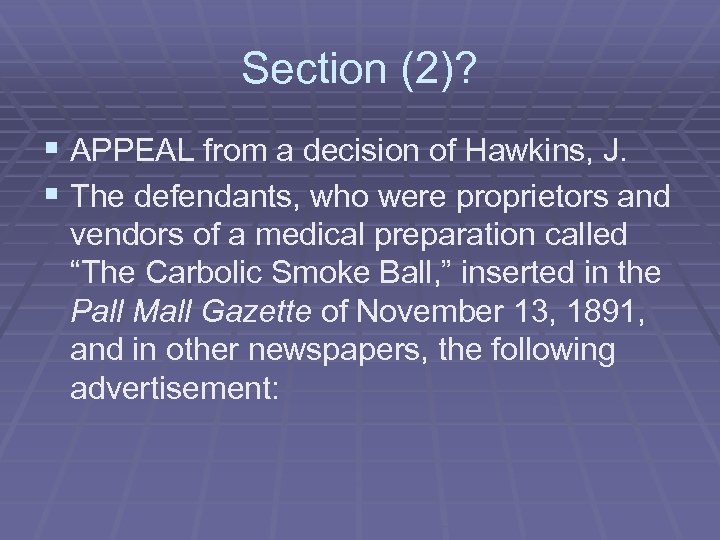 Section (2)? § APPEAL from a decision of Hawkins, J. § The defendants, who were proprietors and vendors of a medical preparation called “The Carbolic Smoke Ball, ” inserted in the Pall Mall Gazette of November 13, 1891, and in other newspapers, the following advertisement:
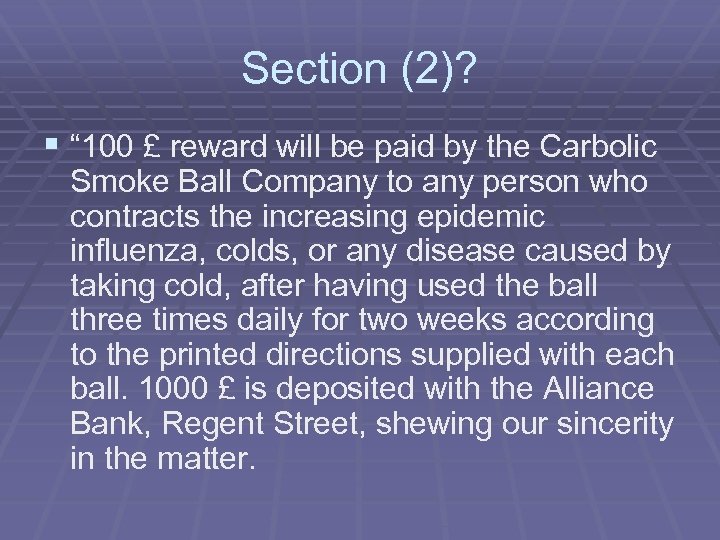 Section (2)? § “ 100 £ reward will be paid by the Carbolic Smoke Ball Company to any person who contracts the increasing epidemic influenza, colds, or any disease caused by taking cold, after having used the ball three times daily for two weeks according to the printed directions supplied with each ball. 1000 £ is deposited with the Alliance Bank, Regent Street, shewing our sincerity in the matter.
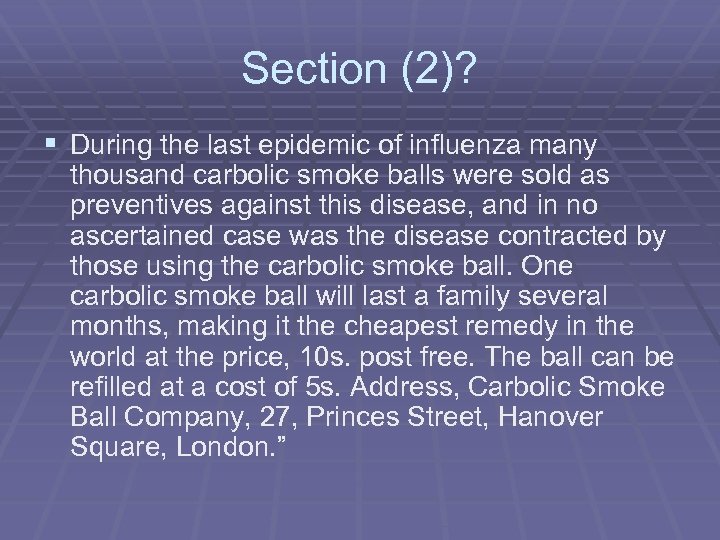 Section (2)? § During the last epidemic of influenza many thousand carbolic smoke balls were sold as preventives against this disease, and in no ascertained case was the disease contracted by those using the carbolic smoke ball. One carbolic smoke ball will last a family several months, making it the cheapest remedy in the world at the price, 10 s. post free. The ball can be refilled at a cost of 5 s. Address, Carbolic Smoke Ball Company, 27, Princes Street, Hanover Square, London. ”
 Section (2)? § The plaintiff, a lady, on the faith of this advertisement, bought one of the balls at a chemist’s, and used it as directed, three times a day, from November 20, 1891, to January 17, 1892, when she was attacked by influenza.
 Section (3)? § Hawkins, J. , held that she was entitled to recover the 100£. The defendants appealed.
 Section (4)? § Lindley, L. J. delivered judgment dismissing the appeal.
 Section (5)? § Bowen, L. J. I am of the same opinion. We were asked to say that this document was a contract too vague to be enforced.
 Section (5)? § The first observation which arises is that the document itself is not a contract at all, it is only an offer made to the public. The defendants contend next, that it is an offer the terms of which are too vague to be treated as a definite offer, inasmuch as there is no limit of time fixed for the catching of the influenza, and it cannot be supposed that the advertisers seriously meant to promise to pay money to every person who catches the influenza at any time after the inhaling of the smoke ball.
 Definite offer § To be considered definite, an offer (and a contract) generally must contain the following terms: (1) identification of the parties, (2) identification of the subject matter and quantity, (3) consideration to be paid, and (4) time of performance
 Section (5)? § It was urged also, that if you look at this document you will find much vagueness as to the persons with whom the contract was intended to be made – that, in the first place, its terms are wide enough to include persons who may have used the smoke ball before the advertisement was issued; at all events, that it is an offer to the world in general, and, also, that it is unreasonable to supose it to be a definite offer, because nobody in their senses would contract themselves out of the opportunity of checking the experiment which was going to be made at their own expense.
 Section (5)? § It is also contended that the advertisement is rather in the nature of a puff or a proclamation than a promise or offer intended to mature into a contract when accepted. But the main point seems to me that the vagueness of the document shews that no contract whatever was intended.
 The development of the text § Why do you think the case starts by stating the legal principles decided in the case?
 Scan the text to find 4 abbreviations. What do they mean? §J § Justice §£ § pound § shilling § LJ § Lord Justice
 Scan the text to find the following: § Who was the plaintiff in the case of first instance? § Who were the defendants? § Who won the case of first instance? § Who appealed against the decision?
 Find the meaning of the following words using context clues: § 1000 £. is DEPOSITED with the Alliance Bank § Many thousand smoke balls were sold as PREVENTIVES against this disease and in no case was the disease contracted § Hawkins J. held that she (the plaintiff) was entitled to RECOVER the 100 £ The defendants appealed.
 Definitions § To deposit = § to put a sum of money in a bank account § Preventives = § things that stop a person from catching a disease § Recover = § to get money from someone as the result of a favourable judgment in a lawsuit
 Answer the following questions: § § § What did the Carbolic Smoke Ball Co. sell? What were they for? According to the company, did they work? Were they expensive? Who did the Company offer to pay 100£ to? Why did they deposit 1000£ with the bank?
 Answer the following questions: § Why did the plaintiff buy the product? § Did she follow the instructions? § Did it work in her case? § Why do you suppose the company made this offer? § In your opinion, does it look like a serious offer? Give reasons.
 Facts of the case § As a preventive against flu the plaintiff bought a carbolic smoke ball from the defendant company because she had read their advertisement. She used it according to the instructions.
 Which summary of the facts corresponds to the text? § 1) She later sued the company for damages because she caught flu. § 2) She later sued the company for the 100 £ reward they had advertised because she caught flu. § 3) She later sued the company because she caught flu, and then appealed against the decision of the court of first instance.
 Describe the facts of the case: § “The defendants, the Carbolic Smoke Ball Company, sold a product called carbolic smoke balls, which they advertised as a very good preventive against flu. In their advertisement the Company offered to pay. . . ”
 Was the advertisment a contract? § No, it was an offer
 Understanding complex sentences § 1. Divide the sentence into short phrases § 2. Study each phrase: (1) for content – what information does it give? (2) for function – what is the relation to the rest of the sentence § 3. Think about the global meaning of the sentence: (1) what are the main points? (2) what other information is important?
 Divide the sentence into short, logical phrases § The Defendants contend next, that it is an offer the terms of which are too vague to be treated as a definite offer, inasmuch as there is no limit of time fixed for the catching of the influenza, and it cannot be supposed that the advertisers seriously meant to promise to pay money to every person who catches the influenza at any time after the inhaling of the smoke ball.
 Function: reporting/specifying/explaining/ asserting? § The defendants contend next, § reporting
 Function: reporting/specifying/explaining/ asserting? § that it is an offer § asserting
 Function: reporting/specifying/explaining/ asserting? § the terms of which are too vague to be treated as a definite offer, § specifying
 Function: reporting/specifying/explaining/ asserting? § inasmuch as there is no limit of time fixed for the catching of the influenza § reason - explaining
 Function: reporting/specifying/explaining/ asserting? § and it cannot be supposed that the advertisers seriusly meant § asserting
 Function: reporting/specifying/explaining/ asserting? § to promise to pay money § specifying
 Function: reporting/specifying/explaining/ asserting? § to every person § specifying
 Function: reporting/specifying/explaining/ asserting? § Who catches the influenza at any time after the inhaling of the smoke ball. § specifying
 What are the defendants’ main assertions? § 1. Not a definite offer; too vague; no time limit § 2. No intention to pay money to every person who catches the influenza § 3. An offer to the world in general § 4. Not a definite offer
 What are the defendants’ basic arguments? § It is too vague to be a definite offer (no time limit, etc. ) § It is an offer to the general public, not a particular person. § It is not a serious offer.
 Divide the sentence into short phrases § It was urged also, that if you look at this document you will find much vagueness as to the persons with whom the contract was intended to be made – that, in the first place, its terms are wide enough to include persons who may have used the smoke ball before the advertisement was issued; at all events, that it is an offer to the world in general, and, also, that it is unreasonable to suppose it to be a definite offer, because nobody in their senses would contract themselves out of the opportunity of checking the experiment which was going to be made at their own expense.
 Example sentence § It was urged also
 Function? § that, if you look at this document § Preliminary condition
 Function: asserting, specifying, explaining, reporting § you will find much vagueness § asserting
 Function: asserting, specifying, explaining, reporting § as to the persons with whom the contract was intended to be made § specifying
 Function: asserting, specifying, explaining, reporting § that, in the first place, its terms are wide enough § asserting
 Function: asserting, specifying, explaining, reporting § to include persons who may have used the smoke ball before the advertisement was issued; § specifying
 Function: asserting, specifying, explaining, reporting § at all events, that it is an offer to the world in general § asserting
 Function: asserting, specifying, explaining, reporting § And, also, that it is unreasonable to suppose it to be a definite offer, § asserting
 Function: asserting, specifying, explaining, reporting § Because nobody in their senses would contract themselves out of the opportunity § explaining
 Function: asserting, specifying, explaining, reporting § of checking the experiment which was going to be made at their own expense § specifying
 The sentence contains 4 main assertions. What are they? § The defendants contend that: § 1) the document is very vague (regarding the persons involved) § 2) its terms are wide enough (to include persons who may have used the smoke ball before the advertisement was issued) § 3) it is an offer to the world in general § 4) it is not a definite offer
 State the defentants’ arguments briefly in your own words § It is not a definite offer, because there is no time limit. It is too vague regarding the persons involved. It is an offer to the world in general. It is not a definite offer because there is no chance of checking the experiment. It is not a serious promise intended to form the basis of a contract. No contract is intended because the advertisment is too vague.
 Role play: introduction § Would there be a valid contract under your legal system in these circumstances? § Would the defendants be able to present similar arguments? § What arguments would the plaintiff present?
 Role play § Form groups of three. Each choose one of the following roles: § THE JUDGE § COUNSEL FOR THE DEFENDANT § COUNSEL FOR THE PLAINTIFF
 Role play § 1. JUDGE: present facts of the case § 2. COUNSEL FOR THE PLAINTIFF: Present your case. (Introduce your arguments with: ‘In my submission, the advertisment…’, ‘In my respectful submission…’’It is submitted that…’ § 3. COUNCIL FOR THE DEFENDANT: present your case (as in 2. above) § 4. JUDGE: coment on counsel’s submissions.
 Role play § Do you think the judges in Carlill will reach the same conclusions as you? § Compare your decision with other groups in the class. Do you all agree?
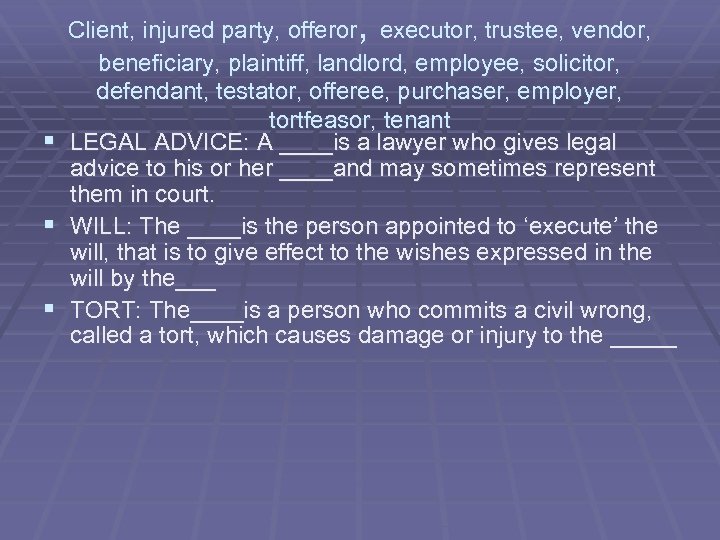 , Client, injured party, offeror executor, trustee, vendor, beneficiary, plaintiff, landlord, employee, solicitor, defendant, testator, offeree, purchaser, employer, tortfeasor, tenant § LEGAL ADVICE: A ____is a lawyer who gives legal advice to his or her ____and may sometimes represent them in court. § WILL: The ____is the person appointed to ‘execute’ the will, that is to give effect to the wishes expressed in the will by the___ § TORT: The____is a person who commits a civil wrong, called a tort, which causes damage or injury to the _____
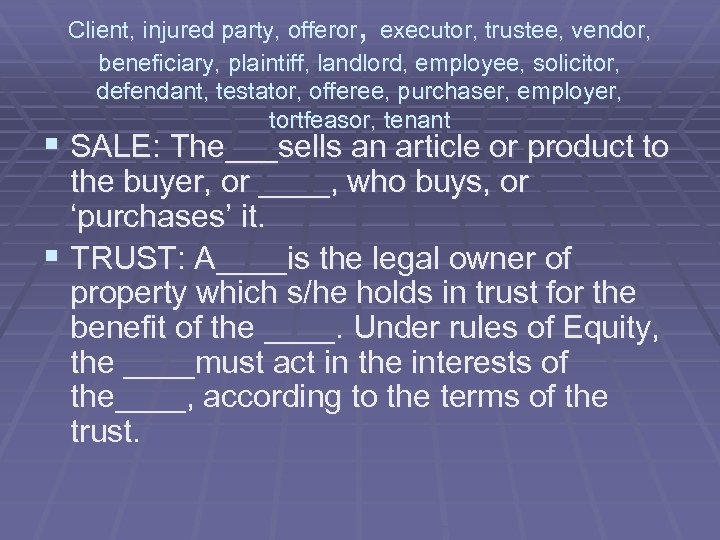 , Client, injured party, offeror executor, trustee, vendor, beneficiary, plaintiff, landlord, employee, solicitor, defendant, testator, offeree, purchaser, employer, tortfeasor, tenant § SALE: The___sells an article or product to the buyer, or ____, who buys, or ‘purchases’ it. § TRUST: A____is the legal owner of property which s/he holds in trust for the benefit of the ____. Under rules of Equity, the ____must act in the interests of the____, according to the terms of the trust.
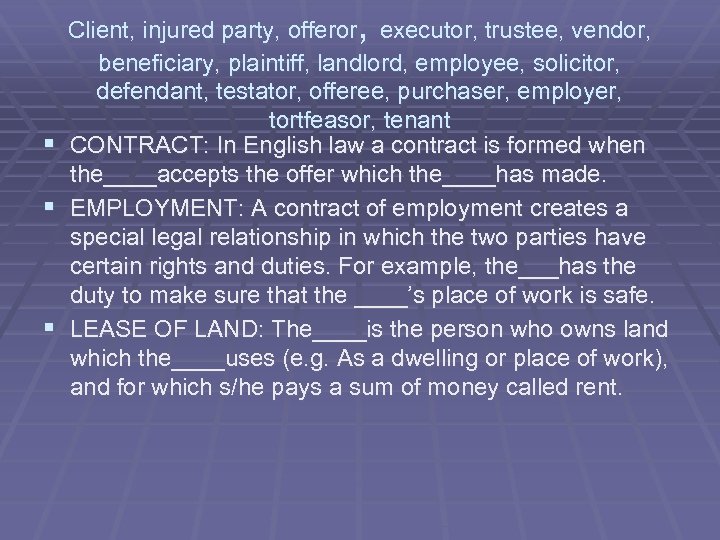 , Client, injured party, offeror executor, trustee, vendor, beneficiary, plaintiff, landlord, employee, solicitor, defendant, testator, offeree, purchaser, employer, tortfeasor, tenant § CONTRACT: In English law a contract is formed when the____accepts the offer which the____has made. § EMPLOYMENT: A contract of employment creates a special legal relationship in which the two parties have certain rights and duties. For example, the___has the duty to make sure that the ____’s place of work is safe. § LEASE OF LAND: The____is the person who owns land which the____uses (e. g. As a dwelling or place of work), and for which s/he pays a sum of money called rent.