


 Скачать презентацию Private Equity An Alternate Source of Capital
8b3be810ba8c09a1c09dbb4ca3a50b89.ppt
- Количество слайдов: 46
 Private Equity – An Alternate Source of Capital Private Alternatives to the Public Markets How to Survive and Grow in a Capital Constrained Environment A Private Conference on May 16, 2001 Sponsored by: Windsor Group Investment Banking Deloitte & Touche Holland & Knight LLP Holland & Knight Consulting SAUNDERS KARP & MEGRUE
 Private Equity – An Alternate Source of Capital Agenda • Introduction to SKM (A Brief SKM Commercial) • State of the Capital Markets (Ugly) • Private Equity as an Alternative Source of Capital (A Viable Option) • Overview of Saunders Karp & Megrue (A Longer SKM Commercial) SAUNDERS KARP & MEGRUE
 Private Equity – An Alternate Source of Capital SKM Overview • Founded in 1989 • Market Leader in Private Company Recapitalizations and Growth Company Buyouts • Selectively Pursue Buy-&-Build Strategies • Over $1. 7 Billion of Equity Capital Raised • Fund I = $300 Million • Fund II = $516 Million • Fund III = $943 Million • 2 Distinct Investment Teams Focused on the Entire Middle Market • Successfully Executed over 50 Investments in Last Seven Years • High Quality Group of Limited Partners • Rely, to a Lesser Extent, on the Public Capital Markets SAUNDERS KARP & MEGRUE
 Private Equity – An Alternate Source of Capital State of Capital Markets SAUNDERS KARP & MEGRUE
 Private Equity – An Alternate Source of Capital Current market conditions have made accessing the capital markets more difficult • Factors effecting how you grow your company, capital formation, capital investment and M&A activity are all struggling • Economy • Public equity market • High yield market • Senior bank market • Need to pursue non-traditional sources to access growth / liquidity capital SAUNDERS KARP & MEGRUE
 Private Equity – An Alternate Source of Capital Economy SAUNDERS KARP & MEGRUE
 Private Equity – An Alternate Source of Capital Turbulence in the Stock Market is the Result of Changes in the Macroeconomic Climate • Industrial production fell in April for the seventh consecutive month, the longest stretch since 1982 • Economy lost more jobs in April than at any time in the last decade, leading to highest unemployment levels in two-and-a-half years • Persistent erosion in current and expected profitability across all sectors • Retail sales reports showed a drop in sales at U. S. retailers during March • Consumer confidence, as measured by Consumer Sentiment Index, has dropped 19% since November 2000 • Lay-offs impacted 545, 000 employees during the first 3 months of 2001 at over 4, 500 companies SAUNDERS KARP & MEGRUE
 Private Equity – An Alternate Source of Capital Public Equity Markets SAUNDERS KARP & MEGRUE
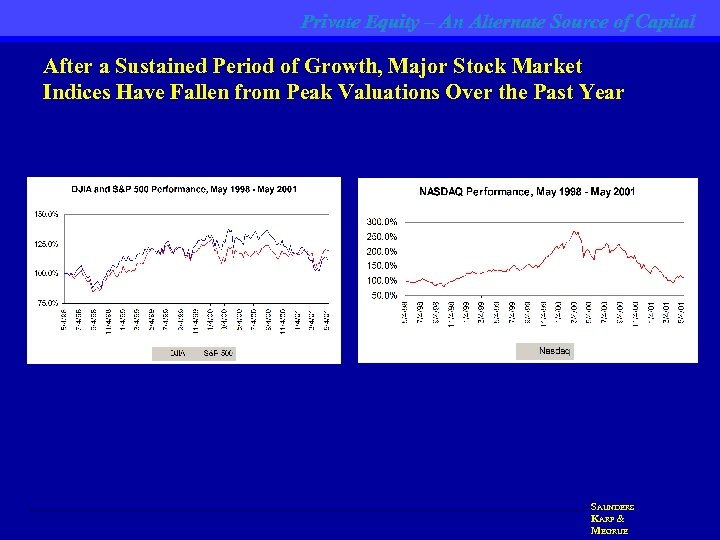 Private Equity – An Alternate Source of Capital After a Sustained Period of Growth, Major Stock Market Indices Have Fallen from Peak Valuations Over the Past Year SAUNDERS KARP & MEGRUE
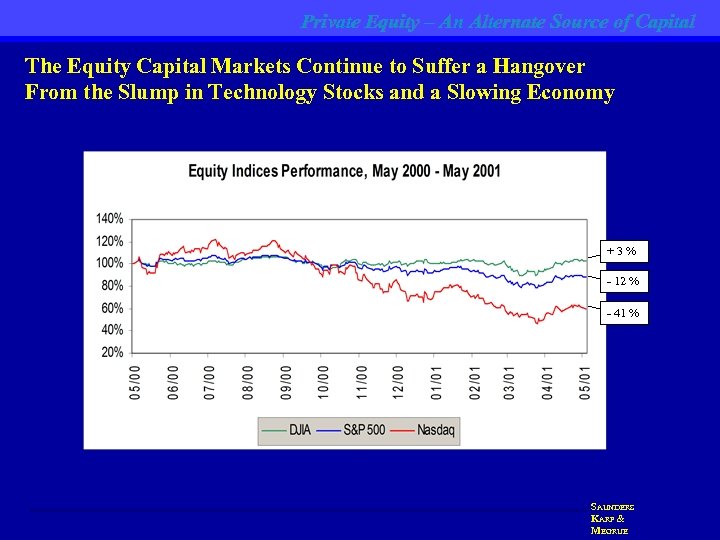 Private Equity – An Alternate Source of Capital The Equity Capital Markets Continue to Suffer a Hangover From the Slump in Technology Stocks and a Slowing Economy + 3 % - 12 % - 41 % SAUNDERS KARP & MEGRUE
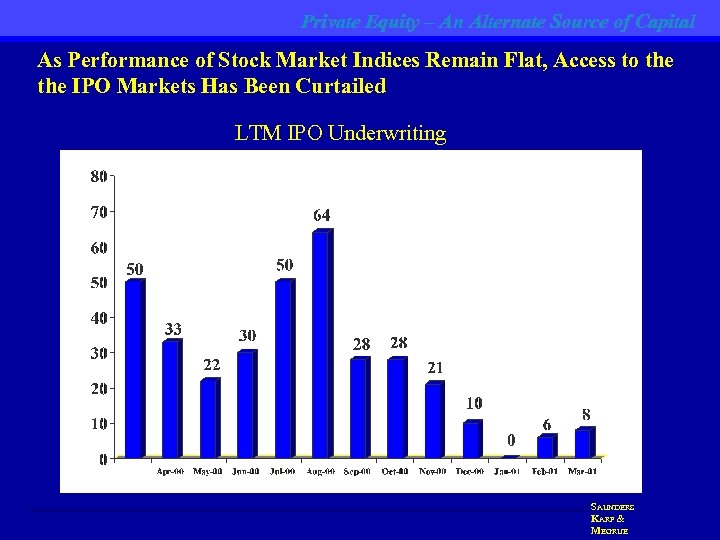 Private Equity – An Alternate Source of Capital As Performance of Stock Market Indices Remain Flat, Access to the IPO Markets Has Been Curtailed LTM IPO Underwriting SAUNDERS KARP & MEGRUE
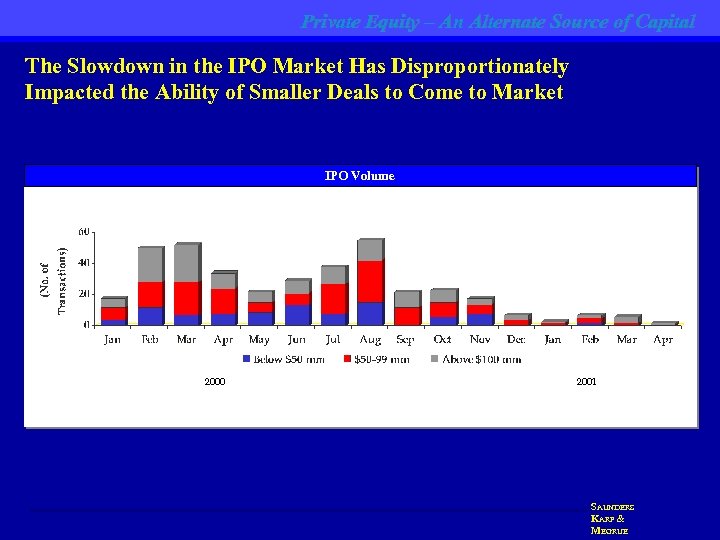 Private Equity – An Alternate Source of Capital The Slowdown in the IPO Market Has Disproportionately Impacted the Ability of Smaller Deals to Come to Market IPO Volume 2000 2001 SAUNDERS KARP & MEGRUE
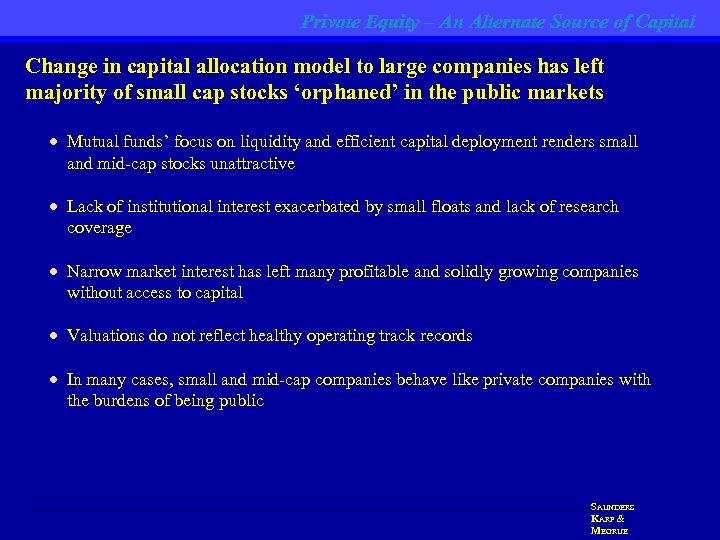 Private Equity – An Alternate Source of Capital Change in capital allocation model to large companies has left majority of small cap stocks ‘orphaned’ in the public markets · Mutual funds’ focus on liquidity and efficient capital deployment renders small and mid-cap stocks unattractive · Lack of institutional interest exacerbated by small floats and lack of research coverage · Narrow market interest has left many profitable and solidly growing companies without access to capital · Valuations do not reflect healthy operating track records · In many cases, small and mid-cap companies behave like private companies with the burdens of being public SAUNDERS KARP & MEGRUE
 Private Equity – An Alternate Source of Capital High Yield Markets SAUNDERS KARP & MEGRUE
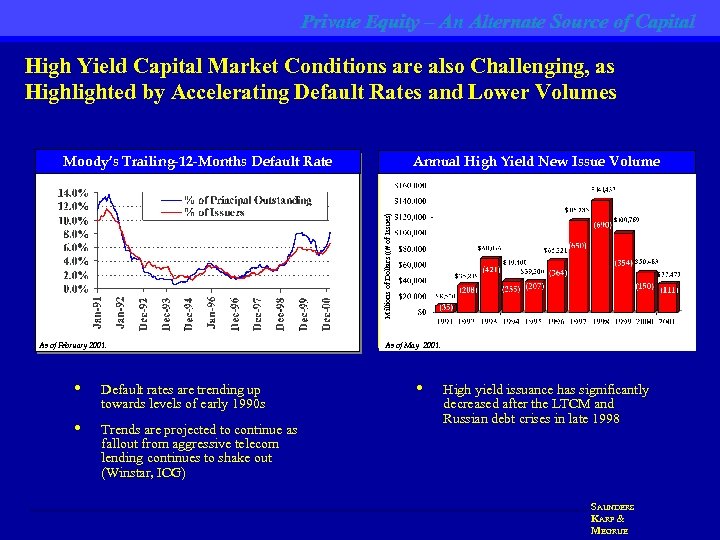 Private Equity – An Alternate Source of Capital High Yield Capital Market Conditions are also Challenging, as Highlighted by Accelerating Default Rates and Lower Volumes Moody’s Trailing-12 -Months Default Rate Millions of Dollars ((# of Issues) Annual High Yield New Issue Volume As of February 2001. • Default rates are trending up towards levels of early 1990 s • Trends are projected to continue as fallout from aggressive telecom lending continues to shake out (Winstar, ICG) As of May 2001. • High yield issuance has significantly decreased after the LTCM and Russian debt crises in late 1998 SAUNDERS KARP & MEGRUE
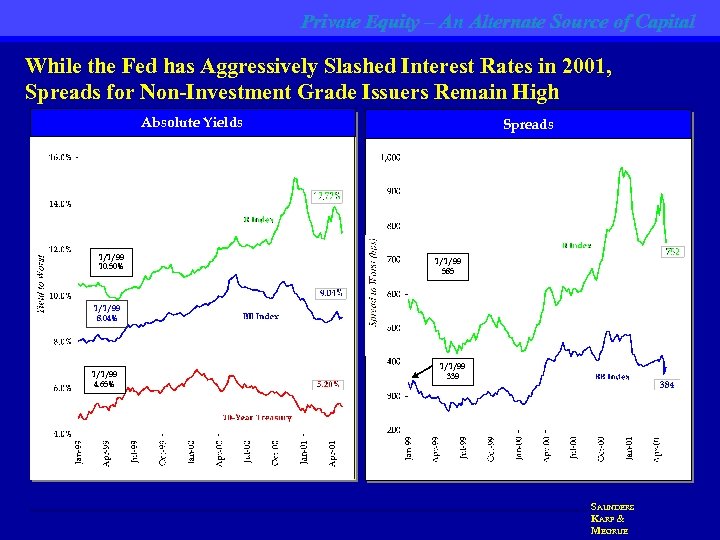 Private Equity – An Alternate Source of Capital While the Fed has Aggressively Slashed Interest Rates in 2001, Spreads for Non-Investment Grade Issuers Remain High Absolute Yields 1/1/99 10. 50% Spreads 1/1/99 585 1/1/99 8. 04% 1/1/99 4. 65% 1/1/99 339 SAUNDERS KARP & MEGRUE
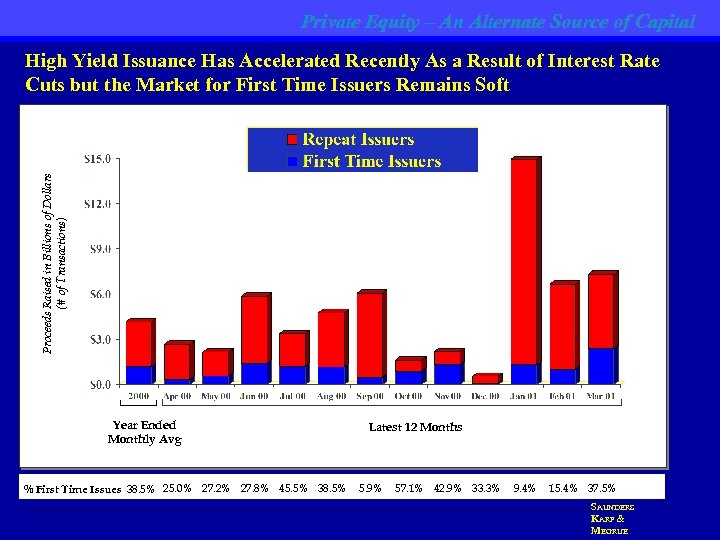 Private Equity – An Alternate Source of Capital Proceeds Raised in Billions of Dollars (# of Transactions) High Yield Issuance Has Accelerated Recently As a Result of Interest Rate Cuts but the Market for First Time Issuers Remains Soft Year Ended Monthly Avg % First Time Issues 38. 5% 25. 0% 27. 2% 27. 8% 45. 5% 38. 5% Latest 12 Months 5. 9% 57. 1% 42. 9% 33. 3% 9. 4% 15. 4% 37. 5% SAUNDERS KARP & MEGRUE
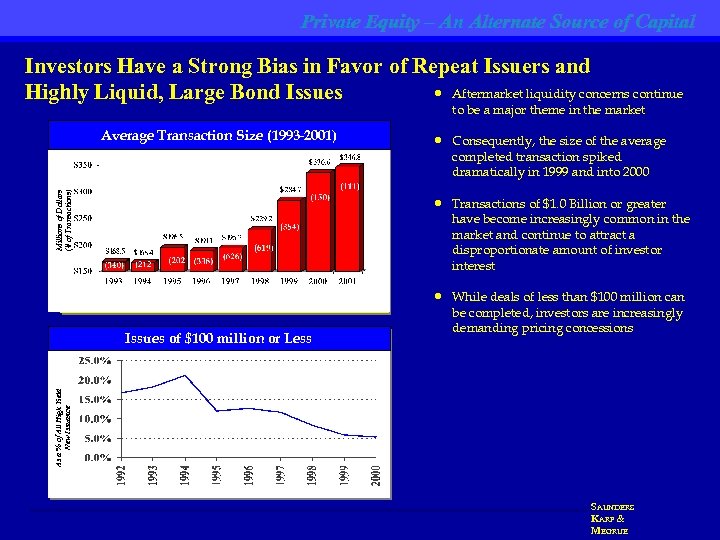 Private Equity – An Alternate Source of Capital Investors Have a Strong Bias in Favor of Repeat Issuers and · Aftermarket liquidity concerns continue Highly Liquid, Large Bond Issues to be a major theme in the market Average Transaction Size (1993 -2001) · Millions of Dollars (# of Transactions) Transactions of $1. 0 Billion or greater have become increasingly common in the market and continue to attract a disproportionate amount of investor interest While deals of less than $100 million can be completed, investors are increasingly demanding pricing concessions As a % of All High Yield New Issuance Consequently, the size of the average completed transaction spiked dramatically in 1999 and into 2000 · Issues of $100 million or Less · SAUNDERS KARP & MEGRUE
 Private Equity – An Alternate Source of Capital Senior Bank Markets SAUNDERS KARP & MEGRUE
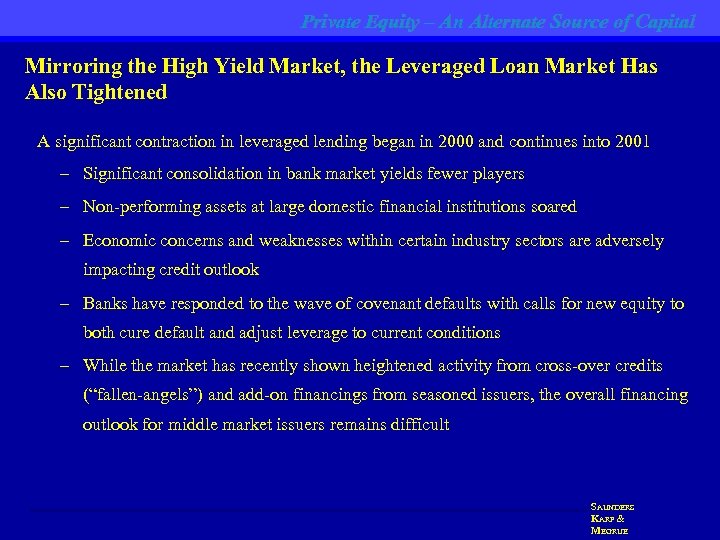 Private Equity – An Alternate Source of Capital Mirroring the High Yield Market, the Leveraged Loan Market Has Also Tightened A significant contraction in leveraged lending began in 2000 and continues into 2001 – Significant consolidation in bank market yields fewer players – Non-performing assets at large domestic financial institutions soared – Economic concerns and weaknesses within certain industry sectors are adversely impacting credit outlook – Banks have responded to the wave of covenant defaults with calls for new equity to both cure default and adjust leverage to current conditions – While the market has recently shown heightened activity from cross-over credits (“fallen-angels”) and add-on financings from seasoned issuers, the overall financing outlook for middle market issuers remains difficult SAUNDERS KARP & MEGRUE
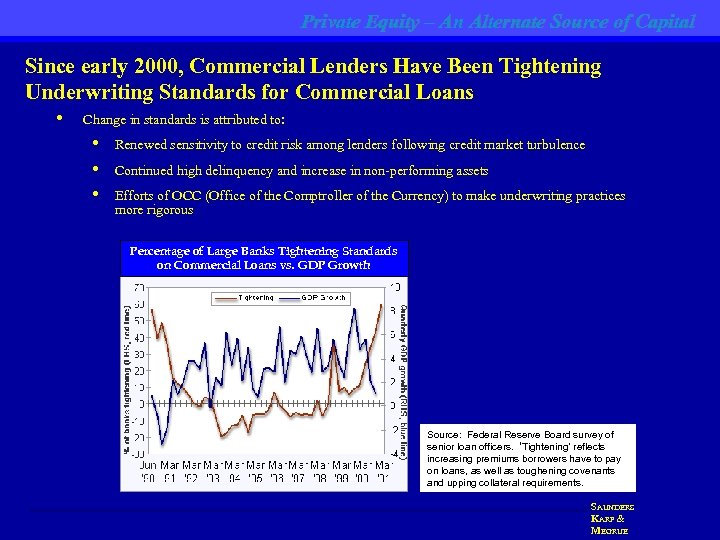 Private Equity – An Alternate Source of Capital Since early 2000, Commercial Lenders Have Been Tightening Underwriting Standards for Commercial Loans • Change in standards is attributed to: • • • Renewed sensitivity to credit risk among lenders following credit market turbulence Continued high delinquency and increase in non-performing assets Efforts of OCC (Office of the Comptroller of the Currency) to make underwriting practices more rigorous Percentage of Large Banks Tightening Standards on Commercial Loans vs. GDP Growth Source: Federal Reserve Board survey of senior loan officers. ‘Tightening’ reflects increasing premiums borrowers have to pay on loans, as well as toughening covenants and upping collateral requirements. SAUNDERS KARP & MEGRUE
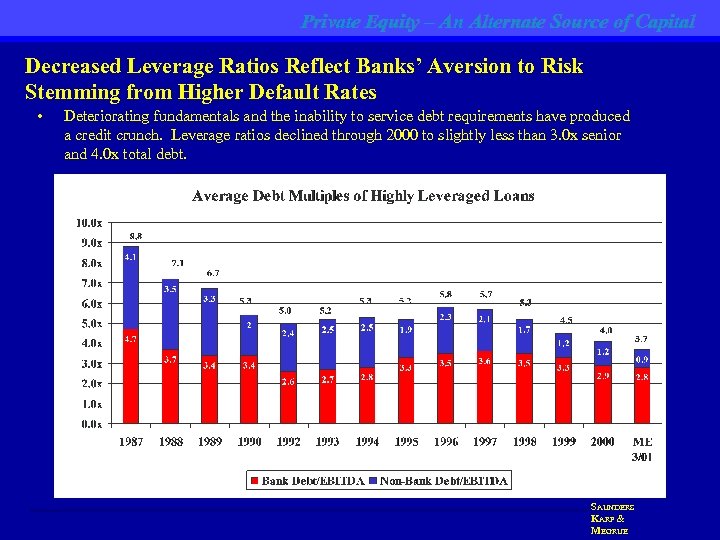 Private Equity – An Alternate Source of Capital Decreased Leverage Ratios Reflect Banks’ Aversion to Risk Stemming from Higher Default Rates • Deteriorating fundamentals and the inability to service debt requirements have produced a credit crunch. Leverage ratios declined through 2000 to slightly less than 3. 0 x senior and 4. 0 x total debt. SAUNDERS KARP & MEGRUE
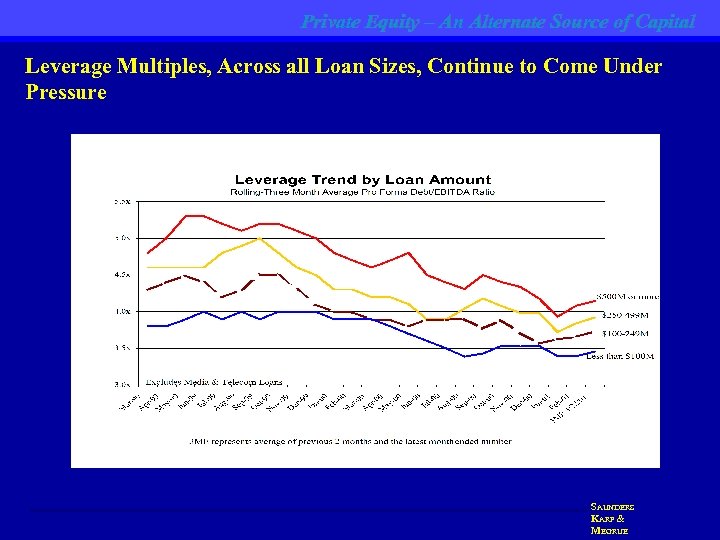 Private Equity – An Alternate Source of Capital Leverage Multiples, Across all Loan Sizes, Continue to Come Under Pressure SAUNDERS KARP & MEGRUE
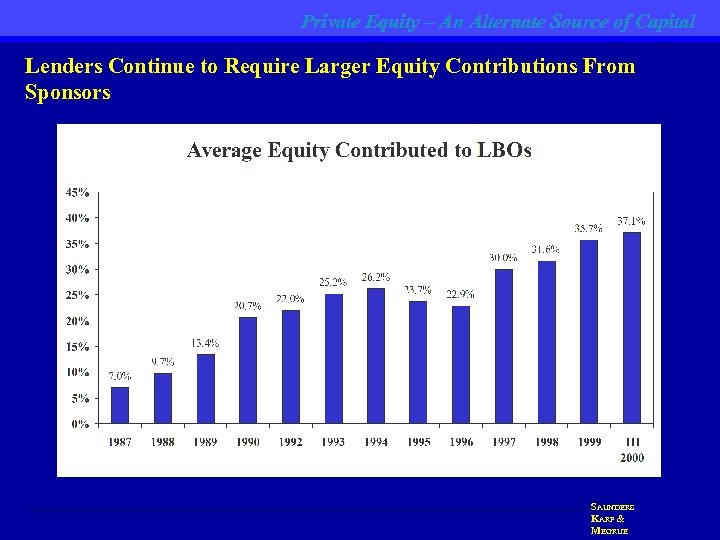 Private Equity – An Alternate Source of Capital Lenders Continue to Require Larger Equity Contributions From Sponsors SAUNDERS KARP & MEGRUE
 Private Equity – An Alternate Source of Capital Private Equity SAUNDERS KARP & MEGRUE
 Private Equity – An Alternate Source of Capital The Turmoil in the Capital Markets Has Disproportionately Impacted Small and Mid-Cap Companies • Equity and debt markets have become increasingly more difficult to access • As a result, increasing numbers of small and mid-cap companies in need of capital are considering private equity • As an alternate pool of capital, private equity is less dependent on the public capital markets SAUNDERS KARP & MEGRUE
 Private Equity – An Alternate Source of Capital Private Equity is Defined as an Equity Investment in any Commercial Enterprise that is not Registered for Public Sale Types of P. E. Investing • Venture Capital – Eearly stage or start-up investment. Highest risk profile, VC investments are relatively small compared to other P. E. classes. • LBO – Substantial ownership / control interest in an established company, funded by a mix of sponsor equity and borrowings. • Mezzanine – Intermediate debt capital between equity and senior debt. Debt holder participates in equity appreciation through conversion features such as warrants or options. SAUNDERS KARP & MEGRUE
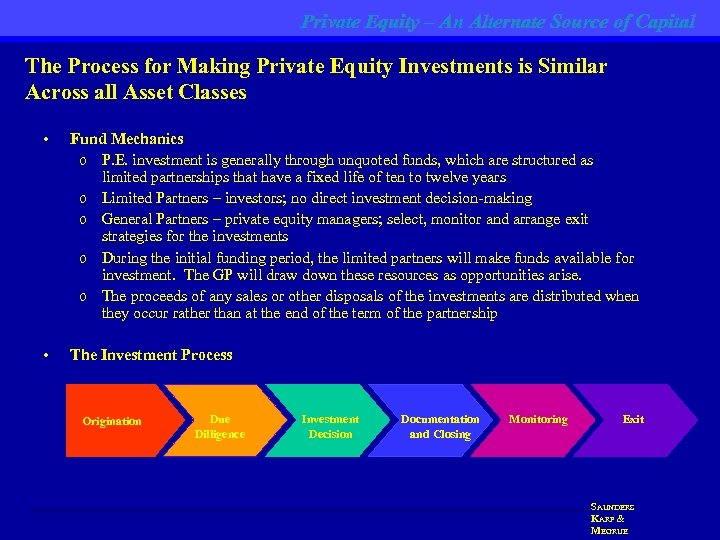 Private Equity – An Alternate Source of Capital The Process for Making Private Equity Investments is Similar Across all Asset Classes • Fund Mechanics o P. E. investment is generally through unquoted funds, which are structured as limited partnerships that have a fixed life of ten to twelve years o Limited Partners – investors; no direct investment decision-making o General Partners – private equity managers; select, monitor and arrange exit strategies for the investments o During the initial funding period, the limited partners will make funds available for investment. The GP will draw down these resources as opportunities arise. o The proceeds of any sales or other disposals of the investments are distributed when they occur rather than at the end of the term of the partnership • The Investment Process Origination Due Dilligence Investment Decision Documentation and Closing Monitoring Exit SAUNDERS KARP & MEGRUE
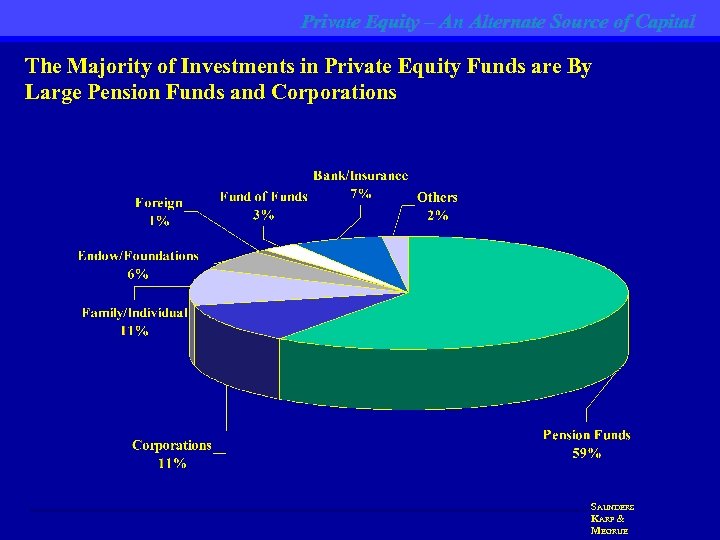 Private Equity – An Alternate Source of Capital The Majority of Investments in Private Equity Funds are By Large Pension Funds and Corporations SAUNDERS KARP & MEGRUE
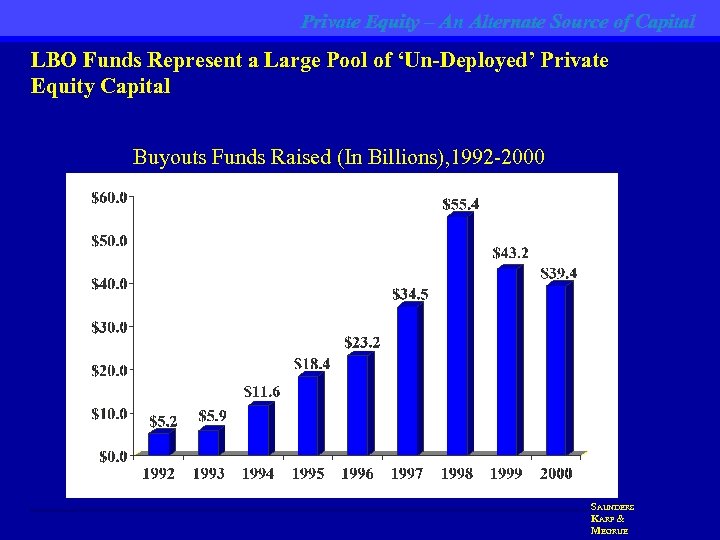 Private Equity – An Alternate Source of Capital LBO Funds Represent a Large Pool of ‘Un-Deployed’ Private Equity Capital Buyouts Funds Raised (In Billions), 1992 -2000 SAUNDERS KARP & MEGRUE
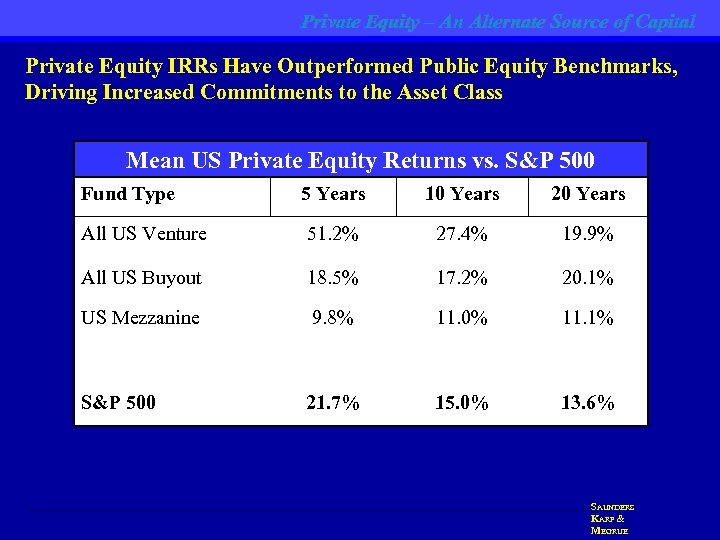 Private Equity – An Alternate Source of Capital Private Equity IRRs Have Outperformed Public Equity Benchmarks, Driving Increased Commitments to the Asset Class Mean US Private Equity Returns vs. S&P 500 Fund Type 5 Years 10 Years 20 Years All US Venture 51. 2% 27. 4% 19. 9% All US Buyout 18. 5% 17. 2% 20. 1% US Mezzanine 9. 8% 11. 0% 11. 1% 21. 7% 15. 0% 13. 6% S&P 500 SAUNDERS KARP & MEGRUE
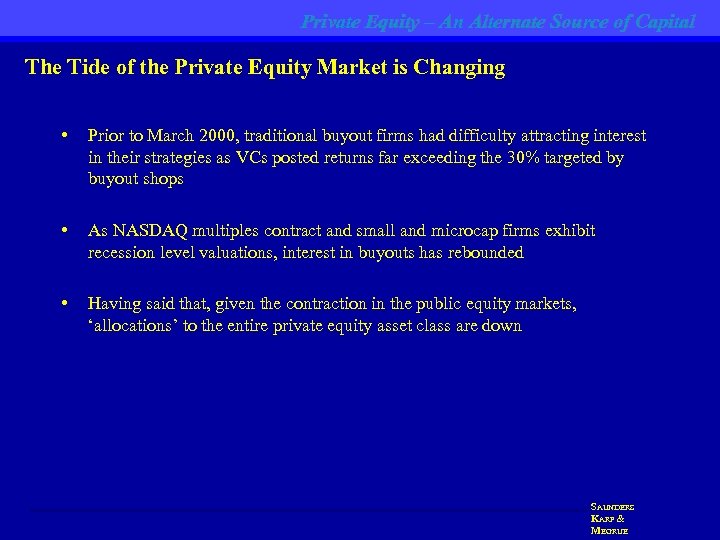 Private Equity – An Alternate Source of Capital The Tide of the Private Equity Market is Changing • Prior to March 2000, traditional buyout firms had difficulty attracting interest in their strategies as VCs posted returns far exceeding the 30% targeted by buyout shops • As NASDAQ multiples contract and small and microcap firms exhibit recession level valuations, interest in buyouts has rebounded • Having said that, given the contraction in the public equity markets, ‘allocations’ to the entire private equity asset class are down SAUNDERS KARP & MEGRUE
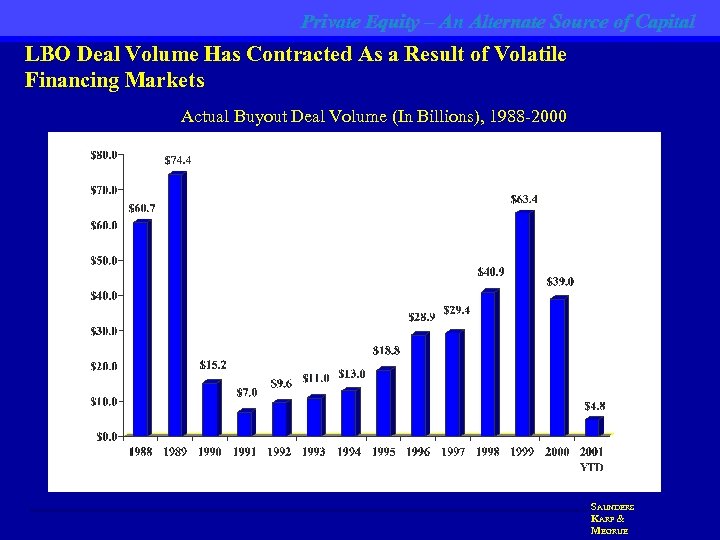 Private Equity – An Alternate Source of Capital LBO Deal Volume Has Contracted As a Result of Volatile Financing Markets Actual Buyout Deal Volume (In Billions), 1988 -2000 SAUNDERS KARP & MEGRUE
 Private Equity – An Alternate Source of Capital Multiples for US LBOs Have Contracted While Strategic Buyer Multiples Remain Constant • Throughout most of the 1990 s , the average multiple of EBITDA increased year after year, but then leveled off in February 1999 and has contracted since • Restricted access to debt markets in 2000 has contributed to this contraction • Multiples paid depend significantly on growth of business, capital requirements and leverage available SAUNDERS KARP & MEGRUE
 Private Equity – An Alternate Source of Capital Partnering with a Private Equity Investor • Huge pool of ‘un-deployed’ capital • Many private equity investors favor small-cap companies • Private equity sponsors can be valuable partners – Expert in accessing capital – Strategic / growth decisions – M&A activity – Attracting management talent – Optimizing exit scenarios SAUNDERS KARP & MEGRUE
 Private Equity – An Alternate Source of Capital Saunders Karp & Megrue SAUNDERS KARP & MEGRUE
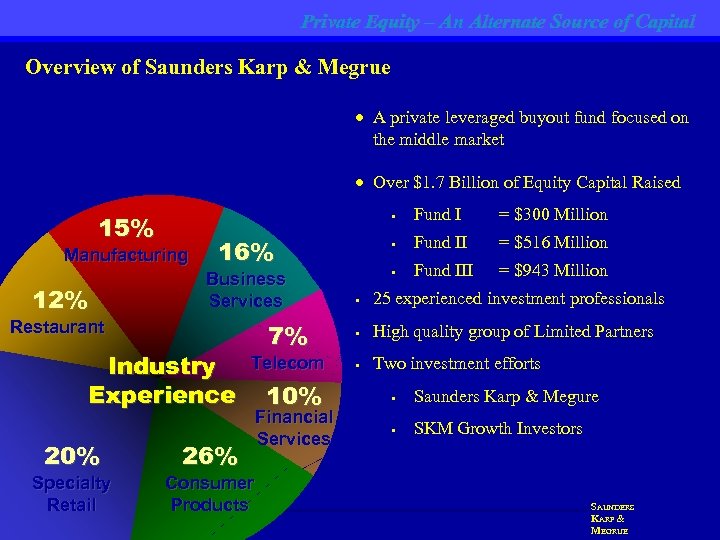 Private Equity – An Alternate Source of Capital Overview of Saunders Karp & Megrue · A private leveraged buyout fund focused on the middle market · Over $1. 7 Billion of Equity Capital Raised • 15% Manufacturing 12% Business Services Fund II = $516 Million • Fund III = $943 Million • 25 experienced investment professionals 7% • High quality group of Limited Partners Telecom • Two investment efforts Restaurant Industry Experience = $300 Million • 16% Fund I 10% Financial Services 20% 26% Specialty Retail Consumer Products • Saunders Karp & Megure • SKM Growth Investors SAUNDERS KARP & MEGRUE
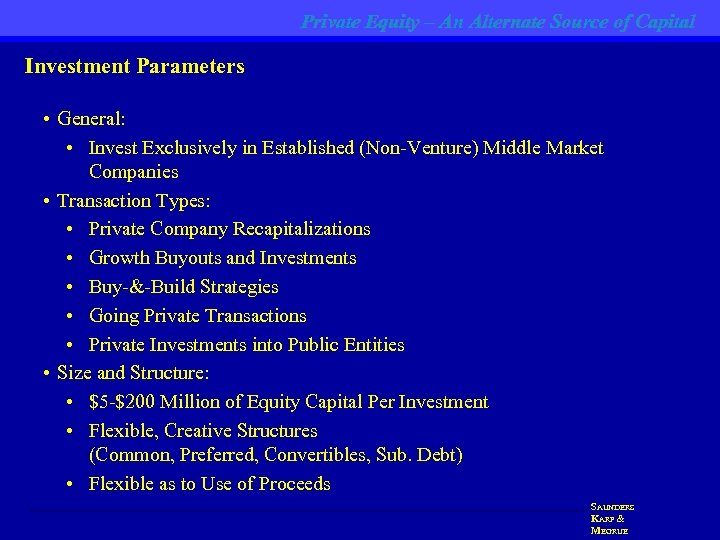 Private Equity – An Alternate Source of Capital Investment Parameters • General: • Invest Exclusively in Established (Non-Venture) Middle Market Companies • Transaction Types: • Private Company Recapitalizations • Growth Buyouts and Investments • Buy-&-Build Strategies • Going Private Transactions • Private Investments into Public Entities • Size and Structure: • $5 -$200 Million of Equity Capital Per Investment • Flexible, Creative Structures (Common, Preferred, Convertibles, Sub. Debt) • Flexible as to Use of Proceeds SAUNDERS KARP & MEGRUE
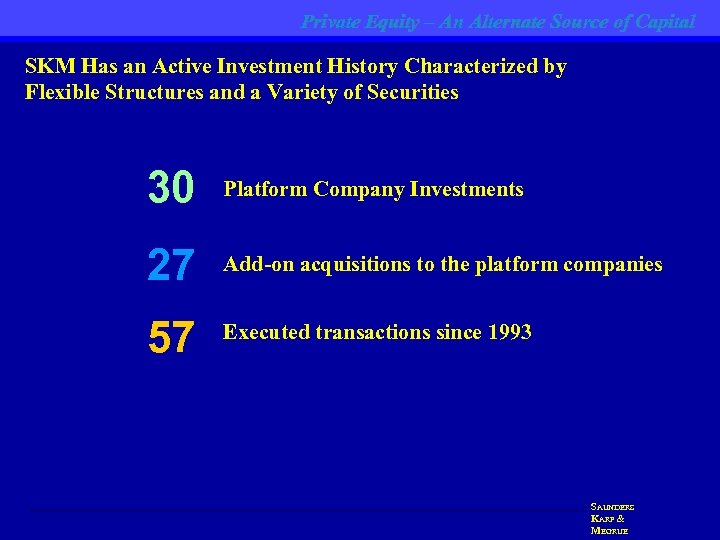 Private Equity – An Alternate Source of Capital SKM Has an Active Investment History Characterized by Flexible Structures and a Variety of Securities 30 Platform Company Investments 27 Add-on acquisitions to the platform companies 57 Executed transactions since 1993 SAUNDERS KARP & MEGRUE
 Private Equity – An Alternate Source of Capital ® A TRADITION OF EXCELLENCE SAUNDERS KARP & MEGRUE
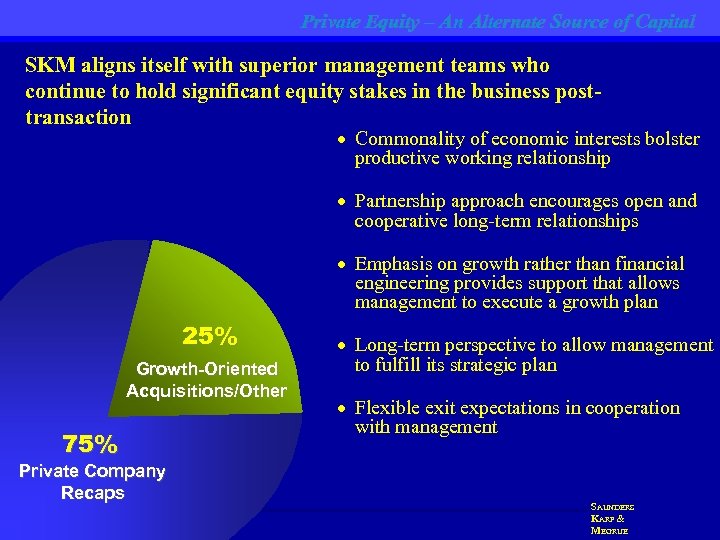 Private Equity – An Alternate Source of Capital SKM aligns itself with superior management teams who continue to hold significant equity stakes in the business posttransaction · Commonality of economic interests bolster productive working relationship · Partnership approach encourages open and cooperative long-term relationships · Emphasis on growth rather than financial engineering provides support that allows management to execute a growth plan 25% Growth-Oriented Acquisitions/Other 75% Private Company Recaps · Long-term perspective to allow management to fulfill its strategic plan · Flexible exit expectations in cooperation with management SAUNDERS KARP & MEGRUE
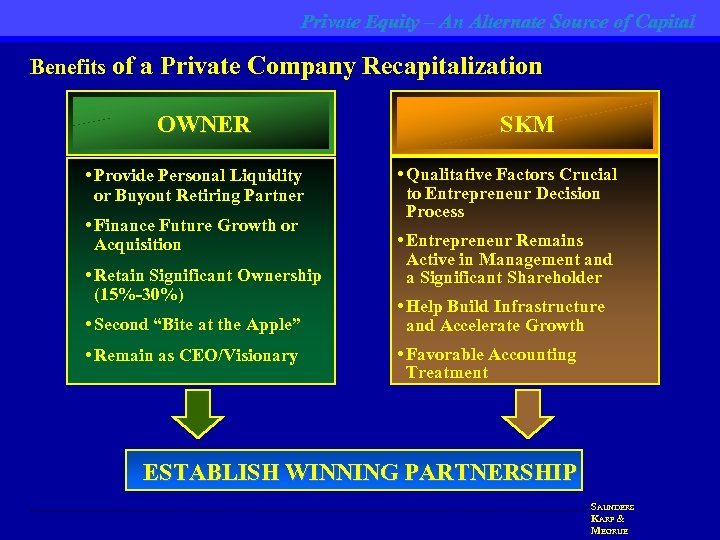 Private Equity – An Alternate Source of Capital Benefits of a Private Company Recapitalization OWNER • Provide Personal Liquidity or Buyout Retiring Partner • Finance Future Growth or Acquisition • Retain Significant Ownership (15%-30%) SKM • Qualitative Factors Crucial to Entrepreneur Decision Process • Entrepreneur Remains Active in Management and a Significant Shareholder • Second “Bite at the Apple” • Help Build Infrastructure and Accelerate Growth • Remain as CEO/Visionary • Favorable Accounting Treatment ESTABLISH WINNING PARTNERSHIP SAUNDERS KARP & MEGRUE
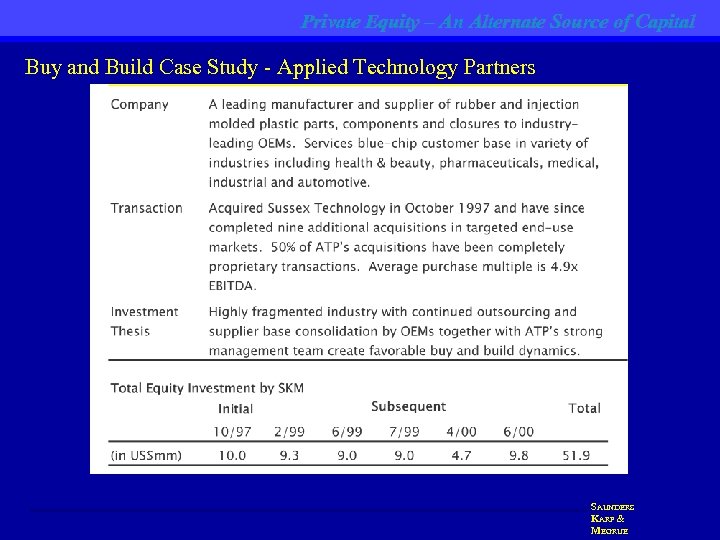 Private Equity – An Alternate Source of Capital Buy and Build Case Study - Applied Technology Partners SAUNDERS KARP & MEGRUE
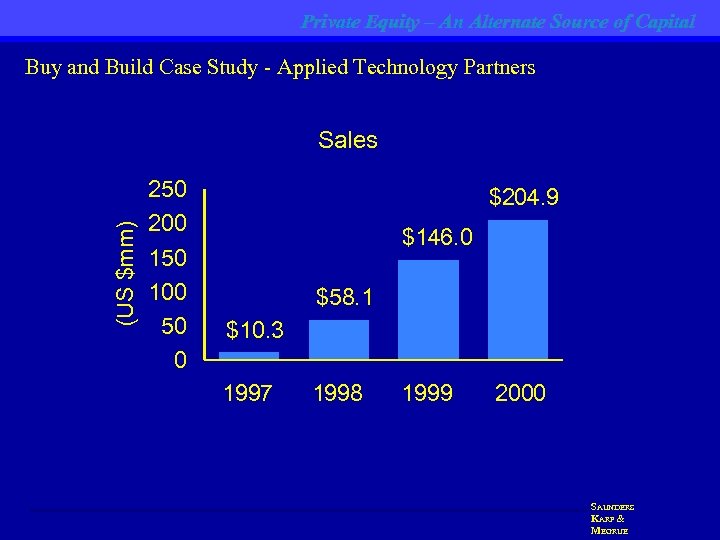 Private Equity – An Alternate Source of Capital Buy and Build Case Study - Applied Technology Partners (US $mm) Sales 250 200 150 100 50 0 $204. 9 $146. 0 $58. 1 $10. 3 1997 1998 1999 2000 SAUNDERS KARP & MEGRUE
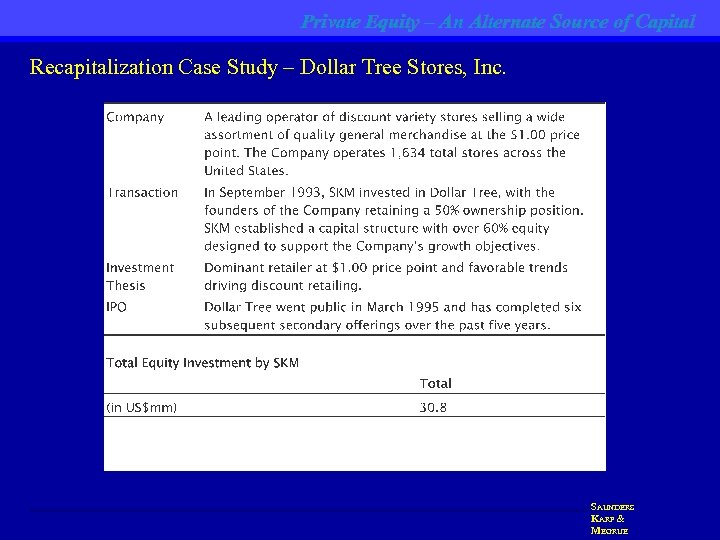 Private Equity – An Alternate Source of Capital Recapitalization Case Study – Dollar Tree Stores, Inc. SAUNDERS KARP & MEGRUE
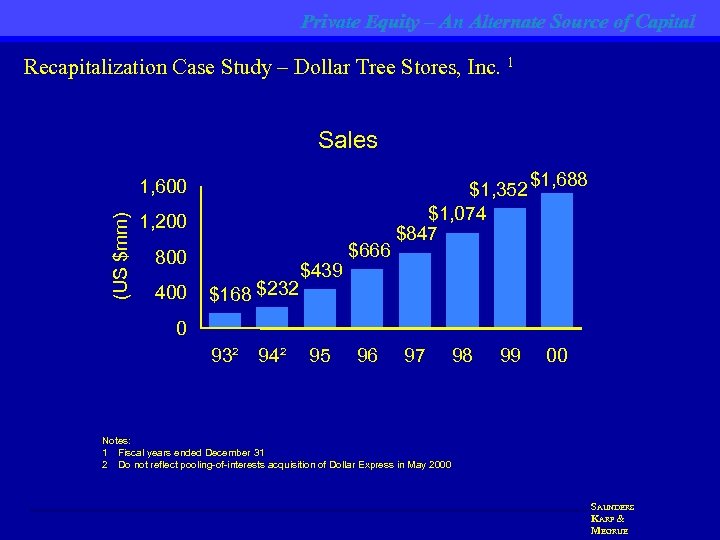 Private Equity – An Alternate Source of Capital Recapitalization Case Study – Dollar Tree Stores, Inc. 1 Sales (US $mm) 1, 600 1, 200 800 400 $168 $232 $439 $666 $1, 352 $1, 688 $1, 074 $847 0 93² 94² 95 96 97 98 99 00 Notes: 1 Fiscal years ended December 31 2 Do not reflect pooling-of-interests acquisition of Dollar Express in May 2000 SAUNDERS KARP & MEGRUE