


 Скачать презентацию Privacy and Security in a Federated Research Network
de7441fb9f24c0775385acd50348434d.ppt
- Количество слайдов: 44
 Privacy and Security in a Federated Research Network Dan Steinberg, JD HIPAA Summit XIII Washington, DC September 26, 2006
 Overview 4 What is ca. BIG™? 4 ca. BIG™ Structure and Oversight 4 HIPAA-Related Issues 4 Issues Identified and Addressed 4 For More Information 1
 ca. BIG™ is the “World Wide Web of cancer research. ” The cancer Biomedical Informatics Grid (ca. BIG™) is a voluntary, virtual network ca. BIG™: Connects individuals and institutions Enables the sharing of data and tools The use of ca. BIG™ resources will speed the delivery of innovative approaches for the prevention and treatment of cancer ca. BIG™ is being developed under the leadership of the National Cancer Institute's Center for Bioinformatics (NCICB) HIPAA Summit XIII September 26, 2006 2
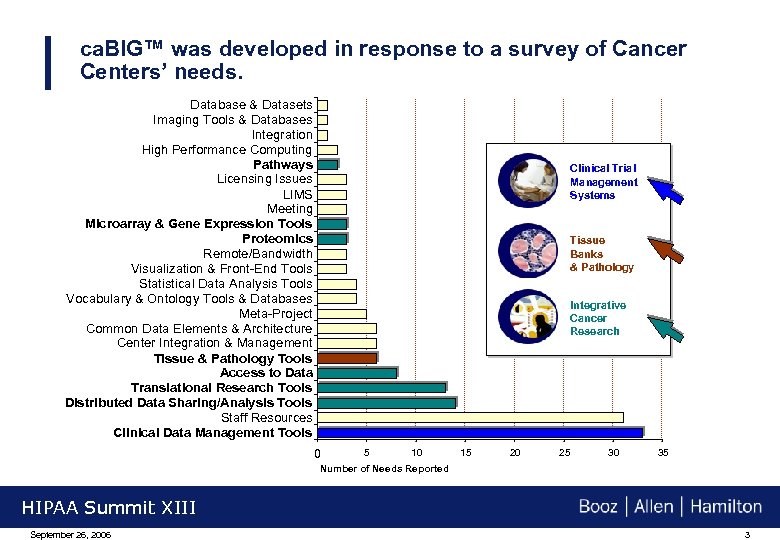 ca. BIG™ was developed in response to a survey of Cancer Centers’ needs. Database & Datasets Imaging Tools & Databases Integration High Performance Computing Pathways Licensing Issues LIMS Meeting Microarray & Gene Expression Tools Proteomics Remote/Bandwidth Visualization & Front-End Tools Statistical Data Analysis Tools Vocabulary & Ontology Tools & Databases Meta-Project Common Data Elements & Architecture Center Integration & Management Tissue & Pathology Tools Access to Data Translational Research Tools Distributed Data Sharing/Analysis Tools Staff Resources Clinical Data Management Tools Clinical Trial Management Systems Tissue Banks & Pathology Integrative Cancer Research 0 5 10 15 20 25 30 35 Number of Needs Reported HIPAA Summit XIII September 26, 2006 3
 ca. BIG™ offers institutions resources to develop tools on the condition that those tools are shared with other institutions that need them. 4 ca. BIG™ established a pilot network of NCI Cancer Centers – Groups agreeing to ca. BIG™ principles – Mixture of capabilities – Mixture of contributions 4 We have expanded the number and types of participants 4 We have also established a consortium development process – Collect and share expertise – Identify and prioritize community needs – Expand development efforts HIPAA Summit XIII September 26, 2006 4
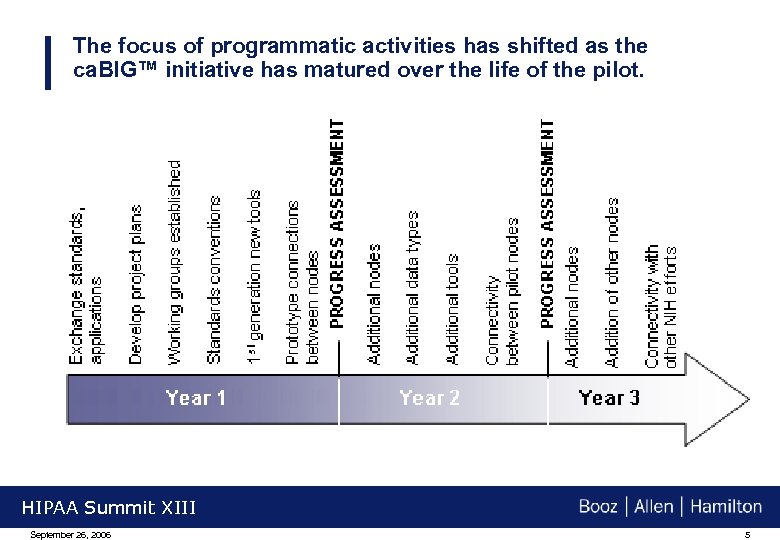 The focus of programmatic activities has shifted as the ca. BIG™ initiative has matured over the life of the pilot. HIPAA Summit XIII September 26, 2006 5
 The ca. BIG™ community now includes hundreds of participants at dozens of institutions. 4 Many developers and adopters are NCI designated cancer centers – Designation based on competitive, peer-reviewed grant application among US cancer research institutions – Virtually all (approximately 50) participate in ca. BIG™ as developers, adopters, or participants 4 Booz Allen is the prime contractor, providing management, coordination, and other supervisory activities 4 Other participants include: – Organizations in the public and private sectors, including nonprofits – Scientists – Informaticists – Patient advocates – Commercial and industry groups (e. g. , information technology companies, software vendors, pharmaceutical companies, biotechnology companies) 4 Participation is open to any interested party, including those beyond the cancer research community HIPAA Summit XIII September 26, 2006 6
 Overview 4 What is ca. BIG™? 4 ca. BIG™ Structure and Oversight 4 HIPAA-Related Issues 4 Issues Identified and Addressed 4 For More Information 7
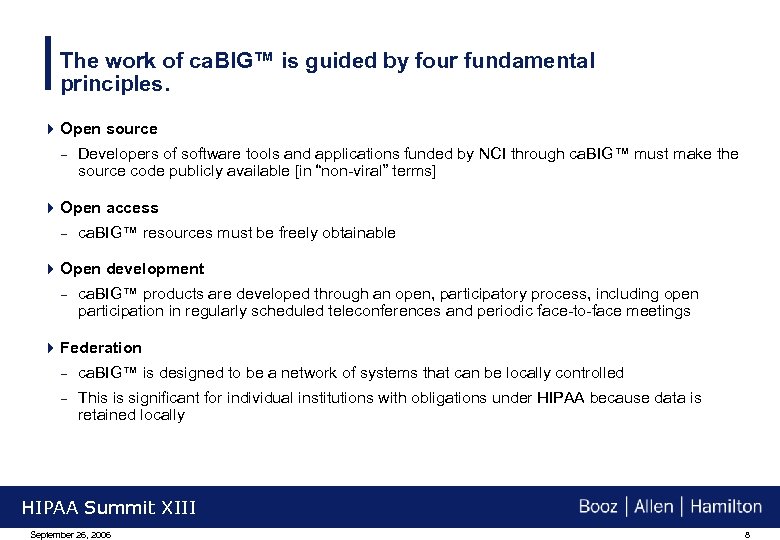 The work of ca. BIG™ is guided by four fundamental principles. 4 Open source – Developers of software tools and applications funded by NCI through ca. BIG™ must make the source code publicly available [in “non-viral” terms] 4 Open access – ca. BIG™ resources must be freely obtainable 4 Open development – ca. BIG™ products are developed through an open, participatory process, including open participation in regularly scheduled teleconferences and periodic face-to-face meetings 4 Federation – ca. BIG™ is designed to be a network of systems that can be locally controlled – This is significant for individual institutions with obligations under HIPAA because data is retained locally HIPAA Summit XIII September 26, 2006 8
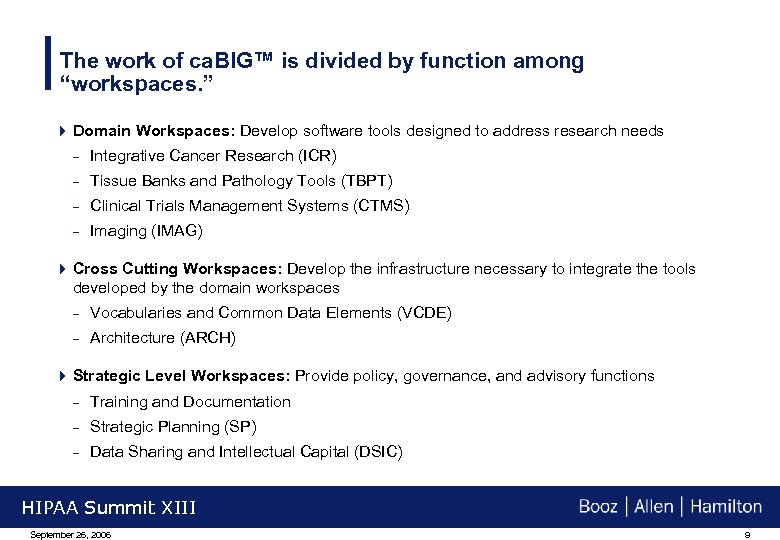 The work of ca. BIG™ is divided by function among “workspaces. ” 4 Domain Workspaces: Develop software tools designed to address research needs – Integrative Cancer Research (ICR) – Tissue Banks and Pathology Tools (TBPT) – Clinical Trials Management Systems (CTMS) – Imaging (IMAG) 4 Cross Cutting Workspaces: Develop the infrastructure necessary to integrate the tools developed by the domain workspaces – Vocabularies and Common Data Elements (VCDE) – Architecture (ARCH) 4 Strategic Level Workspaces: Provide policy, governance, and advisory functions – Training and Documentation – Strategic Planning (SP) – Data Sharing and Intellectual Capital (DSIC) HIPAA Summit XIII September 26, 2006 9
 Examples of ca. BIG™ Tools 10
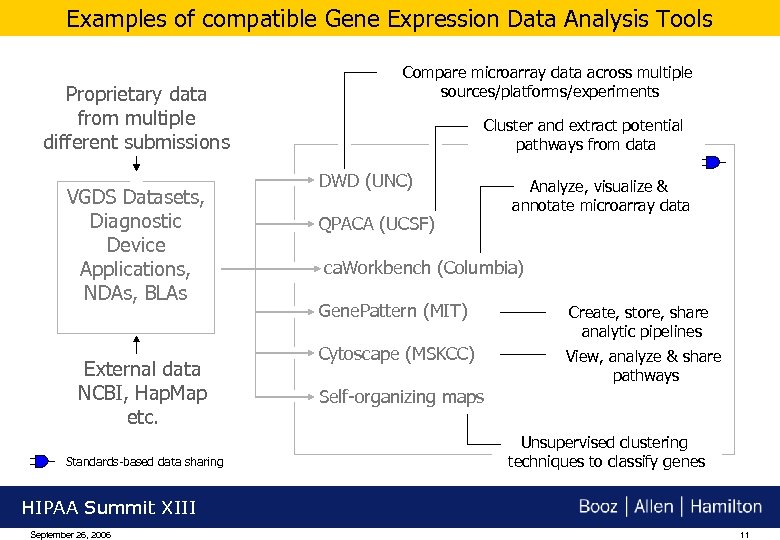 Examples of compatible Gene Expression Data Analysis Tools Proprietary data from multiple different submissions VGDS Datasets, Diagnostic Device Applications, NDAs, BLAs External data NCBI, Hap. Map etc. Standards-based data sharing Compare microarray data across multiple sources/platforms/experiments Cluster and extract potential pathways from data DWD (UNC) QPACA (UCSF) Analyze, visualize & annotate microarray data ca. Workbench (Columbia) Gene. Pattern (MIT) Create, store, share analytic pipelines Cytoscape (MSKCC) View, analyze & share pathways Self-organizing maps Unsupervised clustering techniques to classify genes HIPAA Summit XIII September 26, 2006 11
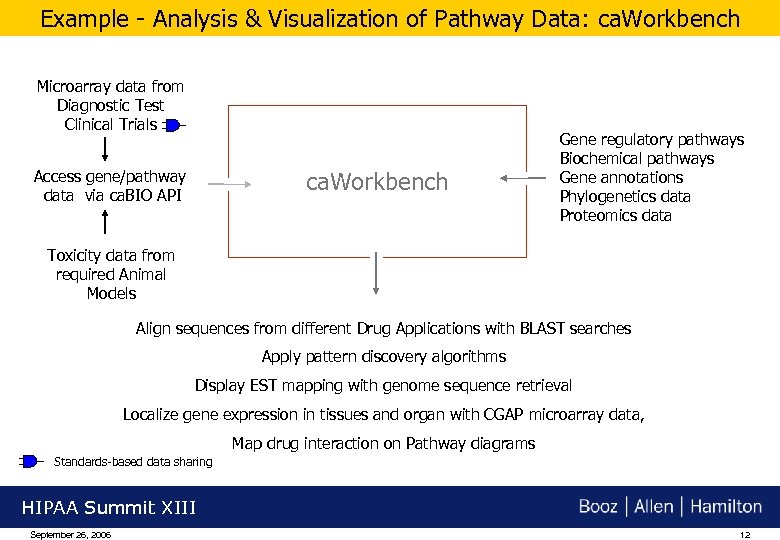 Example - Analysis & Visualization of Pathway Data: ca. Workbench Microarray data from Diagnostic Test Clinical Trials Access gene/pathway data via ca. BIO API ca. Workbench Gene regulatory pathways Biochemical pathways Gene annotations Phylogenetics data Proteomics data Toxicity data from required Animal Models Align sequences from different Drug Applications with BLAST searches Apply pattern discovery algorithms Display EST mapping with genome sequence retrieval Localize gene expression in tissues and organ with CGAP microarray data, Map drug interaction on Pathway diagrams Standards-based data sharing HIPAA Summit XIII September 26, 2006 12
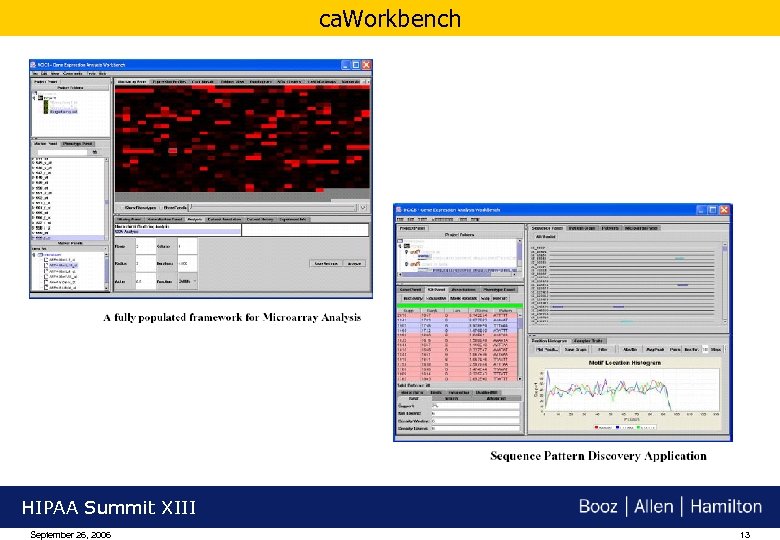 ca. Workbench HIPAA Summit XIII September 26, 2006 13
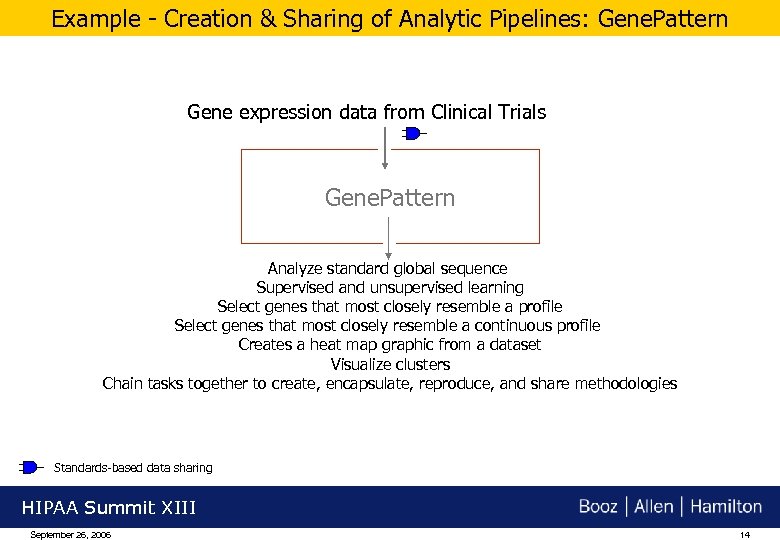 Example - Creation & Sharing of Analytic Pipelines: Gene. Pattern Gene expression data from Clinical Trials Gene. Pattern Analyze standard global sequence Supervised and unsupervised learning Select genes that most closely resemble a profile Select genes that most closely resemble a continuous profile Creates a heat map graphic from a dataset Visualize clusters Chain tasks together to create, encapsulate, reproduce, and share methodologies Standards-based data sharing HIPAA Summit XIII September 26, 2006 14
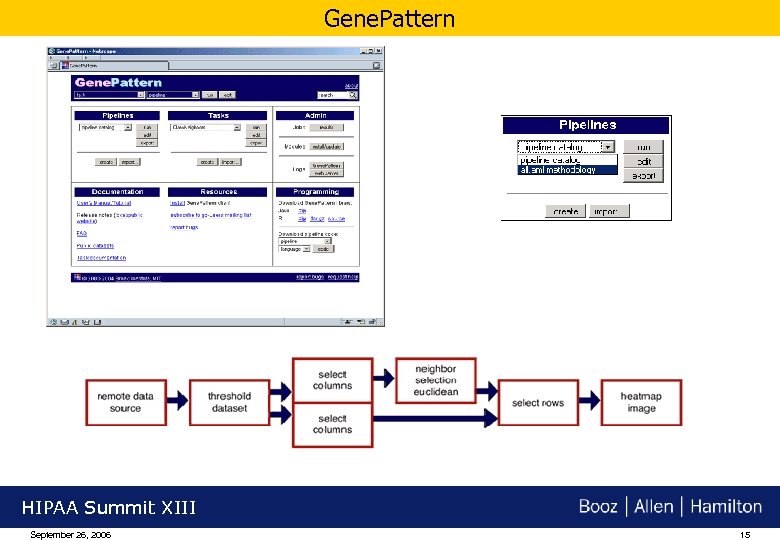 Gene. Pattern HIPAA Summit XIII September 26, 2006 15
 Overview 4 What is ca. BIG™? 4 ca. BIG™ Structure and Oversight 4 HIPAA-Related Issues 4 Issues Identified and Addressed 4 For More Information 16
 Issues related to privacy and security are addressed in the Data Sharing and Intellectual Capital Workspace (DSIC WS). 4 Goal: identify and then propose solutions to potential barriers to data and resource sharing and other collaborative work across the ca. BIG community 4 These barriers may arise from law, regulation, institutional policies and desire to protect intellectual property interests 4 DSIC WS contains about twenty regular participants, and an additional twenty to thirty ad hoc participants, with a wide range of perspectives and expertise 4 Legal and policy requirements related to privacy and security drivers include – HIPAA Privacy Rule – HIPAA Security Rule – The Common Rule for Human Subjects Research – FDA Regulations on Human Subjects – 21 CFR Part 11 – State and institutional requirements. HIPAA Summit XIII September 26, 2006 17
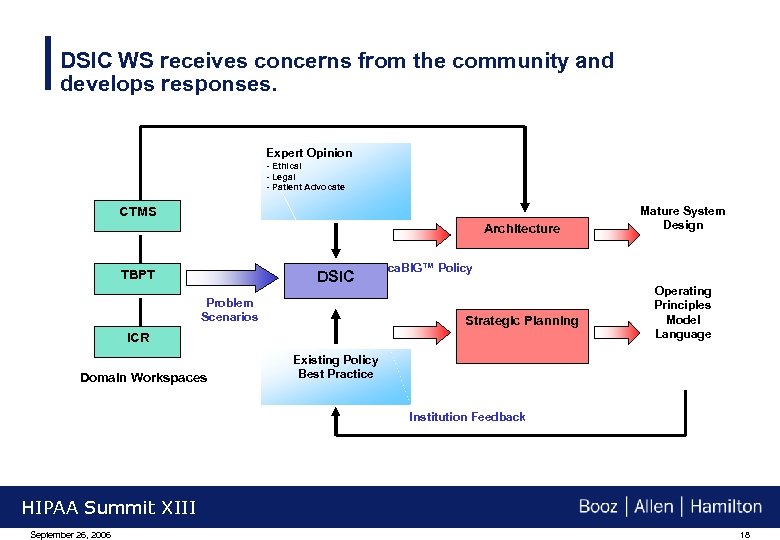 DSIC WS receives concerns from the community and develops responses. Expert Opinion - Ethical - Legal - Patient Advocate CTMS Architecture TBPT DSIC Problem Scenarios ca. BIG™ Policy Strategic Planning ICR Domain Workspaces Mature System Design Operating Principles Model Language Existing Policy Best Practice Institution Feedback HIPAA Summit XIII September 26, 2006 18
 Responsibility for HIPAA compliance remains with ca. BIG participants. 4 ca. BIG™’s federated structure allows data to reside on the servers of its originator or owner 4 Participants maintain control and responsibility for the data 4 Data that is shared must be either de-identified or shared pursuant to HIPAA-compliant agreements between providers and recipients of the data 4 Data use provisions in the funding agreements with ca. BIG participants allocate responsibility for compliance with HIPAA to the institutions of the ca. BIG™ participants: – “Any Data or related information delivered or made available to [NCI either directly or via the prime contractor], the ca. BIG™ Community or the public pursuant to Task Orders and published by Subcontractor shall be published in accordance with institutional review board (IRB) requirements, state privacy laws, and the HIPAA Privacy Rule. ” HIPAA Summit XIII September 26, 2006 19
 Similar requirements are reflected in task orders issuing from the prime contractor for development, adoption, or other research projects. 4 Sample language addressing “Data Use, Disclosure of Information and Handling of Sensitive Information” (for a software development project): The developer must address the potential sensitivity of the information collected, information security issues, local Institutional Review Board (IRB) requirements and the Health Insurance Portability and Accountability Act (HIPAA) of 1996 in its design of the system in question. The system must accommodate the needs and actual uses, related to these laws and regulations, of ca. BIG™ participants. Final regulations issued by the Department of Health and Human Services (DHHS) provide privacy and security standards that must be observed in the handling of patient data resulting from biomedical research. HIPAA privacy standards will be used to establish safeguards and restrictions for the use and disclosure of research records. HIPAA security standards will be used to help Cancer Centers implement administrative, physical, and technical safeguards to protect electronic health information. Improper use or disclosure of sensitive information under the rules may be subject to criminal or civil sanctions prescribed in HIPAA Summit XIII September 26, 2006 20
 DSIC WS seeks to promote data sharing through ca. BIG™ by identifying barriers and proposing solutions. 4 Policies — For adherence to requirements of participation in the ca. BIG™ community – Licensing terms – Disclosure of conflicts of interest – Standards of review for deliverables 4 Guidelines — Recommended practices to enable data sharing – Based on practices of other large data sharing initiatives and proposals to cover gaps not yet addressed – Identification of standard forms 4 Templates — Recommended language for data sharing documents – Authorization and consent forms – Disclaimers and notices to be displayed to users of software – Limited Data Set agreements 4 Education/training — ca. BIG™ Annual Meeting, periodic face-to-face meetings, and regular teleconferences. HIPAA Summit XIII September 26, 2006 21
 DSIC WS is compiling a survey of practices in other initiatives with expectations for large scale data sharing to address ca. BIG™ community needs. 4 Other NCI Sponsored Initiatives – Biomedical Informatics Research Network (BIRN) – Cooperative Breast Cancer Tissue Resource (CBCTR) – Cooperative Human Tissue Network (CHTN) – Cooperative Prostate Cancer Tissue Resource (CPCTR) – Prostate SPORE National Biospecimen Network (NBN) Pilot – Pennsylvania Cancer Alliance Bioinformatics Consortium (PCABC) Shared Pathology Informatics Network (SPIN) – Autism Genetic Resource Exchange (AGRE) – NIMH Human Genetics Initiative (HGI) – Informatics for Integrating Biology and the Bedside (I 2 B 2) – NIGMS Protein Structure Initiative (PSI) – European Organization for the Research and Treatment of Cancer (EORTC) Virtual Tumour Bank Early Detection Research Network (EDRN) – 4 Other Large Scale Biomedical Data Sharing Initiatives 4 Other Grid Computing Projects (In progress) – DOE Earth Systems Grid (ESG) – United Kingdom's my. Grid project – National Science Foundation (NSF) Open Science Grid (OSG) – DOE Particle Physics Data Grid (PPDG) – Department of Energy (DOE) Science Grid – Argonne National Labs’ Tera. Grid HIPAA Summit XIII September 26, 2006 22
 Our research thus far has identified many challenges. 4 Restrictions on sharing PHI is the biggest challenge 4 De-identification standards and practices vary widely 4 Disparate interpretations of legal and regulatory requirements lead to widely different expectations and requirements 4 Stakeholder input is vital – Developers – Researchers and other end users – Human subjects/patients – Security experts – Institutional Review Board (IRB) members 4 Practices are evolving along with developments in federal guidance, emergence of standards/best practices, and novel issues 4 International scientific collaborations increases complexity HIPAA Summit XIII September 26, 2006 23
 Overview 4 What is ca. BIG™? 4 ca. BIG™ Structure and Oversight 4 HIPAA-Related Issues 4 Issues Identified and Addressed 4 For More Information 24
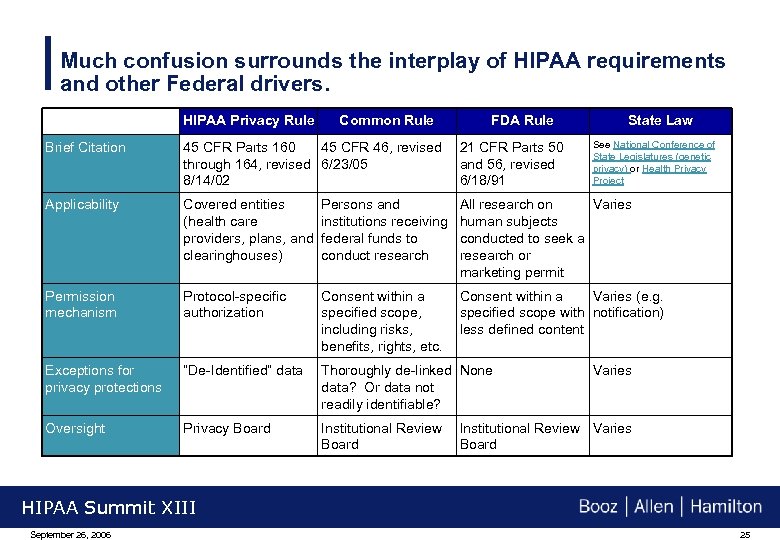 Much confusion surrounds the interplay of HIPAA requirements and other Federal drivers. HIPAA Privacy Rule Common Rule FDA Rule State Law See National Conference of State Legislatures (genetic privacy) or Health Privacy Project Brief Citation 45 CFR Parts 160 45 CFR 46, revised 21 CFR Parts 50 through 164, revised 6/23/05 and 56, revised 8/14/02 6/18/91 Applicability Covered entities Persons and (health care institutions receiving providers, plans, and federal funds to clearinghouses) conduct research All research on Varies human subjects conducted to seek a research or marketing permit Permission mechanism Protocol-specific authorization Consent within a specified scope, including risks, benefits, rights, etc. Consent within a Varies (e. g. specified scope with notification) less defined content Exceptions for privacy protections “De-Identified” data Thoroughly de-linked None data? Or data not readily identifiable? Oversight Privacy Board Institutional Review Varies Board Varies HIPAA Summit XIII September 26, 2006 25
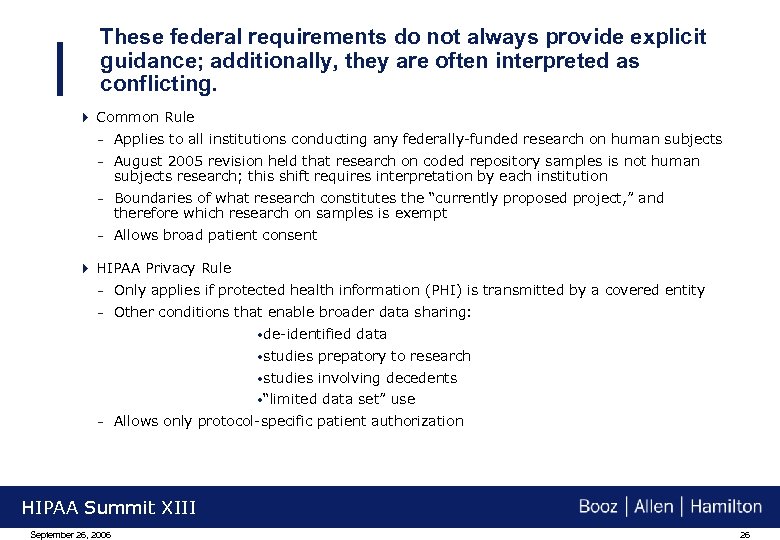 These federal requirements do not always provide explicit guidance; additionally, they are often interpreted as conflicting. 4 Common Rule – Applies to all institutions conducting any federally-funded research on human subjects – August 2005 revision held that research on coded repository samples is not human subjects research; this shift requires interpretation by each institution – Boundaries of what research constitutes the “currently proposed project, ” and therefore which research on samples is exempt – Allows broad patient consent 4 HIPAA Privacy Rule – Only applies if protected health information (PHI) is transmitted by a covered entity – Other conditions that enable broader data sharing: • de-identified data • studies prepatory to research • studies involving decedents • “limited – data set” use Allows only protocol-specific patient authorization HIPAA Summit XIII September 26, 2006 26
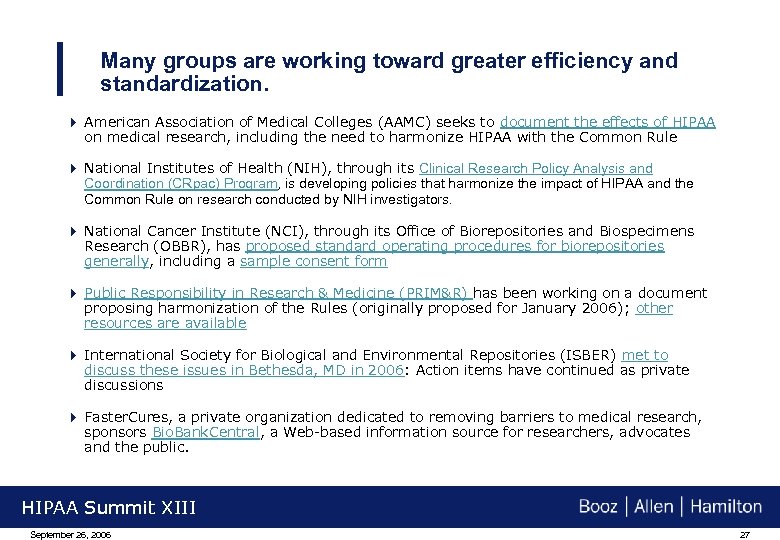 Many groups are working toward greater efficiency and standardization. 4 American Association of Medical Colleges (AAMC) seeks to document the effects of HIPAA on medical research, including the need to harmonize HIPAA with the Common Rule 4 National Institutes of Health (NIH), through its Clinical Research Policy Analysis and Coordination (CRpac) Program, is developing policies that harmonize the impact of HIPAA and the Common Rule on research conducted by NIH investigators. 4 National Cancer Institute (NCI), through its Office of Biorepositories and Biospecimens Research (OBBR), has proposed standard operating procedures for biorepositories generally, including a sample consent form 4 Public Responsibility in Research & Medicine (PRIM&R) has been working on a document proposing harmonization of the Rules (originally proposed for January 2006); other resources are available 4 International Society for Biological and Environmental Repositories (ISBER) met to discuss these issues in Bethesda, MD in 2006: Action items have continued as private discussions 4 Faster. Cures, a private organization dedicated to removing barriers to medical research, sponsors Bio. Bank. Central, a Web-based information source for researchers, advocates and the public. HIPAA Summit XIII September 26, 2006 27
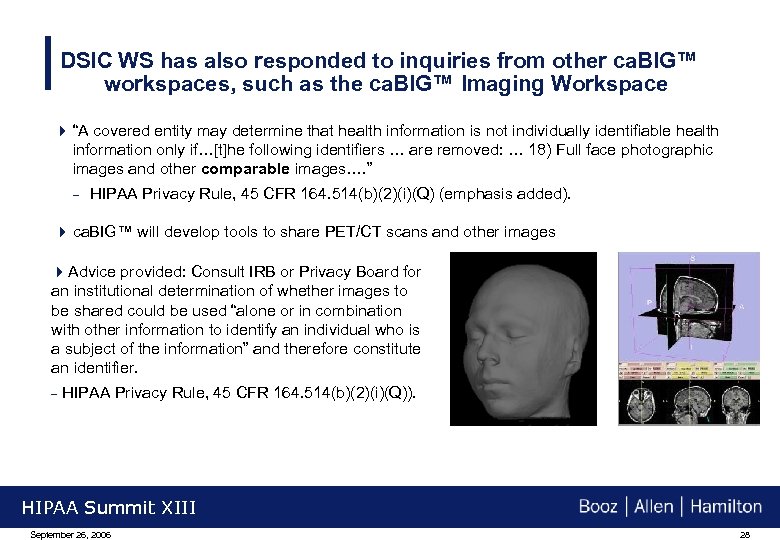 DSIC WS has also responded to inquiries from other ca. BIG™ workspaces, such as the ca. BIG™ Imaging Workspace 4 “A covered entity may determine that health information is not individually identifiable health information only if…[t]he following identifiers … are removed: … 18) Full face photographic images and other comparable images…. ” – HIPAA Privacy Rule, 45 CFR 164. 514(b)(2)(i)(Q) (emphasis added). 4 ca. BIG™ will develop tools to share PET/CT scans and other images 4 Advice provided: Consult IRB or Privacy Board for an institutional determination of whether images to be shared could be used “alone or in combination with other information to identify an individual who is a subject of the information” and therefore constitute an identifier. – HIPAA Privacy Rule, 45 CFR 164. 514(b)(2)(i)(Q)). HIPAA Summit XIII September 26, 2006 28
 DSIC WS provided advice to members of ca. BIG™’s Tissue Banks and Pathology Tools Workspace (TBPT WS) as they integrated an automated de-identification tool. 4 TBPT WS is developing ca. TIES, a tool that will assist with gene annotation 4 ca. TIES includes a software component that can remove PHI from free text, thereby de-identifying it 4 Automated de-identification is accomplished through the comparison of freetext reports with a dictionary of terms 4 DSIC WS provided advice to participants on combining technical solutions for de-identification with non-technical solutions –Manual review –Training, education and awareness –Need-to-know/minimum necessary –Use of “honest broker” to re-identify records (and seek consent and authorization) for longevity studies, future recruitment, etc. HIPAA Summit XIII September 26, 2006 29
 DSIC WS is developing security policies and procedures that include collecting specific boundary requirements from end users. 4 Security and privacy needs are diverse within the ca. BIG™ community 4 Tools vary in: – Complexity – Maturity of Information Model – Security/privacy parameters – Regulatory environments – Supporting technology requirements 4 To clarify what was needed to support these domains, in Summer of 2005, ca. BIG™ commissioned a Security White Paper – Prepared by Booz Allen Hamilton with extensive input and review of the Architecture Workspace and NCICB 4 Scope of paper was largely technical evaluation, with some comments on policy and administration issues 4 Draft circulated in October 2005 with final version available in February 2006. HIPAA Summit XIII September 26, 2006 30
 In response to the Security Technology Evaluation White Paper, a team was tasked with addressing its unmet recommendations. Recommendations from the White Paper included: 4 Develop business-oriented security use & abuse cases – Need input from IRBs, Compliance Officers, Honest Brokers, CIOs and other institutional executives, Bioethicists, etc. 4 Vet the notion of employing Federated Identity Management 4 Develop ca. BIG™ governance policies – Success involves multiple layers (i. e. , trust, identity vetting, guidelines, data standards, firewalls, physical security, etc. ) 4 Involve multiple workspaces and stakeholders in policy development 4 Identify the minimum security requirements from regulatory mandates 4 Develop a Proof-of-Concept implementation 4 Consider the maturity of technologies 4 Consider separating regulated and non-regulated environments HIPAA Summit XIII September 26, 2006 31
 Some standards of the HIPAA Security Rule may require coordination among ca. BIG participants. 4 Some HIPAA requirements may dictate needed functionalities of tools or infrastructure: The Security White Paper supported this idea 4 Other requirements may require coordinated administrative activities such as: – A recommended governance structure for security – Recommended processes for risk assessment and management – A process enabling information system activity review – A process for on going policy and operations review involving end users and stakeholders – Requirements for external audit review & associated policies – A process for managing security incidents & events – A process for management, review, and modification of interconnection security agreements HIPAA Summit XIII September 26, 2006 32
 The real challenges of cross-institutional data sharing are political and cultural, not technical. 4 Sharing information among institutions will require the approval of institutional review boards (IRBs) 4 An agreement on minimum security acceptable to a broad range of IRBs and other compliance officials will be critical to receiving approval (“interconnection security agreement”) 4 Healthcare security problems are complex as epitomized by: – Infrastructure Gaps: Some institutions are sharing data via e-mail attachments while others have more sophisticated biomedical informatics systems – Scientific vs. Engineering Mindset: Enthusiastic about technologies; needs to understand the importance of having an integrated engineering process – Regulatory Compliance: IRBs tend to be both conservative and disparate in interpretation of federal requirements. HIPAA Summit XIII September 26, 2006 33
 ca. BIG™ Security Program Goals 4 Major goal is to develop a framework for security engineering for the ca. BIG™ project as a whole 4 Targets Cancer Centers which are the initial four adopters of ca. TIES – Washington University, U. Pittsburgh Medical Center, Thomas Jefferson, U Penn 4 Focus on involving regulatory and other “business users” at the Cancer Centers – IRB members – Compliance officers 4 Deliverables: – Capstone governance structure framework and documents – Security refinement processes – Interconnection security agreement among adopters – Policy and procedures sufficient to operate ca. TIES at individual Cancer Centers 4 Cross-cutting joint effort between Architecture, VCDE, TBPT, DSIC Workspaces HIPAA Summit XIII September 26, 2006 34
 Policies and procedures are being developed through a process that addresses specific needs of stakeholders. 4 A community of stakeholders and subject matter experts assembled at a face-toface meeting in June, 2006 4 Participants included experts in the fields of security, law, IRB operations, compliance officers, bioinformaticists, and others 4 After soliciting input from all attendees, the team developed scenarios to be used as a framework for open-ended discussions with stakeholders 4 The scenarios will be used to identify security requirements boundary conditions 4 All deliverables (survey-like instruments, ultimately drafted policies etc. ) will be: – Subject to community review – Used to inform the development of the technical infrastructure HIPAA Summit XIII September 26, 2006 35
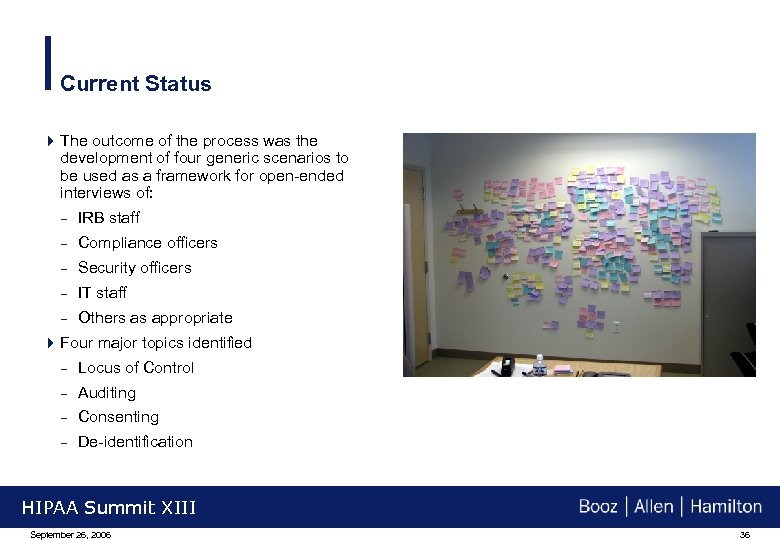 Current Status 4 The outcome of the process was the development of four generic scenarios to be used as a framework for open-ended interviews of: – IRB staff – Compliance officers – Security officers – IT staff – Others as appropriate 4 Four major topics identified – Locus of Control – Auditing – Consenting – De-identification HIPAA Summit XIII September 26, 2006 36
 Data Collection Plan for Security Policy and Process Interviews 4 Task team has identified relevant stakeholders at the institutions included in the study 4 Set up interviews with stakeholders, using usage scenarios and related questions to further define requirements – Scenarios will be sent ahead of time to interviewees – Also sent in advance: A glossary of terms related to privacy and security 4 Each interview will start with 10 minute presentation on ca. BIG™ and ca. TIES 4 Summaries of interviews will be sent back to the interviewee to review and approve – Review may be accompanied by specific requests for clarification if questions arise during analysis 4 Data will be summarized analyzed by institution and across institutions. HIPAA Summit XIII September 26, 2006 37
 Overview 4 What is ca. BIG™? 4 ca. BIG™ Structure and Oversight 4 HIPAA-Related Issues 4 Issues Identified and Addressed 4 For More Information 38
 Your involvement in ca. BIG™ is welcomed! 4 Data Sharing and Intellectual Capital Workspace meets 2 -3 PM EST: – First Thursday of each month – Second and fourth Thursday of each month (Proprietary/Intellectual Property Issues) – Second and fourth Monday of each month (Regulatory issues, e. g. HIPAA) 4 Contacts: Working Group Facilitator (NCI) Wendy Patterson, J. D. (301) 435 -3110 pattersw@mail. nih. gov More on ca. BIG™ at: http: //ca. BIG. nci. nih. gov/ Working Group Coordinator (BAH) Dan Steinberg, J. D. (703) 377 -1261 steinberg_daniel@bah. com HIPAA Summit XIII September 26, 2006 39
 Save the Date for ca. BIG™’s Annual Meeting 2007! 4 February 5 - 7, 2007 4 Marriott Wardman Park, Washington, DC 4 Sessions include – Plenaries – Dozens of break outs – Dozens of demonstrations, posters, and exhibits – Hands-on introduction to ca. BIG™ tools (the popular “ca. BIG™ Hackathon”) 4 Tailored sessions for newcomers February 5 and throughout the conference 4 https: //cabig. nci. nih. gov/2007 ca. BIGconference/ HIPAA Summit XIII September 26, 2006 40
 Questions/Discussion? 41
 Supplemental Materials 42
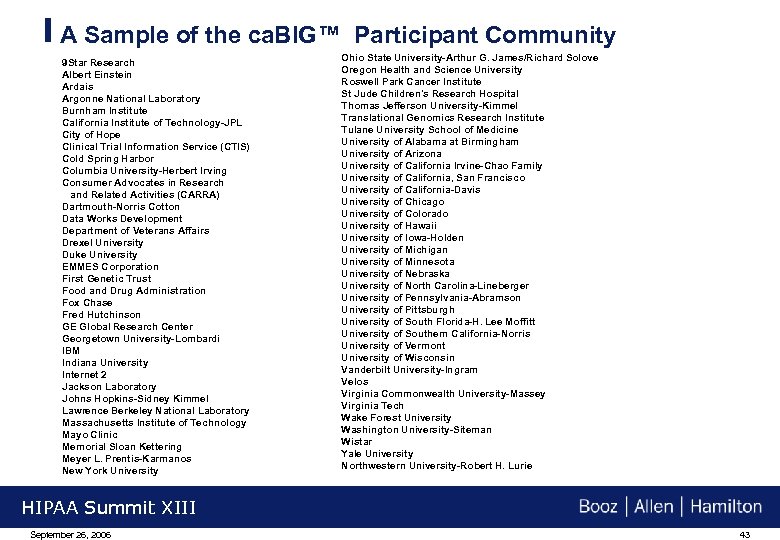 A Sample of the ca. BIG™ Participant Community 9 Star Research Albert Einstein Ardais Argonne National Laboratory Burnham Institute California Institute of Technology-JPL City of Hope Clinical Trial Information Service (CTIS) Cold Spring Harbor Columbia University-Herbert Irving Consumer Advocates in Research and Related Activities (CARRA) Dartmouth-Norris Cotton Data Works Development Department of Veterans Affairs Drexel University Duke University EMMES Corporation First Genetic Trust Food and Drug Administration Fox Chase Fred Hutchinson GE Global Research Center Georgetown University-Lombardi IBM Indiana University Internet 2 Jackson Laboratory Johns Hopkins-Sidney Kimmel Lawrence Berkeley National Laboratory Massachusetts Institute of Technology Mayo Clinic Memorial Sloan Kettering Meyer L. Prentis-Karmanos New York University Ohio State University-Arthur G. James/Richard Solove Oregon Health and Science University Roswell Park Cancer Institute St Jude Children's Research Hospital Thomas Jefferson University-Kimmel Translational Genomics Research Institute Tulane University School of Medicine University of Alabama at Birmingham University of Arizona University of California Irvine-Chao Family University of California, San Francisco University of California-Davis University of Chicago University of Colorado University of Hawaii University of Iowa-Holden University of Michigan University of Minnesota University of Nebraska University of North Carolina-Lineberger University of Pennsylvania-Abramson University of Pittsburgh University of South Florida-H. Lee Moffitt University of Southern California-Norris University of Vermont University of Wisconsin Vanderbilt University-Ingram Velos Virginia Commonwealth University-Massey Virginia Tech Wake Forest University Washington University-Siteman Wistar Yale University Northwestern University-Robert H. Lurie HIPAA Summit XIII September 26, 2006 43