 Скачать презентацию Prisons and Jails Criminal Justice A Brief Introduction
933f290a7649ebe6786ec09c0a0c1115.ppt
- Количество слайдов: 37



Prisons and Jails Criminal Justice: A Brief Introduction, 7 E by Frank Schmalleger © Prentice Hall 2008 Pearson Education, Inc Upper Saddle River, NJ 07458 1
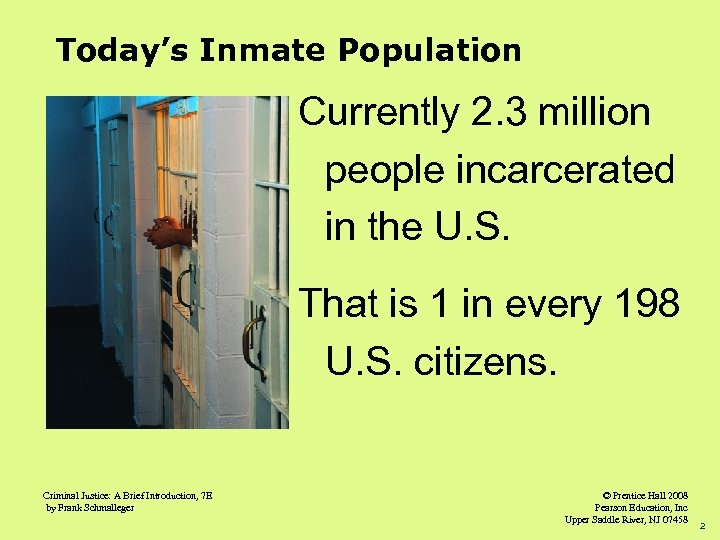
Today’s Inmate Population Currently 2. 3 million people incarcerated in the U. S. That is 1 in every 198 U. S. citizens. Criminal Justice: A Brief Introduction, 7 E by Frank Schmalleger © Prentice Hall 2008 Pearson Education, Inc Upper Saddle River, NJ 07458 2
Prisons § A prison is a state or federal confinement facility that has custodial authority over adults sentenced to confinement. Criminal Justice: A Brief Introduction, 7 E by Frank Schmalleger © Prentice Hall 2008 Pearson Education, Inc Upper Saddle River, NJ 07458 3
Prisons Today: Numbers and Types of Prisons Approximately § 1, 325 state prisons § 84 federal prisons On January 1, 2006, state and federal prisons held 1, 461, 132 inmates. (Almost 7% of those imprisoned were women. ) Criminal Justice: A Brief Introduction, 7 E by Frank Schmalleger © Prentice Hall 2008 Pearson Education, Inc Upper Saddle River, NJ 07458 4
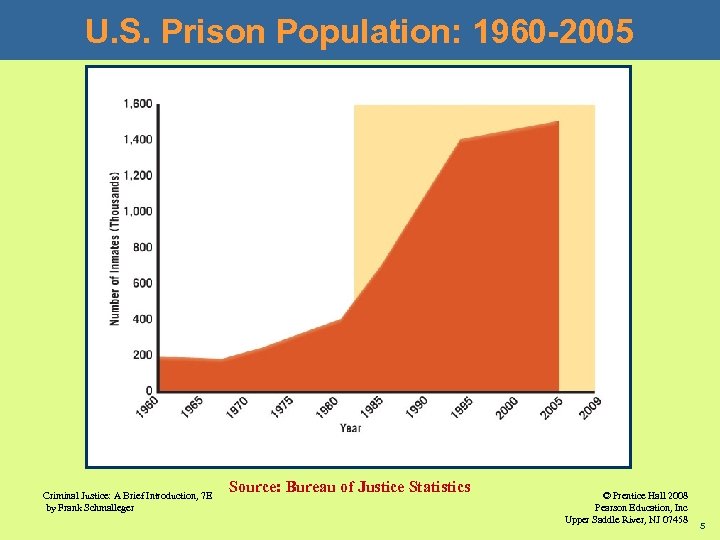
U. S. Prison Population: 1960 -2005 Criminal Justice: A Brief Introduction, 7 E by Frank Schmalleger Source: Bureau of Justice Statistics © Prentice Hall 2008 Pearson Education, Inc Upper Saddle River, NJ 07458 5
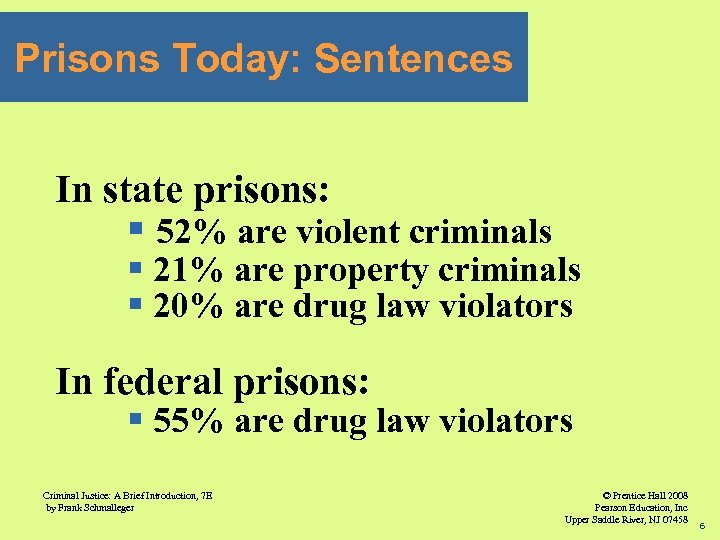
Prisons Today: Sentences In state prisons: § 52% are violent criminals § 21% are property criminals § 20% are drug law violators In federal prisons: § 55% are drug law violators Criminal Justice: A Brief Introduction, 7 E by Frank Schmalleger © Prentice Hall 2008 Pearson Education, Inc Upper Saddle River, NJ 07458 6
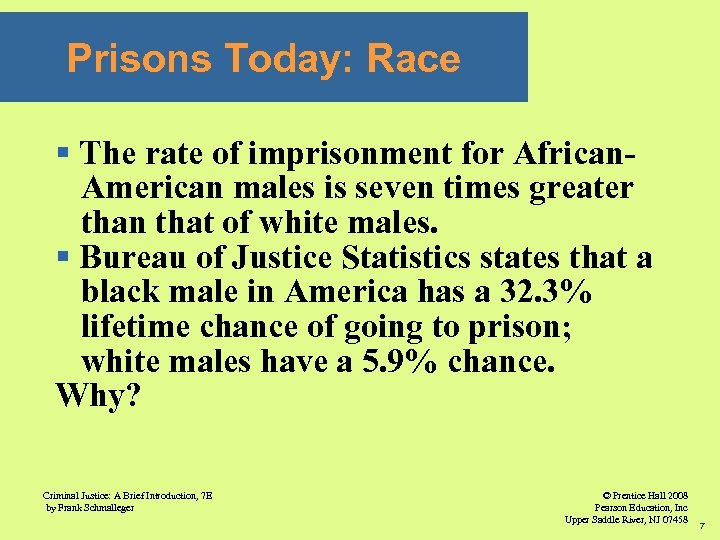
Prisons Today: Race § The rate of imprisonment for African. American males is seven times greater than that of white males. § Bureau of Justice Statistics states that a black male in America has a 32. 3% lifetime chance of going to prison; white males have a 5. 9% chance. Why? Criminal Justice: A Brief Introduction, 7 E by Frank Schmalleger © Prentice Hall 2008 Pearson Education, Inc Upper Saddle River, NJ 07458 7
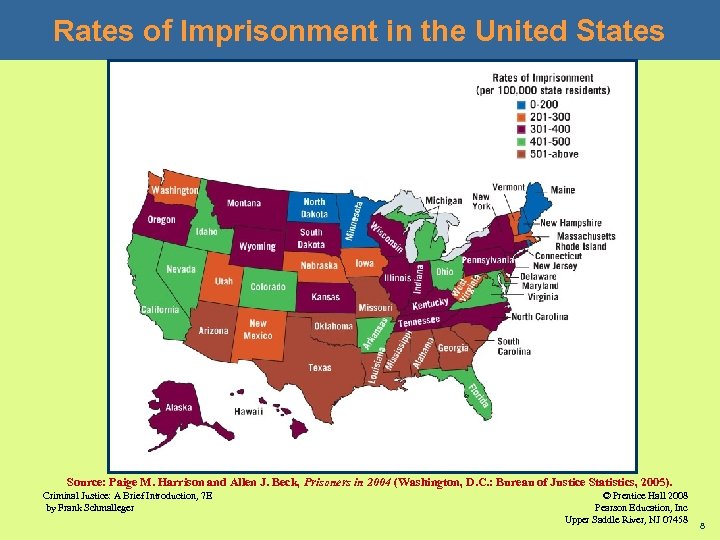
Rates of Imprisonment in the United States Source: Paige M. Harrison and Allen J. Beck, Prisoners in 2004 (Washington, D. C. : Bureau of Justice Statistics, 2005). Criminal Justice: A Brief Introduction, 7 E by Frank Schmalleger © Prentice Hall 2008 Pearson Education, Inc Upper Saddle River, NJ 07458 8
Just Deserts The “get tough on crime” attitude has led to overcrowded conditions. § “Get tough” attitudes based on the justice (just deserts) model. § Emphasizes individual responsibility and punishment § Imprisonment is a fully deserved consequence of criminal behavior. “If you can’t do the time, don’t do the crime. ” Criminal Justice: A Brief Introduction, 7 E by Frank Schmalleger © Prentice Hall 2008 Pearson Education, Inc Upper Saddle River, NJ 07458 9
Overcrowded Prisons Overcrowding is a political issue. § Employee Unions for Correctional Staff are thought of as a contributing factor to overcrowding. § Push for tougher penalties § Lobby for longer sentences § Creates more jobs + more union members § Job Security Criminal Justice: A Brief Introduction, 7 E by Frank Schmalleger © Prentice Hall 2008 Pearson Education, Inc Upper Saddle River, NJ 07458 10
Overcrowded Prisons Overcrowding is a serious issue. § Prison capacity—the size of the correctional population an institution can effectively hold. There are three types of prison capacity: § Rated § Operational § Design § Rhodes v. Chapman (1981)—overcrowding is not by itself cruel and unusual punishment. Criminal Justice: A Brief Introduction, 7 E by Frank Schmalleger © Prentice Hall 2008 Pearson Education, Inc Upper Saddle River, NJ 07458 11
Selective Incapacitation § Selective incapacitation: § Is a strategy to reduce prison population § Seeks to identify the most dangerous offenders and remove them from society § Is reflected by career offender statutes (i. e. 3 Strikes) Criminal Justice: A Brief Introduction, 7 E by Frank Schmalleger © Prentice Hall 2008 Pearson Education, Inc Upper Saddle River, NJ 07458 12
Security Levels in State Prison Systems There are three security levels: 1. Maximum 2. Medium 3. Minimum The typical American prison is medium or minimum custody. . . WESTECCDC-Orientation. ppt Criminal Justice: A Brief Introduction, 7 E by Frank Schmalleger © Prentice Hall 2008 Pearson Education, Inc Upper Saddle River, NJ 07458 13
Maximum Security Most maximum security institutions tend to be massive old buildings with a large inmate population, including all death row inmates. They provide a high level of security with: § High fences/walls of concrete § Several barriers between living area § Secure cells § Armed Officers § Gun towers § Cat Walks Criminal Justice: A Brief Introduction, 7 E by Frank Schmalleger © Prentice Hall 2008 Pearson Education, Inc Upper Saddle River, NJ 07458 14
Medium Security Medium-security prisons are similar in design to maximum-security facilities; however, they: § Usually have more windows. § Tend to have barbed wire fences instead of large stone walls. § Sometimes use dormitory style housing. § Allow inmates more freedom to move about. § Rely on a “count” mechanism. Criminal Justice: A Brief Introduction, 7 E by Frank Schmalleger © Prentice Hall 2008 Pearson Education, Inc Upper Saddle River, NJ 07458 15
Minimum Security In minimum security prisons: § Housing tends to be dormitory style. § Prisoners usually have freedom of movement within the facility. § Work is done under general supervision only. § Guards are unarmed, and gun towers do not exist. § Fences, if they exist, are low and sometimes unlocked. § Prisoners are sometimes allowed to wear their own clothes. Criminal Justice: A Brief Introduction, 7 E by Frank Schmalleger © Prentice Hall 2008 Pearson Education, Inc Upper Saddle River, NJ 07458 16
Prison Classification System Classification systems determine which custody level to assign an inmate to. Assignments are based on: § Offense history § Assessed dangerousness § Perceived risk of escape § Other factors Inmates may move among the security levels depending on their behavior. Internal classification systems determine placement and program assignment within an institution. Criminal Justice: A Brief Introduction, 7 E by Frank Schmalleger © Prentice Hall 2008 Pearson Education, Inc Upper Saddle River, NJ 07458 17
The Federal Prison System Criminal Justice: A Brief Introduction, 7 E by Frank Schmalleger © Prentice Hall 2008 Pearson Education, Inc Upper Saddle River, NJ 07458 18
The Federal Prison System The Federal Bureau of Prisons was established in 1930 to provide more progressive and humane care for Federal inmates, to professionalize the prison service, and to ensure consistent and centralized administration of the 11 Federal prisons in operation at the time. Criminal Justice: A Brief Introduction, 7 E by Frank Schmalleger © Prentice Hall 2008 Pearson Education, Inc Upper Saddle River, NJ 07458 19
Today’s Federal Prison System Today’s federal prison system consists of: § § § 119 institutions 6 regional offices The Central office (headquarters) 2 staff training centers 22 residential re-entry centers The Bureau is responsible for the custody and care of approximately 219, 000 Federal offenders. BOP employees 38, 000 people. Criminal Justice: A Brief Introduction, 7 E by Frank Schmalleger © Prentice Hall 2008 Pearson Education, Inc Upper Saddle River, NJ 07458 20
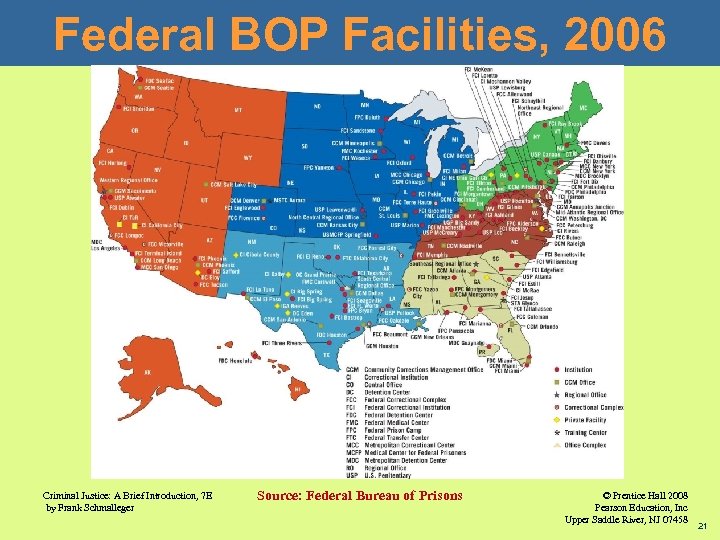
Federal BOP Facilities, 2006 Criminal Justice: A Brief Introduction, 7 E by Frank Schmalleger Source: Federal Bureau of Prisons © Prentice Hall 2008 Pearson Education, Inc Upper Saddle River, NJ 07458 21
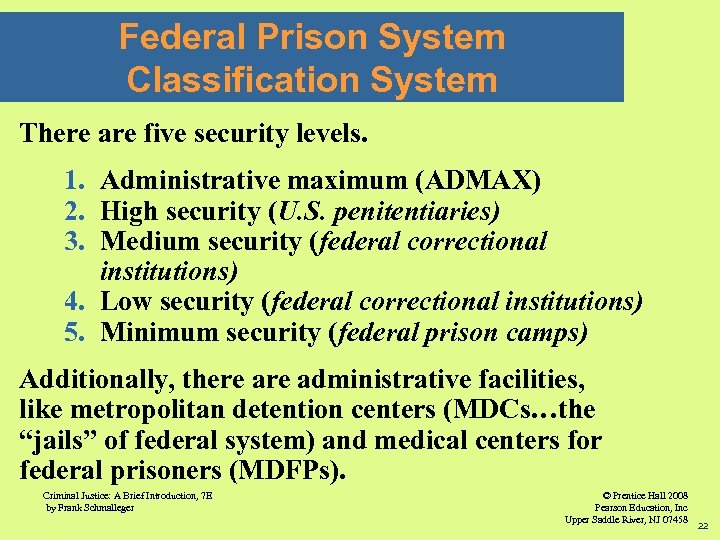
Federal Prison System Classification System There are five security levels. 1. Administrative maximum (ADMAX) 2. High security (U. S. penitentiaries) 3. Medium security (federal correctional institutions) 4. Low security (federal correctional institutions) 5. Minimum security (federal prison camps) Additionally, there administrative facilities, like metropolitan detention centers (MDCs…the “jails” of federal system) and medical centers for federal prisoners (MDFPs). Criminal Justice: A Brief Introduction, 7 E by Frank Schmalleger © Prentice Hall 2008 Pearson Education, Inc Upper Saddle River, NJ 07458 22
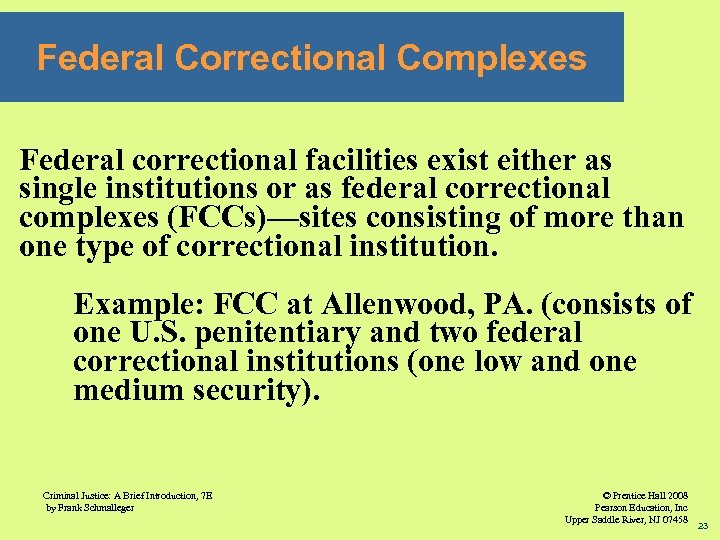
Federal Correctional Complexes Federal correctional facilities exist either as single institutions or as federal correctional complexes (FCCs)—sites consisting of more than one type of correctional institution. Example: FCC at Allenwood, PA. (consists of one U. S. penitentiary and two federal correctional institutions (one low and one medium security). Criminal Justice: A Brief Introduction, 7 E by Frank Schmalleger © Prentice Hall 2008 Pearson Education, Inc Upper Saddle River, NJ 07458 23
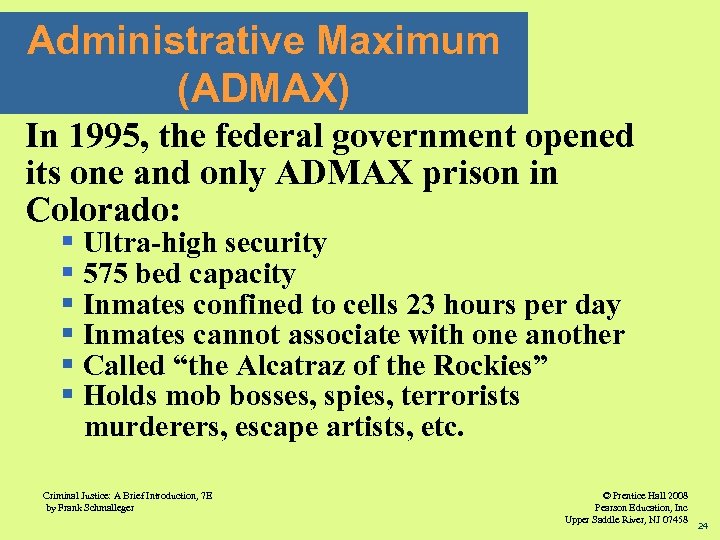
Administrative Maximum (ADMAX) In 1995, the federal government opened its one and only ADMAX prison in Colorado: § Ultra-high security § 575 bed capacity § Inmates confined to cells 23 hours per day § Inmates cannot associate with one another § Called “the Alcatraz of the Rockies” § Holds mob bosses, spies, terrorists murderers, escape artists, etc. Criminal Justice: A Brief Introduction, 7 E by Frank Schmalleger © Prentice Hall 2008 Pearson Education, Inc Upper Saddle River, NJ 07458 24
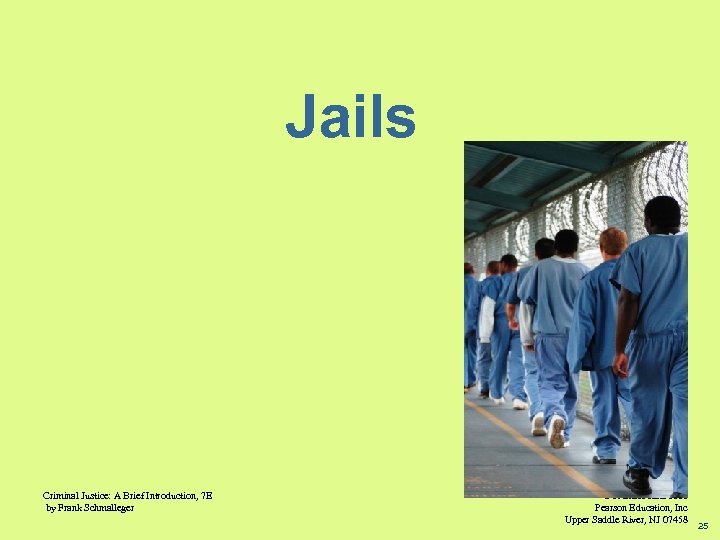
Jails Criminal Justice: A Brief Introduction, 7 E by Frank Schmalleger © Prentice Hall 2008 Pearson Education, Inc Upper Saddle River, NJ 07458 25
Jails § Jails—locally operated, short-term confinement facilities. § Original purpose—confinement of suspects following arrest and awaiting trial. § Current use—confinement of those convicted of misdemeanors and some felonies, as well as holding suspects following arrest and awaiting trial. Criminal Justice: A Brief Introduction, 7 E by Frank Schmalleger © Prentice Hall 2008 Pearson Education, Inc Upper Saddle River, NJ 07458 26
Jails Today §Hold pretrial detainees §Readmit probation, parole, and bail-bond violators §Temporarily detain juveniles, the mentally ill, and others pending transfer to appropriate facilities §Hold individuals for the military, for protective custody, for contempt, and for the courts as witnesses §Release convicted inmates to the community upon completion of their sentences §Transfer inmates to federal, state, and other authorities §House inmates for federal, state, or other authorities because of overcrowding in their facilities §Operate community-based programs with day reporting, home detention, electronic monitoring, or other types of supervision §Hold inmates sentenced to short terms (generally under one year) Criminal Justice: A Brief Introduction, 7 E by Frank Schmalleger © Prentice Hall 2008 Pearson Education, Inc Upper Saddle River, NJ 07458 27
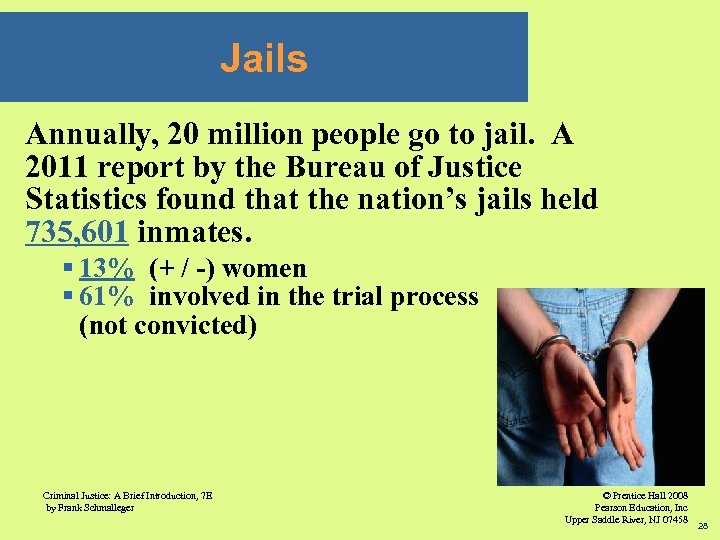
Jails Annually, 20 million people go to jail. A 2011 report by the Bureau of Justice Statistics found that the nation’s jails held 735, 601 inmates. § 13% (+ / -) women § 61% involved in the trial process (not convicted) Criminal Justice: A Brief Introduction, 7 E by Frank Schmalleger © Prentice Hall 2008 Pearson Education, Inc Upper Saddle River, NJ 07458 28
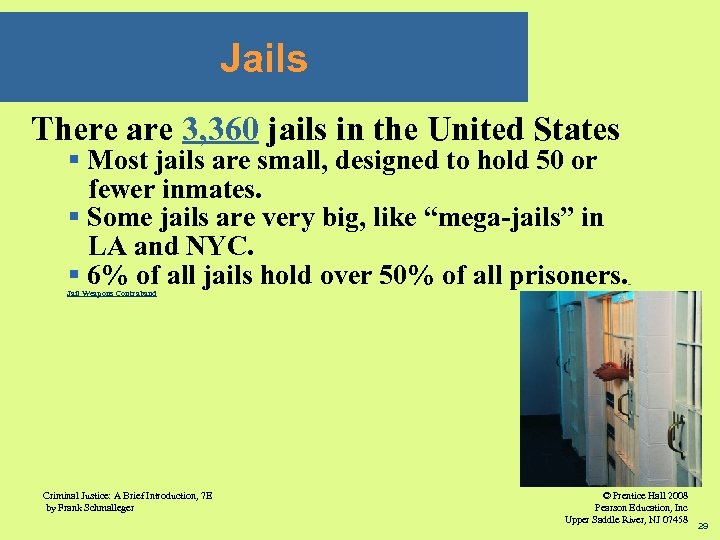
Jails There are 3, 360 jails in the United States § Most jails are small, designed to hold 50 or fewer inmates. § Some jails are very big, like “mega-jails” in LA and NYC. § 6% of all jails hold over 50% of all prisoners. Jail Weapons Contraband Criminal Justice: A Brief Introduction, 7 E by Frank Schmalleger © Prentice Hall 2008 Pearson Education, Inc Upper Saddle River, NJ 07458 29
Jails Most people process through jails are members of minority groups: § 40. 1% African American § 18. 5% Hispanic § 36% Caucasian Typical charges: § 12. 1% drug trafficking § 11. 7% assault § 10. 8% drug possession § 7% larceny Criminal Justice: A Brief Introduction, 7 E by Frank Schmalleger © Prentice Hall 2008 Pearson Education, Inc Upper Saddle River, NJ 07458 30
Current Issues Facing Jails Criminal Justice: A Brief Introduction, 7 E by Frank Schmalleger © Prentice Hall 2008 Pearson Education, Inc Upper Saddle River, NJ 07458 31
Women and Jail § Women comprise 13% of the jail population. § They are the largest growth group nationwide. Why? § Women face a number of special problems, including: § Inadequate classification systems § Lack of separate housing § Low educational levels § Substance abuse § Pregnancy § Motherhood § Inadequate substantive medical programs Criminal Justice: A Brief Introduction, 7 E by Frank Schmalleger © Prentice Hall 2008 Pearson Education, Inc Upper Saddle River, NJ 07458 32
Growth of Jails Many jails are old and overcrowded. - By the end of 1980 s, many jails were so overcrowded that court-ordered caps forced some early releases. - At midyear 2005, national jail occupancy was at 95% rated capacity, with some individual facilities being desperately overcrowded. - At midyear 2011, 89% rated capacity. - 2013 Prison Realignment… Cell Extraction w/ Pepper Ball Criminal Justice: A Brief Introduction, 7 E by Frank Schmalleger © Prentice Hall 2008 Pearson Education, Inc Upper Saddle River, NJ 07458 33
Direct Supervision Jails A new jail architecture and management strategy is called direct supervision. These jails: § Use a system of pods or modular self-contained housing areas § Have a more open environment, using Plexiglas instead of thick walls to separate areas § Use softer furniture § May use “rooms” instead of cells Criminal Justice: A Brief Introduction, 7 E by Frank Schmalleger © Prentice Hall 2008 Pearson Education, Inc Upper Saddle River, NJ 07458 34
Benefits of Direct Supervision Jails Direct supervision jails § Reduce inmate dissatisfaction § Deter rape and violence § Decrease suicide and escape attempts § Eliminate barriers to staff-inmate interaction § Give staff greater control (? ) Why Aggressive Inmates § Improve staff morale § Reduce lawsuits Criminal Justice: A Brief Introduction, 7 E by Frank Schmalleger © Prentice Hall 2008 Pearson Education, Inc Upper Saddle River, NJ 07458 35
Privatization A private prison is a correctional institution operated by a private firm on behalf of the government. The movement toward greater use of private prisons began in the 1980 s. § By 2005, private prisons held 5. 6% of all state and 13. 7% of all federal prisoners. § Private prisons operate in 34 stated and the District of Columbia. Criminal Justice: A Brief Introduction, 7 E by Frank Schmalleger © Prentice Hall 2008 Pearson Education, Inc Upper Saddle River, NJ 07458 36
Benefits of Privatization Private prisons can: § Reduce overcrowding § Lower operating expenses – (Lower Rate of Pay) § Avoid lawsuits – “Indemnification” to govt. Criminal Justice: A Brief Introduction, 7 E by Frank Schmalleger © Prentice Hall 2008 Pearson Education, Inc Upper Saddle River, NJ 07458 37
Скачать презентацию Prisons and Jails Criminal Justice A Brief Introduction
933f290a7649ebe6786ec09c0a0c1115.ppt