


 Скачать презентацию Prison Health Doctor Patient and Society 410 6
01080eefe855dbd6175280aeb4860139.ppt
- Количество слайдов: 41
 Prison Health Doctor Patient and Society 410 6 th Feb, 2013 Ruth Elwood Martin Larry Howett 1
 Acknowledgements and Disclaimers Public Health Agency of Canada 2
 What are the goals for today’s DPAS 410 readings, discussions and presentations? 1. To understand the health disparities of incarcerated populations; 2. To discuss the public health implications of lack of ‘through care’; 3. To listen to narratives of prison health experiences in Canada; 4. To appreciate ways that social exclusion impacts the health of an individual over their lifespan. 3
 Outline of today’s learning activities 1. My presentation • • • International context My own story Numbers of Canadian prisoners and their demographics Health care of Canadian prisoners Prevalence of disease burden among incarcerated people How do we respond? 2. Larry Howett’s story 3. Announcements • • How do we respond to ‘Determinants of Health’? Plenary Quest RFP results 4. Volunteer guests will share their stories with you in in your discussion group
 ‘One can measure the quality of a society by the quality of its prisons’ …. . attributed to Dostoevsky
 2 Nelson Mandela Robben Island Pollsmoor Prison 1962 -1990 ‘The Long Road to Freedom’
 1. The Lancet, 2011. The health of prisoners. 3 2. American Journal of Public Health, 2005. Public health implications of substandard correctional health care. 4 3. American Journal of Public Health, 2005. The World Health Organization European Health in Prisons Project after 10 years: Persistent barriers and achievements. 5 4. Annals of Internal Medicine, 1993. Correctional Health Care: A public health opportunity. 6 5. Canadian Medical Association Journal, 2000. Health care problems in prisons. 7 7
 World Health Organization (Europe) Health in Prisons Programme (HIPP)8 • Initiated in 1995 – academics – mental health • 44 member European countries • WHO International Policy Declarations: – Prisons, drugs and society (2001) – Prison health as part of public health (2003) – Prisons, drugs and harm reduction (2005) – Prisons and mental health (2007) – Women’s health in prison (2009) – Drug overdose in prisons (2010)
 WHO Health in Prisons Programme (HIPP) • Countries should provide prison health care that demonstrates: 1. Community equivalence 2. Integration with a country’s public and primary health care services • Prison health care transferred from Ministry of Justice to Ministry of Health: England, France, Norway, Australia 9 and Italy; and, Nova Scotia!
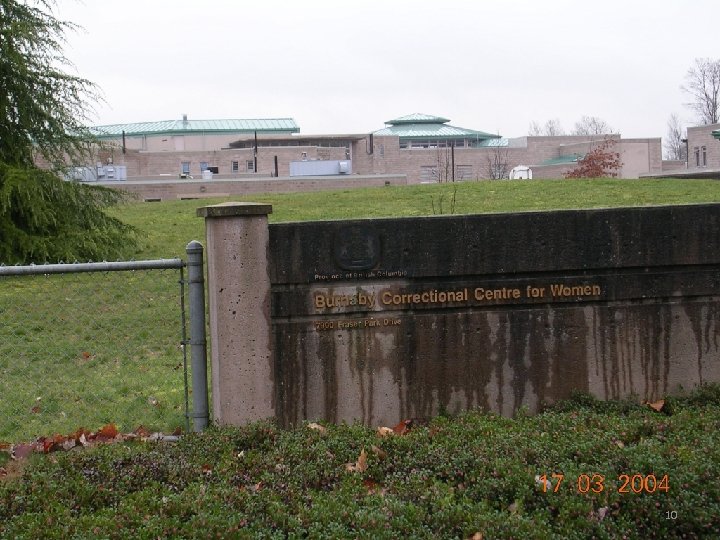 Back in 1994. . . 10
 Incarceration provides a public health opportunity to access and to serve a high-risk population otherwise inaccessible to health care providers 10
 “the value of having prison health as part of medical school is that it exposes you to more or less every population (determinant of health) you could imagine. It’s immigrants, it’s women, it’s homelessness, it’s aboriginal, it’s drug dependency …. ” —medical student 11
 Numbers of Canadian prisoners and demographics • Federal offenders: sentenced>2 years • Provincial inmates: sentenced<2 years • Remanded to custody: awaiting sentencing…may be overnight or many months • Canadian custodial admissions 262, 067(2010)12
 Correctional Service Canada • 53 federal penitentiaries • 8, 323 federal custodial admissions (2010)12 – 11% female – 27% Aboriginal • 15, 055 ‘count’-> institution Webpages (2011) • 8, 016 federal community admissions (2010)
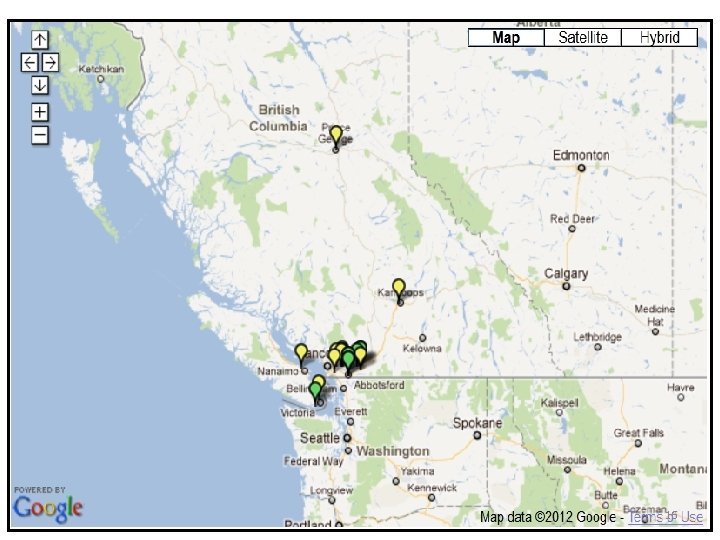
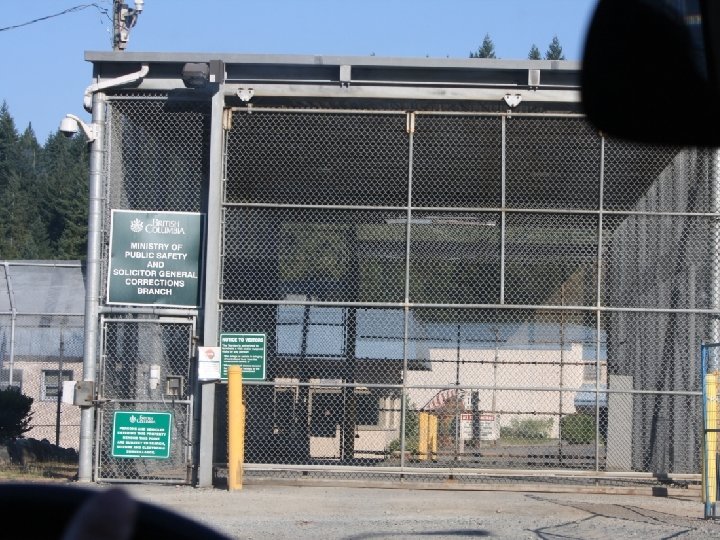
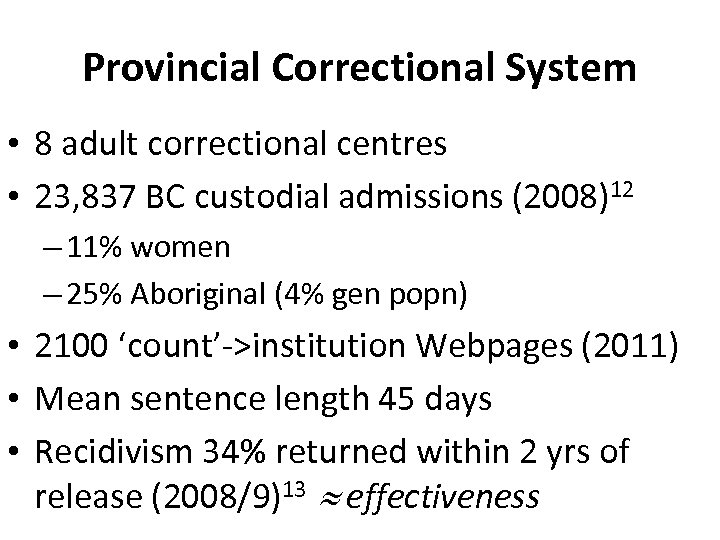 Provincial Correctional System • 8 adult correctional centres • 23, 837 BC custodial admissions (2008)12 – 11% women – 25% Aboriginal (4% gen popn) • 2100 ‘count’->institution Webpages (2011) • Mean sentence length 45 days • Recidivism 34% returned within 2 yrs of release (2008/9)13 effectiveness
 16
16
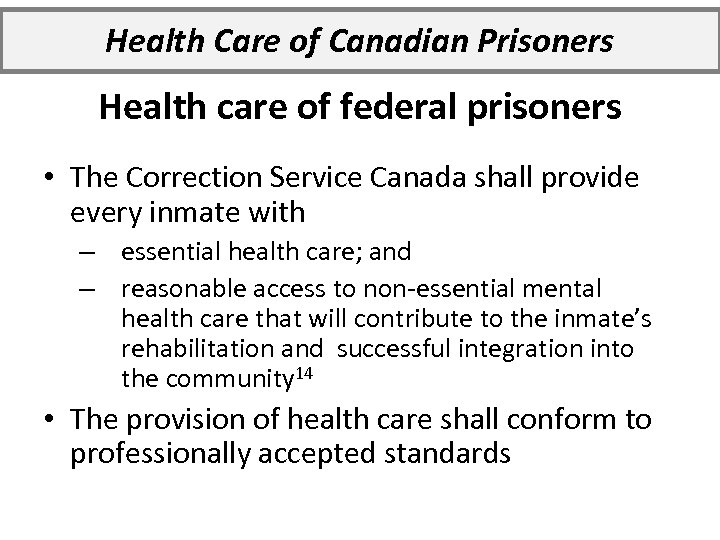 Health Care of Canadian Prisoners Health care of federal prisoners • The Correction Service Canada shall provide every inmate with – essential health care; and – reasonable access to non-essential mental health care that will contribute to the inmate’s rehabilitation and successful integration into the community 14 • The provision of health care shall conform to professionally accepted standards
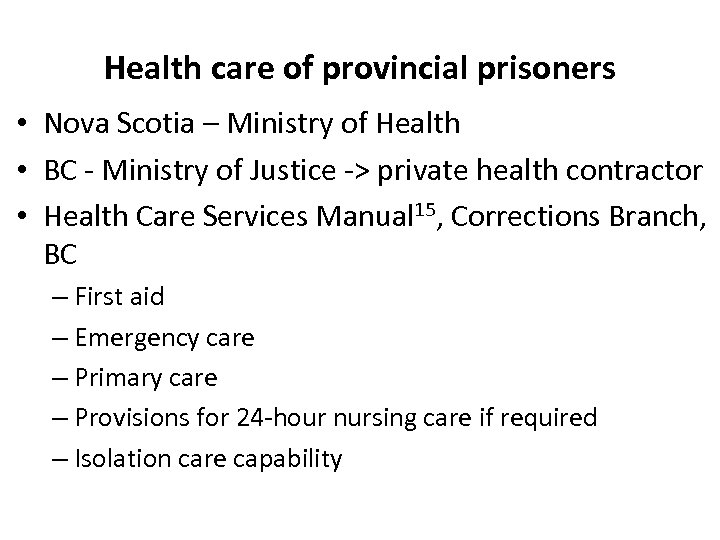 Health care of provincial prisoners • Nova Scotia – Ministry of Health • BC - Ministry of Justice -> private health contractor • Health Care Services Manual 15, Corrections Branch, BC – First aid – Emergency care – Primary care – Provisions for 24 -hour nursing care if required – Isolation care capability

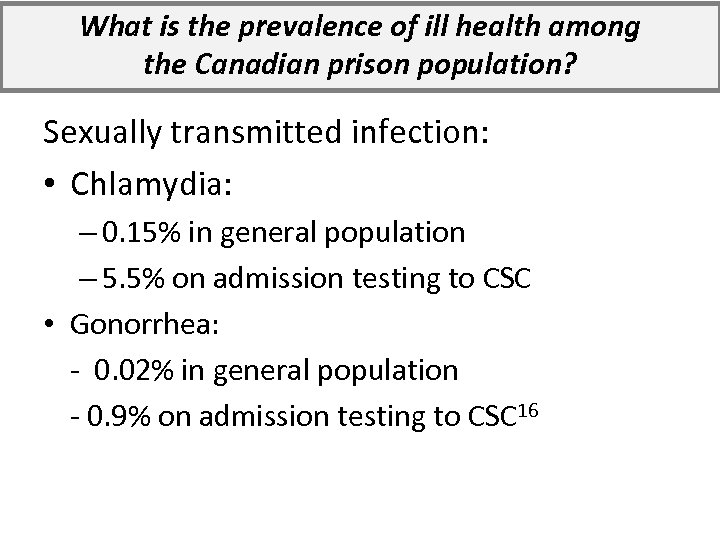 What is the prevalence of ill health among the Canadian prison population? Sexually transmitted infection: • Chlamydia: – 0. 15% in general population – 5. 5% on admission testing to CSC • Gonorrhea: - 0. 02% in general population - 0. 9% on admission testing to CSC 16
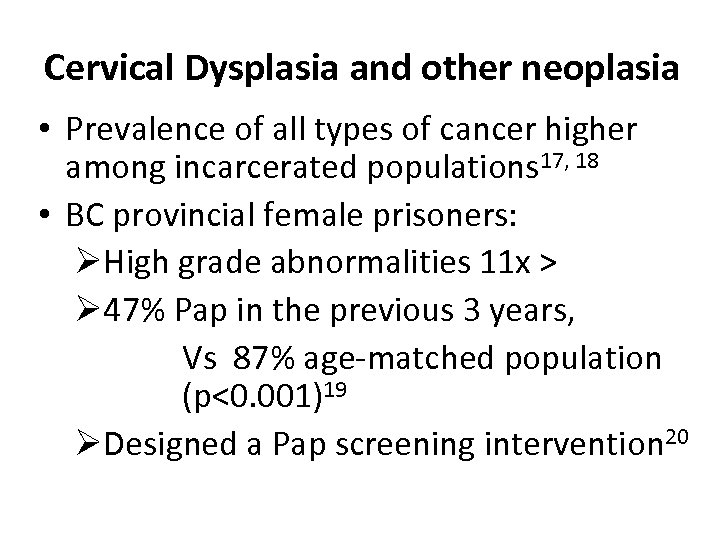 Cervical Dysplasia and other neoplasia • Prevalence of all types of cancer higher among incarcerated populations 17, 18 • BC provincial female prisoners: ØHigh grade abnormalities 11 x > Ø 47% Pap in the previous 3 years, Vs 87% age-matched population (p<0. 001)19 ØDesigned a Pap screening intervention 20
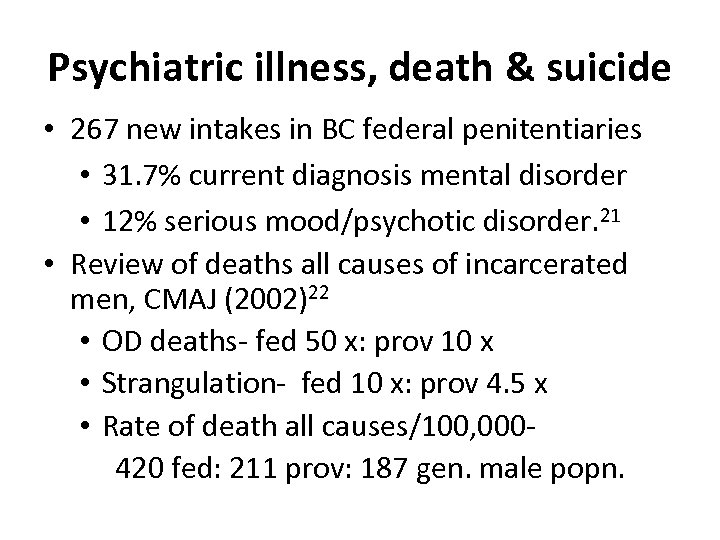 Psychiatric illness, death & suicide • 267 new intakes in BC federal penitentiaries • 31. 7% current diagnosis mental disorder • 12% serious mood/psychotic disorder. 21 • Review of deaths all causes of incarcerated men, CMAJ (2002)22 • OD deaths- fed 50 x: prov 10 x • Strangulation- fed 10 x: prov 4. 5 x • Rate of death all causes/100, 000420 fed: 211 prov: 187 gen. male popn.
 Yvonne Johnson Stolen Life The Journey of a Cree Woman 23 1990’s Ashley Smith Inquest 24 CBC Fifth Estate 25
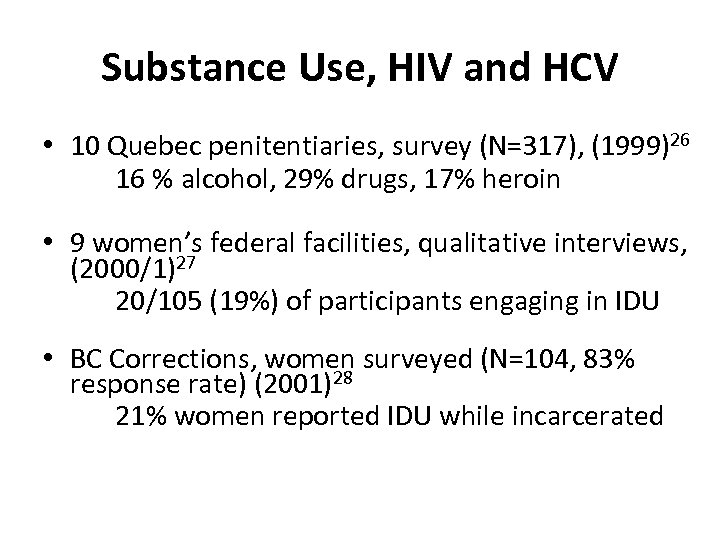 Substance Use, HIV and HCV • 10 Quebec penitentiaries, survey (N=317), (1999)26 16 % alcohol, 29% drugs, 17% heroin • 9 women’s federal facilities, qualitative interviews, (2000/1)27 20/105 (19%) of participants engaging in IDU • BC Corrections, women surveyed (N=104, 83% response rate) (2001)28 21% women reported IDU while incarcerated
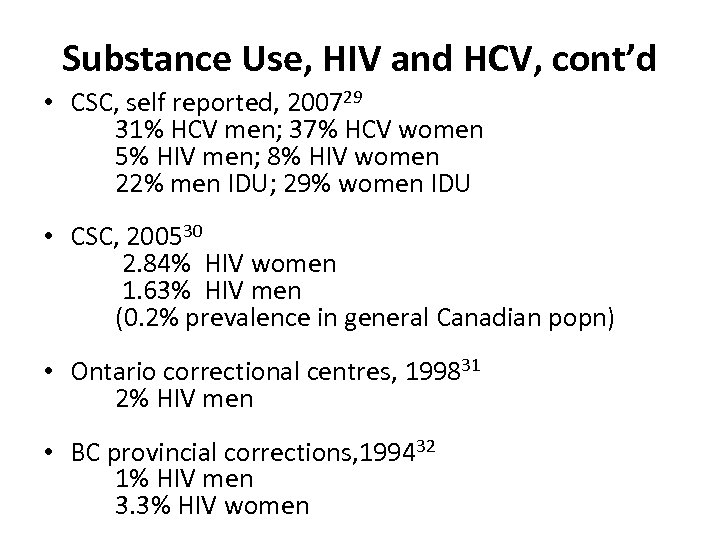 Substance Use, HIV and HCV, cont’d • CSC, self reported, 200729 31% HCV men; 37% HCV women 5% HIV men; 8% HIV women 22% men IDU; 29% women IDU • CSC, 200530 2. 84% HIV women 1. 63% HIV men (0. 2% prevalence in general Canadian popn) • Ontario correctional centres, 199831 2% HIV men • BC provincial corrections, 199432 1% HIV men 3. 3% HIV women
 . . from a poem…. Grey Cocoon
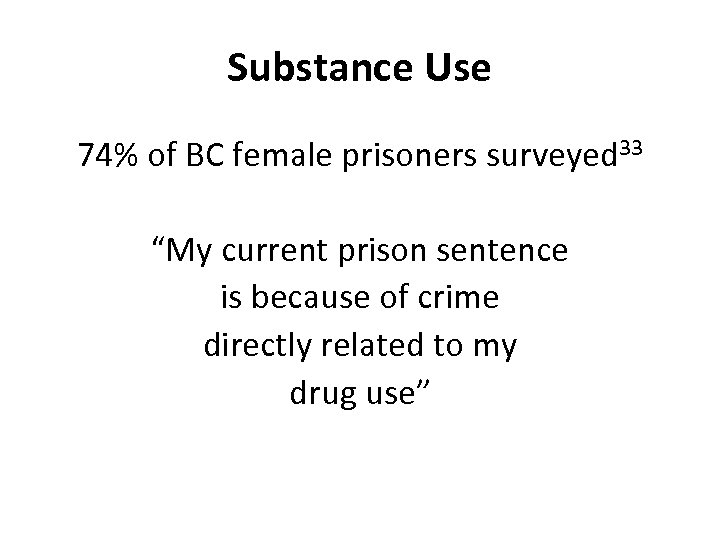 Substance Use 74% of BC female prisoners surveyed 33 “My current prison sentence is because of crime directly related to my drug use”
 Leanne’s letter to the Parole Board
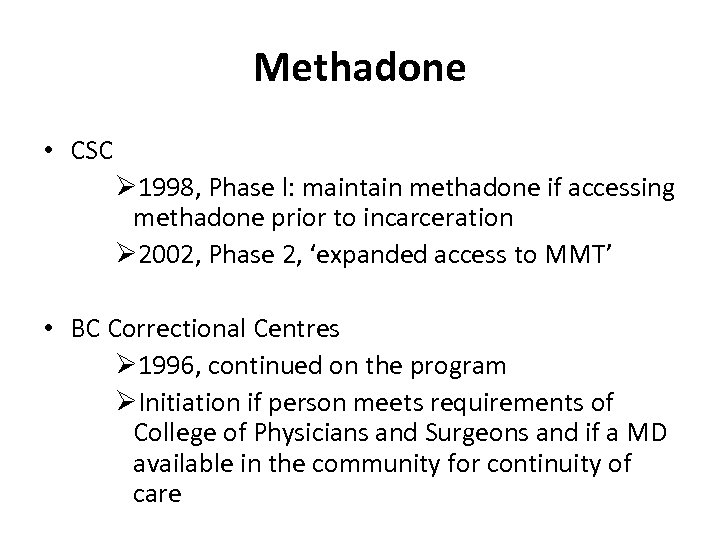 Methadone • CSC Ø 1998, Phase l: maintain methadone if accessing methadone prior to incarceration Ø 2002, Phase 2, ‘expanded access to MMT’ • BC Correctional Centres Ø 1996, continued on the program ØInitiation if person meets requirements of College of Physicians and Surgeons and if a MD available in the community for continuity of care
 34 Action on HIV/AIDS in Prisons Too Little, Too Late - A Report Card (2002) -
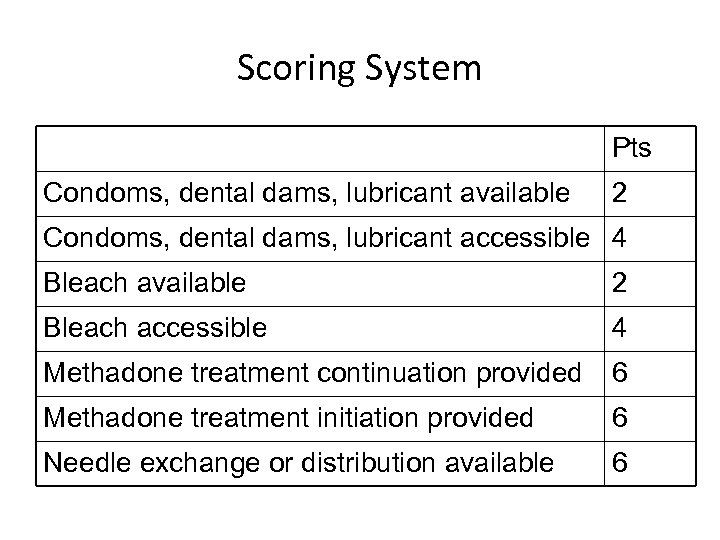 Scoring System Pts Condoms, dental dams, lubricant available 2 Condoms, dental dams, lubricant accessible 4 Bleach available 2 Bleach accessible 4 Methadone treatment continuation provided 6 Methadone treatment initiation provided 6 Needle exchange or distribution available 6
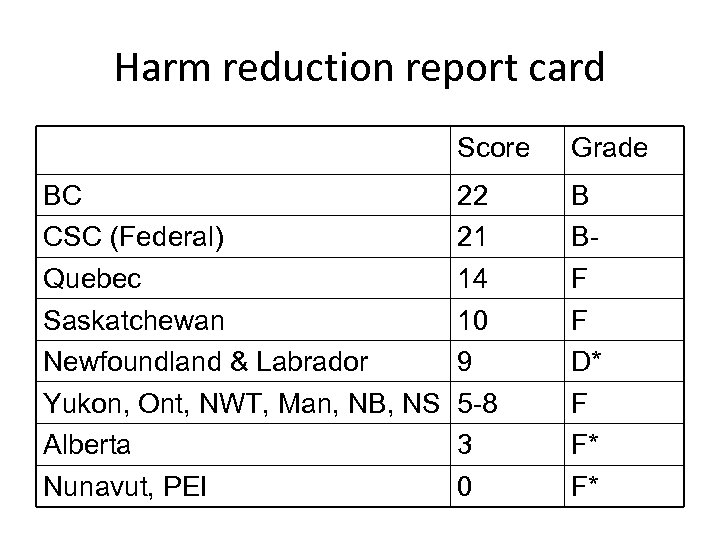 Harm reduction report card Score BC CSC (Federal) Quebec Saskatchewan Newfoundland & Labrador Yukon, Ont, NWT, Man, NB, NS Alberta Nunavut, PEI Grade 22 21 14 10 9 5 -8 3 0 B BF F D* F F* F*
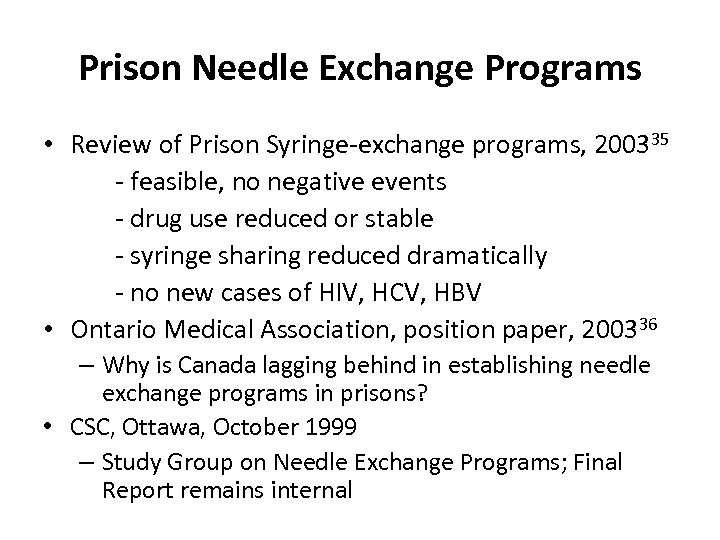 Prison Needle Exchange Programs • Review of Prison Syringe-exchange programs, 200335 - feasible, no negative events - drug use reduced or stable - syringe sharing reduced dramatically - no new cases of HIV, HCV, HBV • Ontario Medical Association, position paper, 200336 – Why is Canada lagging behind in establishing needle exchange programs in prisons? • CSC, Ottawa, October 1999 – Study Group on Needle Exchange Programs; Final Report remains internal
 Paradox…… Providing health care for my patient (the prisoner) within a correctional system
 How should prison health care clinicians respond? 1. Witnesses and observers of our patients’ lives 2. Conscientious and compassionate medical care 3. Prison-based clinical quality improvement activities 4. Advocacy role……. .
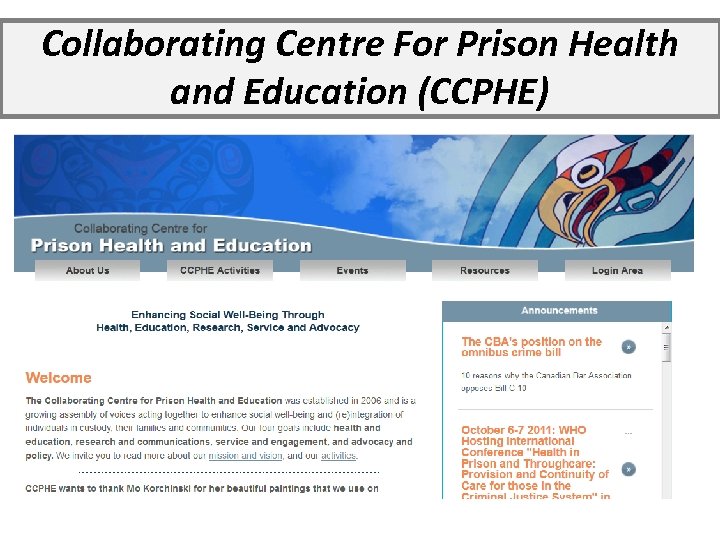 Collaborating Centre For Prison Health and Education (CCPHE)
 Thank you for listening! Collaborating Centre for Prison Health and Education 300 - 5950 University Boulevard Vancouver, BC V 6 T 1 Z 3 Tel: (604) 827 -4976 Fax: (604) 827 -4184 Email: prison. health@familymed. ubc. ca CCPHE banners paintings: Artist Mo Korchinski lives in Maple Ridge, BC, and is a mother and grandmother. Mo paints with acrylics on canvas to portray images that inspired her during her incarceration and during her (re)integration into the community. Mo is also community-based researcher with Women in 2 Healing and is passionate about working to improve the health and education of women inside and outside of prison.
 References 1 Dostoevsky, Fyodor. The House of the Dead (1862) Walk to Freedom: The Autobiography of Nelson Mandela 3 Fazel S, Baillargeon J. The health of prisoners. The Lancet 2011; 377(9769): 956 -965. 4 Restum ZG. Public health implications of substandard correctional health care. Am J Public Health 2005; 95(10): 16891691. 5 Gatherer A, Moller L, Hayton P. The World Health Organization European Health in Prisons Project after 10 years: Persistent barriers and achievements. Am J Public Health 2005; 95(10): 1696. 6 Glaser JB, Greifinger RB. Correctional Health Care: A public health opportunity. Ann Intern Med. 1993; 118: 139 -145 7 Ford PM, Wobeser, WL. Health care problems in prisons. CMAJ 2000; 162(5): 664 -665 8 World Health Organization (Europe), Health in Prisons Programme (HIPP) http: //www. euro. who. int/en/what-we-do/health-topics/health-determinants/prisons-and-health/who-health-in -prisons-programme-hipp 9 Prison Health and Public Health: the integration of prison health services (report from a conference). International Centre for Prison Studies. April 2004. http: //www. prisonstudies. org/info/downloads/health_service_integration. pdf 10 Glaser JB, Greifinger RB. Correctional Health Care: A public health opportunity. Ann Intern Med. 1993; 118: 139 -145 11 Filek H, Buxton J, Harris J, Pang H, Sharif, N. Martin RE. Medical Students and Residents go to Prison. American Public Health Association, 140 th Annual Meeting and Exposition, San Francisco, USA, Oct 2012 12 Canada Statistics. Correctional Services. Adult correctional services, admissions to provincial, territorial and federal programs. [Internet]. Available from: http: //www. statcan. gc. ca/tables-tableaux/sum-som/l 01/cst 01/legal 30 beng. htm 13 Ministry of Public Safety and Solicitor General, 2010/11 – 2012/13 SERVICE PLAN , March 2010 14 Health Care, Corrections and Conditional Release Act (S. C. 1992, c. 20). Available from: http: //lawslois. justice. gc. ca/eng/acts/C-44. 6/page-24. html#h-33 15 Health Care Services Manual, Corrections Branch, Ministry of Justice, BC 16 Zakaria D, Thompson JM, Jarvis A, Borgatta F. Research Reports [Internet]. Summary of Emerging Findings from the 2007 National Inmate Infectious Diseases and Risk-Behaviours Survey. 2007 [cited 2012 Mar 13]. Available from: http: //www. csc-scc. gc. ca/text/rsrch/reports/r 211 -eng. shtml 2 Mandela, Nelson. Long
 References, continued 17 Davies EA, Sehgal A, Linklater KM, Heaps K, Moren C, Walford C, Cook R, Møller H. Cancer in the London prison population, 1986– 2005. 2010. Journal of Public Health. pp. 1– 6. doi: 10. 1093/pubmed/fdq 009 18 Harzke AJ, Baillargeon JG, Kelley MF, Pruitt SL, Pulvino JS, Paar DP. Leading medical causes of mortality among male prisoners in Texas, 1992 --2003. J Correct Health Care. 2011 Jul; 17(3): 241 -53. doi: 10. 1177/1078345811401362. 19 Martin RE. A review of a prison cervical cancer screening program in British Columbia. Can J Public Health. 1998; 89. 6: 382 - 386. 20 Martin RE, Hislop GT, Grams GD, Calam B, Jones E, Moravan V. Evaluation of a cervical cancer screening intervention for prison inmates. Can J Public Health. 2003; 95. 4: 285 - 289. 21 Brink, J. H. , Doherty, D. , & Boer, A. (2001). Mental disorder in federal offenders: A Canadian prevalence study. International Journal of Law and Psychiatry 2, 330 - 356. doi: 10. 1016/S 0160 -2527(01)00071 -1. 22 Wobeser WL, Datema J, Bechard B, Ford P. Causes of death among people in custody in Ontario, 1990 -1999. CMAJ. 2002 Nov 12; 167(10): 1109 -13. 23 Wiebe R, Johnson Y. Stolen Life: The Journey of a Cree Woman. Vintage Canada. ISBN-10: 0676971962. 24 See daily postmedia news reports written by. Christie Blatchford. For example, Guard cries at Ashley Smith inquest over ‘what we were reduced to’, Feb 6, 2013. http: //www. canada. com/Guard+cries+Ashley+Smith+inquest+over+what+were+reduced/7928857/story. html 25 CBC Fifth Estate documentaries, Behind the Wall http: //www. cbc. ca/fifth/2010 -2011/behindthewall/ and Out of Control http: //www. cbc. ca/fifth/2009 -2010/out_of_control/ 26 Poulin C, Michel A, Gilles L, Gaston G, et al. Prevalence of HIV and hepatitis C virus infections among inmates of Quebec provincial prisons. CMAJ. 2007; 177(3): 252 -256. DOI: 10. 1503/cmaj. 060760 27 Di. Censo AM, Dias G, Gahagan J. Unlocking our Futures: A National Study on Women, Prisons, HIV, and Hepatitis C. 2003. Prisoners' HIV/AIDS Support Action Network (PASAN). http: //www. pasan. org/Publications/Unlocking_Our_Futures. pdf 28 Martin RE, Gold F, Murphy W, Remple V, Berkowitz J, Money D. Drug use and risk of bloodborne infections: a survey of female prisoners in British Columbia. Can J Public Health. 2005; 96. 2: 97 – 101. 29 Calzavara L, Ramuscak N, Burchell AN, et al. Prevalence of HIV and hepatitis C virus infections among inmates of Ontario remand facilities. CMAJ. 2007; 177. 3: 257 30 Correction Service Canada Infectious Disease Surveillance System (2005). Available at http: //www. cscscc. gc. ca/text/pblct/infdscfp-2005 -06/p 6 -eng. shtml#l 31
 References, continued 31 Ford, P. et al. HIV and Hep C Seroprevalence and Associated Risk Behaviours in a Canadian Prison. Canadian HIV/AIDS Policy and Law Newsletter (Volume 4, Number 2/3, Spring 1999). 32 Rothon D, Mathias R, Schechter M. Prevalence of HIV infection in provincial prisons in British Columbia. CMAJ. 1994; 151. 6: 781 -786. 33 Martin RE, Gold F, Murphy W, Remple V, Berkowitz J, Money D. Drug use and risk of bloodborne infections: a survey of female prisoners in British Columbia. Can J Public Health. 2005; 96. 2: 97 – 101. 34 Lines, Rick. Action on HIV/AIDS in Prisons, Too Little, Too Late - A Report Card. http: //www. aidslaw. ca/publications/interfaces/download. File. php? ref=179 35 Dolan K, Rutter S, Wodak AD. Prison-based syringe exchange programmes: a review of international research and development. Addiction. 2003 Feb; 98(2): 153 -8. 36 Improving our health. Why is Canada lagging behind in establishing needle exchange programs? Position paper, Ontario Medical Association. 2004. http: //www. iprt. ie/files/oma_pnep_doc. pdf 37 Study Group on Needle Exchange Programs (October 1999). Final Report of the Study Group on Needle Exchange Programs. Correctional Service of Canada: Ottawa.