


 Скачать презентацию PRISM Forum SIG Clinical Informatics — mining patient-centric
f221529c8644e4d90137bb877b7d2344.ppt
- Количество слайдов: 33
 PRISM Forum SIG: Clinical Informatics - mining patient-centric data 22 -Oct-2010
 Overview 1 • Overarching Themes: • Patient data accumulated by payors and health care providers as a part of their routine activities will provide a fount of information and insight about the activity of pharmaceuticals in real-world use • Randomized clinical trial – including Phase IV trials although still the ‘gold standard’ for ensuring efficacy and safety, is perceived to be insufficient to provide an understanding of the full spectrum of use and response to pharmaceuticals in the marketplace.
 Overview 2 • More Overarching Themes: • Health care providers and life-science IT organizations, are moving aggressively to aggregate data they have under their control or get access to that data. • Payors, both commercial and governmental, and regulatory agencies are beginning to mine available data to establish, or refute, effectiveness and or safety claims. • Privacy advocates, and some local and national legislators are attempting to make it harder to gain access to this data • Existing initiatives (HIGHTECH, ARRA) are driving the adoption of technology to capture even more patient data
 Overview 3 • More Overarching Themes: • Organizations which develop the capability to use this fragmented, heterogeneous data will have a huge advantage over competitors, vendors and others with whom they do business. • This requires: • The physical infrastructure to support the activities • Access to people with appropriate domain knowledge and analytical capabilities • Analytical tools
 Overview 4 • More Overarching Themes: • Without ability to access and utilize this data, Pharma companies will be at a distinct disadvantage; unable to engage effectively in discussions: • regarding safety or comparative effectiveness • With payors to establish support for future development • Pharma will also lack a potentially critical source of data for translational medicine efforts. • However: use of the available data with appropriate tools can yield surprising and valuable results for all phases of the development process.
 Steven Labkoff, Deloitte The Data Gold Rush: Opportunities for the Pharmaceutical Industry from Healthcare Data • There is growing recognition of the potential value of patient care data • The vast bulk of patient data (prescribing information, physicians notes, hospital records, lab results, etc) are outside the control of the pharma industry • Regulators, payors and providers will make assessments of safety, formulary placement and pricing based on this data • The data is: • Dispersed • Heterogeneous and difficult to aggregate • Outside the control of pharma • Some efforts, both regional and national, are aimed at making it more difficult to gain access than it already is
 Steven Labkoff, Deloitte (2) • Those who currently have the data (providers, payors) and come major life-science IT organizations are building capabilities to market the data and/or analytical services. • Hiring Informatics and IT talent to create and maintain useable data • Having access to the data, and the ability to use it effectively, provides a tremendous competitive advantage in any discussion of efficacy or safety
 Kristen Rosati, Coppersmith Schermer & Brockelman, PLC HIPAA Challenges Ahead in Mining Patient-Centric Data • The High Tech Act (HTA) creates incentives for: • Physicians to adopt electronic health records • Communities to create Health Information Exchanges • HTA also includes: • Prohibition on the sale of private patient data • New privacy rules • New rules apply to business associates • Mandatory breach reporting • Civil and criminal penalties for improper release of patient data • Series of tiered penalties, up to $1. 5 M peryearpertype • State Attorneys general can bring HIPAA actions • Opens door to multiple, conflicting interpretations of the regulations
 Kristen Rosati (2) • HTA also: • limits the way in which providers can communicate with patients if they are being paid by third parties • Requires authorization from patients before data can be sold • Requires that patients opt-in to authorize the storage of samples for research purposes • De-identified data and aggregated data are not covered under these laws
 Kristen Rosati (3) • Final regulations based on the laws have not been finalized • HHS is holding public meetings to discuss how to write the regulations • Privacy advocates are actively engaged in influencing the discussion
 Ken Park, Mc. Kinsey Exploring the Clinical Informatics Landscape in Europe, Asia, and Beyond • Providers, payors and regulators increasingly are doing their own comparative effectiveness and safety research using the real-world patient data. • Outside the US the landscape is fragmented. The UK and Germany have examples of organizations developing data and analytics: • GPRD and QResearch in the UK • AOK and BIPS in Germany • These are a mix of public and private organizations, with public and private data sources
 Ken Park, Mc. Kinsey (2) • Other European countries have some capabilities • Their focus is often on: • The specific needs of their patient population • Outcomes research based on their particular practices and standards of care
 Ken Park, Mc. Kinsey (3) • Building relationships with the existing local medical infrastructure is essential in order to gain access to patient data • Many organizations hesitant, unwilling or unable to work directly with Pharma companies • Access may be available via: • Local commercial data providers • Local academic researchers
 Ken Park, Mc. Kinsey (4) • In Asia: • South Korea, Taiwan and Thailand have some efforts underway • Potential game-changers: • China • Able to dictate medical practice • Able and willing to create needed infrastructure • Abu Dhabi • Used oil wealth to build medical infrastructure (including EHRs) from the ground-up • Alberta, Canada • Regional health care authority driving adoption of EHRs
 Bill Marder, Thomson Reuters Five Year Trends in Spending by Disease: Results from the Market. Scan Database • “Bending the Cost Curve” • An illustration of the use of EMR data to identify changes in spending patterns in a large patient population. • Able to identify major diseases contributing to changes in spending. • This type of information is critical for a provider when negotiating reimbursement rates with a payor • EMR data from an employer-based insurance pool was processed using proprietary software • Very difficult to process textual data • Provide-centric EMRs do not provide longitudinal data • There are no standards: Some key data (e. g. blood pressure, height, weight) may be missing
 John Murphy, Quintiles Advanced Analytic Concepts: A Gambler’s Guide to the Drug Discovery, Development & Commercial Universe • Model-Based Drug Discovery (MBDD) should be used for all phases of development • • Disease modeling Dose selection Trial design Financial analysis, etc • Quintiles has built a ‘data factory’ to support MBDD • Data from > 10, 000 clinical trials • Commercial data • Links to external data from 1000 databases
 John Murphy, Quintiles (2) • PACe. R – Partnership to Advance Clinical electronic Research • Consortium with New York hospitals and medical centers , Pharma companies • Collect and federate all patient data • Use advanced analytics (including neural networks) to drive modeling efforts
 John Murphy, Quintiles (3) • PACe. R is a business • Using activity as incubator • Partners are VC for spin-offs • Maintain vocabularies, ontologies, processes • Pharma Purchasers will be customers • PACe. R Clinical Science will do modeling • Trial modeling, patient selection, protocol validation, safety • Hospitals, etc will provide data to answer questions • Franchise model, HPCs will buy into selling data based on common model • Adopt processes and standards established by PACe. R • Monetary incentives will bring slow followers along • Make adoption and compliance based on financial benefit
 Paul Bleicher, Humedica Healthcare Informatics: Creating Value and Defining Challenges • Different organizations have different uses for de-identified data • Health Care Organizations • Quality management • Patient safety • Resource management • Government • Effectiveness and safety research • Establishing reimbursement schedules • Public health • Pharma • Clinical research • Pharmacovigilance • Market research
 Paul Bleicher, Humedica (2) • Longitudinal data is the ‘holy grail’ • EHR adoption is improving, and already better than assumed • The problem is the data is: • Textual, hard to process • Not structured for analysis • Generated from a variety of platforms and legacy systems • Analytical tools need to improve • Users of the data must become comfortable with new visualizations and analytic techniques • Concerns about data security need to be addressed
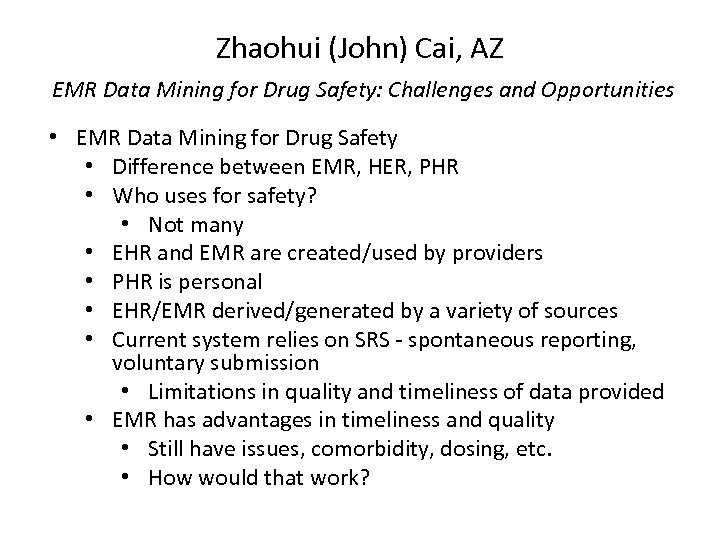 Zhaohui (John) Cai, AZ EMR Data Mining for Drug Safety: Challenges and Opportunities • EMR Data Mining for Drug Safety • Difference between EMR, HER, PHR • Who uses for safety? • Not many • EHR and EMR are created/used by providers • PHR is personal • EHR/EMR derived/generated by a variety of sources • Current system relies on SRS - spontaneous reporting, voluntary submission • Limitations in quality and timeliness of data provided • EMR has advantages in timeliness and quality • Still have issues, comorbidity, dosing, etc. • How would that work?
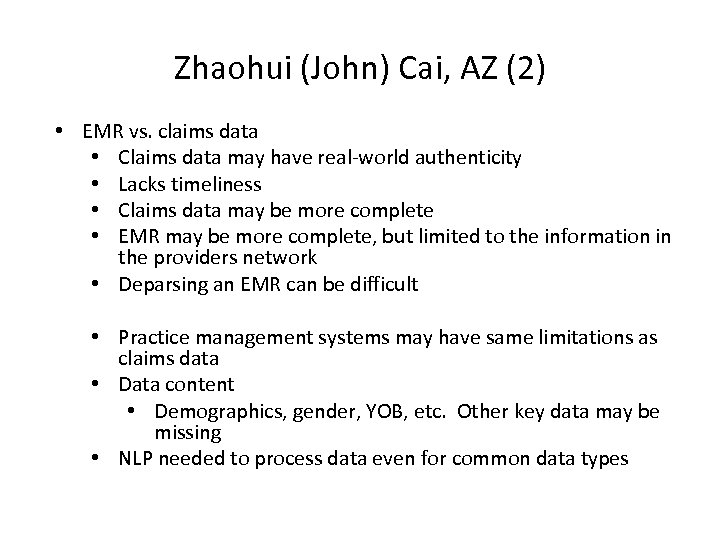 Zhaohui (John) Cai, AZ (2) • EMR vs. claims data • Claims data may have real-world authenticity • Lacks timeliness • Claims data may be more complete • EMR may be more complete, but limited to the information in the providers network • Deparsing an EMR can be difficult • Practice management systems may have same limitations as claims data • Data content • Demographics, gender, YOB, etc. Other key data may be missing • NLP needed to process data even for common data types
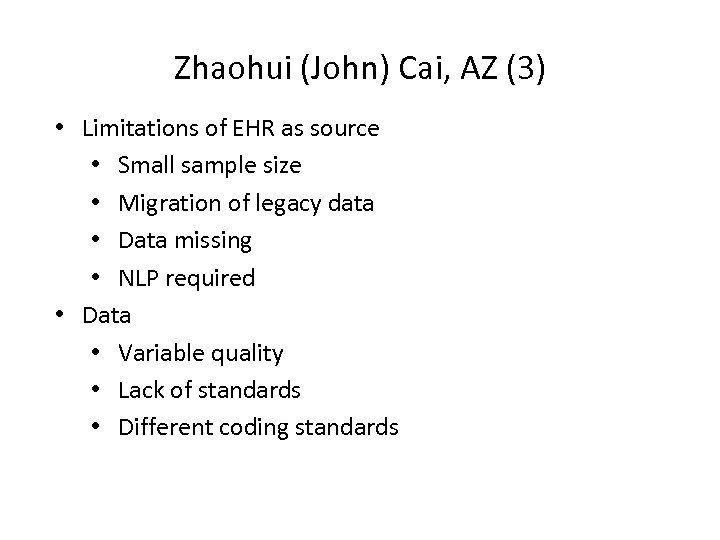 Zhaohui (John) Cai, AZ (3) • Limitations of EHR as source • Small sample size • Migration of legacy data • Data missing • NLP required • Data • Variable quality • Lack of standards • Different coding standards
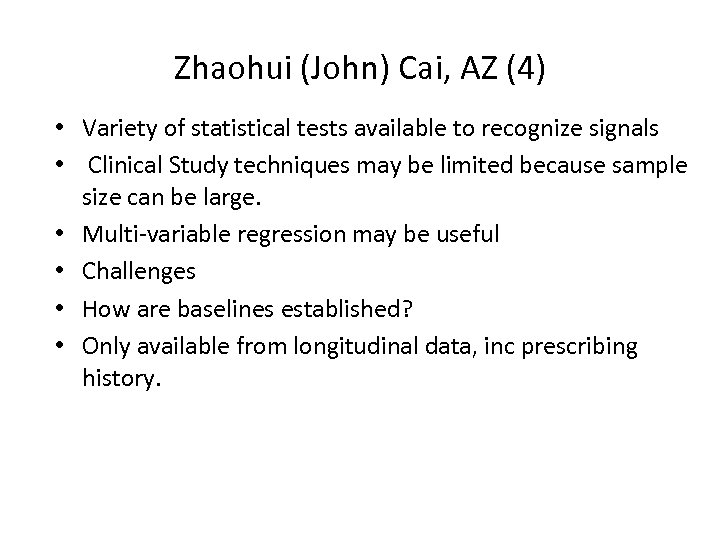 Zhaohui (John) Cai, AZ (4) • Variety of statistical tests available to recognize signals • Clinical Study techniques may be limited because sample size can be large. • Multi-variable regression may be useful • Challenges • How are baselines established? • Only available from longitudinal data, inc prescribing history.
 Patrick Ryan, OMOP Informatics Opportunities for Exploring the Real-World Effects of Medical Products • Observational Medical Outcomes Partnership • FDAAA establishes national network SENTINAL to create surveillance for all regulated medical products • If the data were available • What could be done with it? • What hypotheses could be generated? • How reliable would the results be? • What infrastructure is required? • Governance • How to satisfy all stakeholders: • FDA • payors • Providers • patients
 Patrick Ryan, OMOP (2) • OMOP Public/private partnership • Conduct research on methodologies to evaluate performance of analytical methods to identify drug safety issues • Data provided by multiple sources – hospitals and health care systems • ETL required significant effort, no one ran into insurmountable barriers to converting data to common model
 Patrick Ryan, OMOP (3) • Created common data model • Identified ten mature drug classes with well-defined safety profiles • Created informatics tools (now in public domain) • Created processing tools to allow aggregation on population/subpopulation • Key to success is the creation of aset of informatics tools • Much current work is one-off and ad hoc • Standards –both data and analytical – are needed • Problem with federating disparate data sources • Necessary, arduous to develop tools • Think such an approach could be done
 Patrick Ryan, OMOP (4) • Common vocabsularies, NML, MEDRA • Change from standard thinking: rather than tracking one drug at one time, need to track all drugs across all available data sources • Asked community which questions they would ask if they had access to this data • Community invited to implement their query • Can test results, compare across db • See variability in outcomes from db • Also able to test sensitivity of tests to initial parameters • Compare outcomes to benchmarks, true negatives and positives • These tools have broader applicability outside safety.
 Marsha Wilcox, J&J Using Publically Available Data to Redefine the Phenotype for Genetic Studies • Public data – refine phenotype in genetic studies • Let data/genetics define what the phenotype should be. • Mental illness, the phenotype is a surrogate for ogran pathology • NIH data from db. GAP, metabolic data from Framingham Heart Study • Is it possible to identify genetic subtypes of patients with the same diagnosis, and correlate this to newly available data (e. g. imaging)
 Marsha Wilcox, J&J (2) • Used unusual statistical methods (machine learning) to identify subtypes • NIMH and VA data • Diagnostic algorithms to identify subtypes based on qualitative traits from manuals • Mapped pos/neg/disorganized symptoms from diagnosis and mapped to chromosome map. Found + symptoms peak on chromosome 5, - symptoms on chromosome 12(? )
 Marsha Wilcox, J&J (3) • Schizophrenia results in loss of tissue, maybe disease or treatment with neuroleptics • Did imaging on patients soon after early diagnosis • Brain imaging links brain loss to negative traits • Also found relationship of HLA region with early-onset RA • GWAS differentiated obese populations to identify subpops at risk for heart disease and not.
 Panel Discussion • • Panel: • Diego Miralles • Ken Park • Bill Mardar Where will Clin. Inf be in 2020? • KP: Tend to underestimate what can be accomplished in 10 years • Pharma wants result in 1 year • BM: some areas will move forward (oncology). Still relying on organizations like Partners and Intermountain Health • DM: Pharma will be much smaller, no new drugs. DD too long and expensive. Need to bring cost structure down, use technology. How clinical trials are conducted. • Social networking as mechanism for conducting trials • DM: mytrust Things will change, capabilitites. Have to be able to take advantage of patients’ capabilities My. Medical. Information (? ). Don’t underestimate consumer-derived data. • BM: complex negotiations with regulators, reducing • KP: These may influence pipelines, but won’t really affect empty piplines. But innovation is unpredictable.
 Panel Discussion (2) • Will we use Personally Health Records? • DM: Everyone has failed miserably with PHRs. Compare with San. Disk with encoded information. Patients can’t provide adequate information. Must be provided by HCP. • BM: must lower concern over privacy. Then HCP can enter data. • KP: If you’re healthy PHR is useless, if you’re sick it’s too late. It’s not a privacy issue, it’s just a hassle. MS Vault facilitates upload from some centers, but data entry is still too hard. • Paul: Parallel to financial data? Anyone comfortable with putting all their data in Mint? • Alistair: What about physician expectation and behavior? • Paul: See Patients. Like. Me – questions about where data was going resulted in many users abandoning the site. They didn’t want data sold to pharma.