


 Скачать презентацию Principles of technology transfer in Particle Physics From
949f226cd5043051980c0e5a9fe048a5.ppt
- Количество слайдов: 19
 Principles of technology transfer in Particle Physics From collaborations to spin-offs Jožef Stefan Institute – 1 and 2 October 2009 Jean-Marie Le Goff, Ph. D, DPhil Experimental physicist CERN Visiting professor at the Faculty of mathematics and Computing of the University of the West of England, UK Jean-Marie. Le. Goff@cern. ch
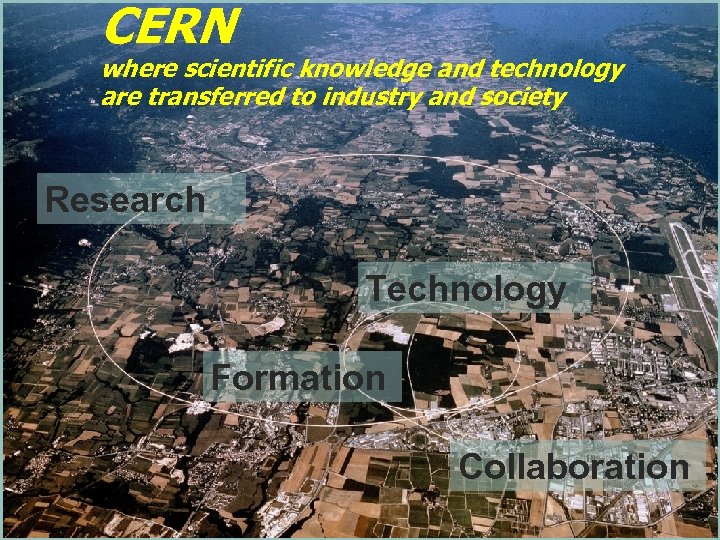 CERN where scientific knowledge and technology are transferred to industry and society Research Technology Formation Collaboration The TT Network Procter & Gamble, September 26 th 2007 2
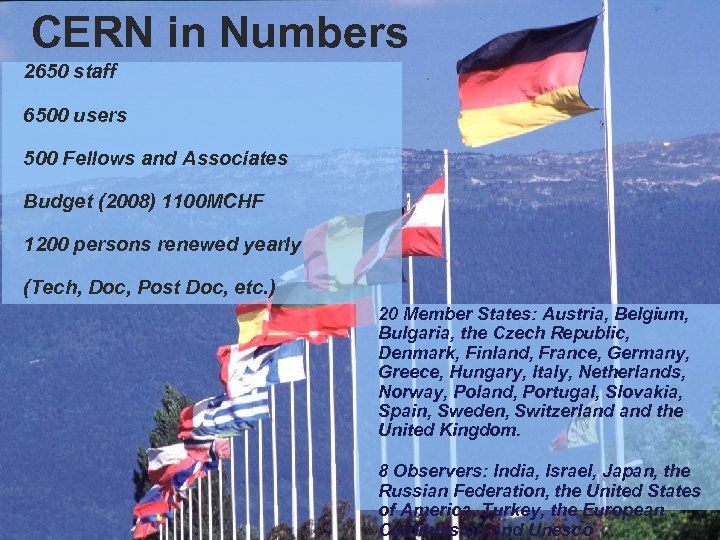 CERN in Numbers 2650 staff 6500 users 500 Fellows and Associates Budget (2008) 1100 MCHF 1200 persons renewed yearly (Tech, Doc, Post Doc, etc. ) 20 Member States: Austria, Belgium, Bulgaria, the Czech Republic, Denmark, Finland, France, Germany, Greece, Hungary, Italy, Netherlands, Norway, Poland, Portugal, Slovakia, Spain, Sweden, Switzerland the United Kingdom. 8 Observers: India, Israel, Japan, the Russian Federation, the United States The TT of America, Turkey, the European Network Commission and Unesco 3
 Fundamental Science and TT Science leads to technology innovation. High tech industry is the backbone of economy. Society relies on technology. Discoveries alone are no longer sufficient to substantiate the investment level of Member States in fundamental science*. Particle Physics is required to demonstrate its importance to Society: • Communication is key to reach this objective Particle Physics is required to demonstrate its usefulness to Society: • TT is a key mean to reach this objective. (*) CERN Council in charge of the European Strategy for Particle Physics The TT Network 4
 Particle Physics characteristics PP characteristics • Research in curiosity-driven science is an important driver for technological innovation and economic success • PP is a highly collaborative open science environment q requiring expertise in many technology domains q offering top quality education and training from apprentice to post-doctoral • PP experiments are extremely demanding in terms of equipment design, and they generate novel technical approach which ultimately benefit society • Technological innovations from PP benefit many research disciplines other than physics World standard institutions (centres of excellence) with high tech laboratories for: • Accelerator elements, Vacuum technologies, magnets • Particle detectors • Electronics & IT • Super-conductivity and Cryogenics • Mechanics & surface Treatments The TT Network 5
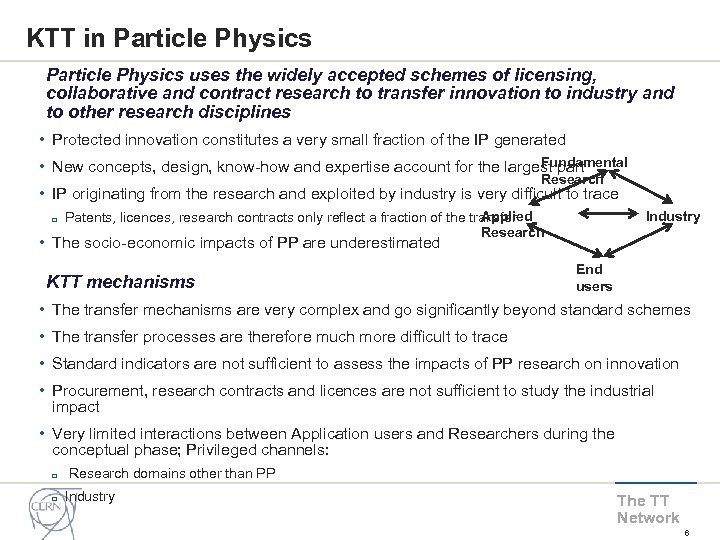 KTT in Particle Physics uses the widely accepted schemes of licensing, collaborative and contract research to transfer innovation to industry and to other research disciplines • Protected innovation constitutes a very small fraction of the IP generated Fundamental • New concepts, design, know-how and expertise account for the largest part Research • IP originating from the research and exploited by industry is very difficult to trace q Applied Patents, licences, research contracts only reflect a fraction of the transfer Research Industry • The socio-economic impacts of PP are underestimated KTT mechanisms End users • The transfer mechanisms are very complex and go significantly beyond standard schemes • The transfer processes are therefore much more difficult to trace • Standard indicators are not sufficient to assess the impacts of PP research on innovation • Procurement, research contracts and licences are not sufficient to study the industrial impact • Very limited interactions between Application users and Researchers during the conceptual phase; Privileged channels: q Research domains other than PP q Industry The TT Network 6
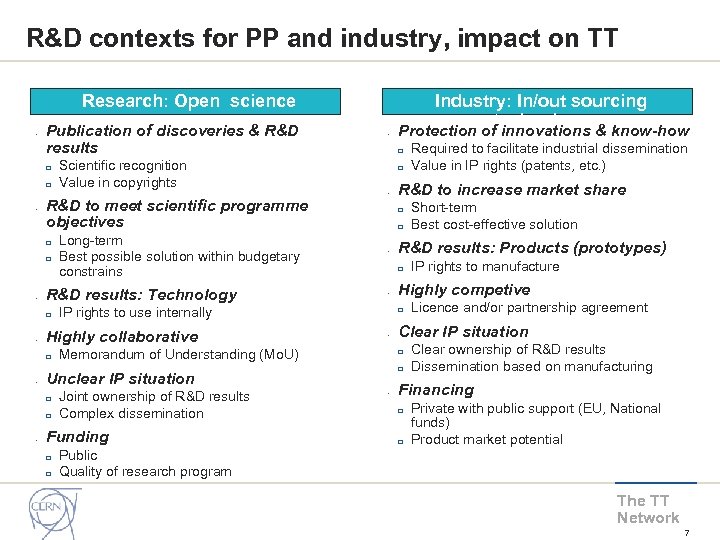 R&D contexts for PP and industry, impact on TT • Research: Open science Publication of discoveries & R&D results q q • q • • R&D to meet scientific programme objectives q q • R&D results: Technology q • • Memorandum of Understanding (Mo. U) q Joint ownership of R&D results Complex dissemination Funding q q Licence and/or partnership agreement Clear IP situation q q • IP rights to manufacture Highly competive q • Short-term Best cost-effective solution R&D results: Products (prototypes) q Unclear IP situation q • Required to facilitate industrial dissemination Value in IP rights (patents, etc. ) R&D to increase market share q IP rights to use internally Highly collaborative q • Long-term Best possible solution within budgetary constrains Protection of innovations & know-how q Scientific recognition Value in copyrights Industry: In/out sourcing technology Clear ownership of R&D results Dissemination based on manufacturing Financing q q Private with public support (EU, National funds) Product market potential Public Quality of research program The TT Network 7
 From research to industry: Challenges Finding an IP management strategy compatible with open science • Possible limitation of dissemination of R&D results due to unclear IP situation Finding the right balance between openness and the commercial exploitation • Possible negative effects of IP protection on the willingness to share research results Identifying market for PP technologies • Innovations in PP result from R&D programmes requiring non-commercially available products. Applications and markets identification outside PP requires dedicated efforts and understanding of potential application domains specific requirements Funding the gap between public innovation and commercial application • Firms are reluctant to invest in basic research; need for funds to support collaborative R&D with commercial aims and for early phases of start-ups promoting PP innovations Collaborating with industry on basic technologies research while remaining compatible with purchasing rules The • Basic technology developed in collaboration with industry may generate IP TT Network needed for future procurement contracts. Risk of monopolistic situations 8
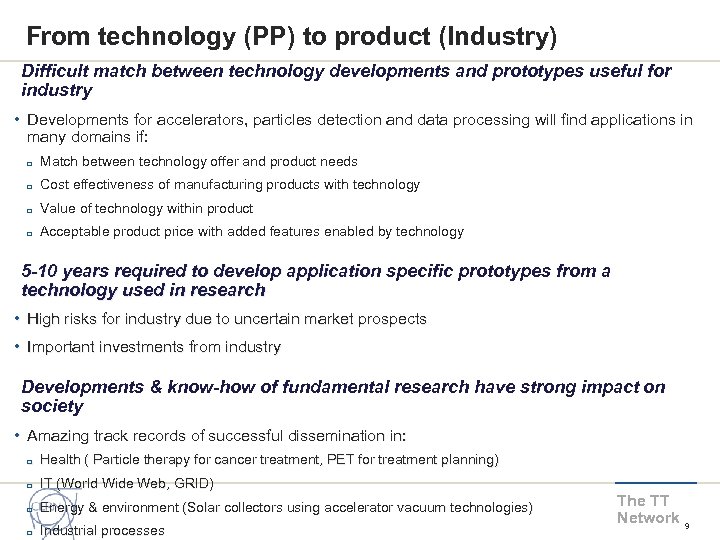 From technology (PP) to product (Industry) Difficult match between technology developments and prototypes useful for industry • Developments for accelerators, particles detection and data processing will find applications in many domains if: q q Cost effectiveness of manufacturing products with technology q Value of technology within product q Match between technology offer and product needs Acceptable product price with added features enabled by technology 5 -10 years required to develop application specific prototypes from a technology used in research • High risks for industry due to uncertain market prospects • Important investments from industry Developments & know-how of fundamental research have strong impact on society • Amazing track records of successful dissemination in: q Health ( Particle therapy for cancer treatment, PET for treatment planning) q IT (World Wide Web, GRID) q Energy & environment (Solar collectors using accelerator vacuum technologies) q Industrial processes The TT Network 9
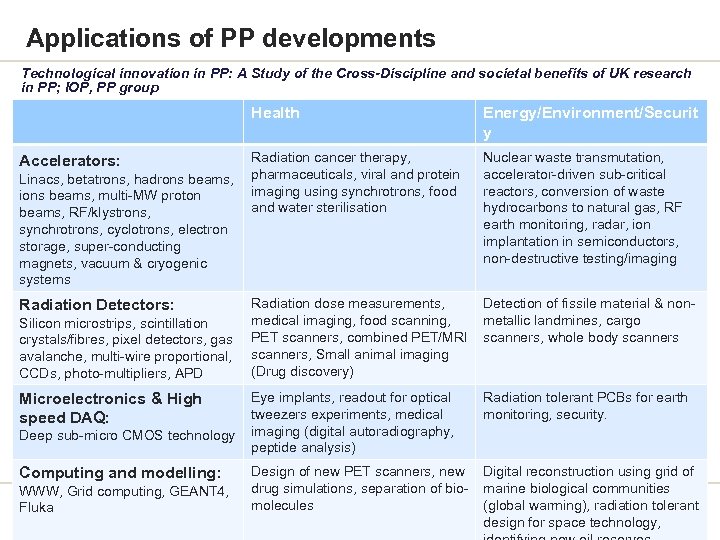 Applications of PP developments Technological innovation in PP: A Study of the Cross-Discipline and societal benefits of UK research in PP; IOP, PP group Health Radiation cancer therapy, Linacs, betatrons, hadrons beams, pharmaceuticals, viral and protein imaging using synchrotrons, food ions beams, multi-MW proton and water sterilisation beams, RF/klystrons, synchrotrons, cyclotrons, electron storage, super-conducting magnets, vacuum & cryogenic systems Accelerators: Radiation Detectors: Silicon microstrips, scintillation crystals/fibres, pixel detectors, gas avalanche, multi-wire proportional, CCDs, photo-multipliers, APD Microelectronics & High speed DAQ: Deep sub-micro CMOS technology Computing and modelling: WWW, Grid computing, GEANT 4, Fluka Energy/Environment/Securit y Nuclear waste transmutation, accelerator-driven sub-critical reactors, conversion of waste hydrocarbons to natural gas, RF earth monitoring, radar, ion implantation in semiconductors, non-destructive testing/imaging Radiation dose measurements, Detection of fissile material & nonmedical imaging, food scanning, metallic landmines, cargo PET scanners, combined PET/MRI scanners, whole body scanners, Small animal imaging (Drug discovery) Eye implants, readout for optical tweezers experiments, medical imaging (digital autoradiography, peptide analysis) Radiation tolerant PCBs for earth monitoring, security. Design of new PET scanners, new drug simulations, separation of biomolecules Digital reconstruction using grid of marine biological communities The TT (global warming), radiation tolerant Network design for space technology, 10
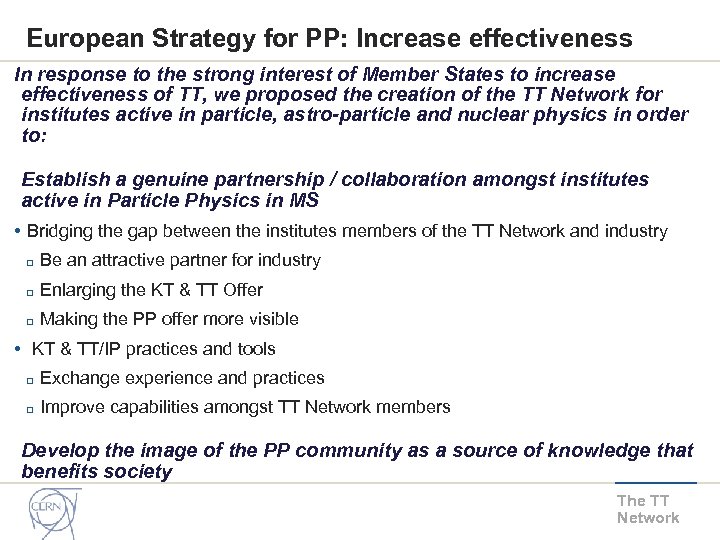 European Strategy for PP: Increase effectiveness In response to the strong interest of Member States to increase effectiveness of TT, we proposed the creation of the TT Network for institutes active in particle, astro-particle and nuclear physics in order to: Establish a genuine partnership / collaboration amongst institutes active in Particle Physics in MS • Bridging the gap between the institutes members of the TT Network and industry q Be an attractive partner for industry q Enlarging the KT & TT Offer q Making the PP offer more visible • KT & TT/IP practices and tools q q Exchange experience and practices Improve capabilities amongst TT Network members Develop the image of the PP community as a source of knowledge that benefits society The TT Network
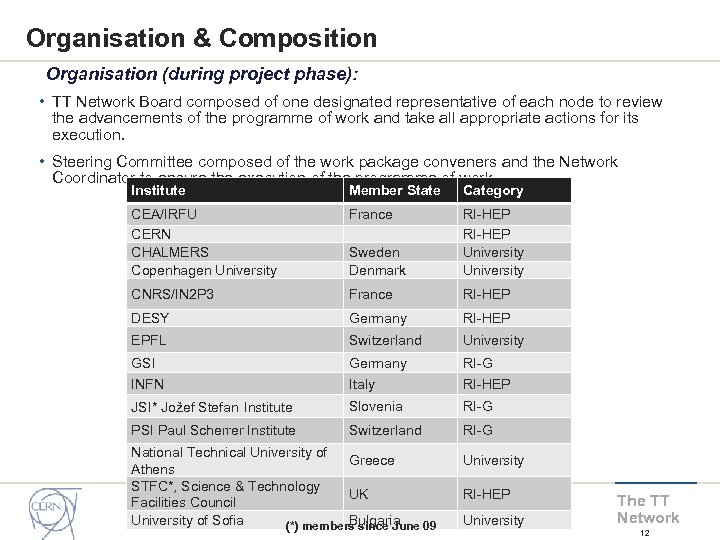 Organisation & Composition Organisation (during project phase): • TT Network Board composed of one designated representative of each node to review the advancements of the programme of work and take all appropriate actions for its execution. • Steering Committee composed of the work package conveners and the Network Coordinator to ensure the execution of the programme of work. Institute Member State Category CEA/IRFU CERN CHALMERS Copenhagen University France Sweden Denmark RI-HEP University CNRS/IN 2 P 3 France RI-HEP DESY Germany RI-HEP EPFL Switzerland University GSI INFN Germany Italy RI-G RI-HEP JSI* Jožef Stefan Institute Slovenia RI-G PSI Paul Scherrer Institute Switzerland RI-G National Technical University of Greece Athens STFC*, Science & Technology UK Facilities Council University of Sofia Bulgaria (*) members since June 09 University RI-HEP University The TT Network 12
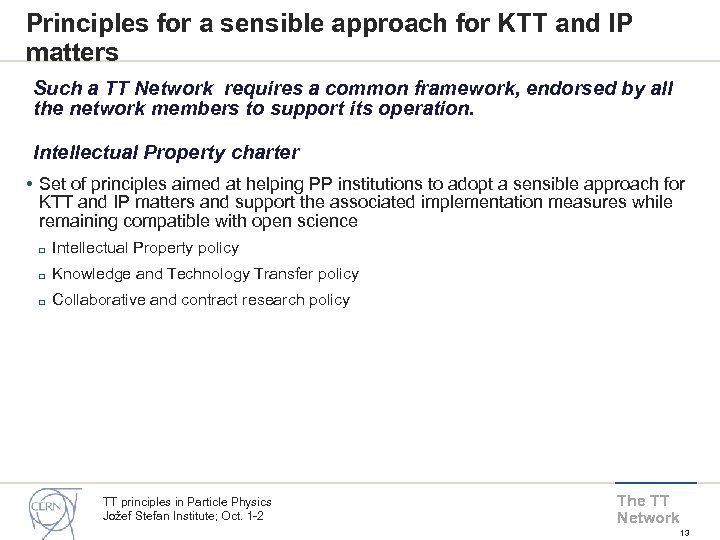 Principles for a sensible approach for KTT and IP matters Such a TT Network requires a common framework, endorsed by all the network members to support its operation. Intellectual Property charter • Set of principles aimed at helping PP institutions to adopt a sensible approach for KTT and IP matters and support the associated implementation measures while remaining compatible with open science q Intellectual Property policy q Knowledge and Technology Transfer policy q Collaborative and contract research policy TT principles in Particle Physics Jožef Stefan Institute; Oct. 1 -2 The TT Network 13
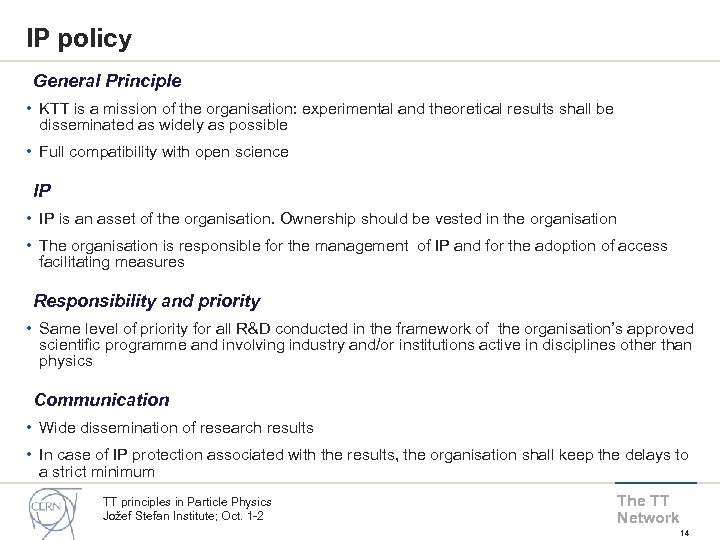 IP policy General Principle • KTT is a mission of the organisation: experimental and theoretical results shall be disseminated as widely as possible • Full compatibility with open science IP • IP is an asset of the organisation. Ownership should be vested in the organisation • The organisation is responsible for the management of IP and for the adoption of access facilitating measures Responsibility and priority • Same level of priority for all R&D conducted in the framework of the organisation’s approved scientific programme and involving industry and/or institutions active in disciplines other than physics Communication • Wide dissemination of research results • In case of IP protection associated with the results, the organisation shall keep the delays to a strict minimum TT principles in Particle Physics Jožef Stefan Institute; Oct. 1 -2 The TT Network 14
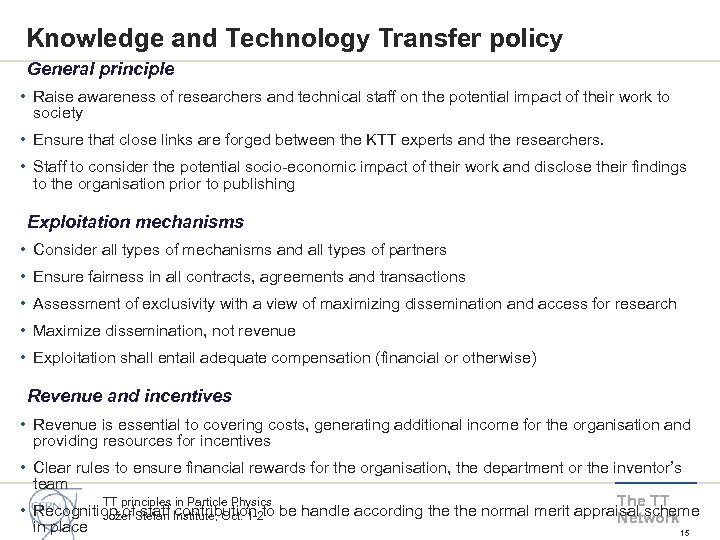 Knowledge and Technology Transfer policy General principle • Raise awareness of researchers and technical staff on the potential impact of their work to society • Ensure that close links are forged between the KTT experts and the researchers. • Staff to consider the potential socio-economic impact of their work and disclose their findings to the organisation prior to publishing Exploitation mechanisms • Consider all types of mechanisms and all types of partners • Ensure fairness in all contracts, agreements and transactions • Assessment of exclusivity with a view of maximizing dissemination and access for research • Maximize dissemination, not revenue • Exploitation shall entail adequate compensation (financial or otherwise) Revenue and incentives • Revenue is essential to covering costs, generating additional income for the organisation and providing resources for incentives • Clear rules to ensure financial rewards for the organisation, the department or the inventor’s team TT principles in Particle Physics The TT • Recognition of staff contribution to be handle according the normal merit appraisal scheme Jožef Stefan Institute; Oct. 1 -2 Network in place 15
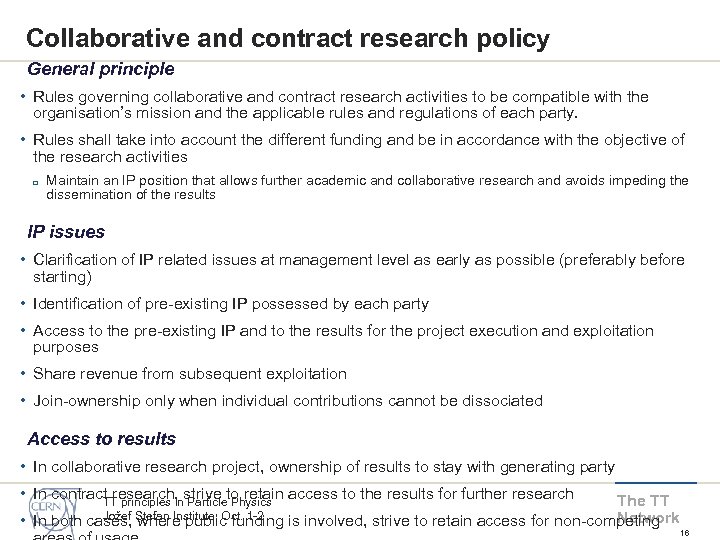 Collaborative and contract research policy General principle • Rules governing collaborative and contract research activities to be compatible with the organisation’s mission and the applicable rules and regulations of each party. • Rules shall take into account the different funding and be in accordance with the objective of the research activities q Maintain an IP position that allows further academic and collaborative research and avoids impeding the dissemination of the results IP issues • Clarification of IP related issues at management level as early as possible (preferably before starting) • Identification of pre-existing IP possessed by each party • Access to the pre-existing IP and to the results for the project execution and exploitation purposes • Share revenue from subsequent exploitation • Join-ownership only when individual contributions cannot be dissociated Access to results • In collaborative research project, ownership of results to stay with generating party • In contract research, strive to retain access to the results for further research TT principles in Particle Physics The TT Network • In both cases, where public funding is involved, strive to retain access for non-competing Jožef Stefan Institute; Oct. 1 -2 16
 Implementation of KTT mechanisms on the basis of these principles These principles will lay the foundations of the TT Network’s operation. Various KTT mechanisms and tools will be addressed in order to support this operation: Technology pooling • How to bundle technologies together? • Elaborate concerted offers Research contracts • Multi-partite research contracts Licences • Multi-partite licence agreements with industry Push/pull mechanisms • Concerted offer with clear access conditions • Access of local industry, including start-up companies to technology from foreign institute with the assistance of local laboratory In a later stage: Spin-offs • Bridging the gap between PP technology and saleable industrial prototype • Support from PP including access to infrastructure, VC funding, concerted offers and fair treatment of European industry TT principles in Particle Physics Jožef Stefan Institute; Oct. 1 -2 The TT Network 17
 Conclusion Particle Physics is required to demonstrate its usefulness to Society PP is a highly collaborative international open science environment TT Network for PP in order to: • Establish a genuine partnership / collaboration amongst institutes active in Particle Physics • Develop the image of the PP community as a source of knowledge that benefits society Principles for the adoption of a sensible approach to KTT activities are essential for enhancing effectiveness and benefits to industry and society The IP charter must be endorsed by all the institute participating in the network TT principles in Particle Physics The TT Network will operate according to these principles Jožef Stefan Institute; Oct. 1 -2 The TT Network 18
 Color palette (nice to have when checking the projector setup) 51 51 0 33 181 201 150 192 190 153 204 255 208 208 240 205 150 204 0 0 0 Standard box: Arial Narrow, word-wrap The TT Network 19