


 Скачать презентацию Principles of Taxation Chapter 14 Compensation and Retirement
dee3c8168e828b92c38b482516529373.ppt
- Количество слайдов: 29
 Principles of Taxation Chapter 14 Compensation and Retirement Irwin/Mc. Graw-Hill ©The Mc. Graw-Hill Companies, Inc. , 2000
 Objectives Slide 14 -2 Ø Ø Ø Ø Irwin/Mc. Graw-Hill employees versus self-employed family compensation planning nontaxable employee fringe benefits stock options employee-related expenses qualified versus nonqualified retirement plans deferred compensation ©The Mc. Graw-Hill Companies, Inc. , 2000
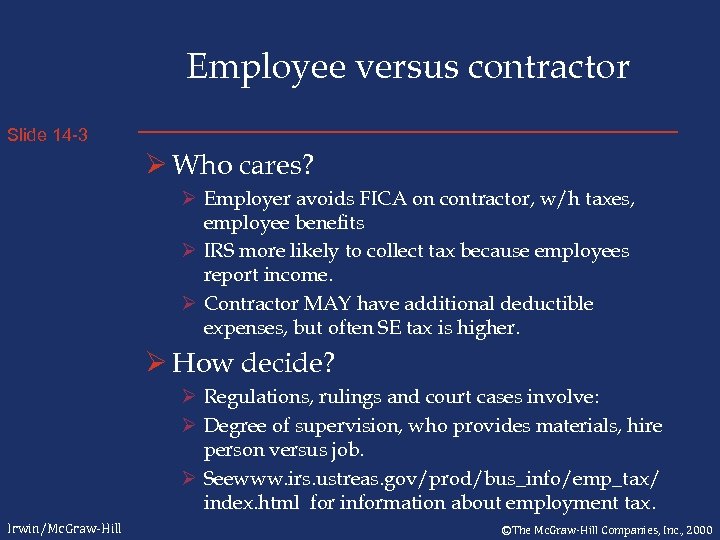 Employee versus contractor Slide 14 -3 Ø Who cares? Ø Employer avoids FICA on contractor, w/h taxes, employee benefits Ø IRS more likely to collect tax because employees report income. Ø Contractor MAY have additional deductible expenses, but often SE tax is higher. Ø How decide? Ø Regulations, rulings and court cases involve: Ø Degree of supervision, who provides materials, hire person versus job. Ø Seewww. irs. ustreas. gov/prod/bus_info/emp_tax/ index. html for information about employment tax. Irwin/Mc. Graw-Hill ©The Mc. Graw-Hill Companies, Inc. , 2000
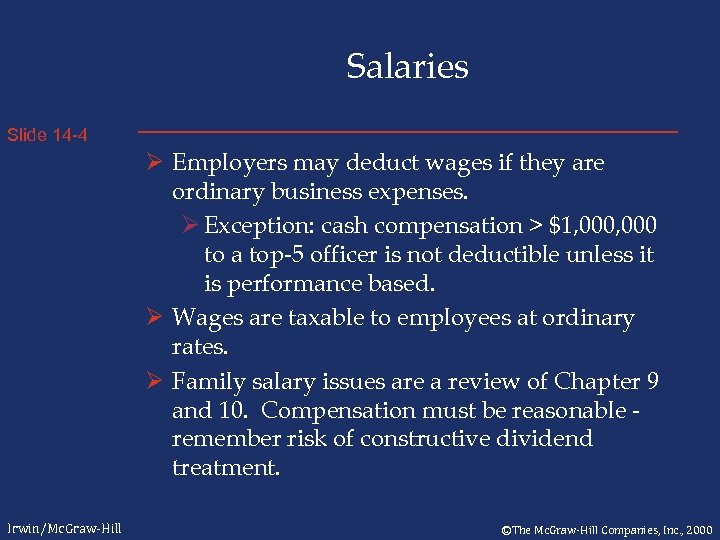 Salaries Slide 14 -4 Ø Employers may deduct wages if they are ordinary business expenses. Ø Exception: cash compensation > $1, 000 to a top-5 officer is not deductible unless it is performance based. Ø Wages are taxable to employees at ordinary rates. Ø Family salary issues are a review of Chapter 9 and 10. Compensation must be reasonable remember risk of constructive dividend treatment. Irwin/Mc. Graw-Hill ©The Mc. Graw-Hill Companies, Inc. , 2000
 Foreign Earned Income Exclusion Slide 14 -5 Ø Expatriates are U. S. citizens (or permanent residents) who reside and work overseas. Ø Exclude $74, 000 (1999 limit) from taxation in the U. S. Ø Cannot claim foreign tax credit (see chapter 12) on excluded income. Irwin/Mc. Graw-Hill ©The Mc. Graw-Hill Companies, Inc. , 2000
 Employee Fringe Benefits Slide 14 -6 Ø General rule: fringe benefits are taxable. Ø Exclusions of fringe benefits are usually: Ø Providing a social welfare benefit (health, life ins, child care), Ø Hard to enforce anyway (de minimis rules, cisounts), Ø Non-discriminatory, or Ø Necessary for job (moving expenses, supplies at work) Irwin/Mc. Graw-Hill ©The Mc. Graw-Hill Companies, Inc. , 2000
 Employee Fringe Benefits Slide 14 -7 Ø Why are these advantageous Ø Often lower cost than employee can obtain Ø Nontaxable Ø Cafeteria plans allow broader employee choices among same-cost options for employer. Irwin/Mc. Graw-Hill ©The Mc. Graw-Hill Companies, Inc. , 2000
 Specific fringe benefit examples Slide 14 -8 Ø Health insurance or coverage is not taxable if nondiscriminatory. Ø Only cost to provide group term life insurance benefits > $50, 000 is taxable. Ø Dependent care assistance up to $5000 is excluded. Ø See http: //www. irs. ustreas. gov/prod/forms_pu bs/pubs/p 5350404. htm for an IRS summary of other nontaxable fringe benefits. Irwin/Mc. Graw-Hill ©The Mc. Graw-Hill Companies, Inc. , 2000
 Employee Stock Options -BIG $$$’s Slide 14 -9 Ø Stock option defined: the right to buy stock in the future for a set price (called the exercise price). Ø General attributes: when the stock option is granted, the option price is the FMV at the date of the grant. Irwin/Mc. Graw-Hill ©The Mc. Graw-Hill Companies, Inc. , 2000
 Stock options - grant date Slide 14 -10 Ø GAAP rules: must disclose compensation element due to FMV of option at grant date. Ø Black Scholes option pricing method. Ø Tax rules: NO tax owed at date of grant. Tax at exercise and sale depends on whether a Non. Qualified Stock Option (NSO) or Incentive Stock Option (ISO). Irwin/Mc. Graw-Hill ©The Mc. Graw-Hill Companies, Inc. , 2000
 Employee Stock Options nonqualified stock option (NSO) Slide 14 -11 Ø Employee has salary income equal to difference in FMV of stock and exercise price. Ø Employee’s new basis in stock is FMV at exercise date. Ø Employer gets tax deduction equal to employee income. Ø When employee sells stock in future, he generates a capital gain (loss) = selling price basis ($FMV date of exercise). Irwin/Mc. Graw-Hill ©The Mc. Graw-Hill Companies, Inc. , 2000
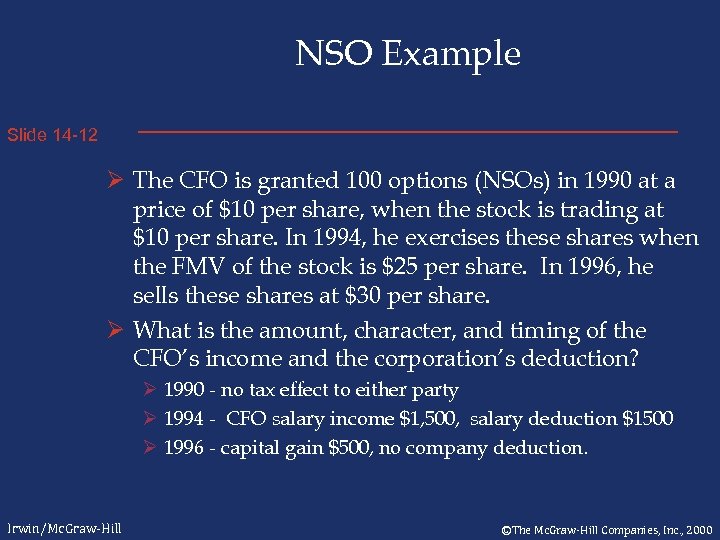 NSO Example Slide 14 -12 Ø The CFO is granted 100 options (NSOs) in 1990 at a price of $10 per share, when the stock is trading at $10 per share. In 1994, he exercises these shares when the FMV of the stock is $25 per share. In 1996, he sells these shares at $30 per share. Ø What is the amount, character, and timing of the CFO’s income and the corporation’s deduction? Ø 1990 - no tax effect to either party Ø 1994 - CFO salary income $1, 500, salary deduction $1500 Ø 1996 - capital gain $500, no company deduction. Irwin/Mc. Graw-Hill ©The Mc. Graw-Hill Companies, Inc. , 2000
 NSO Example (you do it) Slide 14 -13 Ø The Treasurer is granted 100 options (NSOs) in 1990 at a price of $10 per share, when the stock is trading at $10 per share. In 1995, she exercises these shares when the FMV of the stock is $30 per share. In 1998, she sells these shares at $36 per share. Ø What is the amount, character, and timing of the Treasurer’s income and the corporation’s deduction? Irwin/Mc. Graw-Hill ©The Mc. Graw-Hill Companies, Inc. , 2000
 Employee Stock Options Incentive Stock Option (ISO) Slide 14 -14 Ø Employee has no salary income on exercise. AMT adjustment = untaxed bargain element. Ø Employer has no salary deduction ever. Ø Exception - early disposition of stock (w/in 2 years). Ø Employee has basis in stock equal to exercise price Ø When employee sells stock in future, he generates at capital gain (loss) = selling price - exercise price. Irwin/Mc. Graw-Hill ©The Mc. Graw-Hill Companies, Inc. , 2000
 ISO Example Slide 14 -15 Ø The CFO is granted 100 options (ISOs) in 1990 at a price of $10 per share, when the stock is trading at $10 per share. In 1994, he exercises these shares when the FMV of the stock is $25 per share. In 1996, he sells these shares at $30 per share. Ø What is the amount, character, and timing of the CFO’s income and the corporation’s deduction? Ø 1990 - no effect. Ø 1994 - no effect (except AMT) Ø 1996 - $2000 capital gain, no corporate deduction. Irwin/Mc. Graw-Hill ©The Mc. Graw-Hill Companies, Inc. , 2000
 ISO Example (you do it) Slide 14 -16 Ø The Treasurer is granted 100 options (ISOs) in 1990 at a price of $10 per share, when the stock is trading at $10 per share. In 1995, she exercises these shares when the FMV of the stock is $30 per share. In 1998, she sells these shares at $35 per share. Ø What is the amount, character, and timing of the Treasurer’s income and the corporation’s deduction? Irwin/Mc. Graw-Hill ©The Mc. Graw-Hill Companies, Inc. , 2000
 Employee stock options thinking Slide 14 -17 Ø Which would employee prefer? Ø ISO - delay taxation, all capital gain Ø Which would employer prefer? Ø NSO - claim salary deduction Ø Do you expect preference has changed over time? Irwin/Mc. Graw-Hill ©The Mc. Graw-Hill Companies, Inc. , 2000
 Employee expenses Slide 14 -18 Ø Unreimbursed expenses are deductible to the extent they exceed 2% of AGI. Ø These are ITEMIZED deductions. Ø 2% limit, combined with Itemized requirement, means most employees can’t use. Irwin/Mc. Graw-Hill ©The Mc. Graw-Hill Companies, Inc. , 2000
 Moving expenses Slide 14 -19 Ø Unreimbursed moving expenses are deducted in computing AGI. Form 3903 flows to Line 25 of 1040. Ø This is more advantageous because you can take the deduction even if you are using the standard deduction. Ø Requirements for moving expenses: Ø new job meeting certain mileage and time of work requirements Ø deduct cost of moving furniture and cars, moving family (but not meals). Irwin/Mc. Graw-Hill ©The Mc. Graw-Hill Companies, Inc. , 2000
 Retirement Planning Slide 14 -20 Ø This is COMPLICATED - we are only hitting highlights. Ø Main concepts to learn in this course: Ø qualified plans provide DEFERRAL (sometimes exemption) of tax on earnings. The compounding effect of this is BIG. Ø Withdrawal cannot begin before age 59 1/2 (without penalty) but must begin after 70 1/2. Ø Basic types of qualified plans: a) employer, b) self-employed (Keogh), c) IRA Irwin/Mc. Graw-Hill ©The Mc. Graw-Hill Companies, Inc. , 2000
 Attributes - qualified plans Slide 14 -21 Ø Plan cannot be discriminatory; $ limits in law. Ø Current earned income contributed to plan is not currently taxed (IRA, 401 K, Defined contribution plans). Ø Employer generally gets deduction for funding plan. Ø The plan is tax exempt, so earnings are not taxed as they accumulate. Ø Retired person is taxed on withdrawals of all amounts. Ø Premature withdrawals 10% excise tax Irwin/Mc. Graw-Hill ©The Mc. Graw-Hill Companies, Inc. , 2000
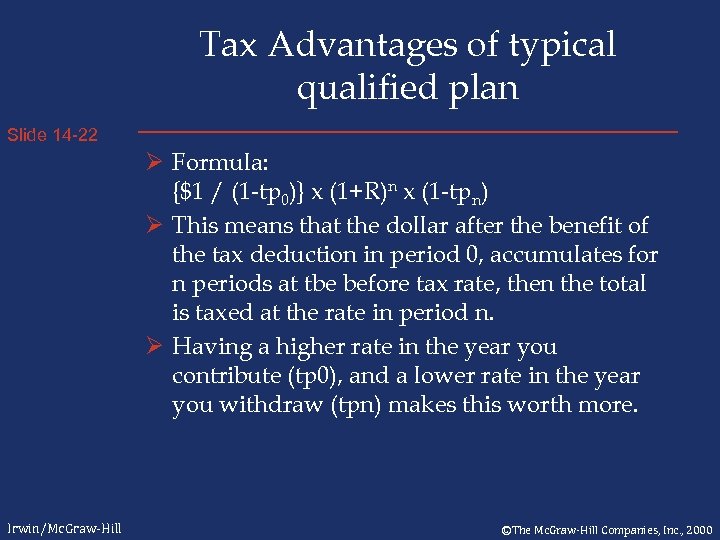 Tax Advantages of typical qualified plan Slide 14 -22 Ø Formula: {$1 / (1 -tp 0)} x (1+R)n x (1 -tpn) Ø This means that the dollar after the benefit of the tax deduction in period 0, accumulates for n periods at tbe before tax rate, then the total is taxed at the rate in period n. Ø Having a higher rate in the year you contribute (tp 0), and a lower rate in the year you withdraw (tpn) makes this worth more. Irwin/Mc. Graw-Hill ©The Mc. Graw-Hill Companies, Inc. , 2000
 Employer plans - qualified Slide 14 -23 Ø qualified plans cannot discriminate - have $ limits Ø Defined benefit - Employer assumes risk and promises a certain retirement income stream. Ø This is the type of plan that intermediate accounting class pension rules deal with (SFAS 87). Ø Annual pension limited to the lesser of Ø 100% of average three highest years’ wages Ø $130, 000 (in 1999). Irwin/Mc. Graw-Hill ©The Mc. Graw-Hill Companies, Inc. , 2000
 Employer plans - qualified Slide 14 -24 Ø Defined contribution - the employer sets aside a certain defined amount each year. The employee bears the risk of what return the investment provides. Ø Yearly contribution limited to the lesser of Ø 25% of annual compensation or Ø $30, 000 (in 1999). Ø 401 K plan - the employer and employee both contribute. Employee contribution limit = $10, 000. MY ADVICE - Start right away! Irwin/Mc. Graw-Hill ©The Mc. Graw-Hill Companies, Inc. , 2000
 Employer plans - nonqualified Slide 14 -25 Ø Nonqualified deferred compensation Ø Employee delays paying tax until receive money. Ø Corporation delays deducting salary expense until pay money. Ø Often used by top executives. Ø Since nonqualified, these plans CAN discriminate! Irwin/Mc. Graw-Hill ©The Mc. Graw-Hill Companies, Inc. , 2000
 Self-employed plans - Keogh Slide 14 -26 Ø Contribute up to the lesser of Ø 20% of earned income from selfemployment Ø $30, 000 in 1999. Ø Must not discriminate. If owner has employees then he/she must provide retirement benefits to them. Irwin/Mc. Graw-Hill ©The Mc. Graw-Hill Companies, Inc. , 2000
 Individual Retirement Accounts Slide 14 -27 Ø Individuals contribute the lesser of Ø $2, 000 or Ø 100% of compensation (but each spouse may contribute $2000 if combined earned income = $4000). Ø Deduction for contribution is limited Ø if taxpayer participates in a qualified plan (phase-out range for MFJ starts at $51, 000 in 1999) Ø if spouse participates in a qualified plan (phase-out range for MFJ starts at $150, 000). Irwin/Mc. Graw-Hill ©The Mc. Graw-Hill Companies, Inc. , 2000
 IRA Withdrawals Slide 14 -28 Ø Withdrawal is ordinary income if all contributions were deductible. Ø If some contributions were nondeductible: Ø nontaxable withdrawal % = unrecovered investment / current year IRA value. Ø Early withdrawals subject to 10% penalty, except: Ø $10, 000 withdrawal for “first-time homebuyer” Ø Funds to pay higher education expenses Irwin/Mc. Graw-Hill ©The Mc. Graw-Hill Companies, Inc. , 2000
 Roth IRA Slide 14 -29 Ø Roth works differently from general rule. Ø NO deduction when contribute, but NO tax when distribute Ø Formula = $1 x (1+R)n Ø Roth is better than regular if you expect tax rates to increase. Ø Roth not available for rich - e. g. MFJ AGI>160, 000. Irwin/Mc. Graw-Hill ©The Mc. Graw-Hill Companies, Inc. , 2000