


 Скачать презентацию Principles of Tax Analysis Allen C Goodman
2727eb87721826310c0bbcdb9136899a.ppt
- Количество слайдов: 36
 Principles of Tax Analysis © Allen C. Goodman, 2009 1
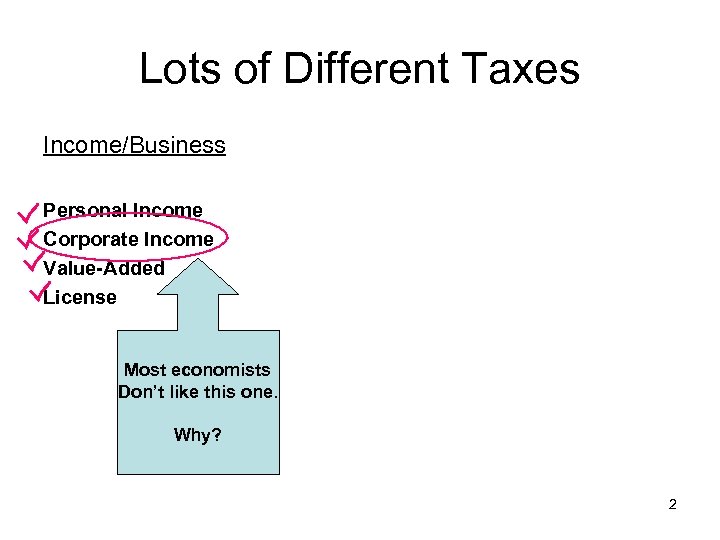 Lots of Different Taxes Income/Business Personal Income Corporate Income Value-Added License Consumption Sales Use Motor Fuel Alcoholic Beverage Hotel/Motel Restaurant Meals Most economists Telephone Call Don’t like this one. Gambling Wealth Property Estate Inheritance Transfer Why? 2
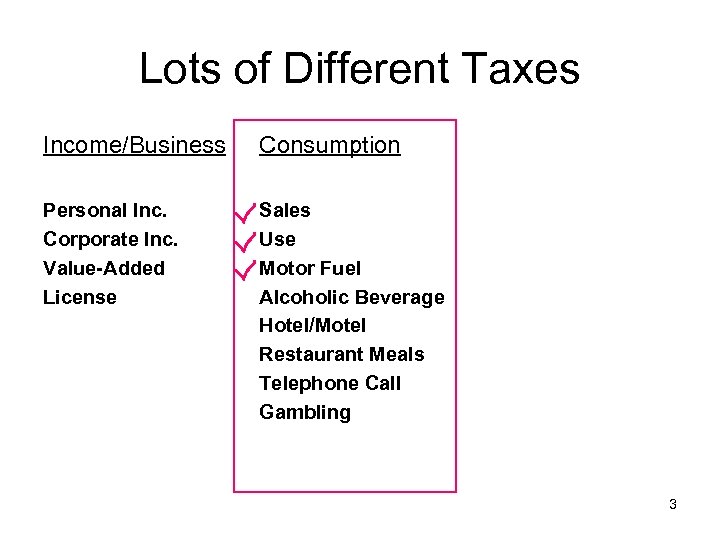 Lots of Different Taxes Income/Business Consumption Wealth Personal Inc. Corporate Inc. Value-Added License Sales Use Motor Fuel Alcoholic Beverage Hotel/Motel Restaurant Meals Telephone Call Gambling Property Estate Inheritance Transfer 3
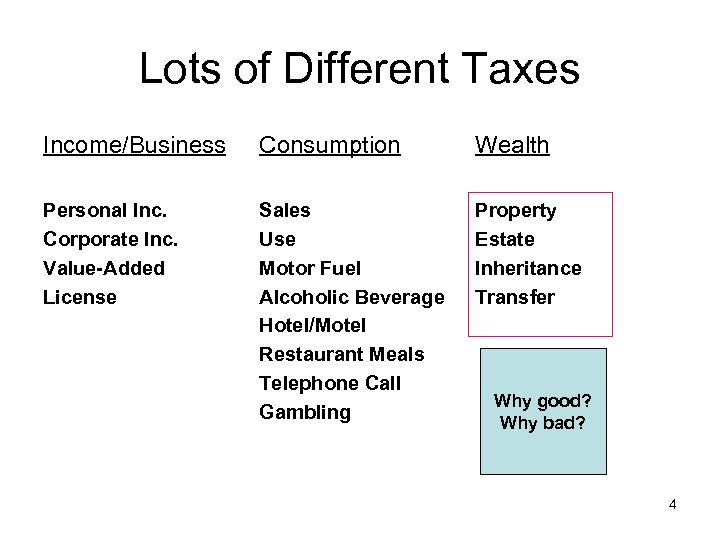 Lots of Different Taxes Income/Business Consumption Wealth Personal Inc. Corporate Inc. Value-Added License Sales Use Motor Fuel Alcoholic Beverage Hotel/Motel Restaurant Meals Telephone Call Gambling Property Estate Inheritance Transfer Why good? Why bad? 4
 Tax Incidence • Who REALLY pays the tax • If you buy something at the store, you give $ to the clerk, and the store pays $ to the gov’t, but who really pays? • If you rent an apartment and property taxes in your city rise, what happens to the rent that you pay? Who really pays? 5
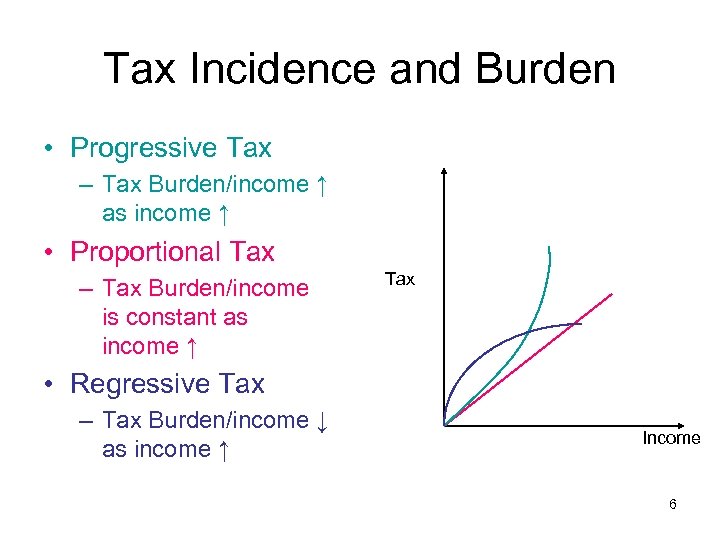 Tax Incidence and Burden • Progressive Tax – Tax Burden/income ↑ as income ↑ • Proportional Tax – Tax Burden/income is constant as income ↑ Tax • Regressive Tax – Tax Burden/income ↓ as income ↑ Income 6
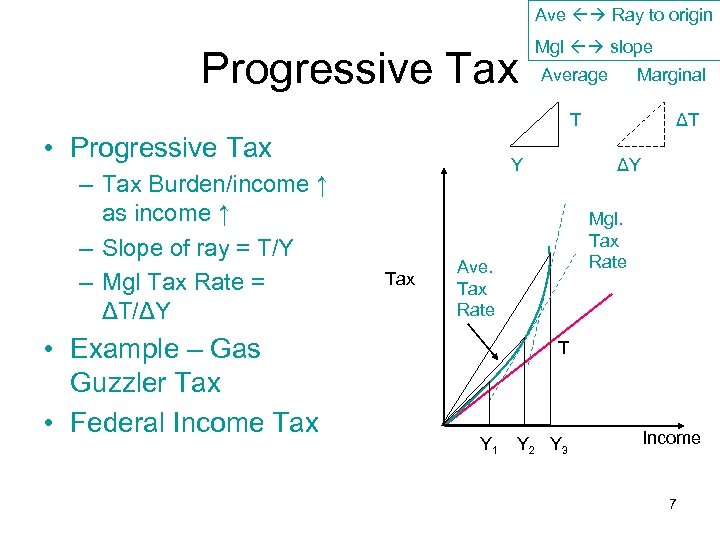 Ave Ray to origin Progressive Tax Mgl slope Average Marginal T • Progressive Tax – Tax Burden/income ↑ as income ↑ – Slope of ray = T/Y – Mgl Tax Rate = ΔT/ΔY • Example – Gas Guzzler Tax • Federal Income Tax Y Tax ΔT ΔY Mgl. Tax Rate Ave. Tax Rate T Y 1 Y 2 Y 3 Income 7
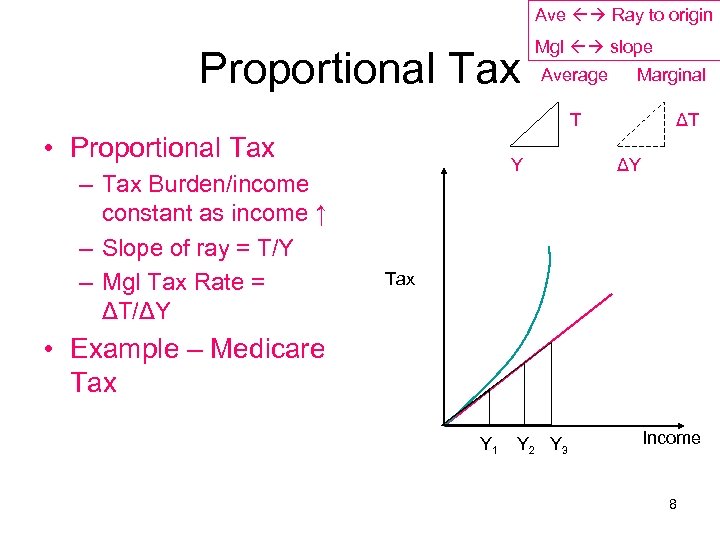 Ave Ray to origin Proportional Tax Mgl slope Average Marginal T • Proportional Tax – Tax Burden/income constant as income ↑ – Slope of ray = T/Y – Mgl Tax Rate = ΔT/ΔY Y ΔT ΔY Tax • Example – Medicare Tax Y 1 Y 2 Y 3 Income 8
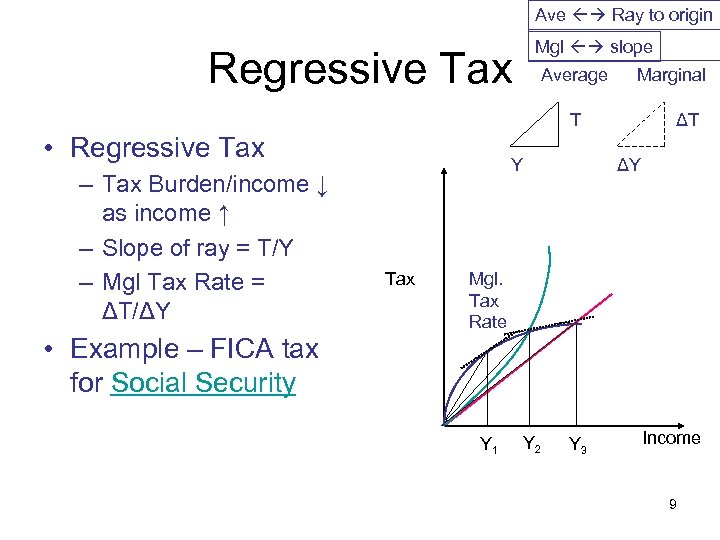 Ave Ray to origin Regressive Tax Mgl slope Average Marginal T • Regressive Tax – Tax Burden/income ↓ as income ↑ – Slope of ray = T/Y – Mgl Tax Rate = ΔT/ΔY Y Tax ΔT ΔY Mgl. Tax Rate • Example – FICA tax for Social Security Y 1 Y 2 Y 3 Income 9
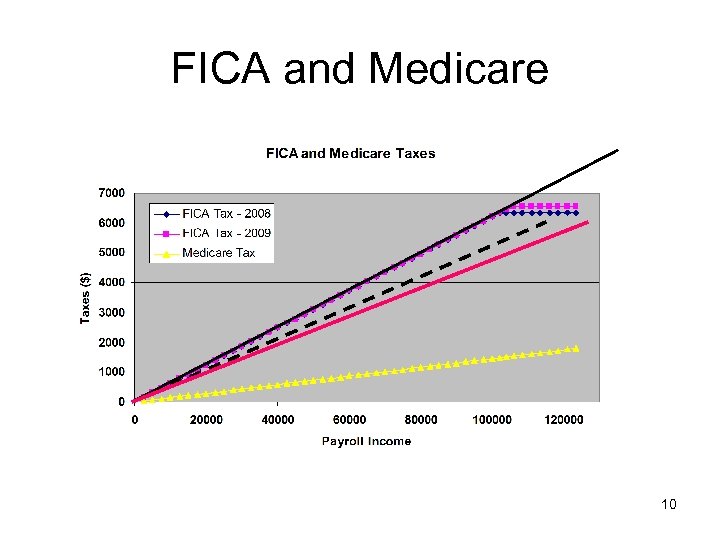 FICA and Medicare 10
 General Rules for Taxes • Only way (legally) to avoid taxes is to change behavior. • The more that one agent can avoid the tax – the less is collected – the more someone else pays 11
 Efficient Quantity! WHY? Taxes and Efficiency • Excise Tax – Tax on a particular good. – Look at a unit (as oppose to percentage) tax. D S $ P 0 • Partial eq’m analysis looks at a single market. Q 0 12 Q
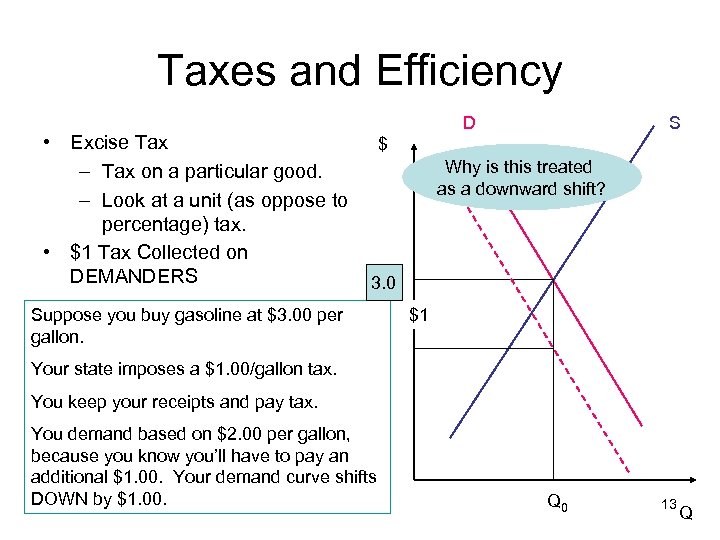 Taxes and Efficiency • Excise Tax – Tax on a particular good. – Look at a unit (as oppose to percentage) tax. • $1 Tax Collected on DEMANDERS D S $ Why is this treated as a downward shift? P 0 3. 0 Suppose you buy gasoline at $3. 00 per gallon. $1 Your state imposes a $1. 00/gallon tax. You keep your receipts and pay tax. You demand based on $2. 00 per gallon, because you know you’ll have to pay an additional $1. 00. Your demand curve shifts DOWN by $1. 00. Q 0 13 Q
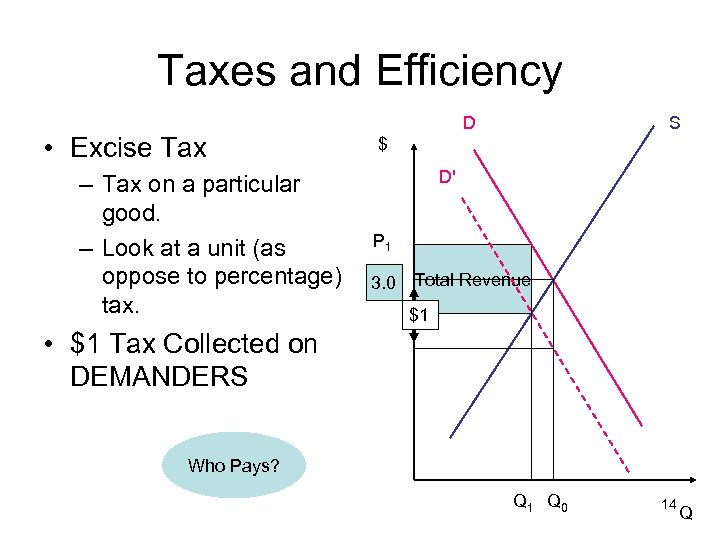 Taxes and Efficiency • Excise Tax – Tax on a particular good. – Look at a unit (as oppose to percentage) tax. D S $ D' P 1 P 0 3. 0 Total Revenue $1 • $1 Tax Collected on DEMANDERS Who Pays? Q 1 Q 0 14 Q
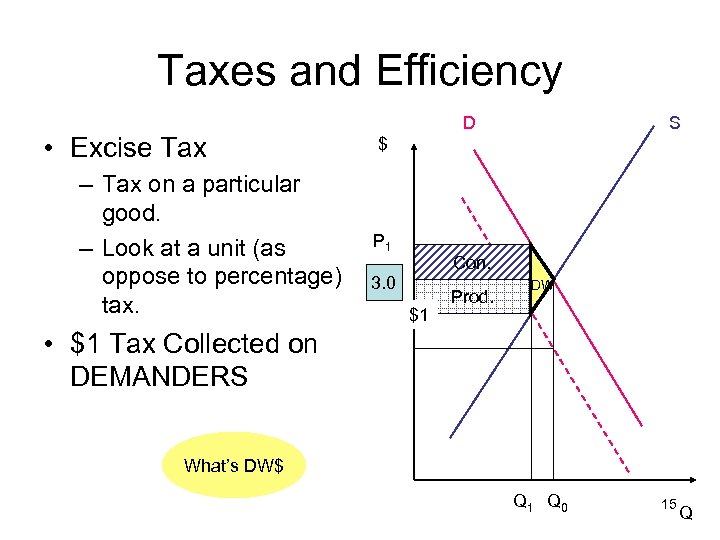 Taxes and Efficiency • Excise Tax – Tax on a particular good. – Look at a unit (as oppose to percentage) tax. D S $ P 1 Con. P 0 3. 0 $1 Prod. DW • $1 Tax Collected on DEMANDERS What’s DW$ Q 1 Q 0 15 Q
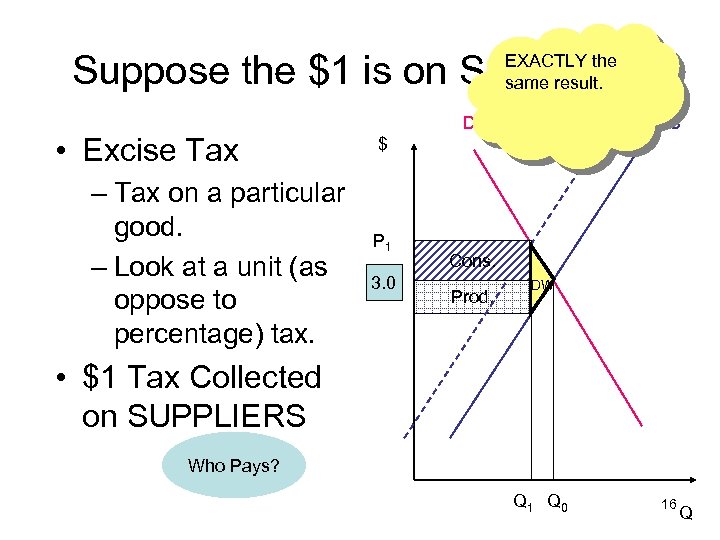 Suppose the $1 is on Suppliers? EXACTLY the same result. • Excise Tax – Tax on a particular good. – Look at a unit (as oppose to percentage) tax. D S $ P 1 Cons. P 0 3. 0 Total Revenue. DW Prod. • $1 Tax Collected on SUPPLIERS Who Pays? Q 1 Q 0 16 Q
 If result is same … • Why do we usually collect sales taxes from the sellers? • Do we ever try to collect it from the buyers? • What happens when we do? 17
 Important Concepts! • DW loss relates to the change in quantity. Remember, we saw that efficiency related to quantity. The more behavioral change that a tax makes, the more DW loss. • Incidence relates to elasticity of demand supply. Remember elasticity addresses whether quantity changes a little or lot. If you can change your behavior a lot, and avoid the tax, its incidence on you is small. • If you can’t change your behavior and avoid it, its incidence is a lot! Does it matter how we collect the tax? 18
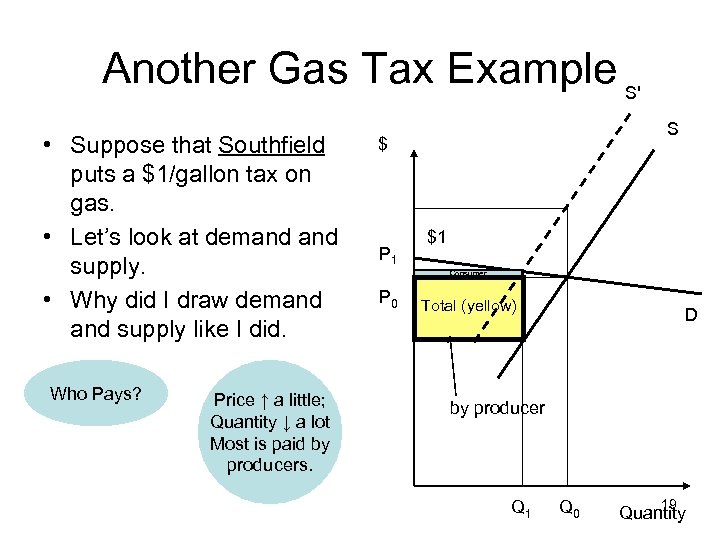 Another Gas Tax Example S' • Suppose that Southfield puts a $1/gallon tax on gas. • Let’s look at demand supply. • Why did I draw demand supply like I did. Who Pays? Price ↑ a little; Quantity ↓ a lot Most is paid by producers. S $ P 1 $1 Consumer P 0 Total (yellow) D by producer Q 1 Q 0 19 Quantity
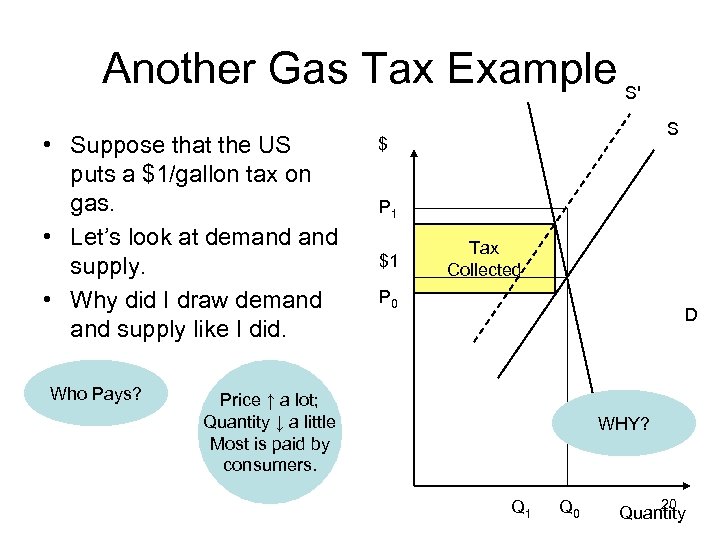 Another Gas Tax Example S' • Suppose that the US puts a $1/gallon tax on gas. • Let’s look at demand supply. • Why did I draw demand supply like I did. Who Pays? S $ P 1 $1 Tax Collected P 0 D Price ↑ a lot; Quantity ↓ a little Most is paid by consumers. WHY? Q 1 Q 0 20 Quantity
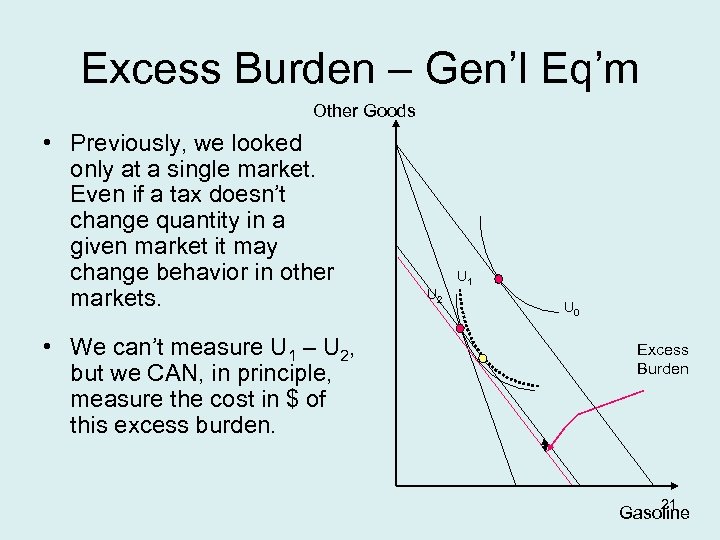 Excess Burden – Gen’l Eq’m Other Goods • Previously, we looked only at a single market. Even if a tax doesn’t change quantity in a given market it may change behavior in other markets. • We can’t measure U 1 – U 2, but we CAN, in principle, measure the cost in $ of this excess burden. U 2 U 1 U 0 Excess Burden 21 Gasoline
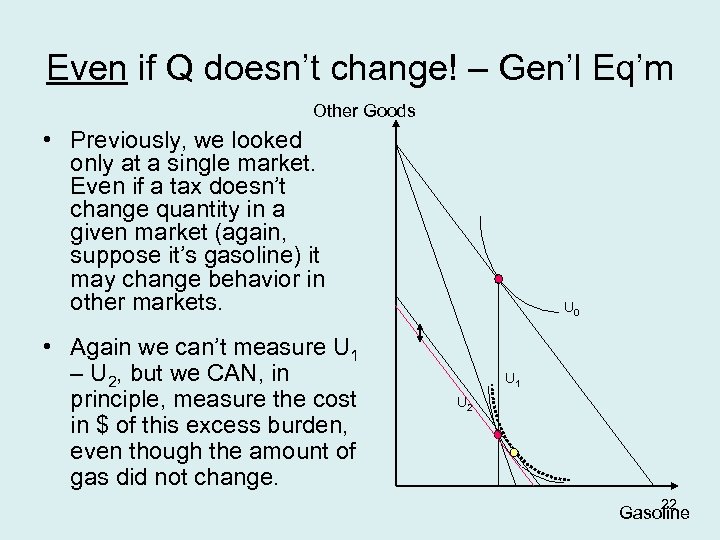 Even if Q doesn’t change! – Gen’l Eq’m Other Goods • Previously, we looked only at a single market. Even if a tax doesn’t change quantity in a given market (again, suppose it’s gasoline) it may change behavior in other markets. • Again we can’t measure U 1 – U 2, but we CAN, in principle, measure the cost in $ of this excess burden, even though the amount of gas did not change. U 0 U 1 U 2 22 Gasoline
 WHO REALLY PAYS? Tax Incidence © Allen C. Goodman, 2009 23
 What has been happening • Over time, the share of output generated from the relatively less cyclically sensitive service-producing industries has risen modestly in comparison with relatively larger cyclically sensitive goods-producing industries. • So, as the share of services has risen the share (and possibly the amount) of goodsbased sales taxes has fallen. 24
 Sources of State Revenues • Go to Spreadsheet All States http: //www. census. gov/compendia/statab/cats/state_local_govt_finances_employment/state_government_finances. html 25
 Where does Michigan stand? • Go to Spreadsheet. http: //www. census. gov/compendia/statab/cats/state_local_govt_finances_employment/state_government_finances. html 26
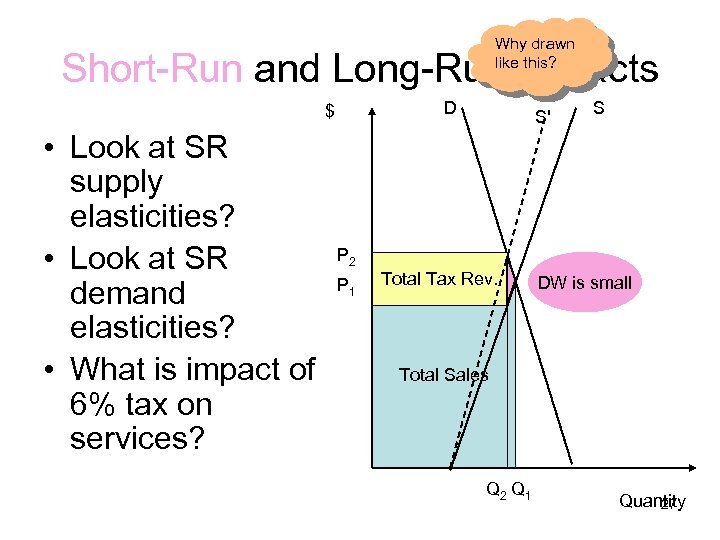 Why drawn like this? Short-Run and Long-Run Impacts D $ • Look at SR supply elasticities? • Look at SR demand elasticities? • What is impact of 6% tax on services? S' S P 2 P 1 Total Tax Rev. DW is small Total Sales Q 2 Q 1 Quantity 27
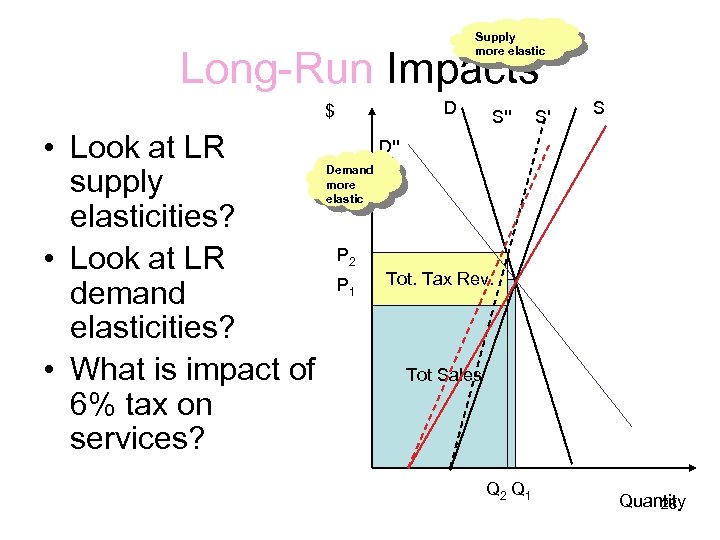 Supply more elastic Long-Run Impacts D $ • Look at LR supply elasticities? • Look at LR demand elasticities? • What is impact of 6% tax on services? S'' S' S D'' Demand more elastic P 2 P 1 Tot. Tax Rev. Tot Sales Q 2 Q 1 Quantity 28
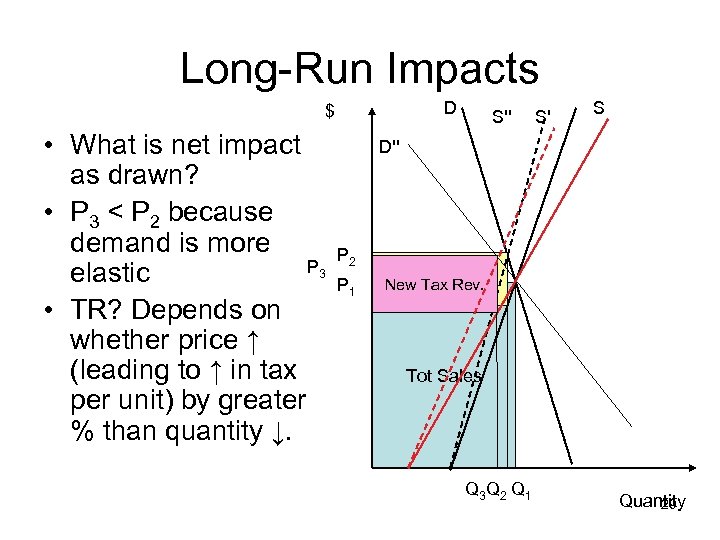 Long-Run Impacts D $ • What is net impact as drawn? • P 3 < P 2 because demand is more P 3 elastic • TR? Depends on whether price ↑ (leading to ↑ in tax per unit) by greater % than quantity ↓. S'' S' S D'' P 2 P 1 Tot. Tax Rev. New Tax Rev. Tot Sales Q 3 Q 2 Q 1 Quantity 29
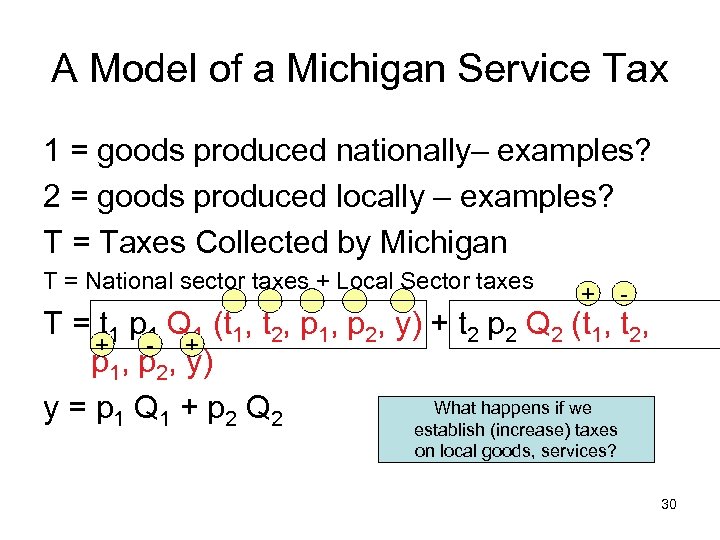 A Model of a Michigan Service Tax 1 = goods produced nationally– examples? 2 = goods produced locally – examples? T = Taxes Collected by Michigan T = National sector taxes + Local Sector taxes + - T = t 1 p 1 Q 1 (t 1, t 2, p 1, p 2, y) + t 2 p 2 Q 2 (t 1, t 2, + - + p 1, p 2, y) What happens if we y = p 1 Q 1 + p 2 Q 2 establish (increase) taxes on local goods, services? 30
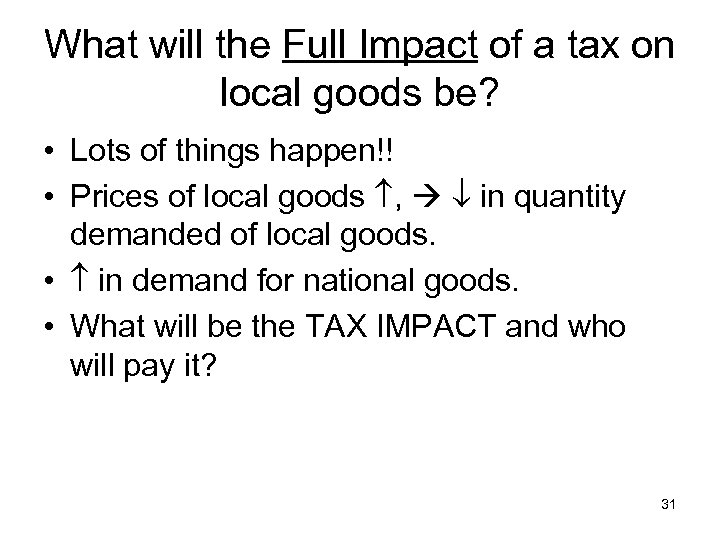 What will the Full Impact of a tax on local goods be? • Lots of things happen!! • Prices of local goods , in quantity demanded of local goods. • in demand for national goods. • What will be the TAX IMPACT and who will pay it? 31
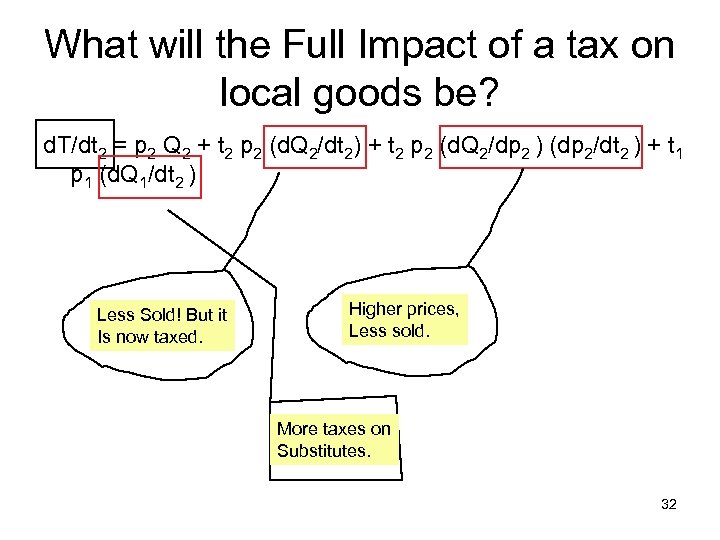 What will the Full Impact of a tax on local goods be? d. T/dt 2 = p 2 Q 2 + t 2 p 2 (d. Q 2/dt 2) + t 2 p 2 (d. Q 2/dp 2 ) (dp 2/dt 2 ) + t 1 p 1 (d. Q 1/dt 2 ) Less Sold! But it Is now taxed. Higher prices, Less sold. More taxes on Substitutes. 32
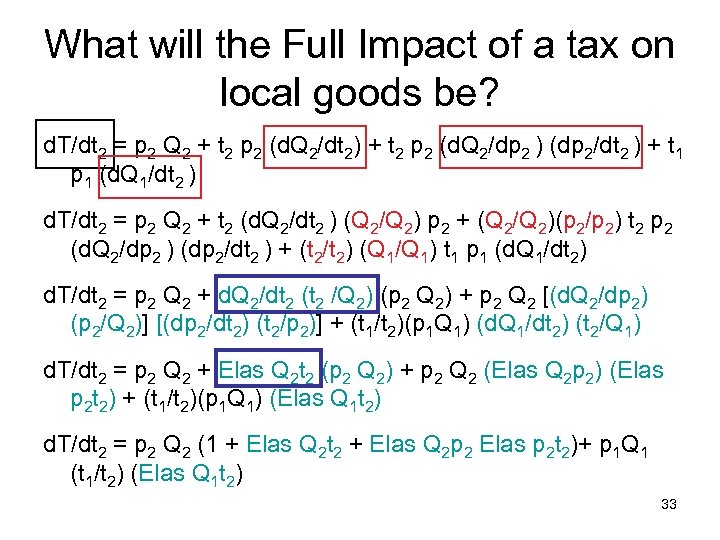 What will the Full Impact of a tax on local goods be? d. T/dt 2 = p 2 Q 2 + t 2 p 2 (d. Q 2/dt 2) + t 2 p 2 (d. Q 2/dp 2 ) (dp 2/dt 2 ) + t 1 p 1 (d. Q 1/dt 2 ) d. T/dt 2 = p 2 Q 2 + t 2 (d. Q 2/dt 2 ) (Q 2/Q 2) p 2 + (Q 2/Q 2)(p 2/p 2) t 2 p 2 (d. Q 2/dp 2 ) (dp 2/dt 2 ) + (t 2/t 2) (Q 1/Q 1) t 1 p 1 (d. Q 1/dt 2) d. T/dt 2 = p 2 Q 2 + d. Q 2/dt 2 (t 2 /Q 2) (p 2 Q 2) + p 2 Q 2 [(d. Q 2/dp 2) (p 2/Q 2)] [(dp 2/dt 2) (t 2/p 2)] + (t 1/t 2)(p 1 Q 1) (d. Q 1/dt 2) (t 2/Q 1) d. T/dt 2 = p 2 Q 2 + Elas Q 2 t 2 (p 2 Q 2) + p 2 Q 2 (Elas Q 2 p 2) (Elas p 2 t 2) + (t 1/t 2)(p 1 Q 1) (Elas Q 1 t 2) d. T/dt 2 = p 2 Q 2 (1 + Elas Q 2 t 2 + Elas Q 2 p 2 Elas p 2 t 2)+ p 1 Q 1 (t 1/t 2) (Elas Q 1 t 2) 33
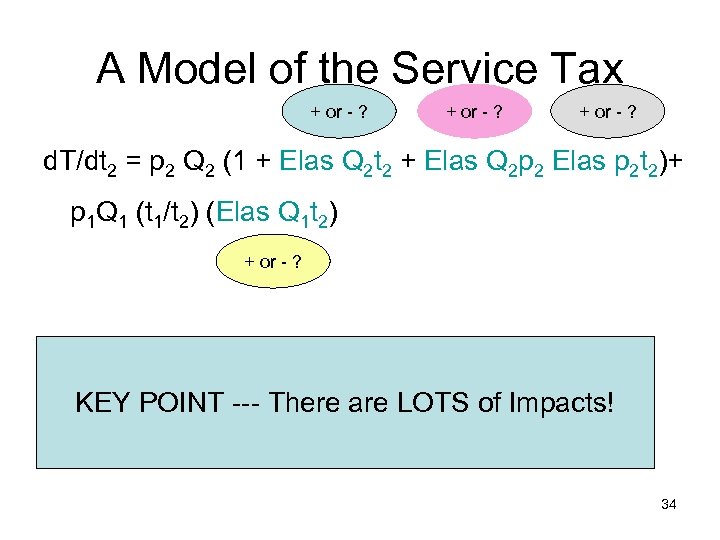 A Model of the Service Tax + or - ? d. T/dt 2 = p 2 Q 2 (1 + Elas Q 2 t 2 + Elas Q 2 p 2 Elas p 2 t 2)+ p 1 Q 1 (t 1/t 2) (Elas Q 1 t 2) + or - ? KEY POINT --- There are LOTS of Impacts! 34
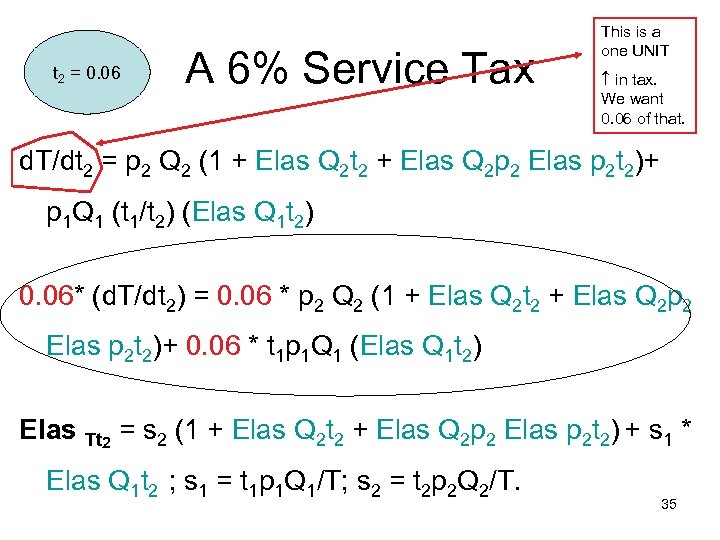 t 2 = 0. 06 A 6% Service Tax This is a one UNIT in tax. We want 0. 06 of that. d. T/dt 2 = p 2 Q 2 (1 + Elas Q 2 t 2 + Elas Q 2 p 2 Elas p 2 t 2)+ p 1 Q 1 (t 1/t 2) (Elas Q 1 t 2) 0. 06* (d. T/dt 2) = 0. 06 * p 2 Q 2 (1 + Elas Q 2 t 2 + Elas Q 2 p 2 Elas p 2 t 2)+ 0. 06 * t 1 p 1 Q 1 (Elas Q 1 t 2) Elas Tt 2 = s 2 (1 + Elas Q 2 t 2 + Elas Q 2 p 2 Elas p 2 t 2) + s 1 * Elas Q 1 t 2 ; s 1 = t 1 p 1 Q 1/T; s 2 = t 2 p 2 Q 2/T. 35
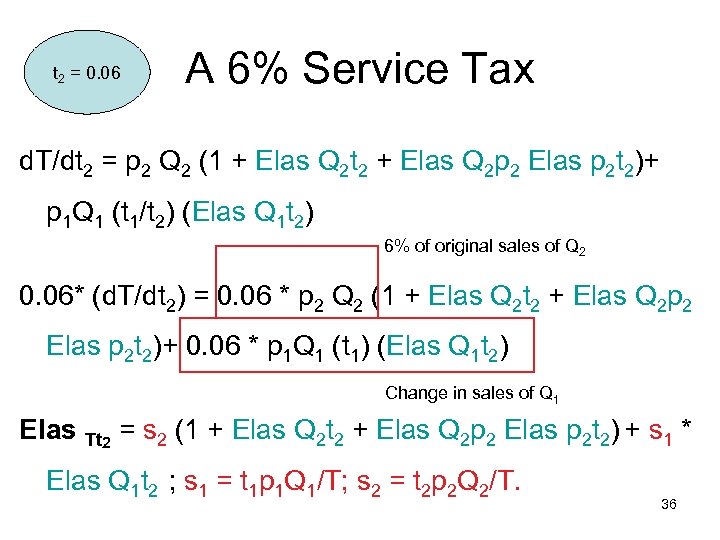 t 2 = 0. 06 A 6% Service Tax d. T/dt 2 = p 2 Q 2 (1 + Elas Q 2 t 2 + Elas Q 2 p 2 Elas p 2 t 2)+ p 1 Q 1 (t 1/t 2) (Elas Q 1 t 2) 6% of original sales of Q 2 0. 06* (d. T/dt 2) = 0. 06 * p 2 Q 2 (1 + Elas Q 2 t 2 + Elas Q 2 p 2 Elas p 2 t 2)+ 0. 06 * p 1 Q 1 (t 1) (Elas Q 1 t 2) Change in sales of Q 1 Elas Tt 2 = s 2 (1 + Elas Q 2 t 2 + Elas Q 2 p 2 Elas p 2 t 2) + s 1 * Elas Q 1 t 2 ; s 1 = t 1 p 1 Q 1/T; s 2 = t 2 p 2 Q 2/T. 36