


 Скачать презентацию Principles of Speed Agility Development Certificate IV
f3ba6b3a867ae444d010e56d2575327e.ppt
- Количество слайдов: 15
 Principles of Speed & Agility Development Certificate IV Fitness Strength & Conditioning 2010
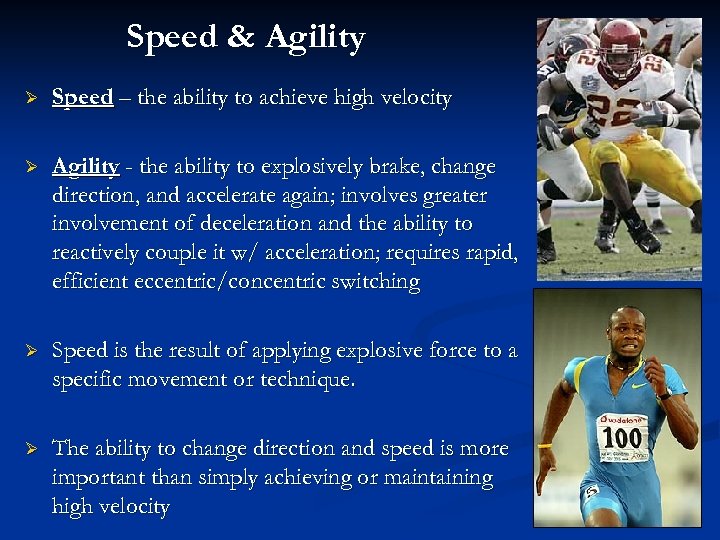 Speed & Agility Ø Speed – the ability to achieve high velocity Ø Agility - the ability to explosively brake, change direction, and accelerate again; involves greater involvement of deceleration and the ability to reactively couple it w/ acceleration; requires rapid, efficient eccentric/concentric switching Ø Speed is the result of applying explosive force to a specific movement or technique. Ø The ability to change direction and speed is more important than simply achieving or maintaining high velocity
 What is sprinting? Ø Ø Short-duration, high-intensity activities at distances of no more than Ø 200 meters for swimming Ø 800 meters for running Ø 1 kilometer for bicycling Ø 1500 meters for speed skating Relies heavily on energy produced from ATP-PC system and anaerobic glycolysis
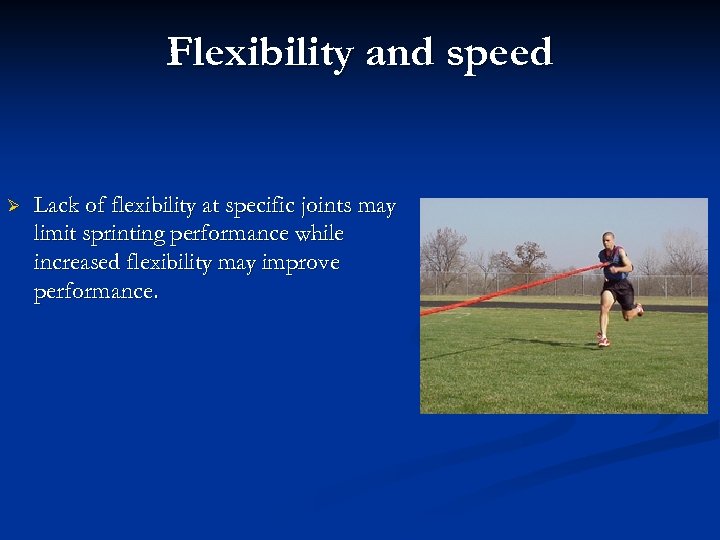 Flexibility and speed Ø Lack of flexibility at specific joints may limit sprinting performance while increased flexibility may improve performance.
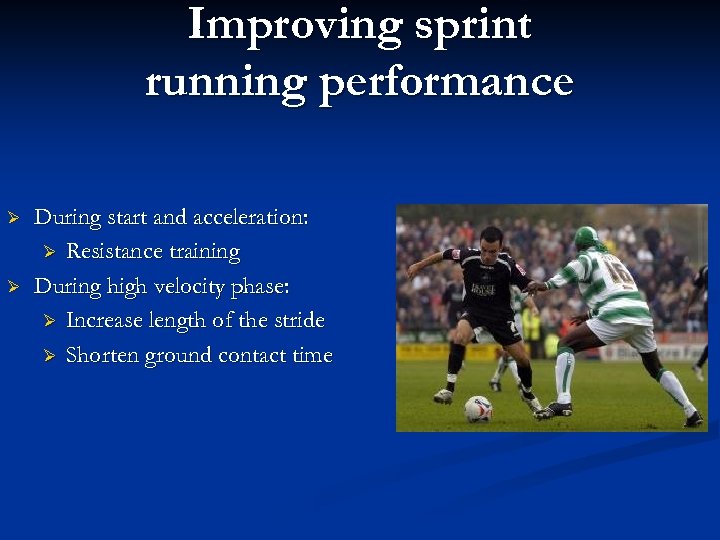 Improving sprint running performance Ø Ø During start and acceleration: Ø Resistance training During high velocity phase: Ø Increase length of the stride Ø Shorten ground contact time
 Improving sprint running performance (cont. ) Ø Improve technique by Ø Using high knee lift Ø Using long running stride Ø Placing feet beneath center of gravity Ø Methods for improving sprint running: Ø Sprint-resisted training Ø Sprint-assisted training
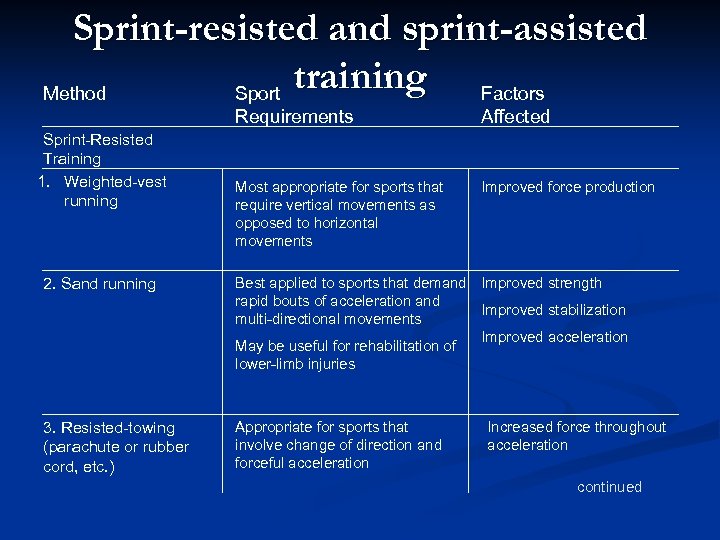 Sprint-resisted and sprint-assisted training Factors Method Sport Requirements Sprint-Resisted Training 1. Weighted-vest running Affected Most appropriate for sports that require vertical movements as opposed to horizontal movements Improved force production 2. Sand running Best applied to sports that demand Improved strength rapid bouts of acceleration and Improved stabilization multi-directional movements Improved acceleration May be useful for rehabilitation of lower-limb injuries 3. Resisted-towing (parachute or rubber cord, etc. ) Appropriate for sports that involve change of direction and forceful acceleration Increased force throughout acceleration continued
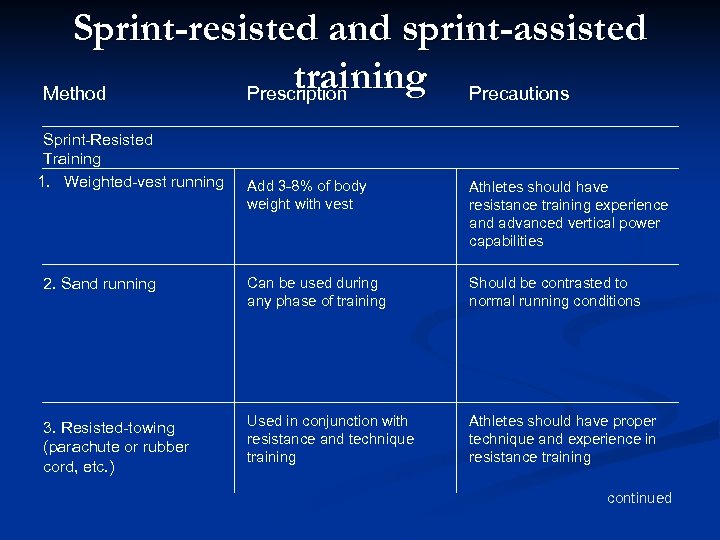 Sprint-resisted and sprint-assisted training Precautions Method Prescription Sprint-Resisted Training 1. Weighted-vest running Add 3 -8% of body weight with vest Athletes should have resistance training experience and advanced vertical power capabilities 2. Sand running Can be used during any phase of training Should be contrasted to normal running conditions 3. Resisted-towing (parachute or rubber cord, etc. ) Used in conjunction with resistance and technique training Athletes should have proper technique and experience in resistance training continued
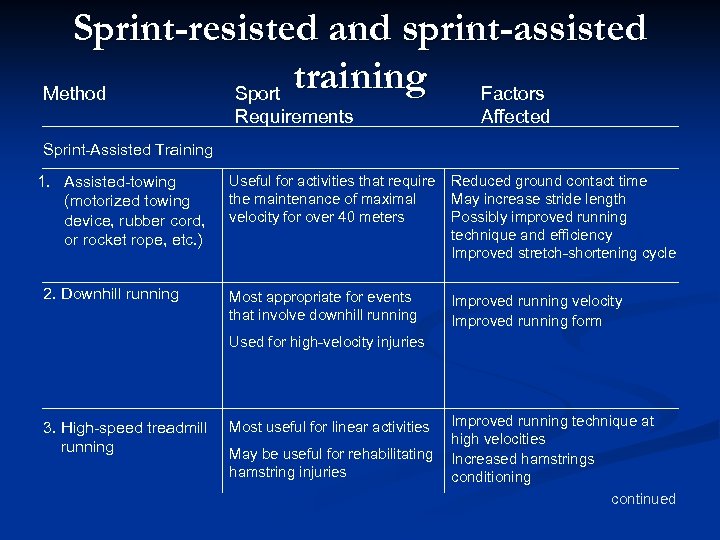 Sprint-resisted and sprint-assisted training Factors Method Sport Requirements Affected Sprint-Assisted Training 1. Assisted-towing (motorized towing device, rubber cord, or rocket rope, etc. ) 2. Downhill running Useful for activities that require the maintenance of maximal velocity for over 40 meters Reduced ground contact time May increase stride length Possibly improved running technique and efficiency Improved stretch-shortening cycle Most appropriate for events that involve downhill running Improved running velocity Improved running form Used for high-velocity injuries 3. High-speed treadmill running Most useful for linear activities May be useful for rehabilitating hamstring injuries Improved running technique at high velocities Increased hamstrings conditioning continued
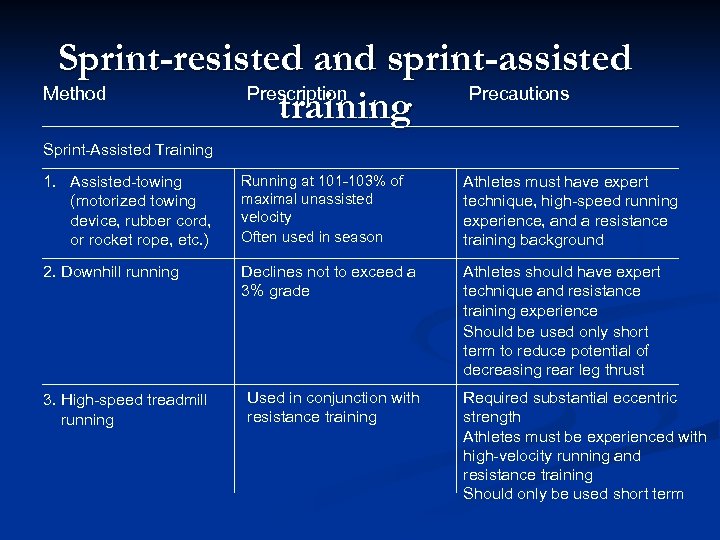 Sprint-resisted and sprint-assisted Method Prescription Precautions training Sprint-Assisted Training 1. Assisted-towing (motorized towing device, rubber cord, or rocket rope, etc. ) Running at 101 -103% of maximal unassisted velocity Often used in season Athletes must have expert technique, high-speed running experience, and a resistance training background 2. Downhill running Declines not to exceed a 3% grade Athletes should have expert technique and resistance training experience Should be used only short term to reduce potential of decreasing rear leg thrust 3. High-speed treadmill running Used in conjunction with resistance training Required substantial eccentric strength Athletes must be experienced with high-velocity running and resistance training Should only be used short term
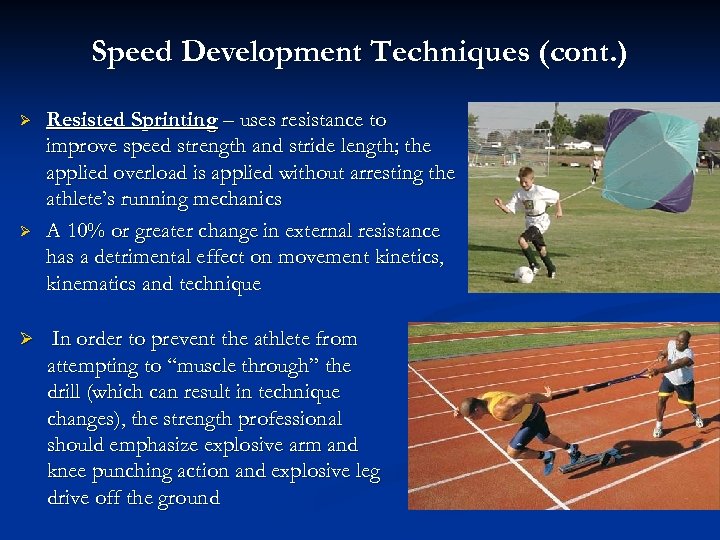 Speed Development Techniques (cont. ) Ø Ø Resisted Sprinting – uses resistance to improve speed strength and stride length; the applied overload is applied without arresting the athlete’s running mechanics A 10% or greater change in external resistance has a detrimental effect on movement kinetics, kinematics and technique Ø In order to prevent the athlete from attempting to “muscle through” the drill (which can result in technique changes), the strength professional should emphasize explosive arm and knee punching action and explosive leg drive off the ground
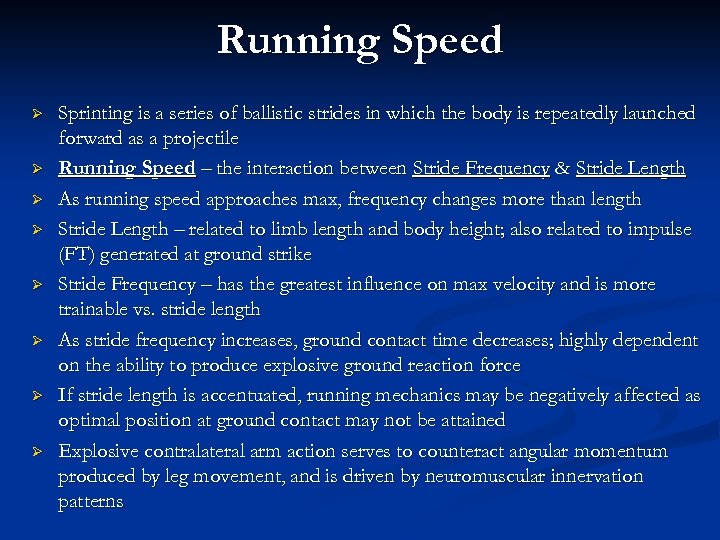 Running Speed Ø Ø Ø Ø Sprinting is a series of ballistic strides in which the body is repeatedly launched forward as a projectile Running Speed – the interaction between Stride Frequency & Stride Length As running speed approaches max, frequency changes more than length Stride Length – related to limb length and body height; also related to impulse (FT) generated at ground strike Stride Frequency – has the greatest influence on max velocity and is more trainable vs. stride length As stride frequency increases, ground contact time decreases; highly dependent on the ability to produce explosive ground reaction force If stride length is accentuated, running mechanics may be negatively affected as optimal position at ground contact may not be attained Explosive contralateral arm action serves to counteract angular momentum produced by leg movement, and is driven by neuromuscular innervation patterns
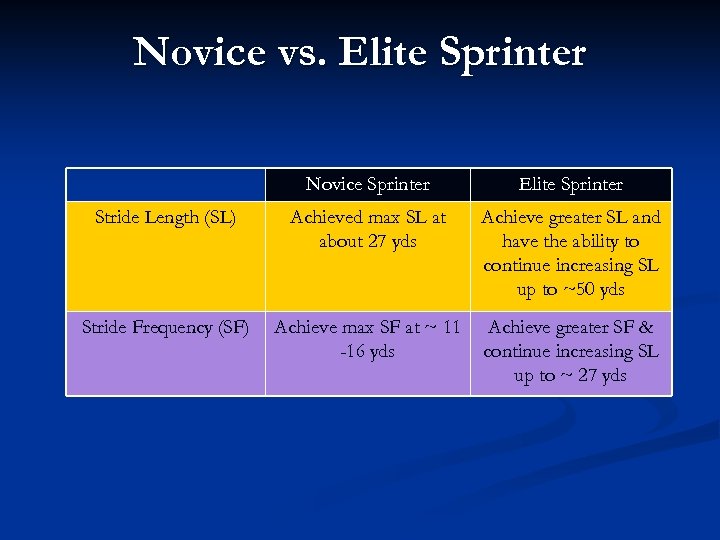 Novice vs. Elite Sprinter Novice Sprinter Elite Sprinter Stride Length (SL) Achieved max SL at about 27 yds Achieve greater SL and have the ability to continue increasing SL up to ~50 yds Stride Frequency (SF) Achieve max SF at ~ 11 -16 yds Achieve greater SF & continue increasing SL up to ~ 27 yds
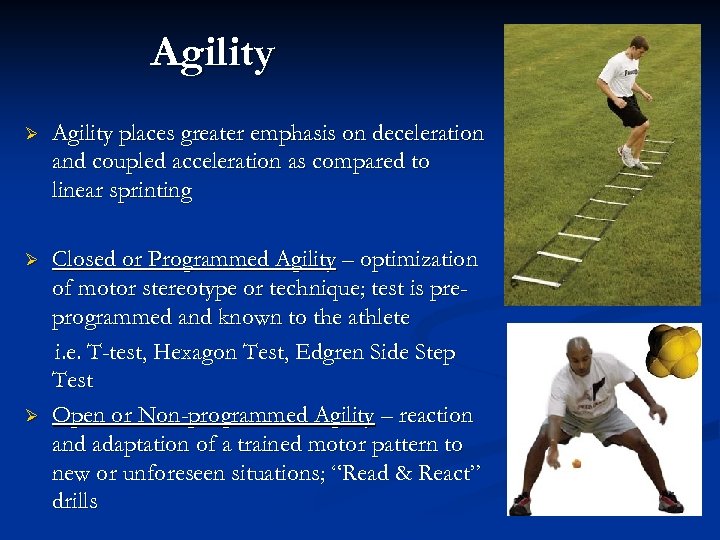 Agility Ø Agility places greater emphasis on deceleration and coupled acceleration as compared to linear sprinting Ø Closed or Programmed Agility – optimization of motor stereotype or technique; test is preprogrammed and known to the athlete i. e. T-test, Hexagon Test, Edgren Side Step Test Open or Non-programmed Agility – reaction and adaptation of a trained motor pattern to new or unforeseen situations; “Read & React” drills Ø
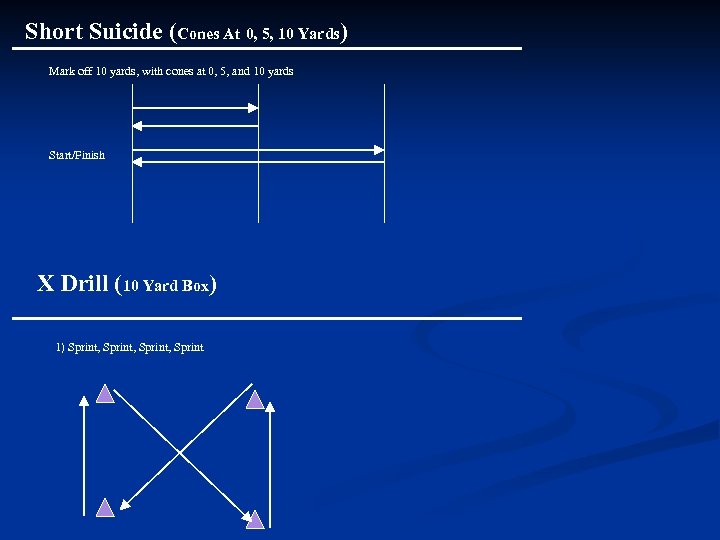 Short Suicide (Cones At 0, 5, 10 Yards) Mark off 10 yards, with cones at 0, 5, and 10 yards Start/Finish X Drill (10 Yard Box) 1) Sprint, Sprint